Carlo Angeli, Lucignano; Edward Hutton (1875–1969), London, by 1926; Maitland Fuller Griggs (1872–1943), New York, 1926
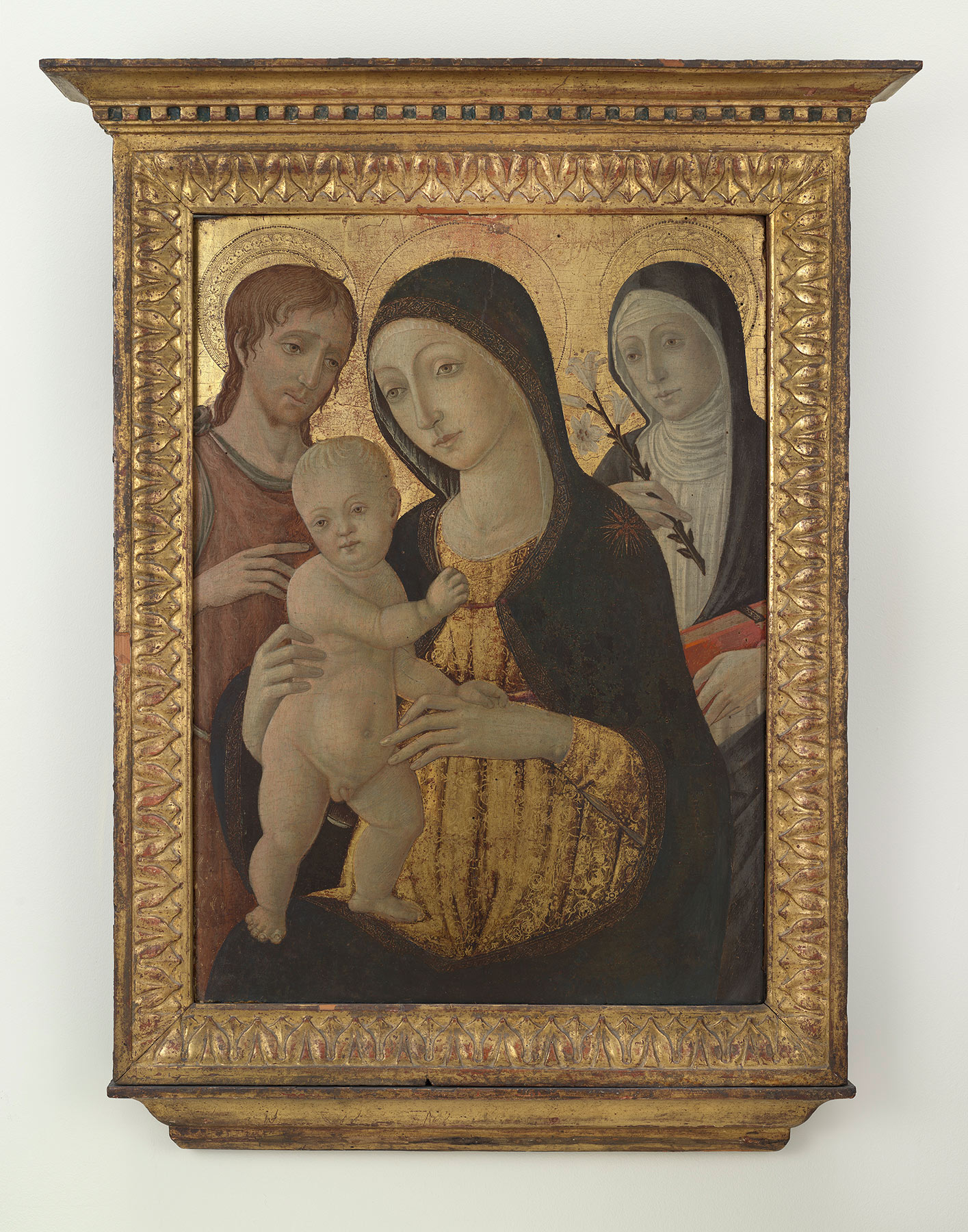
The panel support, of a vertical wood grain, retains its original thickness of 4.3 centimeters and has not been cradled, although it appears to have been trimmed on all four sides. It comprises two pieces of wood joined with a seam running on a slight diagonal, 13.5 centimeters from the right edge at the top to 15.5 centimeters from the right edge at the bottom. The gilding and paint surfaces are heavily abraded, with numerous small areas of loss revealing preparatory gesso layers. A larger triangular area of complete loss, measuring approximately 3 by 7 centimeters, is visible at the lower right corner of the composition. A cleaning of 1957 left the surface with a parched, unsaturated look, exaggerated by the addition of a synthetic varnish that has now grayed considerably.
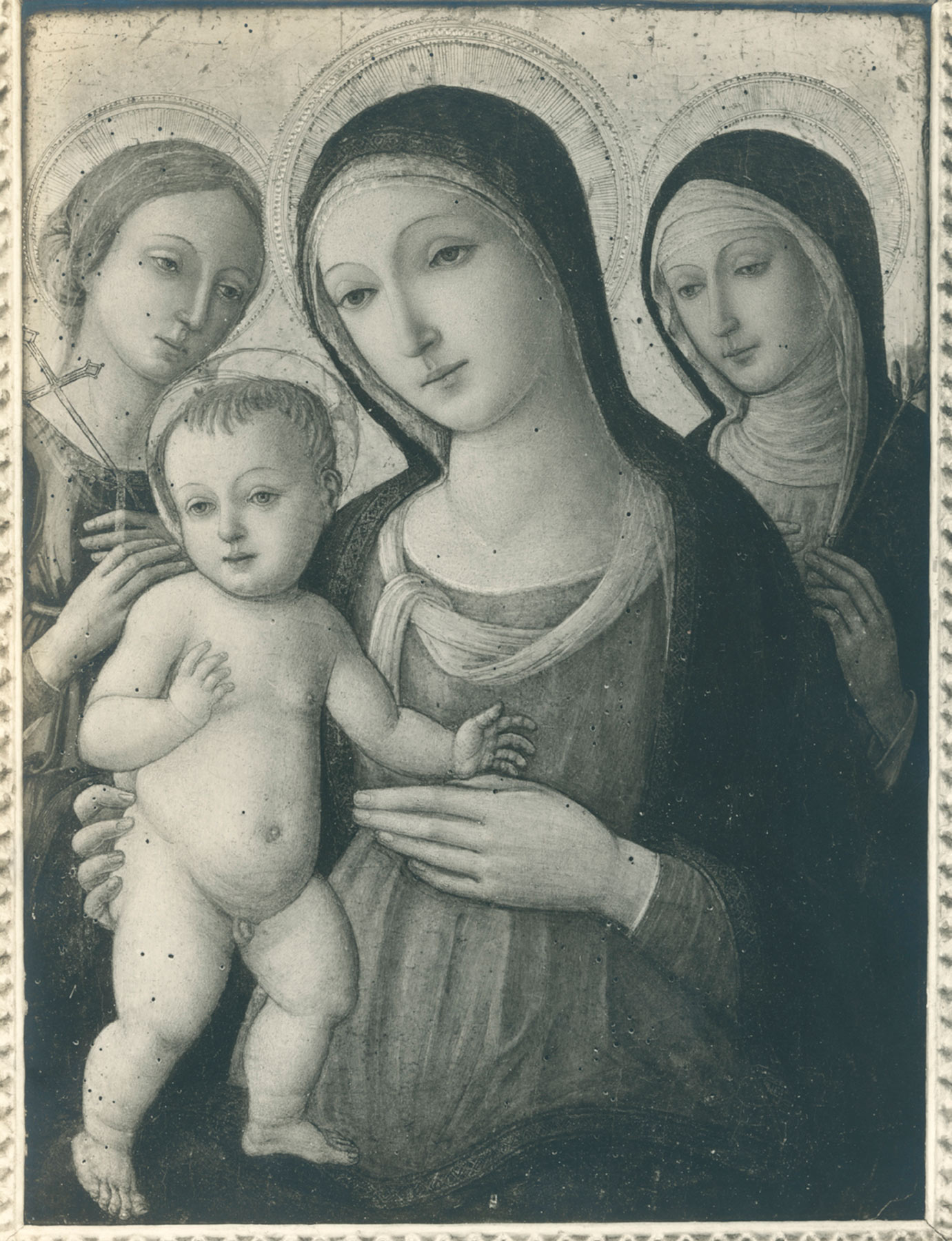
A typical example of Guidoccio Cozzarelli as a painter of domestic objects of devotion, this work was first published with that attribution by Raimond van Marle in 1931, but Maitland Griggs had already received confirmation of this identification from F. Mason Perkins (ca. 1926) and Bernard Berenson (1927).1 Berenson reiterated his attribution to Cozzarelli in the 1932 edition of his lists, while Richard Offner and John Pope-Hennessy demurred, the latter thinking it a product of Cozzarelli’s workshop and the former positing a Sienese contemporary imitating Cozzarelli’s style.2 Offner and Pope-Hennessy may both have been responding to the repainted state in which the picture was known prior to 1957 (fig. 1); photographs recording its appearance at that time bear all the hallmarks of a heavy-handed intervention by Icilio Federico Joni, perhaps undertaken for its first recorded owner, the dealer Carlo Angeli.3 This had been removed by the time Seymour catalogued the painting as shop of Guidoccio, with the inexplicable comment on its condition as “on the whole good; rubbed but showing no serious losses.”4 Federico Zeri and Carl Strehlke concurred in the attribution to Cozzarelli.5 Despite the ruinous condition of the paint surface, there can be no doubt that this attribution is correct.
Since Berenson’s 1918 essay attempting to draw a concrete outline delimiting the range of Cozzarelli’s achievement, the artist has never been the subject of a serious in-depth study.6 Even then, Berenson’s purpose in writing was effectively negative, to “differentiate . . . between the painter of widest range, greatest variety and largest enterprize [sic] of the Sienese Quattrocento—I mean Matteo di Giovanni—and his ablest apprentice and closest follower, Guidoccio Cozzarelli. . . . And if I have succeeded in this task, I shall also have relieved Matteo’s fame of a series of works not worthy of him.”7 Cozzarelli was indeed, at the outset of his career through the decade of the 1470s and into the early 1480s, a respectful follower of Matteo di Giovanni, but assessments of quality alone are insufficient to distinguish between the two painters, and confusion among their works persists today. Furthermore, Cozzarelli’s relationship to Matteo di Giovanni defines only one aspect of his style: in his maturity, he was even more influenced by a fellow assistant in Matteo’s shop, Pietro di Francesco degli Orioli, than either painter was by their common teacher—again with attendant confusion in attributions.8
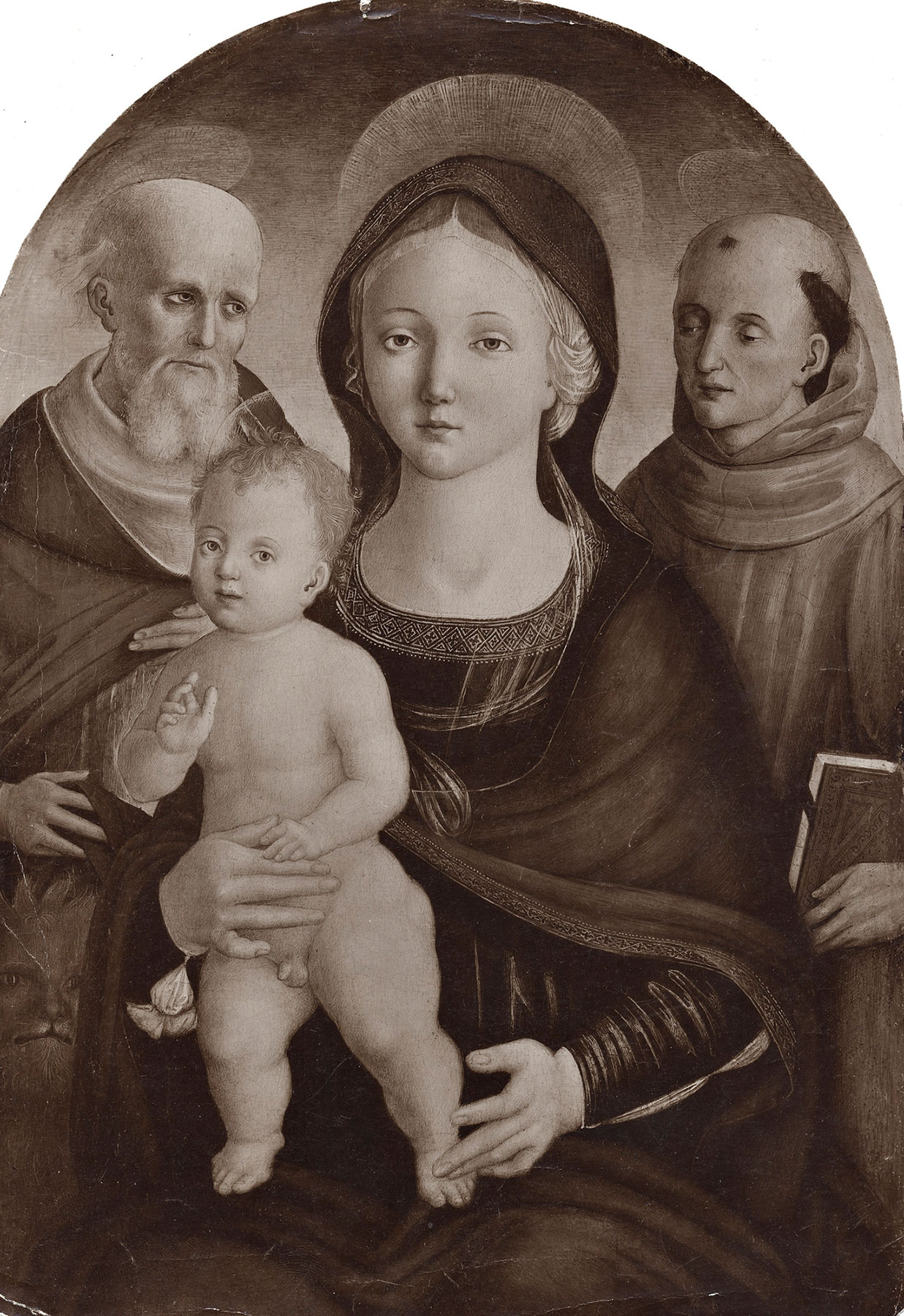
Orioli’s paintings of the mid- and late 1480s reintroduced to Sienese artists an interest in naturalism and the rational construction of pictorial space that had been almost entirely absent in local culture since the deaths of Domenico di Bartolo (1445) and Sassetta (1450) more than three decades earlier. Within the genre of private devotional paintings of the Virgin and Child with saints, the novelty of Orioli’s approach was subtle rather than revolutionary. A Virgin and Child with Saints Jerome and Francis formerly in the Goudistikker collection in Amsterdam (fig. 2),9 for example, transposes gentle and idyllic figures reminiscent of Sano di Pietro into a composition derived from Matteo di Giovanni, but it takes great pains to foreshorten limbs and hands, to justify relative scale by simulating distance behind the picture plane, and to use softened lighting effects to enhance the verisimilitude of textures and volumes. It also introduces a self-consciously animated Christ Child being gently restrained by His mother as He strides across her lap. A motif found in Donatello’s relief sculpture and among Florentine painters of the late fifteenth century but not previously in Sienese paintings—where even the most restless Child is either held in His mother’s arms or embraces her—it appealed directly and immediately both to Matteo di Giovanni and Guidoccio Cozzarelli. Matteo grafted it onto the solemnity of his paintings of the 1490s,10 and Cozzarelli assimilated it, probably at about the same time but in a spirit closer to Orioli’s example, in a series of three closely related paintings, including the Yale Virgin and Child with Saints Margaret and Catherine of Siena.
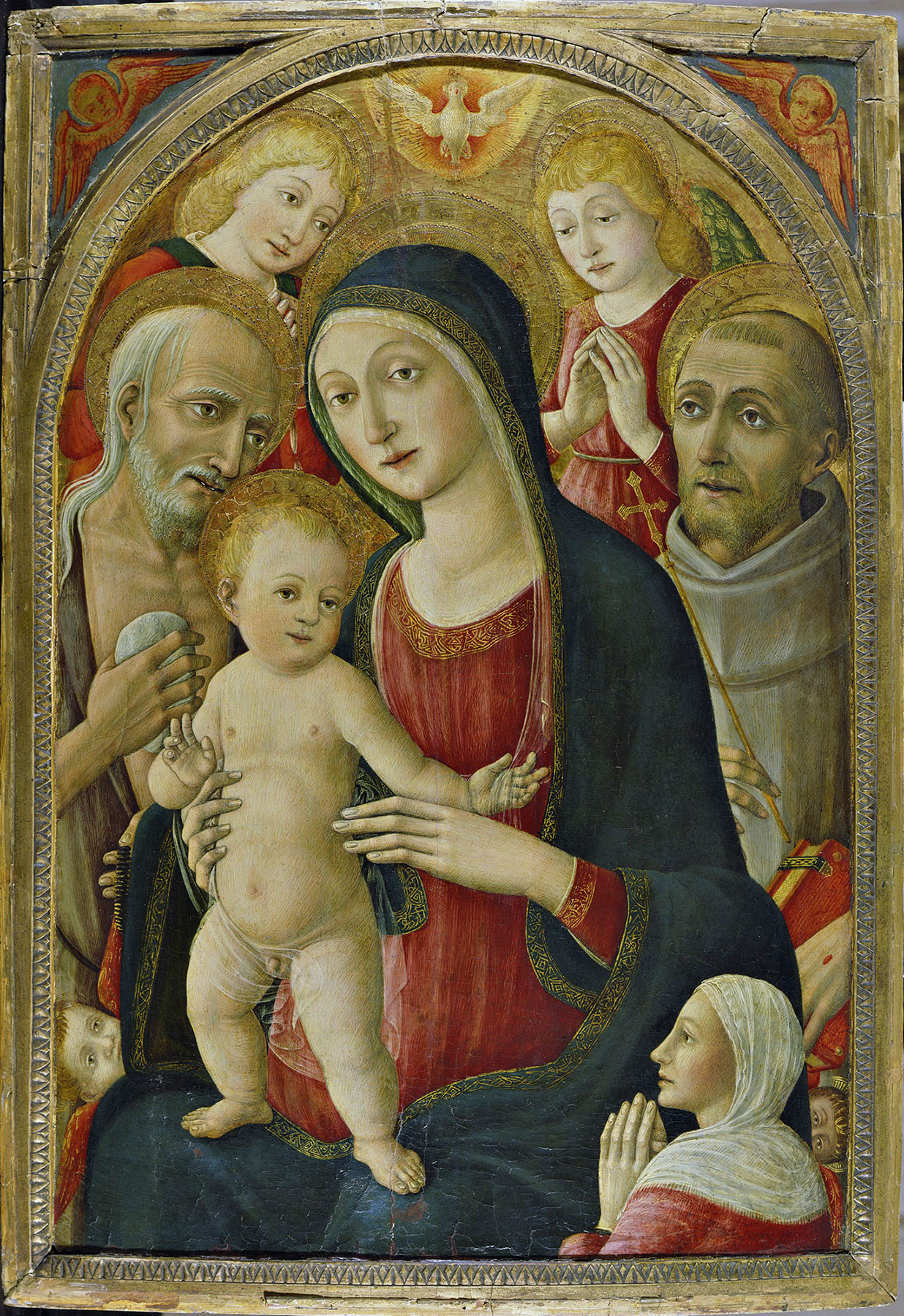
What is almost certainly the first of the three paintings is also the most elaborate (fig. 3). Formerly in the Van Gelder collection at Uccle, Belgium, near Brussels,11 it shows the Virgin seated on a throne of seraphim (symbolized by two seraph heads in the lower left and right corners of the panel), with Saints Jerome and Francis, two angels, and the dove of the Holy Spirit. A bust-length donor in full profile is cropped at the lower edge of the composition at the right. In this painting, the Child strikes a pose leaning back toward the (viewer’s) left and reaches forward across His mother’s chest to finger her veil. To create the Yale painting, Cozzarelli initially just reversed the cartoon for the Child’s legs: an X-radiograph (fig. 4) shows a first position for the Child’s head identical to that in the Van Gelder panel. The idea for the Child’s halo in this position is still visible, engraved in the gold ground and along the edge of Saint Margaret’s throat in the Yale panel, as are numerous drawn pentimenti, due to the sadly reduced opacity of the paint layers. The final iteration of the theme, a painting now in the Virginia Museum of Fine Arts in Richmond (fig. 5),12 probably painted close to the turn of the sixteenth century, follows the final version of the Yale painting fairly closely, converting the figure of Saint Margaret into John the Baptist and moving both saints slightly further back to open a greater volume of air between them and the Virgin, closer in this respect to the lessons of the much-admired Pietro di Francesco degli Orioli. None of these three images is a slavish repetition of a borrowed cartoon. Each is reconsidered to complete the logic of the small changes it introduces, typical of the thoughtful, if modest, efforts of the last generation of Sienese quattrocento painters. —LK

Published References
van Marle, Raimond. “Ancora quadri senesi.” La Diana 6, no. 3 (1931): 168–76., 175; Berenson, Bernard. Italian Pictures of the Renaissance: A List of the Principal Artists and Their Works with an Index of Places. Oxford: Clarendon, 1932., 158; Seymour, Charles, Jr. Early Italian Paintings in the Yale University Art Gallery. New Haven: Yale University Art Gallery, 1970., 189–90, 319, no. 142; Fredericksen, Burton B., and Federico Zeri. Census of Pre-Nineteenth-Century Italian Paintings in North American Public Collections. Cambridge, Mass.: Harvard University Press, 1972., 600
Notes
-
van Marle, Raimond. “Ancora quadri senesi.” La Diana 6, no. 3 (1931): 168–76., 175. Perkins’s expertise is recorded in a handwritten note on the reverse of a photograph of the painting made by N. Cipriani in Florence—so, presumably when the work was on the market in 1926 or earlier. Berenson’s opinion was included in a letter from Mary Berenson to Maitland Griggs, January 18, 1927. Both sources are in the Yale University Art Gallery Archives. ↩︎
-
Berenson, Bernard. Italian Pictures of the Renaissance: A List of the Principal Artists and Their Works with an Index of Places. Oxford: Clarendon, 1932., 158. The painting is omitted from Berenson’s 1968 lists, but it is unclear whether this was due to an oversight or to his having changed his mind about it; see Berenson, Bernard. Italian Pictures of the Renaissance, A List of the Principal Artists and Their Works with an Index of Places: Central Italian and North Italian Schools. 3 vols. London: Phaidon, 1968.. Offner’s opinion was expressed in a lecture at Griggs’s home in 1927; see Seymour, Charles, Jr. Early Italian Paintings in the Yale University Art Gallery. New Haven: Yale University Art Gallery, 1970., 190. Pope-Hennessy’s opinion is recorded only in an undated memo in Seymour’s handwriting in the curatorial files, Department of European Art, Yale University Art Gallery. ↩︎
-
The frame, still on the painting today, is modern but incorporates a late fifteenth- or early sixteenth-century antependium featuring the Bernardine monogram of Christ: “YHS.” A punch tool decorating the top edge of the molding surrounding the image may have belonged to Joni; see Frinta, Mojmír S. Punched Decoration on Late Medieval Panel and Miniature Painting. Vol. 1, Catalogue Raisonné of All Punch Shapes. Prague: Maxdorf, 1998., 505, no. La82aN. ↩︎
-
Seymour, Charles, Jr. Early Italian Paintings in the Yale University Art Gallery. New Haven: Yale University Art Gallery, 1970., 189. ↩︎
-
Fredericksen, Burton B., and Federico Zeri. Census of Pre-Nineteenth-Century Italian Paintings in North American Public Collections. Cambridge, Mass.: Harvard University Press, 1972., 600; and Strehlke, note in curatorial files, Department of European Art, Yale University Art Gallery. ↩︎
-
Berenson, Bernard. “Guidoccio Cozzarelli and Matteo di Giovanni.” In Essays in the Study of Sienese Painting, 81–94. New York: F. F. Sherman, 1918., 81–94. ↩︎
-
Berenson, Bernard. “Guidoccio Cozzarelli and Matteo di Giovanni.” In Essays in the Study of Sienese Painting, 81–94. New York: F. F. Sherman, 1918., 83, 94. ↩︎
-
See Russell, Francis. “The Evolution of a Sienese Painter: Some Early Madonnas of Pacchiarotto.” Burlington Magazine 115, no. 849 (December 1973): 801–2, 804–5., 801–2, 804–5; Angelini, Alessandro. “Da Giacomo Pacchiarotti a Pietro Orioli.” Prospettiva 29 (April 1982): 72–78., 72–78; and Angelini, Alessandro. “Pietro Orioli e il momento ‘urbinate’ della pittura senese del Quattrocento.” Prospettiva 30 (July 1982): 30–43., 30–43. ↩︎
-
Sale, Frederik Muller & Cie., Amsterdam, March 16–18, 1952, lot 734. See van Marle, Raimond. “Ancora quadri senesi.” La Diana 6, no. 3 (1931): 168–76., 176, fig. 22. ↩︎
-
See Pinacoteca Nazionale, Siena, inv. no. 446; and Metropolitan Museum of Art, New York, inv. no. 65.234, https://www.metmuseum.org/art/collection/search/437038. ↩︎
-
Sale, Christie’s, London, May 14, 1971, lot 16. ↩︎
-
This is the panel referred to by Seymour as formerly with Pedulli in Florence; see Seymour, Charles, Jr. Early Italian Paintings in the Yale University Art Gallery. New Haven: Yale University Art Gallery, 1970., 190. ↩︎