on the face of the bottom ledge, IACOBVS • GAMBARVS • BONON • PER • FRANCIAM AVRIFABRVM HOC • OPVS • FIERI • CURAVIT 1495
William Ward (1817–1885), 11th Baron Ward and 1st Earl of Dudley, London, by 1835;1 Nazarena (Zarè) Thalberg (1858–1921), later Marchesa Pulci Doria of Naples, 1878; Sedelmeyer Gallery, Paris, by ca. 1890;2 Quincy Adams Shaw (1825–1908), Boston, by 1895; E. and A. Silberman Galleries, New York; Hannah D. and Louis M. Rabinowitz (1887–1957), Sands Point, Long Island, N.Y., 1941
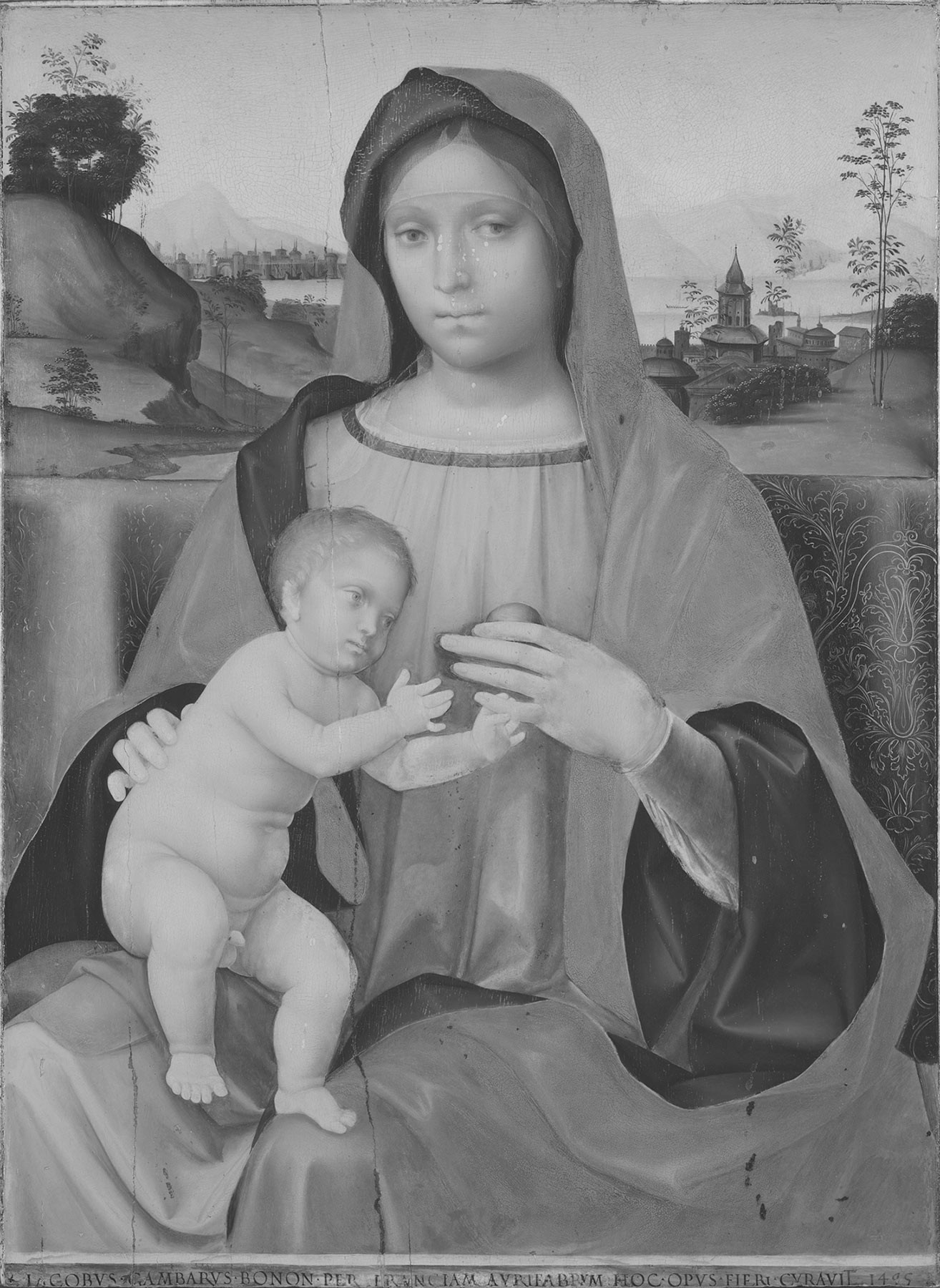
The panel support, of a vertical wood grain, has been thinned to a depth of 9 millimeters and was cradled, either in the nineteenth or early twentieth century, and restored in 2005 by George Bisacca at the Metropolitan Museum of Art, New York. Treatment involved the removal of the existing cradle and replacement with a spring-tension support system, as well as the repair and filling in of old losses along splits: one major diagonal split that rises from the bottom of the panel, approximately 19 centimeters from the left edge, passing to the left of the Virgin’s cowl; and smaller splits closer to the left edge, reaching to the level of the Christ Child’s body. A barb of paint defining the original edges of the picture field is preserved along the top margin only. A restoration of the painted surface was undertaken in 1959, when earlier repaints were removed, including a veil over the Christ Child’s genitals, visible in a photograph from before 1945 (fig. 1). The most recent intervention by Mark Aronson in 2006 entailed the removal of a thick synthetic varnish applied during the previous restoration, which revealed a picture “more damaged than was immediately evident.”3 The paint surface appeared harshly if selectively cleaned, with the elimination of nearly all the mordant gilt decoration of the Virgin’s halo (now only visible under ultraviolet examination) and of the cushion on which the Christ Child sits. The blue of the Virgin’s cloak was severely abraded, and the white of her veil thinned. Her red dress and the green lining of her cloak were less damaged, while the cloth of honor behind her and the landscape background are reasonably well preserved. Many of the previous retouchings were removed during this latest restoration, and the losses filled in, while others, such as those in the hills to the right of the Virgin, were left in place. Infrared examination shows the presence of underdrawing revealing changes, like the repositioning of the Christ Child’s left eye and the part in the Virgin’s hair as well as the original placement of the Child directly on the Virgin’s lap rather than on a pillow (see fig. 2). The central part of the inscription, with the words “PER • FRANCIAM AVRIFABRVM”; the last letter of the word “CVRAVIT”; and the date “1495” seem to have been repainted over existing text at an unknown date.
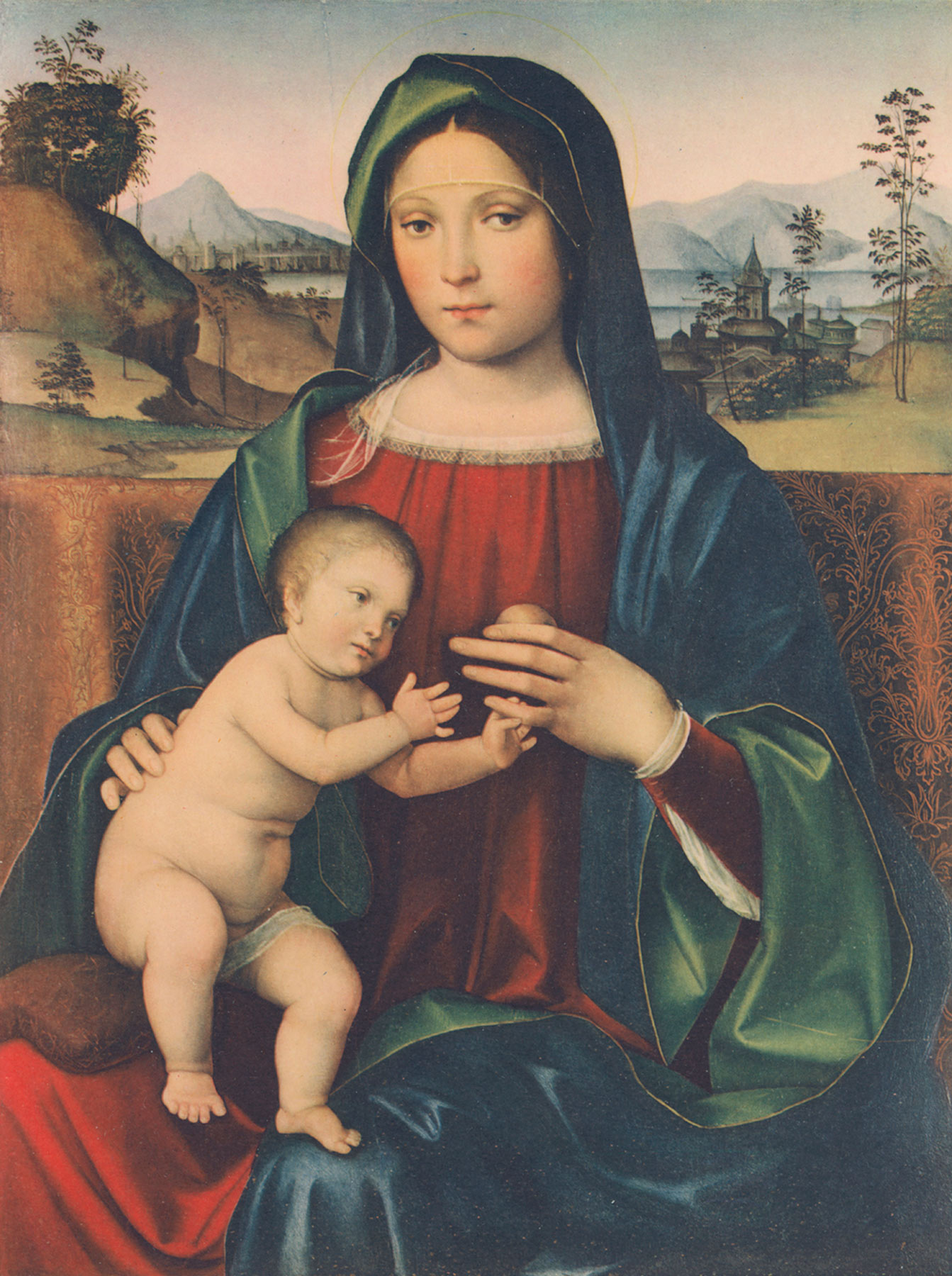
The Virgin and Child are shown seated behind a marble parapet on an invisible throne, hidden by a splendid gold damask cloth of honor with red embroidery. The Virgin wears what was originally a dark blue cloak with green lining over a bright red-lake dress, with sleeves of deep crimson velvet revealing a white chemise underneath. Covering her forehead is a transparent veil that falls over her right shoulder. A rosy-cheeked, naked Christ Child with golden locks is seated on His mother’s lap, on a lavender-colored cushion, possibly repainted at a later date, with some visible remnants of mordant gilt decoration. He reaches forward to grasp an apple held in the Virgin’s left hand, a traditional allusion to the fruit of the Tree of Knowledge and Christ’s future role as redeemer from Original Sin. Unfolding behind the Virgin and Child is a view of a green promontory. Rising below it on the right are the roofs of a city situated along a body of water, the roofs and surrounding vegetation highlighted in gold. On the opposite shore is a large, fortified city at the water’s edge, with several big ships anchored below its walls. Fading into the distance behind it are several mountain ranges. Along the face of the painted ledge at the bottom is an inscription with the artist’s signature and date: “IACOBVS • GAMBARVS • BONON • PER • FRANCIAM AVRIFABRVM HOC • OPVS • FIERI • CURAVIT 1495” (Jacopo Gambaro of Bologna saw to it that this work be made by the goldsmith Francia 1495).
The earliest reference to the Yale Virgin and Child, known as the Gambaro Madonna, is in Gustav Waagen’s overview of works of art in English collections, where he stated first having seen the panel in 1835 in the residence of Lord Dudley, in London.4 The Gambaro Madonna was one of three paintings by Francia in the Dudley collection. A second picture, unsigned and depicting the Virgin and Child with Saint Joseph, later passed into the Pállfy collection and from there to the Szépművészeti Múzeum, Budapest.5 In 1871 Joseph Crowe and Giovanni Cavalcaselle mistakenly identified the Budapest panel as the signed work,6 leading to a long-standing confusion between the two pictures,7 resolved only by Lionello Venturi’s 1945 catalogue of the Rabinowitz collection.8 Gone unnoticed by most prior scholarship was the fact that, in 1890, Adolfo Venturi had recorded that the Gambaro Madonna, of which he gave a detailed description along with the accompanying inscription, was then in the Pulci Doria collection in Naples.9 In 1878 the panel had purportedly been presented by Lord Dudley to the young soprano Zaré Thalberg, who enjoyed a brief but successful career in London before retiring around 1880 and eventually marrying the marchese Marino Pulci Doria (1856–1941).10 Sometime between 1890 and 1895, when Wilhelm von Bode referred to it in his survey of Old Masters in American collections,11 the Gambaro Madonna was sold by the Marchese Pulci Doria to Charles Sedelmeyer in Paris and then acquired by the Boston merchant and collector Quincy Adams Shaw. In 1898 it was exhibited in the Sedelmeyer Gallery along with other works that had passed through the hands of the same dealer, including the ex-Dudley Virgin and Child with Saint Joseph, by then in the Pállfy collection.12
While modern scholarship has paid scant attention to the Gambaro Madonna, the painting was described in eloquent terms by early authors as one of the artist’s finest creations. Waagen praised it for embodying the “thoroughly pure, pious, tenderly melancholy feeling, which made Raphael so fond of Francia’s Madonnas,”13 while Lionello Venturi14 compared its quality of execution to that of more famous works by Francia from the same decade, such as the earlier Felicini altarpiece in the Pinacoteca Nazionale, Bologna, and the later Bentivoglio altarpiece, in the same museum.15 Likening the Gambaro Madonna to “a chiaroscuro enamel,” Venturi highlighted, above all, the artist’s nuanced application of color, which deepened and rendered more varied the intensity of the pigments, “worthy of precious stones,” bringing to mind the artist’s activity as a goldsmith that is always alluded to in his signatures.16 Notwithstanding the various interventions undergone by the Yale panel in the three-quarters of a century since Venturi’s text, his observations are still applicable to the lustrous green folds of the Virgin’s silk-lined cloak as well as to the tactile value of her luxurious velvet sleeve. These mimetic qualities, derived from Netherlandish models, are combined with a serene mood and refined sweetness in the figures, indebted to the example of Perugino, to produce an idealized vision of pious “contained beauty” that became widely celebrated by contemporary Bolognese humanists.17
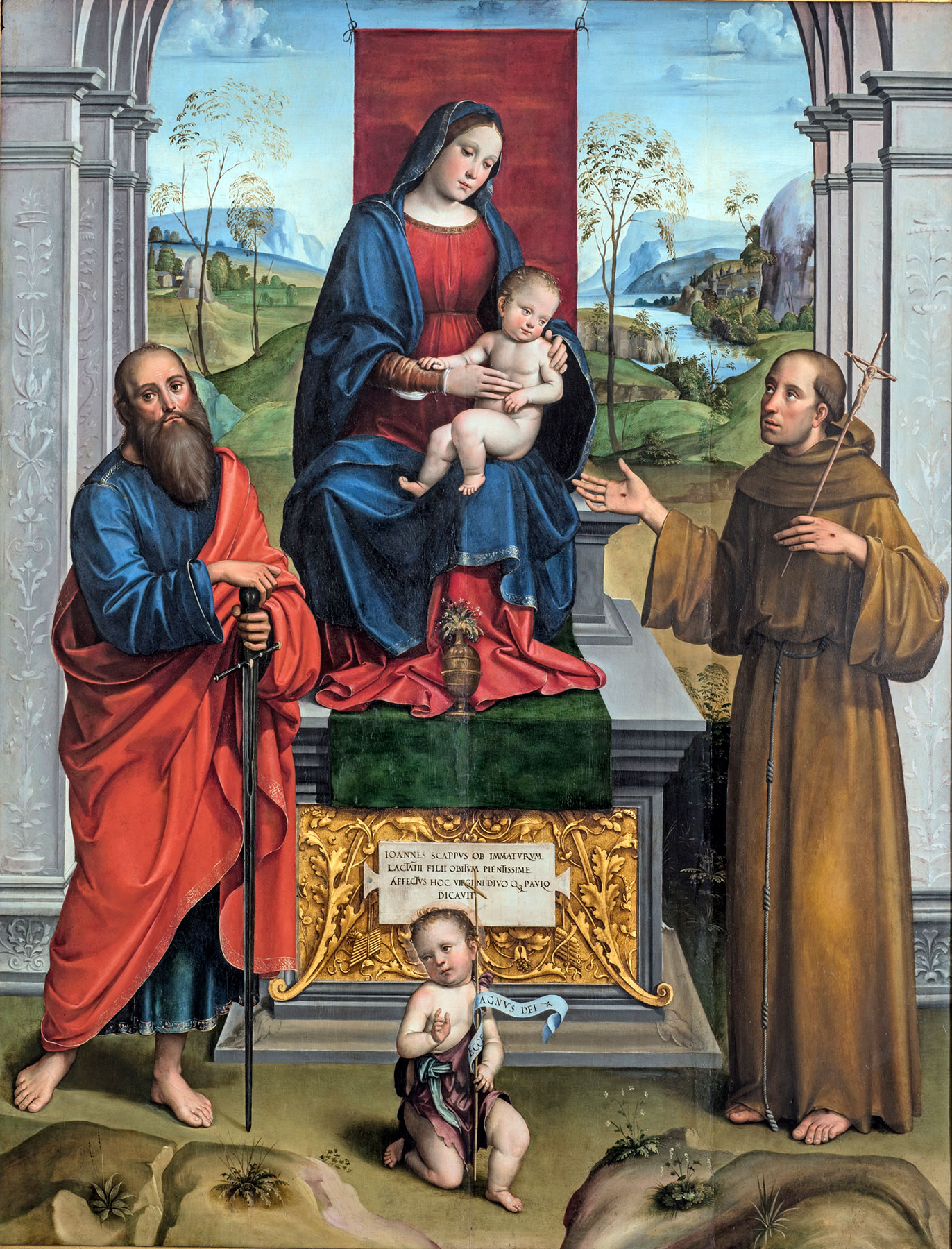
Although the inscription on the Gambaro Madonna has never been questioned by scholars, recent examination with infrared reflectography (fig. 2) and ultraviolet light confirms that the central section with the artist’s name as well as the 1495 date were repainted over an existing text at an unknown, possibly early date. That these interventions are most likely consistent with the original text is indicated by the existence of a later version of the present composition in the Musée des Beaux-Arts, Beziers, France, which also bears the artist’s name and the date 1495.18 Although accepted as autograph by some authors,19 Francia’s involvement in the execution of the Beziers panel, heavily repainted and with a dark background, was already questioned by Salomon Reinach,20 followed by Venturi, who plausibly deemed it a nineteenth-century copy of the Gambaro Madonna.21 Stylistically, the Gambaro Madonna is entirely consonant with the evolution of Francia’s approach in the 1490s as traced by Daniele Benati.22 The latter viewed the ever-increasing attention accorded by the artist to the landscape elements, from the Manzuoli altarpiece of around 149023 to the Scappi altarpiece, datable on circumstantial evidence around 1494–95 (fig. 3),24 to the Bentivoglio altarpiece of around 1498–99, in direct proportion to the growing softening of expressions and mood. The expansive view of fortified cities and waters that forms the backdrop of the Gambaro Madonna fits comfortably within these developments, as does the saccharine sweetness of the Christ Child, who is intimately related to the infants in the Scappi altarpiece.
According to hearsay reported by George Williamson,25 the Gambaro Madonna was originally in the Bolognese church of San Giovanni in Monte and was commissioned by Jacopo Gambaro, also a goldsmith and godfather with Francia to the child of a mutual friend, as a gift to the newborn’s family chapel. In his research on Jacopo Gambaro, Luigi Frati noted that, while the historical accuracy of this account could not be verified, the story was not entirely implausible, since Francia and Gambaro are separately recorded as godfathers to two christenings in 1495—although neither of them took place in San Giovanni in Monte.26 A later Bolognese baptismal register, first referred to by Gaetano Milanesi,27 moreover, notes that on August 30, 1500, “Jacopo di Gambaro and D. M. Francia the goldsmith [franza aurifex]” were jointly godfathers to Laura, daughter of “Bartolomeo di Nicola . . . and his wife, Lucrezia C. S. Laurenti.”28 According to Frati, the Jacopo, or Giacomo, who commissioned the painting was one of three sons of the goldsmith Matteo di Maso Sclarici dal Gambaro. In 1486 Giacomo Sclarici dal Gambaro was enrolled with his brothers, Tommaso and Pietro, in the goldsmith’s guild, after having been previously a member of the silk merchant’s guild. His friendship with Francia, Frati deduced, was probably the result of the artist’s residence in the same parish as the Sclarici dal Gambaro.29
Frati’s reconstruction, however, appears to have conflated the few known events from the life of the goldsmith Giacomo Sclarici dal Gambaro with the biography of a different Giacomo Gambaro, otherwise considered a distinct personality by the eighteenth-century local historian Giovanni Fantuzzi and by more recent authors.30 According to Fantuzzi, this Jacopo Gambaro, who is never referred to as “Sclarici” in the documents, was born around the middle of the fifteenth century and received a law degree from Bologna University, where he was a pupil of the orator and poet Giambattista Refrigerio. In 1487 he became secretary and trusted advisor to Giovanni II Bentivoglio and enjoyed a brilliant career as political envoy and ambassador for the Bentivoglio and then for Pope Leo X (r. 1513–21), before being appointed governor of Pavia between around 1522 and 1535—after which date his name disappears from the records.31 It is likely that this prominent political figure of the day, who in 1497, according to the diaries of Marino Sanudo (1466–1526),32 was ambassador to Venice on behalf of the Bentivoglio, is the Jacopo alluded to in the Gambaro Madonna. The unusually detailed quality of Francia’s landscape, evoking the topography of river- and lake-bound cities in the Po Valley, could perhaps be interpreted in terms of Gambaro’s biography and allude to the specific events or political activities of which he was a protagonist in the region. —PP
Published References
Waagen, [Gustav]. Works of Art and Artists in England. 3 vols. London: John Murray, 1838., 2:397; Waagen, [Gustav]. Treasures of Art in Great Britain. 3 vols. London: John Murray, 1854., 3:199; National Exhibition of Works of Art at Leeds, 1868: Official Catalogue. Leeds: Edward Baines and Sons, 1868., 144, no. 2927; Crowe, Joseph Archer, and Giovanni Battista Cavalcaselle. A History of Painting in North Italy: Venice, Padua, Vicenza, Verona, Ferrara, Milan, Friuli, Brescia, from the Fourteenth to the Sixteenth Century; Drawn up from Fresh Materials after Recent Researches in the Archives of Italy, and from Personal Inspection of the Works of Art Scattered throughout Europe. 2 vols. London: J. Murray, 1871., 1:561n4; Vasari, Giorgio. Le vite de’ più eccellenti pittori, scultori ed architettori. With new annotations and comments by Gaetano Milanesi. 9 vols. Florence: G. C. Sansoni, 1878–85., 3:556; Cartwright, Julia. Mantegna and Francia. New York: Scribner and Welford, 1881., 116, 118; Adolfo Venturi. “La pittura bolognese nel secolo XV.” Archivio storico dell’arte 3, nos. 7–8 (1890): 281–95., 293n2; Bode, Wilhelm. “Alte Kunstwerke in den Sammlungen der Vereinigten Staaten.” Zeitschrift für bildende Kunst, n.s., 6, no. 1 (1895): 70–76., 71; Catalogue of 300 Paintings by Old Masters of the Dutch, Flemish, Italian, French, and English Schools Being Some of the Principal Pictures Which Have at Various Times Formed Part of the Sedelmeyer Gallery. Paris: Sedelmeyer Gallery, 1898., 267, 269, no. 243; Venturi, Adolfo. Storia dell’arte italiana. 11 vols. Milan: Ulrico Hoepli, 1901–40., 7:854, 881; Williamson, George C. Francesco Raibolini Called Francia. London: Bell and Sons, 1901., 39, 143; Berenson, Bernard. North Italian Painters of the Renaissance. New York: G. P. Putnam’s Sons, 1907., 223; Reinach, Salomon. Répertoire de peintures du Moyen Age et de la Renaissance (1280–1580). Vol. 2. Paris: Ernest Leroux, 1907., 167, fig. 2; Colasanti, Arduino, and Tiberio Gerevich. “I quadri italiani nelle collezioni del conte Pàllfy in Ungheria.” Rassegna d’arte antica e moderna 12, no. 11 (November 1912): 165–70., 168–69; Lipparini, Giuseppe. Francesco Francia. Bergamo: Istituto Italiano d’Arti Grafiche, 1913., 44; Frati, Luigi. “Di alcuni amici del Francia.” Atti e memorie della R. Deputazione di storia patria per le provincie di Romagna, 4th ser., 6 (1916): 219–37., 223–30; Gronau, Georg. “Francia, Francesco.” In Allgemeines Lexikon der bildenden Künstler: Von der Antike bis zur Gegenwart, ed. Ulrich Thieme and Felix Becker. Leipzig, Germany: E. A. Seemann, 1916., 12:321; Venturi, Lionello. The Rabinowitz Collection. New York: Twin Editions, 1945., 29–31; An Exhibition of Paintings, for the Benefit of the Research Fund of Art and Archaeology, The Spanish Institute, Inc. New York: E. and A. Silberman Galleries, 1955., 21, no. 9; “Recent Gifts and Purchases: February 22–December 31, 1959.” Yale University Art Gallery Bulletin 26, no. 1 (December 1960): 52–58., 26, 54, no. 1; Seymour, Charles, Jr. The Rabinowitz Collection of European Paintings. New Haven: Yale University Art Gallery, 1961., 28–29, 55; Berenson, Bernard. Italian Pictures of the Renaissance, A List of the Principal Artists and Their Works with an Index of Places: Central Italian and North Italian Schools. 3 vols. London: Phaidon, 1968., 2:148; Filippini, Francesco, and Guido Zucchini. Miniatori e pittori a Bologna: Documenti del secolo XV. Rome: Accademia nazionale dei Lincei, 1968., 62; Seymour, Charles, Jr. Early Italian Paintings in the Yale University Art Gallery. New Haven: Yale University Art Gallery, 1970., 220–22, no. 165; Fredericksen, Burton B., and Federico Zeri. Census of Pre-Nineteenth-Century Italian Paintings in North American Public Collections. Cambridge, Mass.: Harvard University Press, 1972., 601; Ritchie, Andrew Carnduff, and Katharine B. Neilson. Selected Paintings and Sculpture from the Yale University Art Gallery. New Haven: Yale University Press, 1972., no. 15; David Arnheim, in Seymour, Charles, Jr., et al. Italian Primitives: The Case History of a Collection and Its Conservation. Exh. cat. New Haven: Yale University Art Gallery, 1972., 40–41, no. 32, fig. 32; Stagni, Simonetta. “Francesco Francia.” In Pittura bolognese del ’500, ed. Vera Fortunati Pietrantonio, 1:1–28. Bologna: Grafis, 1986., 8; Faietti, Marzia. “Attorno a Marcantonio: Figure della sua giovinezza e prima maturità.” In Bologna e l’umanesimo, 1490–1510, ed. Marzia Faietti and Konrad Oberhuber, 213–36. Exh. cat. Bologna: Nuova Alfa, 1988., 226; Kenney, Elise K., ed. Handbook of the Collections: Yale University Art Gallery. New Haven: Yale University Art Gallery, 1992., 136; Faietti, Marzia. “Protoclassicismo e cultura umanistica nei disegni di Francesco Francia.” In Il Classicismo: Medioevo, Rinascimento, Barocco; Atti del colloquio Cesare Gnudi, 171–92. Bologna: Nuova Alfa, 1993., 175n24; Ferretti, Massimo. “In cerca di Guido Aspertini.” Arte a Bologna: Bollettino dei musei civici d’arte antica 3 (1993): 35–63., 44; Toniolo, Federica. “I dipinti di Francesco Francia e della sua bottega conservati al Museo di Belle Arti.” Bulletin du Musée Hongrois des Beaux-Arts 78 (1993): 67–141., 68–69, fig. 30; Ugolini, Andrea. “Per Antonio Rimpatta.” Paragone, n.s., 45, nos. 47–48 (535–37) (September–November 1994): 11–37., 22n29; Agosti, Giovanni. “Scrittori che parlano di artisti, tra quattro e cinquecento in Lombardia.” In Quattro pezzi lombardi (per Maria Teresa Binaghi), by Barbara Agosti, Giovanni Agosti, Carl Brandon Strehlke, and Marco Tanzi, 39–93. Brescia: L’Obliquo, 1998., 63n63; Negro, Emilio, and Nicosetta Roio. Francesco Francia e la sua scuola. Modena: Banca agricola Mantovana, 1998., 71, 77, 114, 164–65, no. 35b; Dean, Clay. A Selection of Early Italian Paintings from the Yale University Art Gallery. New Haven: Yale University Art Gallery, 2001., 40–41, no. 13; Negro, Emilio, and Nicosetta Roio. Lorenzo Costa, 1460–1535. Modena: Artioli, 2001., 41, 47n108, fig. 71; Pericolo, Lorenzo. “Francesco Francia’s Raleigh Madonna and Child with Two Angels and the Del Bono Chapel in San Giovanni Evangelista, Parma.” In Viaggio nel Nord Italia: Studi di cultura visiva in onore di Alessandro Nova, ed. Dario Donetti, Hana Gründler, and Mandy Richter, 247–53. Florence: Centro Di, 2022., 251; Valerio Mosso, in Sgarbi, Vittorio, and Michele Danieli, ed. Rinascimento a Ferrara: Ercole de’ Roberti e Lorenzo Costa. Exh. cat. Cinisello Balsamo, Milan: Silvana, 2023., 385
Notes
-
Waagen, [Gustav]. Treasures of Art in Great Britain. 3 vols. London: John Murray, 1854., 3:199. ↩︎
-
According to Catalogue of 300 Paintings by Old Masters of the Dutch, Flemish, Italian, French, and English Schools Being Some of the Principal Pictures Which Have at Various Times Formed Part of the Sedelmeyer Gallery. Paris: Sedelmeyer Gallery, 1898., 267. ↩︎
-
Mark Aronson and Melissa Cacciola, examination and treatment report, November 9, 2006, conservation files, Department of European Art, Yale University Art Gallery. ↩︎
-
The painting is first described by Waagen, [Gustav]. Works of Art and Artists in England. 3 vols. London: John Murray, 1838., 2:397. In the later edition of this work, the author specifies that he had seen the painting in 1835; Waagen, [Gustav]. Treasures of Art in Great Britain. 3 vols. London: John Murray, 1854., 199. ↩︎
-
Inv. no. 4244, https://www.mfab.hu/artworks/8823/. ↩︎
-
Crowe, Joseph Archer, and Giovanni Battista Cavalcaselle. A History of Painting in North Italy: Venice, Padua, Vicenza, Verona, Ferrara, Milan, Friuli, Brescia, from the Fourteenth to the Sixteenth Century; Drawn up from Fresh Materials after Recent Researches in the Archives of Italy, and from Personal Inspection of the Works of Art Scattered throughout Europe. 2 vols. London: J. Murray, 1871., 1:561n4. ↩︎
-
Williamson, George C. Francesco Raibolini Called Francia. London: Bell and Sons, 1901., 39, 143; Berenson, Bernard. North Italian Painters of the Renaissance. New York: G. P. Putnam’s Sons, 1907., 223; Colasanti, Arduino, and Tiberio Gerevich. “I quadri italiani nelle collezioni del conte Pàllfy in Ungheria.” Rassegna d’arte antica e moderna 12, no. 11 (November 1912): 165–70., 168–69; Lipparini, Giuseppe. Francesco Francia. Bergamo: Istituto Italiano d’Arti Grafiche, 1913., 44; Venturi, Adolfo. Storia dell’arte italiana. 11 vols. Milan: Ulrico Hoepli, 1901–40., 7:854; and Gronau, Georg. “Francia, Francesco.” In Allgemeines Lexikon der bildenden Künstler: Von der Antike bis zur Gegenwart, ed. Ulrich Thieme and Felix Becker. Leipzig, Germany: E. A. Seemann, 1916., 12:321. ↩︎
-
Venturi, Lionello. The Rabinowitz Collection. New York: Twin Editions, 1945., 29–31. Doubts as to the identification of the Gambaro Madonna with the ex-Pállfy painting were also expressed by Luigi Frati, in Frati, Luigi. “Di alcuni amici del Francia.” Atti e memorie della R. Deputazione di storia patria per le provincie di Romagna, 4th ser., 6 (1916): 219–37., 226. ↩︎
-
Adolfo Venturi. “La pittura bolognese nel secolo XV.” Archivio storico dell’arte 3, nos. 7–8 (1890): 281–95., 293n2. ↩︎
-
Venturi noted that the painting passed from Lord Dudley “into the hands of signora Zarè Thalberg, now marchesa Pulci Doria”; Adolfo Venturi. “La pittura bolognese nel secolo XV.” Archivio storico dell’arte 3, nos. 7–8 (1890): 281–95., 293n2. When the painting appeared in the 1898 catalogue of an exhibition at the Sedelmeyer Gallery, Paris, it was specified that, in 1878, it had been “presented” by Lord Dudley to the “Marchesa della Petrella Margellina of Naples,” presumably one of the titles of the new marchesa; Catalogue of 300 Paintings by Old Masters of the Dutch, Flemish, Italian, French, and English Schools Being Some of the Principal Pictures Which Have at Various Times Formed Part of the Sedelmeyer Gallery. Paris: Sedelmeyer Gallery, 1898., 267. Although details about her life are scarce and contradictory, Zaré Thalberg seems to have been the daughter of the distinguished composer and pianist Sigismund Thalberg (1812–1871). She made her singing debut at Convent Garden in 1875. ↩︎
-
Bode, Wilhelm. “Alte Kunstwerke in den Sammlungen der Vereinigten Staaten.” Zeitschrift für bildende Kunst, n.s., 6, no. 1 (1895): 70–76., 71. ↩︎
-
Catalogue of 300 Paintings by Old Masters of the Dutch, Flemish, Italian, French, and English Schools Being Some of the Principal Pictures Which Have at Various Times Formed Part of the Sedelmeyer Gallery. Paris: Sedelmeyer Gallery, 1898., 267–69, nos. 243–44. The paintings are illustrated next to each other in the catalogue. ↩︎
-
Waagen, [Gustav]. Works of Art and Artists in England. 3 vols. London: John Murray, 1838., 2:397. ↩︎
-
Venturi, Lionello. The Rabinowitz Collection. New York: Twin Editions, 1945., 31. ↩︎
-
Inv. nos. 583–84. For these works, see, most recently, Alessandro Serrani, in Benati, Daniele, Maria Luisa Pacelli, and Elena Rossoni, eds. Giulio II e Raffaello: Una nuova stagione del Rinascimento a Bologna. Exh. cat. Cinisello Balsamo, Milan: Silvana, 2022., 71, 73, nos. II.2–3, II.7. The execution of the Felicini altarpiece is generally placed around 1490, reflecting the early opinion of Giorgio Vasari, although the painting carries a cartellino, altered on more than one occasion, with the date 1494. The Bentivoglio altarpiece was executed around 1498–99. ↩︎
-
Venturi, Lionello. The Rabinowitz Collection. New York: Twin Editions, 1945., 31. ↩︎
-
Emiliani, Andrea, and Konrad Oberhuber. “Bologna 1490: Dall’umanesimo severo all suavitas rinascimentale.” In Bologna e l’umanesimo, 1490–1510, ed. Marzia Faietti and Konrad Oberhuber, xi–xxxvii. Exh. cat. Bologna: Nuova Alfa, 1988., xix. Filippo Beroaldo (1453–1505) referred to the artist as “the greatest goldsmith among painters” (inter pictores aurifex maximus) and “the most perfect painter among goldsmiths” (inter Aurifices Pictor absolutissimus); cited in D’Apuzzo, Mark Gregory. “Francesco Francia tra umanesimo e pietà devota.” In Il genio di Francesco Francia: Un orafo pittore nella Bologna del Rinascimento, ed. Mario Scalini and Elena Rossoni, 78–93. Exh. cat. Venice: Marsilio, 2018., 81. See also Benati, Daniele. “Bologna e la ‘cultura del 1490.’” In Giulio II e Raffaello: Una nuova stagione del Rinascimento a Bologna, ed. Daniele Benati, Maria Luisa Pacelli, and Elena Rossoni, 52–73. Exh. cat. Cinisello Balsamo, Milan: Silvana, 2022., 57. ↩︎
-
Inv. no. 254. ↩︎
-
Emilio Negro and Nicoletta Roio (in Negro, Emilio, and Nicosetta Roio. Francesco Francia e la sua scuola. Modena: Banca agricola Mantovana, 1998., 77, 164–65, nos. 35a–b) posited that the Beziers panel was an earlier version by Francia of the Gambaro Madonna and more accurately reflected his style around 1495. The Gambaro Madonna, notwithstanding its date, was, in their view, painted as much as a decade later, possibly reflecting the artist’s reworking of the composition years after its completion. ↩︎
-
Reinach, Salomon. Répertoire de peintures du Moyen Âge et de la Renaissance (1280–1580). Vol. 5. Paris: Ernest Leroux, 1922., 273, fig. 3. ↩︎
-
Venturi, Lionello. The Rabinowitz Collection. New York: Twin Editions, 1945., 30–31. Andrea Ugolini cast doubts on the authenticity of the inscription and rejected any association with the artist’s immediate circle; see Ugolini, Andrea. “Per Antonio Rimpatta.” Paragone, n.s., 45, nos. 47–48 (535–37) (September–November 1994): 11–37., 22n29. ↩︎
-
Benati, Daniele. “Bologna e la ‘cultura del 1490.’” In Giulio II e Raffaello: Una nuova stagione del Rinascimento a Bologna, ed. Daniele Benati, Maria Luisa Pacelli, and Elena Rossoni, 52–73. Exh. cat. Cinisello Balsamo, Milan: Silvana, 2022., 57. ↩︎
-
Pinacoteca Nazionale, Bologna, inv. no. 589. ↩︎
-
See Cavalca, Cecilia. La pala d’altare a Bologna nel Rinascimento: Opere, artisti e città, 1450–1500. Cinisello Balsamo, Milan: Silvana, 2013., 354, no. 47, for a full account of the circumstances and patronage of this altarpiece. ↩︎
-
Williamson, George C. Francesco Raibolini Called Francia. London: Bell and Sons, 1901., 39. ↩︎
-
Frati, Luigi. “Di alcuni amici del Francia.” Atti e memorie della R. Deputazione di storia patria per le provincie di Romagna, 4th ser., 6 (1916): 219–37., 223–30. ↩︎
-
Gaetano Milanesi, in Vasari, Giorgio. Le vite de’ più eccellenti pittori, scultori ed architettori. With new annotations and comments by Gaetano Milanesi. 9 vols. Florence: G. C. Sansoni, 1878–85., 3:556n3. ↩︎
-
Negro, Emilio, and Nicosetta Roio. Francesco Francia e la sua scuola. Modena: Banca agricola Mantovana, 1998., 114. ↩︎
-
Frati, Luigi. “Di alcuni amici del Francia.” Atti e memorie della R. Deputazione di storia patria per le provincie di Romagna, 4th ser., 6 (1916): 219–37., 227. For the Sclarici Gambaro family of goldsmiths, see Bulgari, Costantino G. Argentieri, gemmari e orafi d’Italia. Vol. 4, Emilia. Rome: Palombi, 1974., 176–82, esp. 180 (for the documents on Giacomo Sclarici). ↩︎
-
Fantuzzi, Giovanni. “Dal Gambaro Giacopo.” In Notizie degli scrittori Bolognesi, vol. 4, ed. Fiovanni Fantuzzi, 46–48. Bologna: San Tommaso d’Aquino, 1784., 46–48; and Giordano, Silvano. “Gambaro, Giacomo.” In Dizionario biografico degli italiani. Rome: Istituto della Enciclopedia Italiana, 1999. https://www.treccani.it/enciclopedia/giacomo-gambaro (Dizionario-Biografico)/.. Many of the dates and details given by Frati for the presumed political activity of Giacomo Sclarici dal Gambaro coincide with those in the biography of Giacomo Gambaro. Frati obviously believed that they were one and the same person—an assumption that has been maintained in the subsequent art-historical literature; see Negro, Emilio, and Nicosetta Roio. Francesco Francia e la sua scuola. Modena: Banca agricola Mantovana, 1998., 114. ↩︎
-
Giordano, Silvano. “Gambaro, Giacomo.” In Dizionario biografico degli italiani. Rome: Istituto della Enciclopedia Italiana, 1999. https://www.treccani.it/enciclopedia/giacomo-gambaro (Dizionario-Biografico)/.. ↩︎
-
Sanuto, Marino. I diarii di Marino Sanudo. Vol. 1. Ed. Federico Stefani. Venice: Marco Visentini, 1879., 641. ↩︎