on the open book, EGO [SUM] • LVX M • VNDI • QVI A • QVI AM • BVLAT • IN LVC[E] • NON
Count Antonio Mazza (died 1874), Ferrara, ca. 1860; Antonio Santini (1824–1898), Ferrara, by 1888; Filippo Tavazzi, Rome, 1904; Cesare Canessa (1863–1922) and Ercole Canessa (1868–1929), New York and Paris; sale, American Art Galleries, New York, January 25–26, 1924, lot 168; Maitland Fuller Griggs (1872–1943), New York, 1924
The panel, of a vertical wood grain, has been thinned to a depth of 5 millimeters and marouflaged onto a 6-millimeter-thick soft-wood board with a horizontal grain. Splits in the panel interrupt the painted surface at 13.5, 22, 31, 50, 51.5, and 57 centimeters from the left edge. The paint film has been harshly abraded in a selective cleaning in 1960 that resulted in extensive losses along raised craquelure, especially in the face of the Redeemer, but that left residue of old blue repaints scattered across the background. The gilt and punched border lining the upper edge of the composition appears to be original and is much better preserved than any other part of the surface.
The critical history of this panel until 1970 is intertwined with that of a sixteenth-century Crucifixion also in the Yale University Art Gallery attributed to the so-called Master of the Risen Magdalen (Maestro dell’Elevazione della Maddalena).1 Both images are first recorded together in the Antonio Santini collection in Ferrara, in 1888, when they were joined into a single structure, with the Salvator Mundi as a pediment above the Crucifixion (fig. 1).2 The structural integrity of the altarpiece, acquired by Maitland Griggs in this form, was never questioned by early studies, devoted primarily to the examination of the Crucifixion, one of the key works in the reconstruction of the personality of the Master of the Risen Magdalen, a mysterious Ferrarese painter active in the first decade of the sixteenth century. In 1970, following the separation of the two elements, Charles Seymour, Jr., first pointed out that the Salvator Mundi was by a different hand and had been added to the larger panel at an unknown date,3 presumably at the same time that a new nineteenth-century frame was built to enclose the Crucifixion. Seymour tentatively attributed the present work to the North Italian school, with a date around 1460.
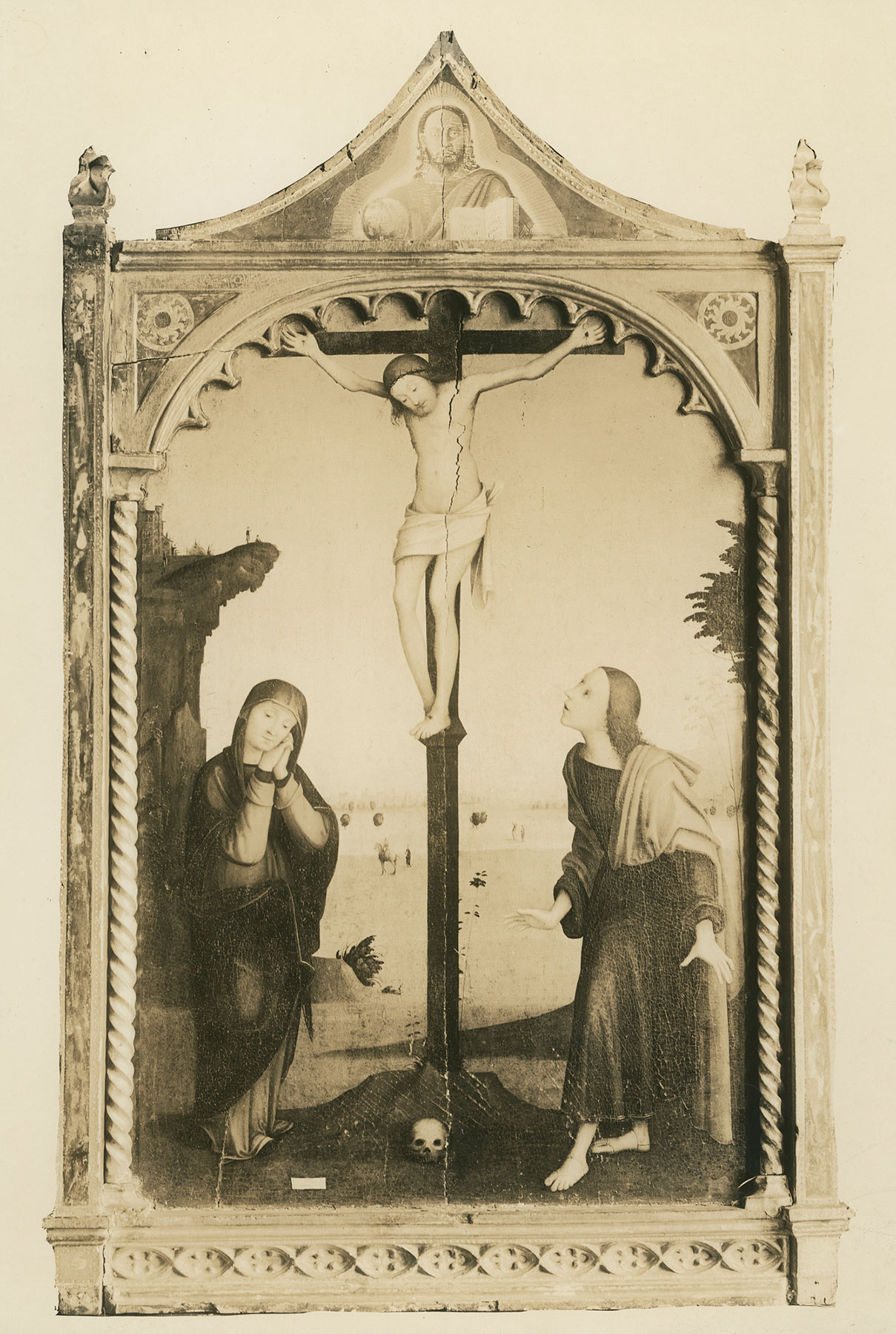
Although there is little question that the Salvator Mundi was originally part of another structure, the present condition of the panel and the irreparable losses to the paint surface induce some caution in any assessment of its attribution. The Anderson photograph published in Venturi’s 1903 study of the complex shows a highly polished work, more in tune, chronologically if not stylistically, with the image below it.4 The perfect oval of Christ’s face and neat locks of hair bring to mind the portraits of Christ and images of the Salvator Mundi, or Savior of the World—holding a globe in one hand and blessing with the other—that were made popular in fifteenth-century Italy by the example of Netherlandish paintings and that were carried into the sixteenth century by “pietistic” Ferrarese painters influenced by Nordic models, such as Gemignano Benzoni (documented 1489–1513).5 It is not clear to what extent the impression conveyed by the Anderson photograph might be the result of nineteenth-century interventions and efforts to incorporate the pinnacle in the reconstruction. By 1924, when the complex appeared in the Cesare and Ercole Canessa sale, the Salvator Mundi, deprived of its carved attachments, had already undergone a cleaning that removed some of the surface layers, highlighting the formal discrepancies between it and the Crucifixion (see fig. 1). The latter work is characterized by a less abstract quality; by figure types with smaller, childlike proportions; and by the rich atmospheric effects that are a signature of the Master of the Risen Magdalen—and that are incompatible with the conservative blue background with gilt rays and stars of the present image.
Beyond the formal contrasts with the Crucifixion, the format of the Salvator Mundi and its gilt and punched border would be anachronistic in a sixteenth-century painting. The shape of the panel indicates that it was cropped from the uppermost section of a mixtilinear pediment, following the example of the ornate frames still common in fifteenth-century altarpiece design in northern Italy in the third quarter of the fifteenth century.6 Stylistic considerations suggest a date for the panel late in the fifteenth century. Although it appears related to Bolognese and Ferrarese examples in the wake of Ercole de Roberti and the circle of Lorenzo Costa, it remains difficult to determine its geographic and cultural connotations with any degree of certainty. Certain iconographic incongruities vis-à-vis typical representations of the Salvator Mundi also leave room for questioning. The addition of an open book alongside the globe as an attribute of Christ is uncommon, reflecting a conflation of the more traditional Blessing Redeemer figures placed at the top of altarpieces and panels for private devotion with the Salvator Mundi type. The text in the book, moreover, incorporates fragments of the frequently used biblical text “Ego sum lux mundi” (I am the light of the world; John 8:12), with verses derived from Thomas Aquinas’s version of a later passage in the Gospel of John (11:9): “Qui ambulat in luce non offendit” (If anyone walks in the light, he does not stumble).7 This combination is highly unusual and, unless it is due to later modifications of the original inscription, may point to a Dominican context. —PP
Published References
Crowe, Joseph Archer, and Giovanni Battista Cavalcaselle. A History of Painting in North Italy: Venice, Padua, Vicenza, Verona, Ferrara, Milan, Friuli, Brescia, from the Fourteenth to the Sixteenth Century; Drawn up from Fresh Materials after Recent Researches in the Archives of Italy, and from Personal Inspection of the Works of Art Scattered throughout Europe. 2 vols. London: J. Murray, 1871., 1:577; Venturi, Adolfo. “Ercole Grandi.” Archivio storico dell’arte 1, no. 6 (June 1888): 193–201., 195; Venturi, Adolfo. “L’arte emiliana (al Burlington Fine-Arts di Londra).” Archivio storico dell’arte 7, no. 2 (1894): 89–106., 96; Gruyer, Gustave. L’art ferrarais à l’èpoque des princes d’Este. 2 vols. Paris: E. Plon, Nourrit, 1897., 2:224–25, 232–33; Venturi, Adolfo. “I quadri di scuola italiana nella Galleria Nazionale di Budapest.” L’arte 3, nos. 5–8 (1900): 185–240., 200; Venturi, Adolfo. Storia dell’arte italiana. 11 vols. Milan: Ulrico Hoepli, 1901–40., 7, pt. 3: 827, fig. 612; Venturi, Adolfo. “Maestri ferraresi del Rinascimento.” L’arte 6, no. 2 (1903): 133–46., 141–42, fig. 9; Noyes, Ella. The Story of Ferrara. London: J. M. Dent, 1904., 328; Filippini, Francesco. “Ercole da Ferrara ed Ercole da Bologna.” Bollettino d’arte, 1st ser., 11, nos. 3–4 (March–April 1917): 49–63., 57n3; Gronau, Georg. “Grandi, Ercole.” In Allgemeines Lexikon der bildenden Künstler: Von der Antike bis zur Gegenwart, ed. Ulrich Thieme and Felix Becker. Leipzig, Germany: E. A. Seemann, 1921., 506; American Art Galleries, New York. Illustrated Catalogue of the Art Collection of the Expert Antiquarians C. and E. Canessa of New York, Paris, Naples. Sale cat. January 25–26, 1924., lot 168; Berenson, Bernard. Italian Pictures of the Renaissance: A List of the Principal Artists and Their Works with an Index of Places. Oxford: Clarendon, 1932., 267; Gamba, Carlo. “Ercole da Ferrara.” In “L’esposizione della pittura ferrarese del Rinascimento.” Supplement, Rivista di Ferrara 11, no. 2 (March 1933): 3–18., 16; Longhi, Roberto. Officina ferrarese. Rome: Edizioni d’Italia, 1934., reprinted in Longhi, Roberto. Officina ferrarese: 1934; Seguita dagli ampliamenti, 1940, e dai nuovi ampliamenti, 1940–55. Edizione delle opere complete di Roberto Longhi 5. Florence: Sansoni, 1956., 67, fig. 218; Berenson, Bernard. Italian Pictures of the Renaissance, A List of the Principal Artists and Their Works with an Index of Places: Central Italian and North Italian Schools. 3 vols. London: Phaidon, 1968., 1:133, 3: pl. 1616; Seymour, Charles, Jr. Early Italian Paintings in the Yale University Art Gallery. New Haven: Yale University Art Gallery, 1970., 223–24, no. 168; Timothy Verdon, in Seymour, Charles, Jr., et al. Italian Primitives: The Case History of a Collection and Its Conservation. Exh. cat. New Haven: Yale University Art Gallery, 1972., 42–43, no. 33, fig. 33; Ugolini, Andrea. “Il Maestro della Maddalena Assunta.” Paragone, n.s., 40, no. 13(467) (January 1989): 72–79., 76n3
Notes
-
Inv. no. 1943.261, https://artgallery.yale.edu/collections/objects/45221. ↩︎
-
Venturi, Adolfo. “Ercole Grandi.” Archivio storico dell’arte 1, no. 6 (June 1888): 193–201., 195. ↩︎
-
Seymour, Charles, Jr. Early Italian Paintings in the Yale University Art Gallery. New Haven: Yale University Art Gallery, 1970., 224. ↩︎
-
Venturi, Adolfo. “Maestri ferraresi del Rinascimento.” L’arte 6, no. 2 (1903): 133–46., fig. 9, reproduced at https://www.lombardiabeniculturali.it/fotografie/schede/IMM-3o030-0000720/. ↩︎
-
See Ervas, Paolo. “Profilo di Gemignano Benzoni.” Nuovi studi 13, no. 14 (2008): 61–67., 61–67, fig. 62. Roberto Longhi first used the term “pietistic” in his groundbreaking study of Ferrarese painting (Longhi, Roberto. Officina ferrarese: 1934; Seguita dagli ampliamenti, 1940, e dai nuovi ampliamenti, 1940–55. Edizione delle opere complete di Roberto Longhi 5. Florence: Sansoni, 1956., 64) to refer to the particular strain of art that flourished in Ferrara in the early years of the sixteenth century with the renewal of religious fervor and the rebirth of observant religious movements and that had its chief exponent in Michele Coltellini (ca. 1480–ca. 1542). ↩︎
-
See Cavalca, Cecilia. La pala d’altare a Bologna nel Rinascimento: Opere, artisti e città, 1450–1500. Cinisello Balsamo, Milan: Silvana, 2013., 127–75. ↩︎
-
“Quia sicut qui ambulat in luce, non offendit, ut dicitur Joan. 11”; Thomas Aquinas. “Expositio in librum sancti Job.” In Doctoris angelici divi Thomae Aquinatis opera omnia, 18:1–227. Paris: Ludovicum Vivès, 1871., 18:112. Thomas Aquinas substitutes the word “die” (day) used in the Gospel with “luce” (light). See Levering, Matthew. “The Gospel of John in Aquinas’s Literal Exposition on Job.” In Reading Job with St. Thomas Aquinas, ed. J. Matthew Levering, Piotr Roszak, and Jörgen Vijgen, 68–90. Washington, DC: Catholic University of America Press, 2020., 78. ↩︎