James Jackson Jarves (1818–1888), Florence, by 1859
The panel support, of a horizontal wood grain, has been neither thinned nor cradled and is 3.8 centimeters thick. It comprises four planks measuring approximately 10, 11.5, 13.5, and 13 centimeters, from top to bottom. The seams between the top two planks and the second two planks have opened slightly; the bottom seam is well adhered except at the furthest-right edge, viewed from the front. Three tapering dovetail channels once holding battens, probably not original, are cut across the grain and were filled with sections of wood running with the grain during a treatment by Gianni Marussich in 1998. The outer edges of the panel show no sign of cutting in modern times, and scattered remnants of gesso preparation along them may be original. The lower 7 centimeters at either side of the panel are cut in a straight vertical, cropping the arc of the lunette short of its full extension; it is unclear whether this is original or a later intervention.
The paint surface overall is lightly abraded but reasonably well preserved. Small losses around the edges, along the center seam, in the foot of the Virgin’s bed, and beneath the Archangel’s right foot and above his left foot—the latter caused by a knot in the panel support—were inpainted by Patricia Garland in 1998–99. The Virgin’s blue robe, by contrast, is missing almost entirely and was completely reconstructed in this campaign. Mordant gilding in the haloes of the two main figures, surrounding the apparition of God the Father at the top center, and defining the vanes of the archangel Gabriel’s wings is largely missing and has not been reconstructed, but the delicate patterns it formed are visible in small remnants of leaf and in the glue residue where it was applied.
One of the most justly famous, frequently published, and imperfectly understood paintings in the collection of the Yale University Art Gallery, the Annunciation depicts the moment of the Incarnation of Christ as the Archangel Gabriel delivers the divine salutation to the Virgin Mary. Loosely based on the composition of Simone Martini’s authoritative model in the altarpiece he painted with Lippo Memmi for Siena Cathedral in 13331 but adapted to a lunette-shaped picture field, the Virgin is shown at the right, seated demurely on a carved marble throne with gilded griffon armrests and an aedicular backrest with gilded capitals. She is interrupted in her reading by the dynamic entrance of the Archangel at the left. Dressed in a blue tunic and billowing pink robe, he kneels in flight, his right hand raised in a gesture of blessing and his left holding a curling banderole inscribed “AVE GRATIA PLENA.” A gilded vase with a stalk of lilies stands on the marble pavement between the two figures. At the far right is a view into the Virgin’s bedchamber; a building behind the Archangel at the left is decorated with a frieze of classical figures in relief, as is a low stone wall closing off the courtyard at the rear. A door cut into this wall offers a glimpse of a river landscape; four trees are visible rising above the ledge of the wall, and a vision of God the Father—holding a globe and blessing the Virgin before and below Him—appears in the clouds at the top of the sky.
Although James Jackson Jarves believed the Annunciation to be Florentine and, specifically, by Piero del Pollaiuolo, this opinion did not outlast the various manuals of his collection published between 1860 and 1871.2 William Rankin said of the painting in 1895 only that it has nothing in common with the work of the Pollaiuolo brothers.3 While he declined to offer an alternative attribution, he did introduce a critical observation that has dogged scholarship of the painting ever since: that “the principal figures are so much weaker” than the remarkable spatial sense of the architecture and the landscape “as to suggest a less vigorous hand.” Bernard Berenson first recognized the correct attribution of the painting to the Sienese master Neroccio de’ Landi, an identification confirmed by F. Mason Perkins and by Charles Fairfax Murray and repeated in every published reference to the painting since then.4 Luigi Dami, expanding upon Rankin’s observations, or arriving independently at the same conclusion, introduced the suggestion that while the figure of the Virgin is incontrovertibly by Neroccio, the limpid spatial structure and architectural background of the scene could not have been his invention: “In nessun’altra opera posteriore Neroccio saprà preparare per le sue figure un teatro così vasto e così splendido” (In no later work did Neroccio know how to prepare so vast and splendid a theater for his figures).5 Dami contended that few Sienese painters around 1475—the date he felt most suitable for the Annunciation—were capable of understanding this overtly Florentine approach to pictorial construction, Francesco di Giorgio being a notable exception.
The intimations of Dami’s critique were developed more fully by Frank Mather, who assigned the painting outright to Francesco di Giorgio, and by Arthur McComb, Helen Comstock, George Edgell, Selwyn Brinton, and Raimond van Marle, who viewed the painting as a collaboration between the two artists.6 This point of view became ensconced as a commonplace in subsequent studies and was repeated or amplified by Allen Weller, Gertrude Coor, Charles Seymour, Jr., Gustina Scaglia, Ralph Toledano, Max Seidel, and others.7 A contrary opinion was articulated by John Pope-Hennessy, who observed that “the fact that Neroccio shared a studio with Francesco di Giorgio [between 1469 and 1475] has given rise to the belief that the two artists were jointly responsible for executing certain paintings . . . but there is no valid reason to believe that any extant panel is the joint product of both artists.”8 Pope-Hennessy’s position remained a minority point of view. Seymour went so far as to claim that “from the recent X-rays of the Annunciation it is beyond question that two hands are present in the work; moreover, the familiar styles of both Neroccio and Francesco di Giorgio are clearly discernable in each.”9 The X-rays in question were published by F. Clancy, who added that “the archaically passive Virgin may be given to the conservative Neroccio. Francesco, however, must be associated with the more active and weightless figure of the angel. The figure of God the Father must also go to Francesco. The dynamic and foreshortened pose is unlike anything Neroccio produced. . . . Finally, the architectural setting must logically go to Francesco in view of his well known involvement in architecture.”10 The fallacious logic of these assertions was first called out by Everett Fahy, who correctly observed that an attribution of the Annunciation to two distinct artists is untenable: “The recent X-rays . . . are homogeneous in appearance, revealing no discrepancies in handling.”11 Garland presented further technical evidence that the structure of the paint layers is uniform in distinct parts of the picture surface.12 While her conclusion does not follow that this demonstrates authorship by one painter alone, visual evidence does argue that no part of the Annunciation was painted by any artist other than Neroccio.
The persistent belief that the Jarves Annunciation was a collaborative work led to two corollary assumptions repeated through most of the literature concerning it. The first of these was that the painting must date between 1469 and 1475, when Neroccio and Francesco di Giorgio are documented as having formed an artistic partnership. The second assumption followed from the first: that the altarpiece for which this painting originally functioned as the lunette cannot be identified, since no altarpieces by Neroccio from this period are known and none by Francesco di Giorgio is either of an appropriate size or missing a lunette. Even those authors who rejected the theory of collaboration within the work clung to an early date for it—Pope-Hennessy, for example, believed it to have been painted ca. 1470, while Luke Syson opted for the years between 1475 and 1480—and therefore continued to believe that it is the lone surviving fragment of an unidentified altarpiece.13
It has often been remarked that Neroccio’s style changed relatively little over much of the course of his career, becoming noticeably different only in the last few years of his life. This contention, however, is partly the result of random or inattentive dating of his many devotional images of the Virgin and Child. Relying on the fixed points of his dated altarpieces of 1476, 1492, and 1496, a progressive chronology of his development is not difficult to construct, leading from the decorative linearity and blonde tonalities of his early efforts through an incipient naturalism and increasingly atmospheric modeling to the solid forms and warm tones of his last works. Within such a chronology, the most telling points of comparison for the Jarves Annunciation are consistently to be found with works clustering around the 1492 altarpiece from Montepescini, now in the Pinacoteca Nazionale, Siena (fig. 1). Paintings such as the Stoclet Madonna formerly in Brussels14 or the Virgin and Child with Saints Bernardino and Catherine of Siena in the Pinacoteca Nazionale, Siena,15 share with these the studied fall of light across gently rounded forms that is at once more advanced than the artist’s effete drawing and palette in the 1476 Saint Michael altarpiece, also in the Pinacoteca,16 and less developed than his overt attempts to imitate Luca Signorelli’s oil-based modeling in the 1496 Montisi altarpiece.17 The type of the archangel Gabriel in the Jarves Annunciation finds an exact counterpart in the figure of Saint Sebastian standing in the Montepescini altarpiece to the left of the Virgin’s throne, while the elaborate carved decoration of this throne—including its griffon armrests—forms a suitable analogue to the decorative forms of the seat and low garden wall in the Annunciation. The Jarves Annunciation is exactly the same width as the Montepescini altarpiece (128.5 cm). The conclusion is inescapable that they originally formed part of a single liturgical ensemble.18
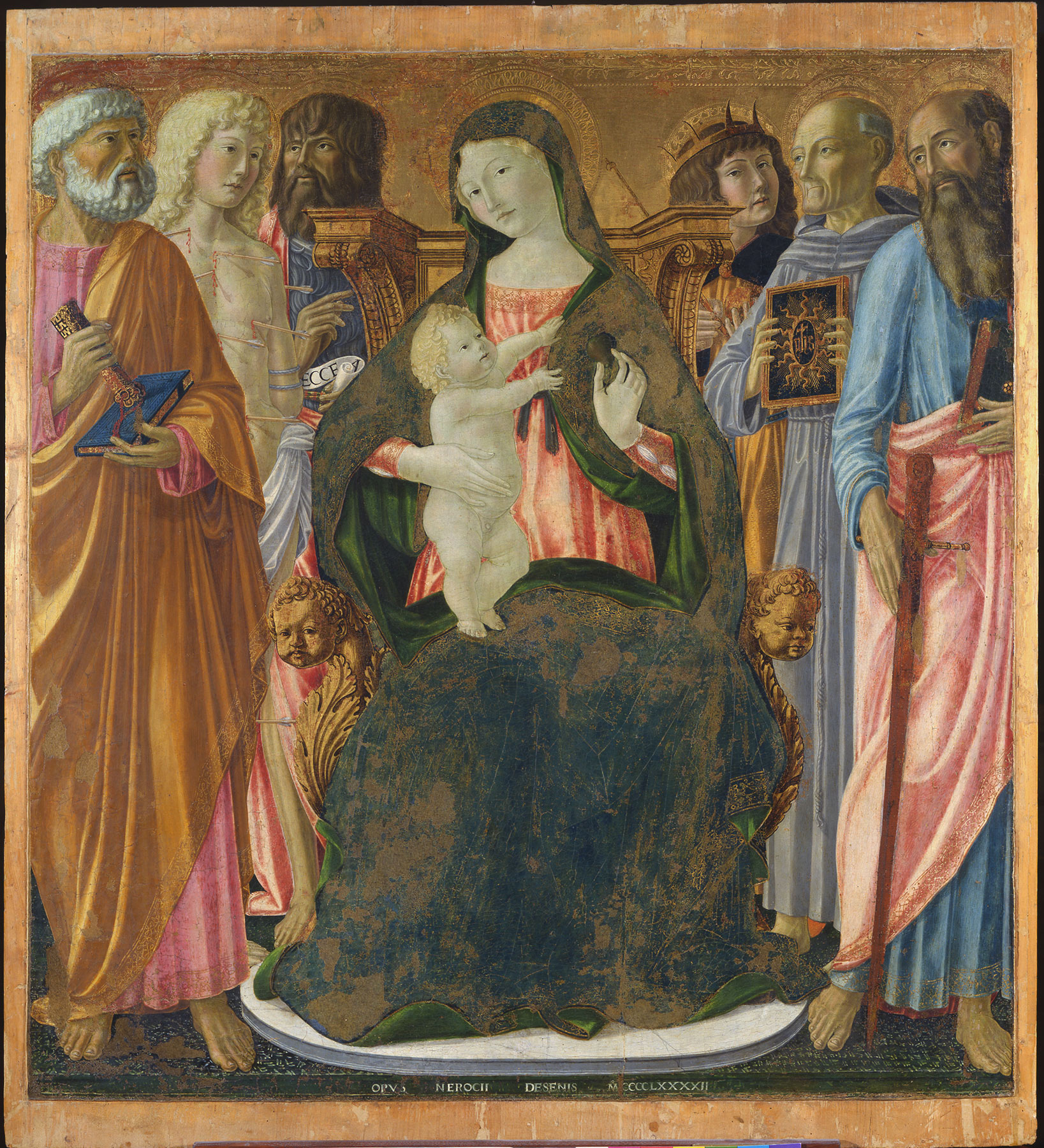
Restoring the lunette to its original context atop a conventional rectangular altarpiece with gold ground and punched margin, an isocephalic line of standing saints clustered closely together, and the Virgin seated on a throne, the architecture of which is projected in exaggerated foreshortening to enhance its decorative effect, forces a reevaluation of the supposedly innovative spatial structure of the courtyard setting of the Annunciation. Neroccio has borrowed the trappings and vocabulary of Albertian perspective to lay out the grid of his marble pavement but in an irrational manner that creates a fantasy setting, not a measurably coherent illusion of depth. The receding orthogonals do converge in a single vanishing point, but this is considerably and inappropriately higher than the horizon line. The intervals between parallels marking depth in space, furthermore, do not diminish according to any mathematical progression; some of the intervals actually lengthen as they move backward, creating an unresolved tension between the notional distance behind the picture plane the parallels are meant to indicate and the height along the picture plane that they actually displace. This tension is most acutely noticeable in the exaggerated distortions of geometric form visible at the extreme ends of the foreground, a distortion familiar to amateurs of Sienese painting from the freely contrived fantasy landscapes of Giovanni di Paolo. The figures, furthermore, are not situated logically within this spatial grid nor are they scaled in such a fashion that would allow the grid to function as a matrix lending empirical credibility to the setting. This is, in fact, the furthest thing from the “perfectly realised linear perspective” that it is often claimed to be.19
The contention, finally, that the grisaille figures adorning the building facade behind the Archangel at the left and the parapet wall closing off the courtyard in the background are too accomplished for Neroccio’s capacities and too accurately reflect familiarity with classical prototypes to reveal his essentially Gothic predisposition as an artist is baseless. Neroccio was a collector of classical statuettes, a number of which were catalogued in the inventory of his estate after his death.20 He was also responsible, contrary to prevailing opinion, for the not dissimilar figures painted only a few years after this in the background of his Claudia Quinta in the National Gallery of Art, Washington, D.C.21 Whether the individual figures included in the frieze(s) in the Jarves Annunciation were intended to have specific and linear iconographic associations relevant to the painting’s theme or were included for their decorative value alone is debatable. It is certain, however, that the artist did not need to call upon a specialist collaborator for their realization. —LK
Published References
Jarves, James Jackson. Descriptive Catalogue of “Old Masters” Collected by James J. Jarves to Illustrate the History of Painting from A.D. 1200 to the Best Periods of Italian Art. Cambridge, Mass.: H. O. Houghton, 1860., 53, no. 76; Sturgis, Russell, Jr. Manual of the Jarves Collection of Early Italian Pictures. New Haven: Yale College, 1868., 62, no. 65; W. F. Brown, Boston. Catalogue of the Jarves Collection of Early Italian Pictures. Sale cat. November 9, 1871., 21, no. 65; Rankin, William. “Some Early Italian Pictures in the Jarves Collection of the Yale School of Fine Arts at New Haven.” American Journal of Archaeology 10, no. 2 (April–June 1895): 137–51., 148; Berenson, Bernard. The Central Italian Painters of the Renaissance. New York: G. P. Putnam’s Sons, 1897., 206; Berenson, Bernard. “An Altar-piece by Girolamo da Cremona.” In The Study and Criticism of Italian Art, 97–110. London: George Bell and Sons, 1902., 156; Crowe, Joseph Archer, and Giovanni Battista Cavalcaselle. A History of Painting in Italy, Umbria, Florence, and Siena from the Second to the Sixteenth Century. Vols. 1–4, ed. Robert Langton Douglas. Vols. 5–6, ed. Tancred Borenius. London: J. Murray, 1903–14., 5:159; Perkins, F. Mason. “Pitture senesi negli Stati Uniti.” Rassegna d’arte senese 1, no. 2 (1905): 74–78., 77; Rankin, William. Notes on the Collections of Old Masters at Yale University, the Boston Museum of Fine Arts, the Fogg Museum of Harvard University. Wellesley, Mass.: Department of Art, Wellesley College, 1905., 11, no. 65; Jacobsen, Emil. Das Quattrocento in Siena: Studien in der Gemäldegalerie der Akademie. Strasbourg, France: Heitz, 1908. , 84, pl. L,3; Berenson, Bernard. The Central Italian Painters of the Renaissance. 2nd rev. ed. New York: G. P. Putnam’s Sons, 1909., 206; Rossi, Pietro. “Neroccio di Bartolomeo Landi e la sua più grande tavola.” Rassegna d’arte senese 5, nos. 1–2 (1909): 15–38., 21n1; Dami, Luigi. “Neroccio di Bartolomeo Landi.” Rassegna d’arte 13, no. 9 (September 1913): 137–47, 160–70., 141–42, fig. 4; Mather, Frank Jewett, Jr. “The Jarves Collection.” Yale Alumni Weekly 23, no. 36 (1914): 965–70., 968; Sirén, Osvald. A Descriptive Catalogue of the Pictures in the Jarves Collection Belonging to Yale University. New Haven: Yale University Press, 1916., 161–62; Porter, Arthur Kingsley. “French Gothic and the Italian Renaissance.” Art and Archaeology 7, nos. 3–4 (March–April 1918): 105–19., 113, 118–19; Mather, Frank Jewett, Jr. A History of Italian Painting. New York: H. Holt, 1923., 100; McComb, Arthur. “The Life and Works of Francesco di Giorgio.” Art Studies 2 (1924): 1–32., 19, fig. 17; Borenius, Tancred. “An American Collection of Italian Primitives.” Apollo 6, no. 36 (December 1927): 261., 261; Offner, Richard. Italian Primitives at Yale University: Comments and Revisions. New Haven: Yale University Press, 1927., 4, 7, 40–41, figs. 33, 33a, 33g; Comstock, Helen. “Francesco di Giorgio as Painter.” International Studio 89, no. 371 (April 1928): 31–36., 35; Schubring, Paul. “Landi, Neroccio di Bartolomeo di Benedetto de’.” In Allgemeines Lexikon der bildenden Künstler: Von der Antike bis zur Gegenwart, ed. Ulrich Thieme and Felix Becker. Leipzig, Germany: E. A. Seemann, 1928., 295; Borenius, Tancred. “Pictures from American Collections at Burlington House.” Apollo 11, no. 63 (March 1930): 153–62., 155, fig. 3; Brockwell, Maurice W. “The Italian Art Exhibition at Burlington House.” Connoisseur 85 (February 1930): 73–83, 141–50., 76, no. 44; Italian Art: An Illustrated Souvenir of the Exhibition of Italian Art at Burlington House, London. London: William Clowes and Sons, 1930., 14, no. 24; Royal Academy of Arts. Exhibition of Italian Art, 1200–1900. Exh. cat. London: Royal Academy of the Arts, 1930., 51, no. 44; Lord Balniel and Kenneth Clark. A Commemorative Catalogue of the Exhibition of Italian Art Held in the Galleries of the Royal Academy, Burlington House, London, January–March 1930. Exh. cat. Oxford: Oxford University Press, 1931., 85–86, no. 246(44); “Handbook: A Description of the Gallery of Fine Arts and the Collections.” Special issue, Bulletin of the Associates in Fine Arts at Yale University 5, nos. 1–3 (1931): 1–64., 27; Venturi, Lionello. Pitture italiane in America. 2 vols. Milan: Ulrico Hoepli, 1931., pl. 234; Berenson, Bernard. Italian Pictures of the Renaissance: A List of the Principal Artists and Their Works with an Index of Places. Oxford: Clarendon, 1932., 390; Edgell, George Harold. A History of Sienese Painting. New York: Dial, 1932., 247, fig. 361; Brandi, Cesare. La Regia Pinacoteca di Siena. Rome: Libreria dello Stato, 1933., 217; Venturi, Lionello. Italian Paintings in America. Trans. Countess Vanden Heuvel and Charles Marriott. 3 vols. New York: E. Weyhe, 1933., pl. 306; Brinton, Selwyn. Francesco di Giorgio Martini of Sienna: Painter, Sculptor, Engineer, Civil and Military Architect (1439–1502). 2 vols. London: Besant, 1934., 109; Exhibition of Italian Paintings of the Renaissance. Exh. cat. New York: Century Association, 1935., 23–24, no. 10; Berenson, Bernard. Pitture italiane del Rinascimento: Catalogo dei principali artisti e delle loro opere. Trans. Emilio Cecchi. Milan: Ulrico Hoepli, 1936., 335; van Marle, Raimond. The Development of the Italian Schools of Painting. Vol. 16. The Hague: M. Nijhoff, 1937., 262, 286, 292, 294–96, fig. 160; Arts of the Middle Ages: A Loan Exhibition. Exh. cat. Boston: Museum of Fine Arts, 1940., 24, no. 68, pl. 62; Boas, George. “The Critical Practice of James Jackson Jarves.” Gazette des beaux-arts 23 (1943): 295–307., 295; Weller, Allen Stuart. Francesco di Giorgio, 1939–1501. Chicago: University of Chicago Press, 1943., 50, 70–71, 74, 82, 398, fig. 14; Comstock, Helen. “The Yale Collection of Italian Paintings.” Connoisseur 118 (September 1946): 45–52., 51–52, no. 10; “Picture Book Number One: Italian Painting.” Special issue, Bulletin of the Associates in Fine Arts at Yale University 15, nos. 1–3 (October 1946): n.p., fig. 23; 40 Masterpieces: A Loan Exhibition of Paintings from American Museums. Exh. cat. Saint Louis: City Art Museum, 1947., 70–71, no. 28; Pope-Hennessy, John. Sienese Quattrocento Painting. London: Phaidon, 1947., 7, 9, 22, 33, pls. 88–89; Steegmuller, Francis. The Two Lives of James Jackson Jarves. New Haven: Yale University Press, 1951., 171, 301; Coor, Gertrude. Neroccio de’ Landi, 1447–1500. Princeton, N.J.: Princeton University Press, 1961., 41–44, 46–47, 58, 72, 78, 89, 107, 112, 124, 127, 133, 163, 171–72, 195, fig. 21; Edgerton, Samuel Y., Jr. “Alberti’s Perspective: A New Discovery and a New Evaluation.” Art Bulletin 48, nos. 3–4 (September–December 1966): 367–78., 377, fig. 9; The Italian Heritage: An Exhibition of Works of Art Lent from American Collections for the Benefit of the Committee to Rescue Italian Art, May 17–Aug 29, 1967. Introduction by Charles Seymour, Jr. Exh. cat. New York: Wildenstein, 1967., no. 7; Berenson, Bernard. Italian Pictures of the Renaissance, A List of the Principal Artists and Their Works with an Index of Places: Central Italian and North Italian Schools. 3 vols. London: Phaidon, 1968., 1:292, 2: pl. 895; Seymour, Charles, Jr. Early Italian Paintings in the Yale University Art Gallery. New Haven: Yale University Art Gallery, 1970., 190–93, no. 144; Fredericksen, Burton B., and Federico Zeri. Census of Pre-Nineteenth-Century Italian Paintings in North American Public Collections. Cambridge, Mass.: Harvard University Press, 1972., 148, 599; Ritchie, Andrew Carnduff, and Katharine B. Neilson. Selected Paintings and Sculpture from the Yale University Art Gallery. New Haven: Yale University Press, 1972., no. 13; F. Clancy, in Seymour, Charles, Jr., et al. Italian Primitives: The Case History of a Collection and Its Conservation. Exh. cat. New Haven: Yale University Art Gallery, 1972., 28, no. 17, figs. 17a–c; Fahy, Everett. Review of Paintings from the Samuel H. Kress Collection: Italian Schools XII–XV Century, by Fern Rusk Shapley; Paintings from the Samuel H. Kress Collection: Italian Schools XV–XVI Century, by Fern Rusk Shapley; Early Italian Paintings in the Yale University Art Gallery, by Charles Seymour, Jr.; and Italian Primitives: The Case History of a Collection and Its Conservation, by Charles Seymour, Jr. Art Bulletin 56, no. 2 (June 1974): 283–85., 285; Scaglia, Gustina. “Autour de Francesco di Giorgio Martini, ingénieur et dessinateur.” Revue de l’art 48 (1980): 7–25., 9, 23n26; Toledano, Ralph. Francesco di Giorgio Martini: Pittore e scultore. Milan: Electa, 1987., 90–91, no. 33, figs. 33, 33a–b; Pope-Hennessy, John. Learning to Look. New York: Doubleday, 1991., 125; Seidel, Max. “Studien zur Skulptur der Frührenaissance: Francesco di Giorgio, Giovanni Antonio Amadeo.” Pantheon 49 (1991): 55–73., 57, 59, fig. 10; Kenney, Elise K., ed. Handbook of the Collections: Yale University Art Gallery. New Haven: Yale University Art Gallery, 1992., 137; Angelini, Alessandro. “Francesco di Giorgio pittore e i suoi collaboratori.” In Francesco di Giorgio e il Rinascimento a Siena, 1450–1500, ed. Luciano Bellosi, 284–90. Exh. cat. Milan: Electa, 1993., 286, 289n18, fig. 3; Bellosi, Luciano. “Il ‘vero’ Francesco di Giorgio e l’arte a Siena nella seconda metà del Quattrocento.” In Francesco di Giorgio e il Rinascimento a Siena, 1450–1500, ed. Luciano Bellosi, 19–89. Exh. cat. Milan: Electa, 1993., 68, 69n74; Garland, Patricia Sherwin. “Recent Solutions to Problems Presented by the Yale Collection.” In Early Italian Paintings: Approaches to Conservation; Proceedings of a Symposium at the Yale University Art Gallery, April 2002, ed. Patricia Sherwin Garland, 54–70, 146–47. New Haven: Yale University Art Gallery, 2003., 66, 68, fig. 3.11; Luke Syson, in Syson, Luke, ed. Renaissance Siena: Art for a City. Exh. cat. London: National Gallery, 2007. , 134–39
Notes
-
Gallerie degli Uffizi, Florence, 1890 nos. 451–53, https://www.uffizi.it/en/artworks/annunciation-with-st-margaret-and-st-ansanus. ↩︎
-
Jarves, James Jackson. Descriptive Catalogue of “Old Masters” Collected by James J. Jarves to Illustrate the History of Painting from A.D. 1200 to the Best Periods of Italian Art. Cambridge, Mass.: H. O. Houghton, 1860., 53, no. 76; and W. F. Brown, Boston. Catalogue of the Jarves Collection of Early Italian Pictures. Sale cat. November 9, 1871., 21, no. 65. ↩︎
-
Rankin, William. “Some Early Italian Pictures in the Jarves Collection of the Yale School of Fine Arts at New Haven.” American Journal of Archaeology 10, no. 2 (April–June 1895): 137–51., 148. ↩︎
-
Berenson, Bernard. The Central Italian Painters of the Renaissance. New York: G. P. Putnam’s Sons, 1897., 206; Berenson, Bernard. “An Altar-piece by Girolamo da Cremona.” In The Study and Criticism of Italian Art, 97–110. London: George Bell and Sons, 1902., 156; Perkins, F. Mason. “Pitture senesi negli Stati Uniti.” Rassegna d’arte senese 1, no. 2 (1905): 74–78., 77; and Murray, as reported in Rankin, William. Notes on the Collections of Old Masters at Yale University, the Boston Museum of Fine Arts, the Fogg Museum of Harvard University. Wellesley, Mass.: Department of Art, Wellesley College, 1905., 11. ↩︎
-
Dami, Luigi. “Neroccio di Bartolomeo Landi.” Rassegna d’arte 13, no. 9 (September 1913): 137–47, 160–70., 141–42. ↩︎
-
Mather, Frank Jewett, Jr. “The Jarves Collection.” Yale Alumni Weekly 23, no. 36 (1914): 965–70., 968; McComb, Arthur. “The Life and Works of Francesco di Giorgio.” Art Studies 2 (1924): 1–32., 19; Comstock, Helen. “Francesco di Giorgio as Painter.” International Studio 89, no. 371 (April 1928): 31–36., 35; Comstock, Helen. “The Yale Collection of Italian Paintings.” Connoisseur 118 (September 1946): 45–52., 51–52; Edgell, George Harold. A History of Sienese Painting. New York: Dial, 1932., 247; Brinton, Selwyn. Francesco di Giorgio Martini of Sienna: Painter, Sculptor, Engineer, Civil and Military Architect (1439–1502). 2 vols. London: Besant, 1934., 109; and van Marle, Raimond. The Development of the Italian Schools of Painting. Vol. 16. The Hague: M. Nijhoff, 1937., 262, 286, 292. ↩︎
-
Weller, Allen Stuart. Francesco di Giorgio, 1939–1501. Chicago: University of Chicago Press, 1943., 50, 70–71, 74, 82, 398; Coor, Gertrude. Neroccio de’ Landi, 1447–1500. Princeton, N.J.: Princeton University Press, 1961., 43–44; Seymour, Charles, Jr. Early Italian Paintings in the Yale University Art Gallery. New Haven: Yale University Art Gallery, 1970., 191–92; Scaglia, Gustina. “Autour de Francesco di Giorgio Martini, ingénieur et dessinateur.” Revue de l’art 48 (1980): 7–25., 9, 23n26; Toledano, Ralph. Francesco di Giorgio Martini: Pittore e scultore. Milan: Electa, 1987., 90–91; and Seidel, Max. “Studien zur Skulptur der Frührenaissance: Francesco di Giorgio, Giovanni Antonio Amadeo.” Pantheon 49 (1991): 55–73., 57–59. ↩︎
-
Pope-Hennessy, John. Sienese Quattrocento Painting. London: Phaidon, 1947., 21. ↩︎
-
Seymour, Charles, Jr. Early Italian Paintings in the Yale University Art Gallery. New Haven: Yale University Art Gallery, 1970., 192. ↩︎
-
F. Clancy, in Seymour, Charles, Jr., et al. Italian Primitives: The Case History of a Collection and Its Conservation. Exh. cat. New Haven: Yale University Art Gallery, 1972., 28. ↩︎
-
Fahy, Everett. Review of Paintings from the Samuel H. Kress Collection: Italian Schools XII–XV Century, by Fern Rusk Shapley; Paintings from the Samuel H. Kress Collection: Italian Schools XV–XVI Century, by Fern Rusk Shapley; Early Italian Paintings in the Yale University Art Gallery, by Charles Seymour, Jr.; and Italian Primitives: The Case History of a Collection and Its Conservation, by Charles Seymour, Jr. Art Bulletin 56, no. 2 (June 1974): 283–85., 285. ↩︎
-
Garland, Patricia Sherwin. “Recent Solutions to Problems Presented by the Yale Collection.” In Early Italian Paintings: Approaches to Conservation; Proceedings of a Symposium at the Yale University Art Gallery, April 2002, ed. Patricia Sherwin Garland, 54–70, 146–47. New Haven: Yale University Art Gallery, 2003., 66, 68. ↩︎
-
Pope-Hennessy, John. Sienese Quattrocento Painting. London: Phaidon, 1947., 22; and Luke Syson, in Syson, Luke, ed. Renaissance Siena: Art for a City. Exh. cat. London: National Gallery, 2007. , 138. ↩︎
-
Coor, Gertrude. Neroccio de’ Landi, 1447–1500. Princeton, N.J.: Princeton University Press, 1961., no. 6, fig. 43. ↩︎
-
Inv. no. 285. ↩︎
-
Inv. no. 282. ↩︎
-
Coor, Gertrude. Neroccio de’ Landi, 1447–1500. Princeton, N.J.: Princeton University Press, 1961., no. 26, fig. 79. ↩︎
-
Possibly but not necessarily incidental to this reconstruction is the fact that the blue of the Virgin’s robe in both altarpiece and lunette are deteriorated to the same degree and in the same fashion. ↩︎
-
Luke Syson, in Syson, Luke, ed. Renaissance Siena: Art for a City. Exh. cat. London: National Gallery, 2007. , 137. ↩︎
-
The inventory, dated November 26, 1500, is published in full by Milanesi, Gaetano. Documenti per la storia dell’arte senese. 3 vols. Siena: n.p., 1854–56., 3:7–9; and in Coor, Gertrude. Neroccio de’ Landi, 1447–1500. Princeton, N.J.: Princeton University Press, 1961., 152–59. Item 183 in the inventory is “una testa di tucto rilievo antica” (an antique head fully in the round); item 267 is “43 pezi di forme di rotture antiche di gesso” (gesso [copies] of antique fragments); and item 268 is “3 gessi d’Apollo” (3 gesso [copies] of Apollo). Numerous pieces of “marmo antico” (antique marble) might also refer to antiquities or antique fragments but are not described in sufficient detail to identify with confidence. ↩︎
-
Inv. no. 1937.1.12, https://www.nga.gov/collection/art-object-page.14.html. The most useful study of the eight figures of heroes and heroines that formed a suite with the Claudia Quinta is to be found in Syson, Luke, ed. Renaissance Siena: Art for a City. Exh. cat. London: National Gallery, 2007. , 234–45, where the proposal is endorsed that the series was begun in 1493 and that the panels by Francesco di Giorgio (Scipio Africanus, Museo Nazionale del Bargello, Florence, inv. no. 2023 Carrand) and Neroccio were completed by the Griselda Master. A contrary opinion, that the paintings could be two or more years later and that the Claudia Quinta is entirely to be attributed to Neroccio, is expressed by the present author in Kanter, Laurence. “Rethinking the Griselda Master.” Gazette des beaux-arts 142 (2000): 147–56., 147–55. ↩︎