Probably Leopold Koppel (1854–1933), Berlin; probably Else Koppel Klotz (died 1950), Berlin and Pontresina, Switzerland; Leopold Hugo Paul Klotz (1909–1993), New York; Ruth Klotz, formerly Baroness von Riedel, New York; sale, Christie’s, New York, September 28, 2006, lot 132
The relief, whose maximum molded depth is approximately 7 centimeters, has been backed with a modern plaster support to a depth of 3.5 centimeters. A triangular damage measuring 9 by 7 centimeters has been repaired at the lower-right corner, and the Child’s extended right foot has been broken and repaired. Discreet flaking losses in the Virgin’s blue robe, on her wrist, and on her throat behind her ear, as well as on the Child’s right thigh, have been retouched. Repairs around the entire perimeter have discolored, but the paint surface otherwise is beautifully preserved, if dirty. The gilding and punch tooling is particularly well preserved, although some of the red-glaze decoration originally highlighting the Virgin’s dress has been lost.
The relief is known in at least twenty examples and is often referred to as the Massimo Madonna, after the former owner, Prince Fabrizio Massimo, of a version that appeared on the market in 2008.1 The model was first discussed by Wilhelm Bode, with reference to a stucco that had been gifted to the Königliche Museen (now Staatliche Museen zu Berlin) in 1882 (fig. 1), as by an artist in the circle of Donatello.2 This attribution was extended to the Massimo relief when that object was first published by Luigi Grassi in 1958 and has been adopted, with a range of dates from the 1430s through the 1470s, by most authors who have mentioned the composition.3 Cataloguing a damaged version of the relief in the Victoria and Albert Museum, London,4 John Pope-Hennessy demurred, saying that “the composition, which cannot be attributed to a known hand, seems to date from the third quarter of the fifteenth century.”5 Giancarlo Gentilini instead considered the Donatellesque qualities of the relief, which he confusingly described as almost stiacciato (exceptionally low relief), as indicative of a date in the 1420s and advanced an attribution for it to the early career of Luca della Robbia.6 He listed four other examples besides those in Berlin, London, and formerly in the Massimo collection: one formerly in the collection of Raimond van Marle, Perugia; one in a private collection, Massalombarda (Ravenna); one in a private collection, Florence; and one in the Biagini collection—and observed that numerous casts were to be found in Siena or in Sienese territory. The latter, twelve in number, were listed by Laura Martini, who noted that the source of these replicas was more likely to be a late work by Donatello than an early work by Luca della Robbia.7 To this list may now be added the present relief and a cast formerly with Stefano Bardini in Florence,8 unless that example is identical with one of the reliefs mentioned by Gentilini.
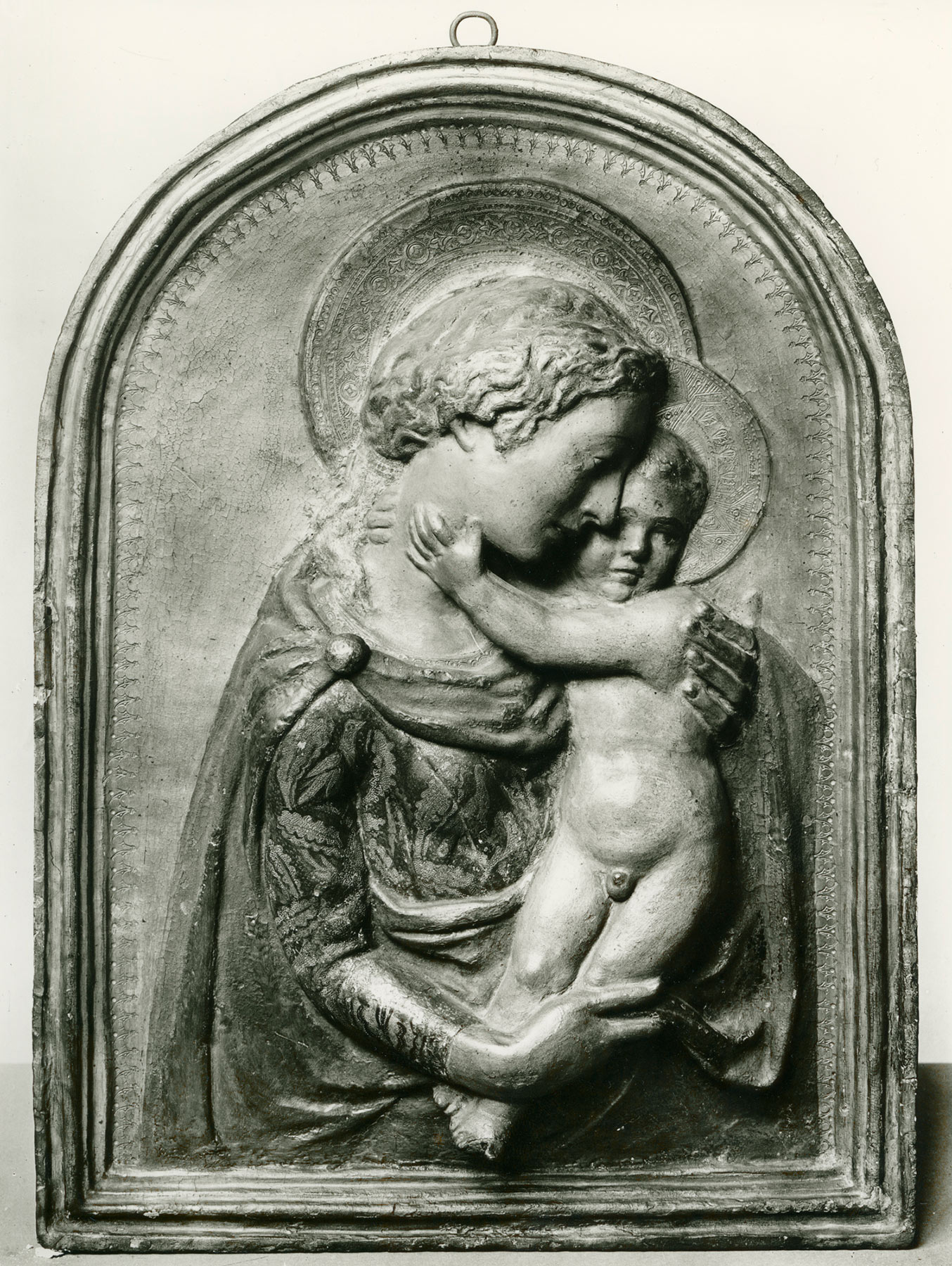
Only two of the known examples can, with confidence, be described as “first generation”— that is, pulled directly from the original mold and not cast later from an existing replica: the version in Berlin (see fig. 1) and the present relief. The Berlin example is cast in one with its molded frame, and such must also have been the case with the Yale relief; cutting away of this frame is the most plausible explanation for the uniform damage running along the entire perimeter of the relief. The version formerly in the van Marle collection was also cast with this frame, but in the absence of the original, it is difficult to judge its surface from photographs. It has not previously been remarked that the format of these three reliefs—an arched top with a gold ground and punched margin—is explicitly Sienese, not Florentine or Paduan, and that the genesis of this model as an autograph work by Donatello is, therefore, likely to date from the brief period of his residence in Siena, between 1458 and 1462. The delicacy of modeled details in both the Berlin and Yale examples, especially the folds of the Virgin’s dress as it falls across her breast; the audacity of the undercutting in fully rounded passages, such as the Child’s left arm or the Virgin’s right forearm; the effortless accuracy of anatomy of the Virgin’s wrist and fingers, the Child’s hands, and the torsion of His body; and the emotional counterpoint of the Virgin’s absorbed gaze contrasted with the Child’s distracted glance away from His mother while He clings tightly to her neck all bespeak an exalted level of artistic invention consonant with Donatello’s work at that date.
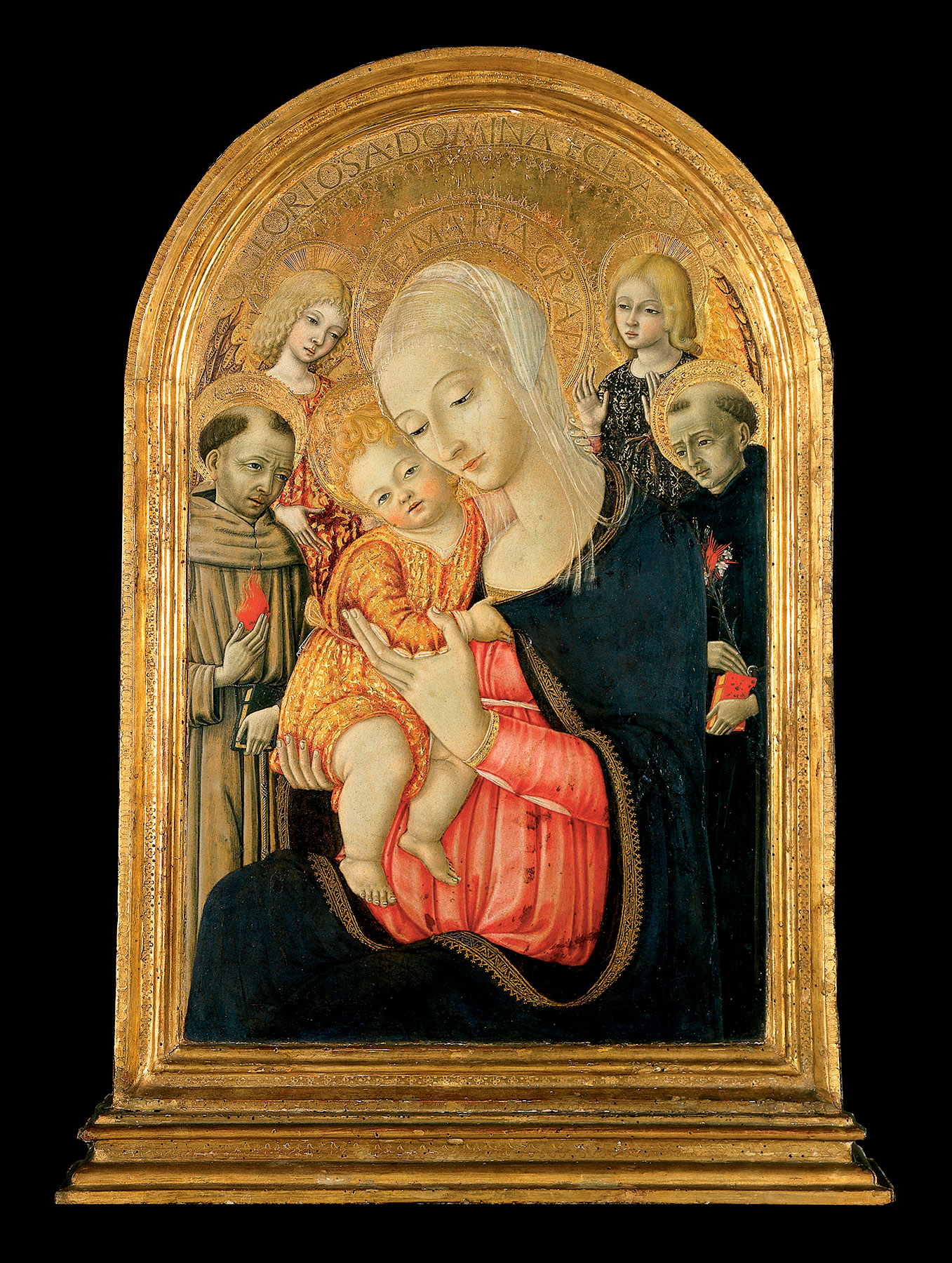
As the present relief was unknown to scholarship and the Berlin relief was severely damaged during the Second World War, it had also escaped notice that the gilding and polychromy of both examples could be attributed, again with confidence, to the Sienese painter Matteo di Giovanni. The four principal punch tools used to decorate the Virgin’s and Child’s haloes and the margin of the gold ground in the Yale example all belonged to Matteo.9 Prewar photographs of the Berlin version suggest that its margin was tooled identically to that at Yale and that three different punch tools, again all belonging to Matteo di Giovanni, were employed in the Virgin’s and Child’s haloes.10 Furthermore, the stippled and glazed patterns decorating the Virgin’s dress in both reliefs recur in well-preserved paintings of the Virgin and Child by Matteo di Giovanni, such as four examples in the Pinacoteca Nazionale, Siena,11 one in the Gallerie degli Uffizi, Florence,12 or a little-known but particularly beautiful panel in the Cincinnati Art Museum (fig. 2), to name just a few. This “documented” contact between Matteo di Giovanni at the outset of his career and Donatello at the twilight of his could explain much of the novelty of Matteo’s contributions to the conservative atmosphere of Sienese visual culture at this seminal moment. It may also add a practical inflection to debates over the choice of Matteo to provide two altarpieces for Pienza Cathedral despite the dissolution of his partnership with Giovanni di Pietro, which had traditionally been adduced as the logical connection between a young, virtually unknown painter and the supposed capo maestro of the project, Lorenzo Vecchietta (Giovanni di Pietro’s brother). Donatello’s influence on Sienese artists during his last sojourn in the city has generally been discussed in terms of sculptural, not pictorial, legacies: the ramifications of this new attribution for the reliefs at Yale and Berlin have yet to be investigated. —LK
Published References
Unpublished
Notes
-
Sale, Babuino Casa d’Aste, Rome, September 16–18, 2008, lot 75; the object measures 55 by 37 centimeters. ↩︎
-
Bode, Wilhelm. Italienische Bildhauer der Renaissance. Berlin: W. Spemann, 1887., 42–43; Bode, Wilhelm, and Hugo von Tschudi. Beschreibung der Bildwerke der christlichen Epoche. Berlin: W. Spemann, 1888., 19; and Schottmüller, Frida. Die italienischen und spanischen Bildwerke der Renaissance und des Barocks in Marmor, Ton, Holz, und Stuck. Berlin: G. Reimer, 1913., no. 62. Leo Planiscig attributed the relief to Nanni di Bartolo, but this suggestion has not been repeated by any other author; see Planiscig, Leo. “Die Bildhauer Venedigs in der ersten Hälfte des Quattrocento.” Jahrbuch der kunsthistorischen Sammlungen in Wien, n.s., 4 (1930): 47–120., 81–82. ↩︎
-
Grassi, Luigi. Tutta la scultura di Donatello. Milan: Rizzoli, 1958., 112, pl. 207. See also Del Vivo Masini, Maria Cristina. “Intorno a una Madonna inedita della cerchia Donatelliana.” Antichità viva 15, no. 5 (1976): 22–26., 22–23; and Jolly, Anna. Madonnas by Donatello and His Circle. New York: Peter Lang, 1998., 184–87, where the composition is referred to as the “Madonna of the classical dress.” ↩︎
-
Inv. no. A.105-1937, https://collections.vam.ac.uk/item/O313502/virgin-and-child-relief-unknown/. ↩︎
-
Pope-Hennessy, John. Catalogue of Italian Sculpture in the Victoria and Albert Museum. 3 vols. London: H. M. Stationery Off., 1964., 1:197, 3:138. The version in London may be presumed to be a later cast after one of the prime versions of the relief; it modifies the folds of the Virgin’s cloak slightly and adds an inexplicable swath of drapery to hide the Child’s nudity. ↩︎
-
Gentilini, Giancarlo. I Della Robbia: La scultura invetriata nel Rinasciamento. Florence: Cantini, 1992., 42–43; and Gentilini, Giancarlo, and Liletta Fornasari. I Della Robbia: Il dialogo tra le arti nel Rinascimento. Exh. cat. Milan: Skira, 2009., 172, 313. ↩︎
-
Martini, Laura. La “rinascita” della scultura: Ricerca e restauri. Siena: Protagon, 2006., 85–87. ↩︎
-
Sale, American Art Association, New York, April 18, 1918, lot 348. ↩︎
-
Frinta, Mojmír S. Punched Decoration on Late Medieval Panel and Miniature Painting. Vol. 1, Catalogue Raisonné of All Punch Shapes. Prague: Maxdorf, 1998., 188, 238, 302, 405–6, nos. EE5, Fda72, GH32, Jc36. ↩︎
-
Frinta, Mojmír S. Punched Decoration on Late Medieval Panel and Miniature Painting. Vol. 1, Catalogue Raisonné of All Punch Shapes. Prague: Maxdorf, 1998., 111–12, no. CC32; 295, no. Gg52; 306, no. H24a. The punching along the right margin of the Berlin relief continued without interruption to the base of the composition. The same course of punching is visible in the Yale relief beneath repaints extending the Virgin’s blue cloak to the edge of the composition. ↩︎
-
Inv. nos. 280, 283, 286, 400. ↩︎
-
Inv. no. 1890 n. 3578, https://catalogo.uffizi.it/it/29/ricerca/detailiccd/1181258/. ↩︎