Private collection, Florence;1 Dan Fellows Platt (1873–1938), Englewood, N.J., by 1909;2 sale, Parke-Bernet Galleries, New York, January 9, 1947, lot 25; James Lord (1922–2009), Paris; Wildenstein & Co., New York; Ann Kinney (born 1931) and Gilbert H. Kinney (1931–2020), New York, by 1975
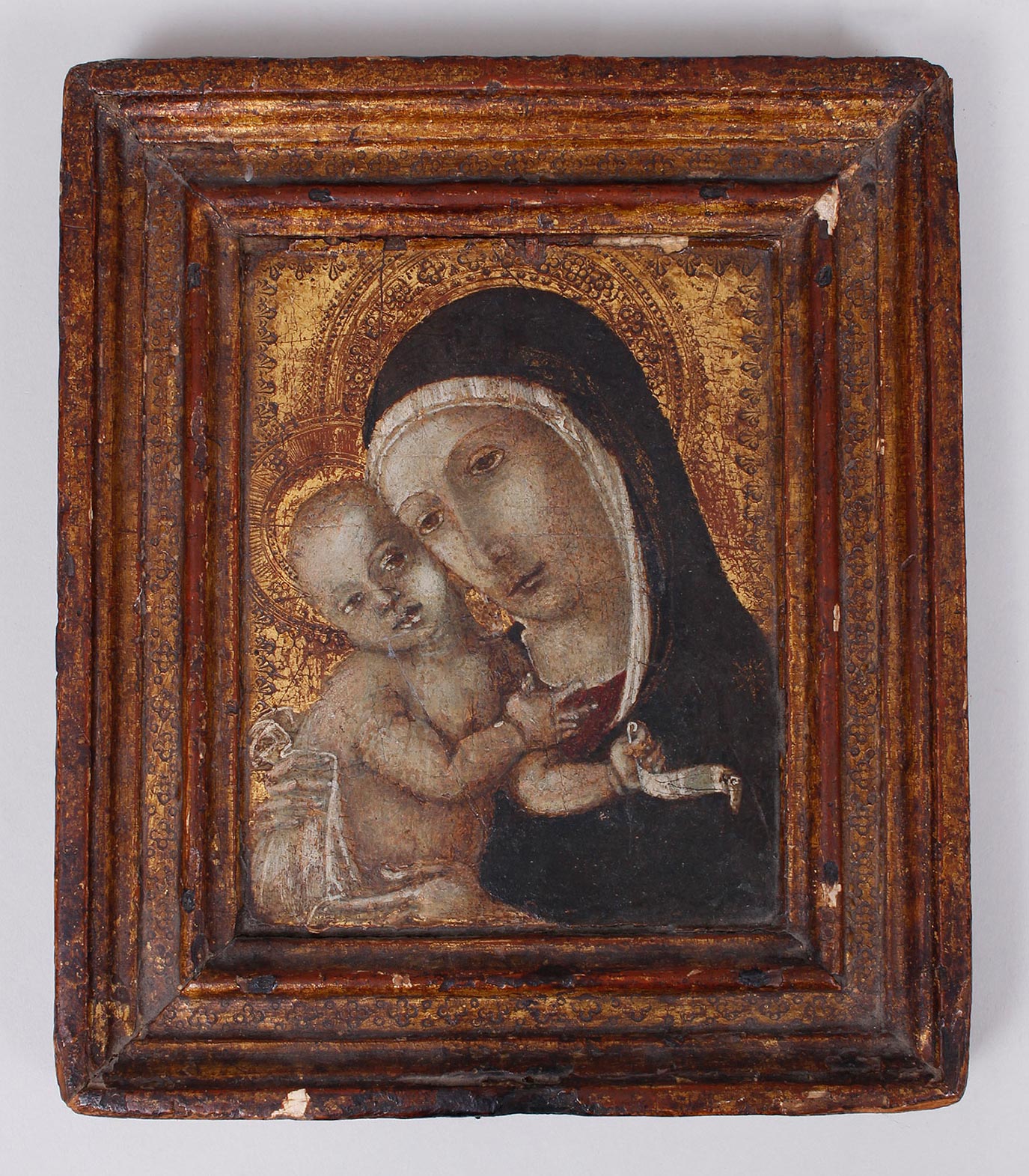
The panel support, of a vertical wood grain, is 3 centimeters thick and exhibits a pronounced convex warp. It comprises a center plank, 47 centimeters wide, with narrow planks glued and nailed to it on either side: 4 centimeters wide on the left and 5 centimeters wide on the right. The panels are joined by two modern battens across the reverse and an engaged frame, 3.5 centimeters wide and 1.8 centimeters deep, applied to the front. The vertical sections of the frame are largely original, but the sections of the segmented arch at the top and the cross-grained molding at the bottom are modern; the latter is applied over a 2.7-centimeter-wide addition to the panel repairing extreme worm damage along its lower edge. The gold ground and haloes are modern leaf applied over remnants of original gilding. The paint surface has suffered numerous complete losses and has been extensively repainted but is relatively free of abrasions other than in the Virgin’s blue robe. The entire surface is, at present, covered by a yellowed and exceptionally thick, glossy varnish that obscures the tone of all the colors.
Other than brief mentions of its existence in the Dan Fellows Platt collection in Englewood, New Jersey, this undeservedly little-known work has appeared only once in the general literature of Renaissance painting. In 1921 F. Mason Perkins vigorously defended an attribution for it to Matteo di Giovanni rather than to Guidoccio Cozzarelli, the name it had been assigned by Bernard Berenson at least since 1909.3 As Perkins wrote:
The painting reveals . . . an amount of character and combination of other qualities hardly to be reconciled with Cozzarelli’s flaccid and defective art. That Guidoccio could, for instance, have been capable, at any period of his career, of producing so well-balanced and perfectly-spaced a composition as that which we have here, it is difficult to believe. Nor do we discover, in his independent works, any such sureness of design or any such general technical ability as are displayed in this panel. Still again, while Cozzarelli shows himself, in almost all his known paintings, as an exclusive imitator of his chosen master’s mature and full-blown style, the picture at Englewood reveals the closest affinities to certain works of Matteo’s early and least-known manner.4
Raimond van Marle adopted Perkins’s conclusions without comment.5 Berenson continued to insist on an attribution to Cozzarelli in all the editions of his lists, and it was with that identification that the painting entered the collection of the Yale University Art Gallery in 1975. Erica Trimpi did not mention the painting in her dissertation on Matteo di Giovanni, which must be understood as a tacit acceptance of Berenson’s attribution for it to Guidoccio Cozzarelli.6
Both Perkins and Berenson called attention to the damaged condition of the panel and its character-altering restorations. Perkins claimed to have seen it unrestored,7 presumably in a state preceding that recorded in a Reali photograph preserved in the Berenson Library, Villa I Tatti, Settignano (fig. 1). That image shows the panel with its still engaged frame moldings. The gold ground had already been renewed, and the Virgin’s dress had been heavily overpainted, as had her features and those of the Christ Child. The deacon saint at the right was portrayed with a crown and held a flail in his right hand. At the left, Saint William of Maleval (Guglielmo da Malavalle) wore the iron cross bands on his head that, together with prayer beads and rustic staff, are his distinguishing attributes. The bishop saint kneeling in the left foreground held what appears to be a curry comb in his right hand, suggesting his identification as Saint Blaise. Not only did these free inventions obscure the iconography of the image, but also the blunting effect of the repaints, especially in the Virgin and Child, made Berenson’s attribution to Guidoccio Cozzarelli easier to explain. They masked almost entirely the incisive handling of paint—exclusively typical of Matteo di Giovanni—revealed in a cleaning possibly undertaken for Wildenstein & Co. when the painting was briefly in their inventory.
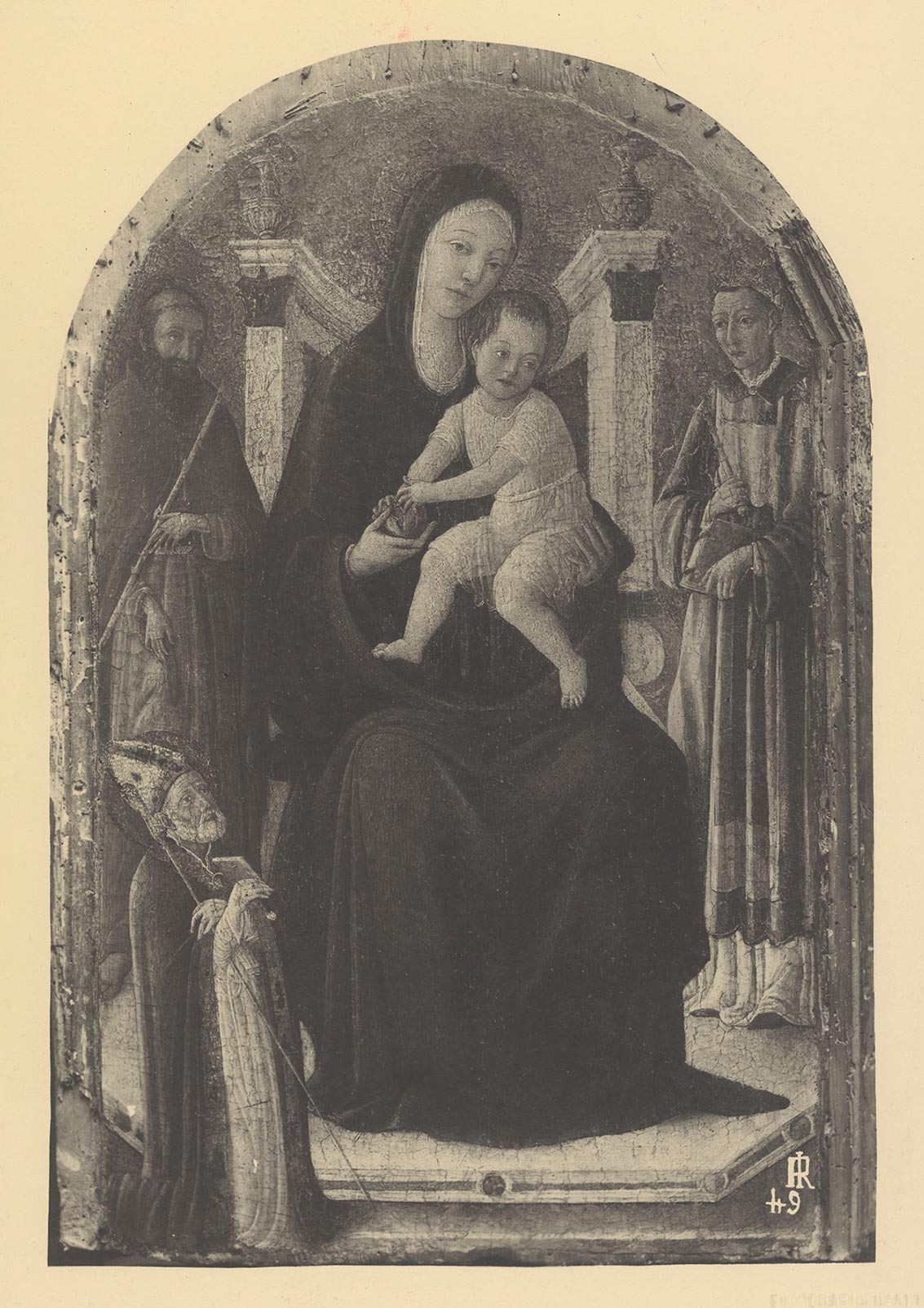
While the present “cleaned” state of the painting may be said to have clarified some of the confusion introduced by the earlier restoration, it is guilty of having replaced other uncertainties with misinterpretations of its own. The kneeling bishop now holds a feather rather than a curry comb, but this must once have been a martyr’s palm. The yellow-and-white form that had been reconstructed as the head of the comb is clearly the upper half of a book, but just as clearly, the book was not meant to be clasped beneath the orphrey of the bishop’s cope, as it now appears to be. Saint William has lost his cross-banded headgear, and his rustic staff has been provided, inappropriately, with an elaborate acanthus finial. The misleading folds in the Virgin’s mantle have disappeared, but a mordant gilt star has been added to (or revealed on) her right shoulder. The thongs of the flail once held by the deacon saint are now revealed to have been epaulettes attached at both of his shoulders, but the form that had constituted the handle of the flail has now been reconstructed as a knife held in the saint’s right hand. Probably this was also originally a martyr’s palm, only vestiges of which remain. The deacon still wears a crown, but this is rendered in new gold, and the top of his head visible above the crown is also modern. There is no indication that these forms follow any remnants of an original design. Probably, the figure was tonsured, and the crown and top of his hair were added as a misunderstanding of damage in that area. Traces of original punch tooling along the gilt margin of the composition survive just above the deacon’s left shoulder, as does a stray lozenge-shape punch strike at the level of his ear, which implies the original circumference of his halo was once considerably larger than it is at present. Probably, all the haloes corresponded to or were larger than the area now occupied by the halo of the kneeling bishop.
Neither the bishop nor the deacon carries a defining attribute that could pinpoint his identification, but there is at least a reasonable likelihood that the bishop is meant to be Saint Sabinus (San Savino), one of the patron saints of Siena. The deacon could be interpreted as Saint Stephen if it is assumed that the damage at the top of his head resulted in the elimination of his key attributes: the stones of his martyrdom. The hermit saint at the left is clearly meant to be William of Maleval (Guglielmo da Malavalle), founder of the eremitical order of Guglielmites, although eleven saints in the Roman calendar bear the name William, and their iconographies, especially that of Saint William of Aquitaine, are frequently confused one with another.8 While William of Maleval was particularly venerated at Castiglion della Pescaia on the Tyrrhenian coast below Grosseto, the Guglielmites were spread throughout Tuscany, western Umbria, and northern Lazio. They were established densely in the Maremma, southwest of Siena, and the most prestigious of the many foundations over which they exercised authority was, from 1291 to 1462, the Benedictine abbey of Sant’Antimo near Montalcino, in the province of Siena.9
Considered without the freely invented repairs to lacunae and unnecessary retouching in the principal figures, it is apparent that Perkins’s assessment of the painting as an early work by Matteo di Giovanni is correct. It must also be acknowledged, however, that persistent disagreement over the outlines of Matteo di Giovanni’s early career necessitates qualification of such an attribution. Matteo is first mentioned as a painter in December 1452, when he is named alongside Giovanni di Pietro—the elder brother of Vecchietta—in a document of payment for gilding and polychromy of a wooden angel carved as part of an Annunciation group in the cathedral of Siena. A second payment for this work, registered in January 1453, specified that Matteo and Giovanni di Pietro were partners in a compagnia, an official business relationship confirmed in a tax declaration filed later that year. These two artists are still named alongside each other in payments for work in the chapel of Saint Bernardino in Siena Cathedral between 1457 and 1461 but not again after that. The first signed and dated painting by Matteo, a Virgin and Child Enthroned with Saints Anthony of Padua and Bernardino now in the Museo dell’Opera del Duomo in Siena, appears only in 1460, followed by two altarpieces for the cathedral in Pienza between 1462 and 1465. Some considerable body of work before this must be presumed, either lost or not yet identified, but only a handful of early paintings are commonly discussed as candidates in the scant art-historical literature dedicated to the artist. Chief among these is an altarpiece of the Annunciation in the church of San Pietro Ovile, Siena, frequently associated with documents of 1459 and 1460,10 and altarpieces in Borgo San Sepolcro and Asciano, both undocumented but generally placed shortly before or after 1460.
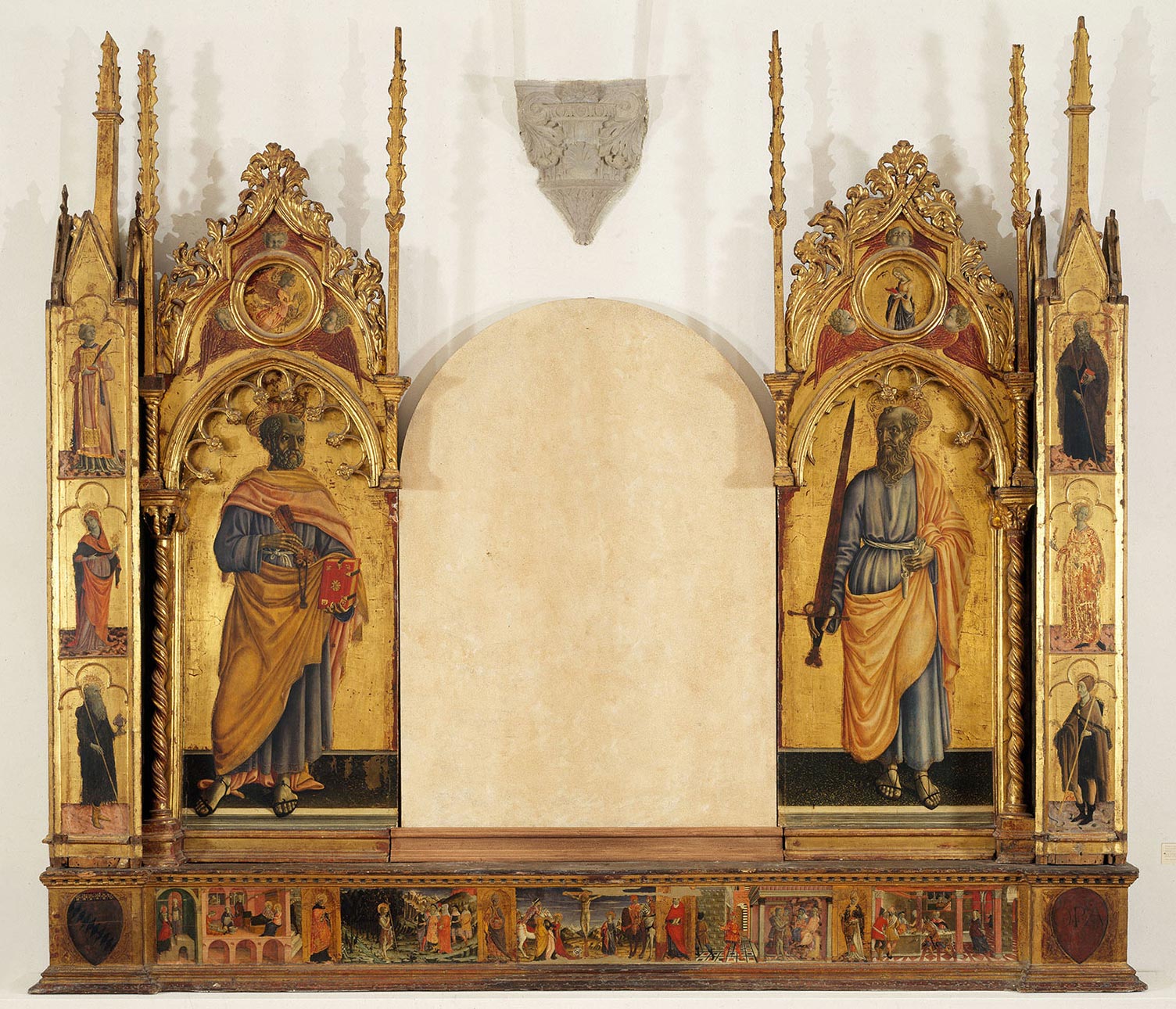
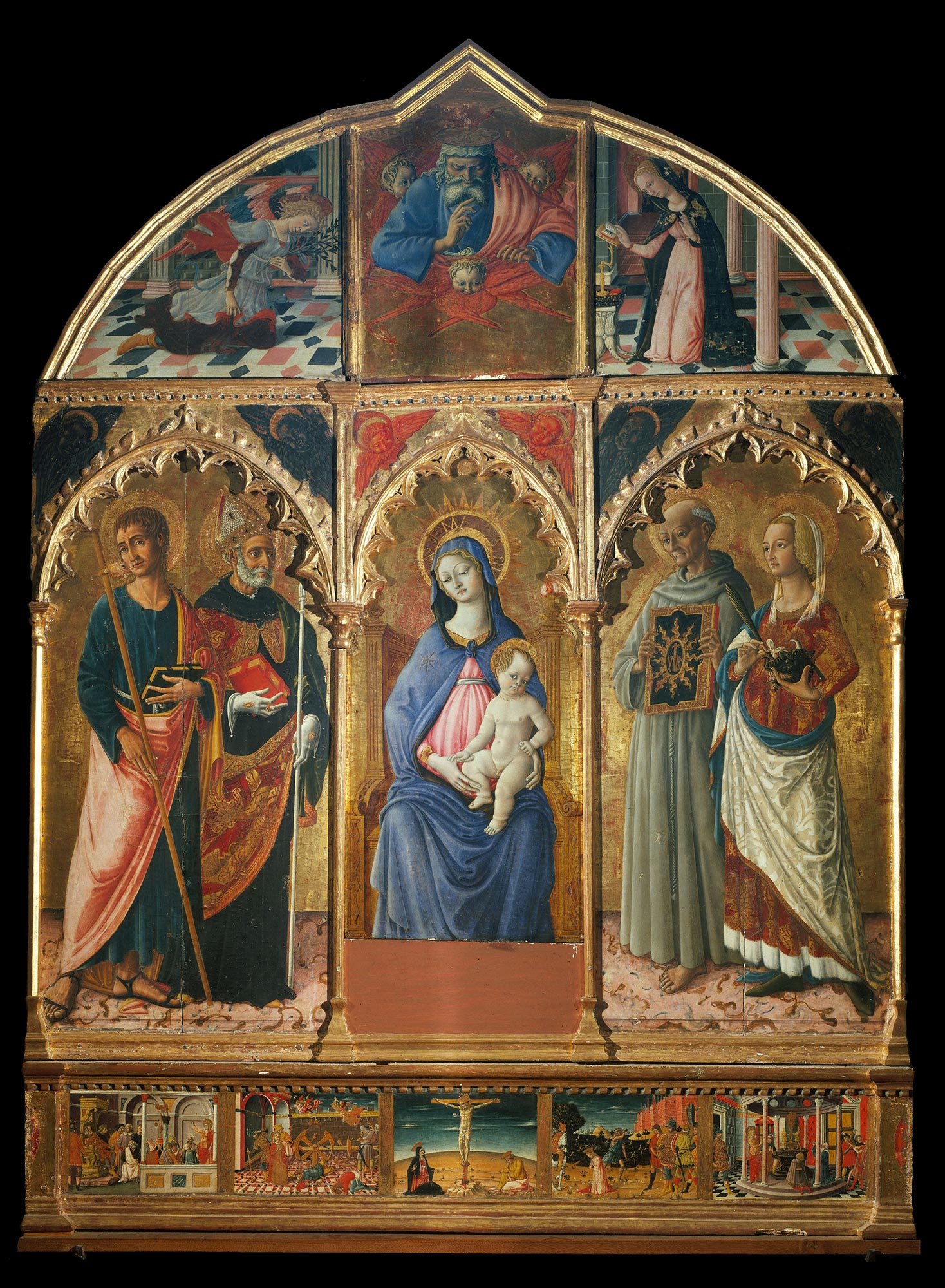
Pia Palladino’s demonstration that the San Pietro Ovile altarpiece and the Saint Bernardino altarpiece of 1460 are both hybrid works makes them definitive indicators of Matteo di Giovanni’s style during the period of his compagnia with Giovanni di Pietro in the 1450s.11 The Graziani altarpiece in Borgo San Sepolcro (fig. 2)—comprising the lateral panels and predella that once completed the Baptism of Christ by Piero della Francesca now in the National Gallery, London12—is frequently considered contemporary to these works, but that contention was based on the mistaken supposition that its predella is also attributable to Giovanni di Pietro. While it is clearly an early work, it more likely follows than precedes the 1460 altarpiece in the Opera del Duomo.13 The Scotti altarpiece in Asciano (fig. 3), considered a work of ca. 1458 in recent scholarship, is instead closest in style to the Pienza altarpieces and probably dates to the middle years of the 1460s.14 Assigning it a precise date or using it as a firm point of comparison for other works is complicated, however, by its having been painted in two distinct campaigns. The predella, center panel, left lateral panel, and pinnacles are products of a first campaign, presumably of the early 1460s. Some few years later, probably not later than 1470, the right lateral panel was repainted to change the dedication of the altarpiece from Saint Catherine of Alexandria, whose legend is recounted in the predella, to Saint Bernardino.15 The pavement in this panel was repainted and the gold ground releafed to cover the wheel of Saint Catherine’s martyrdom, still faintly visible in raking light behind the current figure of Saint Margaret. Sandals once worn by the saint, possibly Philip, now reconfigured as Bernardino, who is barefoot, were also covered over in this campaign but can still be discerned in raking light.16
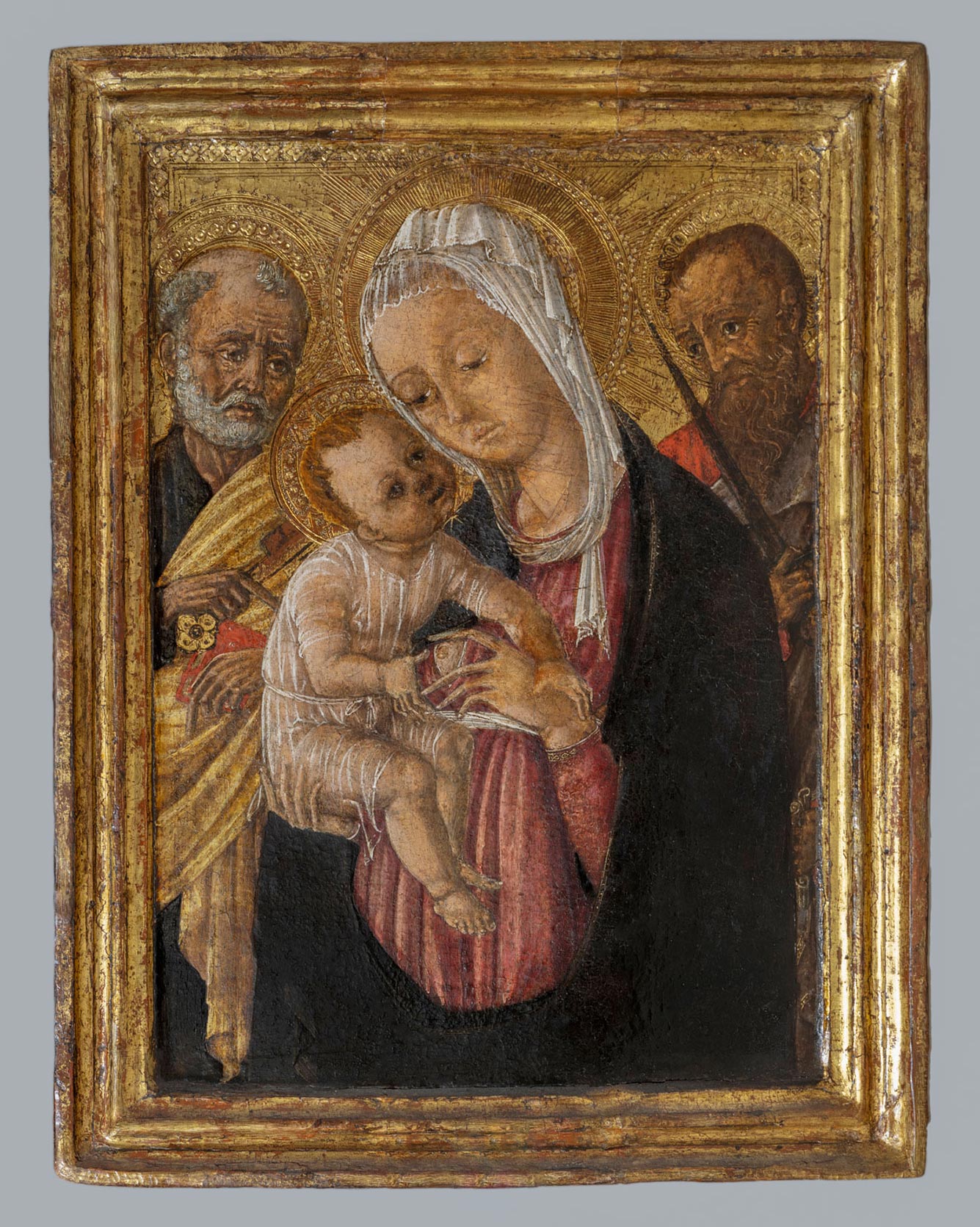
Three undated works of private devotion that can be associated stylistically with these altarpieces are generally featured in discussions of Matteo di Giovanni’s early career: two Virgin and Child compositions in the National Gallery of Art, Washington, D.C.,17 and another in the Gallerie degli Uffizi, Florence.18 All of these are datable to the decade of the 1460s by comparison to the Asciano and Borgo San Sepolcro altarpieces.19 Three much smaller and simpler paintings of the Virgin and Child are known that must precede these and that together offer a compelling point of context for the Yale Virgin and Child Enthroned: a Virgin and Child with Saints Peter and Paul in the Museo Horne, Florence (fig. 4); a Virgin and Child with Saints Jerome and Barbara (formerly?) in the Museo Civico at Ravenna; and a Virgin and Child with no other figures formerly in the collection of Robert Langton Douglas, London (fig. 5).20 These display the same figure types, spidery rendering of limbs and digits, and nervous brushwork encountered in the Yale painting, all cognate to but more amply developed in Matteo’s work at the beginning of the seventh decade of the fifteenth century. There exists no fixed point of reference for determining dates for Matteo’s work in the 1450s. The San Pietro Ovile altarpiece is presumed to be dated ca. 1459, but the documents often associated with it are unspecific.21 A proposal to attribute a biccherna cover of 1452 to Matteo di Giovanni is scarcely persuasive, whereas two other biccherne that are stronger candidates for an attribution to Matteo are both dated 1460 and therefore of little use in establishing finer gradations of chronology for the 1450s.22 Assigning a date of ca. 1455–60 to the Yale Virgin and Child Enthroned is, therefore, emblematic rather than a specific indication of the moment in which it must have been commissioned or executed. —LK
Published References
Berenson, Bernard. The Central Italian Painters of the Renaissance. 2nd rev. ed. New York: G. P. Putnam’s Sons, 1909., 159; Perkins, F. Mason. “Alcuni dipinti senese sconosciuti o inediti.” Rassegna d’arte 13, no. 8 (August 1913): 121–26, 195–99., 199; Perkins, F. Mason. “Some Sienese Paintings in American Collections: Part Four.” Art in America 9, no. 2 (February 1921): 45–60., 47, 49, 50n2; Berenson, Bernard. Italian Pictures of the Renaissance: A List of the Principal Artists and Their Works with an Index of Places. Oxford: Clarendon, 1932., 157; Berenson, Bernard. Pitture italiane del Rinascimento: Catalogo dei principali artisti e delle loro opere. Trans. Emilio Cecchi. Milan: Ulrico Hoepli, 1936., 136; van Marle, Raimond. The Development of the Italian Schools of Painting. Vol. 16. The Hague: M. Nijhoff, 1937., 358; Berenson, Bernard. Italian Pictures of the Renaissance, A List of the Principal Artists and Their Works with an Index of Places: Central Italian and North Italian Schools. 3 vols. London: Phaidon, 1968., 1:98; “Acquisitions 1975.” Yale University Art Gallery Bulletin 36, no. 1 (Fall 1976): 26–57., 38, 43
Notes
-
According to Perkins, F. Mason. “Some Sienese Paintings in American Collections: Part Four.” Art in America 9, no. 2 (February 1921): 45–60., 50n2. ↩︎
-
Bernard Berenson lists a Madonna by Guidoccio Cozzarelli in the Platt collection; see Berenson, Bernard. The Central Italian Painters of the Renaissance. 2nd rev. ed. New York: G. P. Putnam’s Sons, 1909., 159. While the title does not correspond exactly to the present picture, the latter is the only painting Platt is known to have owned that Berenson considered a work by that artist. ↩︎
-
Perkins, F. Mason. “Some Sienese Paintings in American Collections: Part Four.” Art in America 9, no. 2 (February 1921): 45–60., 47, 49, 50n2; and Berenson, Bernard. The Central Italian Painters of the Renaissance. 2nd rev. ed. New York: G. P. Putnam’s Sons, 1909., 159. ↩︎
-
Perkins, F. Mason. “Some Sienese Paintings in American Collections: Part Four.” Art in America 9, no. 2 (February 1921): 45–60., 47. ↩︎
-
van Marle, Raimond. The Development of the Italian Schools of Painting. Vol. 16. The Hague: M. Nijhoff, 1937., 358. ↩︎
-
Trimpi, Erica S. “Matteo di Giovanni: Documents and a Critical Catalogue of His Panel Paintings.” 2 vols. Ph.D. diss., University of Michigan, 1987.. ↩︎
-
Perkins, F. Mason. “Some Sienese Paintings in American Collections: Part Four.” Art in America 9, no. 2 (February 1921): 45–60., 50n2. ↩︎
-
Kaftal, George. Iconography of the Saints in Tuscan Painting. Florence: Sansoni, 1952., col. 1032. ↩︎
-
Corsi, Maria. “Guglielmo da Malavalle: Culto e iconografia nel quattrocento Toscano.” Iconografia, rivista di iconografia medievale e moderna 3 (2004): 100–109., 100–109, esp. 108n20. ↩︎
-
See note 21, below. ↩︎
-
Palladino, Pia. “La collaborazione tra Matteo di Giovanni e Giovanni di Pietro: Appunti per un’indagine.” In Matteo di Giovanni e la pala d’altare nel senese e nell’aretino, 1450–1500, atti del Convegno Internazionale di Studi, Sansepolcro, 9–10 ottobre 1998, ed. Davide Gasparotto and Serena Magnani, 49–56. Montepulciano: Le balze, 2002., 49–56. ↩︎
-
Inv. no. NG665, https://www.nationalgallery.org.uk/paintings/piero-della-francesca-the-baptism-of-christ. ↩︎
-
The most detailed discussion of this painting is to be found in De Marchi, Andrea. “Matteo di Giovanni ai suoi esordi e il politico de San Giovanni in Val d’Afra.” In Matteo di Giovanni e la pala d’altare nel senese e nell’aretino, 1450–1500, ed. Davide Gasparotto and Serena Magnani, 57–75. Montepulciano: Le balze, 2002., 57–75. His conclusion, dating the painting to 1456, is difficult to accept, as is his rejection of Giovanni di Pietro as Matteo’s collaborator on the San Pietro Ovile and Saint Bernardino altarpieces. ↩︎
-
See Alessandro Angelini, in Bellosi, Luciano, ed. Francesco di Giorgio e il Rinascimento a Siena, 1450–1500. Exh. cat. Milan: Electa, 1993. , 126–30. The present author (in Christiansen, Keith, Laurence Kanter, and Carl Brandon Strehlke. Painting in Renaissance Siena, 1420–1500. Exh. cat. New York: Metropolitan Museum of Art, 1988., 272) described the Asciano altarpiece as a midpoint between the Pienza altarpieces and the Virgin and Child Enthroned with Four Angels of 1470 in the Pinacoteca Nazionale, Siena, inv. no. 286. ↩︎
-
Ludwin Paardekooper observed that the patron of the Scotti altarpiece, Giacomo Scotti, owned ius patronatus (right of patronage) over two chapels in the church of Sant’Agostino at Asciano and advanced a proposal that the main panels of the altarpiece came from one, while the predella came from an otherwise lost altarpiece originally in the other; see Paardekooper, Ludwin. “Matteo di Giovanni e la tavola centinata.” In Matteo di Giovanni e la pala d’altare nel senese e nell’aretino, 1450–1500, atti del Convegno Internazionale di Studi, Sansepolcro, 9–10 ottobre 1998, ed. Davide Gasparotto and Serena Magnani, 19–48. Montepulciano: Le balze, 2002., 25–26. The testament of Giacomo Scotti, who died in 1470, records the dedication of these two chapels to Saint Bernardino and to the Holy Cross. Presumably, Scotti’s veneration of Saint Bernardino, an observant Franciscan, accounts for that saint’s having been added to an altarpiece in an Agostinian church. Paardekooper’s observation that the style of the predella is later than ca. 1458 is correct but must be applied to the main panels of the altarpiece as well, while the repainting of the right lateral panel may be assigned a terminus a quo of 1470, in relation both to the testament of Scotti and stylistic similarities to the dated Virgin and Child Enthroned with Four Angels of 1470 in Siena (see note 13, above). ↩︎
-
No other traces of an attribute assist in identifying the underlying figure. Philip and James (Scotti’s name-saint) share a feast day and are frequently paired in fifteenth-century paintings, but it is nothing more than supposition that he may originally have been included in this altarpiece. ↩︎
-
Inv. nos. 1937.1.9, https://www.nga.gov/collection/art-object-page.11.html, and 1939.1.297, https://www.nga.gov/collection/art-object-page.440.html. ↩︎
-
Inv. no. 1890 n. 3949, https://catalogo.uffizi.it/it/29/ricerca/detailiccd/1179918/. ↩︎
-
See Miklós Boskovits (in Boskovits, Miklós, and David Alan Brown. Italian Paintings of the Fifteenth Century: The Collections of the National Gallery of Art, Systematic Catalogue. Washington, D.C.: National Gallery of Art, 2003., 50–12) on the National Gallery paintings, where inv. no. 1937.1.9 is correctly dated ca. 1460–65 and inv. no. 1939.1.297 is assigned a date of ca. 1465–70. The present author (in Christiansen, Keith, Laurence Kanter, and Carl Brandon Strehlke. Painting in Renaissance Siena, 1420–1500. Exh. cat. New York: Metropolitan Museum of Art, 1988., 273–74) concurred with the dating of the latter but incorrectly asserted that it was the earlier of the two paintings in Washington, D.C. ↩︎
-
Erica Trimpi described the Horne and Ravenna panels as “among the earliest of Matteo’s small Madonnas” and dated them ca. 1460–63; see Trimpi, Erica S. “Matteo di Giovanni: Documents and a Critical Catalogue of His Panel Paintings.” 2 vols. Ph.D. diss., University of Michigan, 1987., 141–42, 175–76. She recorded the Ravenna panel as having been stolen in 1973. John Pope-Hennessy, in his unpublished manuscript of a monograph on Matteo di Giovanni completed in 1950, began his catalogue of the artist’s works with these two panels and added the third, formerly in the collection of Langton Douglas. Upon Langton Douglas’s death in 1951, that painting became the property of his widow, Jean Douglas, who later married the art dealer Joseph Duveen’s business partner Edward Fowles. It appeared at auction at Sotheby’s, New York, June 17, 1982, lot 23, as property of the estate of Jean Fowles, where it was purchased by Paul F. Walter, reappearing in one of his estate sales (Stair Galleries, Hudson, N.Y., November 15, 2017, lot 1010). It was last recorded in a private collection in Turin but remains unpublished. The face of the Virgin is largely repainted over a near total loss. ↩︎
-
Two documents recording payments to Matteo di Giovanni and Giovanni di Pietro from the overseers of the Hospital of Santa Maria della Scala on behalf of the church of San Pietro Ovile, without reference to the purpose of the payments, were first published by Pèleo Bacci, who dated both payments 1460; see Bacci, Pèleo. Fonti e commenti per la storia dell’arte senese. Siena: Accademia degli intronati, 1944., 242–43. Cecilia Alessi (in Alessi, Cecilia. “I cicli monocromi di Lecceto: Nuove proposte per vecchi problemi.” In Lecceto e gli eremi agostiniani in terra di Siena, 211–46. Cinisello Balsamo, Milan: Silvana, 1990., 241, 246n58) published a supposed third document with the date 1458, cited in most of the subsequent literature. Pia Palladino (in Palladino, Pia. “La collaborazione tra Matteo di Giovanni e Giovanni di Pietro: Appunti per un’indagine.” In Matteo di Giovanni e la pala d’altare nel senese e nell’aretino, 1450–1500, atti del Convegno Internazionale di Studi, Sansepolcro, 9–10 ottobre 1998, ed. Davide Gasparotto and Serena Magnani, 49–56. Montepulciano: Le balze, 2002., 55n13) pointed out that this third document is identical with one of the two published by Bacci and is dated 1459, not 1458. ↩︎
-
The 1452 cover, now in the Rijksmuseum, Amsterdam (inv. no. SK-A-3429, https://id.rijksmuseum.nl/20026321) was attributed to Matteo di Giovanni by Luciano Bellosi, in Bellosi, Luciano. “Due precisazioni sulla pittura a Siena intorno alla metà del quattrocento.” In Napoli, l’Europa: Ricerche di storia dell’arte in onore di Ferdinando Bologna, 79–83. Catanzaro: Meridiana, 1995., 81–83. The covers of 1460, now in the Archivio di Stato di Siena, were attributed to Vecchietta (inv. no. 32) and Francesco di Giorgio (inv. no. 33) by Laura Cavazzini and Alessandro Angelini, respectively, in Bellosi, Luciano, ed. Francesco di Giorgio e il Rinascimento a Siena, 1450–1500. Exh. cat. Milan: Electa, 1993. , 114–17. Inv. no. 33, representing the investiture as cardinal of Francesco Piccolomini Todeschini, is dated by inscription to the first semester of 1460 and must be slightly earlier than inv. no. 32, representing the coronation of Pius II. Both were painted by Matteo di Giovanni and provide a point of reference for the figure style of the Borgo San Sepolcro altarpiece. ↩︎