Venerabile Compagnia degli Artisti, Montepulciano, by 1862; Alois Stegmüller (born 1889), Heidelberg, Germany, by 1980; sale, Berlinghof Kunstauktionshaus, Heidelberg, Germany, November 21–22, 1980, lot 893; Professor Dr. Wolfgang Jaeger, Heidelberg, Germany; sale, Christie’s, London, July 8, 2008, lot 4 (unsold); sale, Christie’s, London, December 8, 2009, lot 41 (unsold); sale, Christie’s, London, December 7, 2010, lot 9; Alana Collection, Newark, Del.
The panel support of this painting and the related Annunciatory Angel is a single plank with a vertical wood grain; both panels retain their original thickness of 3.5 centimeters, to which front moldings, 2 centimeters thick, have been engaged. The bottom molding on both panels is modern; the others are original but partially regilt along their outer edges. Both panels have a 4.3-centimeter-wide channel, ranging in depth from 2 to 5 millimeters, planed into the reverse along the full height of their inner edge (i.e., the right edge of the Angel, the left edge of the Virgin), presumably to receive a vertical batten or brace, although no nail holes are visible in the channel. These inner edges are beveled in opposite directions, flaring on the Angel and inset on the Virgin, but the engaged frame moldings prevent the bevels from overlapping. Two large nails are driven into this edge on each panel, 38 centimeters apart on the Angel and 39 centimeters apart on the Virgin. The function of these nails is not determined; it is possible that, although old, they may not be original and may instead fill dowel holes. No nails indicative of horizontal battens are anywhere in evidence. The bottom of both panels shows water staining on the reverse.
The gilding on both panels has been lightly abraded and, in some places, locally reinforced with the application of new leaf. Both paint surfaces are extremely well preserved though lightly abraded. A large irregular loss inpainted green rises 16 centimeters from the bottom edge and is 5 centimeters wide at its largest point, following water damage along a split through the forward foot of the seated Virgin. A smaller 4-centimeter-wide loss at the back of the Virgin’s dress has similarly been inpainted, as has a 5-millimeter-wide strip of loss across the full width of the bottom of the panel. Slight inpainting covers thin passages in the Virgin’s blue robe and reinforces missing red glazes over the silver leaf in her dress. The Angel is extremely well preserved, missing little more than abraded glazes over silver in his wings and over gold in his vest. The folds of the Virgin’s robe, but not the Angel’s, are defined by incisions.
The Annunciation of the birth of Christ is enacted across two separate, self-contained panels, each with its own engaged moldings and gilded backgrounds. In the left panel, the archangel Gabriel kneels in profile, facing right on a green marble pavement. In his right hand, he holds an olive branch—a common substitute in Sienese paintings for the usual lily, symbolic of the virgin birth, following the example of Simone Martini’s altarpiece of the Annunciation painted for the cathedral in Siena1—and he touches his left hand respectfully to his chest. The Angel’s wings are silver with the tips of the feathers glazed green, red, and blue. He wears a robe of a heavy violet-colored material; a waistcoat of gold, blue, and red peacock feathers with thick white highlights; and a fluttering blue cape. His golden hair is bound by a blue fillet, with a tongue of flame at his brow. The Virgin is perched on the edge of a gray-and-cream stone seat in the shape of an altar table, which rests on a bright rose-colored marble pavement veined with blue. She wears a deep burgundy dress with sgraffito gold threads and orange and silver highlights, fully enveloped in an ample blue robe lined with green that falls about her in sweeping folds. Her arms are crossed modestly before her, but she looks with confidence back toward the Angel who, instead, casts his eyes demurely downward.
These two panels were, until recently, known to most students of Giovanni di Paolo’s work only from their description in Francesco Brogi’s 1862 inventory of the former Silvestrine church of San Giovanni del Poggiolo in Montepulciano: “La Vergine Annunziata è seduta posando le mani sul petto. Figura grande circa un quarto del vero, dipinta a tempera con fondo d’oro. Tavola acuminata nella parte superiore, alta 1,06 larga 0,42. L’Angelo Annunziante genuflesso col ginocchio sinistro, tiene nella mano destra un ramo d’olivo. Figura e tavola simile alla precedente. Secolo XV. Giovanni di Paolo. Scuola Senese” (The Virgin Annunciate is seated, her hands crossed on her chest. The figure is about one quarter life size, painted in tempera on a gold ground. A pointed panel, 106 centimeters high, 42 centimeters wide. The Annunciatory Angel, genuflecting on his left knee, holds an olive branch in his right hand. Figure and panel similar to the preceding. XV century. Giovanni di Paolo. Sienese school). Hanging alongside them in the sacristy of the church were three predella panels also by Giovanni di Paolo, described by Brogi as “San Giovanni Battista nel Giordano batteza Gesù: a sinistra vedonsi quattro discepoli, ed altri nell’indietro. Nella gloria vi è Iddio Padre. Piccole figure dipinte a tempera sulla tavola con fondo d’oro, alta 0,29, larga 0,36” (Saint John the Baptist baptizing Christ in the Jordan: at the left are four disciples with others behind. In a glory above is God the Father. Small figures painted in tempera on the panel with a gold ground, 29 centimeters high, 36 centimeters wide); “La Crocifissione di Gesù Cristo. Ai lati della Croce stanno due giudei a cavallo; a sinistra vi è la Vergine svenuta, retta dalle Marie, e appresso San Giovanni; a destra vi sono tre altre figure. Tavola dipinta a tempera, fondeggiata in oro, alta 0,29 larga 0,54” (The Crucifixion of Jesus Christ. Alongside the Cross are two Jews on horseback; at the left, the Virgin faints and is supported by the Marys, with Saint John nearby; at the right are three other figures. A panel in tempera, with a gold ground, 29 centimeters high, 54 centimeters wide); and “San Giovanni Apostolo dentro una caldaia d’olio. Vedesi un manigoldo alimentare il fuoco, un altro portare una fascina, e tre spettatori del martirio. Piccole figure dipinte a tempera con fondo a colore. Tavola alta 0,29 larga 0,36—alcune teste sono deturpate” (Saint John the Apostle in a cauldron of oil. An executioner stokes the flames, another carries a bundle of kindling, and three spectators witness the martyrdom. Small figures painted in tempera against a colored ground, a panel 29 centimeters high, 36 centimeters wide—some of the heads are ruined).2
In the nineteenth century, San Giovanni del Poggiolo was the property of the artist’s confraternity of Montepulciano, the Venerabile Compagnia degli Artisti, and all discussion of the panels described by Brogi refer to them as fragments of the Compagnia degli Artisti altarpiece. The Attempted Martyrdom of Saint John the Evangelist—the saint was boiled in oil outside the Porta Latina in Rome but survived—was tentatively identified by John Pope-Hennessy with a panel formerly in the collection of Martin Le Roy in Paris, now in a private collection in Washington, Connecticut (fig. 1).3 Cesare Brandi, whose chief purpose seemed to be to disagree with Pope-Hennessy on as many points as possible, denied this identification on the grounds that the dimensions of the panel did not agree with those reported by Brogi or with those of a Baptism of Christ in the Ashmolean Museum, University of Oxford (fig. 2), that he wished to identify as the second of the Montepulciano predella panels.4 Although refuted by Christopher Lloyd and James Byam Shaw, Brandi’s identification of the Ashmolean Baptism was correct.5 His rejection of the Le Roy Attempted Martyrdom of Saint John the Evangelist was incorrect: the panels are consonant in size, style, and halo decoration and were undoubtedly both once part of the Compagnia degli Artisti altarpiece. Brandi further proposed identifying the third Montepulciano predella panel with a Crucifixion also at Oxford, in the picture gallery at Christ Church,6 but this proposal was incorrect.7 Pope-Hennessy instead suggested that a Crucifixion formerly with Rudolf Heinemann in New York (fig. 3)8 was the missing center of the Montepulciano predella, and he proposed adding—on the basis of iconography, size, and style—a fourth panel not described by Brogi, a scene of Saint John the Evangelist Raising Drusiana in the Robert Lehman Collection at the Metropolitan Museum of Art, New York (fig. 4).9 This reconstruction was accepted by Carl Strehlke and has not subsequently been called into question.10 The Annunciation panels now at Yale appeared at auction in Heidelberg, Germany, in 1980 and were first recognized by Peter Riedl in 1986 both as being by Giovanni di Paolo and as corresponding to the description in Brogi’s inventory.11 Riedl’s publication was not known to Strehlke at the time of the New York exhibition of 1988, but there is no reason to doubt his conclusions.
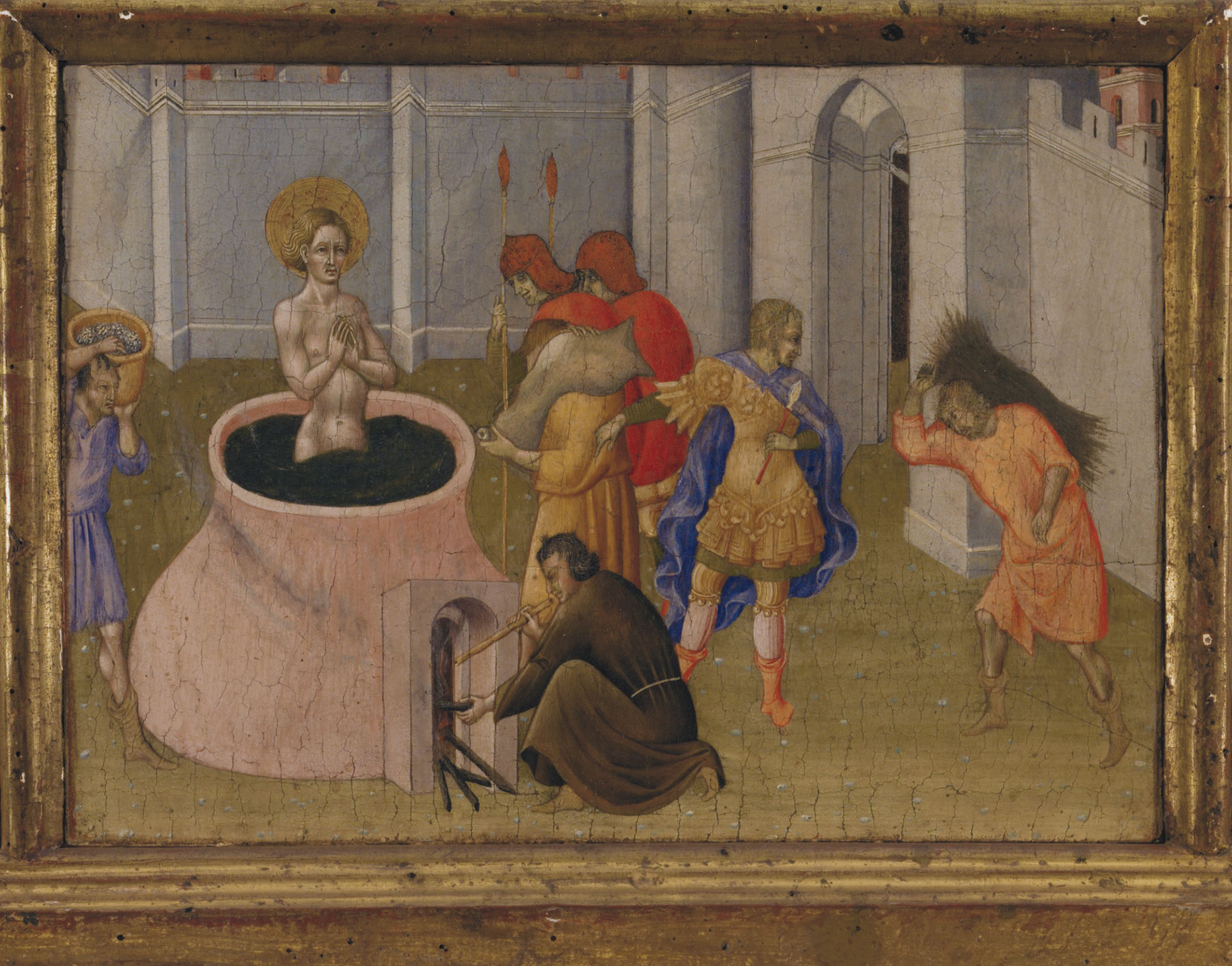
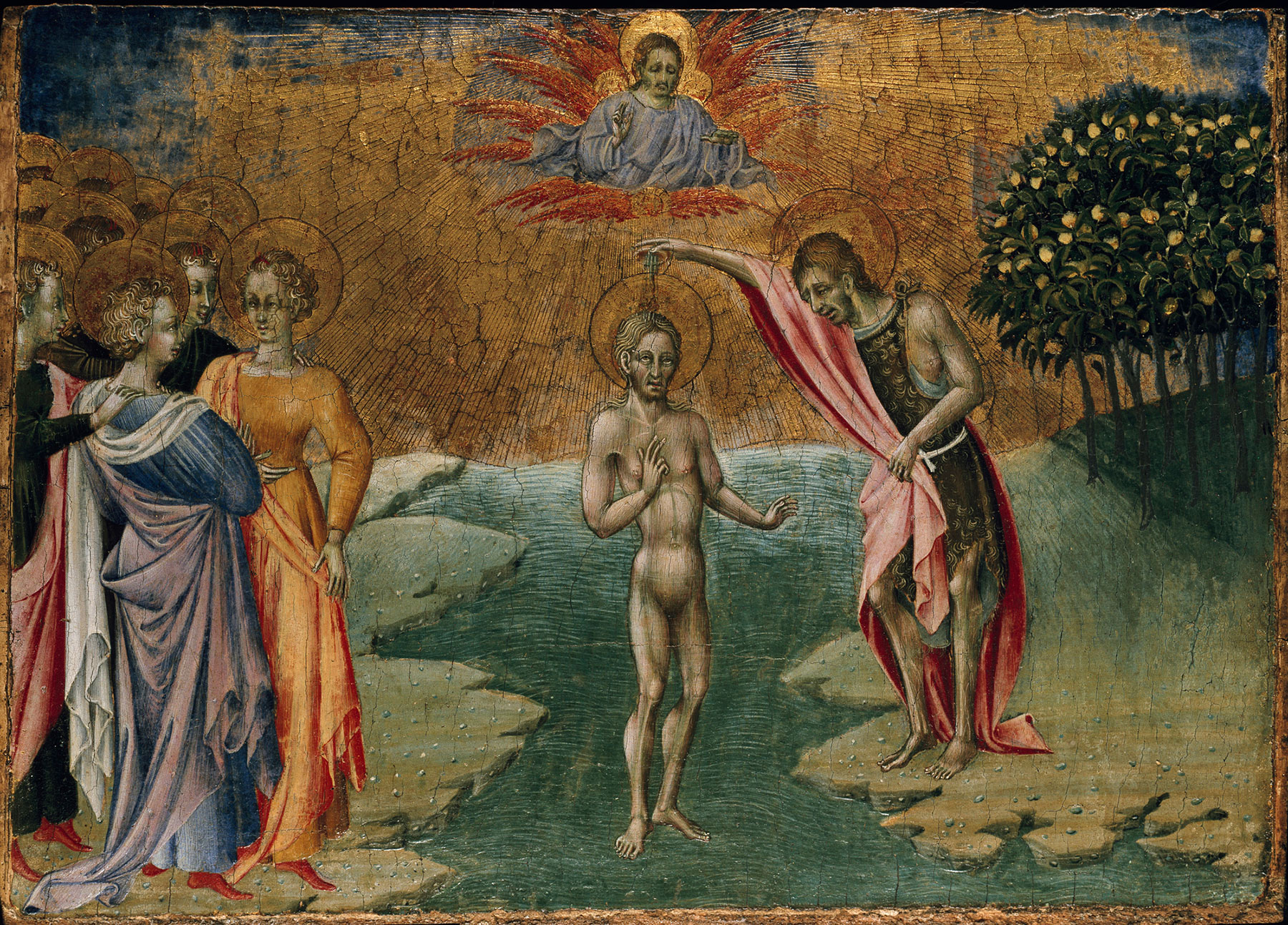
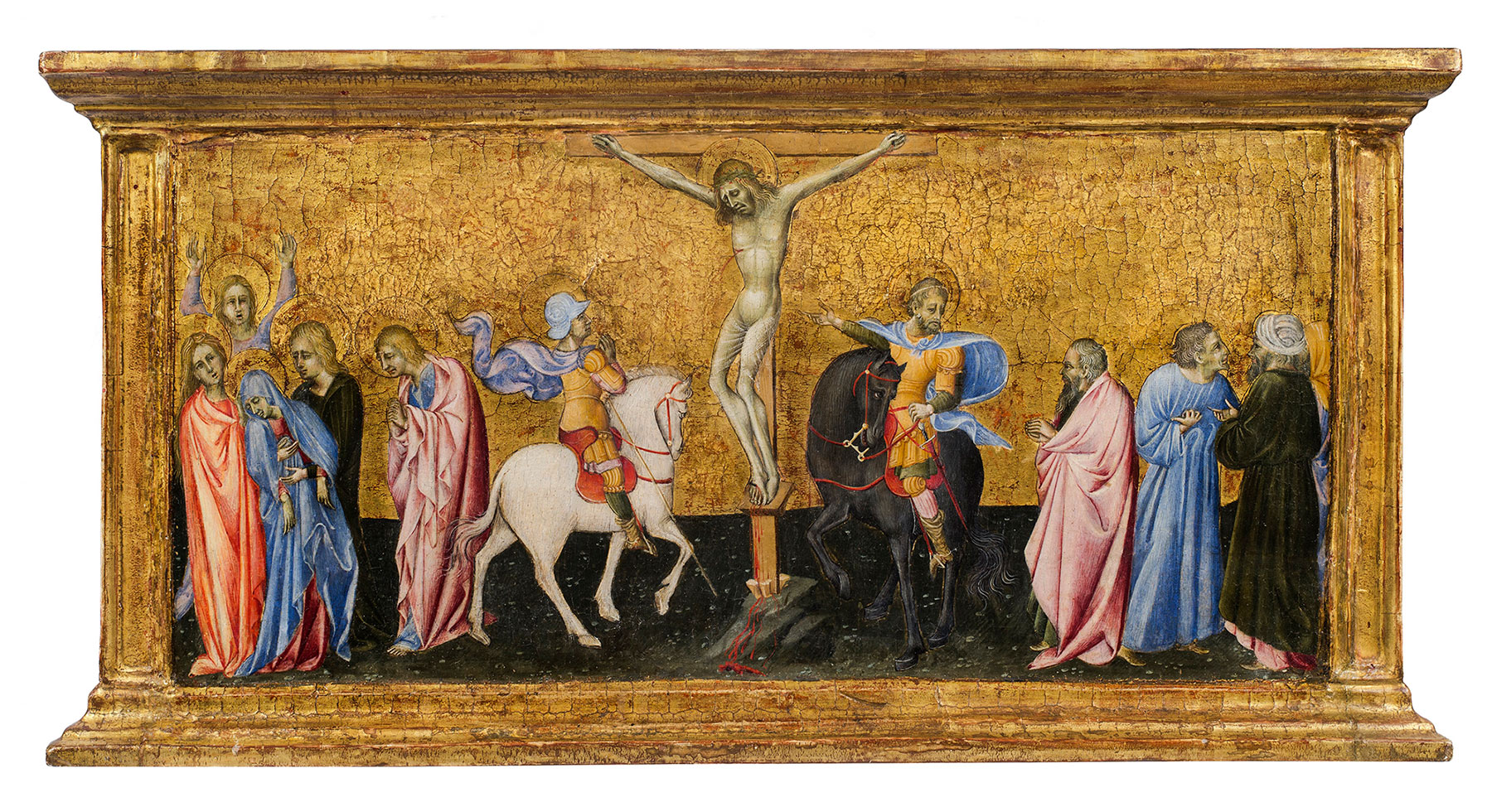
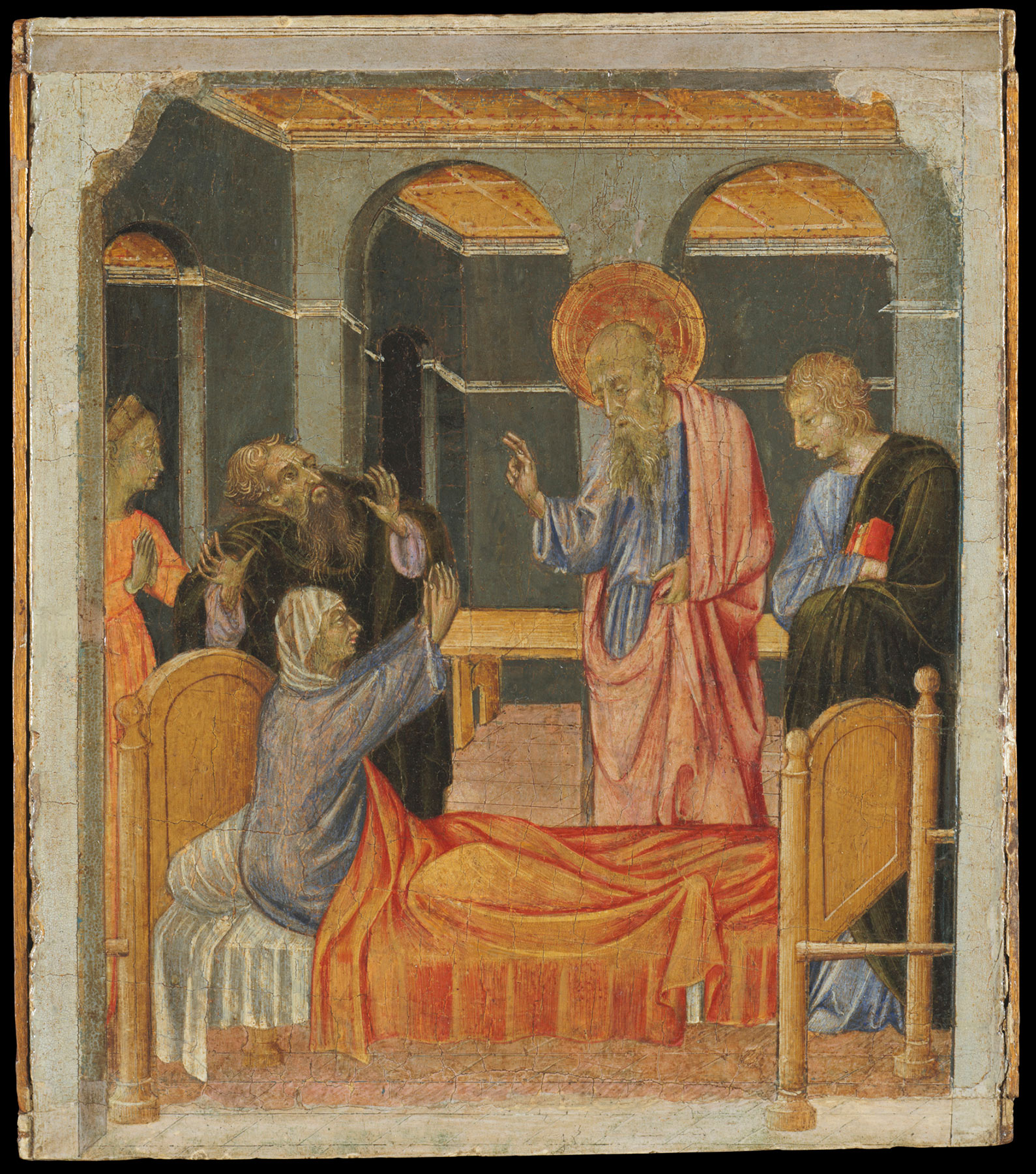
All authors referring to the Annunciation panels, whether addressing the paintings themselves or merely deducing their function from Brogi’s description, presumed them to have been pinnacles removed from the upper tier of the Compagnia degli Artisti altarpiece. In fourteenth- and fifteenth-century altarpieces, pinnacle panels showing the Annunciation are typically divided across the width of the full structure: they are placed—with few exceptions, the Angel on the left and the Virgin on the right—above lateral panels showing standing saints on either side of a larger central panel. When the Yale panels, then in the Alana Collection, were exhibited in Paris in 2019, however, it was noted that they are unprecedentedly large for lateral pinnacles from a conventional altarpiece.12 Close inspection of the carpentry of the panels, not available to earlier authors, indicates that they were designed to be attached either to each other or to another panel standing between them, and they must therefore have formed either a larger central pinnacle from a major monumental altarpiece; part of the main tier of their own, more intimate altarpiece; or parts of an altogether different type of structure. At least two earlier Sienese prototypes exist in which the main tier of an altarpiece comprises an Annunciation spread across two separate panels, one by Andrea di Bartolo in the Museo Civico at Buonconvento13 and one by the Master of Panzano formerly in a private collection,14 both possibly dating to the 1390s or the first decade of the fifteenth century. The outer edges of the Yale Annunciation panels show no evidence of attachment to further panels, however, and it seems unlikely therefore that they appeared in the main register of an altarpiece unless they comprised the entire altarpiece, in which case the four known predella panels must be presumed to have come from a different structure.
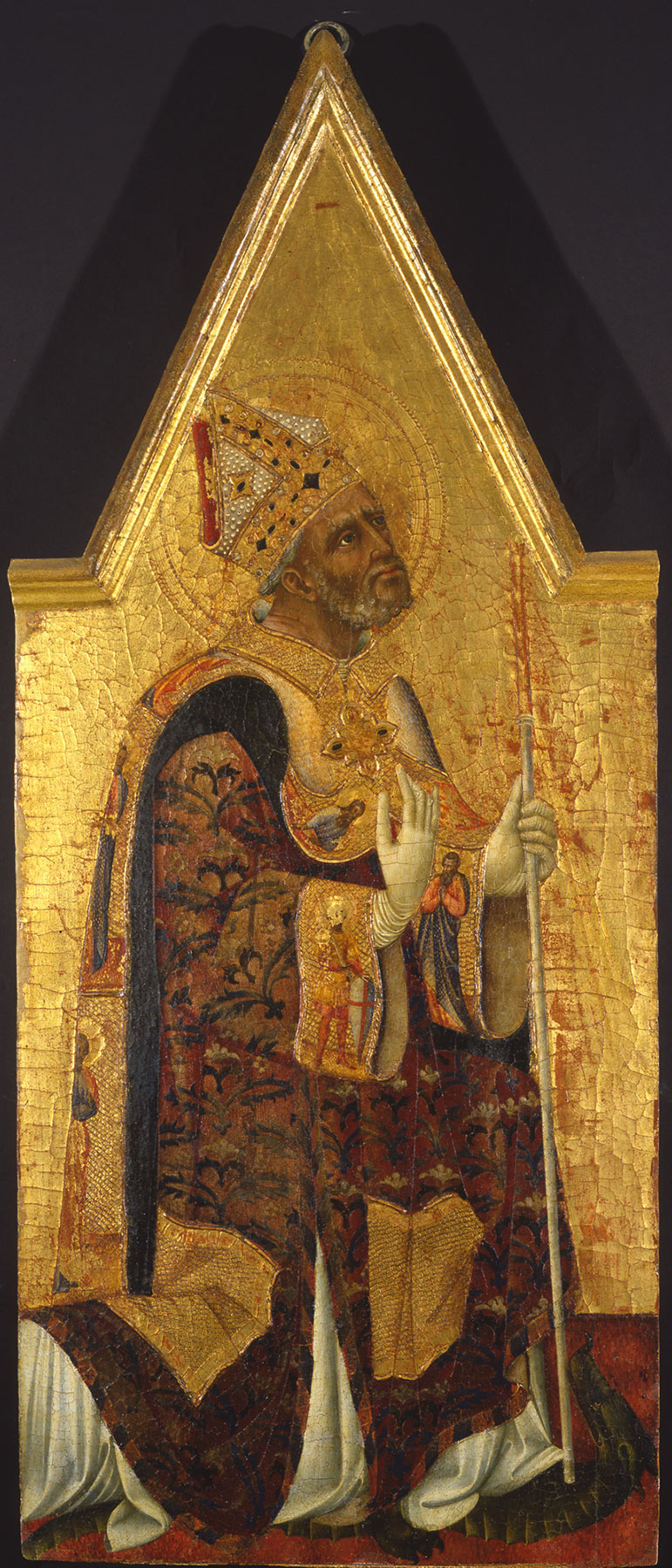
A kneeling Saint Donatus by Giovanni di Paolo in the Pinacoteca Nazionale, Siena (fig. 5), is identical in size and shape to the present Annunciation panels.15 Although recent scholarship assumes that this panel was once a lateral in the main tier of an altarpiece,16 it shows no evidence of dowel holes on either of its sides nor evidence of any other form of attachment to adjacent panels, so the possibility that it may have been a pinnacle panel cannot be discarded lightly.17 The style of the punching in the saint’s halo and the pastiglia decoration of his stole imply a relatively early date for the panel now in Siena, possibly in the 1430s, which means it is unlikely to have come from the same altarpiece as the Yale panels, but their exact correspondence of size and shape implies a template in use by at least one Sienese carpenter’s shop, in turn presupposing a functional demand for panels of this format.
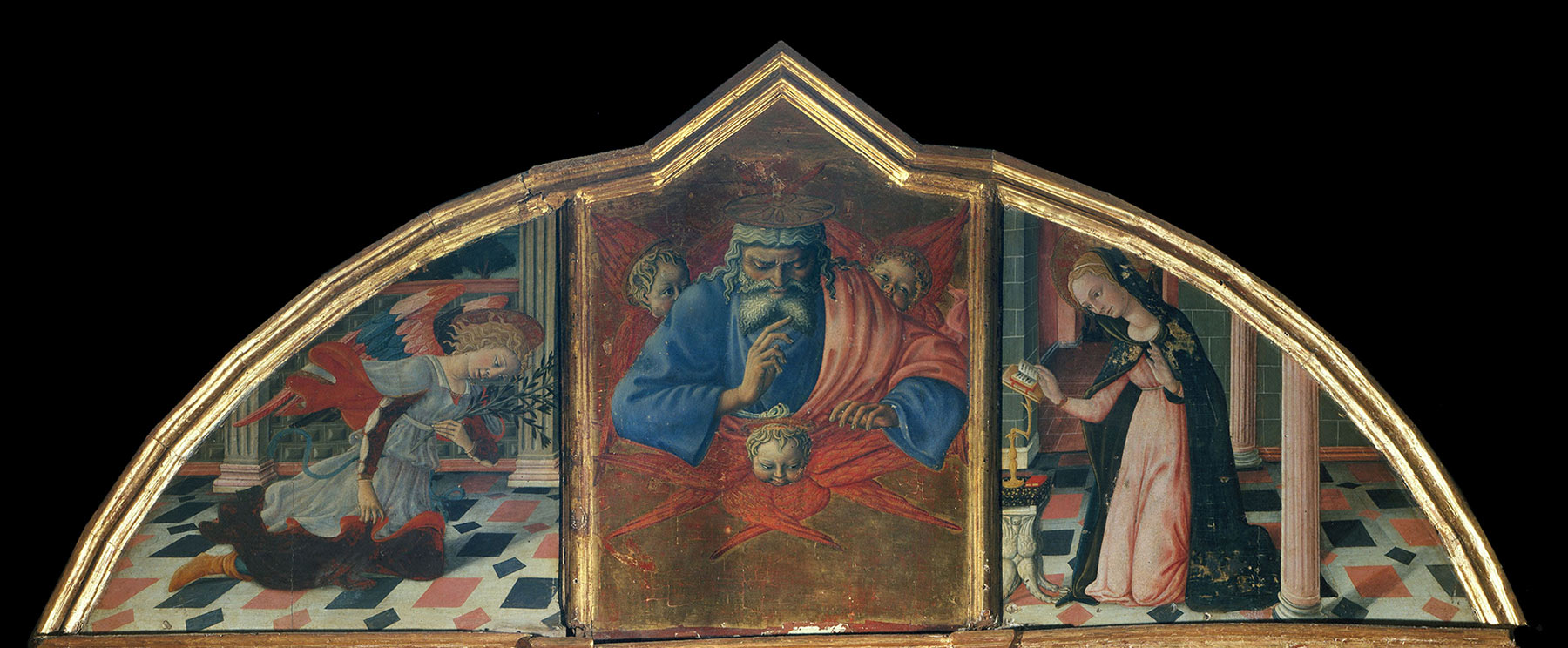
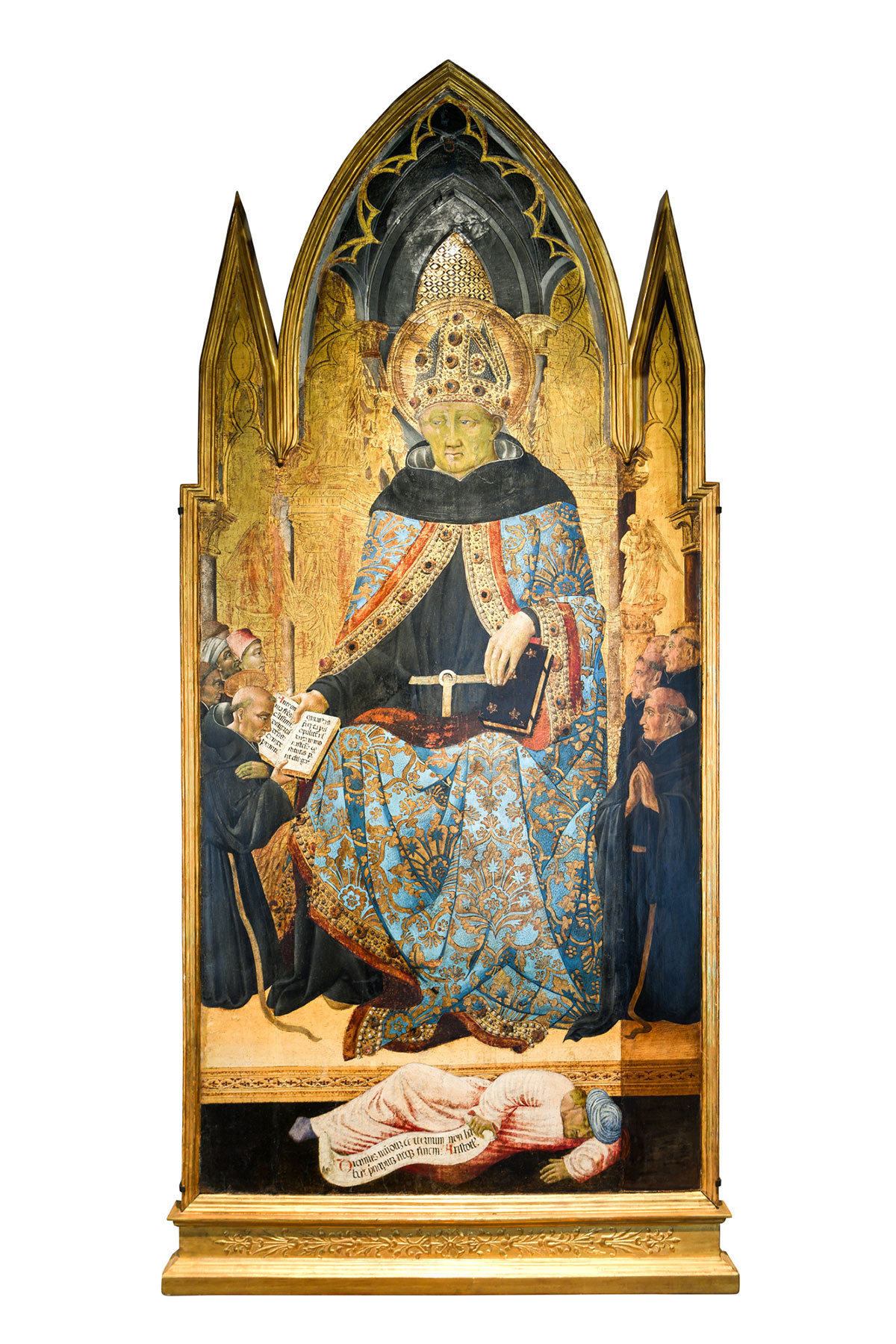
That the format in question may indeed have been intended for the uppermost register of an altarpiece is suggested by the development chronicled by Ludwin Paardekooper of a peculiarly Sienese form of altarpiece pinnacle in which independent panels of the Annunciatory Angel and Virgin Annunciate flank and are attached to a central element, often showing God the Father or a Blessing Redeemer (fig. 6). Leaving aside the debatable notion advanced by Paardekooper of a conscious progression across the last third of the fifteenth century toward a unified lunette-shaped field, this structure seems to be the likeliest explanation of the original appearance of the Annunciation pinnacles now at Yale, with the caveat that no other recorded examples of the type have gabled rather than arced tops. It is necessary to accept the possibility, however, that such gabled structures must once have existed. A Saint Augustine Enthroned by Giovanni di Paolo in the Musée du Petit Palais, Avignon, France (fig. 7), originally the center panel of a large polyptych, parrots such a framing solution at the top.
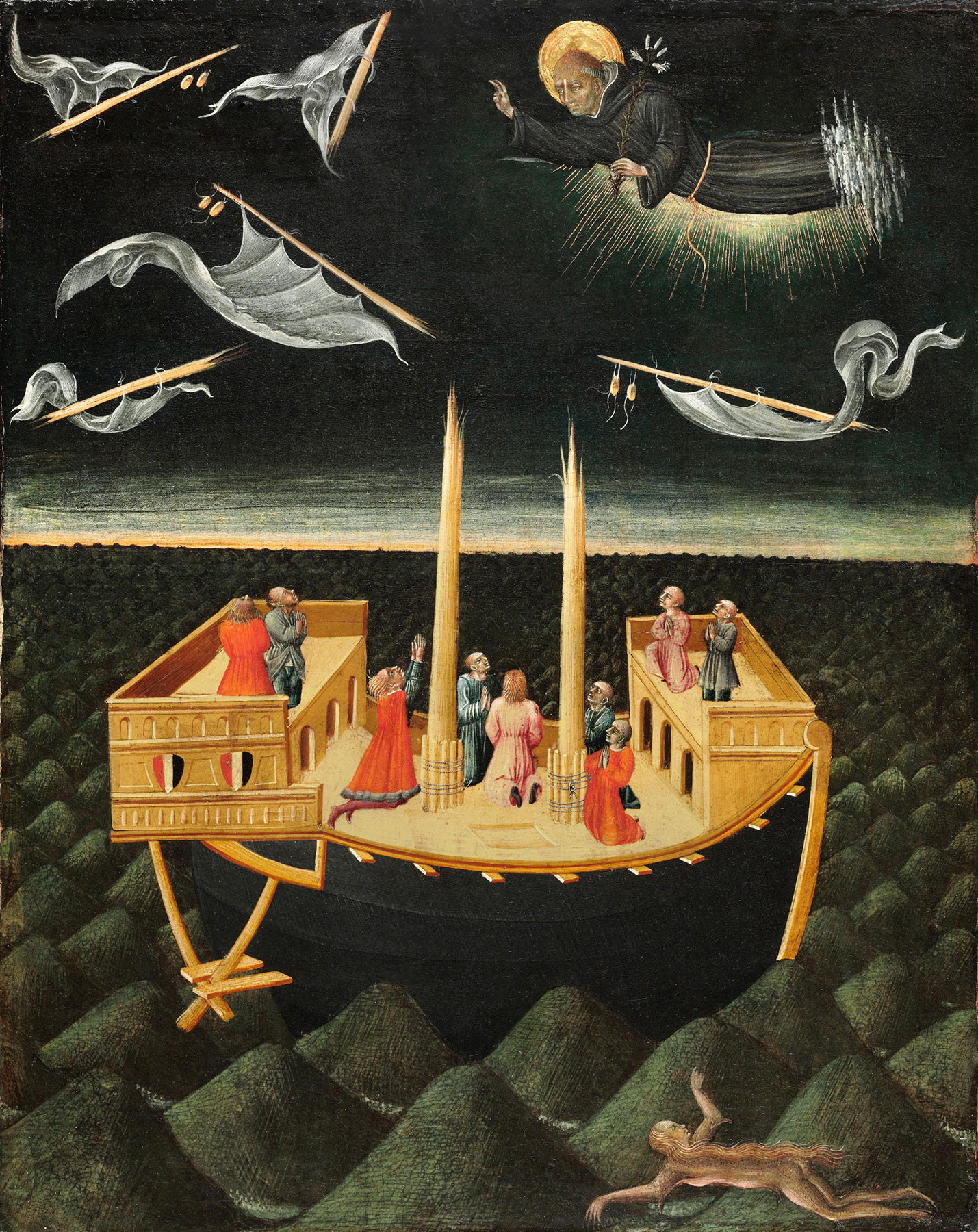
No plausible candidates for any of the panels in the main tier of the Compagnia degli Artisti altarpiece have yet come to light. Strehlke reasonably proposed that the lateral panels must have featured full-length representations of Saints John the Evangelist and John the Baptist, following the iconography of the predella panels and the original dedication of the Silvestrine church in which they were found. He further noted that an earlier Sienese altarpiece painted for the Silvestrine order, comprising panels by Segna di Bonaventura now divided between the Metropolitan Museum of Art18 and the Perkins Collection at the Sacro Convento di San Francesco, Assisi,19 includes figures of both Saints John. It is also not demonstrably certain that the Annunciation pinnacles originate from the same altarpiece as the predella panels, despite having been found together with them in the nineteenth century. The Annunciation panels are almost exactly the same width as another pair of panels by Giovanni di Paolo originating from Montepulciano, showing two miracles of Saint Nicholas of Tolentino, now in Philadelphia (fig. 8) and Vienna (fig. 9). The Philadelphia and Vienna panels have been reconstructed as forming the lateral elements of an altarpiece with a standing image of Saint Nicholas of Tolentino, still in the church of Sant’Agostino at Montepulciano, in its center.20 It is not inconceivable that the Yale Annunciation panels were two of the three crowning elements from this structure.
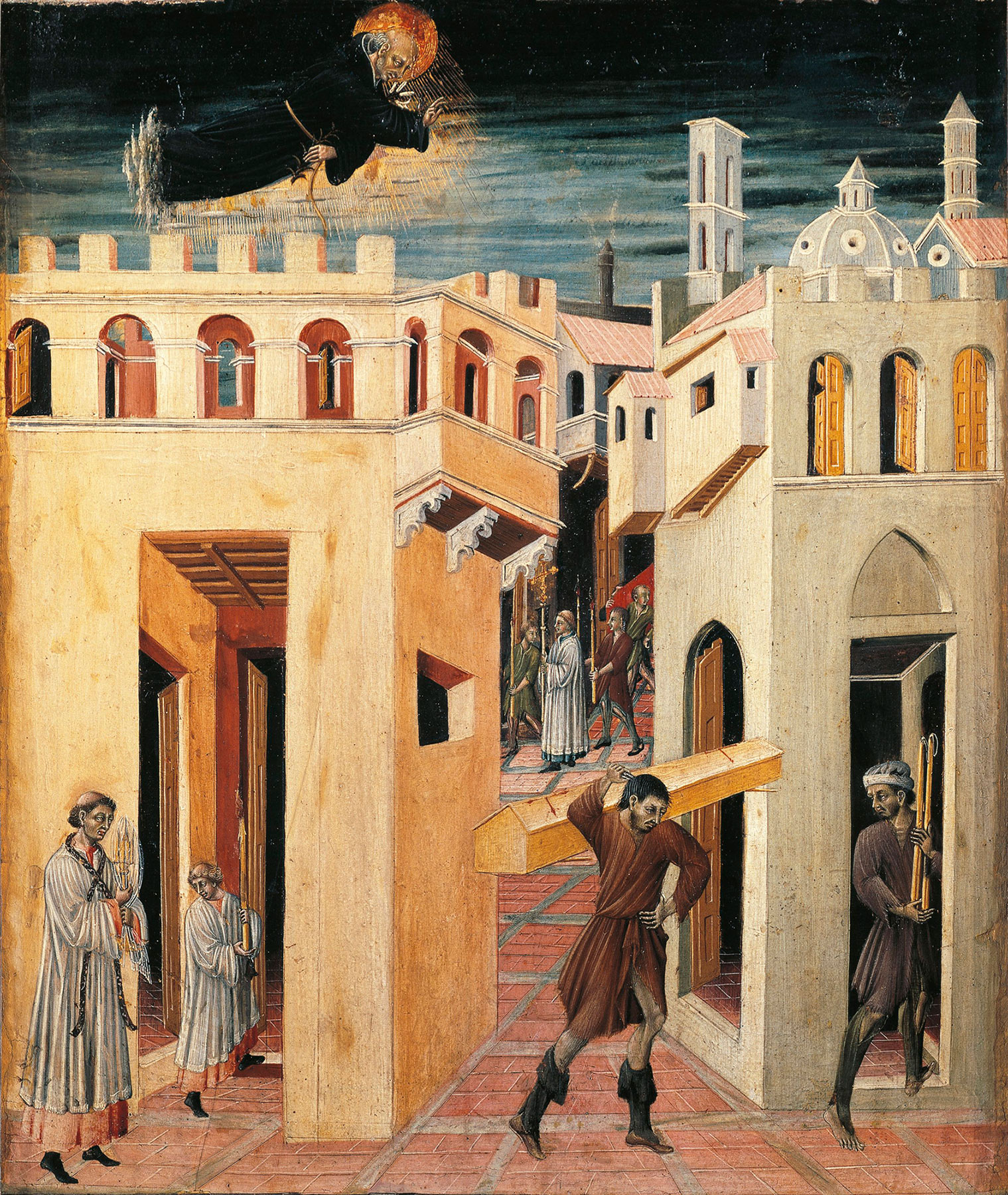
Suggestions for dating the Compagnia degli Artisti predella fragments have consistently gravitated around the decade of the 1450s. In first associating the Attempted Martyrdom of Saint John the Evangelist (see fig. 1) with this group, Pope-Hennessy assigned it a date of 1450–55, relating it to the Saint Nicholas scenes in Philadelphia and Vienna (which he thought could be dated 1453) as evidence of “Giovanni di Paolo’s close observation at this time of ordinary life.”21 Although Brandi rejected this identification, he assigned roughly the same date (“il complesso, già a Montepulciano, va datato a circa il 1449–53” [the complex, formerly in Montepulciano, dates to ca. 1449–53]) to the two panels he believed could be part of the Compagnia degli Artisti group, the Baptism (see fig. 2) and the Crucifixion, both at Oxford.22 When he added the Lehman Saint John the Evangelist Raising Drusiana (see fig. 4) to the predella, Pope-Hennessy revised his dating slightly later, noting that the architectural setting in the Lehman panel recalled that in the Saint Catherine predella of 1461 or later.23 Strehlke noted that the Saint Nicholas of Tolentino altarpiece in the church of Sant’Agostino is dated 1457, and he presumed, therefore, that Giovanni di Paolo was in Montepulciano in that year.24 He suggested a date between 1457 and 1461 for the Compagnia degli Artisti altarpiece, on both circumstantial and stylistic grounds.
All these arguments were advanced without knowledge of the Annunciation panels described by Brogi. When these were first rediscovered and identified by Riedl, he proposed an ambitious reconstruction identifying the Saint Nicholas of Bari polyptych of 1453 in the Pinacoteca Nazionale, Siena, as the main register of the Compagnia degli Artisti altarpiece and, in turn, suggested an original provenance for the complex from the Franciscan church at Montepulciano.25 Presumably, the basis for this proposal lay in the coincidence of date with that of earlier scholarly opinion concerning the predella panels and in the fact that the missing pinnacles of the Saint Nicholas altarpiece seem to have been approximately 45 centimeters wide. Arguing against the reconstruction are the lack of any evidence of a provenance from Montepulciano for the Saint Nicholas of Bari polyptych and the fact that only Franciscan saints—Bernardino, Francis, Clare, and Louis of Toulouse—are portrayed in its lateral panels, whereas two of the predella panels refer to the lives of Saints John the Baptist and John the Evangelist. The central panel of the Saint Nicholas polyptych, furthermore, is approximately 76 centimeters wide, whereas the ex-Heinemann Crucifixion (see fig. 3) measures only 53.7 centimeters in width, and the missing central pinnacle to the altarpiece was, based on the evidence of its frame, the same width as and not attached to the lateral pinnacles. The fact that the present Annunciation panels were conjoined or attached to another panel to form a single central pinnacle rules out the possibility of associating them with the Saint Nicholas polyptych.
Untethering the panels of the Compagnia degli Artisti altarpiece from the dated polyptych of 1453, it is necessary to concur with Pope-Hennessy and Strehlke in noting the greatest stylistic affinities with works known or presumed to have been painted around 1460. Indeed, where the Saint John the Evangelist Raising Drusiana (see fig. 4), which is presumably but not demonstrably part of the Montepulciano suite, clearly recalls the Mystic Marriage of Saint Catherine of Siena now in the Metropolitan Museum of Art,26 datable around 1461, the ex-Heinemann Crucifixion (see fig. 3) is, if anything, later than the Utrecht Crucifixion that formed part of the Saint Catherine series.27 Controversy surrounding the dating of the Saint Catherine panels urges caution in accepting them as a dependable benchmark for discussing other works of art,28 but it must be acknowledged that the figural distortions and broad simplifications of form and palette visible in the Annunciation panels also argue for a slightly later date. Whether they formed part of a structure dated 1457 or of one painted later must remain a matter of speculation. No precisely dated works by Giovanni di Paolo after the Pienza altarpiece of 1463 are known, so calibrating the rate of his development over the last two decades of his career is at best an exercise in inductive reasoning. A date around 1460 is assigned to them here by way of noting their similarity to the figure style within the Saint Nicholas of Tolentino and Pienza altarpieces but not as a specific proposal that they must follow or that they might precede that watershed year. —LK
Published References
Brogi, Francesco. Inventario generale degli oggetti d’arte della provincia di Siena (1862–1865). Siena: Nava, 1897., 305; Pope-Hennessy, John. Giovanni di Paolo, 1403–1483. London: Chatto and Windus, 1937., 178; Brandi, Cesare. Giovanni di Paolo. Florence: Felice Le Monnier, 1947., 79n58; Riedl, Peter Anselm. Eine wiederentdeckte “Verkündigung Mariä” von Giovanni di Paolo. Sitzungsberichte der Heidelberger Akademie der Wissenschaften, Philosphisch-historische Klasse. Heidelberg, Germany: C. Winter, 1986., figs. 1, 4–6, 8; Carl Brandon Strehlke, in Christiansen, Keith, Laurence Kanter, and Carl Brandon Strehlke. Painting in Renaissance Siena, 1420–1500. Exh. cat. New York: Metropolitan Museum of Art, 1988., 210; Rave, August Bernhard. “Die italienische Malerei in der Staatsgalerie Stuttgart: Charakterisierung einer mit Hilfe der Datenverarbeitung erschlossenen Sammlung.” Museumsblatt: Mitteilungen aus der Museumwesen Baden-Württemburg (1992): 44–45., 45; Rettich, Edeltraud, Rüdiger Klapproth, and Gerhard Ewald. Alte Meister, Staatsgalerie Stuttgart. Stuttgart, Germany: Staatsgalerie Stuttgart, 1990., 148–49; Rave, August Bernhard, ed. Frühe italienische Tafelmalerei: Vollständiger Katalog der italienischen Gemälde der Gotik. Stuttgart, Germany: Staatsgalerie Stuttgart, 1999., 105–7; Christopher Daly, in Falciani, Carlo, Carl Brandon Strehlke, and Pierre Curie, eds. Chefs-d’oeuvre de la peinture italienne: La collection Alana. Exh. cat. Paris: Mercator, 2019., 122–23; Raffaele Marrone, in Bagnoli, Alessandro, ed. Il Sassetta e il suo tempo: Uno sguardo sull’arte senese del primo quattrocento. Exh. cat. Florence: Centro Di, 2024., 210
Notes
-
Gallerie degli Uffizi, Florence, inv. nos. 1890 nn. 451–53, https://www.uffizi.it/en/artworks/annunciation-with-st-margaret-and-st-ansanus. ↩︎
-
Brogi, Francesco. Inventario generale degli oggetti d’arte della provincia di Siena (1862–1865). Siena: Nava, 1897., 305. ↩︎
-
Pope-Hennessy, John. Giovanni di Paolo, 1403–1483. London: Chatto and Windus, 1937., 108–9n56. ↩︎
-
Brandi, Cesare. Giovanni di Paolo. Florence: Felice Le Monnier, 1947., 40–41, 78–79n58. ↩︎
-
Lloyd, Christopher. A Catalogue of the Earlier Italian Paintings in the Ashmolean Museum. Oxford: Oxford University Press, 1977., 85, 86n8; and Shaw, James Byam. Paintings by Old Masters at Christ Church, Oxford. London: Phaidon, 1967., 46. Lloyd followed Byam Shaw in believing, mistakenly, that Brogi’s inventory dated from 1897, the year of its publication. The Ashmolean Baptism had been purchased in Siena in 1875 by its eventual donor to the museum, J. R. Anderson. This date might be understood to represent the approximate moment at which all the panels formerly in Montepulciano found their way onto the art market. There is no support for Brandi’s contention that the panels were stolen from the Compagnia degli Artisti and cut down or altered to avoid recognition. ↩︎
-
Shaw, James Byam. Paintings by Old Masters at Christ Church, Oxford. London: Phaidon, 1967., no. 30. ↩︎
-
Byam Shaw (in Shaw, James Byam. Paintings by Old Masters at Christ Church, Oxford. London: Phaidon, 1967., 46) correctly rejected this proposal but for the wrong reasons. The Christ Church panel is earlier in style than the Attempted Martyrdom of Saint John the Evangelist and the Ashmolean Baptism of Christ. Its association with another predella that includes panels at the Metropolitan Museum of Art in New York (inv. no. 1982.60.4, https://www.metmuseum.org
/art ), the Isabella Stewart Gardner Museum in Boston (inv. no. P15W21, https://www.gardnermuseum.org/collection /search /436509 /experience ), and the Harvard University Art Museums in Cambridge (inv. no. 1943.112, https://hvrd.art/o/230462) appears to be correct; see Carl Brandon Strehlke, in Christiansen, Keith, Laurence Kanter, and Carl Brandon Strehlke. Painting in Renaissance Siena, 1420–1500. Exh. cat. New York: Metropolitan Museum of Art, 1988., 208–10. ↩︎/collection /10939 -
In 2002 this painting was in the collection of Claudia Caraballo de Quentin in New York. ↩︎
-
Pope-Hennessy, John, and Laurence Kanter. The Robert Lehman Collection. Vol. 1, Italian Paintings. New York: Metropolitan Museum of Art, 1987., 125–27. ↩︎
-
Strehlke, in Christiansen, Keith, Laurence Kanter, and Carl Brandon Strehlke. Painting in Renaissance Siena, 1420–1500. Exh. cat. New York: Metropolitan Museum of Art, 1988., 208–10. ↩︎
-
Riedl, Peter Anselm. Eine wiederentdeckte “Verkündigung Mariä” von Giovanni di Paolo. Sitzungsberichte der Heidelberger Akademie der Wissenschaften, Philosphisch-historische Klasse. Heidelberg, Germany: C. Winter, 1986., 24. ↩︎
-
Christopher Daly, in Falciani, Carlo, Carl Brandon Strehlke, and Pierre Curie, eds. Chefs-d’oeuvre de la peinture italienne: La collection Alana. Exh. cat. Paris: Mercator, 2019., 112–23, nos. 33–34. ↩︎
-
See Padovani, Serena, and Bruno Santi. Buonconvento: Museo d’arte sacra della Val d’Arbia. Genoa: Sagep, 1981., 23–25, fig. 5. ↩︎
-
See Palladino, Pia. Art and Devotion in Siena after 1350: Luca di Tommè and Niccolò di Buonaccorso. Exh. cat. San Diego: Timken Museum of Art, 1997., 67–68, fig. 71. ↩︎
-
Piero Torriti tentatively identified this figure as Saint Nicholas of Bari; see Torriti, Piero. La Pinacoteca Nazionale di Siena. Vol. 1, I dipinti dal XII al XV secolo. Genoa: Sagep, 1977., 322. The saint kneels on a dragon and must be presumed to represent Donatus. Raffaele Marrone identified the figure as Donatus and noted its identity of size to the ex-Montepulciano Annunciation panels now at Yale; see Marrrone, in Bagnoli, Alessandro, ed. Il Sassetta e il suo tempo: Uno sguardo sull’arte senese del primo quattrocento. Exh. cat. Florence: Centro Di, 2024., 208–11. ↩︎
-
Keith Christiansen supposed this panel, the subject of which he correctly identified as Saint Donatus, to have been a companion to Pinacoteca Nazionale, Siena, no. 215 (see Torriti, Piero. La Pinacoteca Nazionale di Siena. Vol. 1, I dipinti dal XII al XV secolo. Genoa: Sagep, 1977., 308), representing Saint Andrew; see Christiansen, Keith. “Notes on Painting in Renaissance Siena.” Burlington Magazine 132, no. 1044 (March 1990): 205–13., 207n6. The latter has been cropped on all four sides but does seem to portray the saint kneeling and employs the same punch decoration to define his halo. Marrone rejects the association of the Saint Donatus with the Saint Andrew, which he believes came from a different altarpiece datable as much as a decade later; see Marrone, in Bagnoli, Alessandro, ed. Il Sassetta e il suo tempo: Uno sguardo sull’arte senese del primo quattrocento. Exh. cat. Florence: Centro Di, 2024., 208–15. Of these two proposals, Christiansen’s seems the more likely to be correct. Both Marrone and Christiansen believed that the Saint Donatus and Saint Andrew were altarpiece laterals, not pinnacles, on the analogy of two panels by Sano di Pietro then recently discovered, representing kneeling figures of Saints Ansanus and Francis. Andrea De Marchi posited an altarpiece reconstruction in which these latter appear as pinnacles, not laterals; see De Marchi, in Seidel, Max, Francesco Caglioti, Elian Carrara, et al., eds. Le arti a Siena nel primo Rinascimento: Da Jacopo della Quercia a Donatello. Exh. cat. Milan: Federico Motta, 2010., 272–75. ↩︎
-
Paardekooper, Ludwin. “Matteo di Giovanni e la tavola centinata.” In Matteo di Giovanni e la pala d’altare nel senese e nell’aretino, 1450–1500, atti del Convegno Internazionale di Studi, Sansepolcro, 9–10 ottobre 1998, ed. Davide Gasparotto and Serena Magnani, 19–48. Montepulciano: Le balze, 2002., 19–48. ↩︎
-
Inv. nos. 24.79a–c, 41.100.22, https://www.metmuseum.org/art/collection/search/437650, https://www.metmuseum.org/art/collection/search/442749, https://www.metmuseum.org/art/collection/search/442750, https://www.metmuseum.org/art/collection/search/437651. ↩︎
-
See Zeri, Federico. La collezione Federico Mason Perkins. Turin: Umberto Allemandi, 1988., 42–45, no. 12. ↩︎
-
Strehlke, Carl Brandon. Italian Paintings, 1250–1450, in the John G. Johnson Collection and the Philadelphia Museum of Art. Philadelphia: Philadelphia Museum of Art, 2004., 180, fig. 33.3. ↩︎
-
Pope-Hennessy, John. Giovanni di Paolo, 1403–1483. London: Chatto and Windus, 1937., 78. ↩︎
-
Brandi, Cesare. Giovanni di Paolo. Florence: Felice Le Monnier, 1947., 79n58. ↩︎
-
Pope-Hennessy, John, and Laurence Kanter. The Robert Lehman Collection. Vol. 1, Italian Paintings. New York: Metropolitan Museum of Art, 1987., 127. ↩︎
-
Strehlke, in Christiansen, Keith, Laurence Kanter, and Carl Brandon Strehlke. Painting in Renaissance Siena, 1420–1500. Exh. cat. New York: Metropolitan Museum of Art, 1988., 208–10. ↩︎
-
Inv. no. 173; Riedl, Peter Anselm. Eine wiederentdeckte “Verkündigung Mariä” von Giovanni di Paolo. Sitzungsberichte der Heidelberger Akademie der Wissenschaften, Philosphisch-historische Klasse. Heidelberg, Germany: C. Winter, 1986., esp. 27–32. ↩︎
-
Inv. no. 1997.117.2, https://www.metmuseum.org/art/collection/search/438021. ↩︎
-
This Crucifixion belongs to the Rijksmuseum Het Catharijneconvent, Utrecht, Netherlands, and is on deposit at the Rijksmuseum, Amsterdam, inv. no. SK-C-1596, https://id.rijksmuseum.nl/200109302. ↩︎
-
See Strehlke (in Christiansen, Keith, Laurence Kanter, and Carl Brandon Strehlke. Painting in Renaissance Siena, 1420–1500. Exh. cat. New York: Metropolitan Museum of Art, 1988., 218–42) for a thorough summary of the debate surrounding the date of the Saint Catherine of Siena series. The main panel of the altarpiece to which the Saint Catherine scenes were described in the eighteenth century as having been attached—the Purification of the Virgin in the Pinacoteca Nazionale, Siena, inv. no. 211—was painted between 1447 and 1449 for the altar of the guild of spice merchants (Pizzicaiuoli) in the hospital church of Santa Maria della Scala. Saint Catherine, however, was canonized only in 1461, and many scholars maintain either that the predella panels were added to the structure at that date or later, or that they derive from a different complex altogether and were aggregated to the Pizzicaiuoli altarpiece only after it was removed from Santa Maria della Scala. To this writer, the central panel of the predella, the Utrecht Crucifixion, looks like it may be a work of ca. 1449, whereas the ten scenes from the legend of Saint Catherine are incontestably works of the early 1460s. ↩︎