Probably Stefano Bardini (1836–1922), Florence; Ugo Bardini (1892–1965), Florence; Maitland Fuller Griggs (1872–1943), New York, 1926
The fresco, with a 2-centimeter-thick mural substrate (including new plaster reinforcement), has been mounted on a wooden lattice and enclosed in a sixteenth- or seventeenth-century gilt molding. Repainted losses varying in width from 3 to 6 centimeters occur across the full length of the top of the composition, with smaller losses scattered irregularly along the right and bottom edges. The left edge of the composition is largely intact. Small local losses have been inpainted in the central figure and along cracks in the surface near the bottom edge. The deep shadows in the cloak of the armored figure at the right are reinforced. The surface is otherwise well preserved, although at present covered by a discolored coating of varnish.
Although this fresco fragment has been in the collection of the Yale University Art Gallery a full century, it has very seldom been published and never with an attribution directly to Giovanni di Paolo. Without mentioning an artist’s name, Maitland Griggs wrote to George Langzettel at the Yale School of the Fine Arts in December 1926 that the painting would shortly be released from customs, where it had been “for some time,” and that it should be stored, not exhibited, at the Gallery when it arrived there, which it did the following January.1 In 1935 Griggs wrote to Charles Nagel, Jr., at the Gallery, explaining that he had purchased it from the Bardini collection, again without mentioning an artist’s name or whether it had been sold to him with any particular attribution.2 Lane Faison was the most generous in his appreciation of the fresco. He described it as proximate to the style of Giovanni di Paolo, noting that “the late manner of Giovanni . . . is singularly unattractive in its deformations of the human body; to it our fresco bears strong resemblance.” He then expatiated, however, on the lack of individuality within the medieval workshop tradition that “lingered long in Siena. . . . The student of today can do little more than identify the orbit of a great personality.”3 Edward King, in a letter to Faison from December 1935, stated that the fresco “seems to me quite doubtful as an honest-to-goodness Giovanni di Paolo . . . the drawing is sadly off from his better work.”4 John Pope-Hennessy, who may have known the fresco only from Faison’s reproduction and description of it, said nothing more specific than that it was contemporary (i.e., fifteenth-century) Sienese,5 an opinion seconded by Everett Fahy.6 Cesare Brandi reproduced the fresco in his monograph on Giovanni di Paolo but mentioned it in the context of his discussion of Pellegrino di Mariano and Jacomo del Pisano as by “another follower” of the master. He also mistakenly believed it was part of the Jarves Collection.7 Charles Seymour, Jr., catalogued the painting as by the shop of Giovanni di Paolo, specifying in his brief entry that “it is possible that the follower of Giovanni di Paolo who was responsible for the fragment at Yale was the chief assistant in the artist’s last period (ca. 1462–82), Giacomo del Pisano, still a somewhat shadowy personality.”8 Burton Fredericksen and Federico Zeri listed the painting as “Studio of Giovanni di Paolo.”9 It is omitted from all editions of Bernard Berenson’s lists. Creighton Gilbert christened it a work by Pellegrino di Mariano;10 this attribution was never published, although it served as the Gallery’s official designation for the fresco for two decades.
The relative lack of attention paid to this fresco in scholarly publications is attributable both to a falling off of interest in Giovanni di Paolo and in fifteenth-century Sienese painting in general after the Second World War and to the tenacious belief that the work must date from the late career of the artist and was not executed by him personally. Neither of these last two contentions is demonstrable nor indeed accurate. Giovanni di Paolo’s prolific output over the more than sixty-year span of his activity is remarkably consistent in technique and vision, arguing that he did not operate a large studio on the Florentine model, where successful artists required an equipe of well-trained assistants to meet the larger commercial expectations of studio production and the physical demands of fresco commissions. Sienese painters were commissioned to work in fresco far more rarely than their Florentine counterparts. Giovanni di Paolo painted only two frescoes so far as is known, both of which are monochrome: one of these is the Yale fragment and the other is a scene of the Crucifixion in the former Augustinian Eremo di San Salvatore at Lecceto. His commercial output, of which the Griggs Virgin and Child with Saints Bartholomew and Jerome is an excellent example, was relatively small, and the range of handling and style throughout those works and across the many panels of his numerous altarpiece polyptychs is notably uniform. It is probable that he used assistants only, if at all, for mechanical tasks, such as grinding pigments or preparing panel surfaces. Furthermore, while it is possible that Pellegrino di Mariano might have received his initial training as a journeyman working with Giovanni di Paolo, it is fallacious to view him as an imitator or divulgator of the latter’s style.11 It is also scarcely credible to imagine the existence of an independent painter named Jacomo or Giacomo del Pisano, who might have enjoyed a brief career faithfully imitating the most eccentric figural exaggerations of Giovanni di Paolo’s last style. Not only is “Jacomo del Pisano” a linguistic anomaly—“Jacomo” is the Venetian form of the Tuscan “Jacopo,” and “del Pisano” is a meaningless construction—but also the purported basis for his identification is the signature on an altarpiece triptych representing the Virgin and Child with Saints Peter and Mary Magdalen,12 which is clearly an autograph late work by Giovanni di Paolo. The signature on this painting is damaged and although the restoration has carefully and conscientiously respected what remains of the original, it is possible that it may have been intended to read “Iohannes dal Poggio,” a form of Giovanni di Paolo’s signature—he was resident in the district of the Poggio Malavolti in Siena—occasionally encountered on earlier altarpieces.
The Yale fresco, which is essentially a large brush drawing, displays all the bravura control of its materials and sensitivity to nuances of tone that are hallmarks of Giovanni di Paolo’s paintings throughout his career. There is no reason to doubt its autograph status. The “unattractive deformations of the human body” that led Faison to suppose it to have been painted after 1460 and that induced King and others to reject it as a work by the artist’s own hand must be understood as anachronistic appraisals inappropriately measuring the artist by the classicizing ideals in vogue in the 1930s. Similar liberties in anatomical proportions appear already in some of Giovanni di Paolo’s earliest narrative paintings; they are personal quirks rather than insufficiencies of quality or evidence of physical decline in old age. Nothing comparable to the svelte and youthful profiles of the five women clustered in the middle ground of the fresco at its center appears in any of Giovanni di Paolo’s late works, which are populated by monumental if stocky, craggy figures of highly expressionistic ruggedness. Nor are the smooth features of the king and the emperor(?) at the right at all like the angular, outsize heads of the male saints in Giovanni di Paolo’s late altarpieces. Analogous types to these and to the young peasant(?) at the left of the composition are encountered instead, on a much smaller scale, in the background figures of the Branchini predella of 1427 in the Pinacoteca Nazionale, Siena;13 in the predella panel of the Presentation in the Temple of ca. 1435 in the Metropolitan Museum of Art, New York (fig. 1); and, above all, in the two predella panels (location unknown) with scenes from the legend of an unidentified Franciscan saint—one showing the saint levitating before a crucifix and the other, particularly close to the Yale fresco, showing Saint James leading a group of pilgrims to his refuge (fig. 2)—probably painted in the early 1430s.
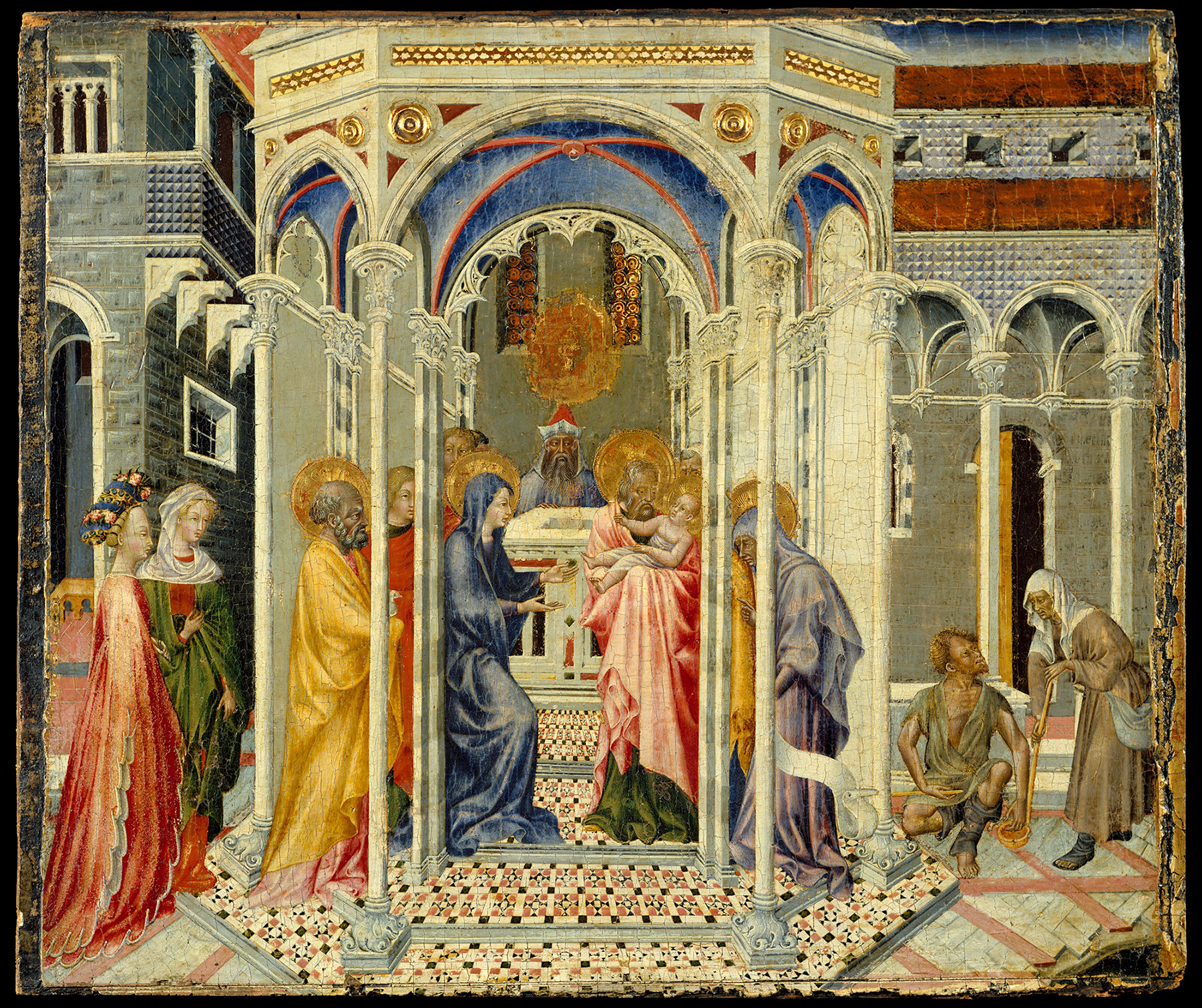
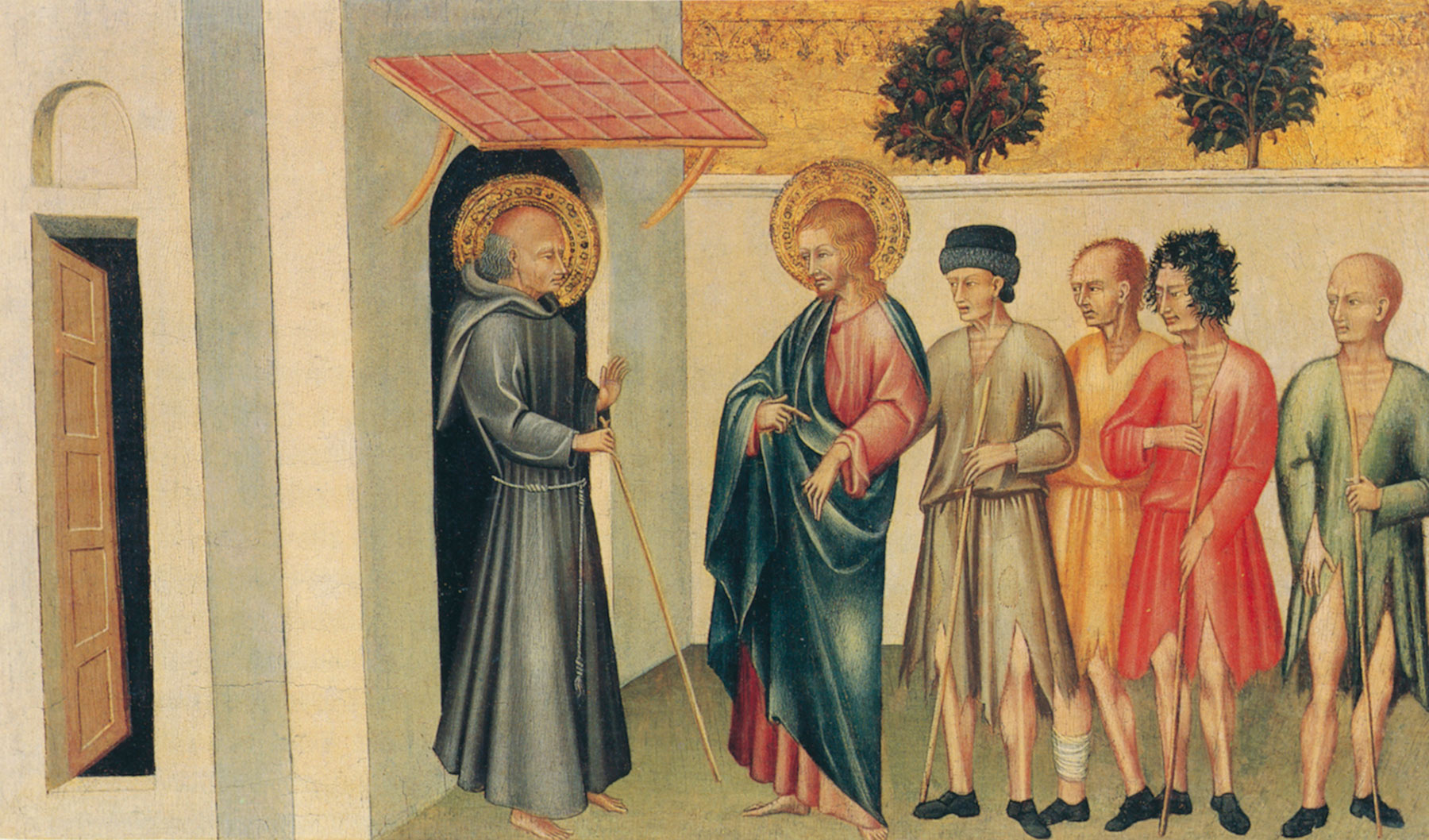
Proposals to identify the subject of the Yale fresco fragment have been inconclusive. Only one figure in the composition is identified by inscription: Artemisia, the second head from the left, whose name is written across her breast. The reference could be either to Artemisia I, queen of Caria, a commander of five ships in the navy of Xerxes at the battle of Salamis, or to Artemisia II, also queen of Caria but two centuries later, ascending to the throne following the death of her husband, King Mausolus. Both Artemisias were warrior queens, but the latter was adduced by Saint Jerome as an exemplar of virtuous marriage, ignoring the fact that her marriage was incestuous: Mausolus and Artemisia were also brother and sister.14 Artemisia figured as an emblem of love thwarted by death in Petrarch’s Triumph of Love, leading Faison to suggest that the Yale fresco might be part of an illustration to that epic poem. Artemisia is named there (chap. 3, vv. 71–74) in the company of Procris and Deidamia, all three mourning the loss of their beloved husbands: Mausolus, Cephalus, and Achilles, respectively.15 Faison understood the king standing in front of Artemisia to represent Mausolus, but while the armored figure at the right might be Achilles, it is difficult to see how the meanly dressed figure at the left, carrying stones or fruit in a fold of his rough garment, could be the hunter Cephalus. If this were a fragmentary illustration of Petrarch’s text but not with a literal or linear correspondence to a particular verse, the figure at the left might represent the shepherd Paris or the biblical king David as a young man, while the figure at the far right could be any of the Roman generals or emperors or Greek warriors mentioned elsewhere in the poem. Such an identification, however, is predicated on the assumption that Artemisia is key to deciphering the fresco’s meaning, as opposed to being accidentally the only figure preserved with an inscription; it is not unreasonable to assume that the others were once identified by similar inscriptions beneath their feet, lost when the fresco was truncated. It also does not account for the rays of light emanating downward from the upper edge of the composition, presumably from allegorical figures similar to those flying above the main figures in Ambrogio Lorenzetti’s frescoes of Good and Bad Government in the Palazzo Pubblico, Siena.
Erwin Panofsky, in a letter to Faison dated May 2, 1936,16 suggested the possibility that the figure at the left of the Yale fresco might be Theseus, based on the appearance in the Florentine Picture-Chronicle of that hero outside the labyrinth in Crete with an apron full of spools of thread. The Picture-Chronicle, however, shows Theseus fully armored; the spools of thread are held by Medea in an apron, not by Theseus.17 Gilbert supposed the fresco represented the Clemency of Scipio, arguing that the inscription identifying Artemisia was apocryphal.18 There is no evidence to support this contention, nor do any of the other figures present in this scene relate to the legend of Scipio Africanus. The argument also presumes that the scene in the fresco is self-contained and complete, or nearly so. Again, the rays of light entering the scene from the top, fragments of another figure barely visible over the shoulder of the soldier/emperor at the right, and the narrative gesture of the king in the center imply that this is not so. Pia Palladino has suggested that the subject of the fresco might relate to Saint Jerome’s text Contra Jovinianus and be intended as a moral exhortation to a community of female tertiaries.19 It is impossible to confirm this (or any other) proposal without the fortuitous recovery of further fragments, but it does at least have the virtue of implying a context in which such a commission might have been given to Giovanni di Paolo. Petrarchan subjects are not uncommon on painted cassone fronts of the fifteenth century, but they are otherwise unknown in large-scale grisaille frescoes in Siena in that period. —LK
Published References
Faison, S. L., Jr. “A Fifteenth-Century Italian Fresco.” Bulletin of the Associates in Fine Arts at Yale University 7, no. 1 (February 1936): 11–13. , 11–13; Pope-Hennessy, John. Giovanni di Paolo, 1403–1483. London: Chatto and Windus, 1937., 157; Brandi, Cesare. Giovanni di Paolo. Florence: Felice Le Monnier, 1947., 92n82, fig. 91; Seymour, Charles, Jr. Early Italian Paintings in the Yale University Art Gallery. New Haven: Yale University Art Gallery, 1970., 198–99, 319, no. 149; Fredericksen, Burton B., and Federico Zeri. Census of Pre-Nineteenth-Century Italian Paintings in North American Public Collections. Cambridge, Mass.: Harvard University Press, 1972., 90, 600; Vertova, Luisa. “The New Yale Catalogue.” Burlington Magazine 115 (March 1973): 159–61, 163., 160
Notes
-
Maitland Griggs, letter to George Langzettel, December 14, 1926, Yale University Art Gallery Archives. ↩︎
-
Maitland Griggs, letter to Charles Nagel, Jr., November 26, 1935, Yale University Art Gallery Archives. ↩︎
-
Faison, S. L., Jr. “A Fifteenth-Century Italian Fresco.” Bulletin of the Associates in Fine Arts at Yale University 7, no. 1 (February 1936): 11–13. , 11–13. ↩︎
-
Edward King, letter to Lane Faison, December 14, 1935, Yale University Art Gallery Archives. ↩︎
-
Pope-Hennessy, John. Giovanni di Paolo, 1403–1483. London: Chatto and Windus, 1937., 157. ↩︎
-
Evert Fahy, undated opinion, Yale University Art Gallery Archives. ↩︎
-
Brandi, Cesare. Giovanni di Paolo. Florence: Felice Le Monnier, 1947., 92n82. ↩︎
-
Seymour, Charles, Jr. Early Italian Paintings in the Yale University Art Gallery. New Haven: Yale University Art Gallery, 1970., 199. ↩︎
-
Fredericksen, Burton B., and Federico Zeri. Census of Pre-Nineteenth-Century Italian Paintings in North American Public Collections. Cambridge, Mass.: Harvard University Press, 1972., 90, 600. ↩︎
-
Creighton Gilbert, 1984, curatorial files, Department of European Art, Yale University Art Gallery. ↩︎
-
See Sallay, Dora. “Pellegrino di Mariano di Jacopo.” In Dizionario biografico degli Italiani. Rome: Istituto della Enciclopedia italiana, 2015. https://www.treccani.it/enciclopedia/pellegrino-di-mariano-di-jacopo (Dizionario-Biografico)/.. ↩︎
-
National Gallery of Ireland, Dublin, inv. no. NGI.1202, http://onlinecollection.nationalgallery.ie/objects/2340/. ↩︎
-
Inv. nos. 174–76. ↩︎
-
Contra Jovinianus, chap. 44: “Artemisia, also, wife of Mausolus, is related to have been distinguished for chastity. Though she was queen of Caria and is extolled by great poets and historians, no higher praise is bestowed upon her than that when her husband was dead she loved him as much as when he was alive, and built a tomb so great that even to the present day all costly sepulchres are called after his name, mausoleums” (emphasis in the original); translation from “St. Jerome—Chastity among Pagan Women,” Harvard’s Geoffrey Chaucer Website, https://chaucer.fas.harvard.edu/pages/st-jeromes-chastity-among-pagan-women. ↩︎
-
Faison, S. L., Jr. “A Fifteenth-Century Italian Fresco.” Bulletin of the Associates in Fine Arts at Yale University 7, no. 1 (February 1936): 11–13. , 11–13. ↩︎
-
Erwin Panofsky, letter to Lane Faison, May 2, 1936, Yale University Art Gallery Archives. ↩︎
-
Colvin, Sidney. A Florentine Picture-Chronicle, Being a Series of Ninety-Nine Drawings Representing Scenes and Personages of Ancient History, Sacred and Profane by Maso Finiguerra. London: Bernard Quaritch, 1898., 218, fig. 83 (engraving); compare with pl. 46, the preparatory drawing in the British Museum, London, that omits the figure of Medea. ↩︎
-
Gilbert, curatorial files. ↩︎
-
Verbal communication with the author, 2025. ↩︎