James Jackson Jarves (1818–1888), Florence, by 1859
The panel support, of a horizontal wood grain, retains its full original thickness of 2.4 centimeters. An old but probably not original vertical batten, 7 centimeters wide, has been dovetailed into the thickness of the panel on the back, approximately on center. The present bottom edge of the panel may be original, but the other three have been cut. A butterfly join closes a split on the reverse, 7 centimeters from the top and 14.5 centimeters from the left edges. The back is painted brown with an inventory number, “416,” painted in blue and another, “L15,” in red. The paint surface has been heavily abraded. Total losses along the left and top edges, along a partial split 11.5 centimeters from the bottom at the left edge, and through a 2-centimeter-wide strip across the full length of the panel at the bottom, exposing gesso and wood, are unretouched. The panel was cleaned by Andrew Petryn in 1960.
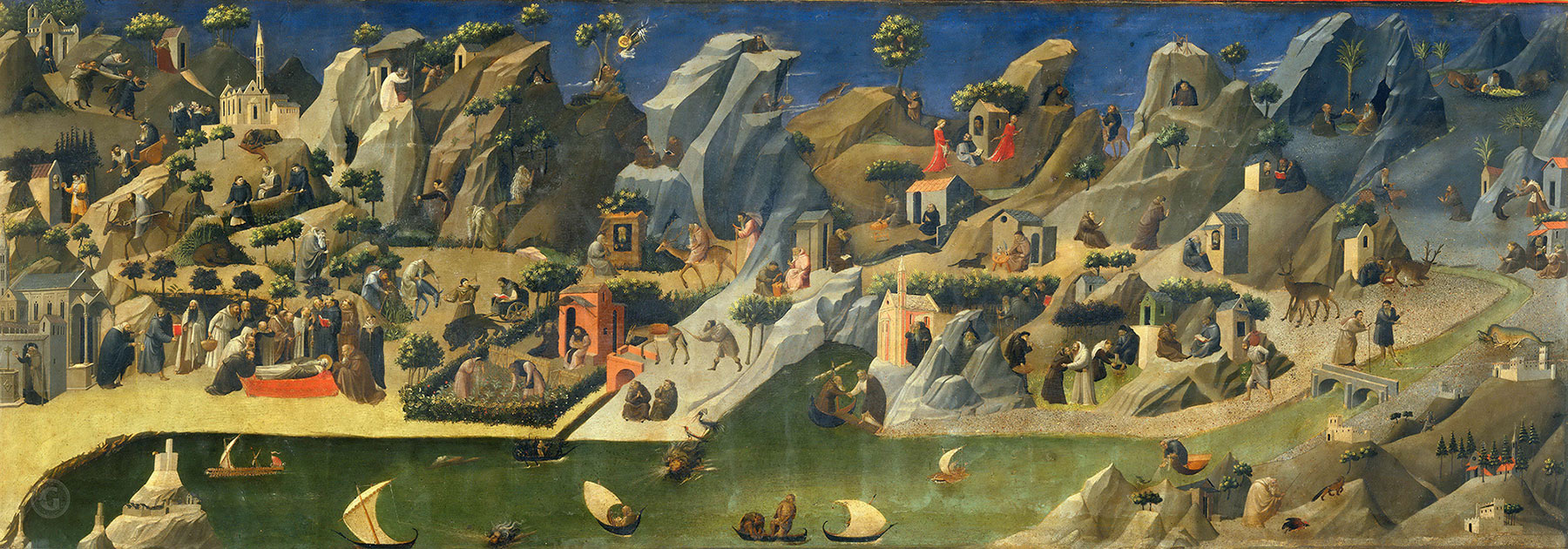
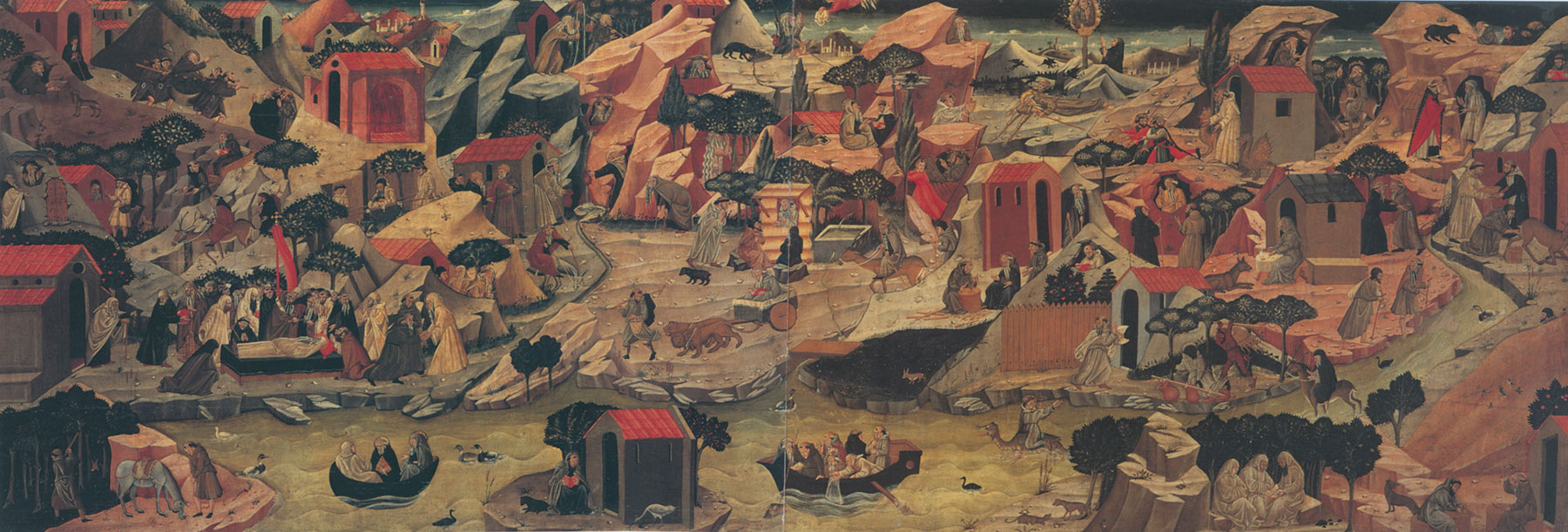
The religious revivals that swept across Europe in the fourteenth century and the reforms undertaken in various monastic communities to reassert the ascetic ideal resulted in the sudden emergence of a new, peculiarly Tuscan iconographic theme in both panel painting and fresco, intended to celebrate the life and experiences of the early Desert Fathers.1 Called Thebaids by modern art historians—who derived the term from literary allusions to the Egyptian desert near Thebes—but generally referred to as “Stories of the Holy Fathers” or “Stories of the Anchorites” by contemporary sources,2 these images illustrate the colorful tales of the first hermits as transmitted by early Greek writers such as Saint Athanasius, Saint Jerome, and Palladius. Around 1333 or earlier, this body of works, known collectively from the Latin edition as the Vitae patrum, had been translated into the Tuscan vernacular by Domenico Cavalca, a friar in the Dominican scriptorium of Santa Caterina in Pisa. Cavalca’s Vite dei santi padri soon became one of the most circulated texts of the late Middle Ages, rivaled in popularity outside monastic confines only by Jacobus de Voragine’s Golden Legend, and provided the inspiration for the earliest Thebaid on a monumental scale, painted by Buffalmacco on the walls of the Camposanto in Pisa between around 1335 and 1340. By the late fourteenth century, as evidenced by the fragments of a Thebaid on panel presently divided between the Keresztény Múzeum in Esztergom, Hungary,3 and a private collection in Britain, Florentine artists had developed their own version of the theme, which included, among the various episodes of eremitical life, the Byzantine-derived koimesis, or dormition, of an anchorite father, notably absent from the Camposanto fresco.4 Set in a mountainous landscape along a river intended to recall the shores of the Nile, the Esztergom/private collection Thebaid, possibly executed in Orcagna’s workshop,5 set the precedent for the most famous version of the subject in the Gallerie degli Uffizi, Florence (fig. 1), traditionally attributed to Fra Angelico and most likely produced in Florentine humanist circles affiliated with the Camaldolese and Dominican Observant movements.6 These images became the prototype for most of the Thebaids executed in Florentine territory into the third quarter of the fifteenth century, after which time the subject seems to have disappeared from works of art. Common to these representations is a bird’s-eye view of a mountainous landscape dotted with vegetation and crossed by a river. Sprinkled across the hills and at the river’s edge are churches and hermits’ huts, among which individual or small groups of hermits are shown going about their daily business or dealing with the devil’s temptations and appearances in disguise. Rather than reading as a continuous narrative, the image is a compendium of different episodes that functioned individually as exempla of the eremitic experience.7 The painters’ close adherence to established visual formulas in the rendering of these small scenes, many of which derived from illustrated Byzantine manuscripts of the Vitae patrum, further reiterated the authority of the ancient sources, while providing an instantly recognizable spiritual guide for the viewer.8
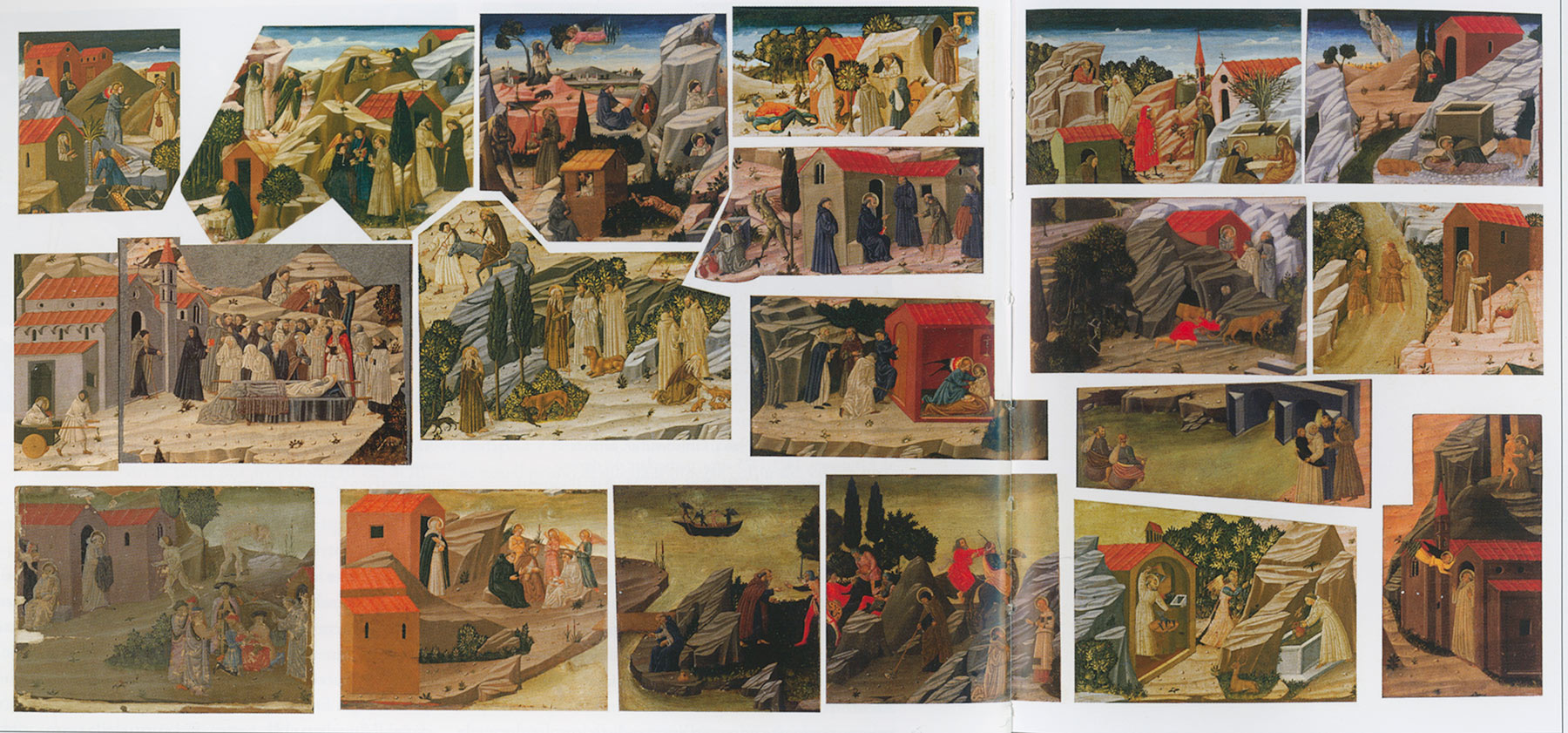
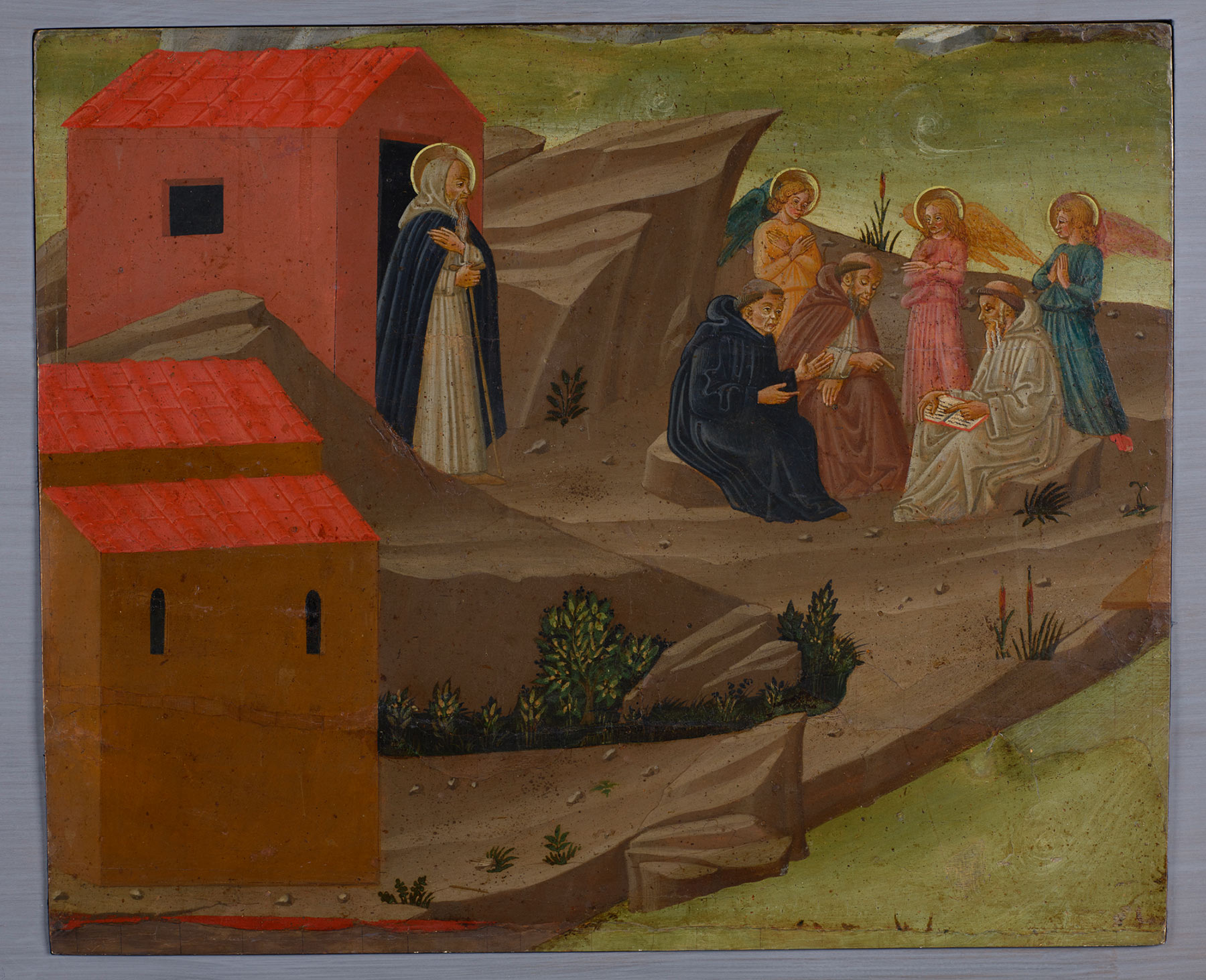
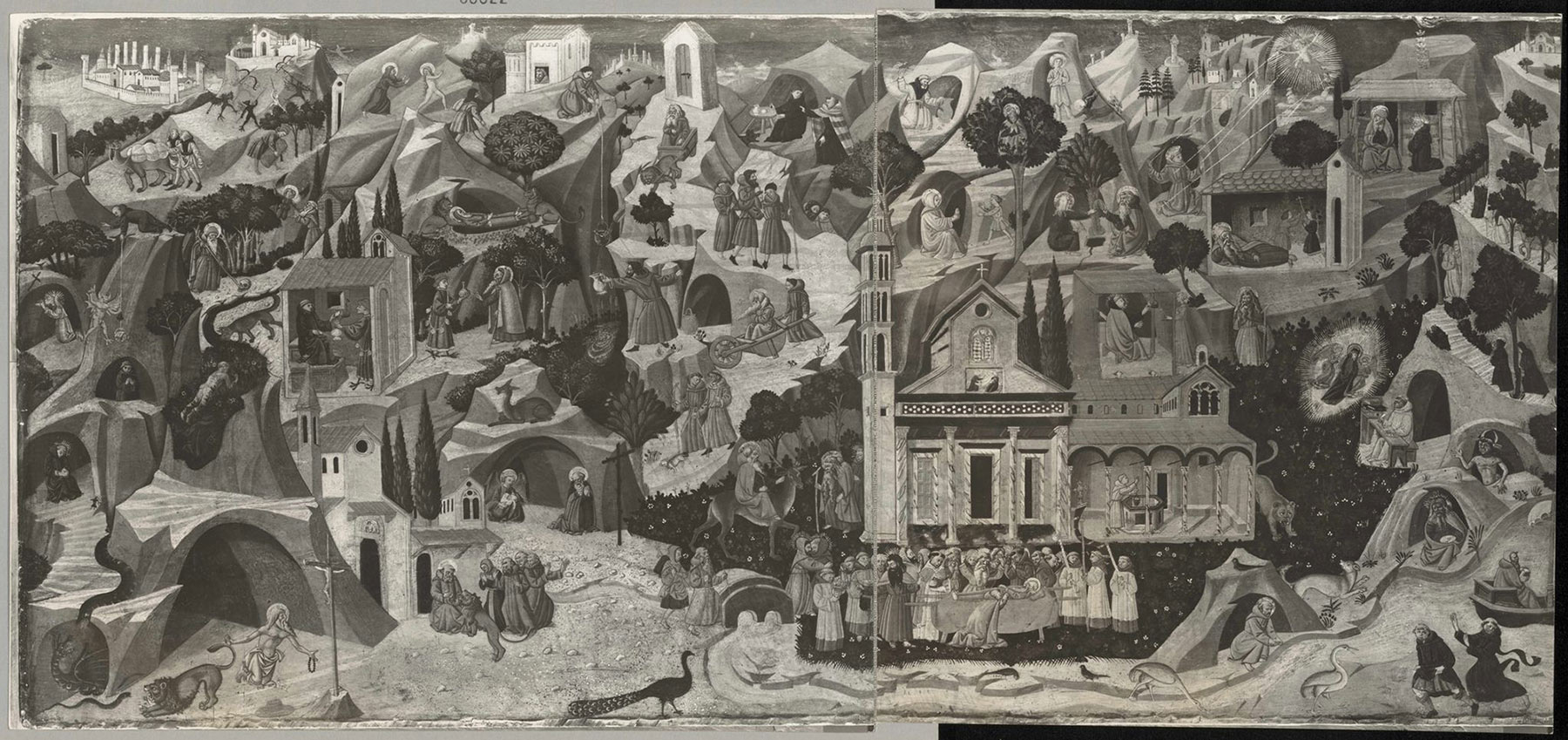
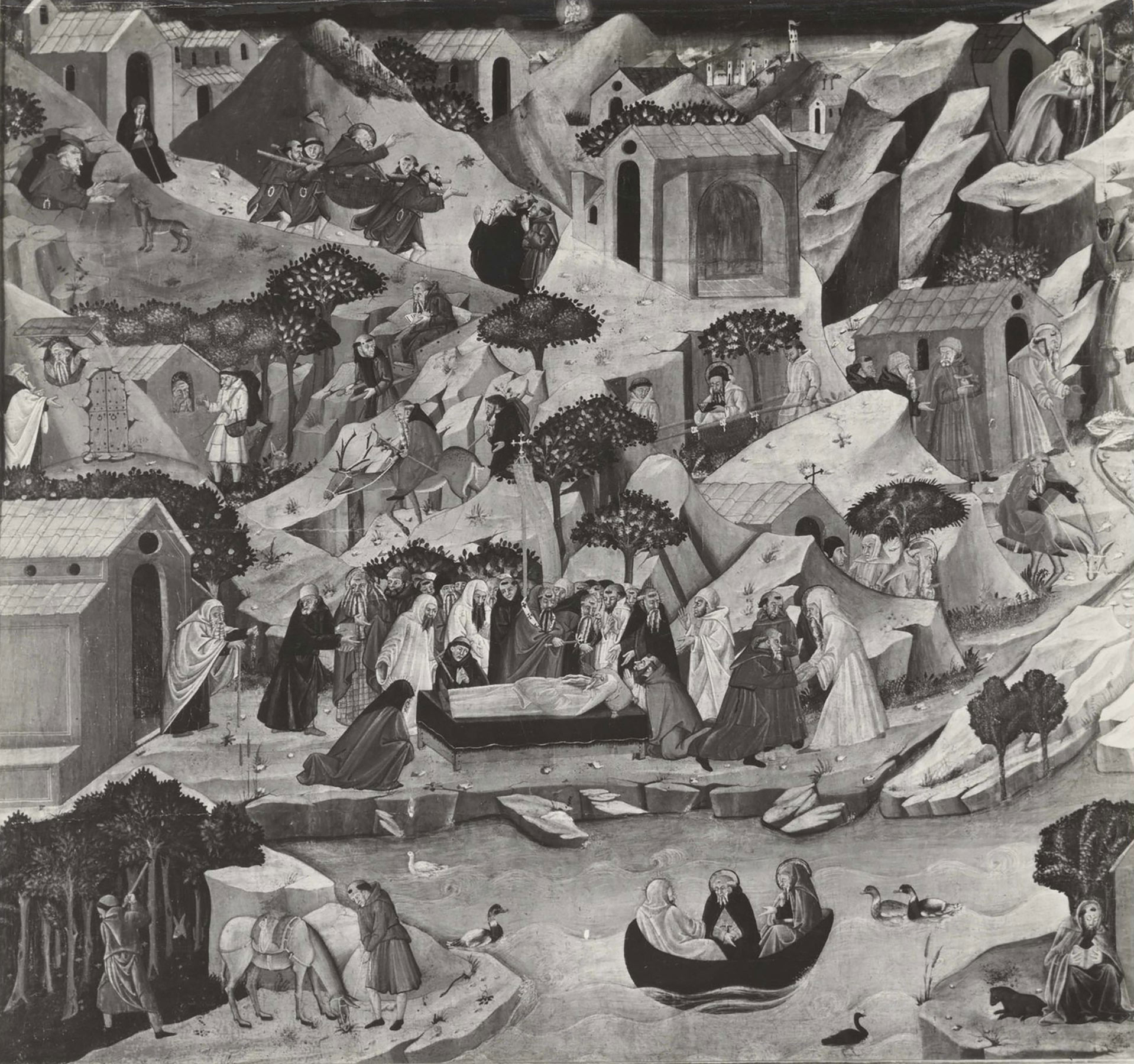
The Yale panel has long been recognized as a fragment of a large Thebaid on panel that was cut into twenty-one irregular pieces sold individually on the art market sometime in the early nineteenth century. The other parts of the complex are currently divided between Christ Church, Oxford;9 the Kunsthaus Zürich (see figs. 3 and 11–12);10 and the National Galleries of Scotland, Edinburgh (see fig. 10).11 The earliest recorded provenance for this work is related to the nine fragments in Christ Church and the one in Edinburgh, which were formerly in the collection of the English poet and writer Walter Savage Landor (1775–1864). Landor made most of his art purchases during his residence in Florence between 1821 and 1835, and he put the Christ Church panels up for auction upon his return to England in 1836.12 The original appearance of the painting, which measured around 110 by 230 centimeters and comprised around fifty individual episodes of eremitic life, was reconstructed by Ellen Callmann in a 1957 article appropriately titled “A Quattrocento Jigsaw Puzzle” (fig. 2).13 Callmann’s study followed upon the independent research of Alice Wolfe,14 which confirmed the relationship between the Yale painting and the Zürich fragments. Wolfe identified two of the episodes in the present panel as scenes from the life of Saint Pachomius, considered the founder of cenobitic monasticism.15 In the upper register, on the left, Pachomius is shown outside his cell receiving the instructions of an angel sent by God to inform him of the Rule, or daily regimen of fasting and prayer that was to be observed by the new community of monks in his care.16 He is depicted next coming out of a doorway to present the habit of the order to an undressed young initiate striding toward him—possibly the same one who is seen removing his worldly clothes on the right. Separated from these events by a hilly outcrop and vegetation is an unrelated episode illustrating the exorcism of a figure who has been brought, hands bound, before the cell of another holy father; the latter is depicted in the act of blessing the victim, whose body is freed of the devil. Scenes of exorcism are common in the Vitae patrum, and it is difficult to associate this one with a particular narrative, although Wolfe tentatively suggested it might be the story of the possessed Orion, who was chained and led by his friends to the monk Hilarion, known for his miraculous cures and exorcism of demons.17 As demonstrated by Wolfe’s and Callmann’s reconstructions, the Yale episodes occupied the lower left edge of the Thebaid. The composition was continued on the right by the Zürich fragment illustrating, in a zone above the cells of Hilarion and his companions, the vision of a holy father who saw angels among a group of gathered monks conversing about God (fig. 3).18
Beginning with Tancred Borenius,19
most authors have underscored the formal relationship
between the Yale/
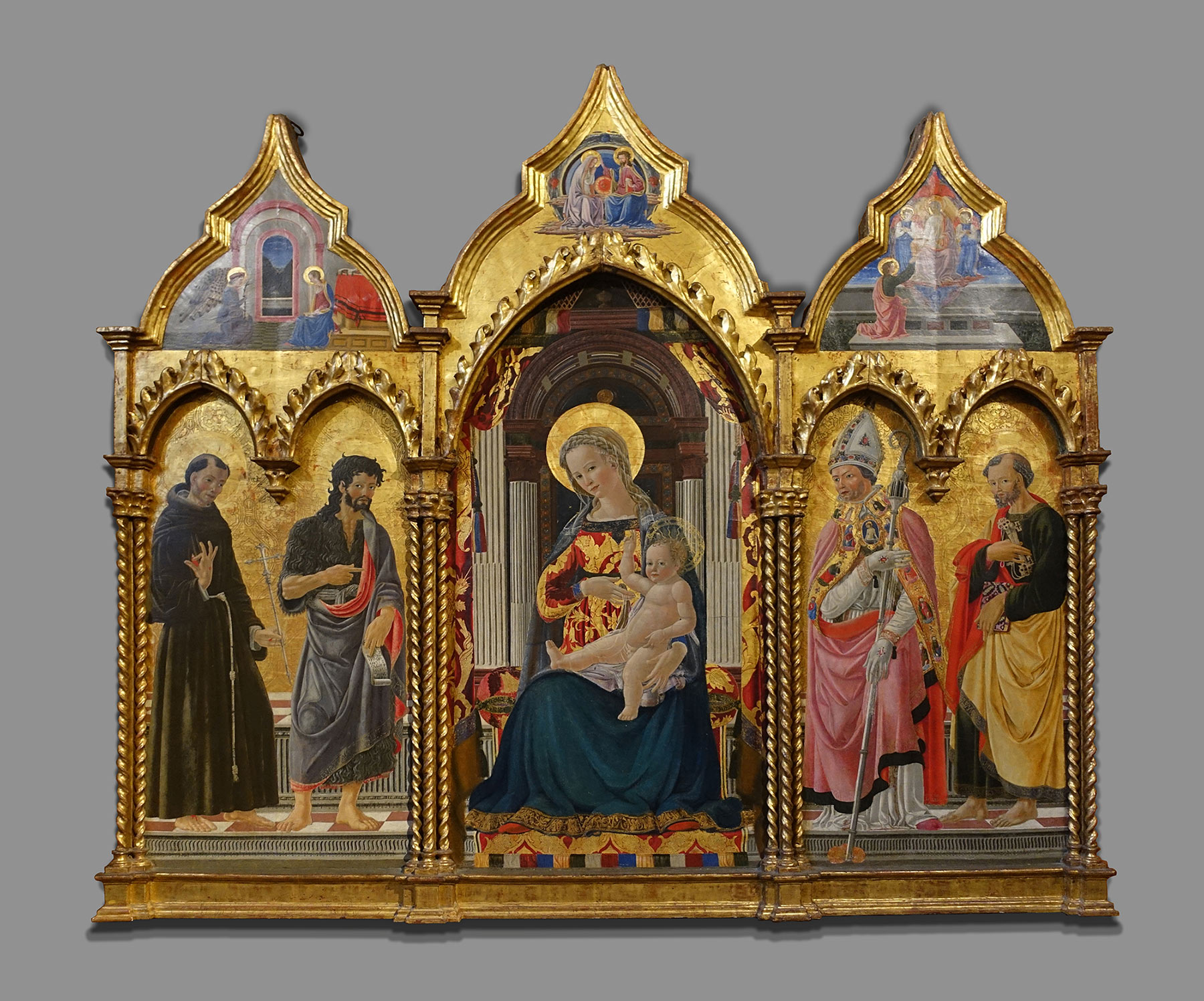
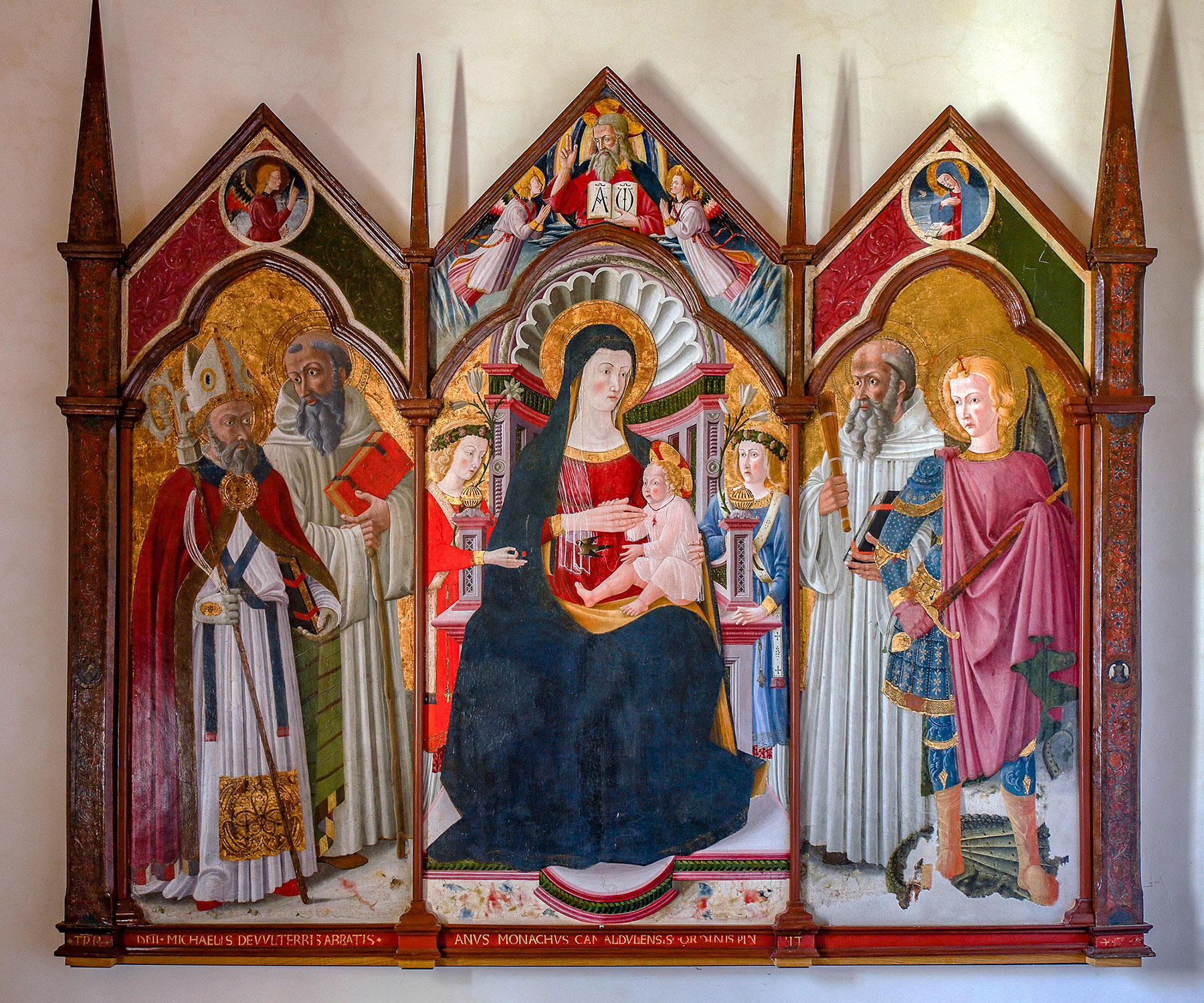
The Yale fragment, bought as a work of the Sienese school by James Jackson Jarves, was assigned by Osvald Sirén24 to the so-called Master of the Carrand Triptych, author of an altarpiece formerly in the Carrand collection, now in the Museo Nazionale del Bargello, Florence (fig. 7). The personality of this master, long confused with that of a younger painter named Giovanni di Francesco, was clarified in relatively recent times by Takuma Ito, who identified him as Giovanni di Franco di Piero, a contemporary and possibly follower of Alesso Baldovinetti, active into the 1490s.25 Sirén’s attribution was taken up in part by Bernard Berenson, who listed the Yale, Christ Church, and Edinburgh fragments, along with the two Crawford Thebaids, among the “Florentine Unknown, 1420–65,” categorizing them as “between Carrand Master and Neri di Bicci.”26 Mario Salmi, who connected the Zürich panels to those at Yale and Christ Church, highlighted the influence of Paolo Uccello and gave the work to an anonymous follower,27 while subsequent writers remained divided between the Florentine and Sienese schools. In the 1967 catalogue of the pictures at Christ Church, James Byam Shaw28 first advanced the suggestion that the reassembled Thebaid, as well as the “large” Lindsay Thebaid, might be by the same hand responsible for the predella of Piero della Francesca’s Misericordia Polyptych in Borgo Sansepolcro,29 and he tentatively proposed that this artist could be the young Neri di Bicci, around 1440–50. According to Byam Shaw, the association with the Misericordia predella was endorsed by Federico Zeri,30 although the latter reportedly drew attention to Salmi’s previous arguments for attributing the Sansepolcro predella to Giuliano Amedei (or Amidei), a Camaldolese monk who signed an altarpiece from the Badia of San Martino a Tifi, not far from Sansepolcro (fig. 8).31 Zeri’s argument in favor of Amedei was regarded with some skepticism by Byam Shaw, who noted the inferior, provincial quality of the Tifi altarpiece compared to the Misericordia scenes and the Thebaid fragments and catalogued these works as “Tuscan School, ca. 1440–1450.”32 Similar reservations were expressed by Callmann, who accepted the proposed relationship between the Sansepolcro predella and the Thebaid fragments but rejected the attribution to Amedei, preferring to label the present work as “Master of the Madonna della Misericordia Predella,” with a date in the late 1450s or the 1460s, contemporary to the completion of the Misericordia Polyptych.33 Amedei’s authorship of the reconstructed Thebaid was reasserted by Gaudenz Freuler and others,34 however, and it has generally been embraced, even if tentatively, by more recent authors, albeit with a chronology that has oscillated from as early as 1446–5335 to as late as 1460–80.36
Overlooked in the long-standing debate around authorship is the fact that, while clearly part of the same complex, not all of the fragments of the reconstructed Thebaid are by the same hand. The presence of two distinct personalities is evidenced by a comparison of prerestoration photographs of the Yale panel (fig. 9) with the Edinburgh Funeral of a Holy Hermit (fig. 10). While the Yale fragment is inhabited by coarse, awkwardly built physical types with enormous hands and bland, summarily defined features, the Edinburgh scene is distinguished by proportionately smaller, poised characters with tiny hands and sharp features that reveal the underlying bone structure. Beyond these formal distinctions, the Edinburgh scene stands out for its vividly conceived narrative details, at odds with the more prosaic approach of the Yale picture: from the three-dimensional view of the bier and sensitive handling of the funerary cloth draped across it and over the saint’s lower body; to the carefully foreshortened books and bowls held in the hands of some of the figures; to the eloquent drapery folds of the cowled pleurants, or weepers. The same distinct personality, who may be referred to, for the sake of convenience, as Hand A, painted five other fragments of the Thebaid: the two flanking the Edinburgh panel (Kunsthaus Zürich, inv. nos. 1455a, 1663) (fig. 11) and the first three in the tier above them (Kunsthaus Zürich, inv. nos. 1455b, 1456; Christ Church, Oxford, inv. no. 21) (fig. 12). The fact that this artist’s intervention is confined to a limited area at the top of the original panel suggests that the commission may have been begun by him, before being taken over by the author of the Yale panel (Hand B), who was responsible for all of the episodes in the fifteen remaining fragments.
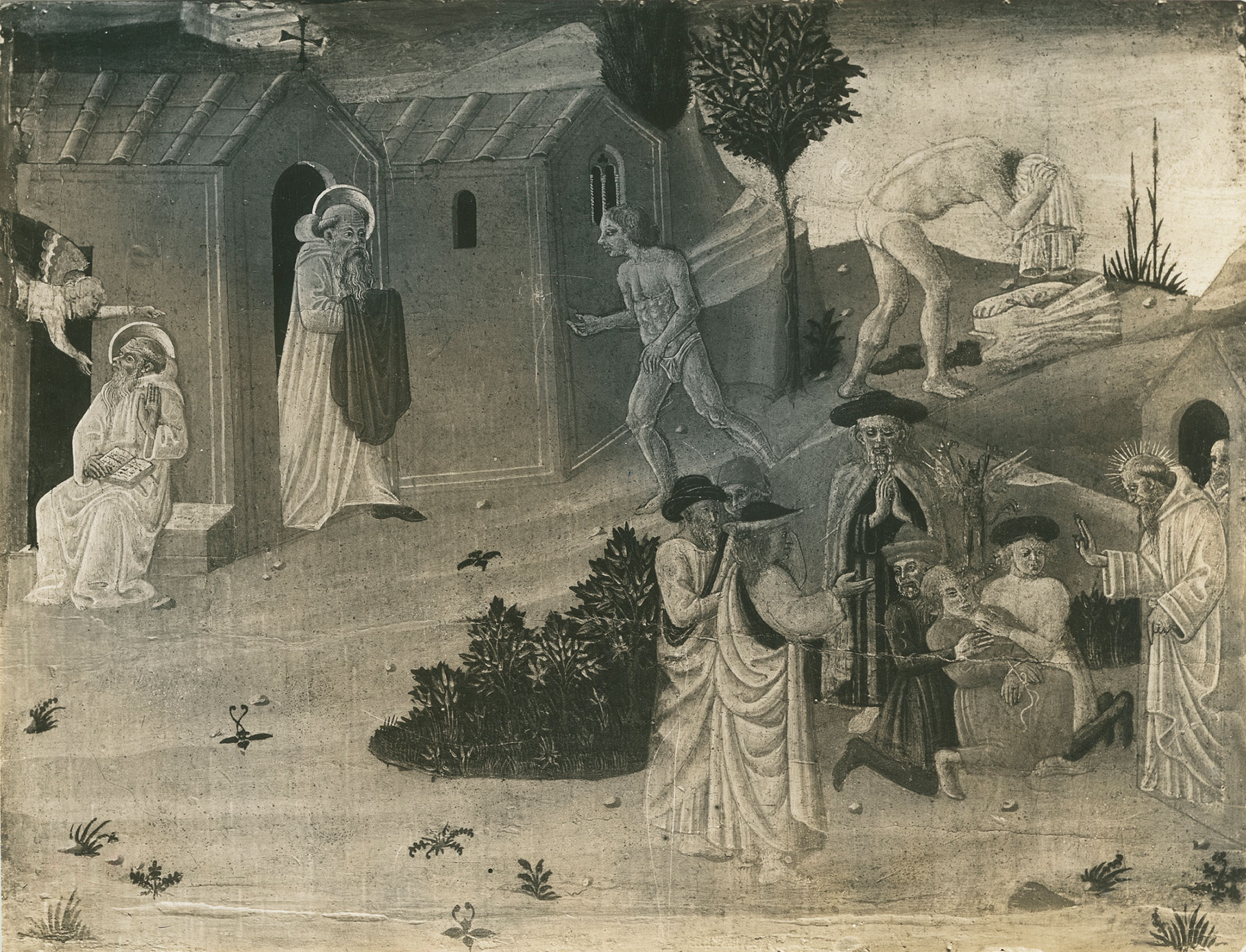
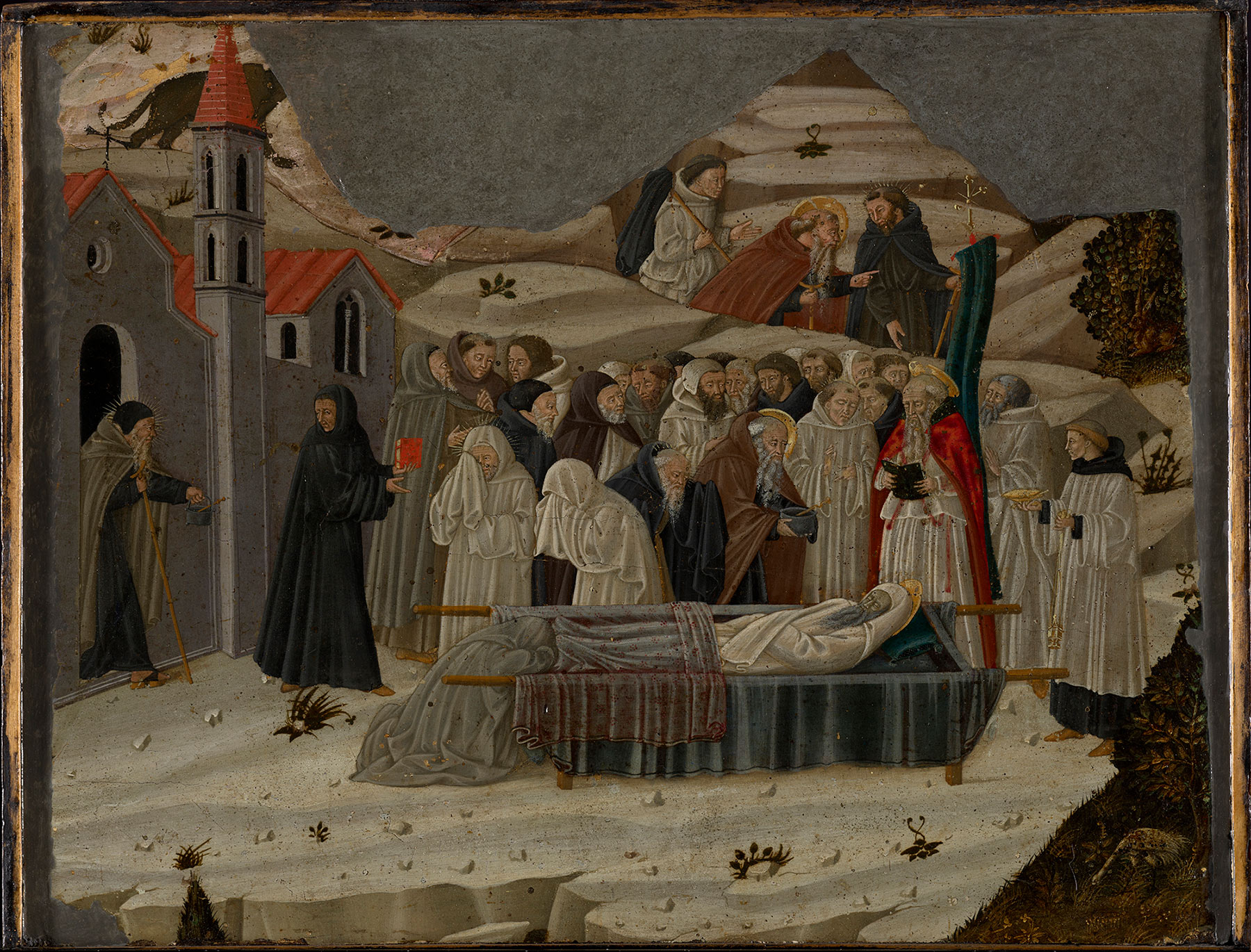
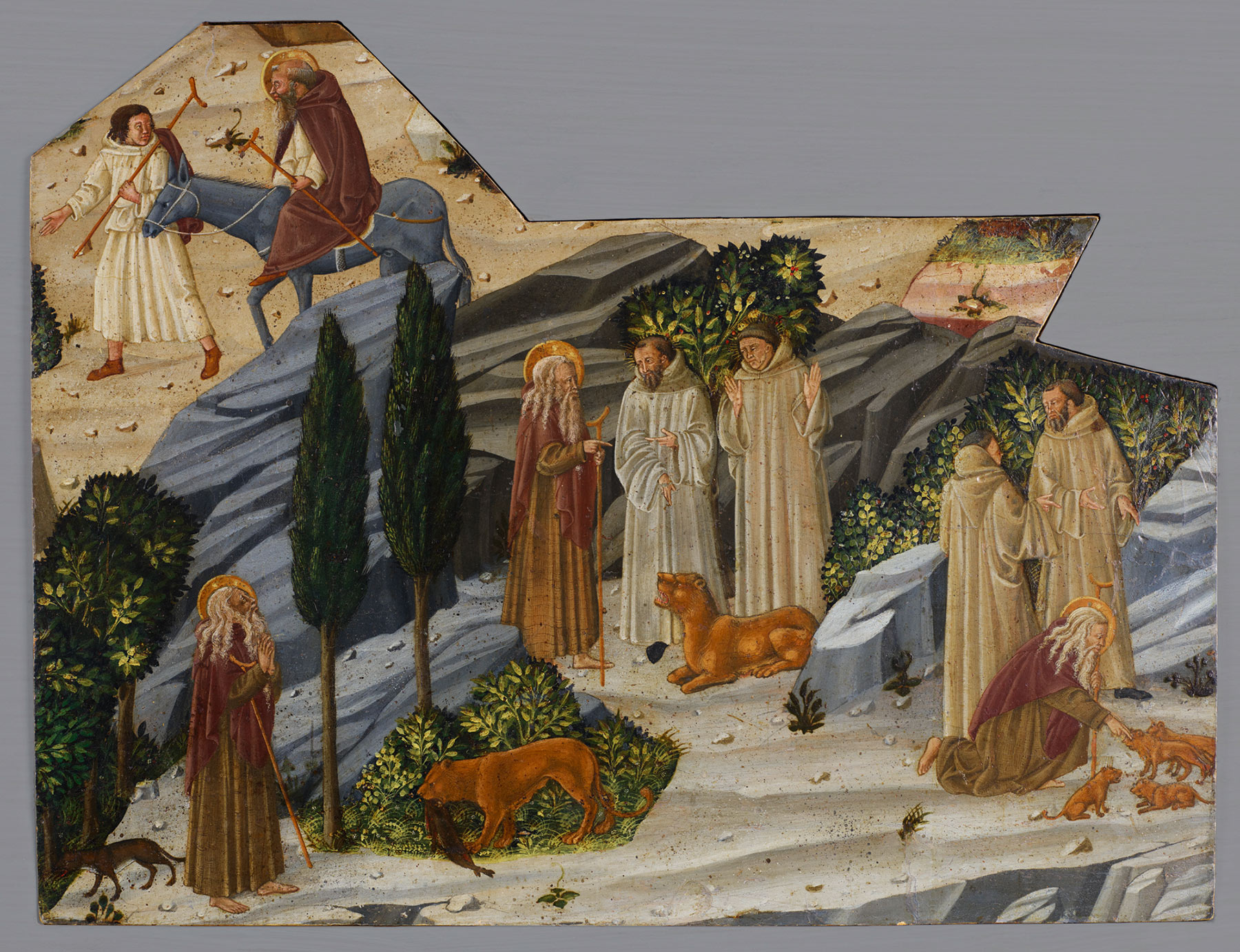
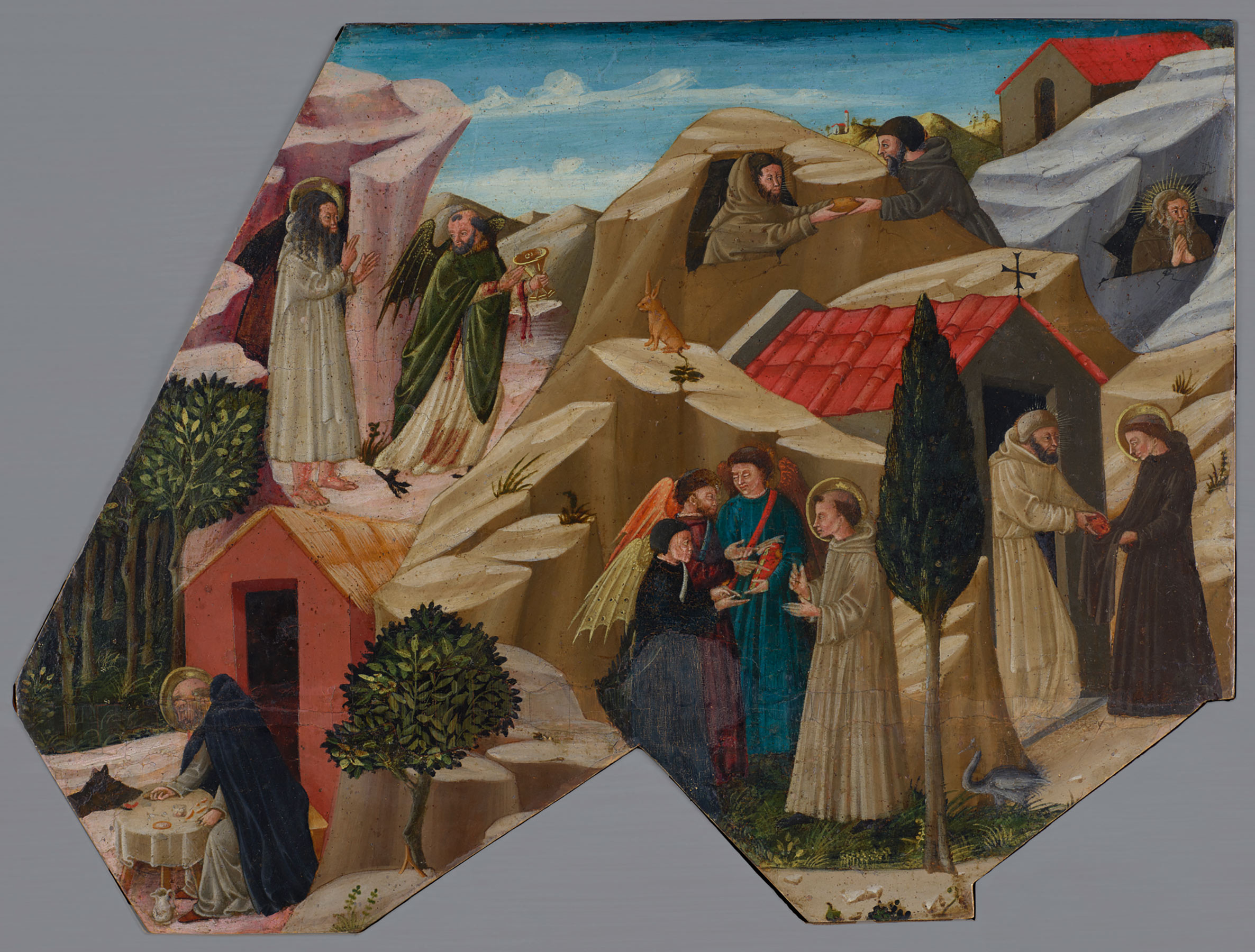
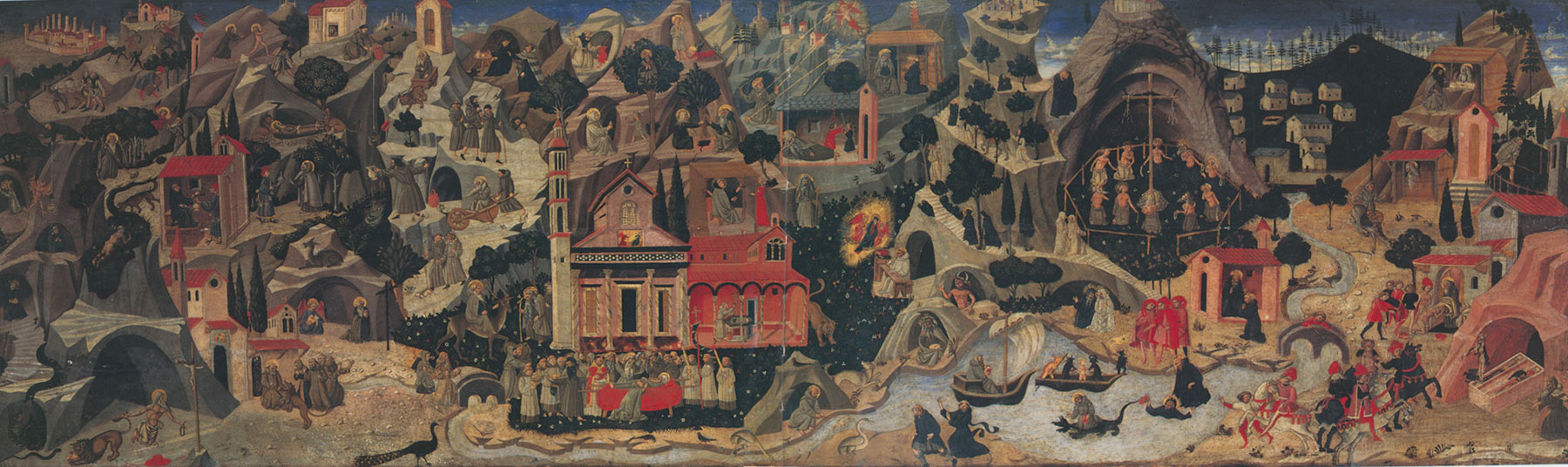
Notwithstanding efforts to relate the Thebaid fragments to Giuliano Amedei, author of the Tifi altarpiece, neither Hand A nor Hand B share the eccentric qualities of that work, strongly characterized by Marchigian inflections and the product of an altogether distinct artistic environment.37 At the same time, both hands reflect an artisanal approach that falls short of the more advanced spatial and expressive concerns of the Madonna della Misericordia predella scenes, which are deeply indebted to Piero della Francesca’s vocabulary and are most likely the effort of an unidentified assistant in his workshop. With the possible exception of the detail of the young man removing his clothes in the Yale fragment, perhaps derived from Piero’s Baptism of Christ in the National Gallery, London,38 there is little evidence of the master’s impact on any of the different parts of the Thebaid.39 The stylistic connotations of the Yale panel and other fragments by Hand B point to an artist working in the shadows of dominant personalities in Florentine painting of the middle third of the fifteenth century but more oriented toward the example of Andrea del Castagno and Alesso Baldovinetti. As was first intuited by Sirén,40 the Yale fragment has much in common, in palette and figure types, with Giovanni di Franco’s manner as represented by the ex-Carrand triptych (see fig. 7). Almost literally taken over from that work are certain idiosyncratic qualities like the exaggerated rendering of the human anatomy and musculature of the novice in the Yale fragment, while broader comparisons may be drawn with the pronounced facial features and ruddy complexions. The looser handling of the forms and cruder execution, as well as the spatial inconsistencies, prevent a direct attribution to Giovanni di Franco, but they could indicate a follower or imitator. The author of the Edinburgh Funeral (see fig. 10) and the scenes around it (Hand A), by contrast, seems indebted to an earlier strain in Florentine painting, represented by the efforts of the young Neri di Bicci and those of an older generation of painters. The same qualities also characterize the “large” Lindsay Thebaid (fig. 13), although the more cursory approach suggests an assistant in the same workshop or collaborative enterprise. A date between 1450 and 1470 for these works seems consistent with the multiplicity of points of reference.
The circumstances surrounding the production of the reconstructed Thebaid are unknown. The inclusion of episodes related to the life of Saint Benedict along with the preponderance of monks in the black habit of the Benedictine order and the white habit of the reformed Camaldolese order have suggested a possible provenance from the famous convent Santa Maria degli Angeli in Florence.41 The insertion of the two pleurant figures in the Edinburgh scene (see fig. 10), a motif derived from Northern funerary sculpture, may shed some light on the cultural environment surrounding the commission. This detail is conspicuously absent from all other known Thebaids and is virtually unknown in Italian painting, hinting at the possibility that the work was underwritten by a prelate or monastic official with ties to Benedictine communities outside Italy. —PP
Published References
Jarves, James Jackson. Descriptive Catalogue of “Old Masters” Collected by James J. Jarves to Illustrate the History of Painting from A.D. 1200 to the Best Periods of Italian Art. Cambridge, Mass.: H. O. Houghton, 1860., 48, no. 48; Sturgis, Russell, Jr. Manual of the Jarves Collection of Early Italian Pictures. New Haven: Yale College, 1868., 55, no. 54; Perkins, F. Mason. “Pitture senesi negli Stati Uniti.” Rassegna d’arte senese 1, no. 2 (1905): 74–78., 77; Sirén, Osvald. A Descriptive Catalogue of the Pictures in the Jarves Collection Belonging to Yale University. New Haven: Yale University Press, 1916., 93–96, no. 37; van Marle, Raimond. The Development of the Italian Schools of Painting. Vol. 9. The Hague: M. Nijhoff, 1927., 460; Offner, Richard. Italian Primitives at Yale University: Comments and Revisions. New Haven: Yale University Press, 1927., 34; van Marle, Raimond. The Development of the Italian Schools of Painting. Vol. 10. The Hague: M. Nijhoff, 1928., 392n3; Berenson, Bernard. Italian Pictures of the Renaissance: A List of the Principal Artists and Their Works with an Index of Places. Oxford: Clarendon, 1932., 195; Pope-Hennessy, John. Giovanni di Paolo, 1403–1483. London: Chatto and Windus, 1937., 159; Salmi, Mario. Paolo Uccello, Andrea del Castagno, Domenico Veneziano. Milan: Ulrico Hoepli, 1938., 44; “Picture Book Number One: Italian Painting.” Special issue, Bulletin of the Associates in Fine Arts at Yale University 15, nos. 1–3 (October 1946): n.p., fig. 21; Callmann, Ellen. “A Quattrocento Jigsaw Puzzle.” Burlington Magazine 99, no. 650 (May 1957): 149–55, 157., 149–50, 154, fig. 15; Wolfe, Alice. “The Thebaid Fragments of the Yale Art Gallery and the Zurich Kunsthaus.” In Essays in Honor of Hans Tietze, 1880–1954, ed. Ernst Gombrich, Julius S. Held, and Otto Kurz, 393–406. New York: Gazette des Beaux-Arts, 1958., 393–406; Shaw, James Byam. Paintings by Old Masters at Christ Church, Oxford. London: Phaidon, 1967., 40–42; Seymour, Charles, Jr. Early Italian Paintings in the Yale University Art Gallery. New Haven: Yale University Art Gallery, 1970., 160–61, 317, no. 115; Fredericksen, Burton B., and Federico Zeri. Census of Pre-Nineteenth-Century Italian Paintings in North American Public Collections. Cambridge, Mass.: Harvard University Press, 1972., 599; Callmann, Ellen. “Thebaid Studies.” Antichità viva 14, no. 3 (1975): 3–22., 16; Brigstocke, Hugh. “Panels Showing the ‘Death of St. Ephraim.’” Burlington Magazine 118, no. 881 (August 1976): 584–86, 589., 586; Brigstocke, Hugh. Italian and Spanish Paintings in the National Gallery of Scotland. Edinburgh: The Gallery, 1978., 589; de Klerck, B. “De Thebaid in haar religieuze en historische context, de functie van heremietenafbeeldingen in de Toscaanse vroege Renaissance.” Ph.D. diss., Katholieke Universiteit Nijmegen, 1988., 52, 59; Freuler, Gaudenz. “Manifestatori delle cose miracolose”: Arte italiana del ’300 e ’400 da collezioni in Svizzera e nel Liechtenstein. Exh. cat. Lugano-Castagnola, Switzerland: Fondazione Thyssen-Bornemisza, 1991., 250; Giovanna Damiani, in Berti, Luciano, ed. Nel raggio di Piero: La pittura nell’Italia centrale nell’età di Piero della Francesca. Exh. cat. Venice: Marsilio, 1992., 69, 81n13, 81n15, 84, fig. 5; De Marchi, Andrea. “Identità di Giuliano Amadei miniatore.” Bollettino d’arte, 6th ser., 80, nos. 93–94 (September–December 1995): 119–58., 126; Hugh Brigstocke, in Barker, Nicholas, Hugh Brigstocke, and Timothy Clifford. “A Poet in Paradise”: Lord Lindsay and Christian Art. Exh. cat. Edinburgh: National Galleries of Scotland, 2000., 61; Falabella, Susanna. “Giuliano di Amadeo.” In Dizionario biografico degli italiani. Rome: Istituto della Enciclopedia Italiana, 2001. https://www.treccani.it/enciclopedia/giuliano-di-amadeo_(Dizionario-Biografico)/., 56:742–43; Marcon, Suzy. “Amadei, Giuliano/Pseudo Amadei.” In Dizionario biografico dei miniatori italiani: Secoli IX–XVI, ed. Milvia Bollati, 12. Milan: Sylvestre Bonnard, 2004., 12; Klemm, Christian, Franziska Lentzsch, and Gian Casper Bott, eds. Kunsthaus Zürich: Gesamtkatalog der Gemälde und Sculpturen. Ostfildern, Germany: Hatje Cantz, 2007., 36; Malquori, Alessandra. “Umanesimo e padri del deserto.” In Bagliori dorati: Il Gotico Internazionale a Firenze, 1375–1440, ed. Antonio Natali, Enrica Neri Lusanna, and Angelo Tartuferi, 83–91. Exh. cat. Florence: Giunti, 2012., 90; Maria Corsi, in Natali, Antonio, Enrica Neri Lusanna, and Angelo Tartuferi. Bagliori dorati: Il gotico internazionale a Firenze, 1375–1440. Exh. cat. Florence: Giunti, 2012., 188; Maria Corsi, in Malquori, Alessandra, Manuela Di Giorgi, and Laura Fenelli, eds. Atlante delle Tebaidi e dei temi figurativi. Florence: Centro Di, 2013., 65, 67, 69n3, fig. 36
Notes
-
For the evolution of the theme, see the fundamental studies by Ellen Callmann and Alessandra Malquori: Callmann, Ellen. “Thebaid Studies.” Antichità viva 14, no. 3 (1975): 3–22., 3–22; Malquori, Alessandra. Il giardino dell’anima: Ascesi e propaganda nelle Tebaidi fiorentine del quattrocento. Florence: Centri Di, 2012.; and Alessandra Malquori, in Malquori, Alessandra, Manuela Di Giorgi, and Laura Fenelli, eds. Atlante delle Tebaidi e dei temi figurativi. Florence: Centro Di, 2013.. ↩︎
-
Malquori, Alessandra. Il giardino dell’anima: Ascesi e propaganda nelle Tebaidi fiorentine del quattrocento. Florence: Centri Di, 2012., 15. ↩︎
-
Inv. no. 55.168. For the most recent discussion of this work, see Malquori, in Malquori, Alessandra, Manuela Di Giorgi, and Laura Fenelli, eds. Atlante delle Tebaidi e dei temi figurativi. Florence: Centro Di, 2013., 44–50, who argued for a considerably later date of execution. ↩︎
-
In the most recent examination of the subject, Malquori highlighted the connection between the representation of the koimesis in fifteenth-century Florentine painting and the daily cycle of monastic prayer; see Malquori, Alessandra. “Borrowing Figurative Patterns: The Meaning of the ‘Dormition of the Hermit’ in Fifteenth-Century Florentine Paintings.” In Transcultural Imaginations of the Sacred, ed. Margit Kern and Klaus Krüger, 163–80. Leiden, Netherlands: Brill, 2019., 163–80 (with previous bibliography). The earliest known representation of the motif in Italian art is the thirteenth-century triptych by Grifo di Tancredi from a private collection in Scotland, now on loan to the National Galleries of Scotland, Edinburgh, which Malquori has tentatively associated with a Dominican commission. ↩︎
-
Palladino, Pia. “Pilgrims and Desert Fathers: Dominican Spirituality and the Holy Land.” In Fra Angelico, ed. Laurence Kanter and Pia Palladino, 27–39. Exh. cat. New York: Metropolitan Museum of Art, 2005., 36. A chronology in the middle of the fourteenth century was also advanced by Carl Strehlke, in Strehlke, Carl Brandon. Fra Angelico and the Rise of the Florentine Renaissance. Exh. cat. Madrid: Museo Nacional del Prado, 2019., 104. ↩︎
-
Malquori, Alessandra. Il giardino dell’anima: Ascesi e propaganda nelle Tebaidi fiorentine del quattrocento. Florence: Centri Di, 2012., 115–44. Malquori (in Malquori, Alessandra, Manuela Di Giorgi, and Laura Fenelli, eds. Atlante delle Tebaidi e dei temi figurativi. Florence: Centro Di, 2013., 33–38) embraced a proposition first advanced by Antonio Natali (in Natali, Antonio. “Il secolo dei ‘primitivi.’” In Il fasto e la ragione: Arte del settecento a Firenze, ed. Carlo Sisi and Riccardo Spinelli, 13–21. Exh. cat. Florence: Giunti, 2009., 13–21) and considered the Uffizi Thebaid to be an eighteenth-century replica of a painting from the first decades of the fifteenth century. The suggestion was categorically rejected by Strehlke and more recent scholarship; see Strehlke, Carl Brandon. Fra Angelico and the Rise of the Florentine Renaissance. Exh. cat. Madrid: Museo Nacional del Prado, 2019., 100–105, no. 11; and Strehlke, Carl Brandon, with Stefano Casciu and Angelo Tartuferi, eds. Beato Angelico. Exh. cat. Florence: Marsilio Arte, 2025., 112–13, no. 1.6. ↩︎
-
Malquori, in Malquori, Alessandra, Manuela Di Giorgi, and Laura Fenelli, eds. Atlante delle Tebaidi e dei temi figurativi. Florence: Centro Di, 2013., 31. ↩︎
-
Malquori, Alessandra. Il giardino dell’anima: Ascesi e propaganda nelle Tebaidi fiorentine del quattrocento. Florence: Centri Di, 2012., 22. ↩︎
-
Inv. nos. JBS 21–29. See Shaw, James Byam. Paintings by Old Masters at Christ Church, Oxford. London: Phaidon, 1967., 40–46, nos. 21–29. JBS 29 consists of two fragments. ↩︎
-
In addition to figs. 3 and 10–11: inv. nos. 1455a–b, 1457–58, 1661, 1664. See Klemm, Christian, Franziska Lentzsch, and Gian Casper Bott, eds. Kunsthaus Zürich: Gesamtkatalog der Gemälde und Sculpturen. Ostfildern, Germany: Hatje Cantz, 2007., 36–37. ↩︎
-
See Brigstocke, Hugh. Italian and Spanish Paintings in the National Gallery of Scotland. Edinburgh: The Gallery, 1978., 1–4, no. 1528. ↩︎
-
Sale, Christie’s, London, June 25, 1836, lot 105. Prior to the sale, the Edinburgh fragment had been sold by Landor to William Bell Scott (1811–1890); see Brigstocke, Hugh. Italian and Spanish Paintings in the National Gallery of Scotland. Edinburgh: The Gallery, 1978., 3, 4n15. For Landor’s time in Italy, see Super, Robert H. Walter Savage Landor: A Biography. New York: New York University Press, 1954., 177–260. The Zurich panels are first recorded in the 1922 sale of the Chillingworth collection: Galerie Fischer, Lucerne, September 5, 1922, lot 105. ↩︎
-
Callmann, Ellen. “A Quattrocento Jigsaw Puzzle.” Burlington Magazine 99, no. 650 (May 1957): 149–55, 157., 149–55. ↩︎
-
Wolfe, Alice. “The Thebaid Fragments of the Yale Art Gallery and the Zurich Kunsthaus.” In Essays in Honor of Hans Tietze, 1880–1954, ed. Ernst Gombrich, Julius S. Held, and Otto Kurz, 393–406. New York: Gazette des Beaux-Arts, 1958., 393–406. The original typescript of this article, completed in 1950, is in the curatorial files, Department of European Art, Yale University Art Gallery. ↩︎
-
Wolfe, Alice. “The Thebaid Fragments of the Yale Art Gallery and the Zurich Kunsthaus.” In Essays in Honor of Hans Tietze, 1880–1954, ed. Ernst Gombrich, Julius S. Held, and Otto Kurz, 393–406. New York: Gazette des Beaux-Arts, 1958., 402–4. ↩︎
-
Cavalca, Domenico. Vite dei santi padri. Ed. Carlo Delcorno. 2 vols. Florence: Galluzzo per la Fondazione Ezio Franceschini, 2009., 1:818–21. ↩︎
-
Wolfe, Alice. “The Thebaid Fragments of the Yale Art Gallery and the Zurich Kunsthaus.” In Essays in Honor of Hans Tietze, 1880–1954, ed. Ernst Gombrich, Julius S. Held, and Otto Kurz, 393–406. New York: Gazette des Beaux-Arts, 1958., 404; and Cavalca, Domenico. Vite dei santi padri. Ed. Carlo Delcorno. 2 vols. Florence: Galluzzo per la Fondazione Ezio Franceschini, 2009., 1:613–14. ↩︎
-
Cavalca, Domenico. Vite dei santi padri. Ed. Carlo Delcorno. 2 vols. Florence: Galluzzo per la Fondazione Ezio Franceschini, 2009., 2:1110–11; and Maria Corsi, in Malquori, Alessandra, Manuela Di Giorgi, and Laura Fenelli, eds. Atlante delle Tebaidi e dei temi figurativi. Florence: Centro Di, 2013., 67. ↩︎
-
Borenius, Tancred. Pictures by the Old Masters in the Library of Christ Church, Oxford. Oxford: Oxford University Press, 1916., 26, nos. 21–29. ↩︎
-
Hugh Brigstocke, in Barker, Nicholas, Hugh Brigstocke, and Timothy Clifford. “A Poet in Paradise”: Lord Lindsay and Christian Art. Exh. cat. Edinburgh: National Galleries of Scotland, 2000., 58–63, nos. 11–12. ↩︎
-
See Maria Corsi, in Natali, Antonio, Enrica Neri Lusanna, and Angelo Tartuferi. Bagliori dorati: Il gotico internazionale a Firenze, 1375–1440. Exh. cat. Florence: Giunti, 2012., 188. ↩︎
-
Malquori, in Malquori, Alessandra, Manuela Di Giorgi, and Laura Fenelli, eds. Atlante delle Tebaidi e dei temi figurativi. Florence: Centro Di, 2013., 80–86 (with previous bibliography). ↩︎
-
The porch is a distinctive feature of the church in the so-called Catena Map, in the Kupfersitchkabinett, Berlin, inv. no. 899-100, based on a design by Francesco Rosselli and considered the earliest topographical view of Florence. ↩︎
-
Sirén, Osvald. A Descriptive Catalogue of the Pictures in the Jarves Collection Belonging to Yale University. New Haven: Yale University Press, 1916., 93–96. ↩︎
-
Ito, Takuma. “L’identità di Giovanni di Francesco.” Ricerche di storia dell’arte 84 (2004): 51–69., 51–69. The documentary research of Ito clarified the long-standing confusion between the author of the ex-Carrand triptych, Giovanni di Franco di Piero, and the so-called Master of Pratovecchio, identified as Giovanni di Francesco del Cervelliera. See Mazzalupi, Matteo. “La Madonna di Brera e il vero Giovanni di Francesco.” In Brera mai vista: Pittura di luce; La Madonna col bambino del Maestro di Pratovecchio, 35–45. Exh. cat. Milan: Skira, 2011., 35–45. ↩︎
-
Berenson, Bernard. Italian Pictures of the Renaissance: A List of the Principal Artists and Their Works with an Index of Places. Oxford: Clarendon, 1932., 194–96. ↩︎
-
Salmi, Mario. Paolo Uccello, Andrea del Castagno, Domenico Veneziano. Milan: Ulrico Hoepli, 1938., 44. ↩︎
-
Shaw, James Byam. Paintings by Old Masters at Christ Church, Oxford. London: Phaidon, 1967., 42–44. ↩︎
-
For this work, in the Museo Civico di Sansepolcro, see, most recently, the collection of essays in Betti, Mariangela, Cecilia Frosinini, and Paola Refice, eds. Ripensando Piero della Francesca: Il polittico della Misericordia di Sansepolcro; Storia, studi e indagini tecnico-scientifiche. Florence: Edifir, 2010.. ↩︎
-
Cited in Shaw, James Byam. Paintings by Old Masters at Christ Church, Oxford. London: Phaidon, 1967., 43. ↩︎
-
Salmi, Mario. “Piero della Francesca e Giuliano Amedei.” Rivista d’arte 24, nos. 1–2 (1942): 26–44., 26–44, nos. 1–2. It is worth noting that Salmi did not reference the Thebaid fragments in his discussion of Amedei. For the Tifi altarpiece, see Giovanna Damiani, in Berti, Luciano, ed. Nel raggio di Piero: La pittura nell’Italia centrale nell’età di Piero della Francesca. Exh. cat. Venice: Marsilio, 1992., 87–89, no. 12 (with previous bibliography). ↩︎
-
Shaw, James Byam. Paintings by Old Masters at Christ Church, Oxford. London: Phaidon, 1967., 44. ↩︎
-
Ellen Callmann, unpublished manuscript, November 28, 1992, curatorial files, Department of European Art, Yale University Art Gallery. ↩︎
-
Freuler, Gaudenz. “Manifestatori delle cose miracolose”: Arte italiana del ’300 e ’400 da collezioni in Svizzera e nel Liechtenstein. Exh. cat. Lugano-Castagnola, Switzerland: Fondazione Thyssen-Bornemisza, 1991., 252; Damiani, in Berti, Luciano, ed. Nel raggio di Piero: La pittura nell’Italia centrale nell’età di Piero della Francesca. Exh. cat. Venice: Marsilio, 1992., 84–86, no. 11; and De Marchi, Andrea. “Identità di Giuliano Amadei miniatore.” Bollettino d’arte, 6th ser., 80, nos. 93–94 (September–December 1995): 119–58., 126. ↩︎
-
Corsi, in Natali, Antonio, Enrica Neri Lusanna, and Angelo Tartuferi. Bagliori dorati: Il gotico internazionale a Firenze, 1375–1440. Exh. cat. Florence: Giunti, 2012., 188. ↩︎
-
Brigstocke, in Barker, Nicholas, Hugh Brigstocke, and Timothy Clifford. “A Poet in Paradise”: Lord Lindsay and Christian Art. Exh. cat. Edinburgh: National Galleries of Scotland, 2000., 62. ↩︎
-
As noted in early discussion of the Tifi altarpiece, which highlighted its non-Tuscan components, “the closest similarities” to it are to be found in the work of Giovanni Boccati. See Anna Maria Maetzke, in Boccia, Lionello G., Carla Corsi, Anna Maria Maetzke, and Albino Secchi, eds. Arte nell’Aretino: Recuperi e restauri dal 1968 al 1974. Exh. cat. Florence: Edam, 1974., 95 (with previous bibliography). ↩︎
-
Inv. no. NG665, https://www.nationalgallery.org.uk/paintings/piero-della-francesca-the-baptism-of-christ. ↩︎
-
It is worth noting that Damiani observed that the undressing figure, while reminiscent of Piero, was more closely derived from a drawing of the Baptism of Christ by Pisanello in the Musée du Louvre, Paris (Département des Arts Graphiques, inv. no. RF 420, recto), presumed to be based on Gentile da Fabriano’s lost frescoes in San Giovanni in Laterano. See Damiani, in Berti, Luciano, ed. Nel raggio di Piero: La pittura nell’Italia centrale nell’età di Piero della Francesca. Exh. cat. Venice: Marsilio, 1992., 81–82n15. ↩︎
-
Sirén, Osvald. A Descriptive Catalogue of the Pictures in the Jarves Collection Belonging to Yale University. New Haven: Yale University Press, 1916., 95–96. ↩︎
-
Damiani, in Berti, Luciano, ed. Nel raggio di Piero: La pittura nell’Italia centrale nell’età di Piero della Francesca. Exh. cat. Venice: Marsilio, 1992., 70; and Corsi, in Malquori, Alessandra, Manuela Di Giorgi, and Laura Fenelli, eds. Atlante delle Tebaidi e dei temi figurativi. Florence: Centro Di, 2013., 68. ↩︎