Ugo Jandolo (1880–1963), Rome, by 1925; Maitland Fuller Griggs (1872–1943), New York, 1926
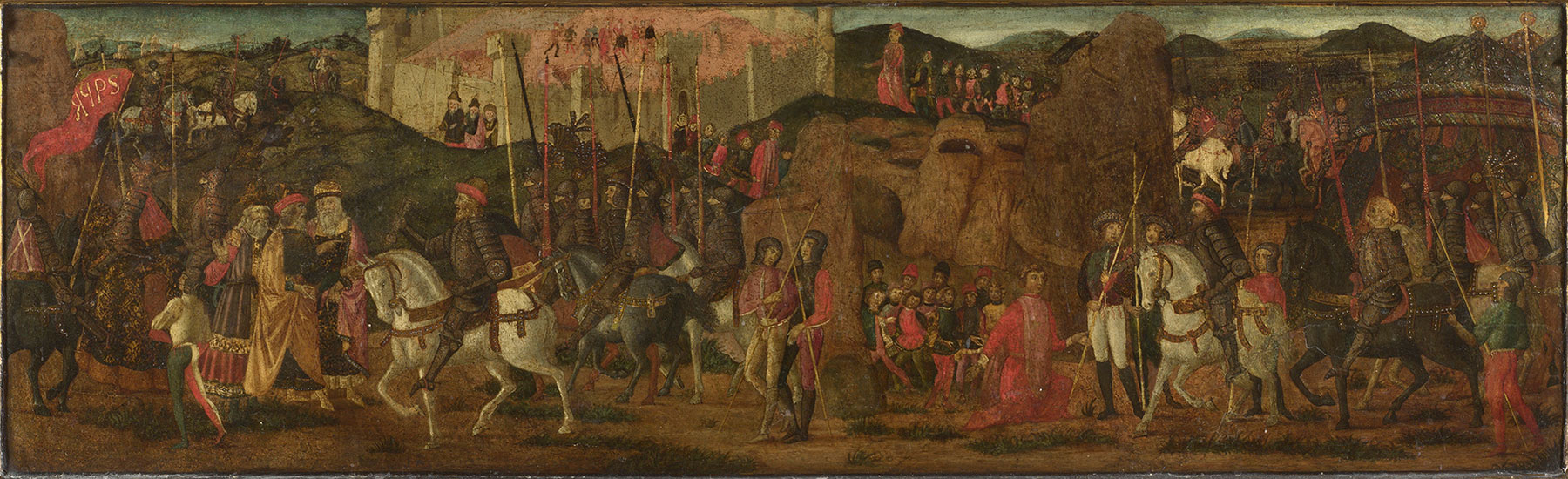
The panel support, of a horizontal wood grain, was thinned to a depth of 7 millimeters and cradled. It comprises two planks—the upper plank approximately 17 centimeters wide, the lower approximately 37.5 centimeters wide—to which has been added a 7-centimeter-wide strip of new wood at the bottom, extending the full length of the panel. A keyhole was cut into the exposed wood of the support outside the paint surface, 6 centimeters from the top edge and 93 centimeters from the left edge. The cradle, which was removed, along with modern engaged-frame moldings that included shields with the arms of the Medici (fig. 1), in a treatment of 2001 by Gianni Marussich and replaced with four flexible cross-grain battens, forced minor splits along the left edge, just 5 millimeters above the seam and running two-thirds the length of the panel, as well as along the right edge, 10 centimeters from the bottom of the panel. Neither interrupts the integrity of the paint surface. Two major splits run on a slight diagonal upward from the left edge of the panel, 15.5 and 27.5 centimeters from the bottom; the lower of the two has provoked considerable paint loss. The paint surface otherwise is unusually well preserved for objects of this type, apart from typical percussion damages, which have been filled with old repaints, chiefly within a 30-centimeter radius of the keyhole. Gilding throughout the composition is intact, with some surviving original glazes. Silver decoration, primarily in the suits of armor, is degraded and has been restored. The entire paint surface is, at present, covered by a thick, discolored varnish.
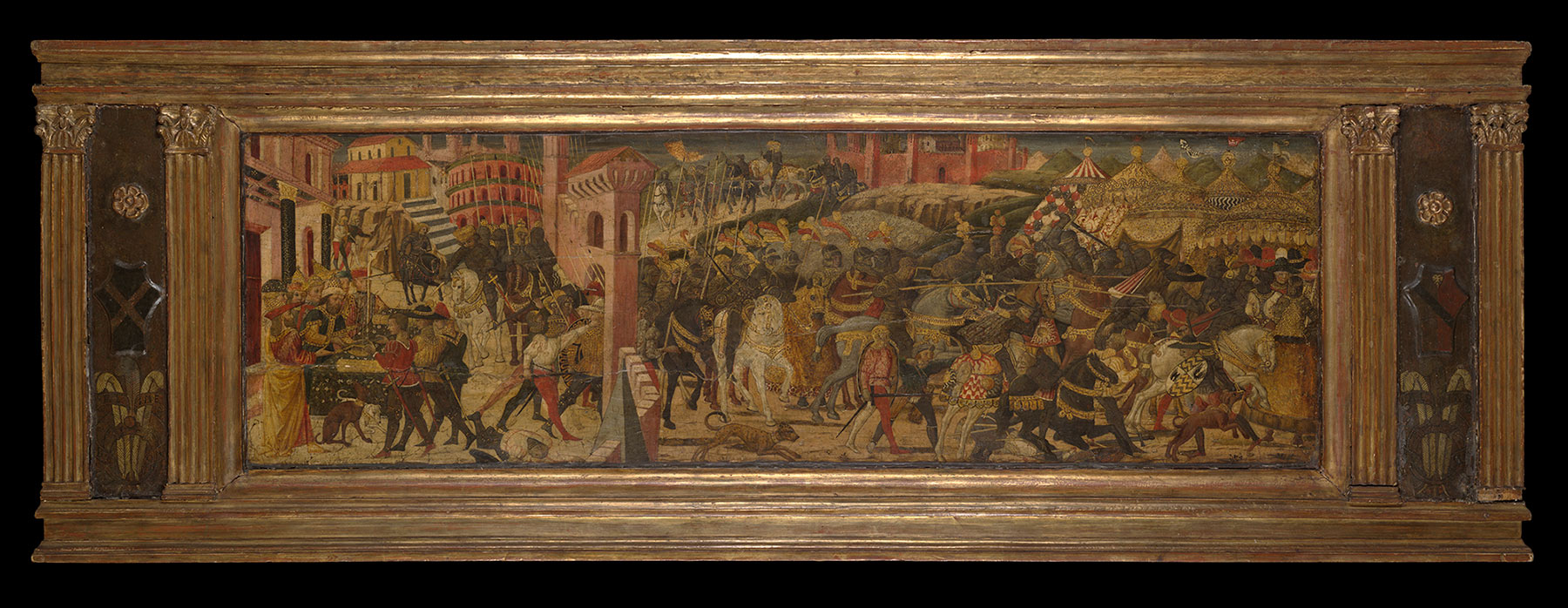
The panel illustrates two successive incidents following the Roman defeat by an army of Gauls at the battle of Allia in ca. 390 B.C., as narrated by Livy and Plutarch in their lives of Marcus Furius Camillus. Three days after the battle, King Brennus and the Gauls occupied Rome, which had been deserted by all but a small garrison that barricaded itself on the Capitoline Hill. Following a siege of the Capitoline reputed to have lasted seven months, Brennus agreed to abandon Rome in exchange for a ransom of one thousand pounds of gold. As the Roman garrison was weighing out the gold, King Brennus disdainfully threw his sword on the scales to tip them further in his favor, upon which the Roman military tribune asked, “What means this?” Brennus replied, “What else but woe to the vanquished.”1 While the garrison debated whether to accede to this insult or repudiate the pact, Camillus led an army of citizen refugees to the gates of the city and put the Gauls to flight. Pursuing them eight miles along the Gabinian Way, he “routed the enemy with great slaughter and took their camp.”2 At the left of the panel, King Brennus lays his sword in one pan of a scale set on a table covered by a flowered carpet. The church of Santa Maria in Aracoeli and the Colosseum in the background indicate that the setting is Rome. Camillus, on a white horse, leads a small cavalry of armored knights onto the scene, and his soldiers drive the Gauls, identifiable by their brimmed and pointed hats, through the gates of the city walls. At the right of the panel, the cavalcade of Roman knights attacks the encampment of the Gauls. In the background at the top center of the panel is shown either the triumphant return of Camillus after the battle or the approach of his army, undetected to Rome, while the garrison disputed with the Gauls on the Capitoline. The banner carried in front of the train of mounted knights is lettered “SPQR.”
Shortly after the painting was purchased by Maitland Griggs in 1926, it was attributed by Paul Schubring to the “Master of the Santa Croce Tournament,”3 an attribution that he almost immediately changed to the “Anghiari Master.”4 This amorphous category, centered around a presumed name-piece in the National Gallery of Ireland at Dublin,5 was accepted by Charles Seymour, Jr., with the qualification that the Anghiari Master “had a large following and was evidently both popular and prolific.”6 While the name “Anghiari Master” is still sometimes encountered in association with Florentine cassone panels, especially battle scenes, this is a heterogeneous group largely defined by iconography, not style.7 Burton Fredericksen and Federico Zeri listed the painting simply as “Florentine, fifteenth century,”8 while Everett Fahy grouped it with the works of an artist he initially baptized the “Master of the Whittemore Madonna,” after a painting he was cataloguing in the collection of the Harvard Art Museums, Cambridge, Massachusetts,9 and subsequently renamed the “Brucianesi Master.”10 Further research led him to divide the paintings in his Brucianesi group between two artists: Bernardo di Stefano Rosselli and Giovanni di Ser Giovanni Guidi, called Lo Scheggia, the younger brother and sometime assistant of Masaccio. Luciano Bellosi absorbed these attributions into his comprehensive list of the works of Lo Scheggia, describing the Yale panel briefly as a late work by the artist (“opera dell’avanzata maturita”).11
The broad outlines of an artistic personality proposed for Giovanni di Ser Giovanni Guidi by Bellosi embrace a wide range of compositional ingenuity and quality of execution, within which the Yale panel occupies a place near the bottom of the scale, presumably—if his identification of the artist is correct—at a point close to the exhaustion of the painter’s creative powers in extreme old age. That this point likely occurred in the mid-1470s is argued by the dependence of the Yale panel on a version of the same subject painted by Biagio d’Antonio and Jacopo del Sellaio on the Morelli-Nerli cassoni at the Courtauld Gallery, London (fig. 2).12 The correspondence of figural groupings and placement between the two chests leaves no question of the direct influence of one upon the other, and in every instance the superior resolution of spatial concerns and narrative impact in the London chest argues for its being the prime version. When Biagio d’Antonio and Jacopo del Sellaio received the commission to paint the Morelli-Nerli chests in 1472, they were renting a workshop in the Loggia dei Pilli jointly with Giovanni di Ser Giovanni Guidi and his son Antonfrancesco,13 establishing that date as a logical terminus post quem for the design and execution of the Yale chest. By extension, this fact also presents a strong argument for supposing that the missing companion chest to that once decorated by the Yale panel probably portrayed a version of the subject of the second of the Morelli-Nerli chests, the story of the Schoolmaster of Falerii (fig. 3), the other popular exemplum of the nobility and magnanimity of Marcus Furius Camillus. This presumption might be confirmed by the existence of a third pair of cassone fronts representing these two stories: Attributable to the still-anonymous Master of Marradi, both fronts, in a Swiss private collection (fig. 4)14 and in the National Gallery, London (fig. 5),15 are recognizably dependent on the Morelli-Nerli panels for their compositional arrangements but were probably painted even later than the Yale panel.
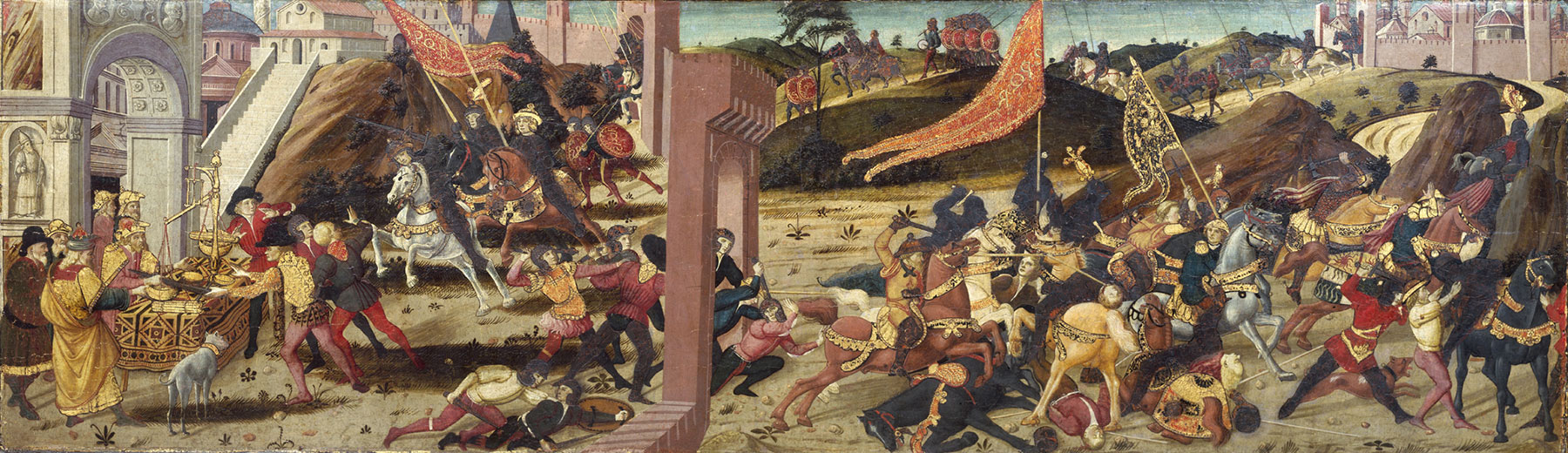
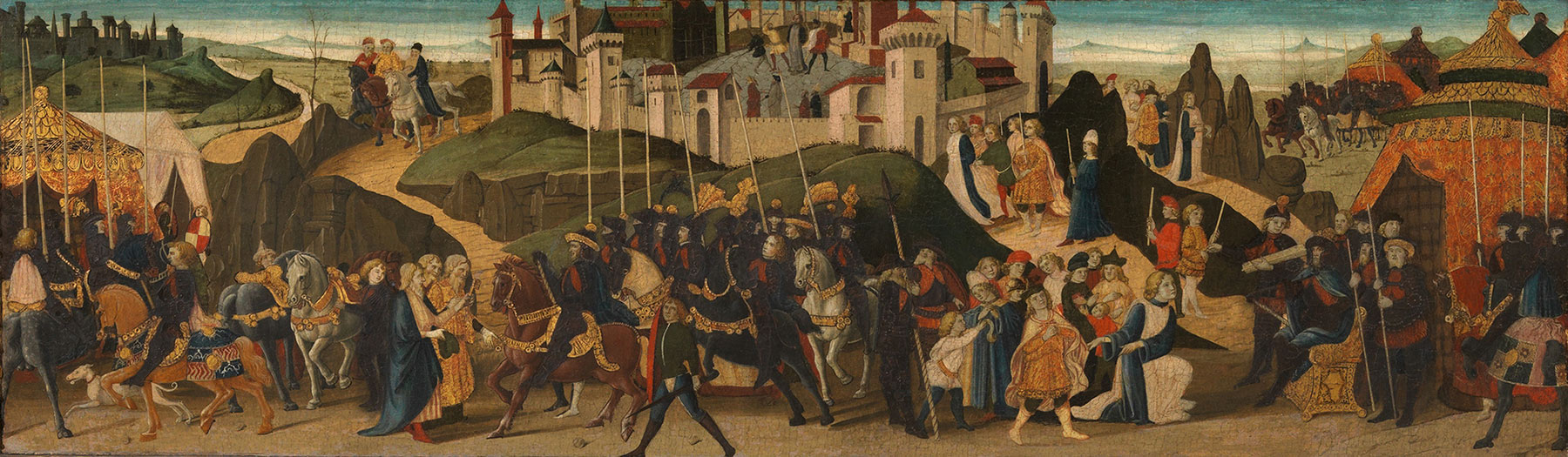
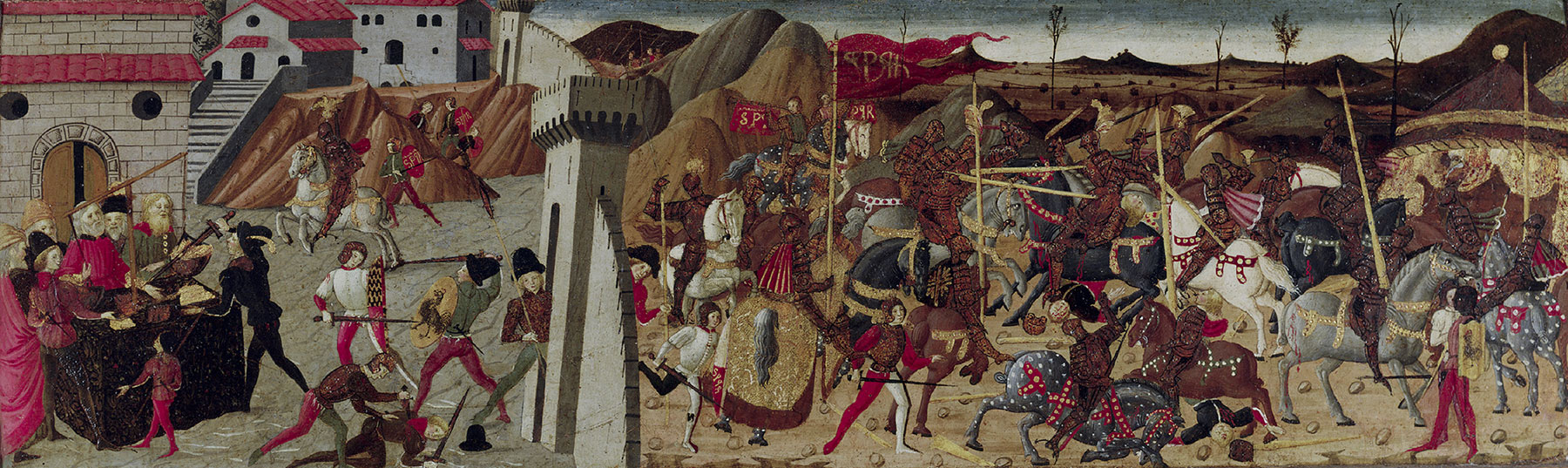
In her review of the documents related to the career of Giovanni di Ser Giovanni Guidi, Margaret Haines suggested that, allowing for the usual exaggeration of hardship presented to the Florentine tax authorities, the bulk of responsibility for the production of the Scheggia studio by 1469 may have fallen to Giovanni’s son Antonfrancesco, the father having declared himself at that time as being infirm.16 While this is highly plausible, Bellosi’s proposal to identify the work of Antonfrancesco within the larger global output of the studio is not. Bellosi recognized a decidedly more modern and accomplished hand, which he inferred was that of Antonfrancesco, in paintings such as the Seven Virtues in the Cambo Collection at the Museu de Art de Catalunya, Barcelona,17 demonstrably a pair to the Seven Liberal Arts in the same collection that he correctly identified as a typical work of Lo Scheggia.18 The Virtues, however, were painted by Biagio d’Antonio, undoubtedly at the time that he was a cotenant with Scheggia of the studio at the Loggia dei Pilli, in or around 1472. There is no internal evidence to support the a priori assumption that Antonfrancesco was a stylistically more advanced painter than his father simply because he was a member of a younger generation. It is at least theoretically possible, if not objectively more likely, that Antonfrancesco may have been responsible for the progressive degradation of the linear style of Giovanni di Ser Giovanni Guidi to the blander but ostensibly smoother painting style that characterizes what Bellosi termed the “avanzata maturita” (advanced maturity) of Lo Scheggia. If so, Antonfrancesco’s premature death at about thirty-five years of age on September 11, 1476,19 must have brought an effective end to the production of the family studio and would provide a probable terminus ante quem for works like the Yale cassone. In August 1477, Lo Scheggia received a gift of two lire from the Compagnia di San Zanobi “per l’amore di Dio per sua infermita” (for the love of God and for his infirmity), and in his tax declaration of 1480, he described himself as “d’eta d’anni 74, non fa piu nulla” (74 years old, no longer doing anything).20 —LK
Published References
Pedrini, Augusto. Il Mobilio: Gli ambienti e le decorazioni del Rinascimento in Italia. Turin: Itala Ars, 1925., 75, pl. 175; Schubring, Paul. “New Cassone Panels—IV.” Apollo 8, no. 46 (October 1928): 1977–83., 181–82; Pedrini, Augusto. Il Mobilio: Gli ambienti e le decorazioni del Rinascimento in Italia; Secoli XV e XVI. Florence: Azienda Libraria, 1948., 78, fig. 201; Seymour, Charles, Jr. Early Italian Paintings in the Yale University Art Gallery. New Haven: Yale University Art Gallery, 1970., 115–17, no. 79; Fredericksen, Burton B., and Federico Zeri. Census of Pre-Nineteenth-Century Italian Paintings in North American Public Collections. Cambridge, Mass.: Harvard University Press, 1972., 600; Bellosi, Luciano, and Margaret Haines. Lo Scheggia. Florence: Maschietto e Musolino, 1999., 89
Notes
-
Plutarch. Lives. Trans. Bernadotte Perin. Vol. 2. Loeb Classical Library. Cambridge, Mass.: Harvard University Press, 1914., 165. ↩︎
-
Plutarch. Lives. Trans. Bernadotte Perin. Vol. 2. Loeb Classical Library. Cambridge, Mass.: Harvard University Press, 1914., 169. ↩︎
-
Paul Schubring, letter to Maitland Griggs, 1927, curatorial files, Department of European Art, Yale University Art Gallery. ↩︎
-
Schubring, Paul. “New Cassone Panels—IV.” Apollo 8, no. 46 (October 1928): 1977–83., 181. ↩︎
-
Inv. no. NGI.778, http://onlinecollection.nationalgallery.ie/objects/10975/the-battle-of-anghiari. ↩︎
-
Seymour, Charles, Jr. Early Italian Paintings in the Yale University Art Gallery. New Haven: Yale University Art Gallery, 1970., 115. ↩︎
-
Although sometimes attributed to Biagio d’Antonio or an anonymous painter of his generation, the Dublin panels portraying the battle of Anghiari (see note 5, above), from which the Anghiari Master took his name, and the conquest of Pisa (inv. no. NGI.780, http://onlinecollection.nationalgallery.ie/objects/10998/the-taking-of-pisa/) are actually important late works by Paolo Uccello, severely damaged and extensively repainted in relatively modern times. ↩︎
-
Fredericksen, Burton B., and Federico Zeri. Census of Pre-Nineteenth-Century Italian Paintings in North American Public Collections. Cambridge, Mass.: Harvard University Press, 1972., 115–16. ↩︎
-
Bernardo Rosselli, The Virgin Adoring the Child with Two Angels, inv. no. 1951.31.3, https://hvrd.art/o/228943. ↩︎
-
Everett Fahy, letters to Michael Komanecky, April 30, 1984; February 14, 1985, Yale University Art Gallery Archives. ↩︎
-
Bellosi, Luciano, and Margaret Haines. Lo Scheggia. Florence: Maschietto e Musolino, 1999., 89. ↩︎
-
See Bartoli, Roberta. Biagio d’Antonio. Milan: Federico Motta, 1999., 150–53, 185–86; and Campbell, Caroline. Love and Marriage in Renaissance Florence: The Courtauld Wedding Chests. Exh. cat. London: Courtauld Gallery with Paul Holberton, 2009.. ↩︎
-
Campbell, Caroline. Love and Marriage in Renaissance Florence: The Courtauld Wedding Chests. Exh. cat. London: Courtauld Gallery with Paul Holberton, 2009., 74, 79n30; and Margaret Haines, in Bellosi, Luciano, and Margaret Haines. Lo Scheggia. Florence: Maschietto e Musolino, 1999., 60, 69, doc. 6. ↩︎
-
Sale, Sotheby’s, London, July 12, 1978, lot 98. ↩︎
-
Davies, Martin. National Gallery Catalogues: The Earlier Italian Schools. 2nd rev. ed., London: National Gallery, 1961., 189–90. ↩︎
-
Bellosi, Luciano, and Margaret Haines. Lo Scheggia. Florence: Maschietto e Musolino, 1999., 59. ↩︎
-
Inv. no. 06 4967-000, https://www.museunacional.cat/en/colleccio/seven-virtues/anton-francesco-dello-scheggia/064967-000. ↩︎
-
Inv. no. 06 4968-000, https://www.museunacional.cat/en/colleccio/seven-liberal-arts/giovanni-di-ser-giovanni-lo-scheggia/064968-000. ↩︎
-
Bellosi, Luciano, and Margaret Haines. Lo Scheggia. Florence: Maschietto e Musolino, 1999., 62. ↩︎
-
Bellosi, Luciano, and Margaret Haines. Lo Scheggia. Florence: Maschietto e Musolino, 1999., 61–62. ↩︎