James Jackson Jarves (1818–1888), Florence, by 1859
The panel support, of a horizontal wood grain, has been thinned to a depth of 8 millimeters, mounted on an auxiliary walnut backing, and cradled. It is composed of three planks with seams on a slight diagonal, measuring approximately 27, 34, and 26 centimeters in width, top to bottom. Each plank has developed one or two full-length splits plus numerous partial splits from the pressure of the cradle and auxiliary backing, but these have provoked only minor paint loss, except for a missing section of sky above and to the left of the Annunciatory Angel’s wings. A partial barb is present along all four edges of the composition, which have also been covered by a thin strip of black paint that once continued onto the engaged frame; there is no indication of whether this is original or a later addition. Gilding throughout is well preserved, although mordant gilding has been nearly entirely lost. The paint surface is abraded, especially at the upper left and in the Virgin’s blue robe. The left hand of the Virgin and the left hand of the Angel have both been effaced. The Angel’s wings (except for the red feathers), the Virgin’s head and book, and the small figure of God the Father are relatively well preserved. A layer of modeling glazes appears to have been lost.
The original function of this work, painted on a horizontally grained support but too large to be a predella fragment, is as confounding as its authorship. Evidence of an engaged frame along all four edges could point to an independent devotional panel, but its square format is unusual. The image conforms to representations of the Annunciation in a tavola quadrata that became popular in fifteenth-century Florence following Fra Angelico’s prototype,1 although these were conceived as large altarpieces. No comparable examples on a smaller scale are known. The Yale version departs from other compositions more closely dependent on Fra Angelico’s model by relegating the rationally conceived Brunelleschian portico outside the Virgin’s chamber, used as a setting for the Annunciation, to a mere backdrop against which the disproportionately large figures are silhouetted. The event takes place in a courtyard with a bright pink stone floor separated from the surrounding garden by a low gray wall. The artist’s emphasis is less on coherent spatial solutions than on brilliant coloristic effects and preciously tooled surfaces. The Virgin is seated on a marble throne covered by an elaborately gilt cloth of honor with a red lining; parallel strokes incised in the gold leaf in different directions around a simple flower motif originally created the effect of a textured, brocaded textile, and a now-vanished lake glaze conveyed the material’s folds and volume.2 The Virgin wears a red-lake dress with embroidered cuffs executed in a sgraffito technique. Her mantle was once painted in lapis lazuli, now faded to pale blue, and edged in gold. The Angel is dressed in a simple puce-colored tunic with green lining that was also decorated with gold trim; on his feet are a pair of delicate gold slippers. The feathers of the Angel’s wings are a rainbow of bright hues, from red lake to green, blue, ochre, yellow, and white. Visible through a doorway leading into the Virgin’s room is a brilliant vermilion bedspread topped by a small pillow with gold tassels. In the upper left of the composition is the traditional image of God the Father sending forth the Dove of the Holy Spirit, a detail only partially alluded to in Angelico’s recasting of the event but typical of earlier Annunciation scenes.
Attributed by James Jackson Jarves to Benozzo Gozzoli,3 the Yale Annunciation was discussed by Osvald Sirén as the youthful, qualitatively uneven effort of a painter influenced by Filippo Lippi and Gozzoli but also aware of the work of Neri di Bicci.4 Based on these stylistic coordinates, Sirén assigned the picture to Giusto di Andrea (1440–1498), son of the painter Andrea di Giusto (active 1424–55), who is recorded as a pupil in Neri’s workshop between 1458 and 1461, during which time he also worked for Filippo Lippi for a year, before joining Gozzoli in San Gimignano and Certaldo, between 1465 and 1468.5 Notwithstanding the availability of biographical information, however, the artistic profile of this little-known master, by whom no authenticated works survive, is vague. Sirén’s attribution of the Yale panel to Giusto was reiterated by Raimond van Marle,6 but both authors based their stylistic comparisons on a body of work that was subsequently recognized as the oeuvre of Angelico’s follower Domenico di Michelino (1417–1491).7 Richard Offner, who rejected the attribution to Giusto in favor of an unidentified painter “related” to Benozzo Gozzoli, followed Sirén nonetheless in noting the strong similarities between the detail of God the Father in the Yale panel and the manner of Neri di Bicci.8 The relevance of Neri di Bicci’s production was fully acknowledged by Bernard Berenson, who inserted the Annunciation in the artist’s corpus, albeit specifying that it was Neri “copying” Francesco Pesellino.9 The reference to Pesellino was taken up by Charles Seymour, Jr., who wrote that “the relationship with Pesellino suggests not so much a copy as a still unidentified follower” and catalogued the work as “Florentine School, around 1455.”10
Following Burton Fredericksen and Federico Zeri, who cited an unrecorded attribution to Domenico di Michelino,11 efforts to assess the formal and stylistic components of the picture have been inconclusive. Everett Fahy, in his notes on some of the paintings in the Yale University Art Gallery collection,12 thought that the author of the Annunciation was an anonymous Florentine artist whose works still remained to be isolated, although he also appears to have included the painting in his files on Apollonio di Giovanni.13 Carl Strehlke assigned the work to Apollonio in his unpublished checklist of paintings in the Gallery,14 while Federico Zeri listed it under Giovanni di Ser Giovanni Guidi, called Lo Scheggia.15 Neither of these proposals is persuasive. The small narrative scenes by Apollonio di Giovanni, who is known primarily as a cassone painter, show a cursory approach and dynamic quality that are absent from the present work, while the group of devotional images currently assigned to him are defined by a drier execution and more pronounced expressive concerns.16 Similarly, comparisons with Scheggia’s agitated, brittle figure types betray a markedly different artistic sensibility.
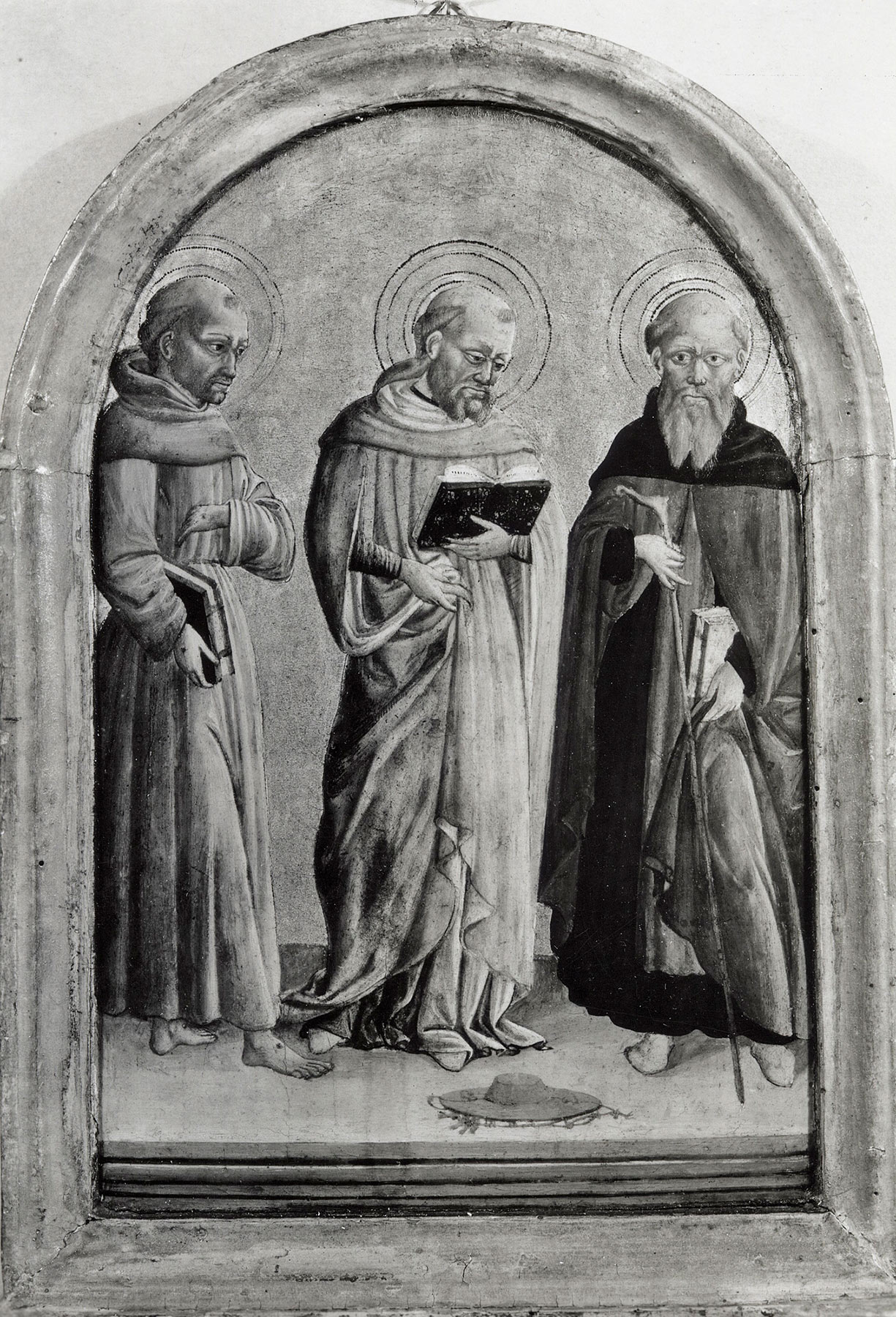
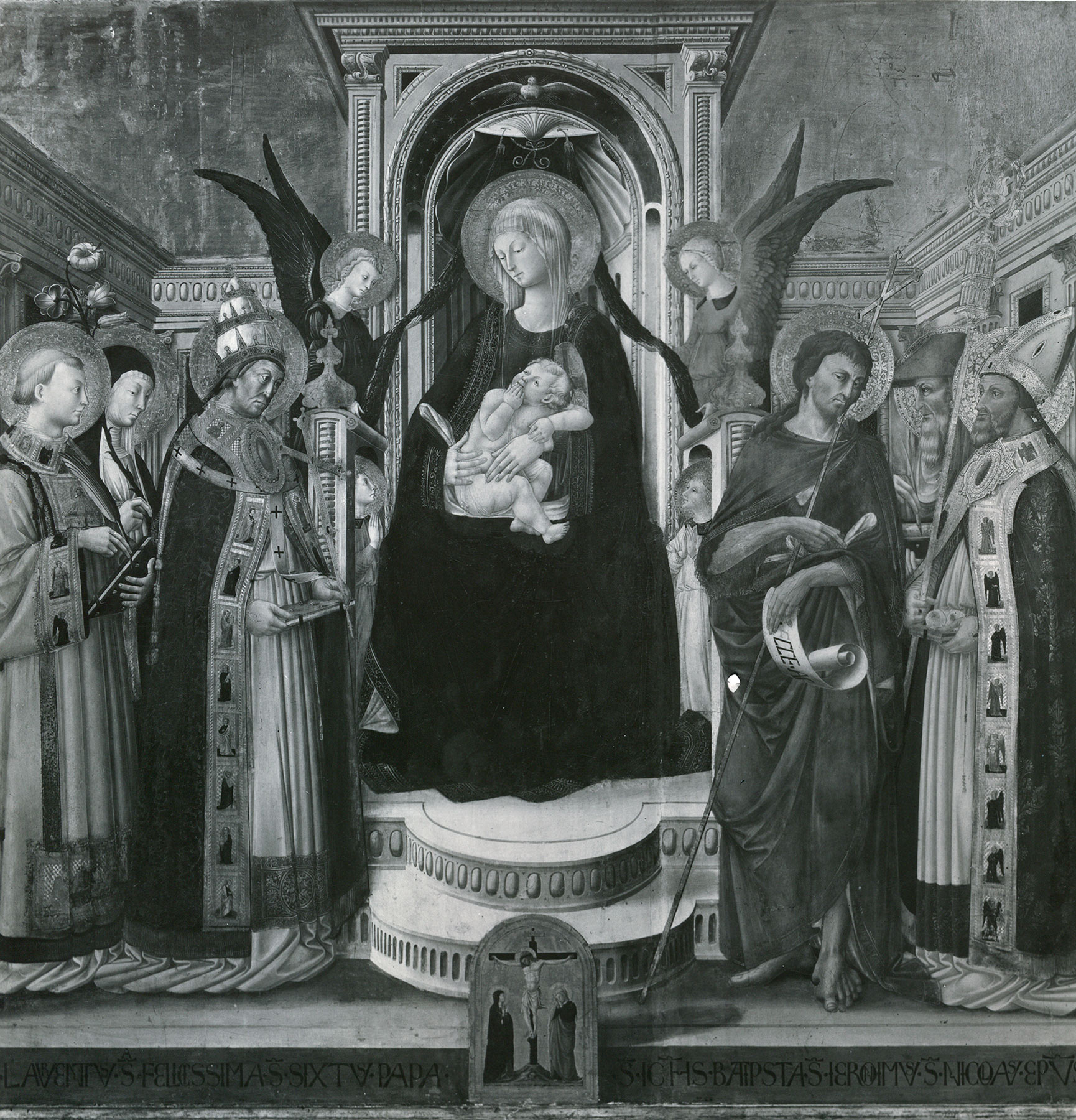
The most compelling analogies for the Yale Annunciation are found in the production of Neri di Bicci, whose influence is immediately recognizable in the image of God the Father, based on a type ubiquitous in Neri’s altarpieces and, in particular, the figure in Neri’s 1464 Annunciation in the Galleria dell’Accademia, Florence, convincingly singled out for comparison by Sirén.17 At the same time, the cruder handling of the Yale God the Father points to a different personality in Neri’s workshop and shows striking similarities to a little-known panel with Saint Jerome between Saints Francis and Anthony Abbot formerly in the collection of Artaud de Montor, Paris (fig. 1), which shares the same coarsely delineated facial features and terracotta flesh tones.18 Assigned by Offner and Zeri to Neri di Bicci,19 the ex–Artaud de Montor picture, like the present image, was listed by Berenson as a work by Neri after Pesellino.20 The possibility that the Yale Annunciation might be by the same hand cannot be dismissed. As implied in Berenson’s assessment, the delicate profile of the Angel shows an awareness of Filippo Lippi’s and Pesellino’s models, evoking some of the golden-haired youths in Pesellino’s Stories of David in the National Gallery, London.21 These influences are overlaid, however, by a certain hardness of execution, more obvious in the contours of the Virgin and in the incisive marking of her facial features and square jaw, that elicits comparison with Neri’s production in the late 1450s, as represented by works such as the Virgin and Child with Six Saints in the church of San Sisto, Viterbo (fig. 2). Technical aspects of the Annunciation, especially the tooling of the large gilt haloes, are also consistent with the conservative, essentially decorative approach of Neri’s workshop—even if the unique penta-rosette pattern used in this instance does not exactly match that in paintings by the artist.22 Smaller details, like the distinctive gilt motif around the cuff of the Virgin’s dress, are typical of Neri’s repertory. Whether the author of this picture could be the “real” Giusto di Andrea remains an open question. —PP
Published References
Jarves, James Jackson. Descriptive Catalogue of “Old Masters” Collected by James J. Jarves to Illustrate the History of Painting from A.D. 1200 to the Best Periods of Italian Art. Cambridge, Mass.: H. O. Houghton, 1860., 51, no. 62; Sturgis, Russell, Jr. Manual of the Jarves Collection of Early Italian Pictures. New Haven: Yale College, 1868., 60–61; W. F. Brown, Boston. Catalogue of the Jarves Collection of Early Italian Pictures. Sale cat. November 9, 1871., no. 63; Rankin, William. “Some Early Italian Pictures in the Jarves Collection of the Yale School of Fine Arts at New Haven.” American Journal of Archaeology 10, no. 2 (April–June 1895): 137–51., 149; Sirén, Osvald. A Descriptive Catalogue of the Pictures in the Jarves Collection Belonging to Yale University. New Haven: Yale University Press, 1916., 101–5, no. 40; van Marle, Raimond. The Development of the Italian Schools of Painting. Vol. 11. The Hague: M. Nijhoff, 1929., 630; “Handbook: A Description of the Gallery of Fine Arts and the Collections.” Special issue, Bulletin of the Associates in Fine Arts at Yale University 5, nos. 1–3 (1931): 1–64., 29; Berenson, Bernard. Italian Pictures of the Renaissance: A List of the Principal Artists and Their Works with an Index of Places. Oxford: Clarendon, 1932., 388, 443; “Picture Book Number One: Italian Painting.” Special issue, Bulletin of the Associates in Fine Arts at Yale University 15, nos. 1–3 (October 1946): n.p., fig. 8; Berenson, Bernard. Italian Pictures of the Renaissance, A List of the Principal Artists and Their Works with an Index of Places: Florentine School. 2 vols. London: Phaidon, 1963., 1:156, 168; Seymour, Charles, Jr. Early Italian Paintings in the Yale University Art Gallery. New Haven: Yale University Art Gallery, 1970., 139, 315, no. 98; Fredericksen, Burton B., and Federico Zeri. Census of Pre-Nineteenth-Century Italian Paintings in North American Public Collections. Cambridge, Mass.: Harvard University Press, 1972., 599; Frinta, Mojmír S. Punched Decoration on Late Medieval Panel and Miniature Painting. Vol. 1, Catalogue Raisonné of All Punch Shapes. Prague: Maxdorf, 1998., 466
Notes
-
Museo del Prado, Madrid, inv. no. P000015, https://www.museodelprado.es/en/the-collection/art-work/the-annunciation/9b02b6c9-3618-4a92-a6b7-26f9076fcb67. ↩︎
-
The author would like to thank Irma Passeri for her technical notes on the picture. ↩︎
-
Jarves, James Jackson. Descriptive Catalogue of “Old Masters” Collected by James J. Jarves to Illustrate the History of Painting from A.D. 1200 to the Best Periods of Italian Art. Cambridge, Mass.: H. O. Houghton, 1860., 51, no. 62. ↩︎
-
Sirén, Osvald. A Descriptive Catalogue of the Pictures in the Jarves Collection Belonging to Yale University. New Haven: Yale University Press, 1916., 101–5, no. 40. ↩︎
-
Knowledge of these details comes from Neri’s Ricordanze and Giusto’s own diary. See Neri di Bicci. Le ricordanze (10 marzo 1453–24 aprile 1475). Ed. Bruno Santi. Pisa: Marlin, 1976., 101, 129–30, 158; and Gaye, Johann Wilhelm. Carteggio inedito d’artisti dei secoli XIV, XV, XVI. Vol. 1. Florence: G. Molini, 1839., 211–13. ↩︎
-
van Marle, Raimond. The Development of the Italian Schools of Painting. Vol. 11. The Hague: M. Nijhoff, 1929., 630. ↩︎
-
Ciaranfi, Annamaria. “Domenico di Michelino.” Dedalo 6, no. 2 (1925–26): 522–38., 522–38; and Collobi Ragghianti, Licia. “Zanobi Strozzi pittore.” Parts 1 and 2. Critica d’arte, 3rd ser., 8, no. 6, fasc. 32 (March 1950): 454–73; 3rd ser., 9, no. 1, fasc. 33 (May 1950): 17–27., 363–78. ↩︎
-
Richard Offner, “Lecture at Jarves Collection, New Haven, November 22, 1924,” cited in the Frick Art Reference Library, New York. ↩︎
-
Berenson, Bernard. Italian Pictures of the Renaissance: A List of the Principal Artists and Their Works with an Index of Places. Oxford: Clarendon, 1932., 388, 433; and Berenson, Bernard. Italian Pictures of the Renaissance, A List of the Principal Artists and Their Works with an Index of Places: Florentine School. 2 vols. London: Phaidon, 1963., 1:156, 168. ↩︎
-
Seymour, Charles, Jr. Early Italian Paintings in the Yale University Art Gallery. New Haven: Yale University Art Gallery, 1970., 139, no. 98. ↩︎
-
Fredericksen, Burton B., and Federico Zeri. Census of Pre-Nineteenth-Century Italian Paintings in North American Public Collections. Cambridge, Mass.: Harvard University Press, 1972., 599. The authors may have been updating the original attribution to Giusto di Andrea. ↩︎
-
See curatorial files, Department of European Art, Yale University Art Gallery. ↩︎
-
See Fototeca Everett Fahy, Federico Zeri Foundation, Bologna, inv. no. 409100. ↩︎
-
Curatorial files, Department of European Art, Yale University Art Gallery. ↩︎
-
Fototeca Zeri, Federico Zeri Foundation, Bologna, inv. no. 10987. ↩︎
-
See Andrea Staderini, in De Marchi, Andrea, and Cristina Gnoni Mavarelli, eds. Da Donatello a Lippi: Officina Pratese. Milan: Skira, 2013., 142–47, nos. 3.5–.8. ↩︎
-
Inv. no 1890 n. 8622, https://catalogo.uffizi.it/it/29/ricerca/detailiccd/1176910/; Sirén, Osvald. A Descriptive Catalogue of the Pictures in the Jarves Collection Belonging to Yale University. New Haven: Yale University Press, 1916., 104. ↩︎
-
The painting, gifted to the New-York Historical Society in 1867 by Thomas J. Bryan, is last recorded in a sale at Sotheby’s, New York, October 9, 1980, lot 69. ↩︎
-
Offner, in a lecture at the New-York Historical Society, December 17, 1924, cited in Frick Art Reference Library; and Fredericksen, Burton B., and Federico Zeri. Census of Pre-Nineteenth-Century Italian Paintings in North American Public Collections. Cambridge, Mass.: Harvard University Press, 1972., 148, 221. ↩︎
-
Berenson, Bernard. Italian Pictures of the Renaissance, A List of the Principal Artists and Their Works with an Index of Places: Florentine School. 2 vols. London: Phaidon, 1963., 1:156, 168. ↩︎
-
National Gallery, London, inv. nos. NG NG6579–80, https://www.nationalgallery.org.uk/paintings/francesco-pesellino-the-story-of-david-and-goliath, https://www.nationalgallery.org.uk/paintings/francesco-pesellino-the-triumph-of-david. ↩︎
-
This punch is listed by Mojmír Frinta (in Frinta, Mojmír S. Punched Decoration on Late Medieval Panel and Miniature Painting. Vol. 1, Catalogue Raisonné of All Punch Shapes. Prague: Maxdorf, 1998., 466, no. Kb42), who cites the Yale Annunciation “by Giusto di Andrea?” as an isolated example of its use. ↩︎