Osvald Sirén (1879–1966), Stockholm, by 1916;1 F. Kleinberger Galleries, New York, 1916; sale, F. Kleinberger Galleries, New York, January 23, 1918, lot 64; Mrs. Alfred Nathan, New York;2 French and Company, New York, by 1935;3 Hannah D. and Louis M. Rabinowitz (1887–1957), Sands Point, Long Island, N.Y., 1943
Both panels, of a vertical wood grain, were thinned to a depth of approximately 9 millimeters, mounted on an auxiliary support, and cradled prior to their arrival at Yale. The overall dimensions for the panel with Saint John the Baptist include veneer capping strips applied all around its perimeter and incorporated into the paint surface. Similar strips surrounding the panel with Saint James Major were removed during an aggressive cleaning by Andrew Petryn in 1967, at which time losses at the top and at the lower-right corner were excavated to beneath the layer of the wood support, as were losses along two major splits, 11.5 and 20 centimeters from the left edge, and along several minor splits. Cavities housing the nails that secured iron strap hinges, aligned at 16 and 69.5 centimeters from the bottom edge, were also excavated during this campaign. In addition to these complete losses and further scattered losses at the left edge of the panel and in the left half of the saint’s halo, the paint surface of the Saint James has been severely abraded and all the mordant gilt decoration lost. The composition has been truncated by at least 1 centimeter on the left, where the band of punched decoration along the margin is incomplete, and possibly more on the top and right, judging from the cropping of figures in the scene of the Resurrection in the lunette. The panel with Saint John the Baptist was left uncleaned in 1967 and is reasonably well preserved, revealing only modest abrasion beneath a heavily discolored synthetic varnish. One major and several minor splits are visible in this panel but have not resulted in significant paint loss. Hinge nails, aligned at 18.5 and 63.5 centimeters from the bottom edge, are visible as minor disturbances in the level of the paint that covers them. Local losses at the lower left and at the peak of the lunette have been repainted. Some flaking of the green leaves of the tree behind the Baptist at the right has occurred where they overlap the gold ground. Flesh tones in the Crucifixion scene in the lunette are well preserved.
As indicated by the traces of hinges attaching them to the central structure, these two panels were once the wings, or doors, of an unidentified tabernacle. The saints decorated the inner faces of the wings and would have been visible when the tabernacle was open. On the left was Saint John the Baptist, standing against a rocky outcrop with the traditional attributes of a reed cross, a camel skin, and a baptismal bowl at his feet. He wears a light gray mantle with pink lining over a long hair garment. In his left hand is a scroll inscribed with the words “ECCE ANGNUS[sic] D[E]I” (Behold the lamb of God). His right hand points up to the Crucifixion scene in the demilunette above. In contrast to the spare representations of Christ on the Cross that usually occupy this small area, the present Crucifixion, as was noted by Lionello Venturi,4 incorporates multiple iconographic details that increase its symbolic and dramatic value: the mourning Virgin and Saint John the Evangelist; the three angels collecting Christ’s blood in Eucharistic plates; the sun and the moon, with their cosmological and theological implications;5 the pelican, a symbol of Christ’s sacrifice, in its nest above the Cross (no longer visible); and the blessing hand of God the Father. On the right shutter, stripped of its original glazes and defaced by modern intervention, is Saint James Major, identified by the pilgrim’s staff and the book with a scallop shell. He stands on a pink marbleized floor and is dressed in a light blue tunic and a rose-colored cloak with gold trim and yellow lining. Above the saint is the Resurrection of Christ. Lying or crouching before the closed marble tomb—sealed shut with red wax—are three soldiers in yellow and red armor. They have just been awakened from their sleep and look up in awe at the miraculous apparition of the risen Christ, who floats above the tomb holding the banner of the Resurrection with its red cross.
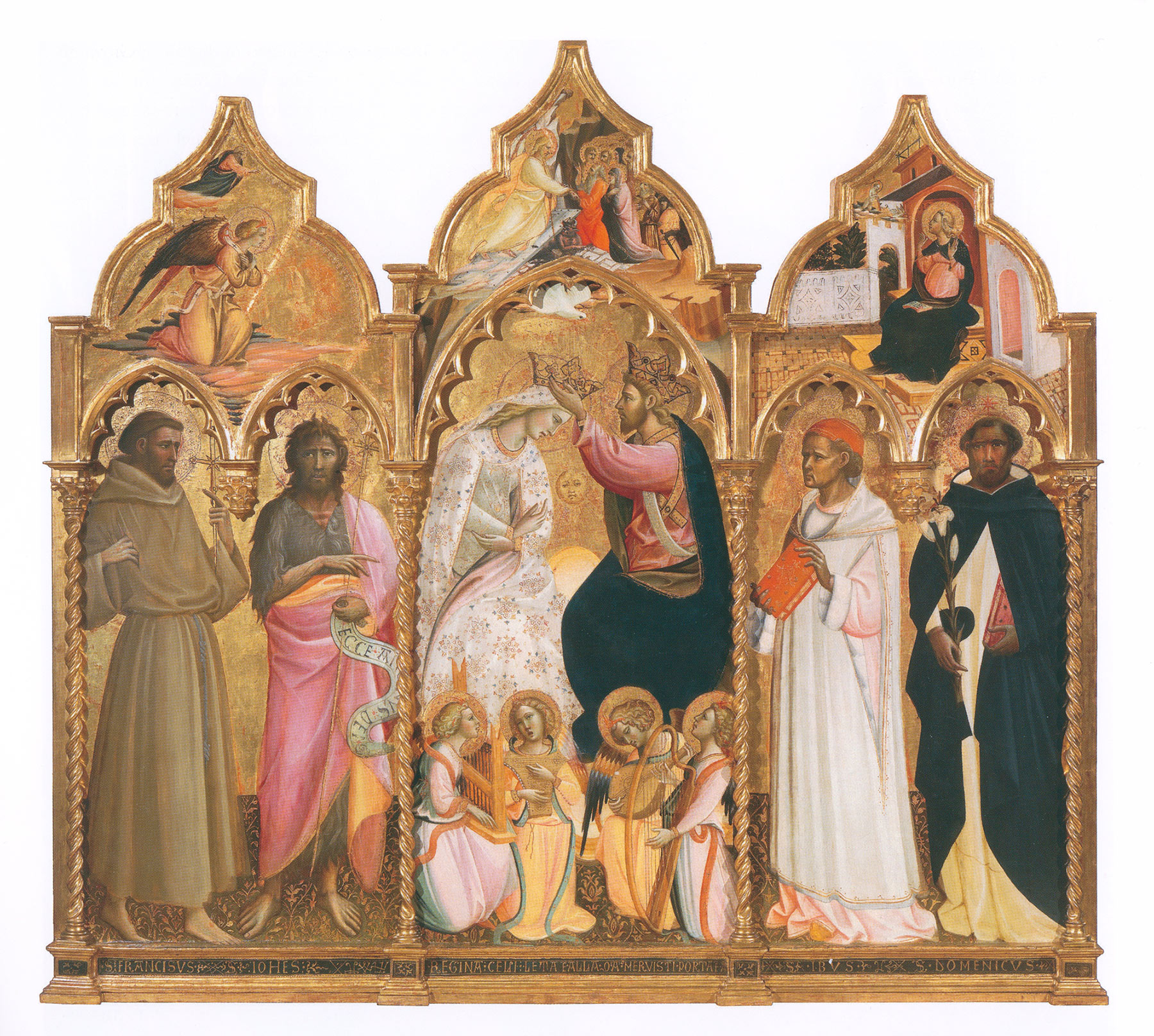
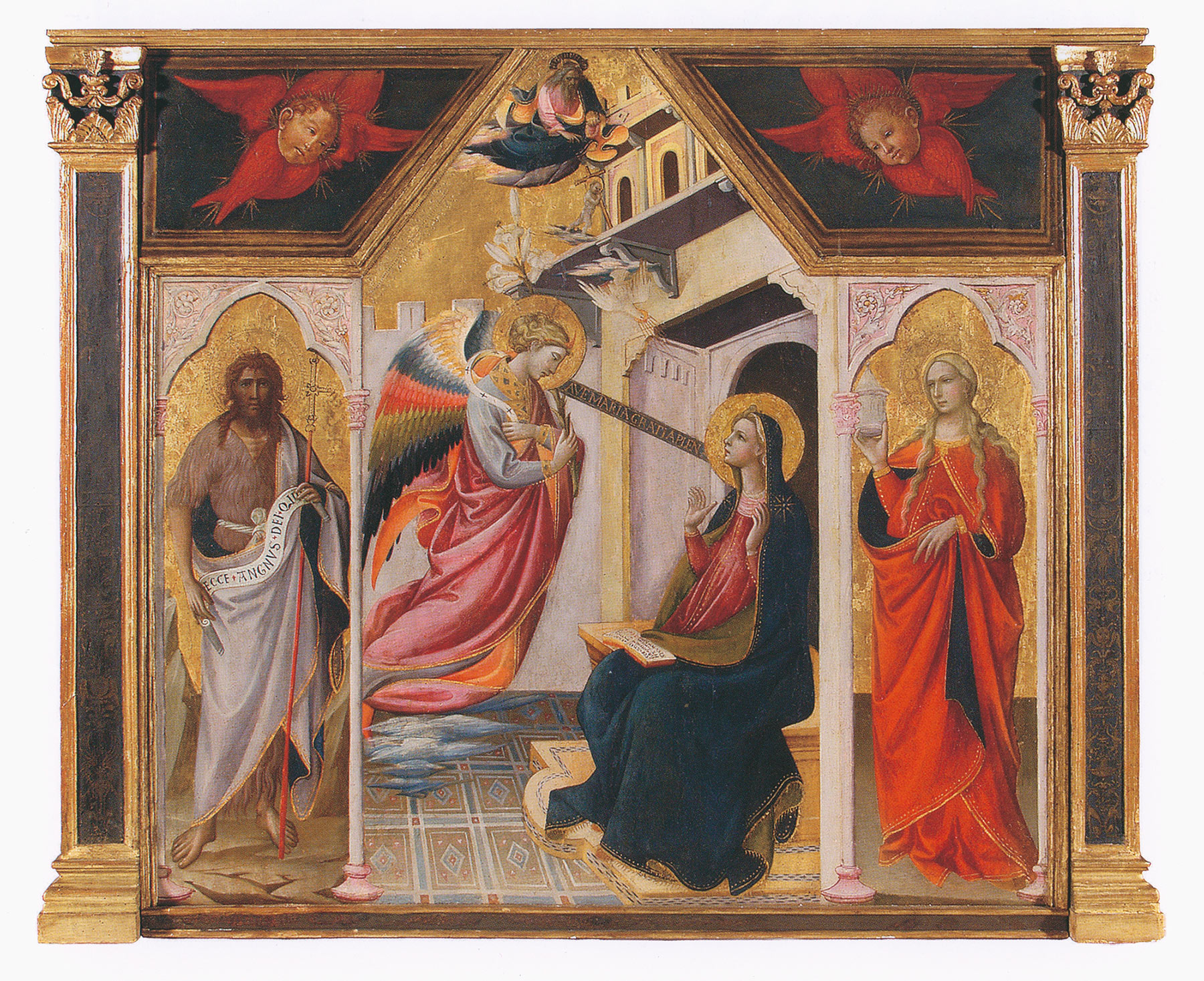
The two wings were formerly owned by Osvald Sirén, who first published them in 1917 with an attribution to Giovanni dal Ponte.6 Catalogued as works of Giovanni dal Ponte by Venturi7 in the only extensive discussion of them to date, they have been listed in the corpus of the artist by all subsequent scholars. As in the case of other works by Giovanni dal Ponte, however, their dating has fluctuated by as much as two decades, from as early as 1410 to 1425–30.8 Although the relative chronology of the artist’s oeuvre remains fluid, hampered by a scarcity of documented or dated works, the Yale Saints appear to be later than the Garden of Love, also in the Yale University Art Gallery. The loose, calligraphic idiom and approximative treatment of the figures approach those images generally placed by current scholarship between the late 1420s and early 1430s. The Saint John the Baptist, in particular, recalls the stolid figure types flanking the Coronation of the Virgin (fig. 1) in the Galleria dell’Accademia, Florence, and the slightly later Annunciation (fig. 2) in the Badia of Santa Maria a Poppiena in Pratovecchio-Stia (Arezzo).9 All three works certainly precede the dated 1434 Annunciation in the abbey of Santa Maria in Rosano, which includes the more animated, eccentric type of Baptist associated with the painter’s last efforts. A date for the Yale Saints around 1430 seems reasonable. —PP
Published References
Sirén, Osvald, and Maurice W. Brockwell. Catalogue of a Loan Exhibition of Italian Primitives in Aid of the American War Relief. Exh. cat. New York: F. Kleinberger Galleries, 1917., 42–43, no. 14, fig. 14; Perkins, F. Mason. “A Florentine Double Portrait at the Fogg Museum.” Art in America 9, no. 4 (1921): 136–48., 148; van Marle, Raimond. The Development of the Italian Schools of Painting. Vol. 9. The Hague: M. Nijhoff, 1927., 86; Venturi, Lionello. The Rabinowitz Collection. New York: Twin Editions, 1945., 17–18; “Recent Gifts and Purchases: February 22–December 31, 1959.” Yale University Art Gallery Bulletin 26, no. 1 (December 1960): 52–58., 54; Seymour, Charles, Jr. The Rabinowitz Collection of European Paintings. New Haven: Yale University Art Gallery, 1961., 16–17; Berenson, Bernard. Italian Pictures of the Renaissance, A List of the Principal Artists and Their Works with an Index of Places: Florentine School. 2 vols. London: Phaidon, 1963., 1:91; Seymour, Charles, Jr. Early Italian Paintings in the Yale University Art Gallery. New Haven: Yale University Art Gallery, 1970., 152–53, nos. 105a–b; Fredericksen, Burton B., and Federico Zeri. Census of Pre-Nineteenth-Century Italian Paintings in North American Public Collections. Cambridge, Mass.: Harvard University Press, 1972., 91, 600; Lorenzo Sbaraglio, in Sbaraglio, Lorenzo, and Angelo Tartuferi, eds. Giovanni dal Ponte: Protagonista dell’umanesimo tardogotico fiorentino. Exh. cat. Florence: Galleria dell’Accademia, 2016., 207, no. 50
Notes
-
Kleinberger Galleries, stock card, no. 15.107, Kleinberger Galleries Records, Watson Library Digital Collections, Metropolitan Museum of Art, New York, F-15107, https://libmma.contentdm.oclc.org/digital/collection/p16028coll23/id/6242. ↩︎
-
According to information provided by French and Company in a letter dated April 25, 1935, recorded in the Frick Art Reference Library, New York. ↩︎
-
See note 2, above. ↩︎
-
Venturi, Lionello. The Rabinowitz Collection. New York: Twin Editions, 1945., 17. ↩︎
-
Personifications of the sun and the moon on either side of the Cross are common in medieval representation of the Crucifixion but become rarer by the fifteenth century. The motif is already found in early Christian art in the West as a symbol of Christ’s cosmic sovereignty. Following Saint Augustine (A.D. 354–430), scholastic theologians construed the moon on the left of the Cross as the Old Testament and the sun on the right as the New. See Schiller, Gertrude. Iconography of Christian Art. Vol. 2, The Passion of Jesus Christ. Trans. Janet Seligman. London: Lund Humphries, 1972., 109. ↩︎
-
Sirén, Osvald, and Maurice W. Brockwell. Catalogue of a Loan Exhibition of Italian Primitives in Aid of the American War Relief. Exh. cat. New York: F. Kleinberger Galleries, 1917., 42–43. ↩︎
-
Venturi, Lionello. The Rabinowitz Collection. New York: Twin Editions, 1945., 17–18. ↩︎
-
Seymour, Charles, Jr. Early Italian Paintings in the Yale University Art Gallery. New Haven: Yale University Art Gallery, 1970., 152–53, nos. 105a–b; and Lorenzo Sbaraglio, in Sbaraglio, Lorenzo, and Angelo Tartuferi, eds. Giovanni dal Ponte: Protagonista dell’umanesimo tardogotico fiorentino. Exh. cat. Florence: Galleria dell’Accademia, 2016., 207, no. 50. ↩︎
-
The Accademia Coronation is dated 1425–30 by Sbaraglio (in Sbaraglio, Lorenzo, and Angelo Tartuferi, eds. Giovanni dal Ponte: Protagonista dell’umanesimo tardogotico fiorentino. Exh. cat. Florence: Galleria dell’Accademia, 2016., 194, no. 23) and Federica Baldini (in Hollberg, Cecilie, Angelo Tartuferi, and Daniela Parenti, eds. Cataloghi della Galleria dell’Accademia di Firenze: Dipinti. Vol. 3, Il tardogotico. Florence: Giunti, 2020., 77–81, no. 15). Angelo Tartuferi (in Sbaraglio, Lorenzo, and Angelo Tartuferi, eds. Giovanni dal Ponte: Protagonista dell’umanesimo tardogotico fiorentino. Exh. cat. Florence: Galleria dell’Accademia, 2016., 150–53, no. 37) dated it ca. 1430 and placed it before the Poppiena Annunciation. Writing in the same volume, Annamaria Bernacchioni dated the Poppiena triptych between the end of the third decade and beginning of the fourth decade, whereas Sbaraglio suggested 1430–35. See Bernacchioni, in Sbaraglio, Lorenzo, and Angelo Tartuferi, eds. Giovanni dal Ponte: Protagonista dell’umanesimo tardogotico fiorentino. Exh. cat. Florence: Galleria dell’Accademia, 2016., 148–49, no. 36; and Sbaraglio, in Sbaraglio, Lorenzo, and Angelo Tartuferi, eds. Giovanni dal Ponte: Protagonista dell’umanesimo tardogotico fiorentino. Exh. cat. Florence: Galleria dell’Accademia, 2016., 211, no. 59. ↩︎