James Jackson Jarves (1818–1888), Florence, by 1859
The panel support, of a vertical wood grain, has been thinned to a depth of 1.5 centimeters, cradled, and waxed. The picture surface retains a complete barb on all four sides with remnants of gilding that continued on the now-lost engaged frame. Losses from worm damage and nail holes in the wood exposed by removal of this frame were inexplicably filled with putty during a cleaning by Andrew Petryn in 1959, whereas losses revealed in the paint surface were left exposed. These losses are concentrated in the landscape around the figure of Saint Jerome, near Saint Francis’s raised left hand, and along the right edge of the composition. The paint surface is otherwise in exceptionally good condition, with light overall abrasion and such fugitive details as the mordant gilt rays of light emanating from the seraph and the modeling in the foliage of the trees preserved intact. Currently, the surface is flattened and dulled by a discolored synthetic varnish.
This modest devotional panel—of interest disproportionate to its size or artistic ambition due to its unusually fine state of preservation—combines several scenes in a single continuous landscape. At the left and notionally in the foreground, Saint Jerome kneels before a crucifix propped up on a rock before the mouth of a cave. He pulls aside his white robe to bare his chest, marks of blood indicating that he has beaten himself with the stone held in his right hand. On the ground before him is one of his two common attributes, the red cardinal’s beretta, and behind him is the other, the lion from whose paw he legendarily pulled a thorn. In the middle distance at the right of the composition, Saint Francis kneels to receive the marks of the stigmata from a vision of Christ as a six-winged seraph, with his companion, Brother Leo, distinguished by the rays of a beato, looking on.1 In the sky above these scenes, at the upper left and right of the panel, are small images of the Annunciatory Angel and the Virgin Annunciate, appearing against bursts of light among the clouds. Centered along the bottom edge of the picture surface, as though resting on the now-missing engaged frame, is a fictive pax showing Christ as the Man of Sorrows, risen from His tomb and accompanied by the instruments of His Passion: the Cross, the lance that pierced His side, and the sponge of vinegar that quenched His thirst.
James Jackson Jarves, when he owned this painting, believed it to be Umbrian, which might be taken as an indication of its possible provenance as much as a stylistic judgment.2 It was first recognized by Bernard Berenson to be Florentine when he placed its artist in the circle of Jacopo del Sellaio.3 Osvald Sirén catalogued the painting as by Francesco Botticini, specifically comparing it to a suite of predella panels in the Metropolitan Museum of Art, New York, then attributed to that artist but now given to Davide Ghirlandaio.4 Charles Seymour, Jr., dismissed the painting as an anonymous Florentine work of ca. 1485, with the comment that “recent cleaning has revealed more than ever the poverty of talent betrayed by the painter, whose provinciality of style and outlook might place him, as Jarves evidently was convinced, even outside the Florentine school.”5 Burton Fredericksen and Federico Zeri proposed no finer judgment of the work.6 Its present attribution to the Master of the Fiesole Epiphany was suggested by Christopher Daly and appears to be correct.7
The Master of the Fiesole Epiphany was first isolated as an independent artistic personality by Everett Fahy, who assembled around an altarpiece of the Adoration of the Magi with Saints Paul, Francis, and John the Baptist, now in the church of San Francesco at Fiesole, a group of paintings formerly attributed to the circles of Jacopo del Sellaio and Domenico Ghirlandaio.8 Fahy, who did not include the present panel in this category, tentatively proposed associating the name Filippo di Giuliano (1449–1503), documented as Sellaio’s studio partner, with the Master of the Fiesole Epiphany. In an expanded review of all the paintings attributed by Fahy and others to this Master, Daly argued that the large corpus of work assembled around the name is heterogeneous, the bulk of it comprising two distinct tendencies.9 The first of these are works of an appreciable artistic individuality and accomplishment influenced not by Jacopo del Sellaio but by Andrea del Verrocchio, Cosimo Rosselli, and, above all, Domenico Ghirlandaio; the second are works of flat and linear execution repeating a limited set of cartoons derived from the first set and disseminated in great numbers in an obviously successful commercial enterprise. For the first set, into which he inserted the Yale panel, he accepted the designation “Master of the Fiesole Epiphany” and proposed a range of dates from the late 1470s through the 1480s. The second set he differentiated from these as later works, stretching probably from the mid-1480s to the end of the century, and he coined for them the epithet “Master of 1493,” after an altarpiece inscribed with that date now in the Museo del Cenacolo di Andrea del Sarto, in San Salvi, Florence.10 For Daly, if the documented Filippo di Giuliano is to be found anywhere among these paintings, it would more likely be in the second than the first group, but the evidence for suggesting either is purely circumstantial.
While the broad-strokes distinction proposed by Daly between these two sets of works is undeniable, the conclusion that they might represent two independent personalities operating at successive moments is not fully persuasive. Several paintings in both groups are so like works in the other group as to blur the boundaries separating them. The Yale panel is one of these. Its relatively crude execution—apparent in the stiff poses of the figures, the limited angles in which they turn toward the picture plane, and their ineffective arrangement in space, poorly coordinated in size to indicate placement in depth—is contradicted by the freshness and delicacy of landscape details and the originality of the overall composition. It is possible that if the Master of the Fiesole Epiphany was, to some degree, responsible for both sets of works, as described by Daly, paintings like the Yale Penitence of Saint Jerome might indicate a transitional point in his career, perhaps around the turn of the last decade of the fifteenth century. It is certainly to be regarded among the better of his small-scale commissions, on a par with the five known panels of the Este predella now in the Kunsthistorisches Museum, Vienna,11 and in an altogether different category of artistic accomplishment than the banal, repetitive products grouped by Daly around the 1493 altarpiece at San Salvi.
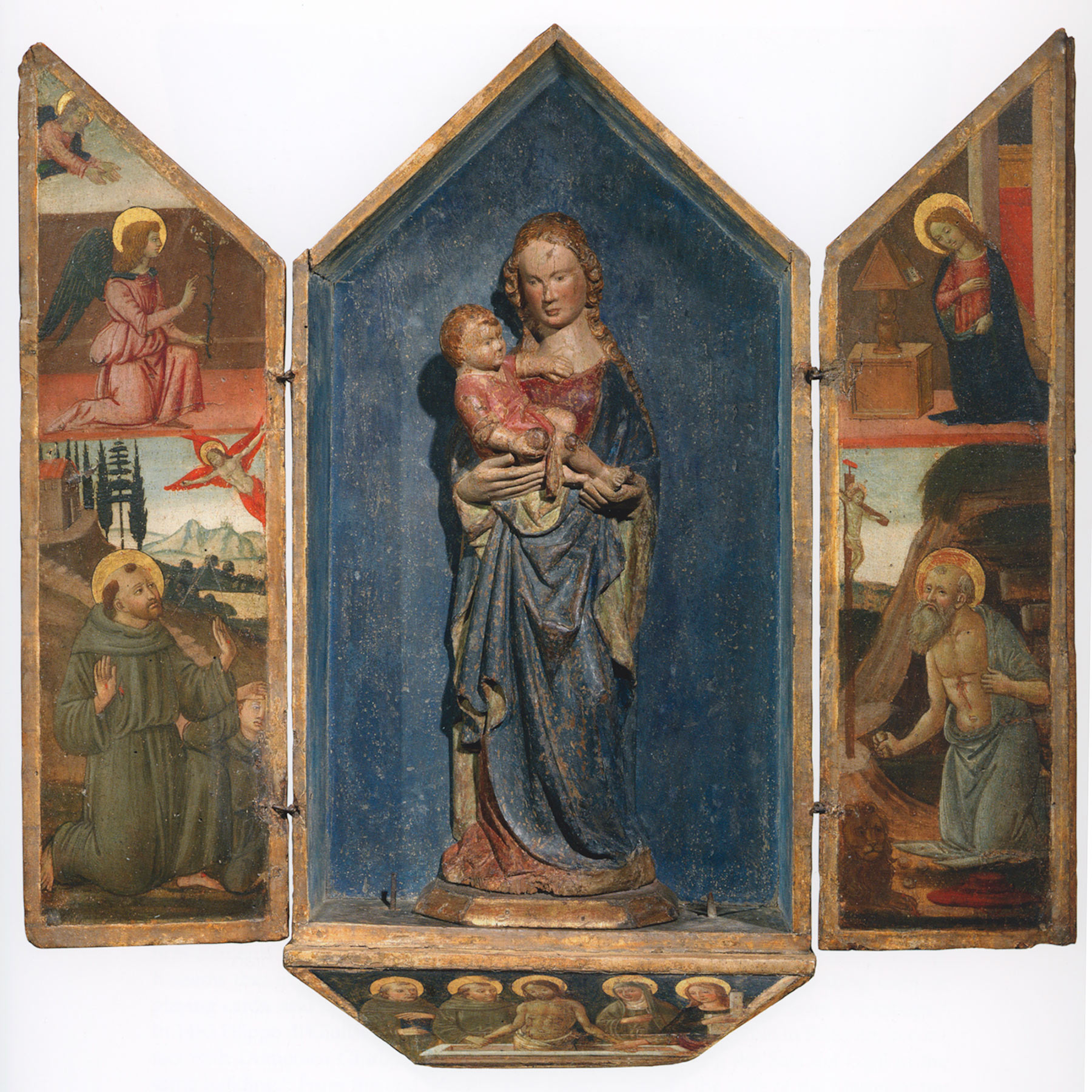
The pairing of Saints Jerome and Francis as subjects of the Yale panel might indicate an original patronage from a member of one of the two Florentine confraternities dedicated to Saint Jerome, both founded in the fifteenth century. The Buca di San Girolamo sulla Costa San Giorgio, one of the most fervent of the Florentine flagellant confraternities, was founded in 1441 by the Franciscan Niccolò da Uzzano (a cousin of the well-known humanist of the same name portrayed by Donatello in a bust now at the Museo Nazionale del Bargello, Florence).12 It and the Buca di San Girolamo alla Sapienza or al Leone, which moved to Florence from Fiesole in 1411 and bore a secondary dedication to San Francesco Poverino, were both nocturnal confraternities, two of the five chartered in Florence at the period.13 The Master of the Fiesole Epiphany may have been working for another member of one of these two confraternities when he painted the shutters of a tabernacle triptych illustrating the Stigmatization of Saint Francis and the Penitence of Saint Jerome—both oriented in reverse to the same vignettes in the Yale panel—with a scene of the Annunciation divided across the gables above (fig. 1). The tabernacle’s painted antependium portrays the Man of Sorrows, as in the fictive pax at the foot of the Yale panel, but in this case supported in His tomb by three Franciscan saints and Saint Barbara.14 The tabernacle may have been commissioned by, or for, a Clarissan rather than a confraternal patron, but its otherwise complete coincidence of subject with the Yale panel is suggestive. —LK
Published References
Jarves, James Jackson. Descriptive Catalogue of “Old Masters” Collected by James J. Jarves to Illustrate the History of Painting from A.D. 1200 to the Best Periods of Italian Art. Cambridge, Mass.: H. O. Houghton, 1860., 48, no. 52; Sturgis, Russell, Jr. Manual of the Jarves Collection of Early Italian Pictures. New Haven: Yale College, 1868., 58; Berenson, Bernard. The Florentine Painters of the Renaissance with an Index to Their Works. 3rd. ed. New York: G. P. Putnam’s Sons, 1909., 183; Sirén, Osvald. A Descriptive Catalogue of the Pictures in the Jarves Collection Belonging to Yale University. New Haven: Yale University Press, 1916., 121–23, no. 44; van Marle. Raimond. The Development of the Italian Schools of Painting. Vol. 12. The Hague: M. Nijhoff, 1931., 412; Berenson, Bernard. Italian Pictures of the Renaissance: A List of the Principal Artists and Their Works with an Index of Places. Oxford: Clarendon, 1932., 527; Berenson, Bernard. Italian Pictures of the Renaissance, A List of the Principal Artists and Their Works with an Index of Places: Florentine School. 2 vols. London: Phaidon, 1963., 1:198; Seymour, Charles, Jr. Early Italian Paintings in the Yale University Art Gallery. New Haven: Yale University Art Gallery, 1970., 131, 313, no. 89; Fredericksen, Burton B., and Federico Zeri. Census of Pre-Nineteenth-Century Italian Paintings in North American Public Collections. Cambridge, Mass.: Harvard University Press, 1972., 599; Daly, Christopher. “Thinking through a Tondo by the Master of the Fiesole Epiphany.” Journal of the Walters Art Museum 77 (2024), https://journal.thewalters.org/volume/77/essay/tondo.
Notes
-
Leo was never officially beatified, having been ostracized from the Franciscan order later in life. His portrayal here as a beato is unusual and may relate directly to the identity of the painting’s original patron. ↩︎
-
Jarves, James Jackson. Descriptive Catalogue of “Old Masters” Collected by James J. Jarves to Illustrate the History of Painting from A.D. 1200 to the Best Periods of Italian Art. Cambridge, Mass.: H. O. Houghton, 1860., 48; and Sturgis, Russell, Jr. Manual of the Jarves Collection of Early Italian Pictures. New Haven: Yale College, 1868., 58. Osvald Sirén recorded the presence on the back of the panel of a seal with the Medici arms, “proving that it has been in the collection of that family”; Sirén, Osvald. A Descriptive Catalogue of the Pictures in the Jarves Collection Belonging to Yale University. New Haven: Yale University Press, 1916., 122. No trace of this seal remains today, so it cannot be confirmed whether it was a collector’s seal or an export seal from the grand duchy of Tuscany. ↩︎
-
Berenson, Bernard. The Florentine Painters of the Renaissance with an Index to Their Works. 3rd. ed. New York: G. P. Putnam’s Sons, 1909., 183; Berenson, Bernard. Italian Pictures of the Renaissance: A List of the Principal Artists and Their Works with an Index of Places. Oxford: Clarendon, 1932., 527; and Berenson, Bernard. Italian Pictures of the Renaissance, A List of the Principal Artists and Their Works with an Index of Places: Florentine School. 2 vols. London: Phaidon, 1963., 1:198. Raimond van Marle followed Berenson’s cue with an emphasis on the questionable nature of the attribution; van Marle. Raimond. The Development of the Italian Schools of Painting. Vol. 12. The Hague: M. Nijhoff, 1931., 412. ↩︎
-
Inv. nos. 13.119.1–.3, https://www.metmuseum.org/art/collection/search/436487, https://www.metmuseum.org/art/collection/search/436486, https://www.metmuseum.org/art/collection/search/436488; see Sirén, Osvald. A Descriptive Catalogue of the Pictures in the Jarves Collection Belonging to Yale University. New Haven: Yale University Press, 1916., 121–23. ↩︎
-
Seymour, Charles, Jr. Early Italian Paintings in the Yale University Art Gallery. New Haven: Yale University Art Gallery, 1970., 131. ↩︎
-
Fredericksen, Burton B., and Federico Zeri. Census of Pre-Nineteenth-Century Italian Paintings in North American Public Collections. Cambridge, Mass.: Harvard University Press, 1972., 599. ↩︎
-
Daly, Christopher. “Thinking through a Tondo by the Master of the Fiesole Epiphany.” Journal of the Walters Art Museum 77 (2024), https://journal.thewalters.org/volume/77/essay/tondo.. ↩︎
-
Fahy, Everett. “Some Early Italian Pictures in the Gambier-Parry Collection.” In “The Gambier-Parry Bequest to the University of London.” Special issue, Burlington Magazine 109, no. 768 (March 1967): 128–39., 133–34; Fahy, Everett. Some Followers of Domenico Ghirlandaio. New York: Garland, 1976., 169–70; and Fahy, Everett. “The Este Predella Panels and Other Works by the Master of the Fiesole Epiphany.” Nuovi studi 6–7, no. 9 (2001–2): 17–29., 17–29. ↩︎
-
Daly, Christopher. “Thinking through a Tondo by the Master of the Fiesole Epiphany.” Journal of the Walters Art Museum 77 (2024), https://journal.thewalters.org/volume/77/essay/tondo.. ↩︎
-
Inv. no. 1890 n. 3453. ↩︎
-
Inv. nos. GG 6705–9. ↩︎
-
Inv. no. Bargello Maioliche 179, https://catalogo.uffizi.it/it/29/ricerca/detailiccd/1174227/; Artusi, Luciano, and Antonio Patruno. Deo gratias: Storia, tradizioni, culti e personaggi delle antiche confraternite fiorentine. Rome: Newton Compton, 1994., 183–88. ↩︎
-
Sebregondi, Ludovica. Tre confraternite fiorentine: Santa Maria della Pietà, detta “Buca” di San Girolamo, San Filippo Benizi, San Francesco Poverino. Florence: Salimbeni, 1991.; Artusi, Luciano, and Antonio Patruno. Deo gratias: Storia, tradizioni, culti e personaggi delle antiche confraternite fiorentine. Rome: Newton Compton, 1994., 189–92; and Strehlke, Carl Brandon. “The Princeton Penitent Saint Jerome, the Gaddi Family, and Early Fra Angelico.” Record: The Art Museum, Princeton University 62 (2003): 4–27., 4–27. ↩︎
-
Nicole Dacos (in Caioni, Gabriele. The Middle Ages and Early Renaissance: Paintings and Sculptures from the Carlo De Carlo Collection and Other Provenance. Florence: Centro Di, 2011., 136–41) incorrectly identified the figure immediately to the right of Christ as the Virgin. She is unequivocally dressed in a Franciscan habit and most likely represents Saint Clare. ↩︎