on the base of the frame, AVE • MARIA • GRATIA • PLENA
(Marcello?) Banti, Florence, 1924; Maitland Fuller Griggs (1872–1943), New York, by 1926
The panel support, of a vertical wood grain, is 2.5 centimeters thick and comprises three planks, measuring 18.6, 24, and 6.8 centimeters wide, left to right. To these is attached along the sides and the upper arch a sloping frame molding, 3.5 centimeters thick, with capping moldings, 1.5 centimeters thick, affixed in turn to this. A predella, measuring 7.3 by 52.5 centimeters, is attached to the support across the bottom. The seam between the left and center planks has opened, resulting in an irregular line of loss extending the full height of the picture surface. Further losses at the right edge near the bottom and over a knot in the wood beneath the Virgin’s draperies have exposed wood or gesso underlayers. The paint surface overall is severely damaged from cleaning with caustic soda. The painted frieze of the fame is better preserved than is the picture surface, though it, too, has been strongly abraded. The capping and sight-edge moldings have been regilt. The predella has been heavily overcleaned, and its inscription together with two Bernardine monograms has been nearly effaced. The outer edges of the frame are painted red—original but abraded—and the original hanging ring is preserved at the top center of the back.
The scenes of the Nativity and Crucifixion occupy the central panel of a still-intact tabernacle structure typical of a class of devotional object sometimes referred to as a colmo, which became a staple of artistic production in Florentine workshops in the second half of the fifteenth century. The composition, more clearly discernible in images taken before the drastic 1959–60 “cleaning” (fig. 1), is dominated by the Virgin, proportionately larger than any of the other figures. She is kneeling in prayer before the restless, naked Christ Child lying on the hem of her dress, an iconographic topos developed by Filippo Lippi that was widely reproduced in countless variants by later artists. The Virgin wears a blue mantle over a red-lake dress, now abraded to pale pink. Crouched in prayer at the Virgin’s right is Saint Joseph, enveloped in an orange cloak worn over a light blue tunic. On the right, behind a wattle fence, are two shepherds in brown dress, one of whom looks up toward the sky, shielding his eyes from the divine radiance—a detail adapted from narrative paintings of the Nativity. Squeezed into the composition below them are the cropped bodies of an ox, an ass, and two rams. Partially visible in the background is a barn structure set against a mountainous landscape and, in the distance, the ghost of what may once have been intended to represent a city. The composition is truncated at the top by an image of the Crucified Christ between the mourning Virgin and Saint John the Evangelist. To the right of the Evangelist, dressed in brilliant red, is Mary Magdalen, kneeling in prayer. Opposite her, next to the Virgin, is a devout female figure wearing a white wimple and brown cloak and tunic, possibly a Franciscan tertiary, but her identity remains uncertain; older photographs show her with a halo and a darker tunic under the brown mantle.1 The Franciscan connotations of the tabernacle are clearly established by the two Franciscan saints painted on the inside of the right frame molding: Saint Francis of Assisi, identified by the stigmata wounds, and, below him, Saint Anthony of Padua, with the attribute of the burning flame in his right hand. In corresponding positions on the left side are Saints John the Baptist and Jerome. Flanking the inscription in the predella—“AVE • MARIA • GRATIA • PLENA” (Hail Mary full of Grace)—is the monogram of Saint Bernardino, “HIS,” surrounded by golden rays. The same symbol, now only partially legible, appears in the center of the frame molding of the upper arch, confirming the picture’s link to the observant branch of the Franciscan order.
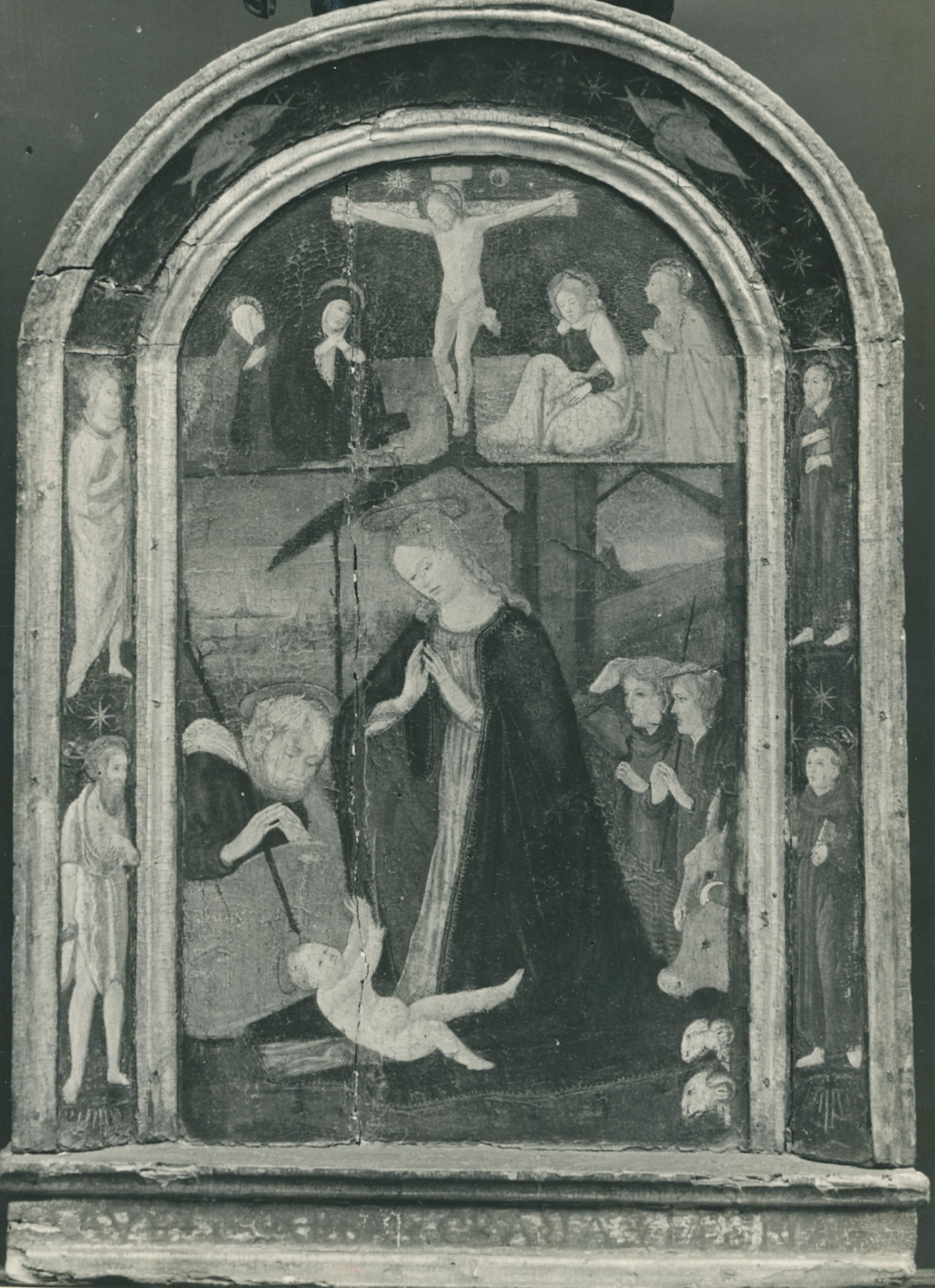
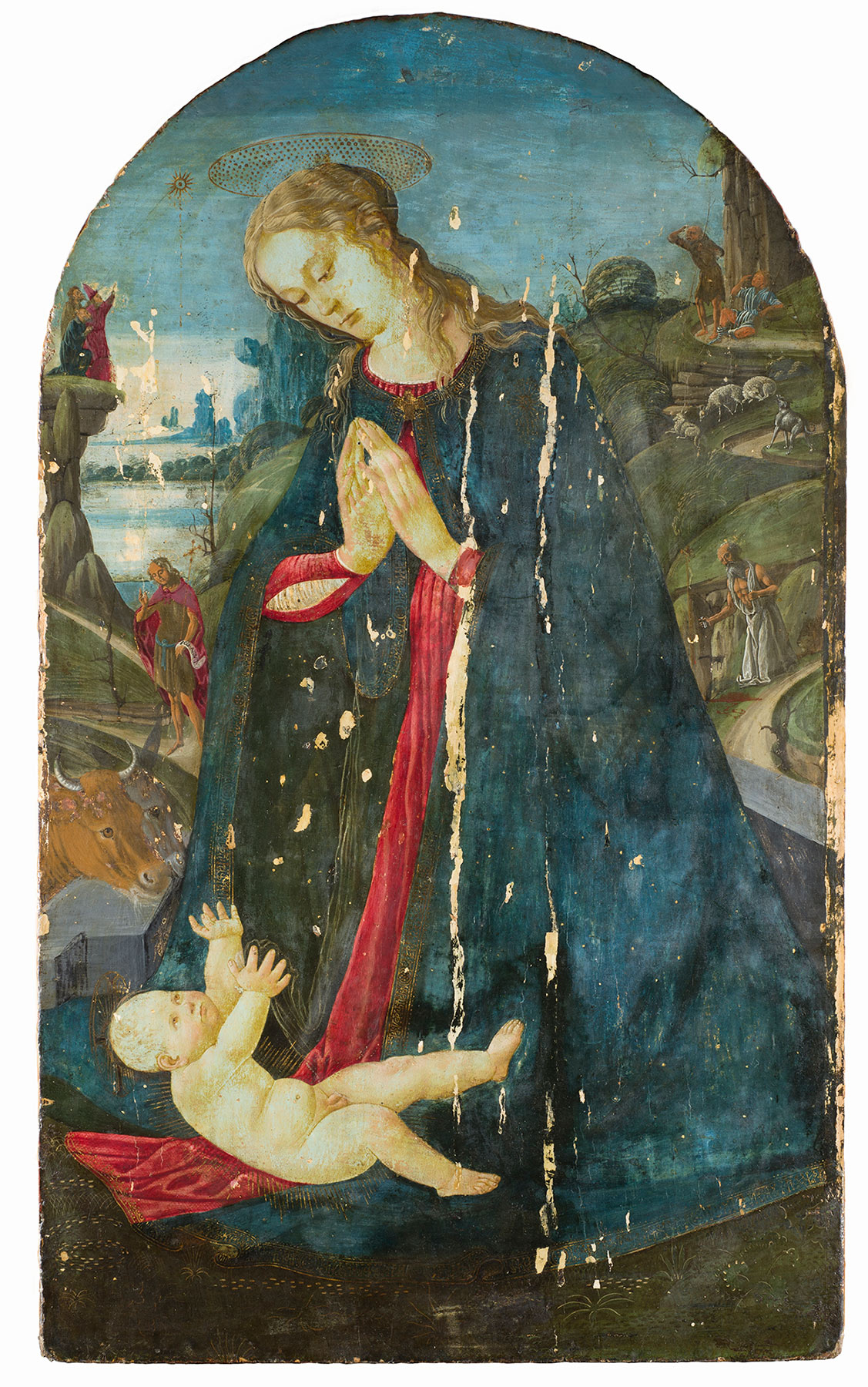
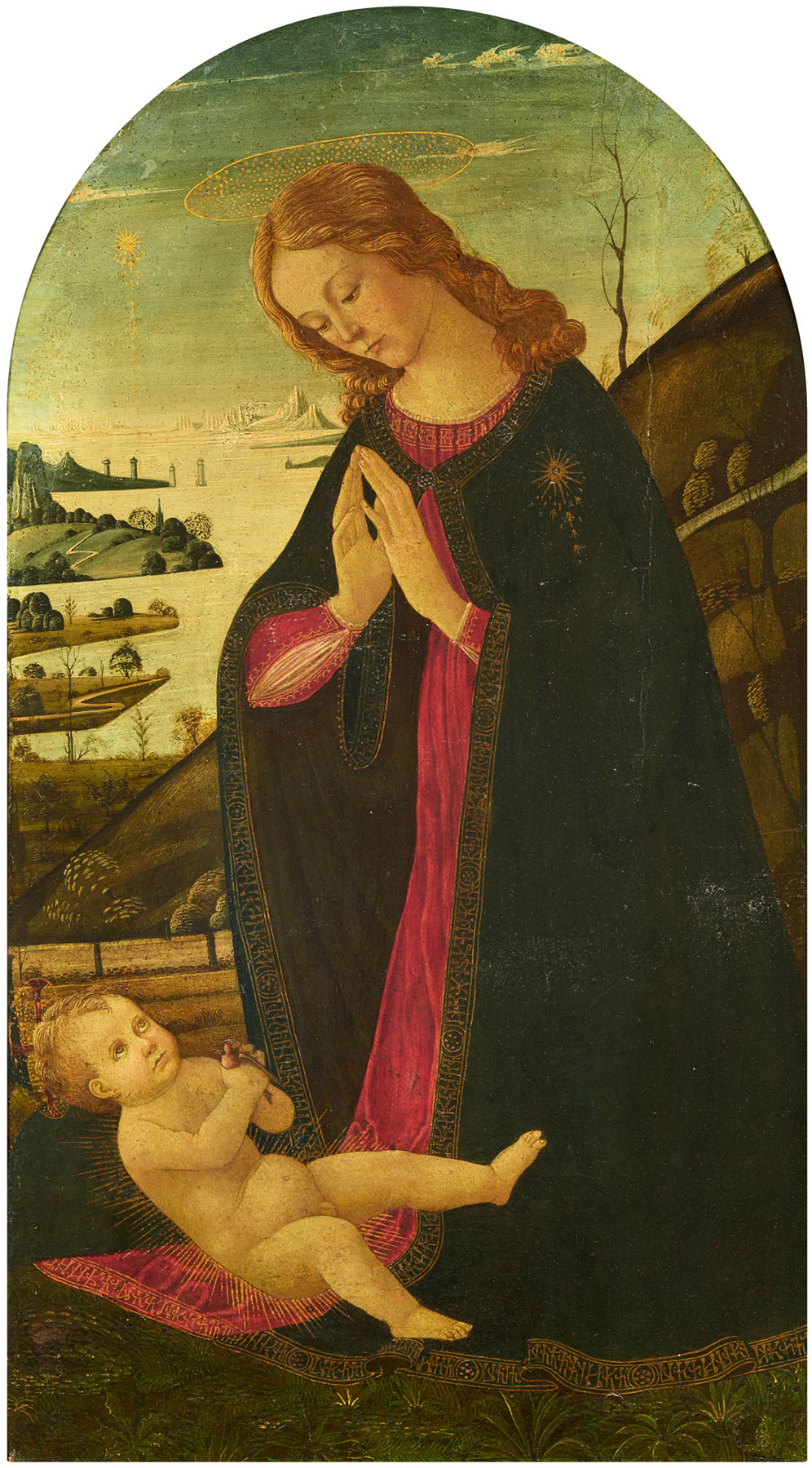
All but unknown to scholars, the Yale tabernacle was first identified as a work from the circle of Jacopo del Sellaio by F. Mason Perkins2 and assigned to the artist himself by Richard Offner.3 The attribution was rejected by Charles Seymour, Jr., who noted the provincial character of the painting and catalogued it as by a “remote follower” of Sellaio.4 Federico Zeri initially listed the picture as shop or school of Sellaio but later revised his opinion in favor of a more generic classification under the category “Anonymous Florentine fifteenth-century painters.”5 While the tabernacle’s present condition could justify Zeri’s assessment, the close links between the composition and Sellaio’s production cannot be overlooked. If the motif of the Virgin in adoration before the Christ Child is common to many Florentine workshops in the latter half of the fifteenth century, the poses and figure types in the Yale version are so intimately related to Sellaio’s example as to suggest the use of cartoons produced in the artist’s studio. The correspondences are most evident in comparisons with representations of the Virgin adoring the Child generally assigned to Sellaio or his workshop, such as the panel in the Philadelphia Museum of Art (fig. 2) and that formerly in the Baron Hans von Schoen collection, Lugano6 (fig. 3)—the latter distinguished by a variation in the Child’s gesture but with an identical Virgin. Also related to Sellaio is the crouching figure of Joseph, possibly derived from the artist’s tondo in the Chiaramonte Bordonaro Collection, Palermo.7 Other elements of the composition, however, like the spatial inconsistencies and the awkwardly arranged barn animals fitted into the composition as an afterthought, along with a certain stiffness of execution, denote a more conservative sensibility dependent on traditional models. Notwithstanding Seymour’s references to its provincial character—largely dictated by the condition of the painted surface after the modern interventions—the Yale tabernacle never approaches the vernacular quality of other serial production of its kind, such as that of the prolific personality known as the Master of San Miniato, active around the same period. Its anonymous author seems rather to reflect on the work of Sellaio in a minor key, making a close study of the artist’s models while not necessarily being affiliated with his shop. A date for the tabernacle around 1490 is consistent with the derivations from Sellaio’s prototypes from the previous decade.
The iconographic references to the observant branch of the Franciscan order implicit in the Bernardine monograms and in the choice of saints—including Saints Jerome and Mary Magdalen, whose asceticism became paradigmatic of the penitential experience—firmly situate the commission for the Yale tabernacle within the revivalist spiritual movement of late fifteenth-century Florence. More specific clues to the tabernacle’s patron would have been provided by the female figure kneeling next to the Virgin, whether a donor or blessed. If originally intended to be a donor portrait—as seems most likely given her position and smaller size in relation to the other figures—her brown dress and wimple could indicate a Franciscan tertiary affiliated with an Observant Clarissan establishment. The most obvious candidate in Florence would be the convent of Santa Chiara Novella, founded in 1452 by a young widow from a prominent Florentine family, Maria degli Albizzi (died 1470). In 1487, after years of petitioning, the nuns of Santa Chiara were officially granted their request to be placed under the jurisdiction of the Observant friars, cementing their credentials as an Observant Clarissan community.8 The convent attracted the young daughters of the Florentine elite, like the Acciaiuoli, Bardi, Medici, and Strozzi, along with mature widows inspired by the spiritual simplicity and austerity of Observance.9 —PP
Published References
Seymour, Charles, Jr. Early Italian Paintings in the Yale University Art Gallery. New Haven: Yale University Art Gallery, 1970., 184, 318, no. 137; Fredericksen, Burton B., and Federico Zeri. Census of Pre-Nineteenth-Century Italian Paintings in North American Public Collections. Cambridge, Mass.: Harvard University Press, 1972., 600
Notes
-
It is impossible to determine whether the halo visible in old photography was added in an earlier restoration. The figure’s appearance does not conform to that of any known Franciscan female saint, although she could be the Blessed Angela da Foligno, a Franciscan tertiary who became a famous mystic and is represented with a brown habit, white wimple, and halo in a manuscript in the Biblioteca Trivulziana, Milan; Angela da Foligno, Liber, MS 150, fol. 1r. ↩︎
-
Verbal opinion, 1924, cited in Frick Art Reference Library, New York. ↩︎
-
Verbal opinion, 1927, cited in Frick Art Reference Library, New York. ↩︎
-
Seymour, Charles, Jr. Early Italian Paintings in the Yale University Art Gallery. New Haven: Yale University Art Gallery, 1970., 184, no. 137. ↩︎
-
Fredericksen, Burton B., and Federico Zeri. Census of Pre-Nineteenth-Century Italian Paintings in North American Public Collections. Cambridge, Mass.: Harvard University Press, 1972., 600; and Fototeca Zeri, Federico Zeri Foundation, Bologna, inv. no. 14383. ↩︎
-
Sale, Koller Auctions, Zürich, March 31, 2023, lot 3003. ↩︎
-
Fototeca Zeri, Federico Zeri Foundation, Bologna, inv. no. 108926. ↩︎
-
See Strocchia, Sharon T. “Begging for Favours: The ‘New’ Clares of Santa Chiara Novella and Their Patrons.” In Studies on Florence and the Italian Renaissance in Honor of F. W. Kent, ed. Peter Howard and Cecilia Hewelett, 277–94. Turnhout, Belgium: Brepols, 2016., 286 (with previous bibliography). ↩︎
-
Among the young women entering Santa Chiara in the 1460s and 1470s were three sisters of the wealthy wool merchant Jacopo di Bongianni di Mino Bongianni (1442–1508), who later commissioned the convent church and main chapel, the remains of which are preserved in the Victoria and Albert Museum, London, inv. no. 7720:1 to 4-1861, https://collections.vam.ac.uk/item/O17758/chancel-chapel-from-church-of-chapel/. Most of the initial building and decorating activity for the new church was carried out during the leadership of Gostanza Bongianni (1447–1522), who was elected the first abbess under formal Observance in 1489. See Strocchia, Sharon T. “Begging for Favours: The ‘New’ Clares of Santa Chiara Novella and Their Patrons.” In Studies on Florence and the Italian Renaissance in Honor of F. W. Kent, ed. Peter Howard and Cecilia Hewelett, 277–94. Turnhout, Belgium: Brepols, 2016., 280–81, 288–89. ↩︎