James Jackson Jarves (1818–1888), Florence, by 1859
The panel support, of a vertical wood grain, has been thinned to a depth ranging from 5 to 9 millimeters and cradled. It is composed of two planks with a seam approximately 24 centimeters from the left edge and has been slightly truncated across the top and trimmed to within the picture field on all sides; no barb is apparent along any edge. Two prominent knots, one below the angel on the right and the other above the cherub head on the left, interrupt the paint surface, as do several partial splits, the most prominent of which runs at a slight angle approximately on center to the left of the Christ Child, through the Virgin’s right eye and knee. The paint surface has been severely abraded throughout, a state exacerbated by a harsh cleaning of 1968–69 that left exposed losses along the seam and splits at the upper edge of the panel (fig. 1). This cleaning also removed areas of shadow in the folds of the blue robes between the Virgin’s knees and especially to the left of her right leg. The mordant gilt decoration of haloes, wings, and hems is much damaged. Most local losses were touched back in a treatment by Irma Passeri in 2018.
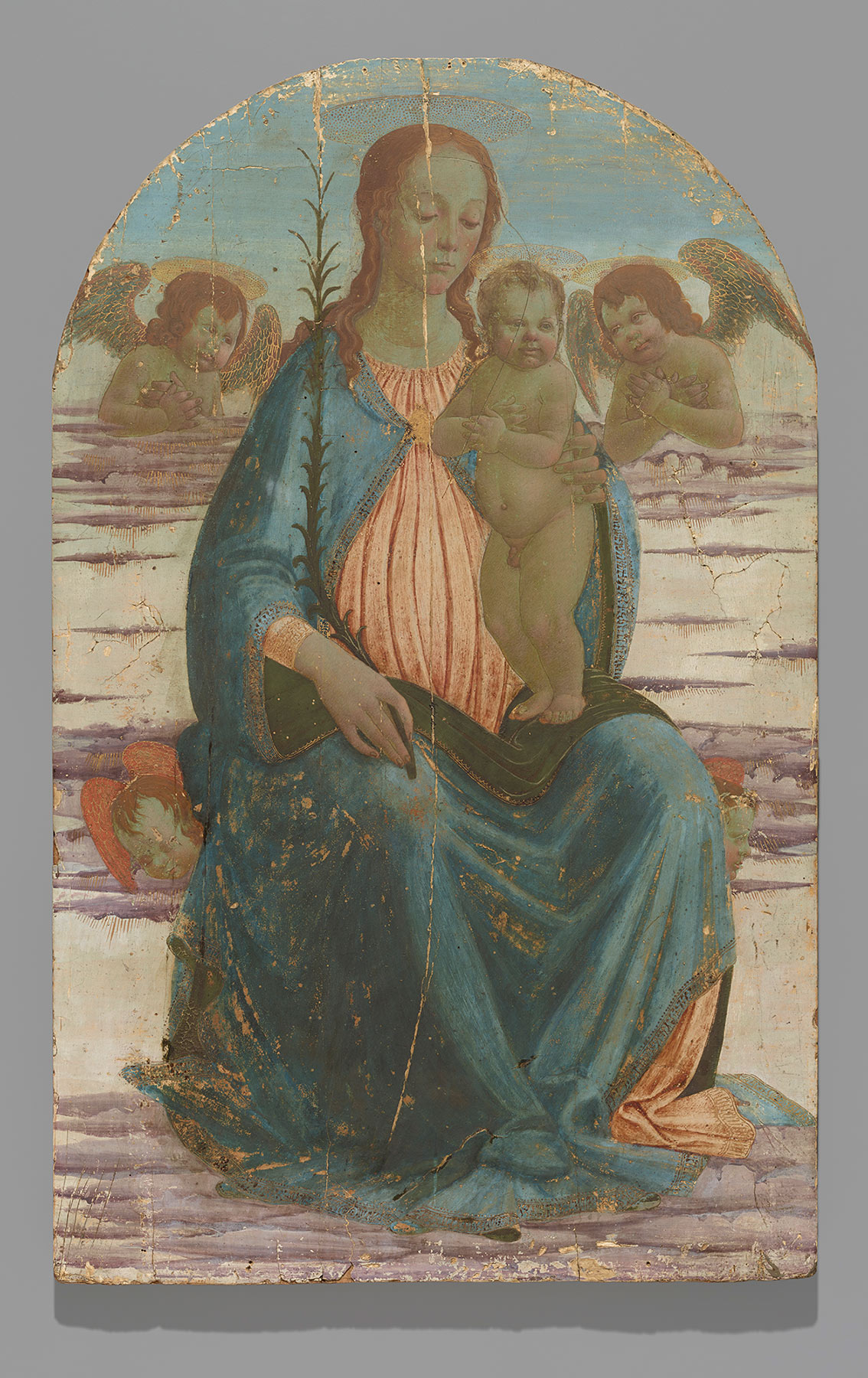
Thought by James Jackson Jarves and the earliest writers to discuss it to be a work by Cosimo Rosselli,1 this imposing panel was recognized by Osvald Sirén to be a typical work of Jacopo del Sellaio, an opinion that has not since been questioned seriously.2 Charles Seymour, Jr., added a qualification that it might be by a close follower of Sellaio, based on an observation made to him by Everett Fahy, who later suggested that this follower could be the Master of the Fiesole Epiphany, an artist sometimes identified as Sellaio’s documented studio partner, Filippo di Giuliano (1449–1503).3 Nicoletta Pons adduced the image as a possible indication of the appearance of a missing fragment of Sellaio’s altarpiece for the chapel of the Compagnia di Santa Maria Assunta e San Sebastiano in Santa Maria del Carmine, Florence, presumably painted after 1486, the year in which the confraternity was awarded patronage rights to the chapel.4 Pons had discovered a fragmentary Martyrdom of Saint Sebastian by Sellaio that included, cropped at its upper edge, the feet of a Virgin in Glory and compared it to the drapery and clouds at the bottom of the Yale panel. Christopher Daly pushed this analogy further but suggested a different paradigm for the Virgin in the missing fragment of the Carmine Altarpiece.5 He noted but rejected Fahy’s attribution of the painting to the Master of the Fiesole Epiphany, restoring it to the status of an autograph work by Sellaio.
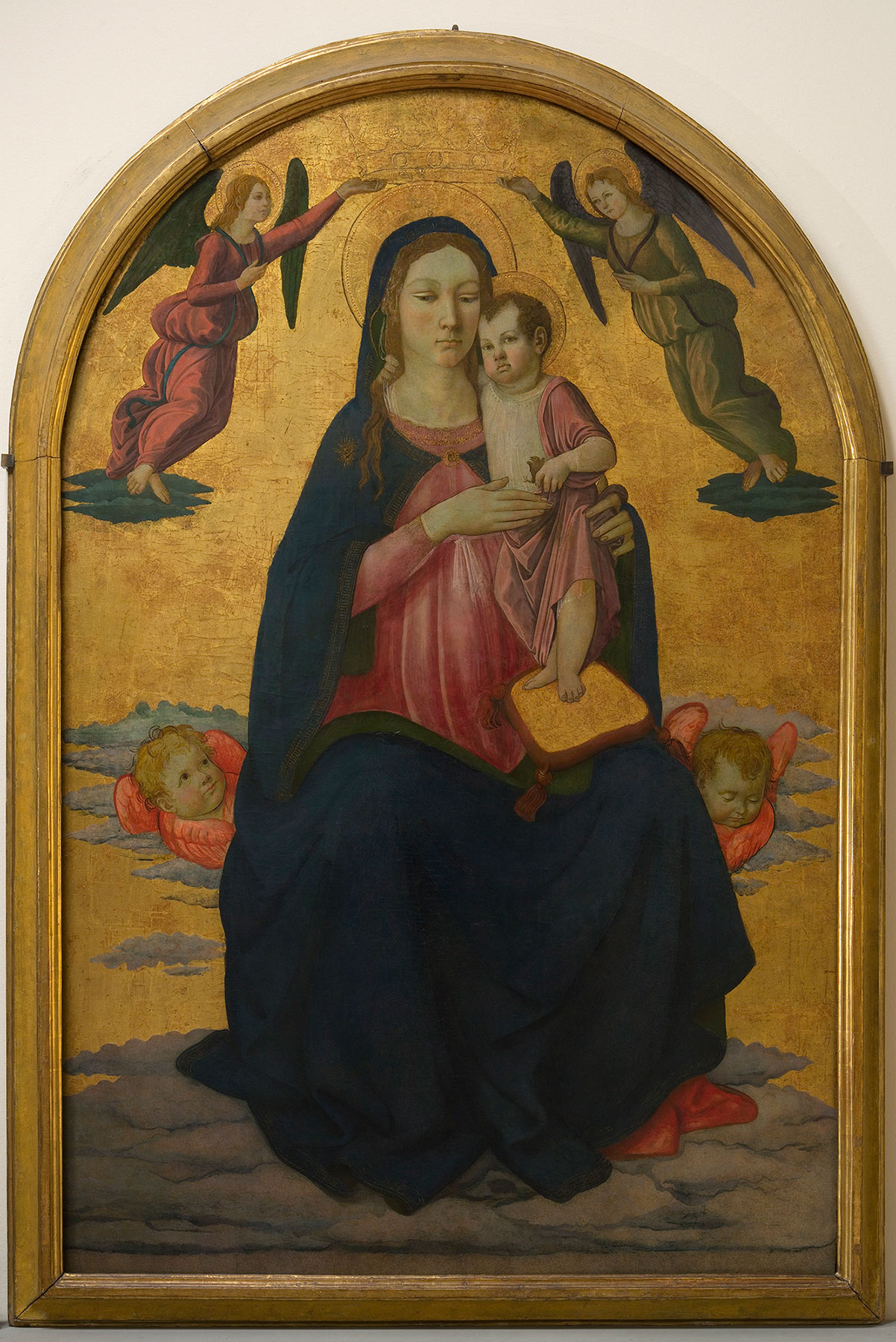
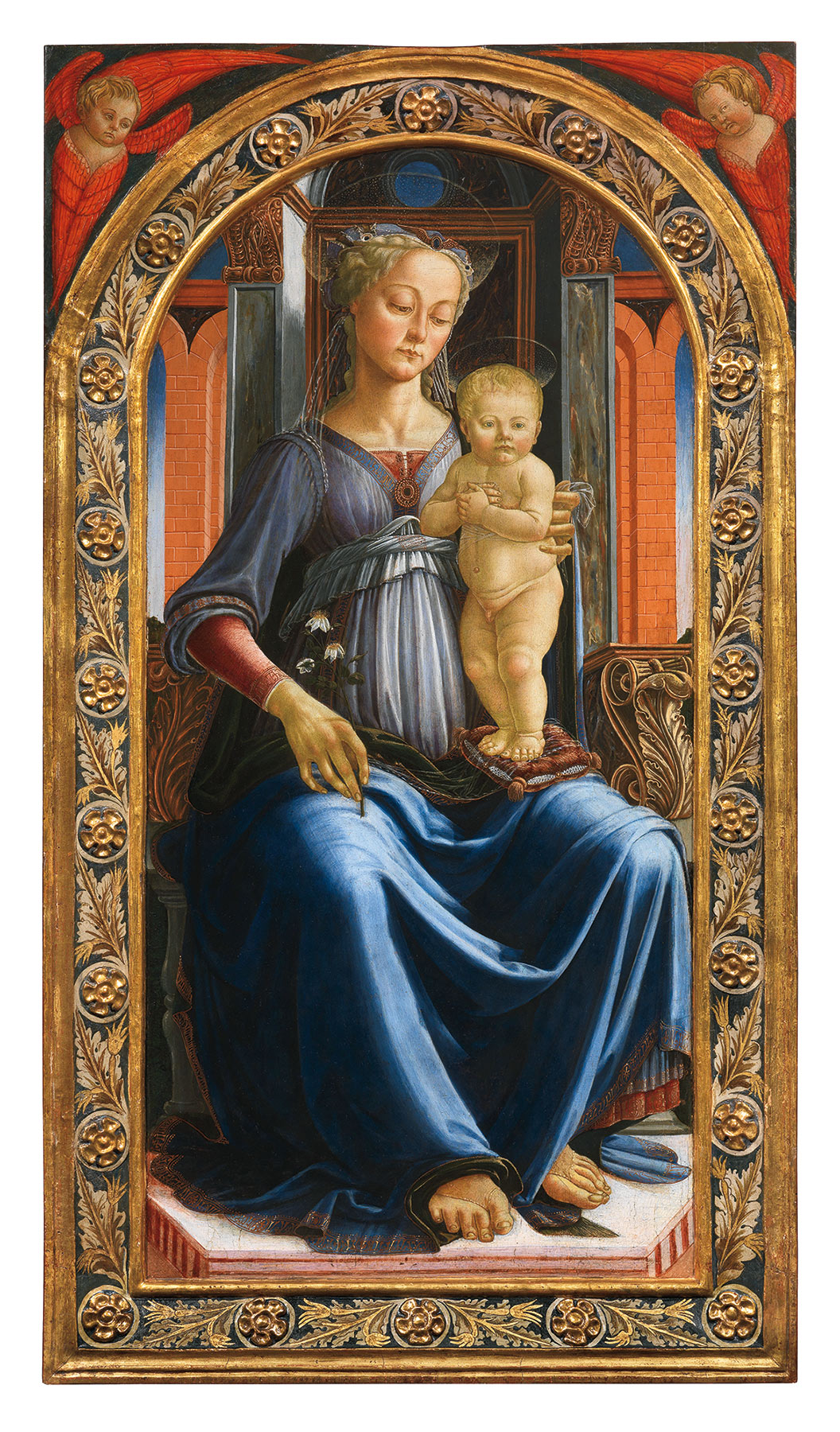
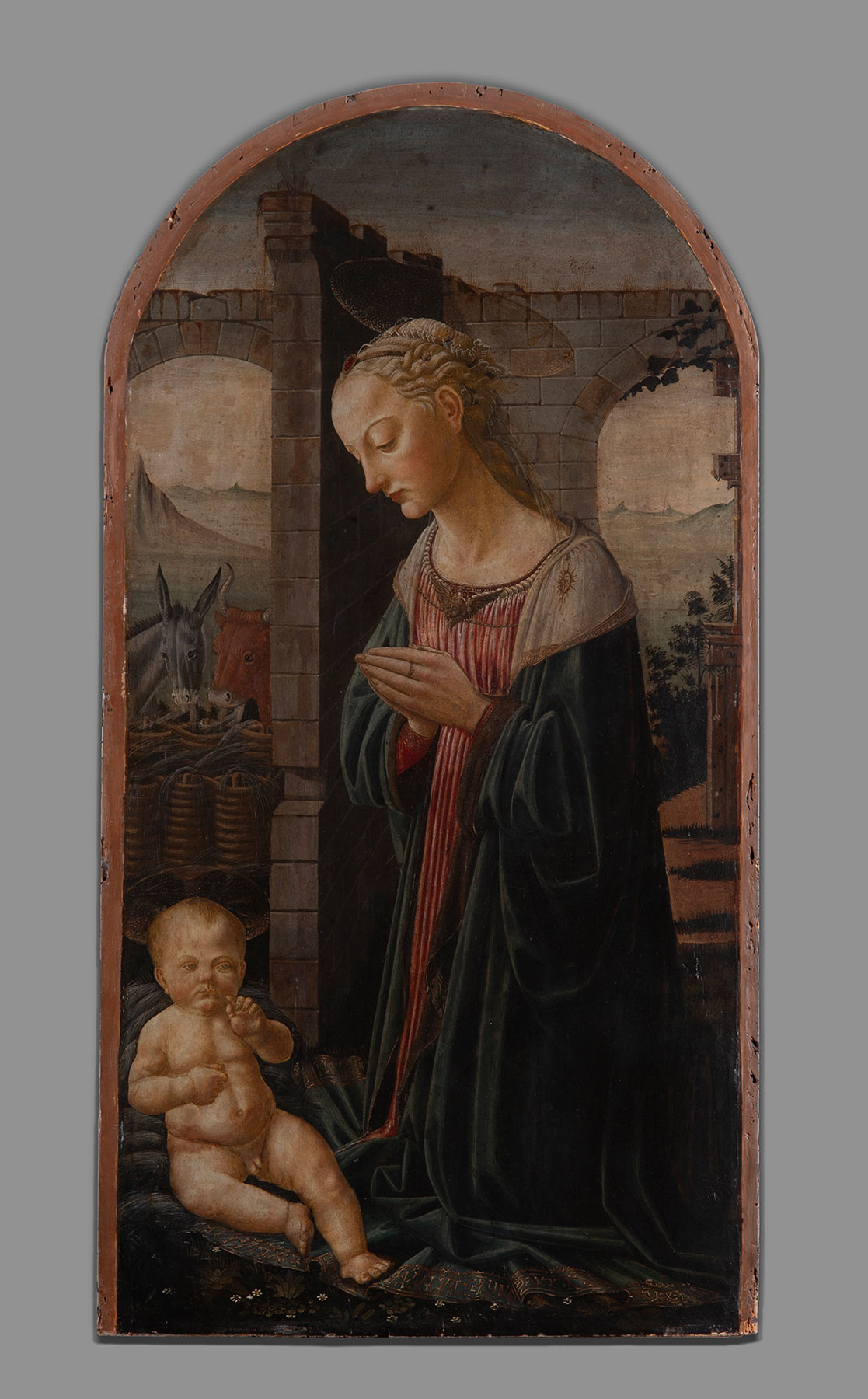
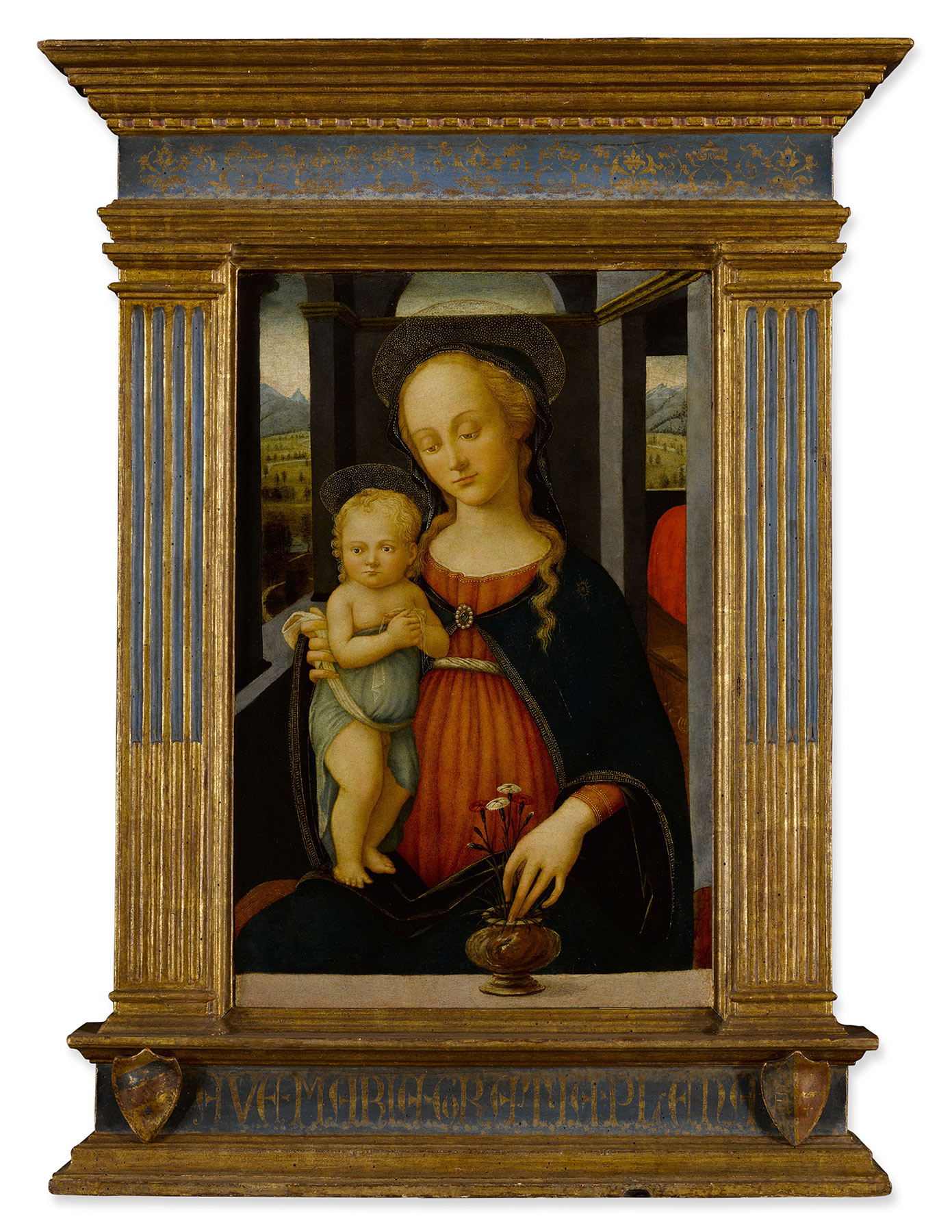
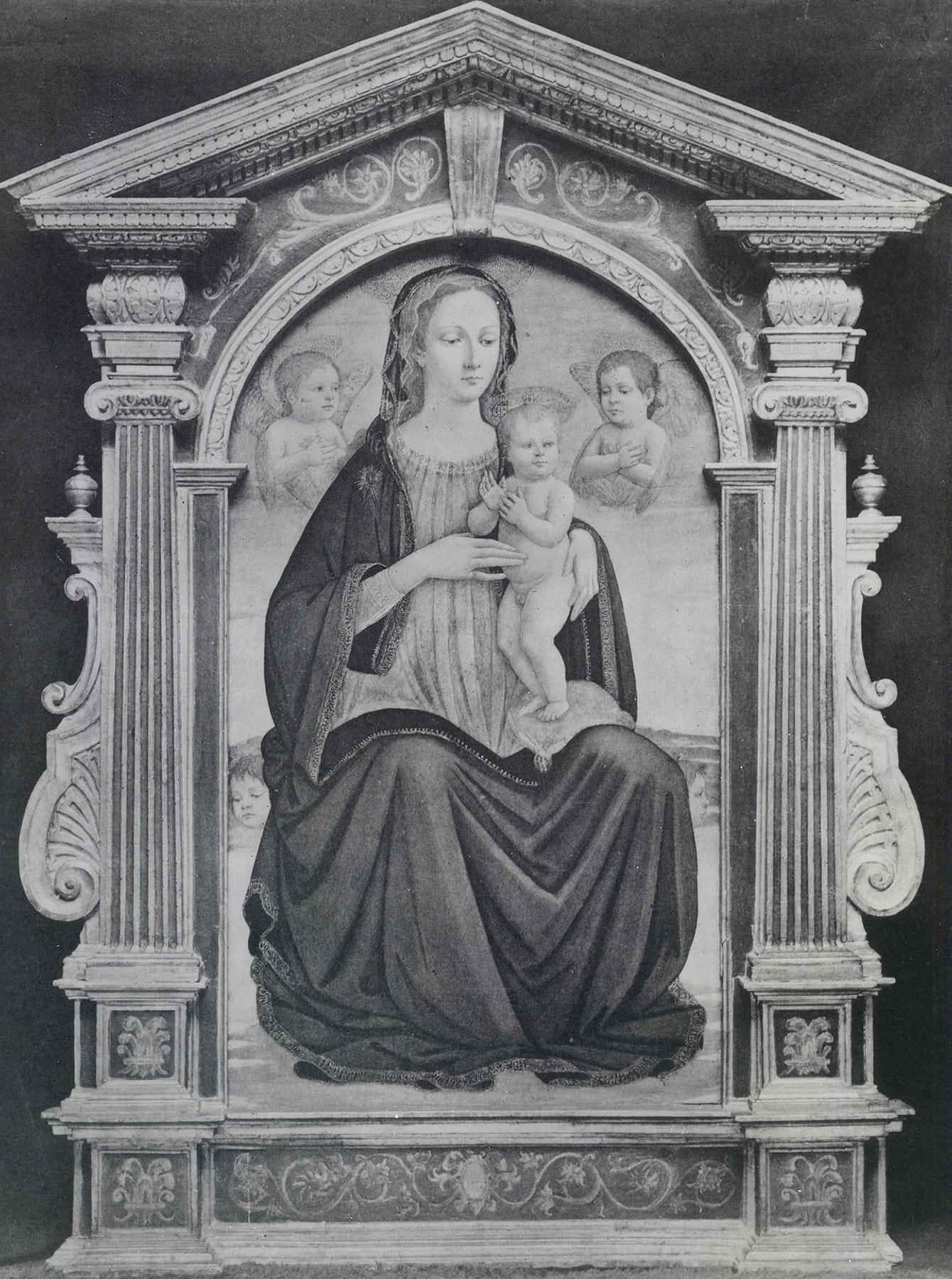
The general lines of the composition of the Yale panel broadly resemble those of a larger painting in the Galleria dell’Accademia, Florence (fig. 2), that Daly and others also attribute to Sellaio, while the cartoon for the two principal figures corresponds exactly to a painting of the Virgin and Child Enthroned, formerly in the Ricasoli collection in Florence, subsequently in the Alana Collection, Newark, Delaware (fig. 3). The ex-Ricasoli/Alana panel had been grouped by Federico Zeri with four others—in the Acton Collection at Villa La Pietra, Florence;6 formerly in the Bernheimer collection, Munich; formerly in the Metropolitan Museum of Art, New York;7 and in the Musée Tessé, Le Mans, France (fig. 4)—that Fahy later attributed to an artist he dubbed the “Argonaut Master.”8 These paintings, which have all come to be recognized, along with other works by the Argonaut Master, as efforts from the early career of Jacopo del Sellaio,9 share among them certain details of figure types or poses, but only one of them—the painting in Le Mans—is of a level of quality at all comparable to the ex-Ricasoli/Alana panel. It was argued by the present writer, however, that while the Le Mans painting is an outstanding early work by Jacopo del Sellaio, showing his typical palette and shorthand notations for drapery textures and landscape details, the ex-Ricasoli/Alana panel is by a different artist, one more committed to realism and of a higher order of conceptual imagination than Jacopo del Sellaio.10 That this artist might have been Andrea del Verrocchio, as was tentatively suggested at that time, cannot be demonstrated or disproven except by reference to varying theories of Verrocchio’s development as a painter, none of which rests on documentary evidence (see Andrea del Verrocchio(?), The Adoration of the Child with the Stigmatization of Saint Francis, Tobias and the Archangel, Saint John the Baptist Entering the Wilderness, and the Penance of Saint Jerome). That the ex-Ricasoli/Alana panel—whoever its artist may have been—is likely to have been painted in the late 1460s is less problematic.
In addition to the Yale panel, two other derivations from the cartoon of the ex-Ricasoli/Alana panel are known. One, formerly attributed to Biagio d’Antonio, employs the cartoon in reverse and crops it to half-length (fig. 5).11 Daly presumed that this and the Yale painting probably dated to the period of Sellaio’s collaboration with Biagio d’Antonio, documented in 1472. The other derivation, not noted in the previous literature on this problem, was formerly in the collection of Lord Lee of Fareham and was last recorded for sale in Berlin in 1927 (fig. 6).12 Fahy attributed this last work to Jacopo del Sellaio’s son, Arcangelo di Jacopo del Sellaio, and therefore thought that it was unlikely to date earlier than ca. 1490. The circumstances under which the cartoon for the ex-Ricasoli/Alana panel might have become Sellaio workshop property, when this might have happened, or the reasons why the cartoon might have been deployed at so late a date are unclear, but the fact that Sellaio made repeated use of this cartoon over time cannot be disputed. The Yale painting, too, is a mature work by Sellaio, probably painted within the last decade of his career. The quality of the central figures is high, despite the harsh cleaning to which they have been subjected, and is typical of Sellaio’s autograph work after his flirtation with the styles of Botticelli and Filippino Lippi in the late 1470s and early 1480s. The angels and cherub heads surrounding the Virgin are instead mechanically conceived and rendered and can at best be considered evidence of workshop participation in an essentially commercial product. —LK
Published References
Jarves, James Jackson. Descriptive Catalogue of “Old Masters” Collected by James J. Jarves to Illustrate the History of Painting from A.D. 1200 to the Best Periods of Italian Art. Cambridge, Mass.: H. O. Houghton, 1860., 52; Sturgis, Russell, Jr. Manual of the Jarves Collection of Early Italian Pictures. New Haven: Yale College, 1868., 67; W. F. Brown, Boston. Catalogue of the Jarves Collection of Early Italian Pictures. Sale cat. November 9, 1871., no. 72; Rankin, William. “Some Early Italian Pictures in the Jarves Collection of the Yale School of Fine Arts at New Haven.” American Journal of Archaeology 10, no. 2 (April–June 1895): 137–51., 149; Berenson, Bernard. The Florentine Painters of the Renaissance with an Index to Their Works. 3rd. ed. New York: G. P. Putnam’s Sons, 1909., 184; Sirén, Osvald. A Descriptive Catalogue of the Pictures in the Jarves Collection Belonging to Yale University. New Haven: Yale University Press, 1916., 129–30; van Marle. Raimond. The Development of the Italian Schools of Painting. Vol. 12. The Hague: M. Nijhoff, 1931., 409; Berenson, Bernard. Italian Pictures of the Renaissance: A List of the Principal Artists and Their Works with an Index of Places. Oxford: Clarendon, 1932., 527; Berenson, Bernard. Italian Pictures of the Renaissance, A List of the Principal Artists and Their Works with an Index of Places: Florentine School. 2 vols. London: Phaidon, 1963., 1:123; Seymour, Charles, Jr. Early Italian Paintings in the Yale University Art Gallery. New Haven: Yale University Art Gallery, 1970., 183–84, 318, no. 136; Fredericksen, Burton B., and Federico Zeri. Census of Pre-Nineteenth-Century Italian Paintings in North American Public Collections. Cambridge, Mass.: Harvard University Press, 1972., 599; Pons, Nicoletta. “La pala del Sellaio per il Carmine: Un ritrovamento.” Antichità viva 29, nos. 2–3 (1990): 5–10., 7–8, fig. 6; Daly, Christopher. “A New Fragment of the Carmine Altarpiece and Other Works by Jacopo del Sellaio.” Commentari d’arte 20, nos. 58–59 (September–December 2014): 53–60., 54–55; Kanter, Laurence, with Bruno Mottin and Rita Piccione Albertson. Leonardo: Discoveries from Verrocchio’s Studio, Early Paintings and New Attributions. Exh. cat. New Haven: Yale University Art Gallery, 2018., 92–93, 97–98, fig. 71
Notes
-
Jarves, James Jackson. Descriptive Catalogue of “Old Masters” Collected by James J. Jarves to Illustrate the History of Painting from A.D. 1200 to the Best Periods of Italian Art. Cambridge, Mass.: H. O. Houghton, 1860., 52; Sturgis, Russell, Jr. Manual of the Jarves Collection of Early Italian Pictures. New Haven: Yale College, 1868., 67; and Rankin, William. “Some Early Italian Pictures in the Jarves Collection of the Yale School of Fine Arts at New Haven.” American Journal of Archaeology 10, no. 2 (April–June 1895): 137–51., 149. ↩︎
-
Sirén, Osvald. A Descriptive Catalogue of the Pictures in the Jarves Collection Belonging to Yale University. New Haven: Yale University Press, 1916., 129–30; van Marle. Raimond. The Development of the Italian Schools of Painting. Vol. 12. The Hague: M. Nijhoff, 1931., 409; Berenson, Bernard. Italian Pictures of the Renaissance: A List of the Principal Artists and Their Works with an Index of Places. Oxford: Clarendon, 1932., 527; Berenson, Bernard. Italian Pictures of the Renaissance, A List of the Principal Artists and Their Works with an Index of Places: Florentine School. 2 vols. London: Phaidon, 1963., 1:123; and Fredericksen, Burton B., and Federico Zeri. Census of Pre-Nineteenth-Century Italian Paintings in North American Public Collections. Cambridge, Mass.: Harvard University Press, 1972., 599. ↩︎
-
Seymour, Charles, Jr. Early Italian Paintings in the Yale University Art Gallery. New Haven: Yale University Art Gallery, 1970., 184. Fahy attributed the painting to the Master of the Fiesole Epiphany in correspondence with the Yale University Art Gallery (curatorial files, Department of European Art) and later clarified his ideas on this artist in Fahy, Everett. “The Este Predella Panels and Other Works by the Master of the Fiesole Epiphany.” Nuovi studi 6–7, no. 9 (2001–2): 17–29., 17–29. See also Daly, Christopher. “Thinking through a Tondo by the Master of the Fiesole Epiphany.” Journal of the Walters Art Museum 77 (2024), https://journal.thewalters.org/volume/77/essay/tondo.. ↩︎
-
Pons, Nicoletta. “La pala del Sellaio per il Carmine: Un ritrovamento.” Antichità viva 29, nos. 2–3 (1990): 5–10., 7–8. ↩︎
-
Daly, Christopher. “A New Fragment of the Carmine Altarpiece and Other Works by Jacopo del Sellaio.” Commentari d’arte 20, nos. 58–59 (September–December 2014): 53–60., 54–55. ↩︎
-
Sale, Sotheby’s New York, February 5, 2026, lot 20. ↩︎
-
Sale, Christie’s, New York, January 29, 2014, lot 101. ↩︎
-
Zeri, Federico, with Elizabeth E. Gardner. Italian Paintings: A Catalogue of the Collection of the Metropolitan Museum of Art. Vol. 1, Florentine School. New York: Metropolitan Museum of Art, 1971., 116–17; Dalli Regoli, Gigetta. “Il Maestro di San Miniato: Anatomia di un’ipotesi.” In Il “Maestro di San Miniato”: Lo stato degli studi, i problemi, le risposte della filologia, ed. Federico Zeri and Gigetta Dalli Regoli, 17–124. Pisa: Giardini, 1988., figs. 57–62, 64; and Fahy, Everett. “The Argonaut Master.” Gazette des beaux-arts, 6th ser., 114 (December 1989): 285–300., 292, 296, where the painting in Le Mans is removed from the group. ↩︎
-
See Daly, Christopher. “A New Fragment of the Carmine Altarpiece and Other Works by Jacopo del Sellaio.” Commentari d’arte 20, nos. 58–59 (September–December 2014): 53–60., 58n11; and Dury, Corentin. Peintures italiennes et hispanique: Collections du Musée de Tessé, XIVe–XVIIIe siècles. Exh. cat. Ghent, Belgium: Snoek, 2016., 76–78, for a summary of scholarly opinions related to this group of paintings and to the Argonaut Master. ↩︎
-
Kanter, Laurence, with Bruno Mottin and Rita Piccione Albertson. Leonardo: Discoveries from Verrocchio’s Studio, Early Paintings and New Attributions. Exh. cat. New Haven: Yale University Art Gallery, 2018., 93. ↩︎
-
Sale, Sotheby’s, New York, January 28, 2022, lot 381 ↩︎
-
Sale, Lepke, Berlin, March 29, 1927, lot 105C. See Borenius, Tancred. A Catalogue of Pictures, etc., at 18 Kensington Palace Gardens, London: Collected by Viscount and Viscountess Lee of Fareham. 2 vols. Oxford: F. Hall, 1926., no. 76. ↩︎