Mrs. Vivian, by 1893;1 E. A. Lewis, Independent Gallery, Grafton Street, London; sale, Sotheby’s, London, May 10, 1922 (unsold);2 sale, Christie’s, London, July 18, 1924, lot 31;3 Tancred Borenius (1885–1948), London; Maitland Fuller Griggs (1872–1943), New York, by 1926
The panel support, of a vertical wood grain, retains its original thickness of 2.5 centimeters. It is composed of three planks, a wide central board to which narrower boards—5 centimeters wide on the left and tapering from 5.8 to 4 centimeters wide on the right—have been glued and secured by three large iron nails, driven in from each side. The picture surface is reasonably well preserved, although dulled by a grayed, synthetic varnish, and retains a barb along all four edges of the composition. The blue draperies and discreet areas of the landscape background were selectively damaged in a cleaning by Andrew Petryn in 1964, but abrasion overall is minimal. The star above the Virgin and Child has been defaced, but the gilding of the haloes and on the draperies survives in a beautiful state.
Discussion of this painting, which was purchased by Maitland Fuller Griggs with an attribution to Benozzo Gozzoli and published by Raimond van Marle as a work from the school of that artist,4 was redirected by Bernard Berenson to the circle of the painter he identified as Giovanni Battista Utili da Faenza and who has subsequently come to be recognized as Biagio d’Antonio.5 Although Charles Seymour, Jr., preferred to leave it in anonymity;6 Burton Fredericksen and Federico Zeri listed it as by a follower of Biagio d’Antonio;7 while Everett Fahy, Carl Strehlke, and Christopher Daly expressed the opinions that it is probably by Biagio himself.8 The painting is not included, even as a dismissed attribution, in Roberta Bartoli’s monograph on Biagio d’Antonio.9
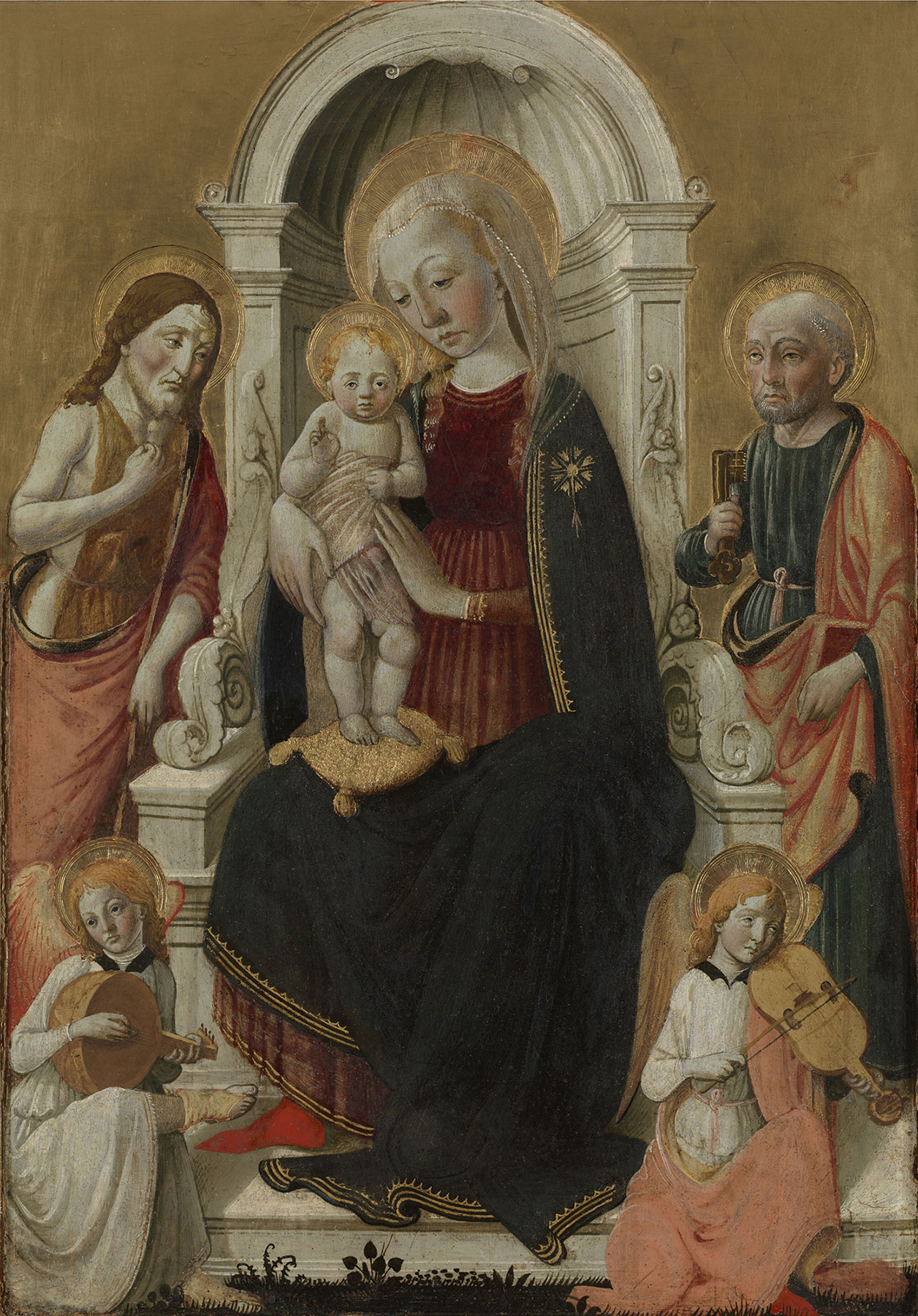
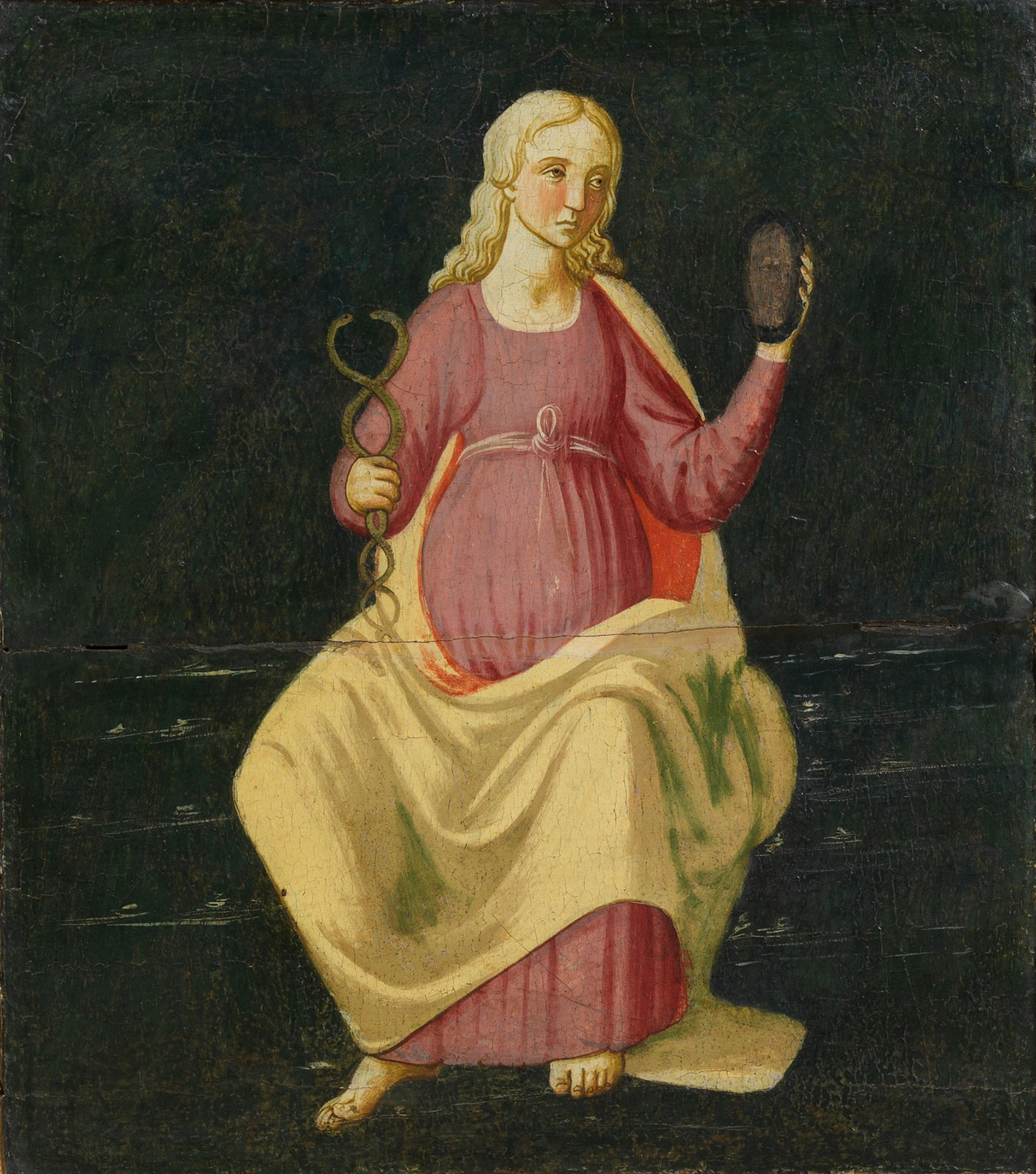
Although exact parallels for the caricatural figure style in this panel are difficult to find, the general type of the landscape recurs in numerous paintings by Biagio, generally with a more refined execution. The hardened facial features, slightly oversize heads, and curiously small hands of all the figures do bear comparison to several works thought to be Biagio’s earliest (known) efforts: a frescoed niche showing Saint Michael the Archangel between Saints John the Baptist and Paul, as well as Saint Sebastian, Saint Christopher, and an Annunciation, formerly in the Oratorio di San Michele at the Castello di Baroncoli, near Calenzano;10 an Adoration in the Radcliffe Collection at the Chateau de Cheseaux, Cheseaux-sur-Lausanne, Switzerland;11 an Adoration in the National Gallery of Ireland, Dublin;12 a Virgin and Child Enthroned with Saints John the Baptist and Peter and Two Music-Making Angels in the Museum voor Schone Kunsten, Ghent, Belgium (fig. 1); and, to a lesser degree, the Virtues painted on the end panels of the Morelli-Nerli cassoni in the Courtauld Gallery, London (fig. 2). The latter is a documented work for which Biagio and his then partner, Jacopo del Sellaio, received three payments in November and one in December of 1472.13 Two years earlier, in 1470, Biagio is mentioned in the Memorie notate of Benedetto Dei as apparently sharing a workshop with Cosimo Rosselli.14 The latter’s Saint Barbara altarpiece of 1468–70 relates suggestively to the Yale panel in its figural eccentricities but less closely than do the works by Biagio thought to be roughly contemporary to it.15
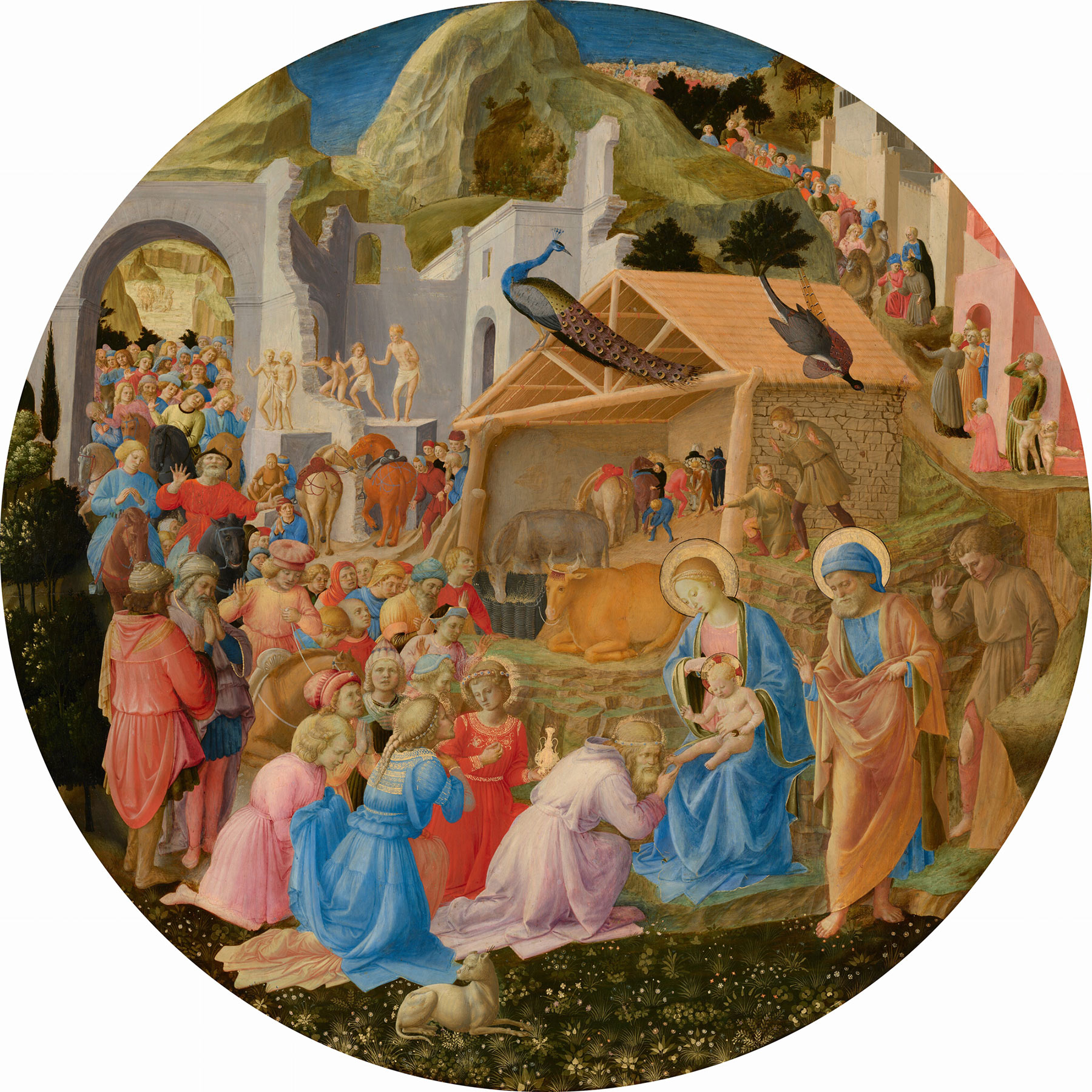
The climax of this phase of Biagio’s career is widely held to be his work on the altarpiece from San Domenico a Maglia, Florence, now in Budapest (see Biagio d’Antonio, The Crucifixion, fig. 2), presumably a collaboration with Andrea del Verrocchio. The Maglia altarpiece is undocumented and variously assigned dates ranging from 1465 to 1475. Assuming that Biagio d’Antonio was indeed Verrocchio’s assistant on this enterprise, it has not been possible to ascertain whether the two artists were linked in a master–pupil relationship or a commercial partnership of convenience: Verrocchio’s early style as a painter has not yet been individuated and therefore cannot be adduced as a possible formative influence on the composition of the Yale panel or any work by Biagio d’Antonio. One significant iconographic oddity in the Yale Adoration of the Magi might suggest that Biagio’s earliest training occurred elsewhere than in Verrocchio’s studio: the prominent inclusion of three shepherds in the scene, figures that are normally segregated in a separate episode of the Nativity cycle. Such figures do appear centrally in two earlier Florentine versions of the Adoration of the Magi. The first is the tondo formerly owned by the Cook family of Doughty House, England, now in the National Gallery of Art, Washington, D.C. (fig. 3), begun by Fra Angelico probably in the 1440s and completed or altered by Fra Filippo Lippi sometime around 1460.16 The second is a little-known panel formerly in a Florentine private collection, attributed by Fahy to the Master of the Louvre Nativity (Fra Diamante?), an assistant of Fra Filippo Lippi.17 That Biagio adopted this unusual iconographic detail might imply that he had encountered it in Fra Filippo’s studio, a possible argument for situating his earliest apprenticeship there. —LK
Published References
van Marle, Raimond. The Development of the Italian Schools of Painting. Vol. 11. The Hague: M. Nijhoff, 1929., 238; Berenson, Bernard. Italian Pictures of the Renaissance: A List of the Principal Artists and Their Works with an Index of Places. Oxford: Clarendon, 1932., 585; Berenson, Bernard. Italian Pictures of the Renaissance, A List of the Principal Artists and Their Works with an Index of Places: Florentine School. 2 vols. London: Phaidon, 1963., 1:142; Seymour, Charles, Jr. Early Italian Paintings in the Yale University Art Gallery. New Haven: Yale University Art Gallery, 1970., 141, 143, 315, no. 100; Fredericksen, Burton B., and Federico Zeri. Census of Pre-Nineteenth-Century Italian Paintings in North American Public Collections. Cambridge, Mass.: Harvard University Press, 1972., 600
Notes
-
Loaned under this name to the New Gallery, Regent Street, London, as by Benozzo Gozzoli; see Exhibition of Early Italian Art from 1300 to 1550. Exh. cat. London: New Gallery, 1893., 172, no. 1568. It is possible that “Mrs. Vivian” references one of two sisters-in-law of Hussey Crespigny Vivian, 3rd Baron Vivian (1834–1893), British ambassador to Italy from 1891–93. Irene Maud Shelah Farrer (died 1940) married the Honorable Charles Hussey Panton Vivian (1847–1892) and was widowed the year before the exhibition. Constance Emily Sartoris (died 1905) came from a banking family that collected early Italian paintings and married the Honorable Claud Vivian (1849–1902) in 1878. She is less likely, however, to have lent the painting under her own name rather than her husband’s. ↩︎
-
Charles Seymour, Jr. (in Seymour, Charles, Jr. Early Italian Paintings in the Yale University Art Gallery. New Haven: Yale University Art Gallery, 1970., 143) listed “The Lord O’Hagen, the Countess of Carlisle and others sale” incorrectly as Christie’s and without a date. Information on the consignor to this sale, where the painting appeared as by Benozzo Gozzoli and is illustrated in the catalogue, kindly provided by Elizabeth Lobkowicz at Sotheby’s, London. ↩︎
-
Consigned by E. A. Lewis of the Independent Gallery, as by Cosimo Roselli; purchased by “Borenius.” Information kindly provided by Jonquil O’Reilly at Christie’s, New York. ↩︎
-
van Marle, Raimond. The Development of the Italian Schools of Painting. Vol. 11. The Hague: M. Nijhoff, 1929., 238. ↩︎
-
Berenson, Bernard. Italian Pictures of the Renaissance: A List of the Principal Artists and Their Works with an Index of Places. Oxford: Clarendon, 1932., 585; and Berenson, Bernard. Italian Pictures of the Renaissance, A List of the Principal Artists and Their Works with an Index of Places: Florentine School. 2 vols. London: Phaidon, 1963., 1:142. ↩︎
-
Seymour, Charles, Jr. Early Italian Paintings in the Yale University Art Gallery. New Haven: Yale University Art Gallery, 1970., 141, 143, as anonymous Florentine, second half of the fifteenth century. ↩︎
-
Fredericksen, Burton B., and Federico Zeri. Census of Pre-Nineteenth-Century Italian Paintings in North American Public Collections. Cambridge, Mass.: Harvard University Press, 1972., 600. ↩︎
-
Unpublished opinions, curatorial files, Department of European Art, Yale University Art Gallery. ↩︎
-
Bartoli, Roberta. Biagio d’Antonio. Milan: Federico Motta, 1999.. ↩︎
-
See Bartoli, Roberta. Biagio d’Antonio. Milan: Federico Motta, 1999., 24–25. ↩︎
-
This painting is catalogued by Roberta Bartoli (in Bartoli, Roberta. Biagio d’Antonio. Milan: Federico Motta, 1999., 188, no. 22) as emerging from Andrea del Verrocchio’s studio at the time of the Maglia altarpiece (see fig. 3). ↩︎
-
Inv. no. 842; see Bartoli, Roberta. Biagio d’Antonio. Milan: Federico Motta, 1999., 189, no. 25, where it is given as closely related to the Radcliffe Adoration in Cheseaux. ↩︎
-
Bartoli, Roberta. Biagio d’Antonio. Milan: Federico Motta, 1999., 244. ↩︎
-
Bartoli, Roberta. Biagio d’Antonio. Milan: Federico Motta, 1999., 9, 18n4. ↩︎
-
Galleria dell’Accademia, Florence, inv. no. 1890 n. 8635, https://catalogo.uffizi.it/it/29/ricerca/detailiccd/1176870/. ↩︎
-
See Boskovits, Miklós, and David Alan Brown. Italian Paintings of the Fifteenth Century: The Collections of the National Gallery of Art, Systematic Catalogue. Washington, D.C.: National Gallery of Art, 2003., 21–30; and Laurence Kanter, in Kanter, Laurence, and Pia Palladino, eds. Fra Angelico. Exh. cat. New York: Metropolitan Museum of Art, 2005., 282–83. ↩︎
-
Fototeca Zeri, Federico Zeri Foundation, Bologna, inv. no. 35945. Three eccentric images of the Adoration of the Shepherds deriving from a single cartoon all seem to have emerged from Lippi’s studio close to this date: formerly Alana Collection, Del., inv. no. 2012.34 (see Dalli Regoli, Gigetta. “Il Maestro di San Miniato: Anatomia di un’ipotesi.” In Il “Maestro di San Miniato”: Lo stato degli studi, i problemi, le risposte della filologia, ed. Federico Zeri and Gigetta Dalli Regoli, 17–124. Pisa: Giardini, 1988., 119, fig. 87); Campion Hall, Oxford; and École Biblique et Archéologique Française, Jerusalem. The last was painted by an artist in or recently emerged from the studio of Neri di Bicci; the Campion Hall painting is attributable to the Master of San Miniato; the ex-Alana painting, attributed to Francesco Botticini by Filippo Todini (as cited by Andrea G. De Marchi, in Mannini, Maria Pia, ed. Da Bernardo Daddi a Giorgio Vasari. Exh. cat. Florence: Plistampa, 1999.), is by an unknown, possibly Umbrian follower of Fra Filippo Lippi. The caricatural style of these works recalls that of the Yale Adoration of the Magi but not closely enough to suggest a common authorship so much as a vaguely common source, possibly a lost work by Lippi himself. ↩︎