James Jackson Jarves (1818–1888), Florence, by 1859
The panel support, of a vertical wood grain, was thinned to 9 millimeters, waxed, and cradled in a treatment of 1930. The cradle has provoked numerous partial splits, none of which have resulted in appreciable paint loss. Extensive abrasions of the paint surface had been heavily overpainted before a cleaning by Hammond Smith in 1915, whose retouches were, in turn, removed by a harsh cleaning in 1954 that left resultant damage and losses fully exposed (fig. 1). The sky and the landscape in the lower half of the panel have been thinned to preparatory layers and are disfigured by flaking losses, especially along the perimeter of the arched top of the composition and within the haloes of the Virgin and Christ Child, where the loss of mordant gilding has pulled away subjacent paint. The gray parapet at both sides of the bottom of the composition has been scraped, leaving only thin ridges of paint. The Virgin’s hands and the Child’s left thigh are missing almost entirely. A knot in the panel over which the knuckles of the Virgin’s left hand were painted may have been the initial cause of damage in this area, exacerbated and enlarged by solvent damage across much of the lower-right quarter of the surface. Modeling in the Virgin’s dress and cloak are much better preserved, as is the mordant gilt decoration along the hems of her garments and the transparent white veil painted over these.
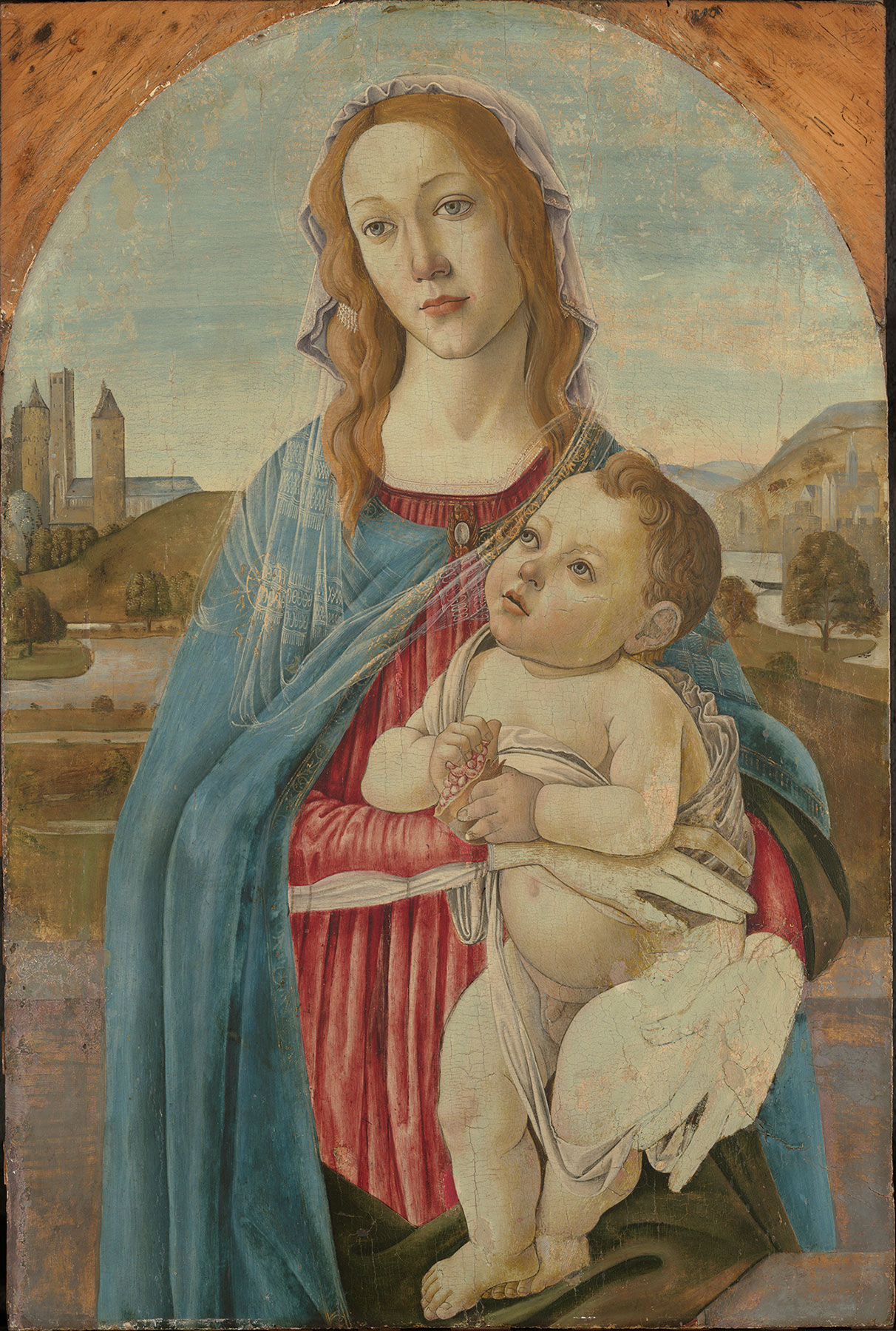
When James Jackson Jarves exhibited this Virgin and Child in New York in 1860, and again when he deposited it in New Haven in 1868, he considered it a work by Botticelli, a claim of no great consequence in the days before Walter Pater’s groundbreaking essay of 1870 and John Ruskin’s lectures throughout that decade first established the artist’s preeminent modern reputation.1 In an attempt to arouse enthusiasm among its American readers, the 1868 manual of the Jarves collection described Botticelli as “a not unworthy member of the extraordinary group of painters who worked side by side in Central Italy . . . an army of disciplined strength, the likeness of which in power, rightness and directness of aim, and purity of taste, all shared by so many men acting together, has never been seen since that era closed.”2 In contrast to Joseph Crowe and Giovanni Cavalcaselle’s dismissal of Botticelli as coarse and repetitive,3 Jarves considered him to be, at the very least, a fitting moral example for the American citizenry of the latter half of the nineteenth century. The sale catalogue accompanying the auction at which Yale purchased the entire Jarves collection in 1871 went so far as to describe the painting as “a fine specimen of this rare master.”4 That was the last printed notice of esteem the Jarves Virgin and Child garnered. At the height of Botticelli’s rapid ascent to popularity in the last years of the nineteenth century, William Rankin described it as “what no doubt, at first sight of the collection, may pass for its greatest picture . . . is pleasing, but Botticelli never did such hard outlines or such feeble hands.”5 Every author to have mentioned it over the next hundred years dismissed it as a charmless—although in Bernard Berenson’s words, “not the worst”—repetition of a tired invention.6
Scholars who referred to or discussed the Jarves Virgin and Child before 1970 knew it in the heavily and clumsily repainted state in which it is reproduced in Osvald Sirén’s 1916 catalogue of Italian paintings at Yale.7 For Sirén, the hard lines and distinctive features of the painting—which he does not appear to have recognized as restoration—suggested a personality who could be isolated within the supposedly crowded studio of assistants working around Botticelli. He identified this assistant through his use of Northern Gothic structures to enliven the landscape backgrounds of his paintings, christening him the “Master of the Gothic Buildings.”8 John Pope-Hennessy doubted the existence of such a painter, noting that the group of works assembled by Sirén is heterogeneous, its members having in common among themselves only their relationship to Botticelli and some shared iconographic motifs.9 Herbert Horne, in his foundational monograph of 1908, made no critical comment about the Jarves painting other than calling it a school piece. He noted that it is one of three half-length Virgin and Child compositions that derive from the cartoon of Botticelli’s San Barnaba altarpiece (fig. 2).10 Ronald Lightbown expanded the thread of Horne’s remarks, cataloguing six paintings besides the Jarves panel and the former high altarpiece from the church of San Barnaba in Florence that employ close variants of the same principal group of two figures—the Virgin holding her Child half standing on a short marble parapet before her.11 These include:
-
a Virgin and Child in the Galleria Sabauda, Turin (81 × 57 cm) (fig. 3);
-
a nearly exact replica of the Turin painting in the Grenville Winthrop bequest at the Harvard University Art Museums (88.9 × 55.9 cm) (fig. 4);
-
the painting mentioned by Horne as in the collection of Robert Benson in London, last recorded at sale at Sotheby’s, New York, January 28, 2016, lot 10 (80 × 50.5 cm) (fig. 5);
-
a Virgin and Child formerly in the Merton collection, sold at Christie’s, London, December 7, 2006, lot 39 (100.5 × 64.5 cm) (fig. 6);
-
a version of the ex-Merton painting, formerly in the Metropolitan Museum of Art, New York, sold at Christie’s, New York, January 29, 2014, lot 102 (74.3 × 40.6 cm) (fig. 7);
-
and a fragmentary (71.4 × 55.5 cm) partial replica of the San Barnaba altarpiece in the National Museum of Malta, Valletta.12
In addition to these, a reduced (29.5 × 19.7 cm) variant, probably from a studio other than Botticelli’s, was presented to the National Gallery, London, with the Layard bequest.13 Most of the limited variation among these images occurs in the figure of the Christ Child and in the background setting. The half-length figure of the Virgin is little altered in each and undoubtedly reflects different degrees of elaboration of a single cartoon.
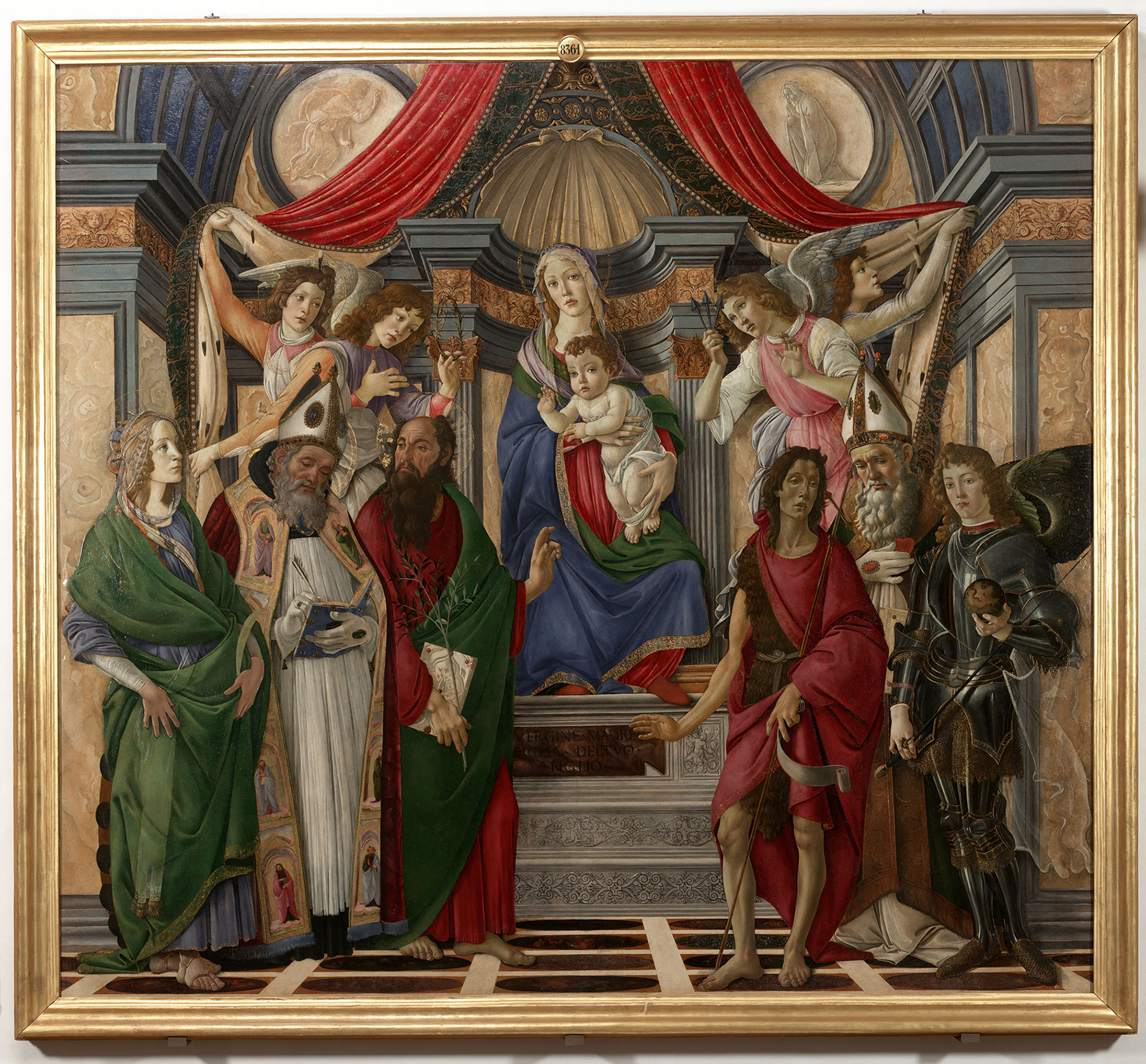
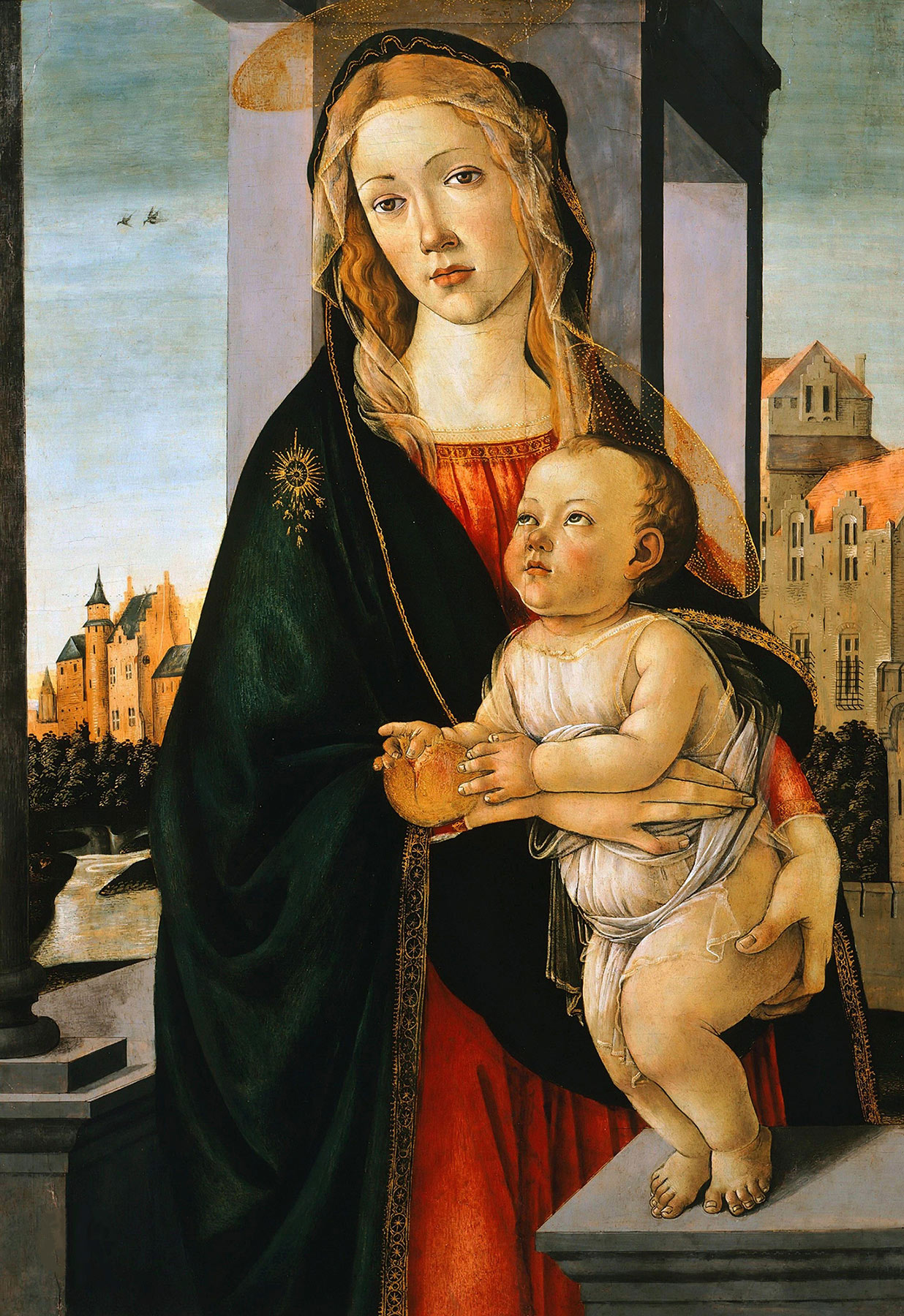
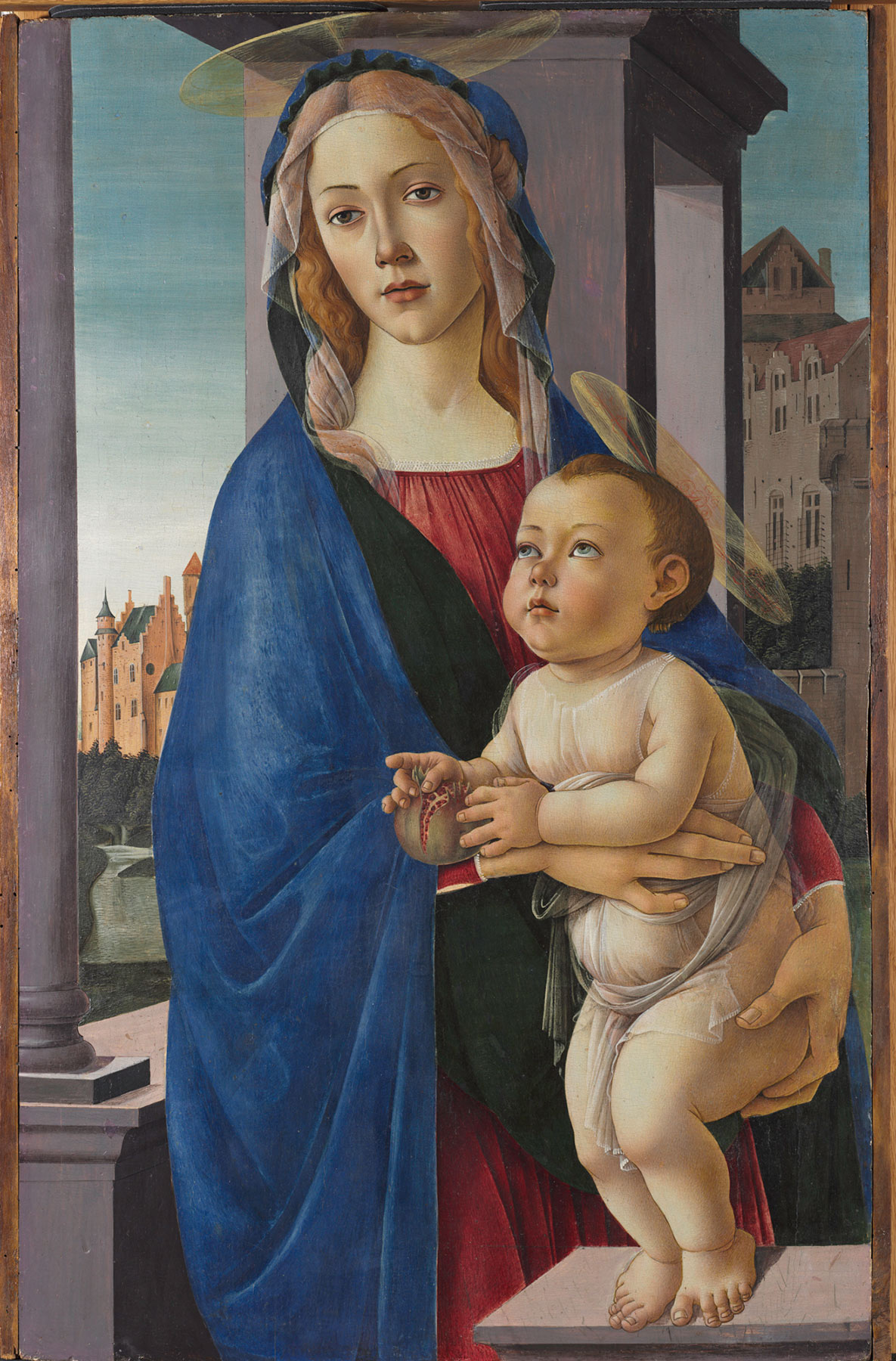
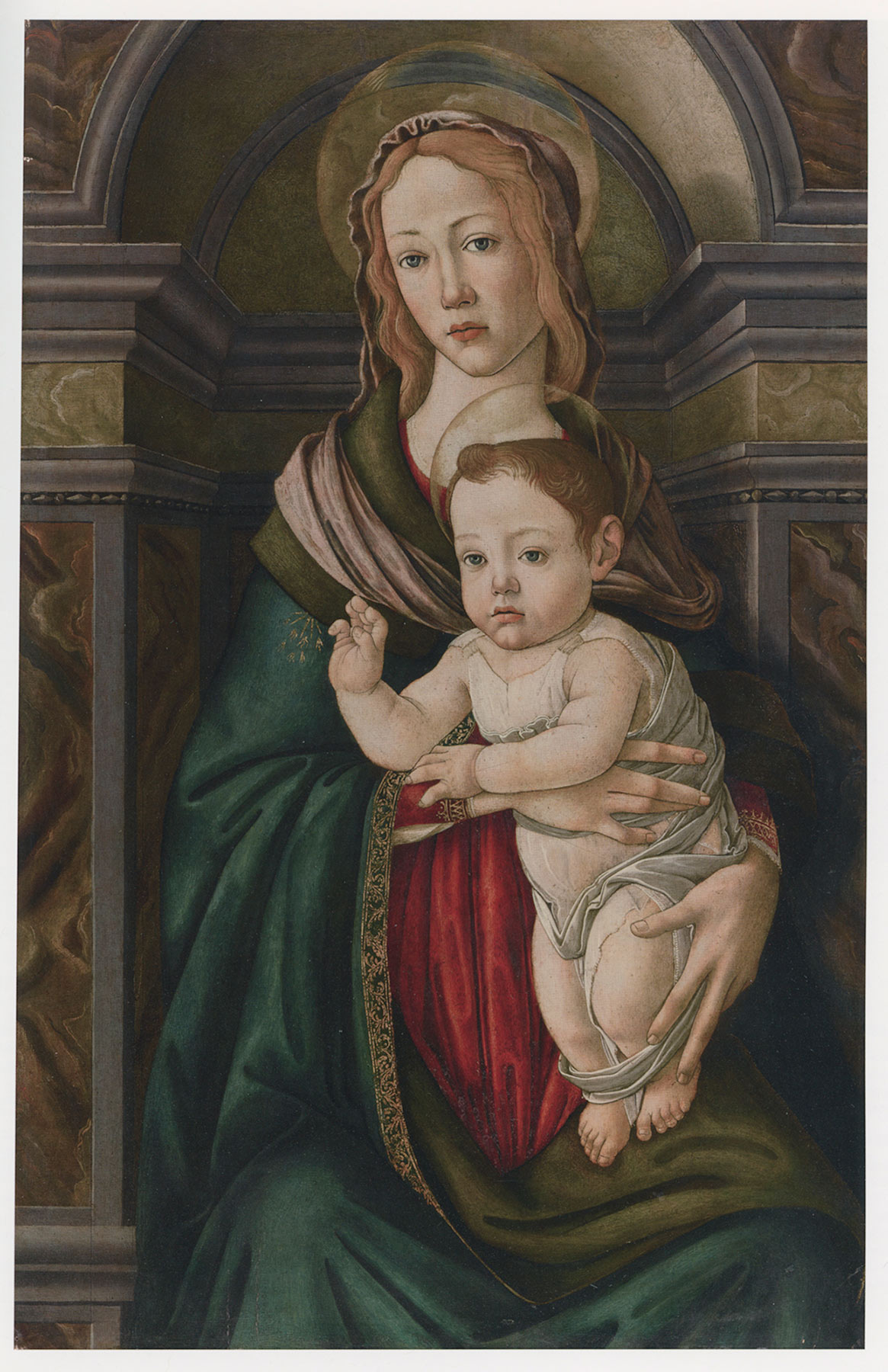
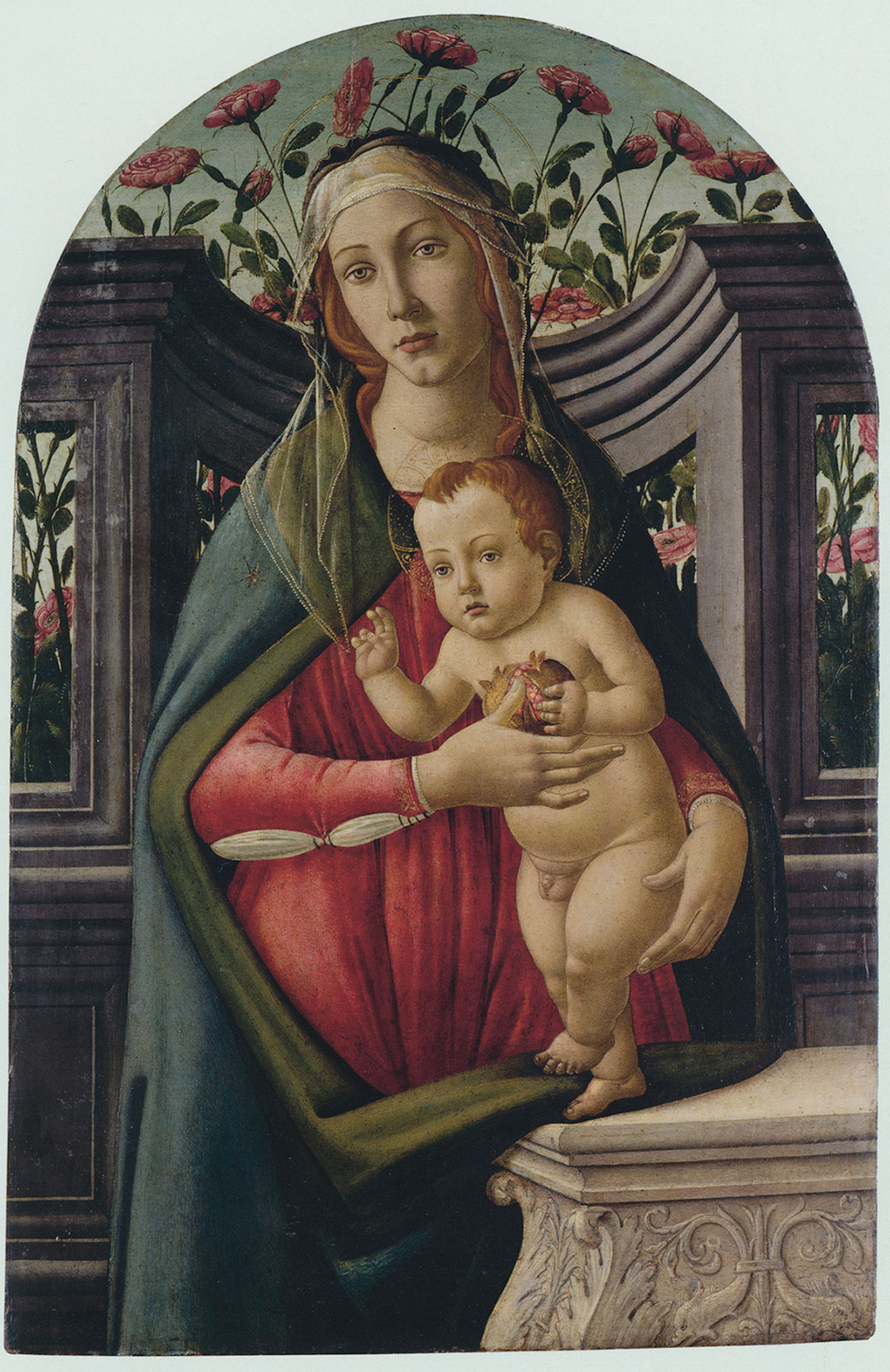
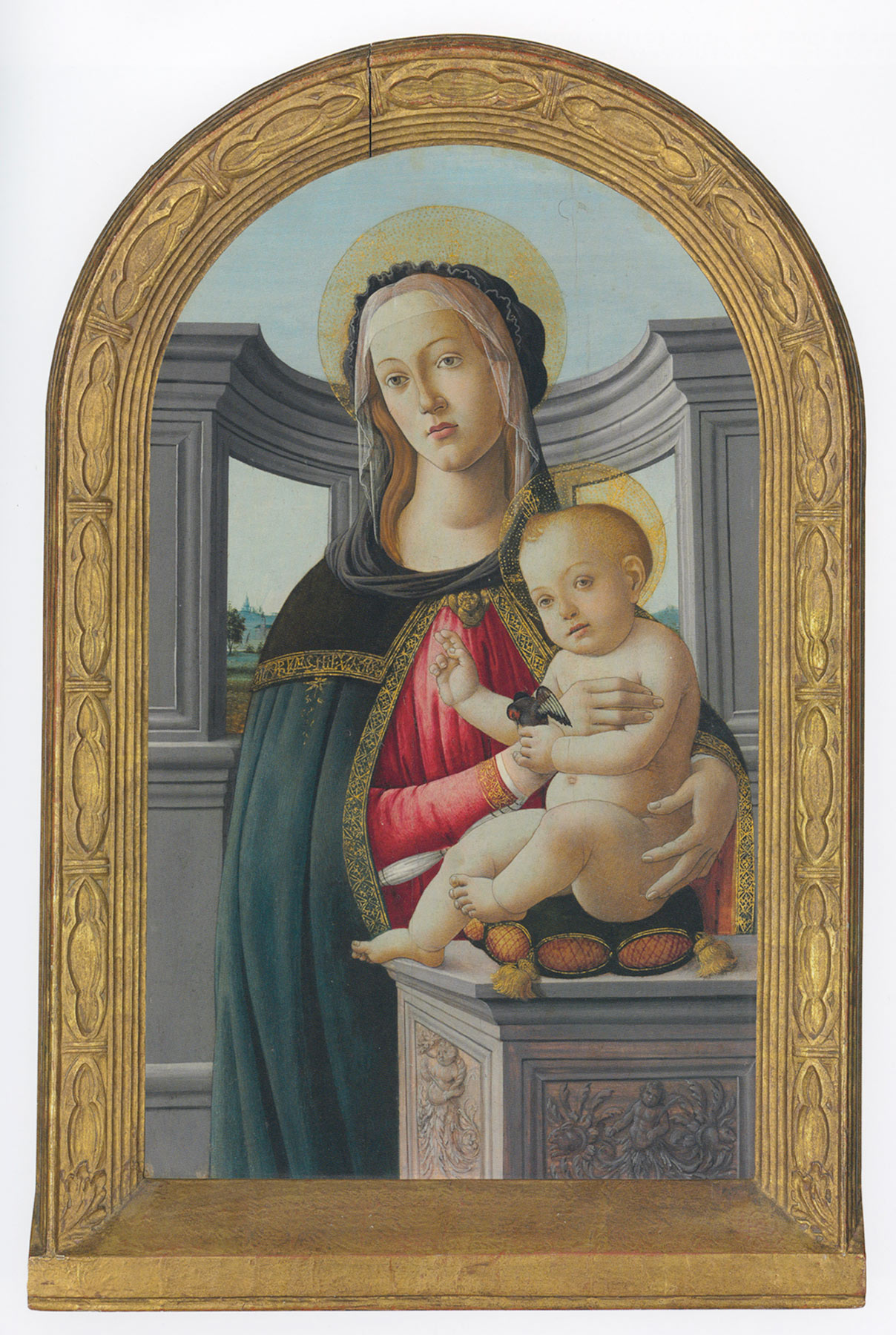
As the San Barnaba altarpiece was a prominent public commission, it has universally been assumed that it was the origin and lone autograph version of the composition, while the rest of the series are all considered studio replicas by various assistants. Although this paradigm of a single autograph original spawning a series of workshop variants lies behind nearly all modern Botticelli scholarship, it cannot be shown to be true. Two of the replicas of the San Barnaba composition, the Jarves painting and the Turin painting (see fig. 3), are autograph creations by Botticelli himself; another, the painting at the Harvard University Art Museums (see fig. 4), was considered by Everett Fahy to be autograph;14 and yet another, the ex-Merton painting (see fig. 6), may in part have been painted by Botticelli. It could be argued that the Turin painting antedates the San Barnaba altarpiece and may have been the occasion for Botticelli’s initial experiments with this figure grouping. Instead of presenting the Virgin enthroned before an elaborate marble and pietra serena niche, the Turin painting shows her standing half length within a marble porch, alongside a river landscape that includes a receding line of Gothic, Northern European townhouses.15 Although she looks vaguely out toward the viewer, as does the Virgin in the San Barnaba altarpiece, she turns her right shoulder and hip forward to accommodate a marble ledge on which the Christ Child stands, with His mother’s help, while He leans on her right arm. In Turin, the Child supports His own weight while His mother, at whom He looks up adoringly, embraces and steadies Him with her left hand beneath Him. In the altarpiece, the same pose is supported with far less credibility entirely by the Virgin, as the Child leans forward in her grasp to bless the viewer. The Child’s left arm in Turin reaches across His mother’s wrist to hold a pomegranate, which He peels open with His right hand. Drawn in the same position in the altarpiece, the Child’s left arm rests purposelessly on His mother’s. The Turin painting includes numerous pentimenti—especially visible beneath the Virgin’s right eye and in the fingers of her left hand—and the eccentric, nonfunctional architecture in the foreground is typical of Botticelli’s practice during the first half of his career. It is probable that this very lively presentation of the Virgin and Child was invented for the private devotional context of the Turin painting and was later adapted for use in a more solemn liturgical context in the San Barnaba commission.
The San Barnaba altarpiece (see fig. 2) is not documented but can be dated on stylistic grounds to the second half of the 1480s; Alessandro Cecchi asserted that it is likely to have been completed and installed in time for the celebration of the Feast of San Barnaba (June 11) in 1488.16 The Turin Virgin and Child (see fig. 3) can with some confidence be dated, again on stylistic grounds, to the first half of the same decade, perhaps four or more years earlier than the San Barnaba altarpiece. A second version of the Turin composition, the Virgin and Child from the Grenville Winthrop bequest at Harvard (see fig. 4), is an arresting image for its beautiful state of preservation and rich coloration, but in all other respects, it is a nearly line-for-line reprise of the Turin painting. Its draftsmanship is stiffer than that in Turin, its surfaces less richly decorated. In the Turin painting, the figures and objects all cast shadows in the same direction, evoking a coherent and unified light source. The shadow cast backward by the column at the left is omitted in the Harvard painting, which reproduces (illogically) only the small pool of shadow at the right of the column’s plinth and the Child’s shadow cast behind Him. The buildings in the backgrounds of the two paintings are copied from the same source—probably a pattern-book drawing—but in the Harvard painting, they are simplified and pushed upward to compress the space they occupy within the taller, narrower picture field. Although the Winthrop painting is a work of appreciable quality, it is not an autograph creation by Botticelli.17
The Virgin and Child formerly in the Benson collection (see fig. 5) is a straightforward reduction and simplification of the central group in the San Barnaba altarpiece, as is the painting in Valletta. The ex-Benson painting includes a varicolored marble background adapted to convert the composition to a more intimate format and to simulate a higher viewing point than the altarpiece, at the level of the Child’s head rather than His knees. It is, like the Harvard painting (see fig. 4), confidently drawn and ably painted, possibly by the same assistant, but if so, he was an artist whose approach to designing drapery folds grew steadily more schematic over time. The painting formerly in the Merton collection (see fig. 6) is instead an inventive reconsideration of the compositions of both the Turin painting and the San Barnaba altarpiece. The Child once again stands, or steps, on a pedestal, in this case with fanciful acanthus decoration at its corners and addorsed dolphins, possibly heraldic, on its front face.18 He retains the blessing gesture of His right hand from the altarpiece but also the pomegranate, as in Turin, here shifted to His left hand and supported with His mother’s help. Behind the Virgin is an architectural structure that combines the shell niche of the altarpiece and the open views of the Turin painting, but the landscape in the latter has been replaced here by a hedge of roses, a motif familiar from numerous fifteenth-century Virgin and Child compositions emerging from other Florentine artists’ workshops. The conception of this painting and the adaptation of its narrative elements to a new context is attributable directly to Botticelli, as is the painting of the Virgin’s beautifully modeled head and veil, reflecting his style of the middle to late 1490s. Other infelicities, such as the Virgin’s inappropriately small and weakly modeled hands, are clearly evidence of workshop intervention. Another version, obliquely related to this one and formerly in the Metropolitan Museum of Art (see fig. 7), was left entirely to assistants to paint if not actually produced outside Botticelli’s studio. Here, the Child is seated on a cushion, the pomegranate has been replaced by a bird, and the Virgin’s right hand, no longer needed to hold the fruit, is shifted maladroitly to a position where it is unclear whether she is supporting or pinioning her Son. The pedestal has been extended upward and drawn as though its upper surface was seen simultaneously from below and from above.
The Jarves Virgin and Child is the most freely inventive of this series after the painting in Turin (see fig. 3), and it is the Turin painting more than the San Barnaba altarpiece (see fig. 2) that must be accounted its principal source of inspiration as well as the point of departure for its innovations. The Virgin in the Jarves painting turns both shoulders and hips parallel to the picture surface, unlike any other version of the composition. The sense of contrapposto in her stance relies instead on the long, elegant curve of her neck, the turn of her head further away from the viewer than in the other versions, and the spatially effective device of her blue cloak and transparent veil pulling forward across her right arm. In the Turin painting, the fall of the Virgin’s blue shawl from the top of her head virtually straight down to the bottom edge of the composition and the soft highlight on her right thigh are intended to convey the impression that she is leaning slightly forward. An imaginary line running through her forehead, right arm, and right knee represents the frontal plane of the image, behind which all the forms of both figures, the architecture, and the background recede in dramatic and effective foreshortening. In the Jarves painting, Botticelli has instead used the Virgin’s shoulders as an anchoring plane, in front of which he projected all the other forms as if in a modeled terracotta relief. The Virgin’s cloak rests on her shoulders rather than falling from her head. It is clasped at her throat by a brooch and stretches forward to accentuate the projection of her right arm and elbow. Underdrawing (fig. 8) reveals the artist’s original intention to exaggerate this effect even further, with indications of major folds radiating outward from the right elbow that he did not ultimately paint. The Child, resting His feet on a ledge or pedestal—His mother’s cloak is thoughtfully draped over the stone surface—does not support His own weight: He leans backward into the crook of His mother’s left arm and rests one foot atop the other in an engagingly childish manner. He clutches the pomegranate firmly in His left hand and with His right forcefully pulls from it its seeds, symbols of eternal life, rather than gently and symbolically pulling back the skin of the fruit, as in Turin. The river running through the landscape background looks more like the lower Arno valley, notwithstanding the Gothic forms of some of the buildings at the left, juxtaposed with an Italianate church and, at the right, a walled city that would not seem out of place in a Tuscan setting.
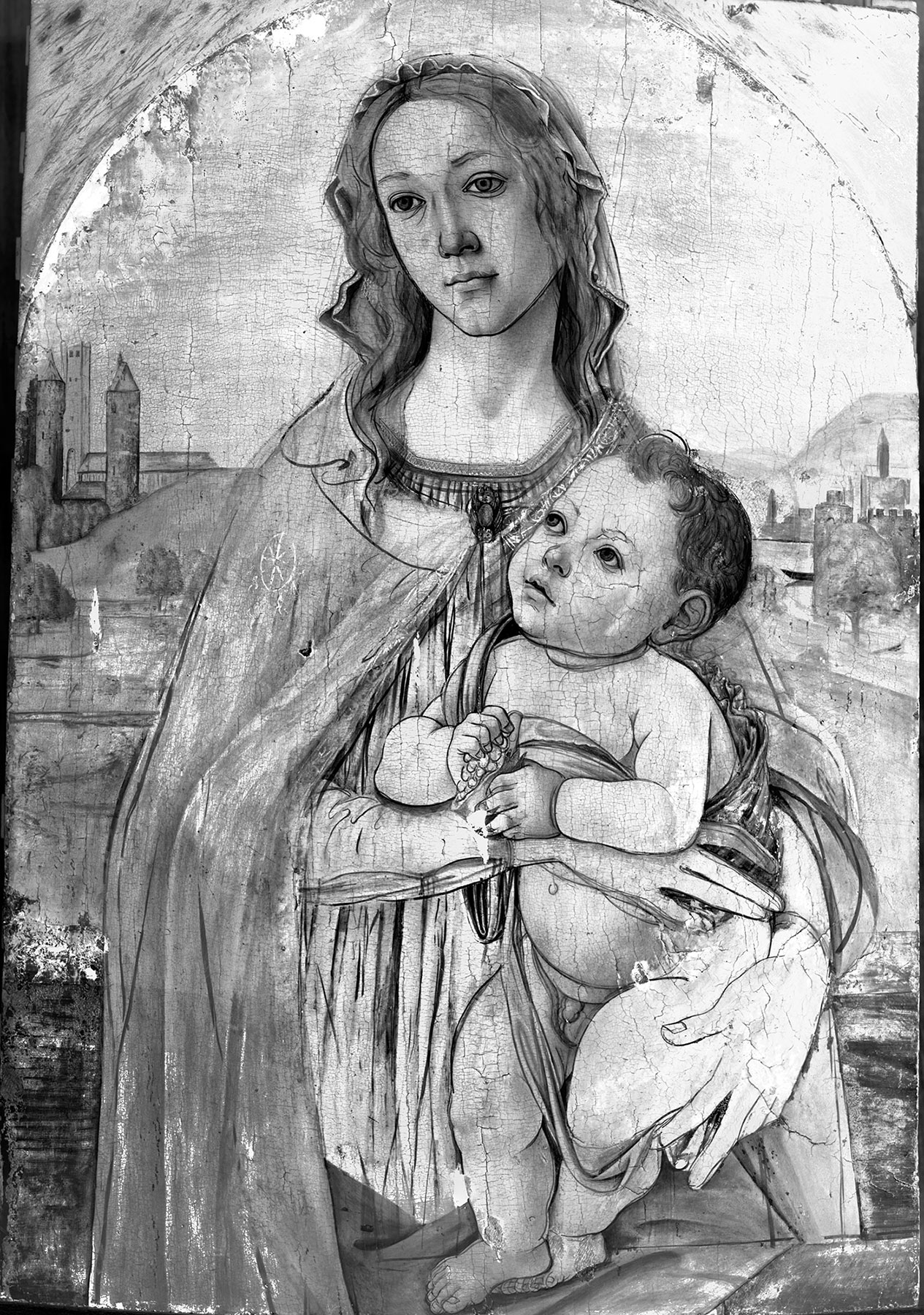
The tall and slender proportions of the Virgin in the Jarves painting and her exaggeratedly elegant features are characteristic of Botticelli’s work in the mid-1480s. The Child, though simply drawn in the manner of Botticelli’s style of the end of that decade, is less stiff than his figures of that date, more animated in His movements, and more rational in His positioning in space. The painting is probably exactly contemporary to the San Barnaba altarpiece: the cartoons for both works may have been developed all but simultaneously to repurpose the invention of the Turin Virgin and Child. The position of the Virgin’s left hand in both the Jarves and San Barnaba paintings is nearly identical, and the splay of the fingers on her right hand corresponds closely. The even, simple outline of the left hand visible in infrared images of the Jarves painting (see fig. 8) could indicate tracing from a cartoon for this detail, but it could equally be a result of the erasure of an upper layer of drawing in this damaged area: contours throughout the rest of the painting were all redrawn freehand with a dark brush line of supreme confidence and rapidity, incorporating adjustments of position for almost every figural detail and drapery fold. Some forms not finally included in the painted surface, such as the summarily indicated collar or hood at the top of the Virgin’s cloak, leave unanswered the question of whether they were inserted in imitation of similar effects in the San Barnaba altarpiece or whether they anticipate solutions more fully worked out there later. The same is true of the folds of the Virgin’s cloak protecting the Christ Child’s feet from the cold stone of the ledge. The drawing of the folds closely approximates the forms in the lining of the Virgin’s cloak in the San Barnaba altarpiece, but it is not at all clear which context provided greater intellectual justification for the invention. Were the Jarves painting better preserved—evenly throughout and at a level comparable to that of the Turin Virgin or the San Barnaba altarpiece—it would certainly be admired as one of the artist’s most accomplished creations, notwithstanding its relationship to an extended family of closely related variants. —LK
Published References
Jarves, James Jackson. Descriptive Catalogue of “Old Masters” Collected by James J. Jarves to Illustrate the History of Painting from A.D. 1200 to the Best Periods of Italian Art. Cambridge, Mass.: H. O. Houghton, 1860., 52; Sturgis, Russell, Jr. Manual of the Jarves Collection of Early Italian Pictures. New Haven: Yale College, 1868., 69; W. F. Brown, Boston. Catalogue of the Jarves Collection of Early Italian Pictures. Sale cat. November 9, 1871., 22, no. 74; Rankin, William. “Some Early Italian Pictures in the Jarves Collection of the Yale School of Fine Arts at New Haven.” American Journal of Archaeology 10, no. 2 (April–June 1895): 137–51., 148; Horne, Herbert P. Alessandro Filipepi, Commonly Called Sandro Botticelli, Painter of Florence. London: Chiswick, 1908., 118; Sirén, Osvald. A Descriptive Catalogue of the Pictures in the Jarves Collection Belonging to Yale University. New Haven: Yale University Press, 1916., 135–36, no. 50; Sirén, Osvald. “Early Italian Pictures at Cambridge.” Burlington Magazine 37, no. 213 (December 1920): 289–91, 294–95, 298–300, 303., 299; Yashiro, Yukio. Sandro Botticelli. London: Medici Society, 1925., 135; Offner, Richard. Italian Primitives at Yale University: Comments and Revisions. New Haven: Yale University Press, 1927., 6; “Handbook: A Description of the Gallery of Fine Arts and the Collections.” Special issue, Bulletin of the Associates in Fine Arts at Yale University 5, nos. 1–3 (1931): 1–64., 31; van Marle. Raimond. The Development of the Italian Schools of Painting. Vol. 12. The Hague: M. Nijhoff, 1931., 238–39, 244; Berenson, Bernard. Italian Pictures of the Renaissance: A List of the Principal Artists and Their Works with an Index of Places. Oxford: Clarendon, 1932., 104; “Picture Book Number One: Italian Painting.” Special issue, Bulletin of the Associates in Fine Arts at Yale University 15, nos. 1–3 (October 1946): n.p., fig. 16; Rediscovered Italian Paintings. Exh. cat. New Haven: Yale University Art Gallery, 1952., 34–35; Berenson, Bernard. Italian Pictures of the Renaissance, A List of the Principal Artists and Their Works with an Index of Places: Florentine School. 2 vols. London: Phaidon, 1963., 1:37; Seymour, Charles, Jr. Early Italian Paintings in the Yale University Art Gallery. New Haven: Yale University Art Gallery, 1970., 128–30, no. 87; Fredericksen, Burton B., and Federico Zeri. Census of Pre-Nineteenth-Century Italian Paintings in North American Public Collections. Cambridge, Mass.: Harvard University Press, 1972., 599; E. Frank and S. Casteras, in Seymour, Charles, Jr., et al. Italian Primitives: The Case History of a Collection and Its Conservation. Exh. cat. New Haven: Yale University Art Gallery, 1972., 24; Brown, David Alan. Berenson and the Connoisseurship of Italian Painting: A Handbook to the Exhibition. Exh. cat. Washington, D.C.: National Gallery of Art, 1979., 19, fig. 28; Lightbown, Ronald. Sandro Botticelli. 2 vols. London: Paul Elek, 1978., 2:123; Pope-Hennessy, John, and Laurence Kanter. The Robert Lehman Collection. Vol. 1, Italian Paintings. New York: Metropolitan Museum of Art, 1987., 192; Kenney, Elise K., ed. Handbook of the Collections: Yale University Art Gallery. New Haven: Yale University Art Gallery, 1992., 135
Notes
-
Pater, Walter. “A Fragment on Sandro Botticelli.” Fortnightly Review, n.s., 8 (August 1870): 155–60., 155–60; for John Ruskin, as well as Algernon Charles Swinburne, Dante Gabriel Rossetti, and other early admirers of Botticelli in England, see Bertram, Anthony. “The English Discovery of Botticelli.” Journal of the Royal Society of Arts 98, no. 4819 (April 1950): 468–84., 468–84. ↩︎
-
Sturgis, Russell, Jr. Manual of the Jarves Collection of Early Italian Pictures. New Haven: Yale College, 1868., 68–69. ↩︎
-
See, for example, Crowe, Joseph Archer, and Giovanni Battista Cavalcaselle. A New History of Painting in Italy: From the Second to the Sixteenth Century; Drawn Up from Fresh Material and Recent Researches in the Archives of Italy, as Well as from Personal Inspection of the Works of Art Scattered throughout Europe. 3 vols. London: J. Murray, 1864., 2:311, 396, 414–23. ↩︎
-
W. F. Brown, Boston. Catalogue of the Jarves Collection of Early Italian Pictures. Sale cat. November 9, 1871., 22. ↩︎
-
Rankin, William. “Some Early Italian Pictures in the Jarves Collection of the Yale School of Fine Arts at New Haven.” American Journal of Archaeology 10, no. 2 (April–June 1895): 137–51., 148. ↩︎
-
Bernard Berenson, quoted in Brown, David Alan. Berenson and the Connoisseurship of Italian Painting: A Handbook to the Exhibition. Exh. cat. Washington, D.C.: National Gallery of Art, 1979., 19. ↩︎
-
Sirén, Osvald. A Descriptive Catalogue of the Pictures in the Jarves Collection Belonging to Yale University. New Haven: Yale University Press, 1916., 136. ↩︎
-
Sirén, Osvald. “Early Italian Pictures at Cambridge.” Burlington Magazine 37, no. 213 (December 1920): 289–91, 294–95, 298–300, 303., 299. ↩︎
-
John Pope-Hennessy, in Pope-Hennessy, John, and Laurence Kanter. The Robert Lehman Collection. Vol. 1, Italian Paintings. New York: Metropolitan Museum of Art, 1987., 192. Everett Fahy (in typescript notes dated 1999 accompanying his photographic archive) acknowledged that Sirén’s group was not cohesive, observing that only half of the pictures are by the same hand. Omitting to specify which half, he nevertheless chose to retain the epithet coined by Sirén and added eleven further works to the artist’s corpus, subsequently adding at least five others. His construction of a Master of the Gothic Buildings has been accepted by, among others, Christopher Daly (in Falciani, Carlo, Carl Brandon Strehlke, and Pierre Curie, eds. Chefs-d’oeuvre de la peinture italienne: La collection Alana. Exh. cat. Paris: Mercator, 2019., 138–39), who characterized the painter as Botticelli’s closest collaborator, particularly active in the 1490s. ↩︎
-
Horne, Herbert P. Alessandro Filipepi, Commonly Called Sandro Botticelli, Painter of Florence. London: Chiswick, 1908., 118. ↩︎
-
Lightbown, Ronald. Sandro Botticelli. 2 vols. London: Paul Elek, 1978., 2:123 ↩︎
-
Zeri, Federico. Italian Paintings in the Walters Art Gallery. 2 vols. Baltimore: Walters Art Gallery, 1976., 1:95. ↩︎
-
Inv. no. NG3082, https://www.nationalgallery.org.uk/paintings/follower-of-sandro-botticelli-the-virgin-and-child; Davies, Martin. National Gallery Catalogues: The Earlier Italian Schools. 2nd rev. ed., London: National Gallery, 1961., 117–18. ↩︎
-
Fahy, typescript notes, 1999, accompanying his photographic archive. ↩︎
-
See Paula Nuttall (in Nuttall, Paula. From Flanders to Florence: The Impact of Netherlandish Painting, 1400–1500. New Haven: Yale University Press, 2004., 206–7) for remarks on the use of specific Flemish models in the backgrounds of Florentine painting at this date. ↩︎
-
Cecchi, Alessandro. Botticelli. Milan: Federico Motta, 2005., 253–54. ↩︎
-
Ironically, while no trace of Botticelli’s intervention in the paint surface of this work is easily discovered, there is some evidence that he was involved in creating or altering the underdrawing, in which the pomegranate in the Child’s hand is rendered as a flute. There is no conventional iconographic context for the Christ Child shown holding a flute; this may be an example of the type of studio prank said by Giorgio Vasari to have been played by the artist on his assistants: see Vasari, Giorgio. Le vite de’ più eccellenti pittori, scultori ed architettori. With new annotations and comments by Gaetano Milanesi. 9 vols. Florence: G. C. Sansoni, 1878–85., 3:319–20. ↩︎
-
In the sales catalogue for Christie’s, London, December 7, 2006, lot 39, Sir Timothy Clifford suggested that these might indicate the patronage of a member of the Pazzi or Pandolfini families at the end of the fifteenth century, a date that would accord with the painting’s style. ↩︎