on the platform, FILII • BARTHOLOMEI • DE • NELIS • DIE • P[RIMO] • FEBRVARII • MCCCCLXXIX • HOC • OPVS • FECERVNT
James Jackson Jarves (1818–1888), Florence, by 1859
The panel support, 2.5 centimeters thick, comprises two vertical planks with a seam approximately on center. Two battens made of old wood, each 8.7 centimeters wide, are applied to the reverse at 18 and 93.5 centimeters from the bottom but may not be original. Five splits have opened across the bottom of the panel, none of which rise above the level of the lower batten, and two have opened at the top of the panel on the right. A red wax seal on the reverse is illegible. The full surface of the reverse was aggressively cleaned in a treatment of 1959–60, destroying any evidence of construction or provenance that might have remained there. The left edge of the panel seems to be original but has been scraped clean of any gesso remnants, whereas the right edge might have been shaved slightly. The arched top appears to be original but has been sanded smooth. The picture surface was harshly abraded in the cleaning of 1959–60, especially in areas of brown pigment. The saint’s hair and the lower third of the composition were scraped. The upper portion of the column to which the saint is bound is intact; the lower portion is nearly effaced. Flesh tones are worn to the verdaccio preparatory layers in shadows but are well preserved otherwise. The mordant gilt crown held by the angel is largely missing. A split running through the head of the angel has not been retouched, nor have losses along the seam where it is open between the saint’s abdomen to just above his ankles or along the five splits across the bottom of the composition.
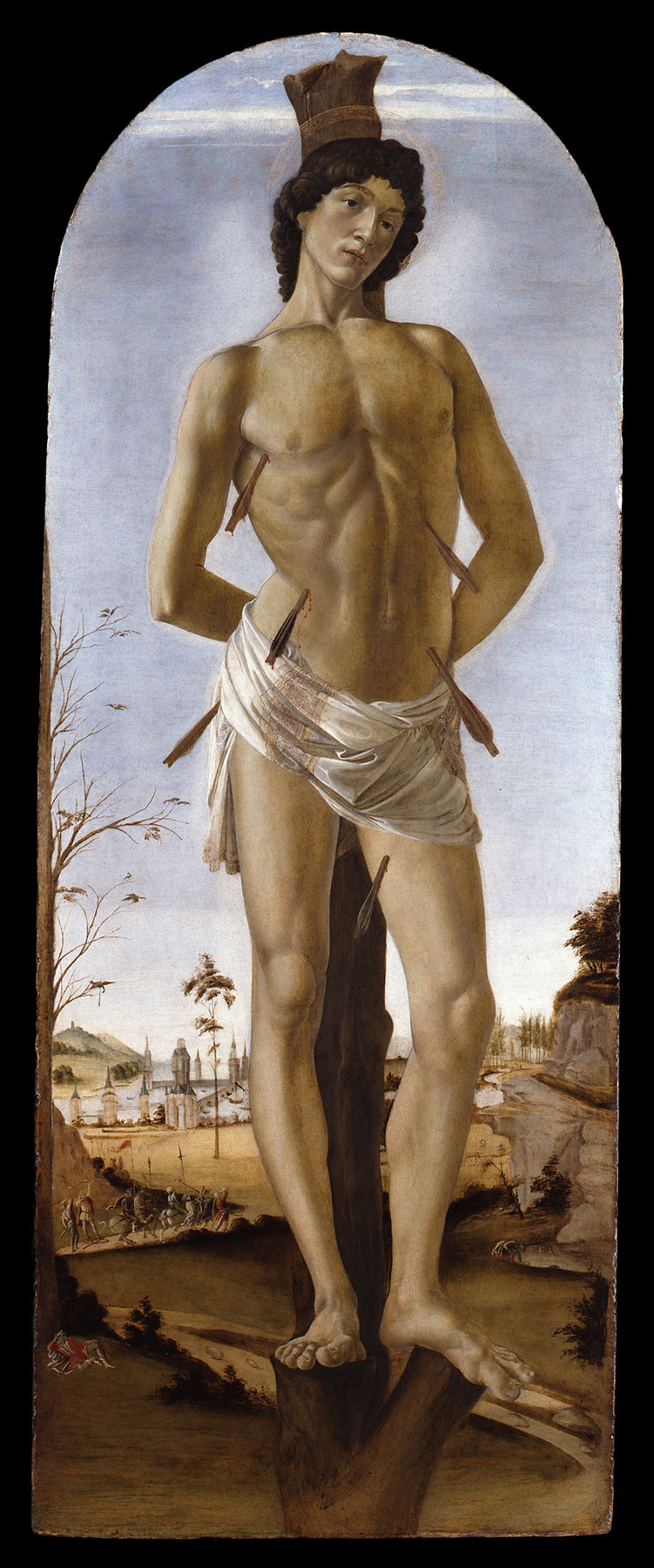
The painting portrays Saint Sebastian pierced by arrows, standing on a marble ledge; his hands are bound behind him to a marble column topped by a Corinthian capital. The saint looks up to his left, where an angel flies toward him bearing the trophies of his martyrdom: a gilt crown and palm leaf. Behind these figures is a view down upon the rooftops of a city with an expansive hilly landscape further in the background. By the panel’s size, format, and subject, it may be presumed to have been a votive offering for protection from the plague, meant to be hung on a column or pier in a church. An example of this type by Botticelli (fig. 1) shows the saint in a landscape, tied to a tree and standing on two branches sawn off at the trunk.1 The same formula was adopted in two similar paintings by Francesco Botticini that are closely related in composition but that add the figure of an angel presenting Sebastian with the crown and palm of his martyrdom, as in the Yale painting.2 None of these three images retains an inscription comparable to that at Yale, specifying the names of its patron or the date of its manufacture.
The inscription on the Yale painting—which reads, “FILII • BARTHOLOMEI • DE • NELIS • DIE • P[RIMO] • FEBRVARII • MCCCCLXXIX • HOC • OPVS • FECERVNT” (The sons of Bartolomeo Nelli had this work made on the first day of February 1479)—was misread by Charles Seymour, Jr., as suggesting that “the sons of Bartolommeo Danieli” were the patrons of the work, concluding that the “commissioners have not as yet been identified, nor the circumstances of the commission fully investigated.”3 The correct transcription of the name refers to the sons of Bartolomeo di Antonio di ser Bartolomeo dei Nelli, a prominent Florentine merchant born in 1411/12. His sons, the filii Bartholomei who ordered the painting, were Francesco and Antonio, best remembered to history for their sale of property to Cardinal Giulio de’ Medici in 1519 and 1520 to facilitate the construction of the New Sacristy of San Lorenzo, where it extends into the street still known as the Canto dei Nelli.4 In 1430 the not yet twenty-year-old Bartolomeo di Antonio Nelli married Susanna di Rinaldo degli Albizzi (1408–1480/82), daughter of the powerful banker and Medici opponent, allying the fortunes of the two houses. As the son-in-law of Rinaldo degli Albizzi, Bartolomeo Nelli was exiled from Florence following the return of Cosimo de’ Medici in 1434. Susanna Nelli reported to the Florentine tax authorities in 1469 that her husband had died in exile, but it is not clear whether she and her sons had by then returned to Florence or whether she was filing in absentia, and they returned at an unknown date after that. Her tax declaration of 1480 does not list any property, but her sons, Francesco and Antonio, declared joint ownership of the family house behind San Lorenzo in 1495, which had been held for them in trust by a collateral branch of the family during their father’s period of exile. The inscription on the Yale Saint Sebastian implies that by February 1480 (1479, according to the old Florentine calendar), they must have been in residence in Florence and, like so many Florentines in 1479 and 1480, seeking protection from a recurrent outbreak of plague in the city. It remains to be determined whether the painting was intended to hang in San Lorenzo, the family’s parish church and otherwise a stronghold of Medici sympathizers, or the Badia Fiorentina, where Susanna Albizzi Nelli and her sons are buried.
When it was owned by James Jackson Jarves, the Yale Saint Sebastian bore a not-unreasonable attribution to Filippino Lippi, and it retained this identification until 1916, when Osvald Sirén reassigned it to Jacopo del Sellaio.5 It was mentioned by all later writers without discussion as a work by Sellaio, until Federico Zeri prudently added a question mark after the attribution in 1972.6 None of Sellaio’s documented or firmly attributed paintings include city views as crowded or complex as that behind the figure of Saint Sebastian in the panel at Yale, and his shorthand notations for features of landscape are looser and more broadly painted than the orderly lines of trees and fields depicted beyond the walls of the city. Sellaio’s anatomical studies also do not dwell on the fine, almost enamel-smooth modeling of highlights and shadows still legible in the tensed muscles of Saint Sebastian’s legs (similar effects no doubt once visible in the saint’s torso are now entirely lost to abrasion). An alternative attribution to the Florentine miniaturist Gherardo di Giovanni del Fora was proposed by Luciano Bellosi in 1994, who described the painting as “unfortunately heavily damaged and scraped off by one of those horrible cleanings undertaken by this museum.”7 Although Bellosi did not argue or explain this attribution, it was subsequently accepted in manuscript opinions by Everett Fahy and Carl Strehlke.8
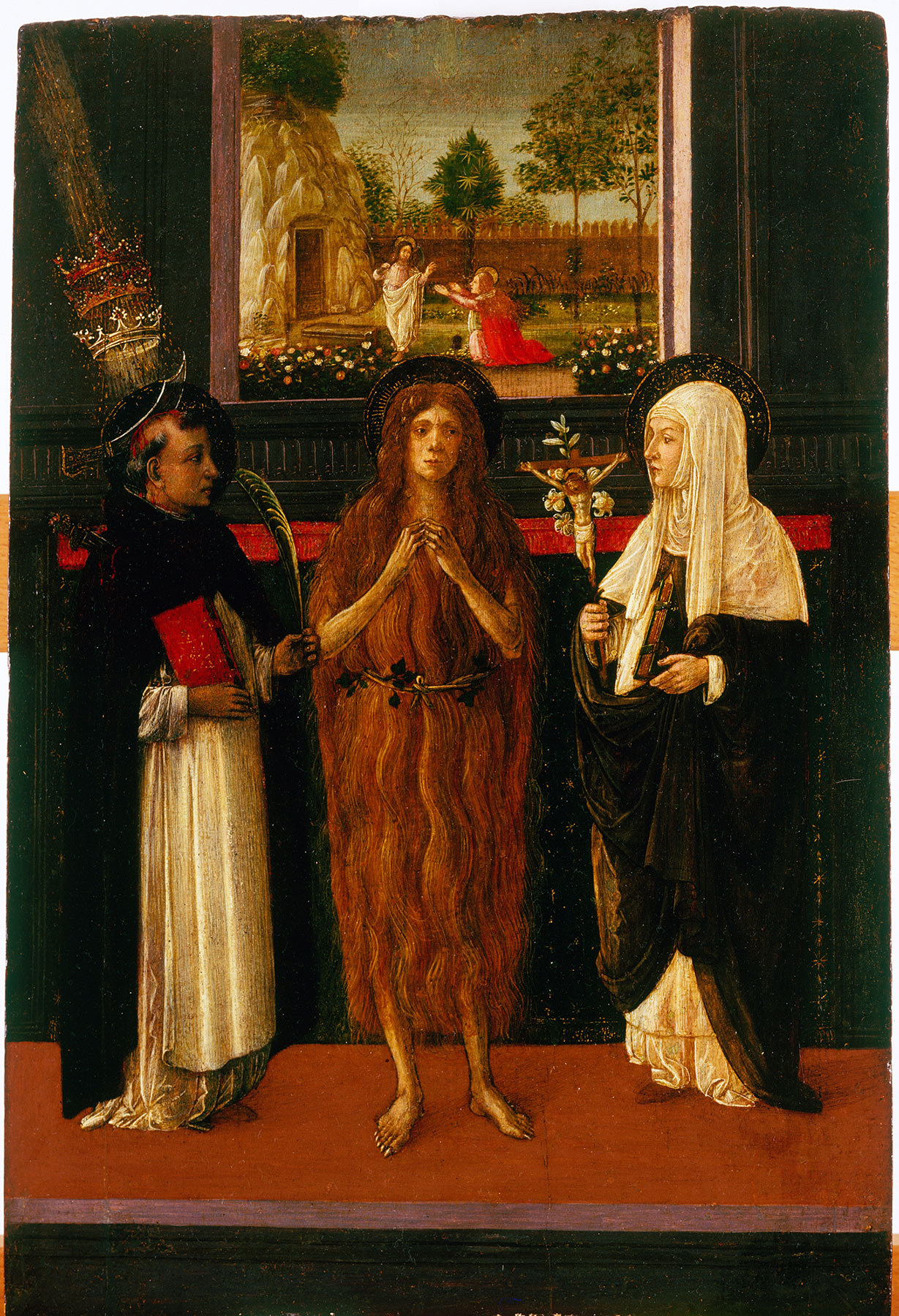
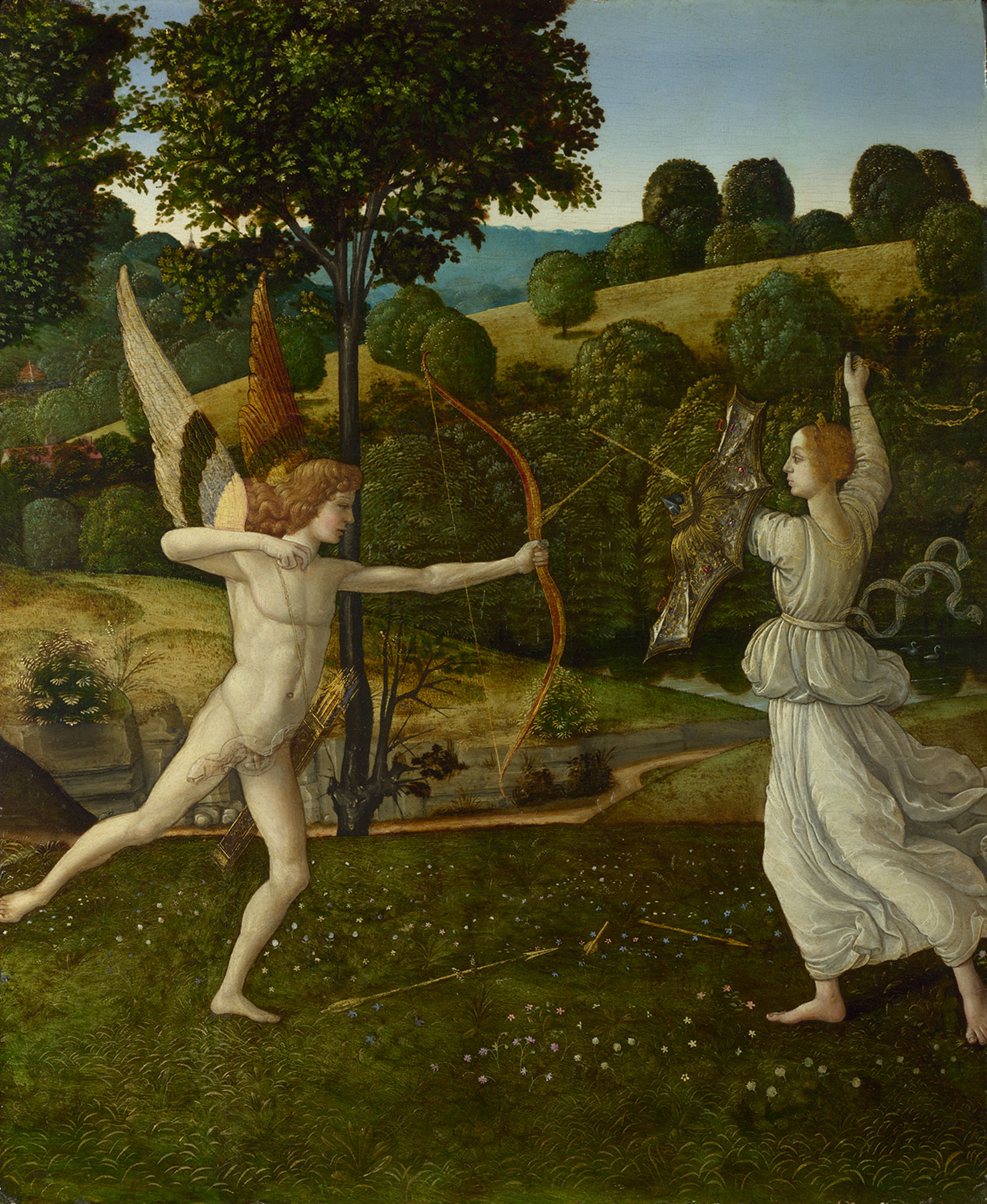
Gherardo di Giovanni and his younger brother Monte di Giovanni operated at least from 1461 a workshop situated behind the Badia Fiorentina specializing in manuscript illumination, and in their capacity as illuminators, they have both been admired among the most accomplished in late fifteenth-century Florence.9 Giorgio Vasari dedicated a laudatory if brief biography to Gherardo, whom he described as a talented musician and respected humanist as well as a gifted panel painter and frescoist and whom he credited with the rediscovery of the ancient art of glass mosaic.10 Based probably on this notice, Roberto Longhi attributed to Gherardo a small panel representing Saint Mary Magdalen standing between Saints Peter and Catherine of Siena (fig. 2), then in the collection of Alessandro Contini-Bonacossi, now in the Kress Collection at the Bowdoin College Museum of Art, Brunswick, Maine.11 In 1968 Everett Fahy recognized that the Kress painting was by the same hand as a larger body of work previously assembled under the rubric Master of the Triumph of Chastity, and he extended Longhi’s attribution to Gherardo di Giovanni to the entire group.12 This group, named after a painting in the National Gallery, London, portraying the Combat of Love and Chastity (fig. 3), had been chiefly a creation of Pietro Toesca and comprised a series of panels featuring small-scale figures in extensive and detailed landscapes.13 While the identification of the Master of the Triumph of Chastity with Gherardo di Giovanni is plausible, it rests only on similarities to the extensive body of miniatures by the artist and is anchored by no certain or documented monumental works—the few paintings mentioned by Vasari that are known to survive are all preserved in illegible states.
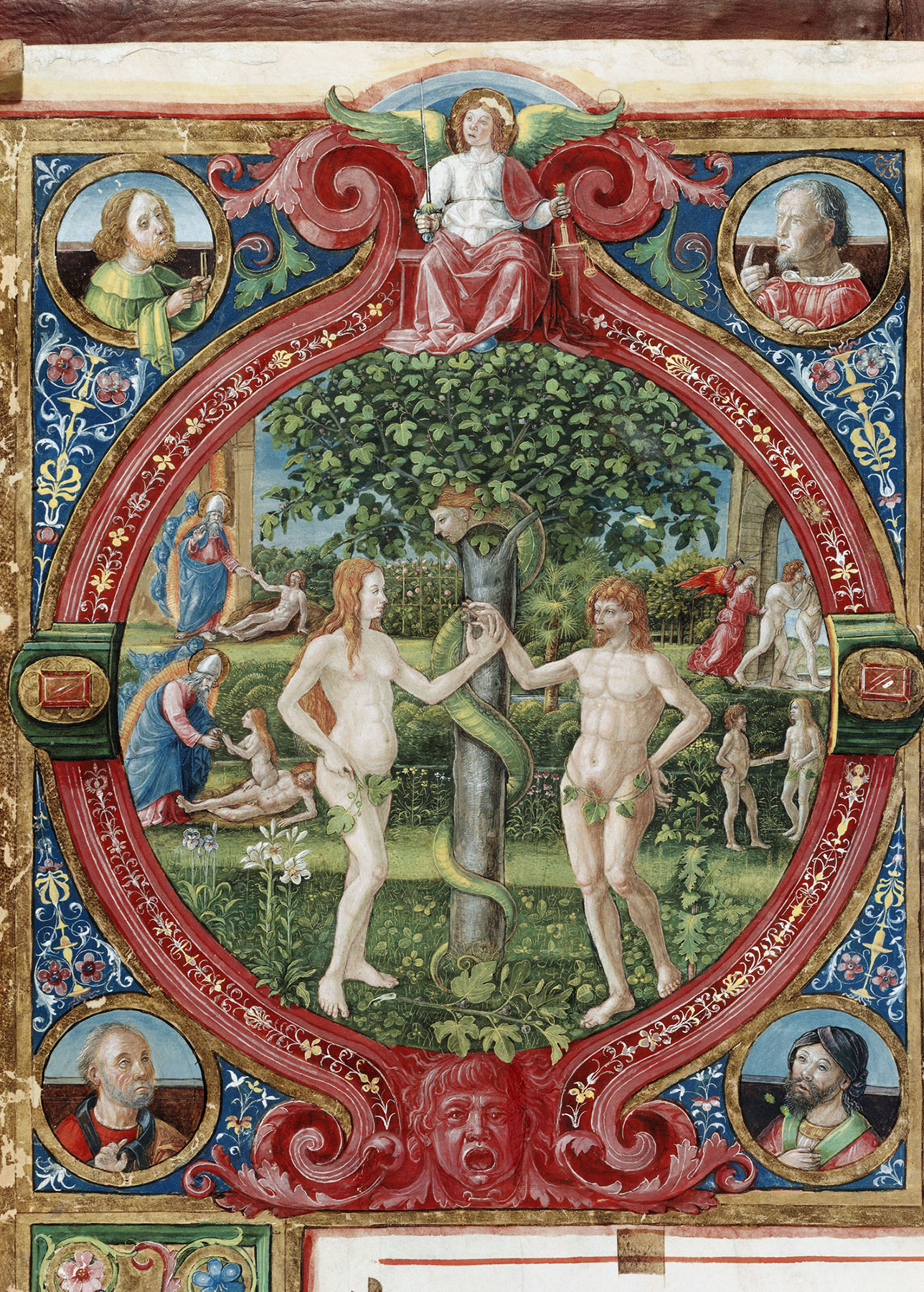
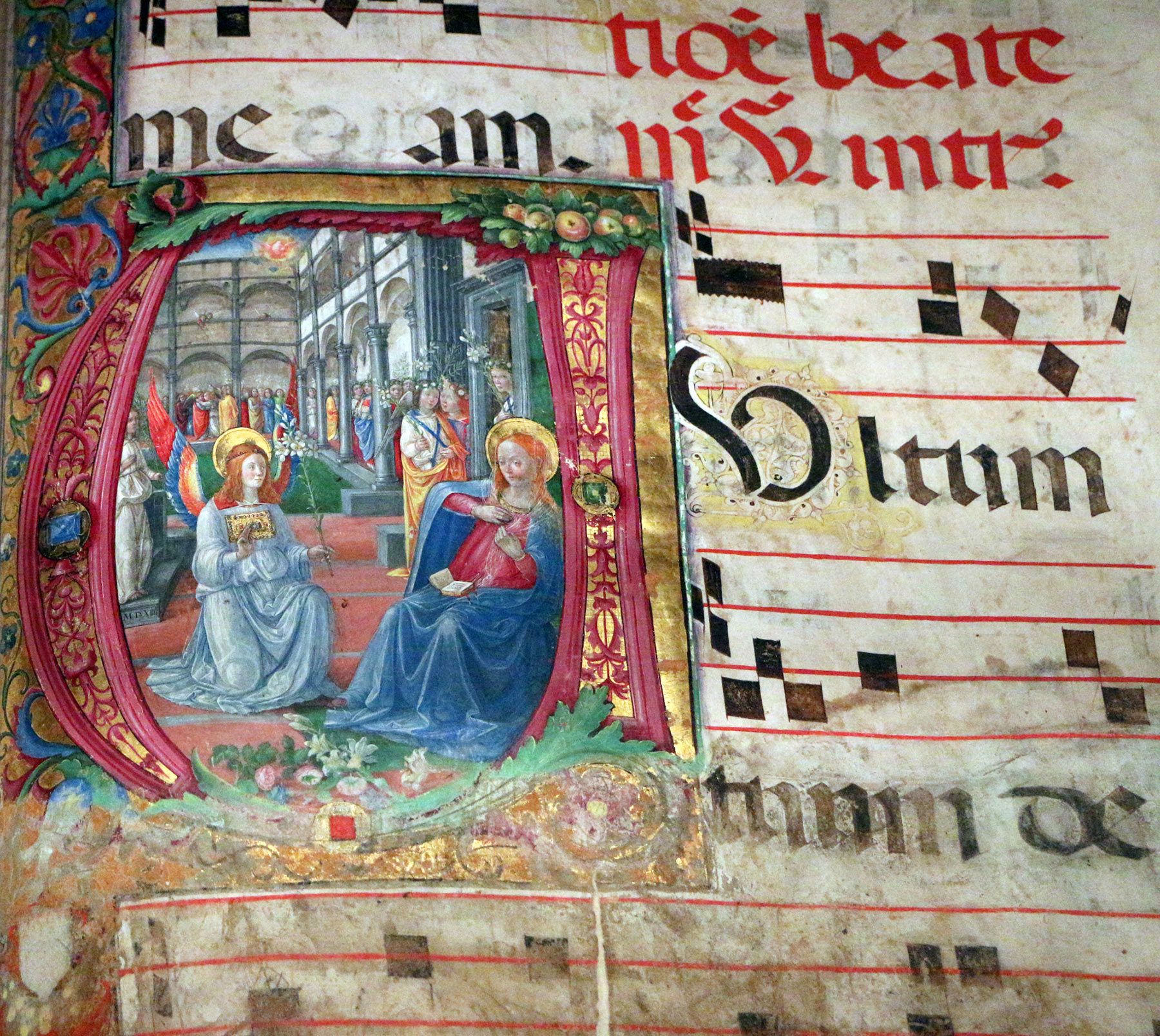
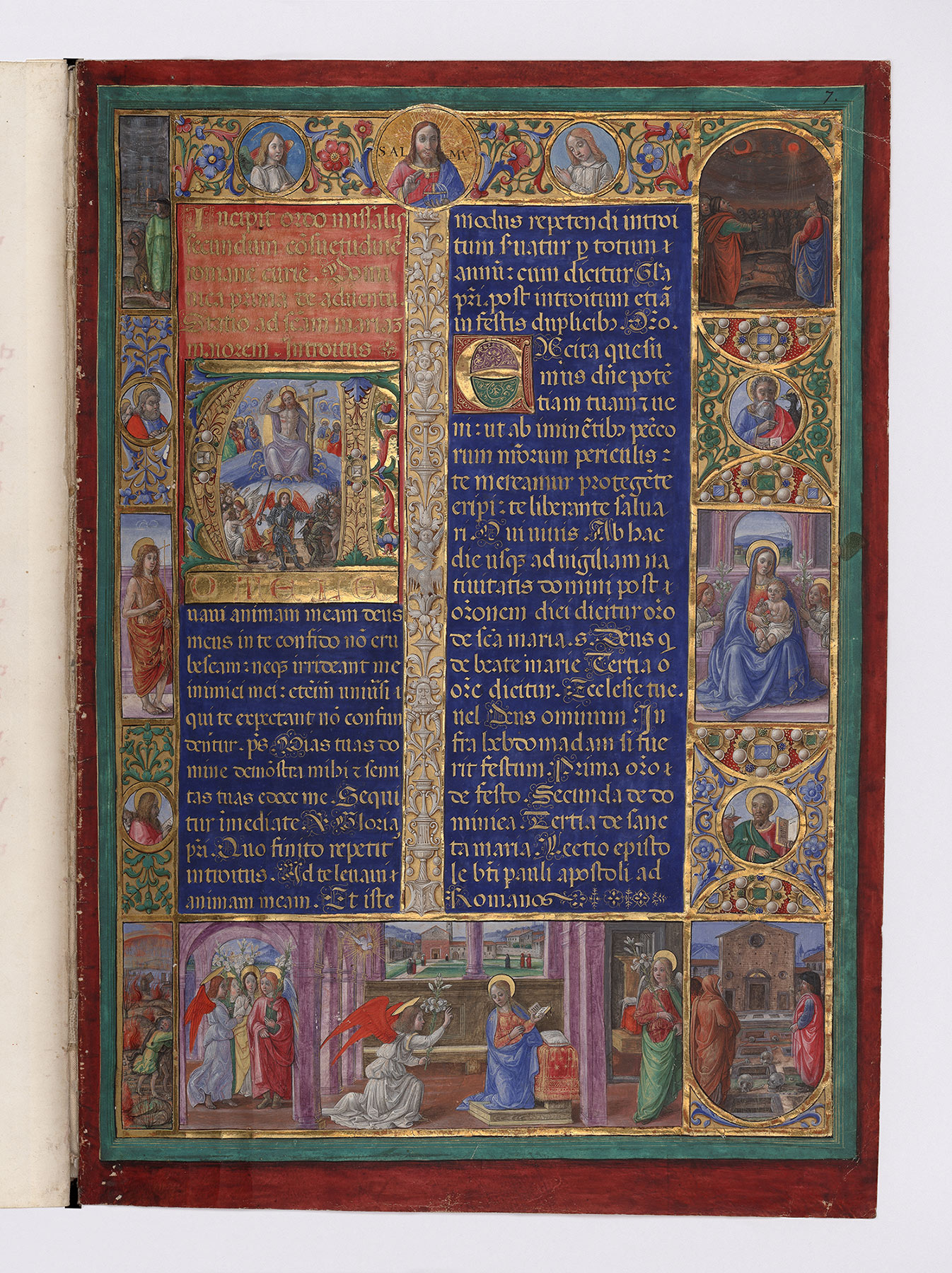
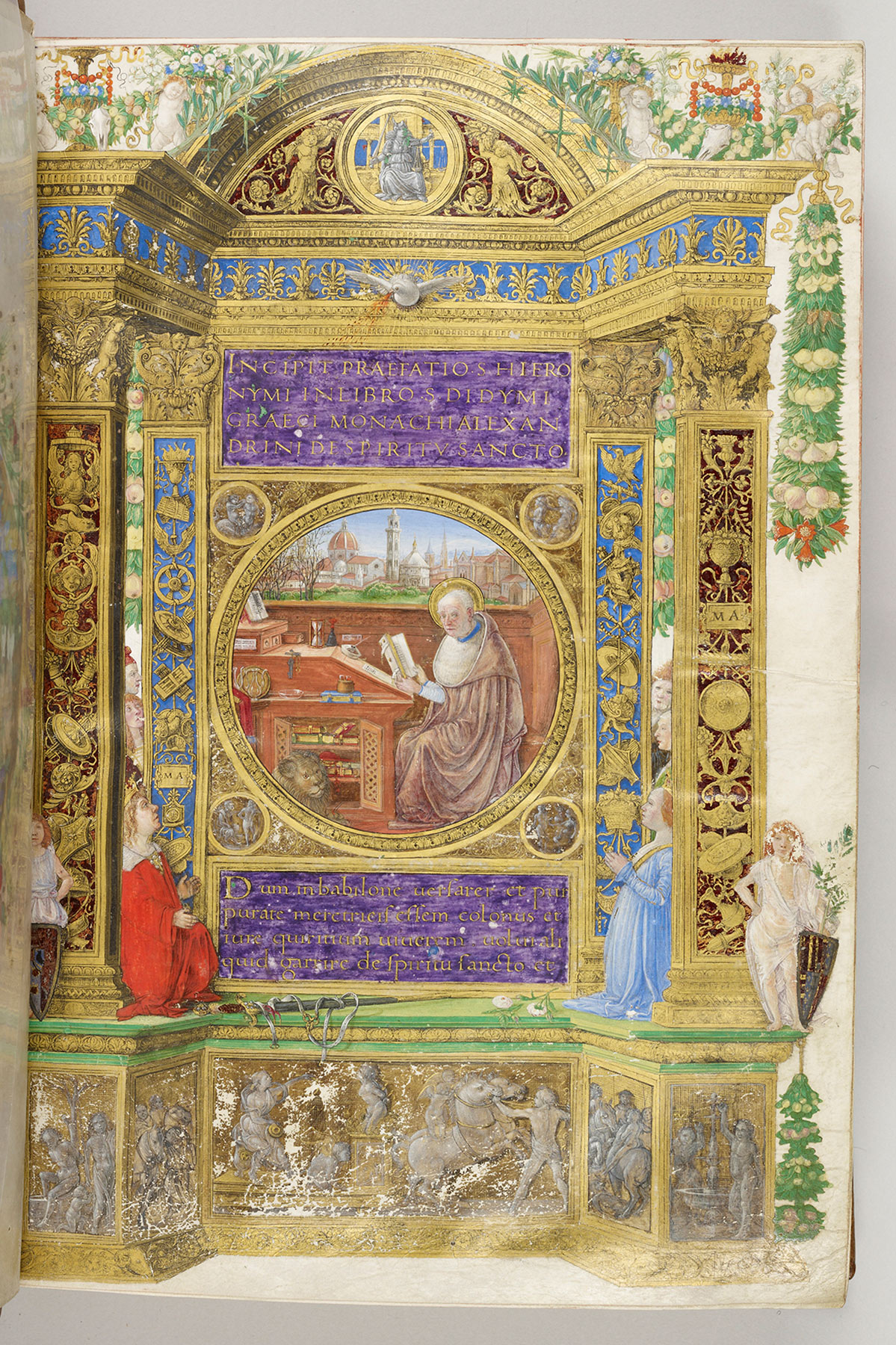
It has not yet been possible to propose a firm distinction between the work of Gherardo and the work of Monte within their copious joint production of manuscript illuminations; that the panel paintings associated with these works might be largely or entirely attributable to Gherardo is an assumption based only on Vasari’s admiration for the older brother and his silence regarding the younger. For Fahy, for example, Monte’s “style is a slightly debased version of Gherardo’s, and usually tends toward greater elaboration of the borders and decorative parts of the illumination,”14 whereas for Annarosa Garzelli, Monte was the more innovative and decisive painter of the two.15 Monte survived his brother by thirty-five years, and while it is regularly acknowledged that commissions documented to him during this second part of his career should form a basis for recognizing his independent personality,16 his exaggerated late style is not, in practice, easy to read back into earlier illuminations with a view to extricating neatly one hand from the collaborative workshop enterprise. The figure style of the Yale Saint Sebastian, however, does relate convincingly to that in the Adam and Eve in an Initial I on folio 2v of Antiphonary D (fig. 4) or in the Annunciation in an Initial V on folio 54r of Gradual S (fig. 5), both at the Museo del Opera di Santa Maria del Fiore in Florence. The latter is dated by inscription 1514, and it is therefore logically the work of Monte, not Gherardo. The same figure types appear in the Annunciation on folio 7 of the missal painted in 1509/10 for the Florentine Baptistery (fig. 6), again a work by Monte, and in a portrait of Saint Jerome in the miscellany of Saint John Climacus at the Morgan Library, New York (fig. 7), illuminated in 1488 for Matthias Corvinus, king of Hungary, possibly a work of the two brothers together. While the attribution of the Yale panel to the del Fora workshop is secure, as is the likelihood of its principal executant having been Monte di Giovanni, it cannot be demonstrated that he was its exclusive author. —LK
Published References
Jarves, James Jackson. Descriptive Catalogue of “Old Masters” Collected by James J. Jarves to Illustrate the History of Painting from A.D. 1200 to the Best Periods of Italian Art. Cambridge, Mass.: H. O. Houghton, 1860., 52; Sturgis, Russell, Jr. Manual of the Jarves Collection of Early Italian Pictures. New Haven: Yale College, 1868., 72; W. F. Brown, Boston. Catalogue of the Jarves Collection of Early Italian Pictures. Sale cat. November 9, 1871., no. 80; Rankin, William. “Some Early Italian Pictures in the Jarves Collection of the Yale School of Fine Arts at New Haven.” American Journal of Archaeology 10, no. 2 (April–June 1895): 137–51., 149n9; Sirén, Osvald. A Descriptive Catalogue of the Pictures in the Jarves Collection Belonging to Yale University. New Haven: Yale University Press, 1916., 130–31, no. 47; van Marle. Raimond. The Development of the Italian Schools of Painting. Vol. 12. The Hague: M. Nijhoff, 1931., 376, 378; Berenson, Bernard. Italian Pictures of the Renaissance: A List of the Principal Artists and Their Works with an Index of Places. Oxford: Clarendon, 1932., 527; Berenson, Bernard. Italian Pictures of the Renaissance, A List of the Principal Artists and Their Works with an Index of Places: Florentine School. 2 vols. London: Phaidon, 1963., 1:198; Seymour, Charles, Jr. Early Italian Paintings in the Yale University Art Gallery. New Haven: Yale University Art Gallery, 1970., 177–78, no. 128; Fredericksen, Burton B., and Federico Zeri. Census of Pre-Nineteenth-Century Italian Paintings in North American Public Collections. Cambridge, Mass.: Harvard University Press, 1972., 599; Padoa Rizzo, Anna. “Per Francesco Botticini.” Antichità viva 15, no. 5 (September–October 1976): 3–19., 4; Bellosi, Luciano. “The Landscape ‘alla fiamminga,’ in Italy and the Low Countries.” In Artistic Relations: The Fifteenth Century; Proceedings of the Symposium Held at Museum Catharijneconvent, Utrecht, 14 March 1994, ed. V. M. Schmidt et al., 97–108. Florence: Centro Di, 1999., fig. 6
Notes
-
This work was identified by Herman Ulmann (in Ulmann, Herman. Sandro Botticelli. Munich: Verlagsanstalt für Kunst und Wissenschaft, 1893., 46–48) as the painting described by the Anonimo Magliabecchiano in the early sixteenth century as hanging on a pier in Santa Maria Maggiore, Florence, and as dated January 1473 (n.s. 1474), undoubtedly referring to a now-lost inscription. ↩︎
-
Metropolitan Museum of Art, New York, inv. no. 48.78, https://www.metmuseum.org/art/collection/search/435734; and Gallerie degli Uffizi, Florence, inv. no. 1890 n. 8476. See Venturini, Lisa. Francesco Botticini. Florence: Edifir, 1994., 101, 117. ↩︎
-
Seymour, Charles, Jr. Early Italian Paintings in the Yale University Art Gallery. New Haven: Yale University Art Gallery, 1970., 177. ↩︎
-
See Elam, Caroline. “The Site and Early Building History of Michelangelo’s New Sacristy.” Mitteilungen des Kunsthistorischen Institutes in Florenz 23, nos. 1–2 (1979): 155–86., 155–86, esp. 181–82; and Saalman, Howard. “The New Sacristy of San Lorenzo before Michelangelo.” Art Bulletin 67, no. 2 (1985): 199–228., 199–228. ↩︎
-
Jarves, James Jackson. Descriptive Catalogue of “Old Masters” Collected by James J. Jarves to Illustrate the History of Painting from A.D. 1200 to the Best Periods of Italian Art. Cambridge, Mass.: H. O. Houghton, 1860., 52; Sturgis, Russell, Jr. Manual of the Jarves Collection of Early Italian Pictures. New Haven: Yale College, 1868., 72; Rankin, William. “Some Early Italian Pictures in the Jarves Collection of the Yale School of Fine Arts at New Haven.” American Journal of Archaeology 10, no. 2 (April–June 1895): 137–51., 149n9; and Sirén, Osvald. A Descriptive Catalogue of the Pictures in the Jarves Collection Belonging to Yale University. New Haven: Yale University Press, 1916., 130–31. ↩︎
-
van Marle. Raimond. The Development of the Italian Schools of Painting. Vol. 12. The Hague: M. Nijhoff, 1931., 376, 378; Berenson, Bernard. Italian Pictures of the Renaissance: A List of the Principal Artists and Their Works with an Index of Places. Oxford: Clarendon, 1932., 527; Berenson, Bernard. Italian Pictures of the Renaissance, A List of the Principal Artists and Their Works with an Index of Places: Florentine School. 2 vols. London: Phaidon, 1963., 1:198; Seymour, Charles, Jr. Early Italian Paintings in the Yale University Art Gallery. New Haven: Yale University Art Gallery, 1970., 177; Padoa Rizzo, Anna. “Per Francesco Botticini.” Antichità viva 15, no. 5 (September–October 1976): 3–19., 4; and Fredericksen, Burton B., and Federico Zeri. Census of Pre-Nineteenth-Century Italian Paintings in North American Public Collections. Cambridge, Mass.: Harvard University Press, 1972., 599. ↩︎
-
Bellosi, Luciano. “The Landscape ‘alla fiamminga,’ in Italy and the Low Countries.” In Artistic Relations: The Fifteenth Century; Proceedings of the Symposium Held at Museum Catharijneconvent, Utrecht, 14 March 1994, ed. V. M. Schmidt et al., 97–108. Florence: Centro Di, 1999., 103. ↩︎
-
Curatorial files, Department of European Art, Yale University Art Gallery. ↩︎
-
See Martini, Giuseppe Sergio. La bottega di un cartolaio fiorentino della seconda metà del quattrocento. La bibliofilia 58. Florence: Leo S. Olschki, 1956.; Garzelli, Annarosa, and Albina De la Mare. Miniatura fiorentina del Rinascimento, 1440–1525: Un primo censimento. Vol. 1, Le immagini, gli autori, i destinatari. Florence: Scandicci, 1985., 1:265–330; Galizzi, Diego. “Gherardo di Giovanni.” In Dizionario biografico dei miniatori italiani: Secoli IX–XVI, ed. Milvia Bollati, 258–62. Milan: Sylvestre Bonnard, 2004., 258–62; and Galizzi, Diego. “Monte di Giovanni.” In Dizionario biografico dei miniatori italiani: Secoli IX–XVI, ed. Milvia Bollati, 798–801. Milan: Sylvestre Bonnard, 2004., 798–801. ↩︎
-
Vasari, Giorgio. Le vite de’ più eccellenti pittori, scultori ed architettori. With new annotations and comments by Gaetano Milanesi. 9 vols. Florence: G. C. Sansoni, 1878–85., 3:237–52. ↩︎
-
Longhi’s opinion is recorded in Shapley, Fern Rusk. Paintings from the Samuel H. Kress Collection: Italian Schools, XIII–XV Century. London: Phaidon, 1966., 138. ↩︎
-
Fahy, Everett. Some Followers of Domenico Ghirlandaio. New York: Garland, 1976., 21–33. ↩︎
-
Toesca, Pietro. “Ricordi di un viaggio in Italia.” L’arte 6 (1903): 225–50., 245–48. The London panel is one of eight known fragments of a large painting illustrating Petrarch’s “Triumph of Chastity.” ↩︎
-
Fahy, Everett. Some Followers of Domenico Ghirlandaio. New York: Garland, 1976., 31. ↩︎
-
Garzelli, Annarosa, and Albina De la Mare. Miniatura fiorentina del Rinascimento, 1440–1525: Un primo censimento. Vol. 1, Le immagini, gli autori, i destinatari. Florence: Scandicci, 1985., 1:269. ↩︎
-
Pons, Nicoletta. “Bartolomeo, Gherardo e Monte di Giovanni.” In Maestri e botteghe: Pittura a Firenze alla fine del quattrocento, ed. Mina Gregori, Antonio Paolucci, and Cristina Acidini Luchinat, 106–8. Exh. cat. Cinisello Balsamo, Milan: Silvana, 1992., 106–8; and Melli, Lorenza. “Gherardo di Giovanni, poliedrico artista alla prese col David del Verrocchio.” In Invisibile agli occhi: Atti della giornata di studio in ricordo di Lisa Venturini, ed. Nicoletta Baldini, 37–43. Florence: Fondazione di Studi di Storia dell’Arte Roberto Longhi, 2007., 37–43. ↩︎