James Jackson Jarves (1818–1888), Florence, by 1859
Originally executed on a horizontally grained wooden support, the paint layers and ground were transferred from panel to canvas by J. Howorth in Boston in 1867, using a lead white gesso adhesive. A fragment of wood found under a sample of original paint and gesso was determined by analysis to be cherry. The edges of the picture field are covered with modern gesso fills that, together with the radio-opacity of the lead white adhesive, make it impossible to detect the presence or absence of a barb delimiting the composition. The paint surface is in exceptionally poor condition: pigment and glaze layers throughout have been severely abraded, are interrupted by numerous losses, and are prominently imprinted with the weave pattern of the modern canvas support. Cleaning in Florence before 1859 removed overpaints that had completely hidden the figure of Deianira, and cleanings at Yale in 1915, 1952–62, and 1998–99 have imposed alternate readings of forms left indistinct by damages and pentimenti, as described below. Large areas of complete loss affect the centaur’s hand and tail; Deianira’s arms, hands, belly, and drapery, together with the adjacent landscape; and Hercules’s waist, his lion skin, and the section of river closest to his figure. Countless smaller losses from solvent damage, worm holes, and flaking are scattered over the entire surface. Translucent layers of blue and green are missing over the brown underpaint of the river, and green copper-resinate glazes over the landscape are either missing altogether or have deteriorated to brown. Much of the distant landscape has been reduced to underpainting, and foreground detail of plants and rocks survives only as islands of paint.
The three principal figures were originally built up of superimposed layers of partially translucent pigment and glaze. Of the three, Nessus is the best preserved, retaining limited passages of the top layer of paint in the face and horse’s body. The torso is abraded, destroying much of the definition of its musculature and the transition from human to equine flesh. Nessus’s hand and the tip of his tail are modern inventions; remnants of color suggest that horse genitalia may once have been present. Almost all the top layers of paint have been removed from Deianira’s body, leaving underpaint exposed with little modeling. The delineation of her arms and hands are reconstructions; her face and draperies are severely abraded and have lost nearly all their definition. Hercules’s silhouette is compromised by paint loss. It is unclear whether a scratched contour reinforcing this silhouette, also present around part of the centaur’s body, is the intervention of a restorer or part of the artist’s original design technique. Hercules’s mouth, eye, and the edge of his face are partially lost. Traces of a mustache and wispy beard are barely visible, as are faint remnants of delicate mordant gilt decoration on his bow and quiver. Very little remains of the musculature and bone structure of his torso and legs, which have been reduced in most areas to the initial layer of pink underpaint.
The figure of Deianira, daughter of Oeneus, king of Calydon (western Greece), and sister of Meleager, plays a pivotal role in the story of Hercules. Won in marriage by Hercules after he wrestled and defeated his rival suitor, the river god Achelous, she is the one who, caught in the throes of jealous passion, will unwittingly bring about the hero’s death. Central to Deianira’s story is Hercules’s killing of the centaur Nessus, who had attempted to rape the young bride as he carried her across the treacherous waters of the River Evenus on his back. Before dying, Nessus gives Deianira some of his blood, poisoned by Hercules’s arrow—the tip of which is smeared with the blood of the Lernaean Hydra—and tricks her into believing it will be effective in preventing her husband from loving any other woman. Many years later, feeling threatened by Hercules’s infatuation with the young Iole, the older Deianira takes Nessus’s purported love charm and dips her husband’s robe into it. Once worn by Hercules, however, the robe catches fire, burning him to death. Horrified at the unintended consequences of her actions, Deianira takes her own life.
The story of Hercules and Deianira is the subject of Sophocles’s tragic play the Trachiniae (Women of Trachis), considered the primary source for the last part of Hercules’s life, after his Labors, and the events leading up to his death and apotheosis.1 At the heart of Sophocles’s retelling of the myth, as noted by modern scholars, is the struggle between the civilized world and the primitive elemental forces of nature, represented not only by the wild landscapes and ancient creatures that inhabit them—from the shape-shifting river god Achelous and the dangerous currents of the River Evenus to the beast Nessus—but also by the “disease” of human passions.2 These themes are reflected in Deianira’s own account of Nessus’s attempted rape, one of three narrative speeches that make up the tragedy’s core. After explaining to the chorus her fears of losing her husband to Iole, Deianira continues:
I will tell you, my friends, the way by which I will have deliverance and relief. I had a gift, an old one given to me by a monster of long ago, and kept it hidden in a bronze urn. While yet a girl, I took this gift from the shaggy-chested Nessus—from his lifeblood, as he lay dying. He is the one who used to carry men in his arms for hire across the deep currents of the Evenus . . . He carried me, too, on his shoulders, when at my father’s sending, I first departed with Heracles as his wife. When I was in midstream, he touched me with lewd hands. I shrieked, and straightaway the son of Zeus turned round and with his hands shot a feathered arrow that whistled right through his chest to the lungs. As he passed away the monster spoke these few words: “Child of aged Oeneus, you will have this benefit from my ferrying, if you obey me, since you were the last whom I carried. If you gather with your hands the blood clotted around my wound, at the place where the Hydra, Lerna’s monstrous growth, imbued the arrow with black gall, you will have a charm for the heart of Heracles, so that he will never look upon any woman and love her more than you.”3
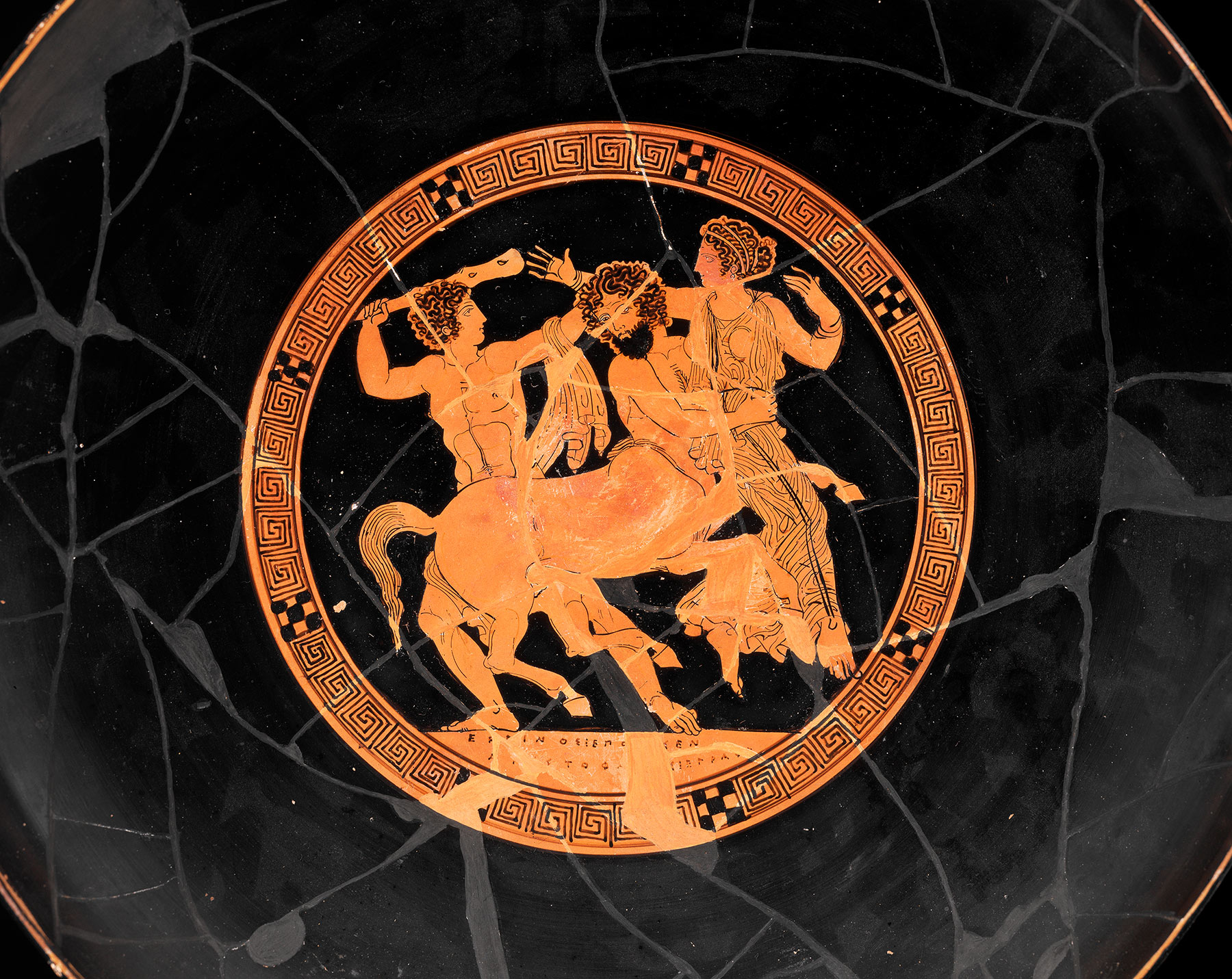
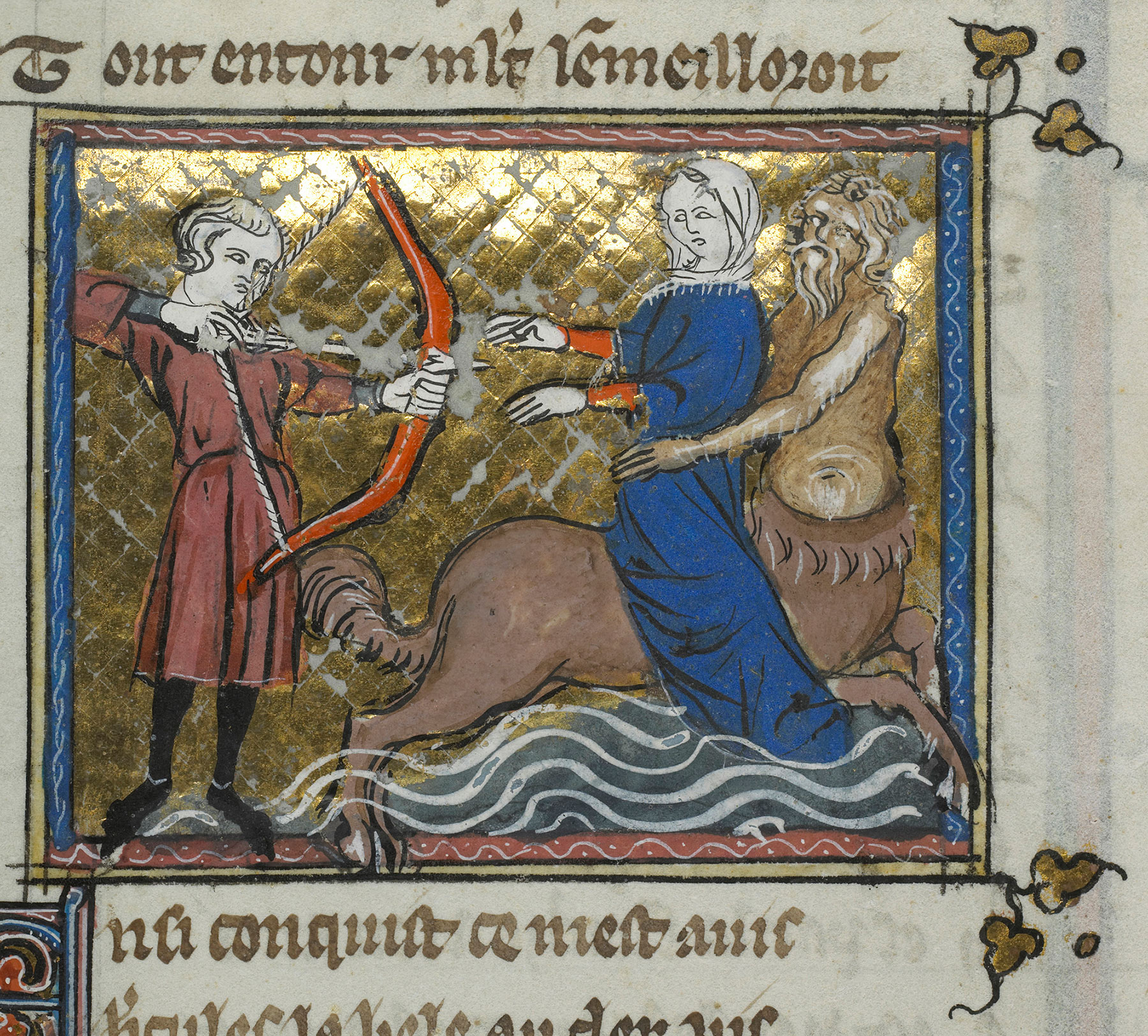
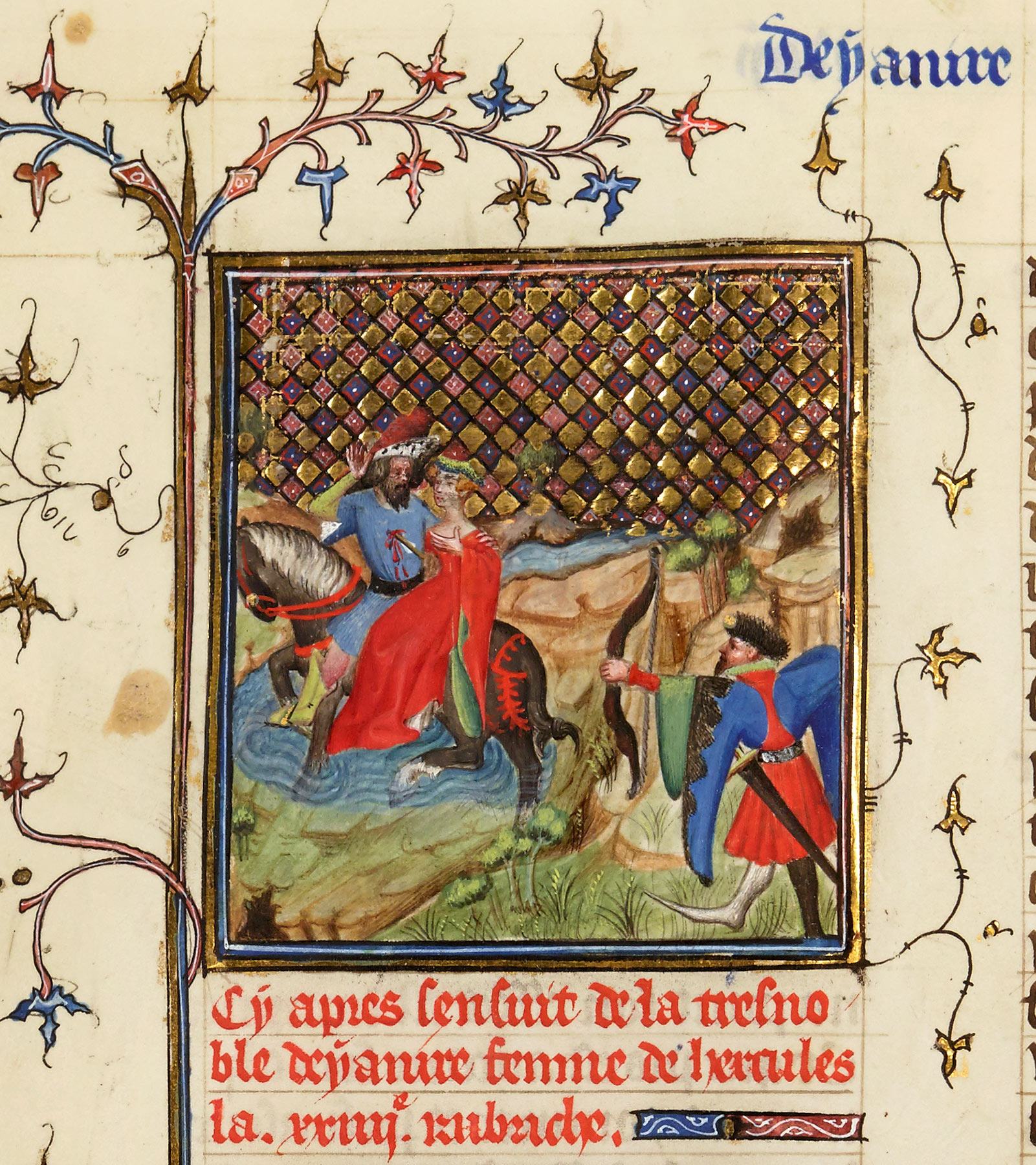
Sophocles’s text is unique in that it compresses the story of Deianira’s abduction and Nessus’s revenge, with its tragic consequences, into a single moment in time, at the heart of the play.4 Highlighted in the process are the complex mythical and ritual roles that were assigned to the tumultuous waters of the River Evenus in antiquity—not least of which was that of “ford” from the virginal to the married state.5 Sophocles’s narrative ploy, which drew the strong criticism of ancient literary critics concerned with its lack of verisimilitude,6 is absent from all later retellings of the myth, from Ovid to Boccaccio. In those works, the story unfolds in logical chronological sequence, from the moment Deianira is ferried across the river by Nessus, to Hercules’s pursuit of the couple on the opposite shore where he shoots an arrow through the centaur’s back, to the gift of the dying beast.7 The representation of the myth in surviving ancient sources, confined primarily to vase painting (fig. 1), make little if any allusion to the river setting.8 It is all the more surprising, therefore, that the Sophoclean version should have laid the groundwork for the iconography developed by Northern Late Gothic manuscript illuminators in the moralizing medieval retellings of the myth.9 A French copy of the Ovide moralisé (Moral Ovid), an enormously popular fourteenth-century text that adapted Ovid’s Metamorphoses for a Christian audience, shows Hercules on the shores of the Evenus, poised to shoot his arrow, as a frantic Deianira extends her arms to him for help while being carried across the turbulent waters by Nessus (fig. 2). The scene is more developed in early fifteenth-century French translations of Boccaccio’s De mulieribus claris (On Famous Women), a teaching guide for virtuous women, where the inclusion of details closely matching the Sophoclean narrative seems to imply a direct knowledge of the Greek text. In one of the most celebrated examples, a French copy in the Bibliothèque Nationale de France, Paris (fig. 3), gifted to Philip the Bold in 1403 by Giovanni Rapondi, a Lucchese silk merchant residing in Paris, and decorated by a Franco-Flemish illuminator, Hercules is shown on the river’s edge in the moment right after he has shot his arrow at Nessus, who is still wading across the Evenus with Deianira on his back.10 In a style suited to the courtly audience for these texts, the wounded centaur, represented as an elegantly dressed knight on horseback, is painted with the arrow visibly protruding from his bleeding chest, as he politely instructs a gracefully poised Deianira on how to use his blood. A version of the same composition appears in a virtually contemporary copy of another well-known French text, the Histoire ancienne jusqu’à César (Ancient History until the Reign of Caesar), a medieval compilation of biblical and classical sources with a similar edifying message, where the incipit “De la mort Heracles” (The Death of Hercules) that accompanies the miniature clearly illustrates the links made in the medieval imagination between these images and Hercules’s tragic end.11 That connection was spelled out by Bocaccio in the conclusion to his own retelling of the myth: “Thus Deianira was bereft of so great a husband, having hoped to recapture his love, but having lost him instead, and also avenged Nessus.”12
In Italy, where the tendency toward the moral allegorization of mythical stories is most evident in the decoration of domestic furnishings (see Paolo Schiavo, The Realms of Love), the iconographic model developed by French manuscript illuminators found its way to the testate, or ends, of matrimonial chests. The earliest surviving examples are all executed in Tuscany and datable around the middle of the fifteenth century, possibly coinciding with a renewed interest in Sophocles’s play in humanist circles.13 They include:
-
a testata formerly on the art market in London, attributed by Everett Fahy to the so-called Master of 1441;14
-
a testata illustrated by Federico Zeri, formerly in a private collection in Bergamo;15
-
the testata of a still-integral cassone with an unidentified battle scene on the front, in the Cincinnati Art Museum, assigned to the workshop of Apollonio di Giovanni (fig. 4);16
-
the testata inserted on the end of a nineteenth-century chest at Blickling Hall, Aylsham, Norwich, England (fig. 5);
-
and a testata formerly on the art market in London, attributed by Roberto Longhi to Pesellino (fig. 6).17
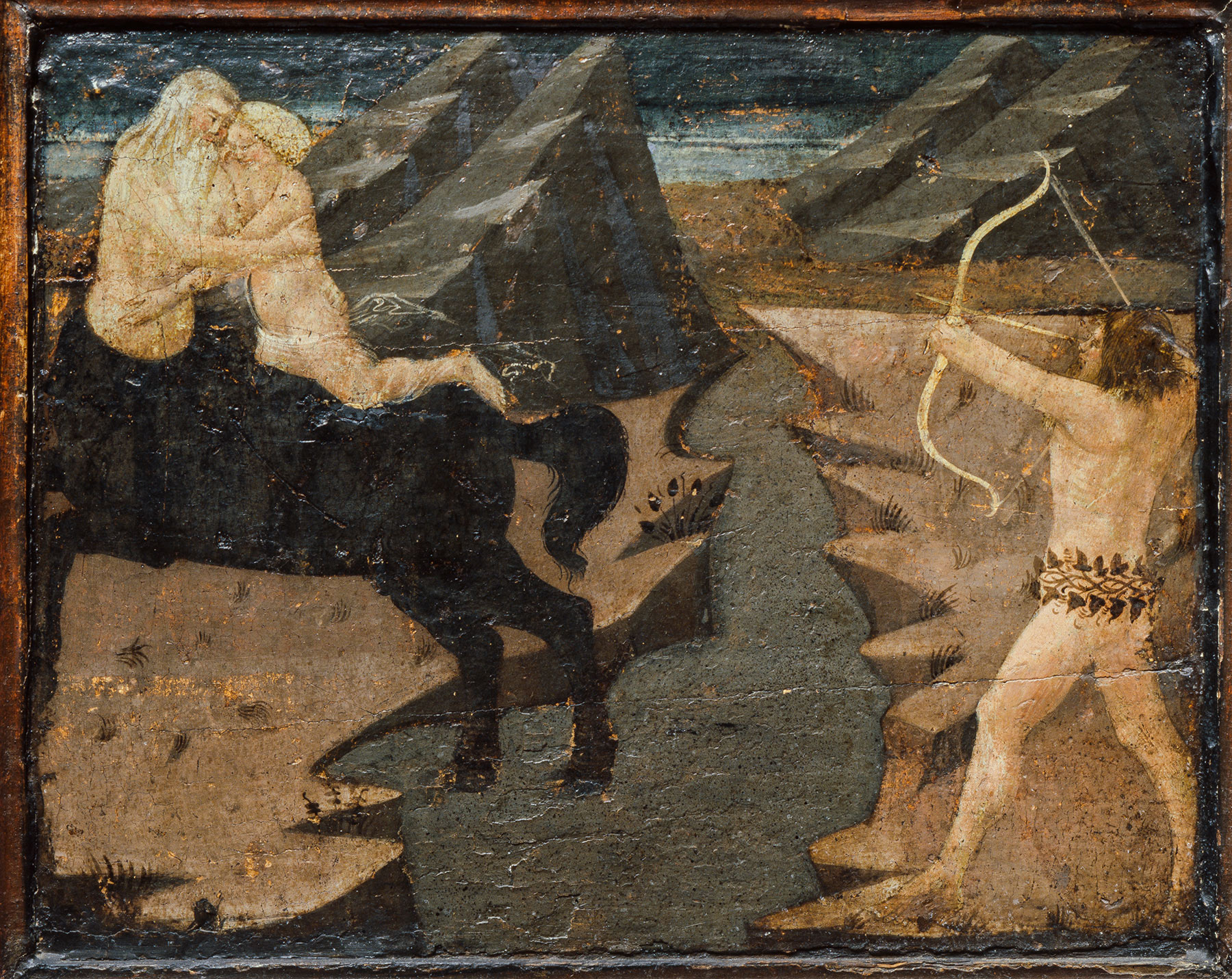
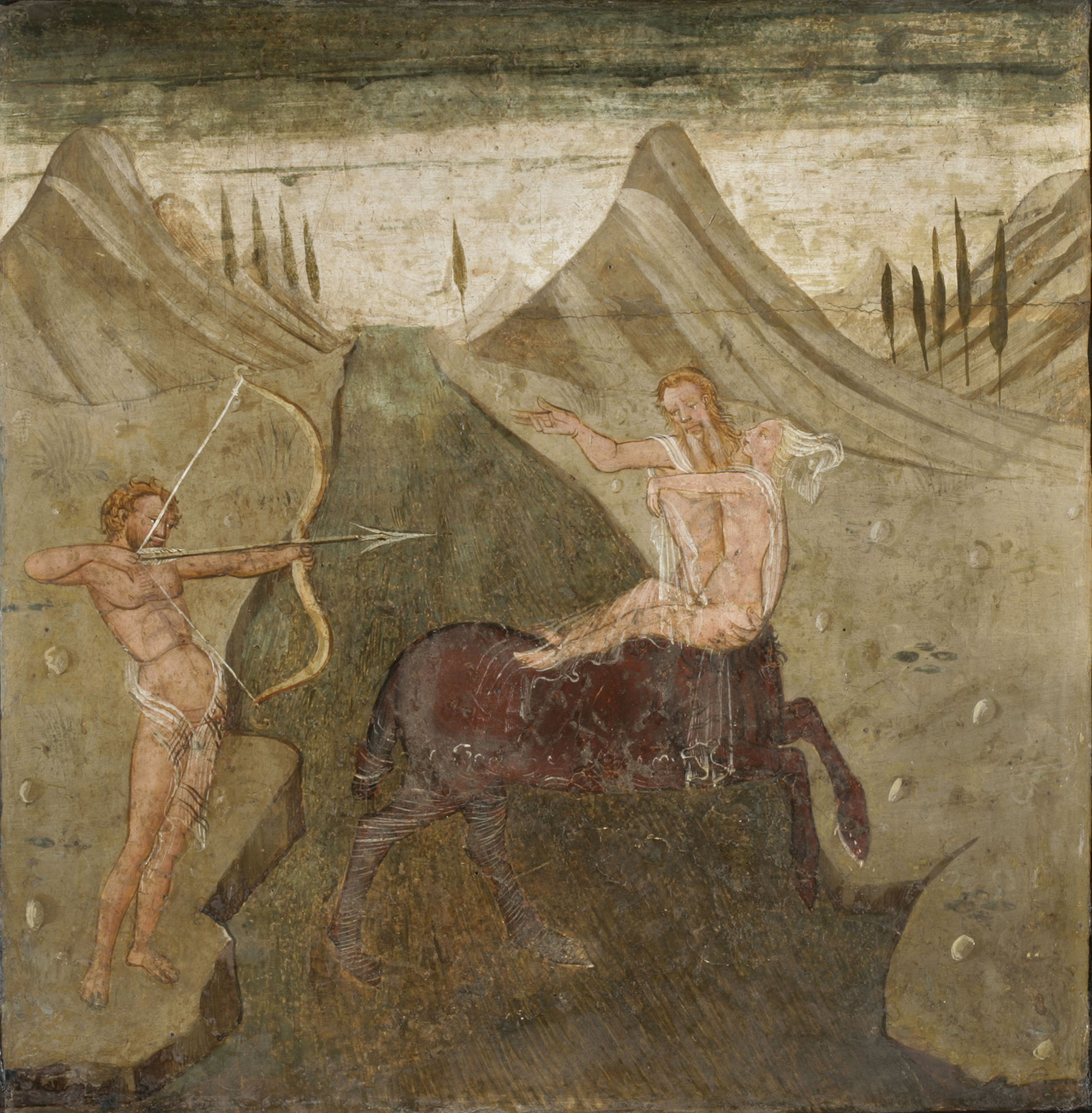
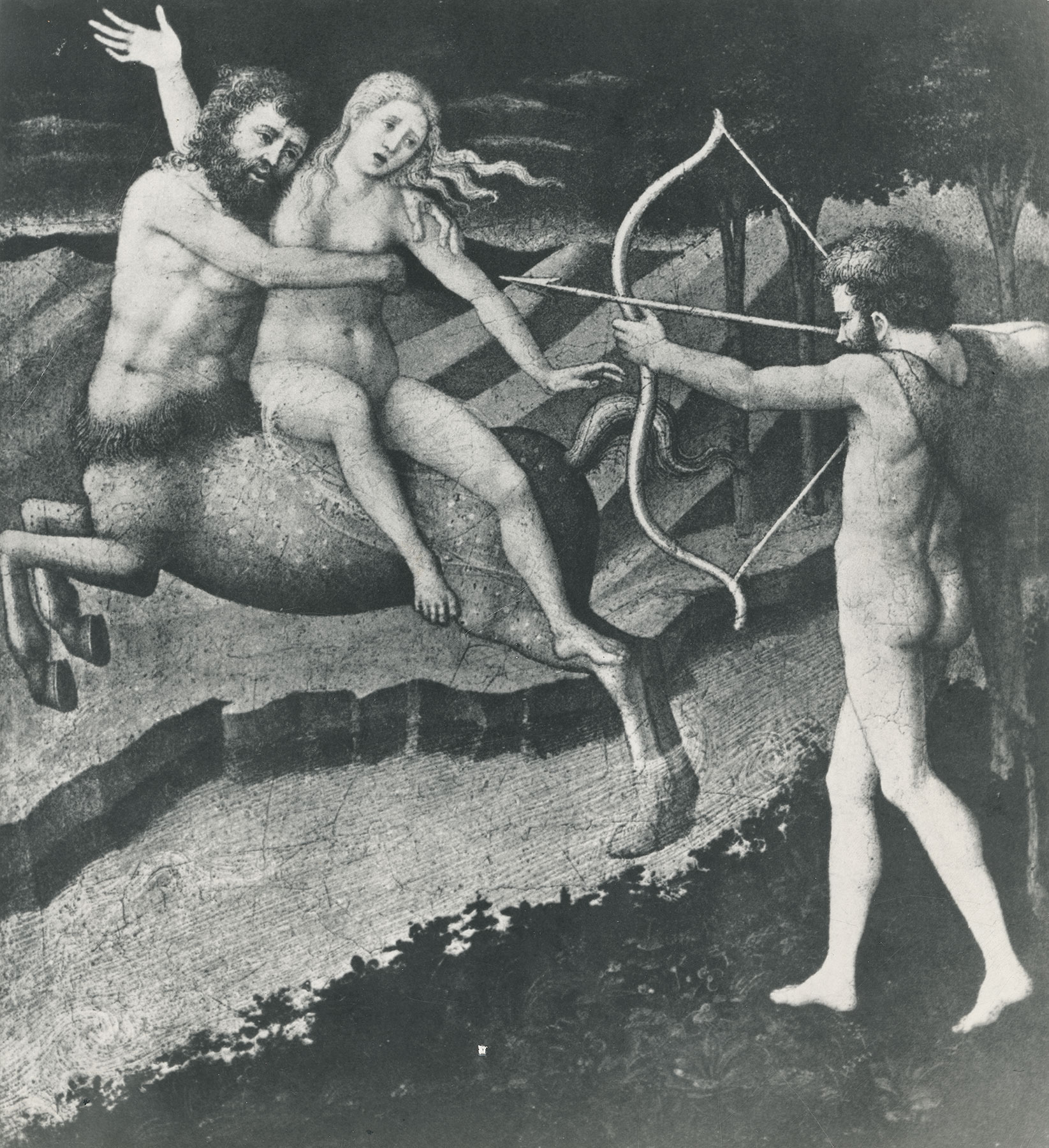
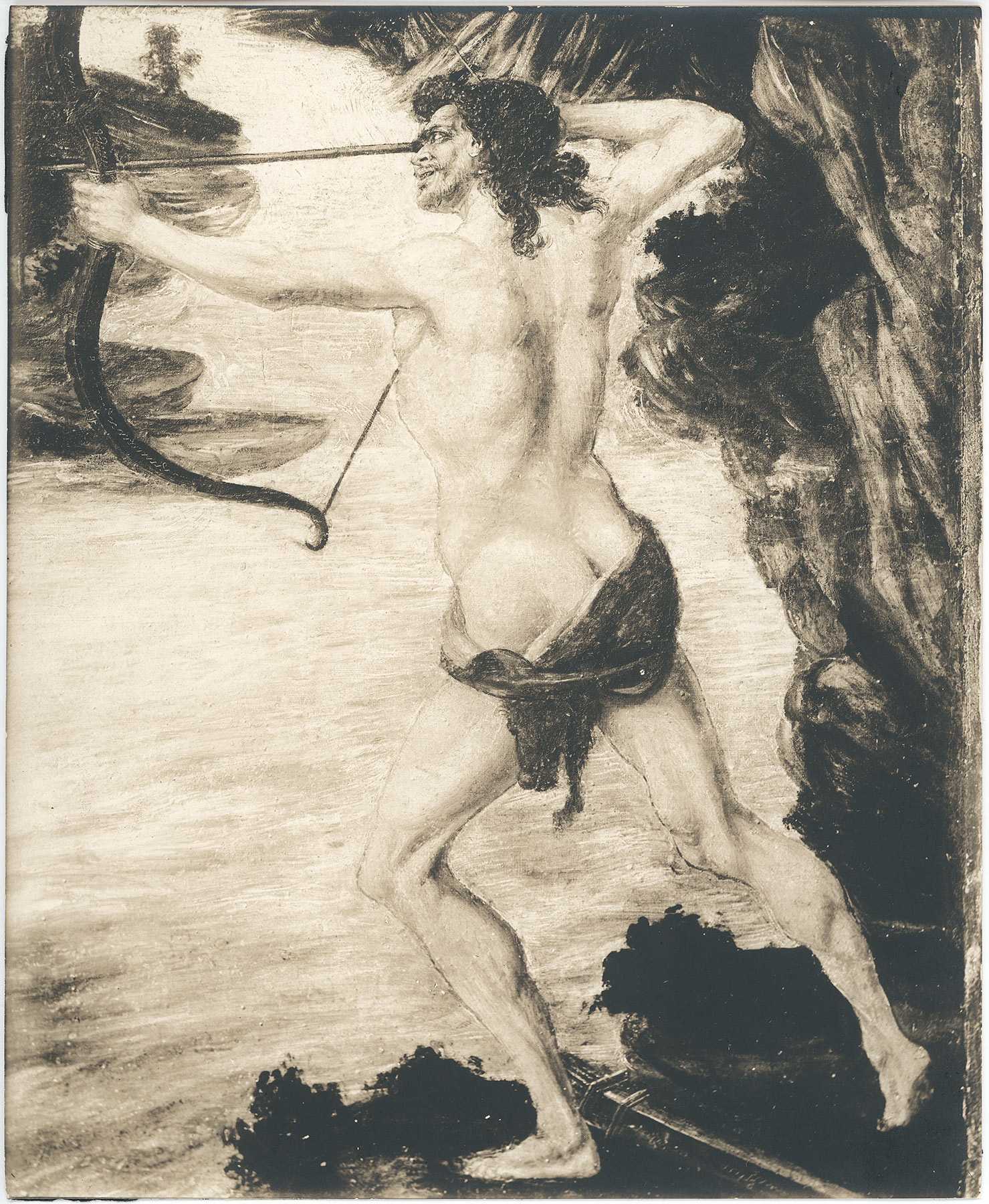
In every instance, except for the Bergamo and Pesellino panels, the images are paired with scenes of Hercules fighting the Nemean lion—the first episode intended as a “warning to the bride,” the second as an example for the groom.18 All five panels elaborate on the basic iconography of the Ovide moralisé miniature (see fig. 2) and later examples by showing Hercules on the river shore, standing in a similar pose and attitude, ready to loose his arrow as Nessus and Deianira flee across the water. The episode unfolds in a mountainous landscape with the river disappearing into the distance.
Alongside the illuminated manuscripts, the testate establish a contemporary framework for understanding the Yale Abduction of Deianira, whose iconography has elicited a number of interpretations, all of which have overlooked the references to the Trachiniae and sought to trace the motifs to a variety of ancient textual sources and lost visual prototypes.19 As in the testata of Pesellino (see fig. 6), the Yale panel shows Nessus leaping across the river to the opposite shore, his hind legs still in the water and his upper body turned to hold onto the frightened Deianira. But in the present instance, Deianira’s nude body is enveloped in a diaphanous dress all’antica that formerly covered her breasts and reached down to her ankles, recalling the short-sleeved chiton worn by female figures in Greek and Etruscan art (see fig. 1). As in previous examples, Hercules is poised along the shore, about to release his arrow. The most original aspect of the Yale picture lies in the unprecedented breadth of the composition, dominated by a sweeping river landscape and, in the foreground, the rushing waters that set the dramatic tone for the action. The Sophoclean setting has been transposed by the artist to the Arno River Valley, identified by the walled city of Florence in the background on the left, with the well-known landmarks of Filippo Brunelleschi’s dome, the Campanile, and the Palazzo della Signoria. While not topographically exact—unlike the Arno, the river in the painting does not run through the city—the image has been widely recognized by scholars as the earliest known picture to provide a panoramic view of Florence and its surrounding countryside.20 A road winding through open fields and wooded areas leads from Florence to another town, possibly Prato, situated beneath the hills in the far distance on the right. In the middle ground, leading into Florence, is another road that cuts across fields dotted with sheep; making their way along it are a horse with rider and other faintly visible figures.
The Abduction of Deianira was acquired by James Jackson Jarves with an attribution to Antonio Pollaiuolo, upheld in most of the subsequent literature but increasingly questioned in the last two decades in favor of Piero Pollaiuolo21 or a collaboration between the two brothers.22 Lost in the arguments, however, has been a proper consideration of the painting’s severely damaged state of preservation. The numerous losses, abrasions, and at least five campaigns of restoration, acknowledged only in passing in the literature, have rarely been taken fully into account in modern debates over attribution and have misled more than one art historian to draw conclusions based on flawed or incomplete visual data. Yet the painting’s true condition and “its lamentable physical history,” were laid bare by the Yale conservator Mark Aronson in a 1999 article for the Yale University Art Gallery Bulletin, published the year after his restoration.23 Rather than attempting the impossible task of returning the picture to its original appearance, the aim of the 1998 intervention, Aronson noted, was “to complete lost narrative and regain a sense of lost space,”24 thus helping the viewer better understand the artist’s original ambitions in the face of the missing elements and alterations.
As pointedly observed by Jarves, the painting had already undergone compositional changes and radical interventions by the time he acquired the work in the 1850s.25 By that time, the figure of Deianira had been entirely painted out—a change that Jarves imputed, improbably, to the moral dictates of Girolamo Savonarola—and the landscape and the body of the centaur skillfully continued. The results of the picture’s cleaning, undertaken by the Italian painter, dealer, and restorer Giorgio Mignati, are recorded in an engraving published in Jarves’s 1861 book, Art Studies (fig. 7). This image is notable, for it shows, among details like Hercules’s lion skin with the animal’s face, the different position of Deianira’s left arm and hand, bent backward rather than held out toward Hercules. One of the earliest known photographs of the work, published in 1906, after Mignati’s intervention and the 1867 transfer to canvas, shows Nessus with two hands on Deianira’s belly, and her hand still bent backward (fig. 8). Following a 1915 restoration, which uncovered the outstretched arm, the bent version was presumed to be a nineteenth-century invention. A pigment analysis conducted in 1955 at the Scientific Research Laboratory of the Museum of Fine Arts, Boston, suggested, however, that the artist himself may have been responsible for the change, after painting the landscape, and that the outstretched arm could be read as a pentimento—still visible in a photograph taken during Andrew Petryn’s extensive “treatment ” campaign between 1952 and 1962 (fig. 9).26 While not conclusive, this finding has not sufficiently been taken into account in the inordinate amount of attention devoted by scholars to the significance of Deianira’s extended arms, since the 1998 restoration.27 The conceit has been related by some authors to Philostratus the Younger’s Imagines,28 imbued with political significance by others,29 or deemed an invention of the artist.30 As evidenced by the miniature in the Ovide moralisé (see fig. 2), the gesture is in fact consistent with established medieval formulas and could have been modified by the artist in the final phase of execution to present an unobstructed view of Florence.
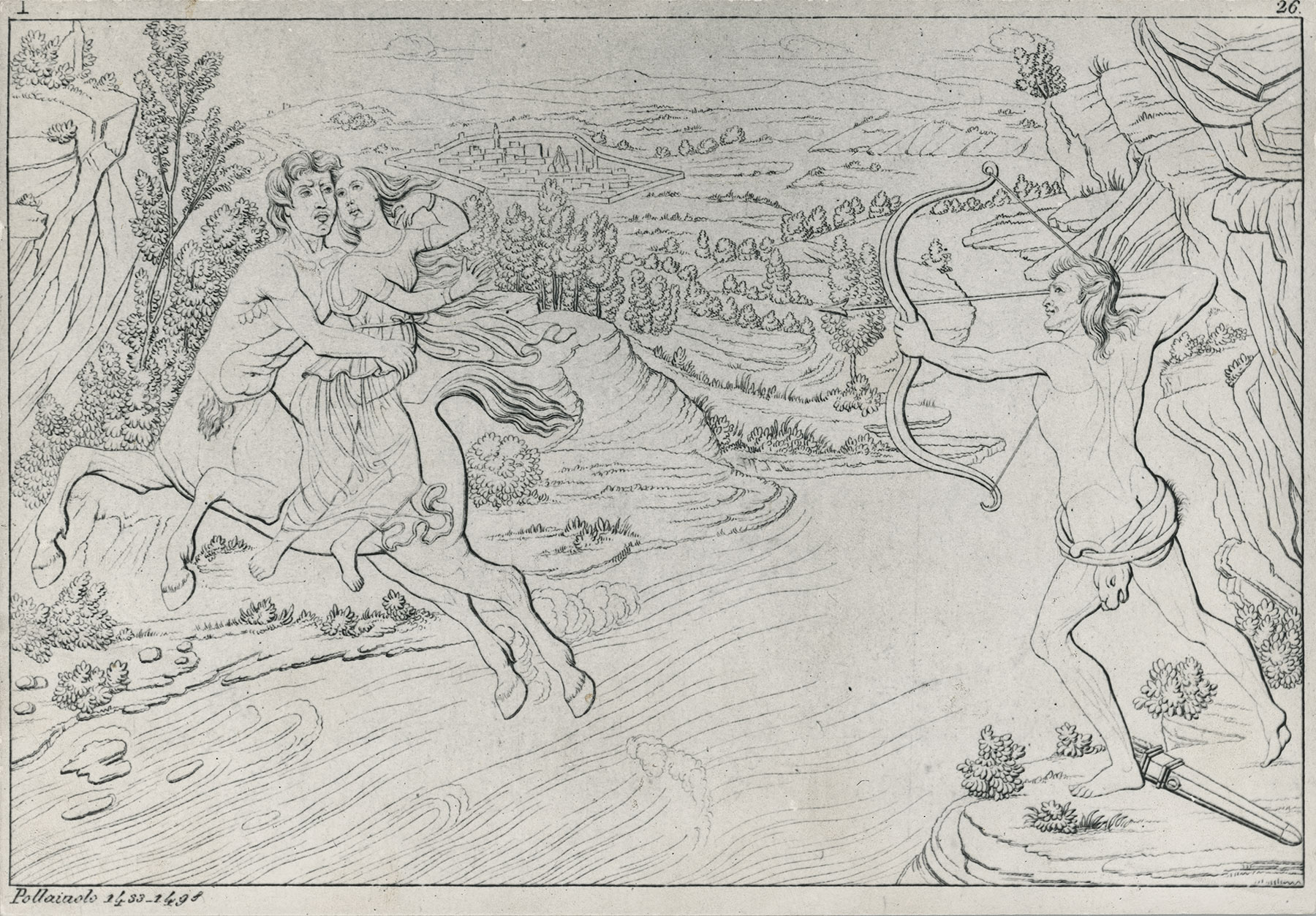
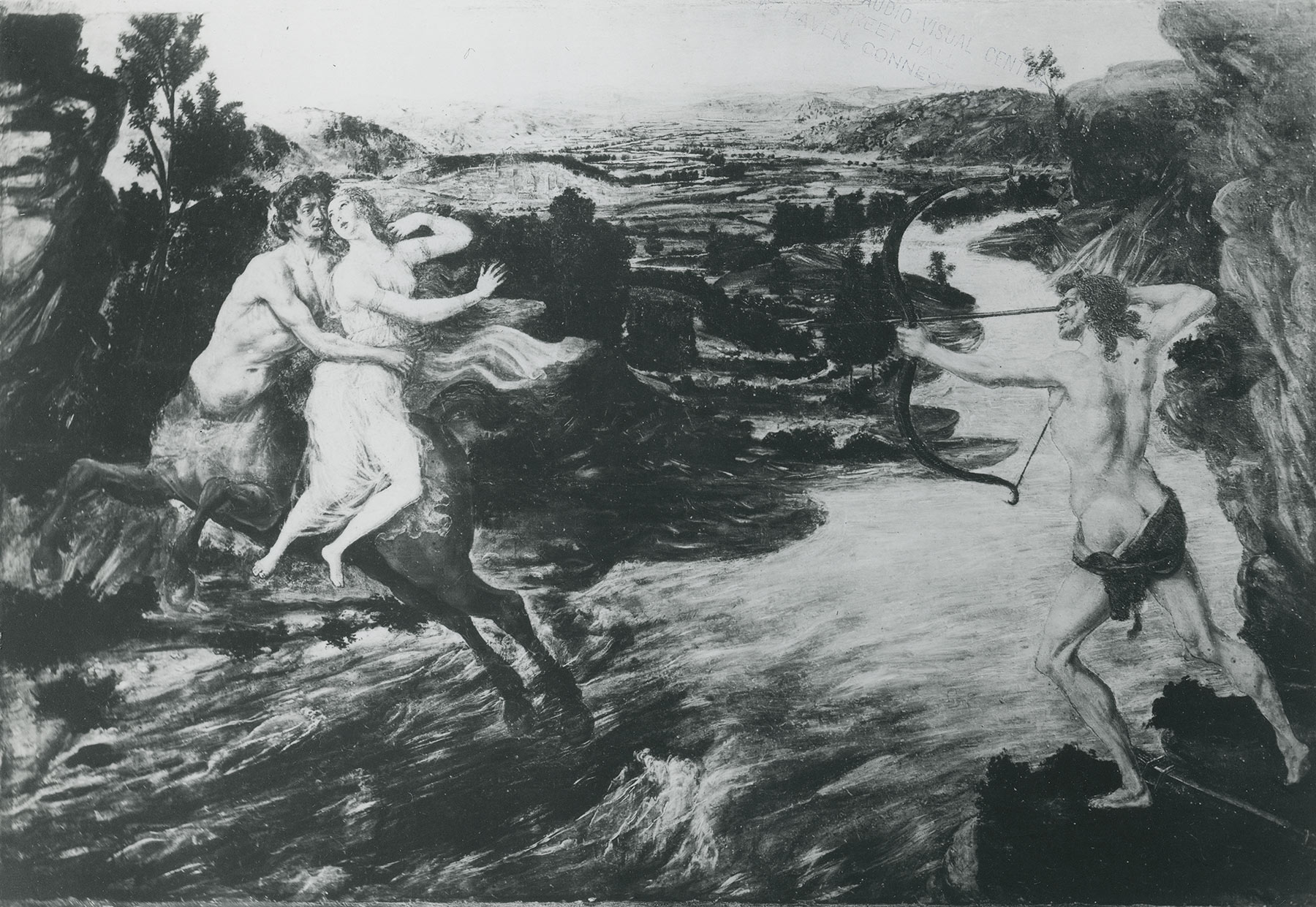
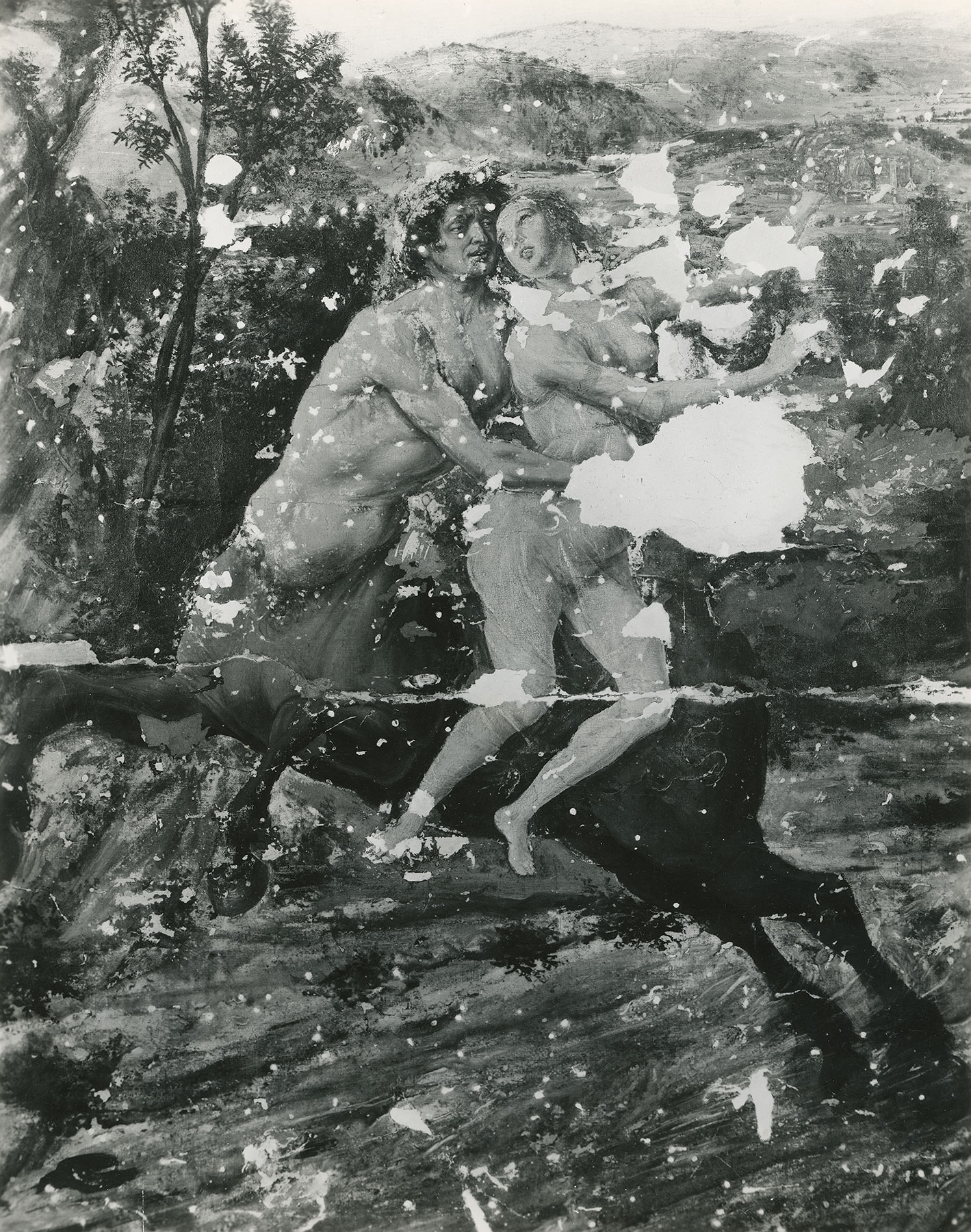
The vicissitudes suffered by the figure of Deianira, in particular, undoubtedly contributed to the doubts about the painting’s authorship in the earliest scholarship. Perceived as inferior to the rest of the composition, it was assigned to Piero Pollaiuolo by Maud Cruttwell, followed by Osvald Sirén, Richard Offner and Helen Comstock.31 Although dismissed by later authors, the notion of a collaboration between the two brothers was recently revived by Alison Wright,32 who detected Piero’s intervention in the handling of the forms and features of Deianira. Wright’s observations, however, cannot be reconciled with the losses and abrasions that are so marked in this figure, reduced to the bottom layers of underpaint in most areas. The broken surface and marred facial features, even where parts of the underdrawing remain, do not allow for specific comparisons with the work of either brother, least of all with the cartoon of Faith by Piero in the Galleria degli Uffizi, Florence, cited as a point of reference by Wright.33 The “boneless form” detected by Wright in the naked body of Deianira, as much as the present awkwardness of her pose, are also due to the loss of the final layers of modeling, which would have added bone structure and musculature and defined her placement on the centaur’s back. The effect would have been complemented by the more visible drapery, which, in the words of the restorer Kristin Hoermann, would have molded and softened the forms of the nude body, “as in antique sculpture.”34 Although now barely discernible, the folds of the diaphanous material, which were once well defined with strong highlights and black shadows, would have added their own linear energy to the composition, resulting in an overall effect comparable to the image of Chloris in Sandro Botticelli’s Primavera.35 The sense of movement in the material, still discernible at the right bottom edge of the dress, was emphasized by the fluttering shawl falling off Deianira’s shoulders—a motif that appears in representations of Deianira on Apulian red-figure pottery in the so-called Ornate style36 but that is even more common in ancient reliefs of Maenads and Victories. The detail, along with the billowing vestments, is representative of what Aby Warburg famously referred to as “moving accessories” (bewegtes Beiwerk)—those motifs derived from antique sources, both textual and visual, that were used by Renaissance painters beginning with Antonio to convey animation and emotional agitation.37
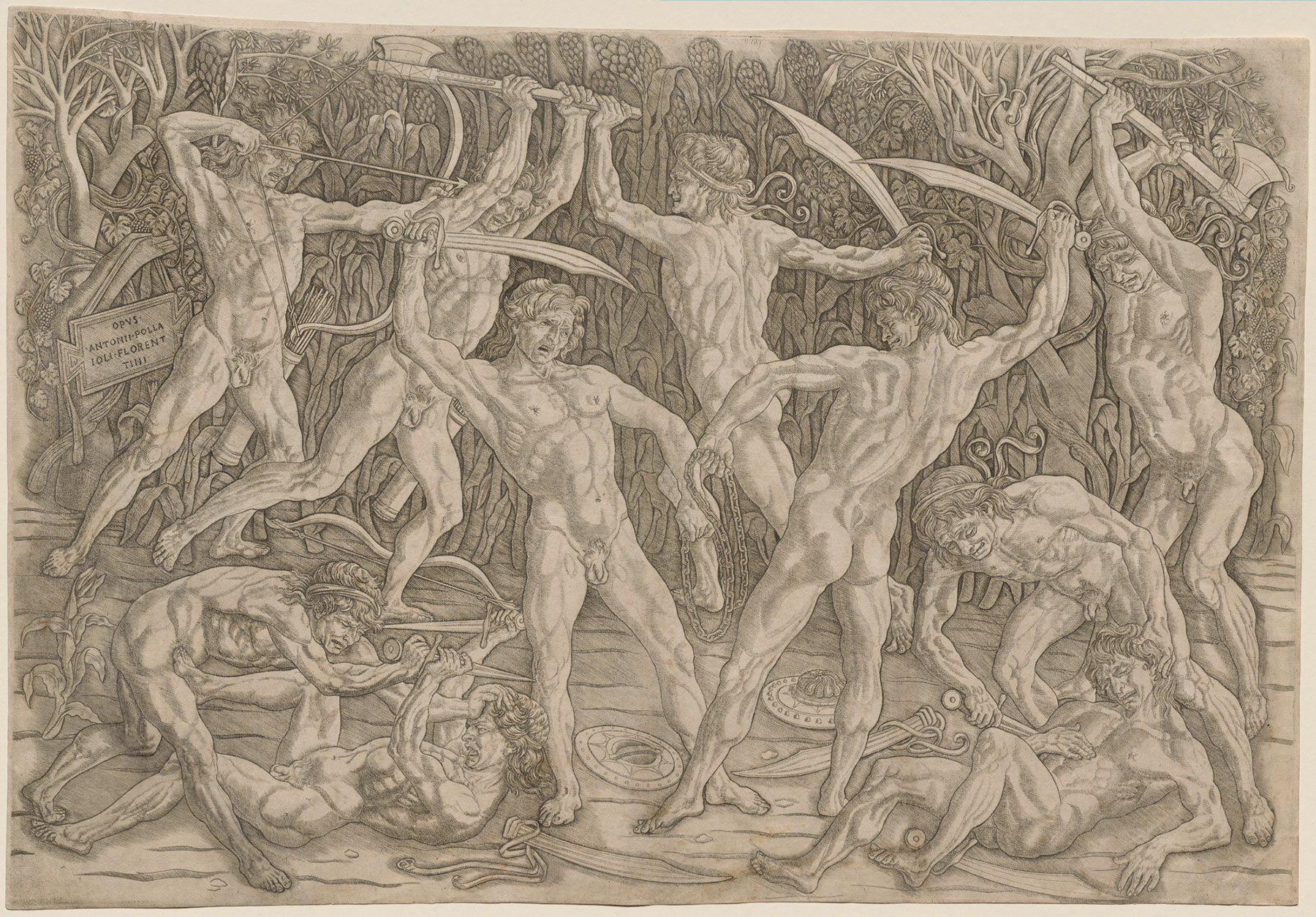
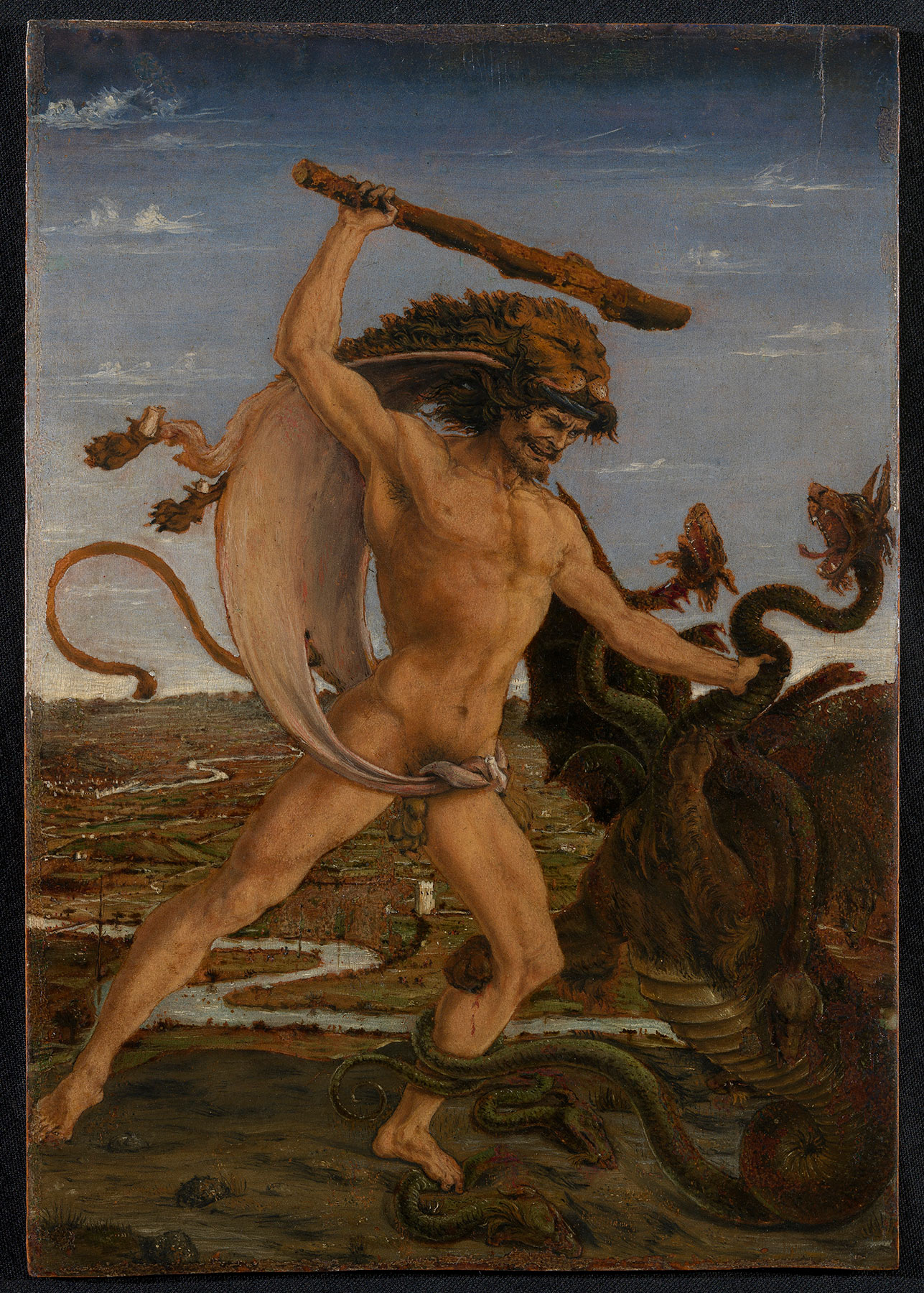
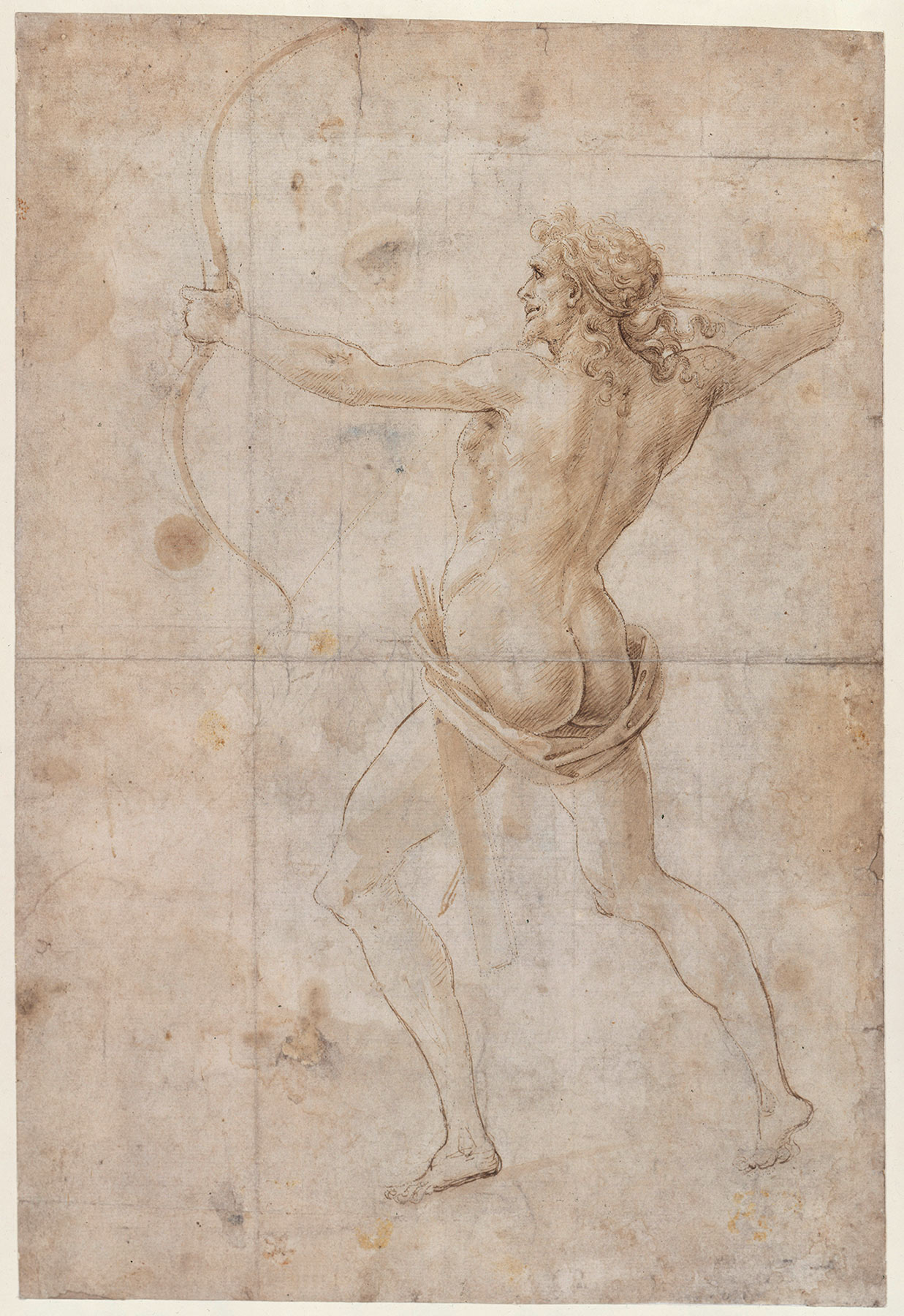
Antonio’s place as a pioneer in the development of a classicizing style in Florentine painting, encapsulated by the signed Battle of the Nudes engraving (fig. 10) and by the Hercules panels in the Gallerie degli Uffizi, Florence (fig. 11),38 unanimously attributed to him, is reflected in the stances and action of the powerfully built male figures in the Yale Abduction. The elegant courtiers of the French miniatures and stiffly posed, two-dimensional nudes of the testate have been transformed into an “anatomical tour de force”39 of tense muscles and energetic movement that convey the full drama of the story. As Offner perspicaciously understood, “There is a tension in the figure at the right, and a release at the left of Nessus’ leap, as in two stages of a consecutive movement. This causal relation between two elements of the action ties it together by something more essential than its meaning. It is in this upward leap and within a twinkling that the arrow will strike home.”40 Since Offner’s writing, as evidenced by comparisons with the earliest photographs of the work (fig. 12), the highly energized and exaggerated silhouettes and the tense musculature have been “softened and obliterated” by abrasions and losses,41 conveying an impression of vague softness that was not present in the original. Only barely discernible now is the ferocious grin with bared teeth that animated Hercules’s features, once comparable to those of his counterpart in the Uffizi (see fig. 11). One can only presume that recent suggestions to attribute the entire composition—not just the image of Deianira—to Piero, albeit over a design of Antonio’s,42 are simply the result of a confusion between the present state of the figures and Piero’s more superficial approach to the human form.43 Compounding this impression is the fact that the reconstruction of the missing parts of Hercules’s anatomy, and the retouches to restore a sense of the original modeling, were based on a well-known drawing of Hercules in the Kupferstichkabinett, Berlin (fig. 13), once attributed to Antonio but now recognized as an inferior copy of a lost drawing for the Yale panel executed by an unidentified Florentine artist of the following generation.44 The virtuosity of Antonio’s treatment of form is more recognizable in the handling of Nessus, who retains the top layers of paint in intermittent areas and is the best preserved of the three figures. Nessus’s face still exhibits the highly defined form and intense coloration with white highlights on the nose, eyes, and teeth that characterize the Uffizi figures. The violence of the action is translated by the taut musculature of his torso, as he rotates back to hold onto Deianira, while his athletic, equine lower body leaps forward across the stream. A meticulous attention to detail is preserved in the few wisps of groin hair and the feathering on the horse’s hooves.
The treatment of the landscape, which has drawn the admiration of all critics since Jarves, is undoubtedly the most remarkable feature of the Yale composition. Yet, it is also the element whose condition has been most misunderstood by recent scholars and the general public alike.45 The overcleaning of the top layer and the elimination of the gradual transitions that originally existed between the foreground and background, along with the missing details of the riverbed and blue-green waters accented by frothy white strokes above it, have resulted in a false impression of exaggerated “painterliness” and lack of finish that is highly prized by modern viewers but antithetical to the period.46 The carefully organized construction that originally characterized the landscape, instead of the present amorphous vision, was evoked by Offner in 1927 in the following poetic terms:
The arrangement is bilateral and determinate, with the exception of the nearest foreground, which runs out of the picture towards us with a boldness unprecedented in Renaissance painting. . . . Beyond, is the wide amphitheater and within it the drifting perspective of the narrowing river, the meander of the stream and of the highways, and of the diminishing masses of trees placed at calculated intervals. The drama of the eventful foreground is resolved in a general harmony and in the deaf and sun drowned distance.47
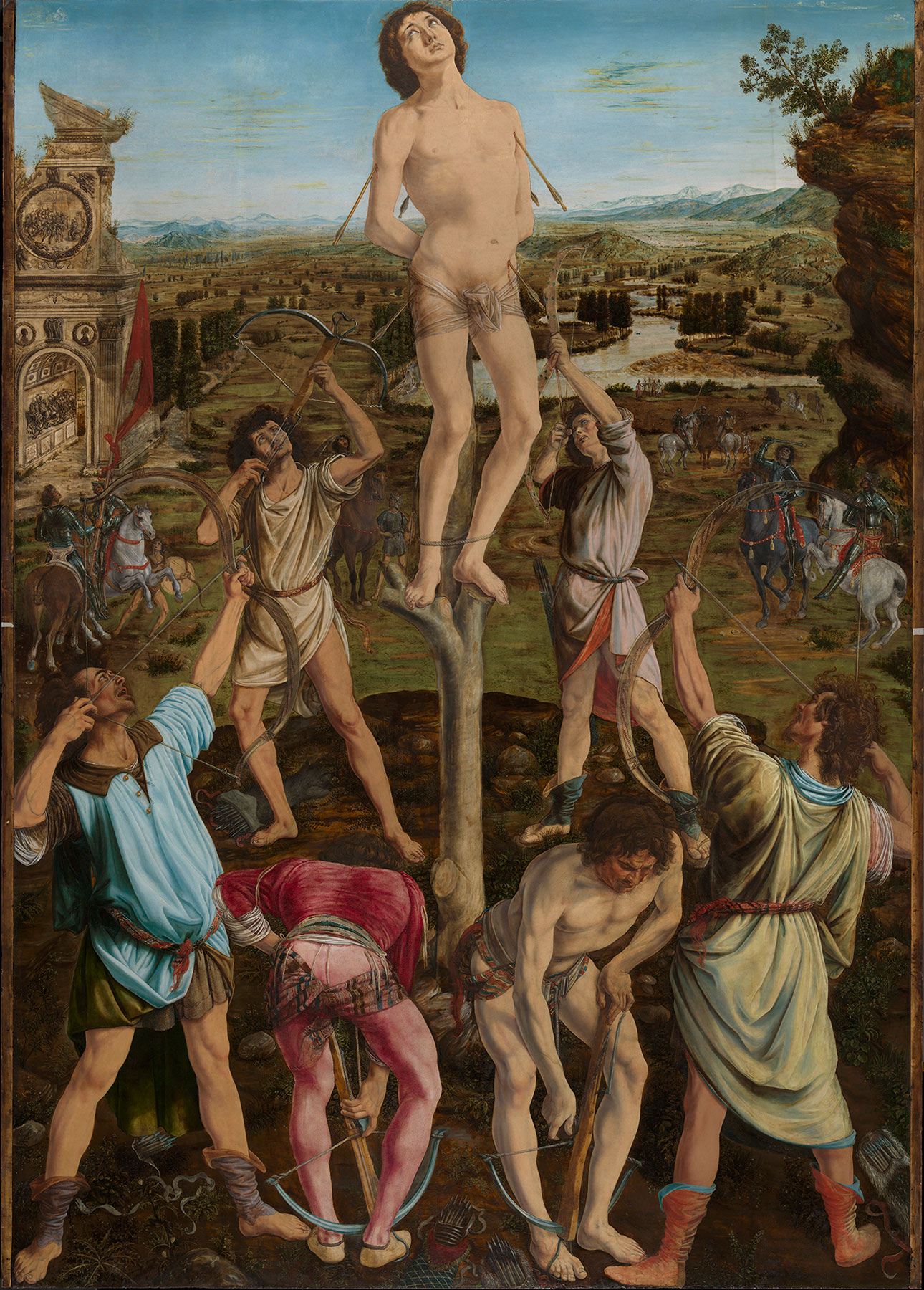
The original appearance of the background elements, as Aronson pointed out,48 may be gauged by the Martyrdom of Saint Sebastian in the National Gallery, London (fig. 14), considered by Wright and others a fixed point for the dating of the present picture.49 Painted around 1475 and traditionally attributed to Antonio on the authority of Giorgio Vasari, the Martyrdom was recently included in Aldo Galli’s radical reconstruction of Piero’s oeuvre50 but was more likely a collaboration between the two artists. Piero’s intervention, as emphasized by Wright,51 is evident in the pale, effeminate form of Saint Sebastian, closely related to the figures in Piero’s signed Coronation of the Virgin in the church of Sant’Agostino in San Gimignano. The detailed landscape, however, with a geometric recession in depth articulated by a winding river and trees gradually disappearing into the distance toward a clear mountainous landscape, is inseparable from the ambitious spatial solutions conceived by Antonio in the Baptism of the Neophyte embroidery, part of a cycle of twenty-seven scenes with the life of Saint John the Baptist designed by the artist for the liturgical vestments in the Florentine Baptistry.52 Based on documentary evidence, it is thought that this prestigious commission occupied Antonio at intervals, between around 1465 and 1469, when he completed the first block of drawings, and 1475 and 1480, when he handed in the second and final set.53 During this time, the evolution of the artist’s approach is traceable in the progressively more expansive treatment of architectural and landscape settings, culminating with the Baptism of the Neophytes, which is generally considered one of the final designs in the series.54 Following Ellen Callmann, Wright proposed a date for the Yale Abduction “at least as late as the mid-1470s,” emphasizing its relationship to the London Martyrdom.55 A date between 1470 and 1475 has also been advanced in the most recent literature,56 but a slightly later chronology, closer to 1480, could be warranted by the equal proximity to the last embroidery designs.
The original function of the Yale Abduction and the circumstances of its commission have been the subject of much speculation. The discovery of traces of cherry wood under the original gesso confirm that the scene was intended to decorate a piece of furniture, while its subject matter is clearly suited to nuptial occasions or marriage chambers. Its present dimensions, however, do not fit comfortably into the category of either cassone panels, on average shorter in height, or spalliera paintings—panels that were mounted on walls or set into or above furniture—which tend to be taller.57 Yet, the existence of notable exceptions suggest some caution in drawing firm conclusions based on dimensions alone. While Timothy Verdon58 referred to the Yale painting as a fragment of a marriage chest, Callmann59 thought that the rocks enclosing the composition indicated that the panel could not have been much wider than at present and proposed that it may have been one of a set of three or more Hercules scenes that made up the spalliera section of a bench or lettuccio, “a settle that functioned as a day bed above a storage chest.”60 Following Callmann, Wright supposed that the Yale Abduction was “an early example of a rather small spalliera panel, perhaps placed above a piece of furniture within a chamber.”61 The height of the Yale picture, while inferior to that of the average spalliera, is not inconsistent with that of other panels that have also evaded clear categorization.62 Elements in favor of a spalliera setting are the ambitious narrative structure and spatial solutions adopted by the artist, which are in tune with the visual conventions of the genre and its evolution around the middle of the 1470s. The integration of the figures into the landscape and the role of the landscape in the composition seem to anticipate the three panels with the story of Orpheus and Eurydice painted by Jacopo del Sellaio around 1490, which are not much taller than the Yale painting.63 It is indeed possible, as suggested by Callmann, that the Yale picture formed part of a set of other scenes with the stories of Hercules. At the same time, it cannot be ruled out that the composition is just a fragment of a wider panel that, as in the Sellaio examples, continued on one or both sides of the rocky outcrops, perhaps with other details or events preceding or following Deianira’s abduction.
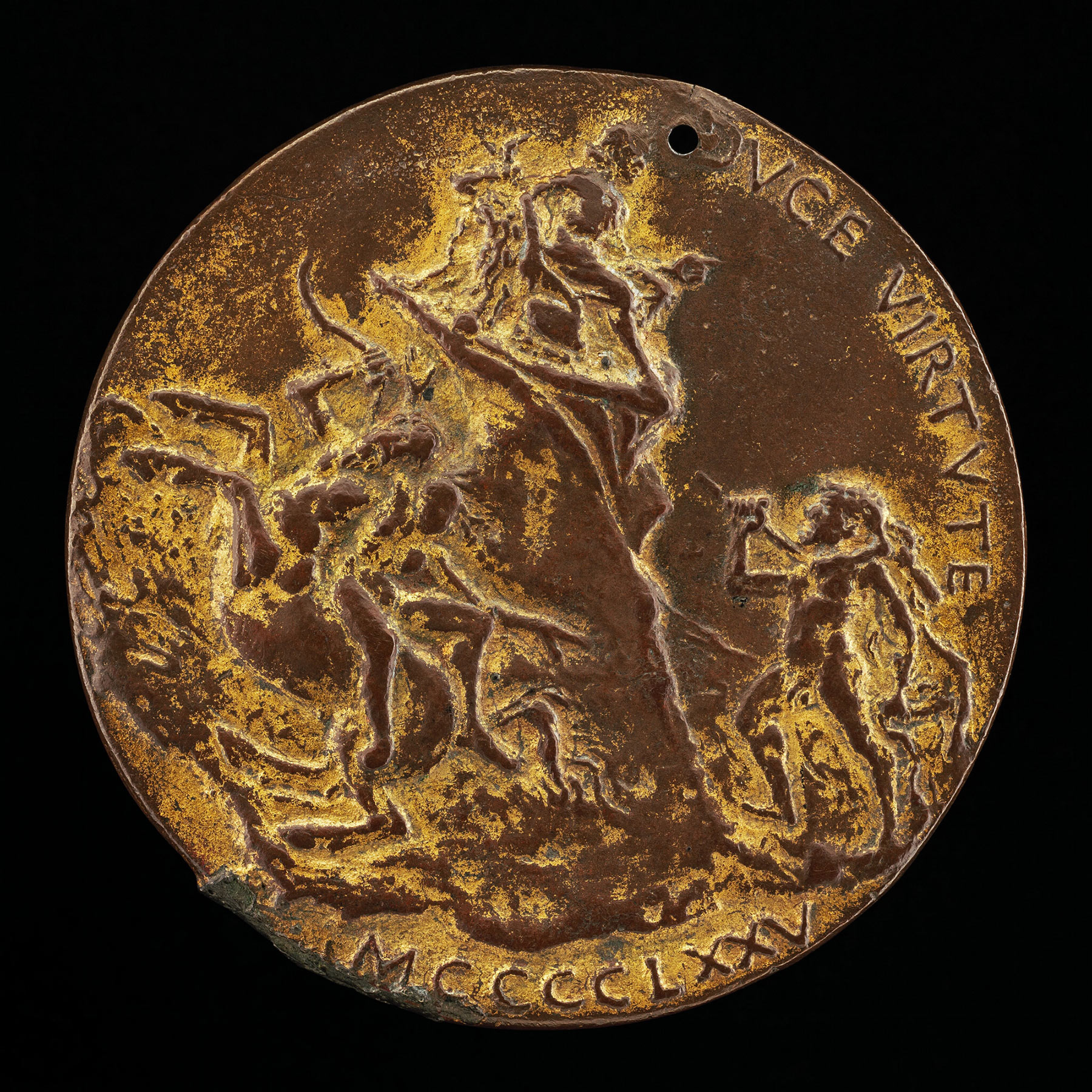
The near-topographical quality of the impressive landscape that distinguishes the Yale panel has elicited some far-fetched scenarios to explain its commission, which has been related in one way or another to the patronage of Lorenzo de’ Medici. Verdon, who referred to the setting “as a sweeping vision of Tuscan civilization,” identified the precise stretch of the Arno as the ford at Signa, where in ancient times there was a special cult of Hercules, adding that it was the site of an ambitious Medici project to build a canal from Signa to Prato.64 Luba Freedman, who analyzed the Yale panel and Piero’s Annunciation in the Gemäldegalerie, Staatliche Museen zu Berlin,65 solely in terms of their topographical details, proposed that they were conceived as a pair to be placed above doorways in the Medici villa at Careggi.66 While her conclusions are not persuasive, Freedman’s arguments drew attention to the civic virtues embodied in the figure of Hercules in the Florentine imagination, as both founder and protector of the city, specifically in relation to the story of Nessus and Deianira.67 The importance of the episode as a lesson on moral leadership, as noted by Freedman, is attested to by the reverse of a portrait medal of the Venetian humanist and statesman Francesco Diedo, once attributed to Bertoldo di Giovanni and dated 1475, which shows Hercules, bearing a club instead of a bow, in pursuit of Nessus and Deianira (fig. 15).68 On a promontory overlooking the abduction scene is a nude male figure seated atop a lion and an ox and seemingly pointing a finger toward the inscription “VIRTUTE DVCE” (Lead with virtue), a humanist platitude derived from Cicero.69 Although there is no evidence to suggest a direct link with a Medici property, the precedent established by Antonio and Piero’s lost canvases with the labors of Hercules for Piero de’ Medici70 and by Antonio’s panels in the Uffizi (see fig. 11), possibly executed for the illustrious Gondi family,71 suggests the involvement of a Medici or a close member of their circle in the present commission as well. The melding of medieval and ancient visual sources, from classical reliefs to Greek vase painting,72 and the intimate knowledge of Sophocles’s tragic play that are reflected in Antonio’s dramatically charged composition could point to one of the leading figures in the humanist environment around the Medici court—if not to Lorenzo de’ Medici himself.73 —PP
Published References
Jarves, James Jackson. Descriptive Catalogue of “Old Masters” Collected by James J. Jarves to Illustrate the History of Painting from A.D. 1200 to the Best Periods of Italian Art. Cambridge, Mass.: H. O. Houghton, 1860., 53, no. 75; Jarves, James Jackson. Art Studies: The “Old Masters” of Italy; Painting. New York: Derby and Jackson, 1861., 272, pl. I, fig. 26 (engraving); Sturgis, Russell, Jr. Manual of the Jarves Collection of Early Italian Pictures. New Haven: Yale College, 1868., 61–62; W. F. Brown, Boston. Catalogue of the Jarves Collection of Early Italian Pictures. Sale cat. November 9, 1871., 21, no. 64; Rankin, William. “Some Early Italian Pictures in the Jarves Collection of the Yale School of Fine Arts at New Haven.” American Journal of Archaeology 10, no. 2 (April–June 1895): 137–51., 148; Venturi, Adolfo. Storia dell’arte italiana. 11 vols. Milan: Ulrico Hoepli, 1901–40., 7, pt. 1: 562; Crowe, Joseph Archer, and Giovanni Battista Cavalcaselle. A History of Painting in Italy, Umbria, Florence, and Siena from the Second to the Sixteenth Century. Vols. 1–4, ed. Robert Langton Douglas. Vols. 5–6, ed. Tancred Borenius. London: J. Murray, 1903–14., 4:223–24, editor’s note; Cook, Herbert. “The New Haven Pollaiuolo.” Burlington Magazine 9, no. 37 (April 1906): 52–53., 52–53; Mather, Frank Jewett, Jr. “The New Haven Pollaiuolo.” Burlington Magazine 8, no. 36 (March 1906): 440–41, 443., 440–41, 443; Cruttwell, Maud. Antonio Pollaiuolo. New York: Charles Scribner’s Sons, 1907., 78–81; Schiaparelli, Attilio. La casa fiorentina e i suoi arredi nei secoli XIV e XV. Vol 1. Florence: Sansoni, 1908., 286, fig. 170; Sirén, Osvald. A Descriptive Catalogue of the Pictures in the Jarves Collection Belonging to Yale University. New Haven: Yale University Press, 1916., 111–17, no. 42; Shapley, Fern Rusk. “A Student of Ancient Ceramics: Antonio Pollaiuolo.” Art Bulletin 2, no. 2 (December 1919): 78–86., 84; Offner, Richard. Italian Primitives at Yale University: Comments and Revisions. New Haven: Yale University Press, 1927., 6, 30–34, fig. 23; “Bulletin of the Associates in Fine Arts at Yale University.” Bulletin of the Associates in Fine Arts at Yale University 2, no. 3 (February 1928): 35–47., 43; van Marle, Raimond. The Development of the Italian Schools of Painting. Vol. 11. The Hague: M. Nijhoff, 1929., 362–63; Borenius, Tancred. “Pictures from American Collections at Burlington House.” Apollo 11, no. 63 (March 1930): 153–62., 157, 159, fig. 5; Italian Art: An Illustrated Souvenir of the Exhibition of Italian Art at Burlington House, London. London: William Clowes and Sons, 1930., 38, fig. 65; Royal Academy of Arts. Exhibition of Italian Art, 1200–1900. Exh. cat. London: Royal Academy of the Arts, 1930., 90, no. 123; Lord Balniel and Kenneth Clark. A Commemorative Catalogue of the Exhibition of Italian Art Held in the Galleries of the Royal Academy, Burlington House, London, January–March 1930. Exh. cat. Oxford: Oxford University Press, 1931., 64–65, no. 188; “Handbook: A Description of the Gallery of Fine Arts and the Collections.” Special issue, Bulletin of the Associates in Fine Arts at Yale University 5, nos. 1–3 (1931): 1–64., 33; Venturi, Lionello. Pitture italiane in America. 2 vols. Milan: Ulrico Hoepli, 1931., 2: pl. 174; Berenson, Bernard. Italian Pictures of the Renaissance: A List of the Principal Artists and Their Works with an Index of Places. Oxford: Clarendon, 1932., 466; Catalogue of “A Century of Progress”: Exhibition of Paintings and Sculpture Lent from American Collections. Exh. cat. Chicago: Art Institute of Chicago, 1933., 20, no. 124, pl. 13; Salmi, Mario. L’arte italiana. 3 vols. Florence: Sansoni, 1942–47., 2:282; Sabatini, Attilio. Antonio e Piero del Pollaiuolo. Florence: Sansoni, 1944., 54, 84; Colacicchi, Giovanni. Antonio del Pollaiuolo. Florence: Chessa, 1945., 9–10, 23, 32; Comstock, Helen. “The Yale Collection of Italian Paintings.” Connoisseur 118 (September 1946): 45–52., 46, 49, no. 6; “Picture Book Number One: Italian Painting.” Special issue, Bulletin of the Associates in Fine Arts at Yale University 15, nos. 1–3 (October 1946): n.p., fig. 15; Ortolani, Sergio. Il Pollaiuolo. Milan: Ulrico Hoepli, 1948., 106–8, 218–19; Clark, Kenneth. Landscape into Art. London: J. Murray, 1949., 22; Wechsler, Herman J. Gods and Goddesses in Art and Legend: Great Myths as Pictured by Great Masters. New York: Pocket Books, 1950., 82, 89, pl. 46; Steegmuller, Francis. The Two Lives of James Jackson Jarves. New Haven: Yale University Press, 1951., 171, 173, 174n16, 185–86; Rediscovered Italian Paintings. Exh. cat. New Haven: Yale University Art Gallery, 1952., 5; Berenson, Bernard. Italian Pictures of the Renaissance, A List of the Principal Artists and Their Works with an Index of Places: Florentine School. 2 vols. London: Phaidon, 1963., 1:179; Bovi, Arturo. Pollaiolo. Milan: Fabbri, 1965., 5, pl. 16; Busignani, Alberto. Pollaiolo. Florence: Edizioni d’Arte il Fiorino, 1969., 162–63; Seymour, Charles, Jr. Early Italian Paintings in the Yale University Art Gallery. New Haven: Yale University Art Gallery, 1970., 170–72, no. 123; Fredericksen, Burton B., and Federico Zeri. Census of Pre-Nineteenth-Century Italian Paintings in North American Public Collections. Cambridge, Mass.: Harvard University Press, 1972., 599; Ritchie, Andrew Carnduff, and Katharine B. Neilson. Selected Paintings and Sculpture from the Yale University Art Gallery. New Haven: Yale University Press, 1972., no. 11; Timothy Verdon, in Seymour, Charles, Jr., et al. Italian Primitives: The Case History of a Collection and Its Conservation. Exh. cat. New Haven: Yale University Art Gallery, 1972., 26–27, no. 16; Ettlinger, Leopold D. Antonio and Piero Pollaiuolo. Oxford: Phaidon, 1978., 142; A. Carmichael, in Shestack, Alan, ed. Yale University Art Gallery: Selections. New Haven: Yale University Art Gallery, 1983., 28; von Hessert, Marlis. Zum Bedeutungswandel der Herkules-figur in Florence: Von den Anfängen der Republik bis zum Prinzipat Cosimos I. Cologne, Germany: Böhlau, 1991., 28; Pope-Hennessy, John. Learning to Look. New York: Doubleday, 1991., 125, 303; Davidson, Bernice. Italian Art at the Close of the Quattrocento: Pollaiuolo and Hercules; Painting and Sculpture in the Frick Collection from the Age of Piero della Francesca. Exh. cat. New York: Frick Collection, 1992., no. 7; Aronson, Mark. “The Re-Restoration of Antonio del Pollaiuolo’s Hercules and Deianira.” Yale University Art Gallery Bulletin (1999): 4, 44–59., 4, 44–59; Bambach, Carmen C. “The Early Italian Drawings in Berlin.” Master Drawings 37, no. 1 (Spring 1999): 55–62., 59–60; Alison Wright, in Wright, Alison, and Patricia Lee Rubin, eds. Renaissance Florence: The Art of the 1470s. Exh. cat. London: National Gallery, 1999., 225, 234–35, no. 46; Dean, Clay. A Selection of Early Italian Paintings from the Yale University Art Gallery. New Haven: Yale University Art Gallery, 2001., 34–35; Poletti, Federico. Antonio e Piero Pollaiolo. Turin: Menarini, 2001., 182, 185–86; Even, Yael. “The Emergence of Sexual Violence in Quattrocento Florentine Art.” In “Violence in Fifteenth-Century Text and Image,” ed. Edelgard E. DuBruck and Uael Even. Special issue, Fifteenth-Century Studies 27 (2002): 113–28., 113–14; Langdale, Shelley R. Battle of the Nudes: Pollaiuolo’s Renaissance Masterpiece. Exh. cat. Cleveland: Cleveland Museum of Art, 2002., 42; Miklòs Boskovits, in Boskovits, Miklós, and David Alan Brown. Italian Paintings of the Fifteenth Century: The Collections of the National Gallery of Art, Systematic Catalogue. Washington, D.C.: National Gallery of Art, 2003., 587; Wright, Alison. The Pollaiuolo Brothers: The Arts of Florence and Rome. New Haven: Yale University Press, 2005. , 93–94, 98–102, 188, 415, 417–18, 423, 525, no. 57, figs. 72–73; Kanter, Laurence. Review of The Pollaiuolo Brothers: The Arts of Florence and Rome, by Alison Wright. Burlington Magazine 148, no. 1237 (April 2006): 279–81., 280; Freedman, Luba. “Florence in Two Pollaiuolo Paintings.” Annali della Scuola Normale Superiore di Pisa: Classe di lettere e filosofia, 5th ser., 2, no. 1 (2010): 275–96., 275–96; Kanter, Laurence, and Ian McClure. “Yale’s Garofalo: Conversion and Transfer.” In “Time Will Tell: Ethics and Choices of Conservation.” Special issue, Yale University Art Gallery Bulletin (2010): 66–79., 72–73, fig. 7; Galli, Aldo. “La sorte dei Pollaiolo.” In Antonio e Piero del Pollaiolo: “Nell’argento e nell’oro, in pittura e nel bronzo . . . ,” ed. Andrea di Lorenzo and Aldo Galli, 25–77. Exh. cat. Milan: Skira, 2014., 40–41, 43, fig. 22; Nethersole, Scott. Art and Violence in Early Renaissance Florence. New Haven: Yale University Press, 2018., 158–59, fig. 124; Geddes, Leslie A. Watermarks: Leonardo da Vinci and the Mastery of Nature. Princeton, N.J.: Princeton University Press, 2020., 152–58; Dressen, Angela. The Intellectual Education of the Italian Renaissance Artist. Cambridge: Cambridge University Press, 2021., 230–31, fig. 28; Melli, Lorenza. I disegni di Antonio e Piero del Pollaiolo. Pt. 1, vol. 16 of Corpus der italienischen Zeichnungen, 1300–1500, ed. Johannes Röll. Petersberg, Germany: Michael Imhof, 2023., 38, 197–201, no. 25
Notes
-
For a summary of some of the earlier texts that may have served as source material for Sophocles, see Mills, Sophie. “The Women of Trachis.” In Brill’s Companion to the Reception of Sophocles, ed. Rosanna Lauriola and Kyriakos N. Demetriou, 512–57. Boston: Brill, 2017., 513n1. ↩︎
-
Segal, Charles. Sophocles’ Tragic World: Divinity, Nature, Society. Cambridge, Mass.: Harvard University Press, 1995., 28–30, 35–36. “The poetry of the Trachiniae,” as noted by Segal, “magnificently depicts the darkness of destructive passions and the unleashed powers of a primordial beast-world beneath the civilized surface of human life” (29). ↩︎
-
Sophocles. The Trachiniae. Trans. and ed. Sir Richard Jebb. Cambridge: Cambridge University Press, 1892., lines 555–75, http://data.perseus.org/citations/urn:cts:greekLit:tlg0011.tlg001.perseus-eng1:531-587. ↩︎
-
Fornaro, Sotera. “Miti tragici e filosofi teatrali: L’orazione LX ‘Nesso o Deianira’ di Dione Crisostomo.” Sandalion 26–28 (2003–5): 127–39., 130. For an illuminating discussion of the mythoritual symbolism of the river Evenus, formerly known as Likormas, within the context of Deianira’s story, see d’Alfonso, Francesca. “Sulle rive del Licorma: I miti di Marpessa e Deianeria.” Studi italiani di filologia classica, 4th ser., 8, no. 2 (2010): 133–78., 133–78. ↩︎
-
d’Alfonso, Francesca. “Sulle rive del Licorma: I miti di Marpessa e Deianeria.” Studi italiani di filologia classica, 4th ser., 8, no. 2 (2010): 133–78., 133–78. ↩︎
-
Fornaro, Sotera. “Miti tragici e filosofi teatrali: L’orazione LX ‘Nesso o Deianira’ di Dione Crisostomo.” Sandalion 26–28 (2003–5): 127–39., 127–39. See also Romero-González, Dámaris. “Deianeira, Death, and Apotheosis.” In The Oxford Handbook of Heracles, ed. Daniel Ogden, 26–80. Oxford: Oxford University Press, 2021., 270–73. ↩︎
-
Ovid, Metamorphoses, Book 9, lines 98–171; and Boccaccio, De claris mulieribus, chap. 22. ↩︎
-
See F. Diez de Velasco, F. “Nessos.” In Lexicon iconographicum mythologiae classicae. Zurich: Artemis, 1992., 6, pt. 1: 838–47, pt. 2: 534–55, figs. 1–125. As pointed out by Francesca d’Alfonso (in d’Alfonso, Francesca. “Sulle rive del Licorma: I miti di Marpessa e Deianeria.” Studi italiani di filologia classica, 4th ser., 8, no. 2 (2010): 133–78., 164), the only exception is an Attic amphora in the Museo di Scultura Antica Giovanni Barracco, Rome, inv. no. 223 (illustrated in F. Diez de Velasco, F. “Nessos.” In Lexicon iconographicum mythologiae classicae. Zurich: Artemis, 1992., 6, pt. 2: 548, fig. 82), where the decoration with stylized dolphins is an allusion to the presence of water. ↩︎
-
For the medieval reception of the Trachiniae, see Mills, Sophie. “The Women of Trachis.” In Brill’s Companion to the Reception of Sophocles, ed. Rosanna Lauriola and Kyriakos N. Demetriou, 512–57. Boston: Brill, 2017., 521–22. ↩︎
-
For this famous manuscript, see Marie-Hélène Tesnière, in Branca, Vittore, ed. Boccaccio visualizzato: Narrare per parole e per immagini fra Medioevo e Rinascimento. Vol. 3, Opere d’arte d’origine francese, fiamminga, inglese, spagnola, tedesca. Turin: Giulio Einaudi, 1999., 35–39, no. 8 (with previous bibliography). The anonymous author of the illuminations, christened the “Master of the Incoronation of the Virgin” after the frontispiece to a French manuscript of the Golden Legend (Bibliothèque Nationale de France, Paris, MS fr. 242, fol. 1r), is thought to be an artist of Flemish origin active in Paris between 1400 and 1405. See also Bibliothèque Nationale de France, Paris, MS fr. 598, fol. 35v, for the composition in reverse and showing the centaur in his more traditional form. ↩︎
-
Bibliothèque Nationale de France, Paris, MS fr. 301, fol. 34v. ↩︎
-
Boccaccio, Giovanni. On Famous Women. Trans. with introduction and notes by Guido A. Guarino. 2nd rev. ed. New York: Italica, 2011., 48. ↩︎
-
For the presence of Greek manuscripts of the Trachiniae in Florentine humanist libraries since at least the middle of the fifteenth century, see Masi, Gianluca. “La riscoperta della tragedia greca nella Firenze del Rinascimento.” In Comico e tragico nella vita del Rinascimento: Atti del XXVI convegno internazionale (Chianciano-Pienza, 17–19 luglio 2014), ed. L. Secchi Tarugi, 125–45. Florence: Cesati, 2016., 131–33, 143. ↩︎
-
Sale, Sotheby’s, London, October 29–November 5, 1986, lot 2; Everett Fahy, cited by Federico Zeri, in Fototeca Zeri, Federico Zeri Foundation, Bologna, inv. no. 102959. For a profile of the Master of 1441, see, most recently, Tartuferi, Angelo. “Ercole nell’arte fiorentina dei secoli XIV e XV: Alcuni esempi e una proposta per il Maestro del 1441 a Signa.” In Ercole il fondatore dall’antichità al Rinascimento, ed. Marco Bona Castellotti and Antonio Giuliano, 84–95. Exh. cat. Milan: Electa, 2011., 84–91. ↩︎
-
Fototeca Zeri, Federico Zeri Foundation, Bologna, inv. no. 14284, as “Anonymous Florentine Artist,” recorded as being in Bergamo in 1978. ↩︎
-
Callmann, Ellen. Apollonio di Giovanni. Oxford: Clarendon, 1974., 45, 74, no. 55. Federico Zeri, in Fototeca Zeri, Federico Zeri Foundation, Bologna, inv. no. 14224, assigned this work to an anonymous fifteenth-century painter. See also Melli, Lorenza. I disegni di Antonio e Piero del Pollaiolo. Pt. 1, vol. 16 of Corpus der italienischen Zeichnungen, 1300–1500, ed. Johannes Röll. Petersberg, Germany: Michael Imhof, 2023., 200. ↩︎
-
Sale, Christie’s, London, November 28, 1975, lot 80; Longhi’s opinion is cited by Federico Zeri, in Fototeca Zeri, Federico Zeri Foundation, Bologna, inv. no. 10750. The panel, which, according to Longhi, was “retouched,” was otherwise attributed to Jacopo Bellini by Lionello Venturi (in Venturi, Lionello. “A Mythological Picture by Jacopo Bellini.” Burlington Magazine 49, no. 284 (November 1926): 204–5, 207., 204), to Pisanello by George Richter (in Richter, George Martin. “Pisanello Studies—II.” Burlington Magazine 55, no. 318 (September 1929): 129, 132–35, 138–39., 133–35, 138–39), and to Domenico di Michelino by Fahy (opinion cited by Zeri, in Fototeca Zeri, Federico Zeri Foundation, Bologna, inv. no. 102959). Longhi’s assessment, reiterated by Zeri, seems consistent with the style of the painting as reflected in the available photographs. ↩︎
-
See Callmann, Ellen. Apollonio di Giovanni. Oxford: Clarendon, 1974., 45, 45n30. ↩︎
-
Alison Wright (in Wright, Alison, and Patricia Lee Rubin, eds. Renaissance Florence: The Art of the 1470s. Exh. cat. London: National Gallery, 1999., 234; and Wright, Alison. The Pollaiuolo Brothers: The Arts of Florence and Rome. New Haven: Yale University Press, 2005. , 98–100) focused on the possible influence of ancient mosaics, followed by Clay Dean (in Dean, Clay. A Selection of Early Italian Paintings from the Yale University Art Gallery. New Haven: Yale University Art Gallery, 2001., 34) and Leslie Geddes (in Geddes, Leslie A. Watermarks: Leonardo da Vinci and the Mastery of Nature. Princeton, N.J.: Princeton University Press, 2020., 152–56). Ellen Callmann (unpublished manuscript, March 1996, curatorial files, Department of European Art, Yale University Art Gallery) referred to the Cincinnati chest (see fig. 4) and Blickling Hall panel (see fig. 5) as later works derived from the Yale painting. Lorenza Melli (in Melli, Lorenza. I disegni di Antonio e Piero del Pollaiolo. Pt. 1, vol. 16 of Corpus der italienischen Zeichnungen, 1300–1500, ed. Johannes Röll. Petersberg, Germany: Michael Imhof, 2023., 200) was the first author to recognize the Cincinnati cassone as a visual precedent. ↩︎
-
Freedman, Luba. “Florence in Two Pollaiuolo Paintings.” Annali della Scuola Normale Superiore di Pisa: Classe di lettere e filosofia, 5th ser., 2, no. 1 (2010): 275–96., 277. ↩︎
-
Miklòs Boskovits, in Boskovits, Miklós, and David Alan Brown. Italian Paintings of the Fifteenth Century: The Collections of the National Gallery of Art, Systematic Catalogue. Washington, D.C.: National Gallery of Art, 2003., 587; and Galli, Aldo. “La sorte dei Pollaiolo.” In Antonio e Piero del Pollaiolo: “Nell’argento e nell’oro, in pittura e nel bronzo . . . ,” ed. Andrea di Lorenzo and Aldo Galli, 25–77. Exh. cat. Milan: Skira, 2014., 40. ↩︎
-
Wright, in Wright, Alison, and Patricia Lee Rubin, eds. Renaissance Florence: The Art of the 1470s. Exh. cat. London: National Gallery, 1999., 234–35, no. 46; and Wright, Alison. The Pollaiuolo Brothers: The Arts of Florence and Rome. New Haven: Yale University Press, 2005. , 98. ↩︎
-
Aronson, Mark. “The Re-Restoration of Antonio del Pollaiuolo’s Hercules and Deianira.” Yale University Art Gallery Bulletin (1999): 4, 44–59., 44–59. The author pointedly observed that “unless that very state [of the picture] is understood and explained, it can compromise any lesson the painting has to teach” (45, see also 56n2). These observations were reiterated by Laurence Kanter in his review of Wright, Alison. The Pollaiuolo Brothers: The Arts of Florence and Rome. New Haven: Yale University Press, 2005. ; see Kanter, Laurence. Review of The Pollaiuolo Brothers: The Arts of Florence and Rome, by Alison Wright. Burlington Magazine 148, no. 1237 (April 2006): 279–81., 280. ↩︎
-
Aronson, Mark. “The Re-Restoration of Antonio del Pollaiuolo’s Hercules and Deianira.” Yale University Art Gallery Bulletin (1999): 4, 44–59., 55. ↩︎
-
Jarves, James Jackson. Descriptive Catalogue of “Old Masters” Collected by James J. Jarves to Illustrate the History of Painting from A.D. 1200 to the Best Periods of Italian Art. Cambridge, Mass.: H. O. Houghton, 1860., 53, no. 75; and Sturgis, Russell, Jr. Manual of the Jarves Collection of Early Italian Pictures. New Haven: Yale College, 1868., 62. ↩︎
-
Report of W. J. Young, Head of the Scientific Research Laboratory, Museum of Fine Art, Boston, copy in the files, Conservation Department, Yale University Art Gallery. ↩︎
-
The existence of the two versions presented a “puzzle” for Aronson, in Aronson, Mark. “The Re-Restoration of Antonio del Pollaiuolo’s Hercules and Deianira.” Yale University Art Gallery Bulletin (1999): 4, 44–59., 54. While the bent-back arm may well have been the final position, he observed, the absence of enough physical evidence for a proper reconstruction of this version, painted over the final layer of paint, prompted his decision to preserve the “now well-known position of Deineira’s outstretched left arm.” Aronson, it should be noted, was careful to remind the reader that his choice was also influenced by a passage in Philostratus the Younger’s Imagines. Describing a representation of the story of Nessus, Philostratus noted that “Deianira is painted in the attitude of one in danger, in the extremity of her fear stretching out her arms to Heracles”; Philostratus the Younger. Imagines. In Elder Philostratus, Younger Philostratus, and Callistratus, Philostratus the Elder, Imagines; Philostratus the Younger, Imagines; Callistratus, Descriptions, trans. Arthur Fairbanks. Cambridge, Mass.: Harvard University Press, 1931., 363 (sec. 16). The full text of the Imagines, however, alludes to another version of the myth, which has Nessus on the other side of the river and Hercules in a chariot accompanied by his son Hyllus. ↩︎
-
See note 27, above. Wright (in Wright, Alison, and Patricia Lee Rubin, eds. Renaissance Florence: The Art of the 1470s. Exh. cat. London: National Gallery, 1999., 234–35; and Wright, Alison. The Pollaiuolo Brothers: The Arts of Florence and Rome. New Haven: Yale University Press, 2005. , 99–100) cited the same passage referred to by Aronson (in Aronson, Mark. “The Re-Restoration of Antonio del Pollaiuolo’s Hercules and Deianira.” Yale University Art Gallery Bulletin (1999): 4, 44–59., 54). ↩︎
-
Luba Freedman drew a political message from the fact the Deianira’s left hand, which has been entirely reconstructed, “optically encircles the tower of the Palazzo della Signoria”; Freedman, Luba. “Florence in Two Pollaiuolo Paintings.” Annali della Scuola Normale Superiore di Pisa: Classe di lettere e filosofia, 5th ser., 2, no. 1 (2010): 275–96., 292. ↩︎
-
Melli, Lorenza. I disegni di Antonio e Piero del Pollaiolo. Pt. 1, vol. 16 of Corpus der italienischen Zeichnungen, 1300–1500, ed. Johannes Röll. Petersberg, Germany: Michael Imhof, 2023., 200. ↩︎
-
Cruttwell, Maud. Antonio Pollaiuolo. New York: Charles Scribner’s Sons, 1907., 79; Sirén, Osvald. A Descriptive Catalogue of the Pictures in the Jarves Collection Belonging to Yale University. New Haven: Yale University Press, 1916., 115; Offner, Richard. Italian Primitives at Yale University: Comments and Revisions. New Haven: Yale University Press, 1927., 33; and Comstock, Helen. “The Yale Collection of Italian Paintings.” Connoisseur 118 (September 1946): 45–52., 49. ↩︎
-
Wright, in Wright, Alison, and Patricia Lee Rubin, eds. Renaissance Florence: The Art of the 1470s. Exh. cat. London: National Gallery, 1999., 234–35, no. 46; and Wright, Alison. The Pollaiuolo Brothers: The Arts of Florence and Rome. New Haven: Yale University Press, 2005. , 98. ↩︎
-
Inv. no. 14506 F; Wright, Alison. The Pollaiuolo Brothers: The Arts of Florence and Rome. New Haven: Yale University Press, 2005. , 98. ↩︎
-
Kristin Hoermann, condition report, dated ca. 1990 but written in 1992 (according to Aronson, Mark. “The Re-Restoration of Antonio del Pollaiuolo’s Hercules and Deianira.” Yale University Art Gallery Bulletin (1999): 4, 44–59., 58n39), files, Conservation Department, Yale University Art Gallery. ↩︎
-
Gallerie degli Uffizi, Florence, inv. no. 1890 n. 8360, http://www.uffizi.it/en/artworks/botticelli-spring/. Hoermann, condition report. ↩︎
-
See, for example, Collection Hellas et Roma, Geneva, inv. no. HR 76; illustrated in Cambitoglu, Alexandre, Christian Aellen, and Jacques Chamai. Le peintre de Darius et son milieu: Vases grecs de l’Italie méridionale. Geneva: Hellas et Roma, 1986., 201–3; and F. Diez de Velasco, F. “Nessos.” In Lexicon iconographicum mythologiae classicae. Zurich: Artemis, 1992., 6, pt. 2: fig. 95. ↩︎
-
See Panofsky, Erwin. Renaissance and Renascences in Western Art. 2nd ed. Stockholm: Almqvist and Wiksell, 1960., 175. As pointedly observed by Scott Nethersole (in Nethersole, Scott. Art and Violence in Early Renaissance Florence. New Haven: Yale University Press, 2018., 175), Warburg’s “conception of the pathos inherent in certain antique motifs still provides the most compelling insights into what inspired and moved artists when they looked to the art of the distant past.” See also Woldt, Isabella. “Ur-Words of the Effective Language of Gestures: The Hermeneutics of Body Movement in Aby Warburg.” Gestures and Transmission 40 (2018): 133–57., 143n7. For an English translation of Warburg’s most influential texts, including his groundbreaking analysis of Botticelli’s Primavera, see Warburg, Aby. The Renewal of Pagan Antiquity. Introduction by Kurt W. Forster. Trans. David Britt. Los Angeles: Getty Research Institute, 1999.. ↩︎
-
For the second panel, see Matteo di Giovanni, Hercules and Antaeus, fig. 3. ↩︎
-
Wright, Alison. The Pollaiuolo Brothers: The Arts of Florence and Rome. New Haven: Yale University Press, 2005. , 100. ↩︎
-
Offner, Richard. Italian Primitives at Yale University: Comments and Revisions. New Haven: Yale University Press, 1927., 31. ↩︎
-
Hoermann, condition report. ↩︎
-
Aldo Galli does not provide an explanation for his attribution of the Yale painting to Piero, only made explicit in the caption below an illustration of this work; in Galli, Aldo. “La sorte dei Pollaiolo.” In Antonio e Piero del Pollaiolo: “Nell’argento e nell’oro, in pittura e nel bronzo . . . ,” ed. Andrea di Lorenzo and Aldo Galli, 25–77. Exh. cat. Milan: Skira, 2014., 40. The painting is strangely omitted from his earlier monograph of the Pollaiuolos, Galli, Aldo. The Pollaiuolo. Milan: 5 Continents, 2005.. Galli’s attribution is embraced by Lorenza Melli (in Melli, Lorenza. I disegni di Antonio e Piero del Pollaiolo. Pt. 1, vol. 16 of Corpus der italienischen Zeichnungen, 1300–1500, ed. Johannes Röll. Petersberg, Germany: Michael Imhof, 2023., 198), also without explanation but with the caveat that it was executed from a design by Antonio. ↩︎
-
For a discussion of Piero’s painting technique, see Rossi, Daniel. “Il restauro dell’ Incoronazione della Vergine di San Gimignano (con alcune osservazioni sulla tecnica pittorica di Piero del Pollaiolo).” In Antonio e Piero del Pollaiolo: “Nell’argento e nell’oro, in pittura e nel bronzo . . . ,” ed. Andrea di Lorenzo and Aldo Galli, 131–38. Exh. cat. Milan: Skira, 2014., 131–37. Interestingly, in the process of highlighting the different approaches of the two brothers, Rossi pointed to Antonio’s technique of defining forms by incising the contours with a stylus before applying the paint layers; Rossi, Daniel. “Il restauro dell’ Incoronazione della Vergine di San Gimignano (con alcune osservazioni sulla tecnica pittorica di Piero del Pollaiolo).” In Antonio e Piero del Pollaiolo: “Nell’argento e nell’oro, in pittura e nel bronzo . . . ,” ed. Andrea di Lorenzo and Aldo Galli, 131–38. Exh. cat. Milan: Skira, 2014., 135. On the basis of this evidence, the sharply incised outlines noticeable around the figure of Hercules in the Yale panel, deemed by restorers to be part of later interventions, could instead be viewed as in keeping with Antonio’s methods. ↩︎
-
See Melli, Lorenza. I disegni di Antonio e Piero del Pollaiolo. Pt. 1, vol. 16 of Corpus der italienischen Zeichnungen, 1300–1500, ed. Johannes Röll. Petersberg, Germany: Michael Imhof, 2023., 197–201, no. 25 (with previous bibliography). “The drawing,” Aronson wrote (in Aronson, Mark. “The Re-Restoration of Antonio del Pollaiuolo’s Hercules and Deianira.” Yale University Art Gallery Bulletin (1999): 4, 44–59., 53), “was indispensable for understanding the modeling of the Hercules figure, and for reconstructing the small of his back.” ↩︎
-
See Aronson, Mark. “The Re-Restoration of Antonio del Pollaiuolo’s Hercules and Deianira.” Yale University Art Gallery Bulletin (1999): 4, 44–59., 56n2. ↩︎
-
Wright, Alison. The Pollaiuolo Brothers: The Arts of Florence and Rome. New Haven: Yale University Press, 2005. , 102. For the different perceptions of the landscape produced by succeeding phases of restoration, see Aronson, Mark. “The Re-Restoration of Antonio del Pollaiuolo’s Hercules and Deianira.” Yale University Art Gallery Bulletin (1999): 4, 44–59., 50. ↩︎
-
Offner, Richard. Italian Primitives at Yale University: Comments and Revisions. New Haven: Yale University Press, 1927., 31. ↩︎
-
Aronson, Mark. “The Re-Restoration of Antonio del Pollaiuolo’s Hercules and Deianira.” Yale University Art Gallery Bulletin (1999): 4, 44–59., 51–52. ↩︎
-
Wright, in Wright, Alison, and Patricia Lee Rubin, eds. Renaissance Florence: The Art of the 1470s. Exh. cat. London: National Gallery, 1999., 235; Poletti, Federico. Antonio e Piero Pollaiolo. Turin: Menarini, 2001., 186–87; and Wright, Alison. The Pollaiuolo Brothers: The Arts of Florence and Rome. New Haven: Yale University Press, 2005. , 100. ↩︎
-
Galli, Aldo. The Pollaiuolo. Milan: 5 Continents, 2005., 24–25; and Galli, Aldo. “La sorte dei Pollaiolo.” In Antonio e Piero del Pollaiolo: “Nell’argento e nell’oro, in pittura e nel bronzo . . . ,” ed. Andrea di Lorenzo and Aldo Galli, 25–77. Exh. cat. Milan: Skira, 2014., 31, 36. ↩︎
-
Wright, Alison. The Pollaiuolo Brothers: The Arts of Florence and Rome. New Haven: Yale University Press, 2005. , 223–24. ↩︎
-
Opera di Santa Maria del Fiore, Florence, inv. nos. 302–28. ↩︎
-
See Wright, Alison. The Pollaiuolo Brothers: The Arts of Florence and Rome. New Haven: Yale University Press, 2005. , 270; and, most recently, Galli, Aldo, and Federica Siddi. “Antonio del Pollaiolo e il parato di San Giovanni.” In “Segni di maraviglia”: I ricami su disegno del Pollaiolo per il parato di San Giovanni; Storia e restauro, ed. Marco Ciatti, Susanna Conti, Rita Filardi, and Licia Triolo, 55–72. Florence: Mandragora, 2019., 58 (with previous bibliography). ↩︎
-
Wright, Alison. The Pollaiuolo Brothers: The Arts of Florence and Rome. New Haven: Yale University Press, 2005. , 278–79; and Galli, Aldo, and Federica Siddi. “Antonio del Pollaiolo e il parato di San Giovanni.” In “Segni di maraviglia”: I ricami su disegno del Pollaiolo per il parato di San Giovanni; Storia e restauro, ed. Marco Ciatti, Susanna Conti, Rita Filardi, and Licia Triolo, 55–72. Florence: Mandragora, 2019., 59–63. ↩︎
-
Callmann, unpublished manuscript, 4–5; and Wright, Alison. The Pollaiuolo Brothers: The Arts of Florence and Rome. New Haven: Yale University Press, 2005. , 73, 525. Both Callmann and Wright (in Wright, Alison. The Pollaiuolo Brothers: The Arts of Florence and Rome. New Haven: Yale University Press, 2005. , 98) correctly dismissed Herbert Cook’s proposal (in Cook, Herbert. “The New Haven Pollaiuolo.” Burlington Magazine 9, no. 37 (April 1906): 52–53.), embraced by Sirén (in Sirén, Osvald. A Descriptive Catalogue of the Pictures in the Jarves Collection Belonging to Yale University. New Haven: Yale University Press, 1916., 114), that the inclusion of a presumed copy of the Yale scene on the testata of a chest then in the Cook collection (sale, Christie’s, London, December 8, 2005, lot 23), associated with a 1467 marriage between the Lanfredini and Carnesecchi, established a terminus ante quem for the present work. The Cook cassone is, in fact, a nineteenth-century composite of different works, so the date 1467 derived from the coats of arms on the front cannot be applied to the end panels. The greater coarseness of execution suggests that the Cook testata is a much later version of Antonio’s painting that has nothing to do with the front panel. ↩︎
-
Geddes, Leslie A. Watermarks: Leonardo da Vinci and the Mastery of Nature. Princeton, N.J.: Princeton University Press, 2020., 158; and Melli, Lorenza. I disegni di Antonio e Piero del Pollaiolo. Pt. 1, vol. 16 of Corpus der italienischen Zeichnungen, 1300–1500, ed. Johannes Röll. Petersberg, Germany: Michael Imhof, 2023., 38. ↩︎
-
For the height distinction between cassone and spalliera panels, see Barriault, Anne B. Spalliera Paintings of Renaissance Tuscany: Fables of Poets for Patrician Homes. University Park: Pennsylvania State University Press, 1994., 57–58. Barriault’s volume, based on the pioneering research of Attilio Schiaparelli (in Schiaparelli, Attilio. La casa fiorentina e i suoi arredi nei secoli XIV e XV. Vol 1. Florence: Sansoni, 1908., 134–94), was the first study devoted to the analysis of spalliera painting as a distinct genre. Schiaparelli explained the term spalliera, from the Italian spalla, or shoulder, as follows: “In order to protect the rooms from the humidity and cold, the walls were often covered to a height of three braccia or more with a revetment of wooden panels. To this revetment was given the name of spalliera, since it functioned as the back (schienale) of pieces of furniture, such as beds, daybeds, benches, cupboards, chests that were placed against it or even nailed to it on one end to form a single unit”; Schiaparelli, Attilio. La casa fiorentina e i suoi arredi nei secoli XIV e XV. Vol 1. Florence: Sansoni, 1908., 159–60. ↩︎
-
Timothy Verdon, in Seymour, Charles, Jr., et al. Italian Primitives: The Case History of a Collection and Its Conservation. Exh. cat. New Haven: Yale University Art Gallery, 1972., 26. ↩︎
-
Callmann, unpublished manuscript, 7–8. ↩︎
-
Barriault, Anne B. Spalliera Paintings of Renaissance Tuscany: Fables of Poets for Patrician Homes. University Park: Pennsylvania State University Press, 1994., 28. ↩︎
-
Wright, Alison. The Pollaiuolo Brothers: The Arts of Florence and Rome. New Haven: Yale University Press, 2005. , 99. ↩︎
-
See, for example, the Stories of Lucretia by Biagio d’Antonio in the Galleria Giorgio Franchetti alla Ca’ d’Oro, Venice, inv. nos. CGF d. 105–6, which measure 53 by 133 centimeters each and are catalogued as spalliera panels by Roberta Bartoli, in Paolini, Claudio, Daniela Parenti, and Ludovica Sebregondi, eds. Virtù d’amore: Pittura nuziale nel quattrocento fiorentino. Exh. cat. Florence: Giunti, 2010., 202, no. 15. ↩︎
-
For this series—currently divided between the Museum Boijmans Van Beuningen, Rotterdam, Netherlands, inv. no. 2563, https://www.boijmans.nl/en/collection/artworks/3868/orpheus-eurydice-and-aristaeus; the Museum of Western and Oriental Art, Kyiv, Ukraine, inv. no. K. 115; and the Lanckoroński Collection in Wawel Royal Castle, Kraków, Poland, inv. no. 7934—see Nicoletta Pons, in Paolini, Claudio, Daniela Parenti, and Ludovica Sebregondi, eds. Virtù d’amore: Pittura nuziale nel quattrocento fiorentino. Exh. cat. Florence: Giunti, 2010., 216–19, no. 18. ↩︎
-
Verdon, in Seymour, Charles, Jr., et al. Italian Primitives: The Case History of a Collection and Its Conservation. Exh. cat. New Haven: Yale University Art Gallery, 1972., 26. ↩︎
-
Inv. no. 73, https://id.smb.museum/object/871029/die-verkündigung-an-maria. ↩︎
-
Freedman, Luba. “Florence in Two Pollaiuolo Paintings.” Annali della Scuola Normale Superiore di Pisa: Classe di lettere e filosofia, 5th ser., 2, no. 1 (2010): 275–96., 275–392. ↩︎
-
The significance of the figure of Hercules in a Florentine context has received a vast amount of scholarly attention. See Bona Castellotti, Marco, and Antonio Giuliano, eds. Ercole il fondatore dall’antichità al Rinascimento. Exh. cat. Milan: Electa, 2011. (with previous bibliography). ↩︎
-
Freedman, Luba. “Florence in Two Pollaiuolo Paintings.” Annali della Scuola Normale Superiore di Pisa: Classe di lettere e filosofia, 5th ser., 2, no. 1 (2010): 275–96., 294. For the medal, see Pollard, John Graham. Renaissance Medals: Italy. Washington, D.C.: National Gallery of Art, 2007., 1, 306–7, no. 289 (with previous bibliography). ↩︎
-
Pollard, John Graham. Renaissance Medals: Italy. Washington, D.C.: National Gallery of Art, 2007., 309. Melli’s proposed attribution of the medal to Antonio is unconvincing; see Melli, Lorenza. I disegni di Antonio e Piero del Pollaiolo. Pt. 1, vol. 16 of Corpus der italienischen Zeichnungen, 1300–1500, ed. Johannes Röll. Petersberg, Germany: Michael Imhof, 2023., 24. The identity of the seated figure, tentatively referred to as Virtus by Pollard and thought to be Diomedes carrying the Palladium by Melli, is elusive. His gesture and the fact that he is accompanied by a lion and an ox, both associated with two of Hercules’s labors, may indicate that he is the triumphant hero seated among the gods on Mount Olympus after his death and apotheosis. See Boardman, John. “Herakles.” In Lexicon iconographicum mythologiae classicae. Zurich: Artemis, 1990., 5, pt. 2: figs. 3201, 3324, 3353. ↩︎
-
For a discussion of this commission, see Wright, Alison. The Pollaiuolo Brothers: The Arts of Florence and Rome. New Haven: Yale University Press, 2005. , 75–78 (with previous bibliography). ↩︎
-
See Federica Siddi, in Di Lorenzo, Andrea, and Aldo Galli, eds. Antonio e Piero del Pollaiolo: “Nell’argento e nell’oro, in pittura e nel bronzo . . .” Exh. cat. Milan: Skira, 2014., 192–96, no. 12 (with previous bibliography). ↩︎
-
The possible influence of Greek vase painting on Pollaiuolo’s works was first highlighted by Fern Shapley, in Shapley, Fern Rusk. “A Student of Ancient Ceramics: Antonio Pollaiuolo.” Art Bulletin 2, no. 2 (December 1919): 78–86., 78–86. Shapley, followed, most recently, by Luke Syson and Dora Thornton (in Syson, Luke, and Dora Thornton. Objects of Virtue: Art in Renaissance Italy. Los Angeles: J. Paul Getty Museum, 2001., 214), pointed to evidence suggesting that Greek vases, though rare, were not unknown in fifteenth-century Italy. Among the sources gathered by the authors is a famous letter addressed by the Florentine humanist and scholar Angelo Poliziano to Lorenzo de’ Medici, dated June 20, 1491. The letter was written from Venice, where Poliziano was acting as agent in the purchase of ancient codices and antiquities for the Medici collection. In it, Poliziano referred to “an extremely beautiful and ancient earthenware vase” (un bellissimo vaso di terra antiquissimo) that Zaccaria Barbaro had newly received from Greece and said that he would be glad to send along to Lorenzo “with two other small earthenware vases” (con due altri vasetti pur di terra). See Poliziano, Angelo. Lettere volgari. Ed. Elisa Curti. Rome: Edizioni di storia e letteratura, 2016., 85. The vase in question, which has not been identified, was thought to be an example of Byzantine hardstone by Maria Menna (in Menna, Maria Raffaella. “Bisanzio e l’ambiente umanistico a Firenze.” Rivista dell’Istituto Nazionale d’Archeologia e Storia dell’Arte, 3rd ser., 21(53) (1998): 111–58., 134n93), but the reference to “terra” implies otherwise. ↩︎
-
For Poliziano’s deep familiarity with the Trachiniae and Sophocles’s other plays, see Vespoli, Lorenzo. “Presenze sofoclee nel postillato inedito di Angelo Poliziano alle Bucoliche e all’Eneide.” Sileno 49, nos. 1–2 (2023): 255–74., 255–74, esp. 265–70. ↩︎