James Jackson Jarves (1818–1888), Florence, by 1859
The panel support, of a vertical wood grain, comprises three planks, approximately 14.5, 16, and 31 centimeters wide, from left to right (viewed from the back), and it retains its original thickness of 3.8 centimeters, although it has been slightly beveled around all edges on the front. Two tapering, dovetailed channels for battens cut into the reverse, 16 and 67.5 centimeters from the bottom, on center, appear not to be original. The battens have provoked a minor washboarding effect on the surface, primarily visible at the seams between the planks, but the seams are well adhered, and neither they nor minor splits in the upper quarter of the panel, repaired on the reverse with inserts of aged poplar, have resulted in any appreciable paint loss. There is no barb along any edge of the picture surface, which is delimited by an engraved line along its full perimeter and polished gesso beyond that. The paint surface extends irregularly beyond this line, as much as 2 centimeters at the right and 1 centimeter at the bottom and left, indicating that the panel did not have an engaged frame but was probably inserted into an independent frame, possibly a marble tabernacle.
The paint surface has been severely if unevenly abraded: most of the landscape is beautifully preserved while the sky, figures, and draperies are worn thin. Translucent oil glazes—other than a remnant of a dark blue glaze across the uppermost stretches of cloud—are missing throughout. These glazes chiefly modeled gray shadows in the lower banks of cloud, in the dark gray rocks especially on the left of the landscape, and in all the figures’ draperies. The Virgin’s blue robe is now largely formless, though the highlights of its folds can be intuited as passages of deeper pigment while its missing shadows remain as underpaint. The folds of Saint Jerome’s habit are mostly reconstructed, while the lion behind him is preserved only as dark brush lines on thin brown underpaint. The archangel Raphael and Tobias in the landscape at the left are much better preserved, as are all the botanical details in the foreground and much of the detail in the middle and far distance of the landscape. The complex color changes in the lining of the Virgin’s robe are well preserved, as is the transparent white veil trailing from her head to the outstretched hand of the Christ Child. Locks of the Virgin’s hair falling across her right breast are lost below the level of her shoulder; her hands are preserved chiefly as underpaint and drawing; and the fingers of the Child’s right hand are modern reconstructions. Except along the punched margins of their rims, gold leaf in the haloes is worn to the gesso and scattered remnants of orange-red bolus, but the gilt clasp of the Virgin’s cloak is intact. Mordant gilt decoration of her pink dress survives only as darkened traces of the glue substrate but is preserved nearly complete in the hem of her blue robe and in the star at her shoulder.
Ascribed by its first owner, James Jackson Jarves, to Masolino,1 this bucolic image was recognized by William Rankin as a work of the second, not the first, half of the fifteenth century, when he assigned it instead to “some minor scholar” of Filippo Lippi.2 Hans Mackowsky shortly afterward included it in his pioneering study of Jacopo del Sellaio,3 an attribution treated with some skepticism by Osvald Sirén.4 Sirén dedicated an unusually long and detailed discussion to what he perceptively called this “remarkably fine and attractive example of Florentine painting from the middle of the XV century.”5 He perceived in the painting a direct and intelligent response to the example of Pesellino and argued for attributing it to the same hand as two large cassone panels (now recognized to be spalliera panels rather than cassone fronts) in the Metropolitan Museum of Art, New York, then thought to be by Pesellino, representing the story of Jason and the Argonauts.6 These had been discussed by Mary Logan Berenson in her reconstruction of the artistic personality she baptized the “Compagno di Pesellino,” where she assigned them to Jacopo del Sellaio at his closest approximation to the style of her new artist.7 For Sirén, the Metropolitan Museum panels “appear so unlike everything else that we know by [Sellaio] that we feel unable to follow the suggested solution of the problem. . . . But as the definition of the artistic personality of [the Compagno di Pesellino] is still rather wavering we also hesitate to ascribe the pictures in question to him.”8 Declining to invent an artist’s name for either the Yale or Metropolitan panels, he nevertheless joined to them a fourth painting that he thought could be by the same painter: a cassone front in the Ashmolean Museum, University of Oxford, illustrating the flight of the Vestal Virgins after the Sack of Rome.9
All subsequent references to the Yale Adoration of the Christ Child have gravitated around one or another of the ideas raised or dismissed by Sirén. Various Yale handbooks labeled it either as by Pesellino or a follower of Pesellino,10 while Raimond van Marle opted for Logan’s designation, Compagno di Pesellino.11 Bernard Berenson listed it as by Jacopo del Sellaio, and this attribution was adopted as well by Charles Seymour, Jr., Federico Zeri, and Miklós Boskovits.12 Everett Fahy, recognizing that the Argonaut panels at the Metropolitan Museum were painted by two different artists, attributed the more accomplished of them to Biagio d’Antonio—the artist responsible for many of the paintings initially isolated by Logan as by the Compagno di Pesellino and to whom the Ashmolean Flight of the Vestal Virgins is now assigned—and suggested that the Yale Adoration might be an early work by the same hand.13 The present author, initially, and Carl Strehlke accepted this proposal,14 which was rejected by Roberta Bartoli in her monograph on Biagio d’Antonio. Bartoli instead associated the Yale painting with the author of the second of the two Argonaut panels in New York, for whom the name Argonaut Master had been retained and whose identification with Bernardo di Stefano Rosselli she followed.15 On a subsequent visit to the Yale University Art Gallery, Bartoli acknowledged that the Adoration is of far more elevated quality than any other painting by the Argonaut Master. Nevertheless, she maintained that it is too close in style to Verrocchio to be an early work by Biagio d’Antonio yet too little like Biagio’s mature work to support an attribution to him at any other stage of his career.16
Fahy introduced, indirectly, a further complication to this attributional round-robin when he amalgamated to the corpus of the Argonaut Master—the second of the two artists involved in painting the spalliera panels in the Metropolitan Museum—five Virgin and Child compositions that had previously been grouped together by Zeri. These comprise a Virgin and Child Enthroned formerly in the Ricasoli and Alana collections (fig. 1); an Adoration of the Christ Child in the Acton Collection at Villa La Pietra, Florence; a half-length Virgin and Child in the style of Filippo Lippi, formerly in the Bernheimer collection, Munich;17 a bust-length Virgin and Child formerly in the Metropolitan Museum of Art, New York;18 and an Adoration of the Christ Child in the Musée de Tessé, Le Mans, France.19 Fahy later identified these paintings as early works by Jacopo del Sellaio,20 and Sellaio’s name is now widely applied to the entire expanded corpus of works once known as by the Argonaut Master, regardless of the inconsistent range of quality embraced by their full number. It was argued by the present author that this group is not homogeneous: while the Le Mans painting is an outstanding early work by Jacopo del Sellaio, showing his typical palette, feathery brushwork, and shorthand notations for drapery textures and landscape details, the ex-Ricasoli/Alana panel is by a different artist, one more committed to naturalism and with a richer pictorial imagination than Jacopo del Sellaio.21 This artist appears to be the author of the Yale Adoration as well. The two works were exhibited together at the Gallery in the 2018 exhibition Leonardo: Discoveries from Verrocchio’s Studio and looked to be products of a single hand in radically different states of preservation: the surface of the Yale Adoration has been severely compromised by abrasion and many of its “Morellian” features, such as the extended fingers of the Christ Child, are reconstructions by modern restorers.
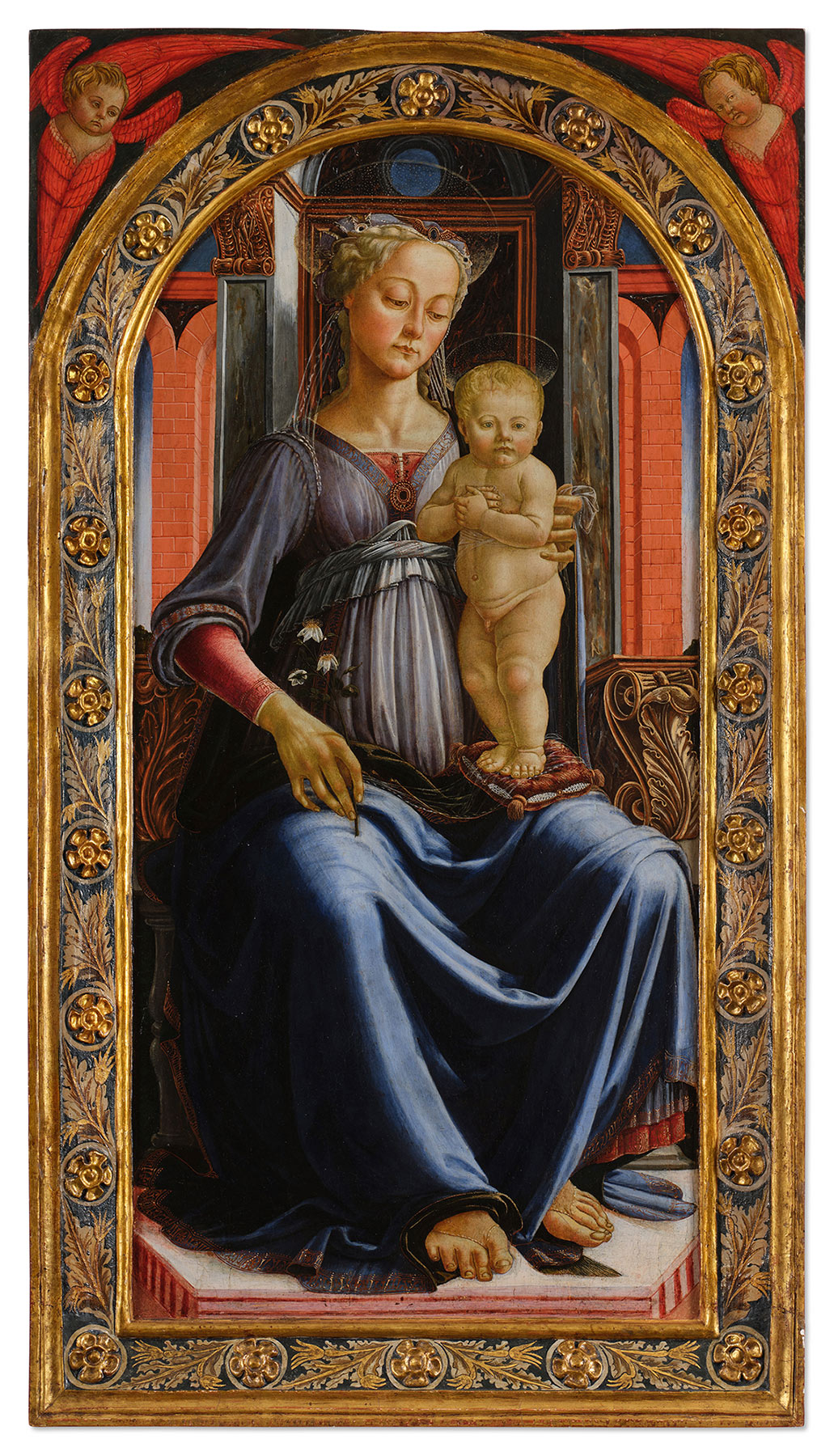
In the same ways that the ex-Ricasoli/Alana Virgin and Child Enthroned (see fig. 1) distinguished itself from the other paintings that had been grouped with it on the basis of a superficial resemblance of motifs and figure types, the Yale Adoration of the Christ Child stands apart from the innumerable repetitions of its basic compositional formula that are now assigned to artists like Biagio d’Antonio, Jacopo del Sellaio, and Francesco Botticini. Ultimately derived from the example of Filippo Lippi, the Virgin shown kneeling in a flowery meadow with her Child lying on the hem of her robe as it spreads out on the ground around her is treated by most late quattrocento Florentine painters in a decorative manner, the picture surfaces completed with a stock repertoire of emblematic landscape motifs usually comprising two hills enlivened with trees and ashlar rock formations bracketing a deep river valley and a further line of blue hills ranged across the horizon. Few if any of these incorporate perspectival effects as masterful as those in the Yale painting, where, for example, the bridge crossing the river in the middle distance is faultlessly foreshortened; the diminution in scale of trees, buildings, rocks, and hills as they recede in depth is meticulously calibrated; and all the figures are drawn not just in silhouette flat against the picture plane but with an effortless command of their full spatial presence. Especially notable are such easily overlooked details as the Baptist’s cloak furling in the wind behind him or the perfectly convincing outline of the Virgin’s right arm as it moves directly forward from elbow to wrist. None of the stable of artists to whom this painting has been assigned in the past demonstrates the capacity or even interest in deploying spatial devices of this sophistication, nor do any of them approximate the richly luminous atmospheric effects that have been so grievously compromised by abrasion in this painting, to reconstruct which it is necessary to compare it to the beautifully preserved ex-Ricasoli/Alana Virgin and Child Enthroned.
The suggestion that the artist responsible for these two exceptional works might have been Andrea del Verrocchio was advanced by the present author in the 2018 Yale exhibition as a hypothesis intended to extend a plausible arc of Verrocchio’s activity as a painter into the 1460s.22 That Verrocchio operated a successful painter’s workshop as early as 1468 is attested by documents, but no documented paintings by him from any point in his career survive. The one altarpiece for which payments to him are preserved, the so-called Madonna di Piazza in Pistoia, is attributed by most scholars to his pupil Lorenzo di Credi, and one of the two altarpieces mentioned as his by Giorgio Vasari, from San Domenico a Maglia and now in the Szépművészeti Múzeum, Budapest, is assumed by nearly all scholars to have been painted by another pupil, Biagio d’Antonio.23 The other altarpiece mentioned by Vasari, the San Salvi Baptism now in the Gallerie degli Uffizi, Florence,24 is universally recognized as a collaboration with yet a third pupil: Leonardo da Vinci. A further half dozen works, chiefly devotional paintings of the Virgin and Child, have been associated with these in a contentious litany of scholarly debates but with no consensus supporting their attributions. All these works are datable to the 1470s, and most rely on assessments of their pictorial quality to affirm a relationship to Verrocchio. Given that no hard evidence of Verrocchio’s specific pictorial qualities is available, this is a circular argument based exclusively on presumptions derived from his imposing historical reputation.
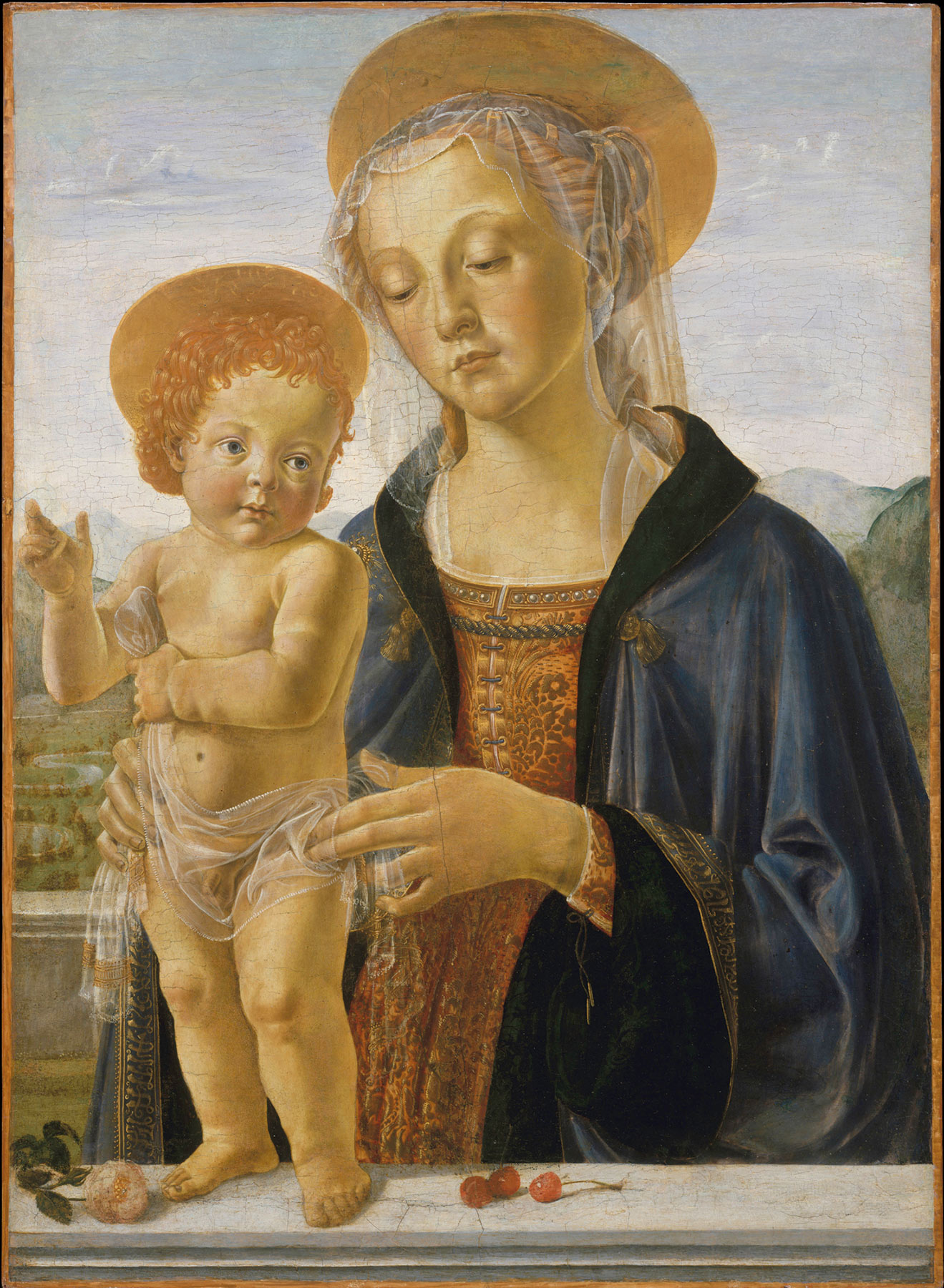
Accepting the division of labor within the San Salvi Baptism that was suggested by Vasari and that is supported by the presence within it of two distinct painting techniques—a conventional tempera technique attributed to Verrocchio and an innovative oil technique recognized as Leonardo’s—the present author proposed a more conservative standard for judging Verrocchio’s contribution to a number of paintings that could justifiably be considered as by or partially by him. These include a Virgin and Child with Two Angels in the National Gallery, London;25 an Archangel Raphael and Tobias also in the National Gallery, London;26 a Virgin and Child in the Gemäldegalerie, Staatliche Museen zu Berlin;27 and a Virgin and Child in the Metropolitan Museum of Art, New York (fig. 2). The last of these is extensively damaged and restored; the first three are all collaborative works. The two earliest paintings in this group are the Metropolitan Museum Virgin and Child and the National Gallery Raphael and Tobias, both of which could be dated to the end of the 1460s or around 1470. The former, the painting in New York—the attribution of which as an autograph work by Verrocchio is not accepted by most scholars—establishes a tangible link with the ex-Ricasoli/Alana Virgin and Child Enthroned (see fig. 1) by its subject, its figure style, and its treatment of light and of surface detail. The ex-Ricasoli/Alana Virgin must be earlier by several years at least and probably does not postdate 1465. By extension, the Yale Adoration of the Christ Child would be a still earlier work by the same hand. If its attribution to Andrea del Verrocchio is sound, it would suggest a period of apprenticeship, probably in the 1450s, for that great artist in the studio either of Francesco Pesellino or of Filippo Lippi. Such a scenario is entirely speculative and runs counter to current notions of Verrocchio training as a sculptor either with Donatello or with Desiderio da Settignano and emerging only later as a self-taught painter, but it has the merit of possibly being more historically plausible. —LK
Published References
Jarves, James Jackson. Descriptive Catalogue of “Old Masters” Collected by James J. Jarves to Illustrate the History of Painting from A.D. 1200 to the Best Periods of Italian Art. Cambridge, Mass.: H. O. Houghton, 1860., 51; Sturgis, Russell, Jr. Manual of the Jarves Collection of Early Italian Pictures. New Haven: Yale College, 1868., 47; W. F. Brown, Boston. Catalogue of the Jarves Collection of Early Italian Pictures. Sale cat. November 9, 1871., no. 41; Rankin, William. “Some Early Italian Pictures in the Jarves Collection of the Yale School of Fine Arts at New Haven.” American Journal of Archaeology 10, no. 2 (April–June 1895): 137–51., 147–48; Mackowsky, Hans. “Jacopo del Sellaio.” Jahrbuch der preußischen Kunstsammlungen 20 (1899): 192–202, 271–84., 271; Sirén, Osvald. A Descriptive Catalogue of the Pictures in the Jarves Collection Belonging to Yale University. New Haven: Yale University Press, 1916., 125–28, no. 45; van Marle, Raimond. The Development of the Italian Schools of Painting. Vol. 10. The Hague: M. Nijhoff, 1928., 513; “Handbook: A Description of the Gallery of Fine Arts and the Collections.” Special issue, Bulletin of the Associates in Fine Arts at Yale University 5, nos. 1–3 (1931): 1–64., 28; Berenson, Bernard. Italian Pictures of the Renaissance: A List of the Principal Artists and Their Works with an Index of Places. Oxford: Clarendon, 1932., 527; “Picture Book Number One: Italian Painting.” Special issue, Bulletin of the Associates in Fine Arts at Yale University 15, nos. 1–3 (October 1946): n.p., fig. 9; Berenson, Bernard. Italian Pictures of the Renaissance, A List of the Principal Artists and Their Works with an Index of Places: Florentine School. 2 vols. London: Phaidon, 1963., 1:198; Seymour, Charles, Jr. Early Italian Paintings in the Yale University Art Gallery. New Haven: Yale University Art Gallery, 1970., 175–77, no. 127; Fredericksen, Burton B., and Federico Zeri. Census of Pre-Nineteenth-Century Italian Paintings in North American Public Collections. Cambridge, Mass.: Harvard University Press, 1972., 599; Fahy, Everett. “The Argonaut Master.” Gazette des beaux-arts, 6th ser., 114 (December 1989): 285–300., 291; Kanter, Laurence. Italian Paintings in the Museum of Fine Arts Boston. Vol. 1, 13th–15th Century. Boston: Museum of Fine Arts, 1994., 167; Bartoli, Roberta. Biagio d’Antonio. Milan: Federico Motta, 1999., 230
Notes
-
Jarves, James Jackson. Descriptive Catalogue of “Old Masters” Collected by James J. Jarves to Illustrate the History of Painting from A.D. 1200 to the Best Periods of Italian Art. Cambridge, Mass.: H. O. Houghton, 1860., 51; and Sturgis, Russell, Jr. Manual of the Jarves Collection of Early Italian Pictures. New Haven: Yale College, 1868., 47. ↩︎
-
Rankin, William. “Some Early Italian Pictures in the Jarves Collection of the Yale School of Fine Arts at New Haven.” American Journal of Archaeology 10, no. 2 (April–June 1895): 137–51., 147–48. ↩︎
-
Mackowsky, Hans. “Jacopo del Sellaio.” Jahrbuch der preußischen Kunstsammlungen 20 (1899): 192–202, 271–84., 271. ↩︎
-
Sirén, Osvald. A Descriptive Catalogue of the Pictures in the Jarves Collection Belonging to Yale University. New Haven: Yale University Press, 1916., 125–28, no. 45. ↩︎
-
Sirén, Osvald. A Descriptive Catalogue of the Pictures in the Jarves Collection Belonging to Yale University. New Haven: Yale University Press, 1916., 125. ↩︎
-
Inv. nos. 09.136.1–.2, https://www.metmuseum.org/art/collection/search/435665, https://www.metmuseum.org/art/collection/search/436994. ↩︎
-
Logan, Mary. “Compagno del Pesellino et quelques peintures de l’école.” Gazette des beaux-arts, 3rd ser., 26 (1901): 18–34, 333–43., 334. ↩︎
-
Sirén, Osvald. A Descriptive Catalogue of the Pictures in the Jarves Collection Belonging to Yale University. New Haven: Yale University Press, 1916., 127. ↩︎
-
Inv. no. WA1850.28, https://collections.ashmolean.org/object/372362. ↩︎
-
“Handbook: A Description of the Gallery of Fine Arts and the Collections.” Special issue, Bulletin of the Associates in Fine Arts at Yale University 5, nos. 1–3 (1931): 1–64., 28; and “Picture Book Number One: Italian Painting.” Special issue, Bulletin of the Associates in Fine Arts at Yale University 15, nos. 1–3 (October 1946): n.p., fig. 9. ↩︎
-
van Marle, Raimond. The Development of the Italian Schools of Painting. Vol. 10. The Hague: M. Nijhoff, 1928., 513. ↩︎
-
Berenson, Bernard. Italian Pictures of the Renaissance: A List of the Principal Artists and Their Works with an Index of Places. Oxford: Clarendon, 1932., 527; Berenson, Bernard. Italian Pictures of the Renaissance, A List of the Principal Artists and Their Works with an Index of Places: Florentine School. 2 vols. London: Phaidon, 1963., 1:198; Seymour, Charles, Jr. Early Italian Paintings in the Yale University Art Gallery. New Haven: Yale University Art Gallery, 1970., 175–77; Fredericksen, Burton B., and Federico Zeri. Census of Pre-Nineteenth-Century Italian Paintings in North American Public Collections. Cambridge, Mass.: Harvard University Press, 1972., 599; and Boskovits, verbal opinion to the author. ↩︎
-
Fahy, Everett. “The Argonaut Master.” Gazette des beaux-arts, 6th ser., 114 (December 1989): 285–300., 291. ↩︎
-
Kanter, Laurence. Italian Paintings in the Museum of Fine Arts Boston. Vol. 1, 13th–15th Century. Boston: Museum of Fine Arts, 1994., 167; and Strehlke, manuscript opinion, 1999, curatorial files, Department of European Art, Yale University Art Gallery. ↩︎
-
Bartoli, Roberta. Biagio d’Antonio. Milan: Federico Motta, 1999., 230. The identification of the Argonaut Master with Bernardo di Stefano Rosselli was proposed by Konrad Oberhuber, in Levenson, Jay A., Konrad Oberhuber, and Jacquelyn L. Sheehan. Early Italian Engravings from the National Gallery of Art. Washington, D.C.: National Gallery of Art, 1973., 53n22. This identification has not been widely accepted and is indeed unlikely. ↩︎
-
Verbal opinion to the author, ca. 2012. ↩︎
-
Dalli Regoli, Gigetta. “Il Maestro di San Miniato: Anatomia di un’ipotesi.” In Il “Maestro di San Miniato”: Lo stato degli studi, i problemi, le risposte della filologia, ed. Federico Zeri and Gigetta Dalli Regoli, 17–124. Pisa: Giardini, 1988., fig. 59. ↩︎
-
Sale, Christie’s, New York, January 29, 2014, lot 101. ↩︎
-
Inv. no. R.F. 2088. See Zeri, Federico, with Elizabeth E. Gardner. Italian Paintings: A Catalogue of the Collection of the Metropolitan Museum of Art. Vol. 1, Florentine School. New York: Metropolitan Museum of Art, 1971., 116–17; Dalli Regoli, Gigetta. “Il Maestro di San Miniato: Anatomia di un’ipotesi.” In Il “Maestro di San Miniato”: Lo stato degli studi, i problemi, le risposte della filologia, ed. Federico Zeri and Gigetta Dalli Regoli, 17–124. Pisa: Giardini, 1988., figs. 57–62, 64; and Fahy, Everett. “The Argonaut Master.” Gazette des beaux-arts, 6th ser., 114 (December 1989): 285–300., 292, 296 (where the painting in Le Mans is removed from the group). ↩︎
-
See Daly, Christopher. “A New Fragment of the Carmine Altarpiece and Other Works by Jacopo del Sellaio.” Commentari d’arte 20, nos. 58–59 (September–December 2014): 53–60., 58n11; and Dury, Corentin. Peintures italiennes et hispanique: Collections du Musée de Tessé, XIVe–XVIIIe siècles. Exh. cat. Ghent, Belgium: Snoek, 2016., 76–78, for a summary of scholarly opinions related to this group of paintings and to the Argonaut Master. ↩︎
-
Kanter, Laurence, with Bruno Mottin and Rita Piccione Albertson. Leonardo: Discoveries from Verrocchio’s Studio, Early Paintings and New Attributions. Exh. cat. New Haven: Yale University Art Gallery, 2018., 93. The panels formerly in the Metropolitan Museum and formerly in the Bernheimer collection may also be attributable to Jacopo del Sellaio, although the latter appears in photograph to be heavily restored and is therefore difficult to judge with any confidence. The Adoration in the Acton Collection is of distinctly lower quality than the others and is more closely related to the general standard of works by the Argonaut Master. ↩︎
-
See Kanter, Laurence, with Bruno Mottin and Rita Piccione Albertson. Leonardo: Discoveries from Verrocchio’s Studio, Early Paintings and New Attributions. Exh. cat. New Haven: Yale University Art Gallery, 2018.. The Yale Adoration did not appear in the catalogue. ↩︎
-
Inv. no. 1386. ↩︎
-
Inv. no. 1890 n. 8358, https://www.uffizi.it/en/artworks/verrocchio-leonardo-baptism-of-christ. ↩︎
-
Inv. no. NG 296, https://www.nationalgallery.org.uk/paintings/andrea-del-verrocchio-assisted-by-lorenzo-di-credi-the-virgin-and-child-with-two-angels. ↩︎
-
Inv. no. NG 781, https://www.nationalgallery.org.uk/paintings/workshop-of-andrea-del-verrocchio-tobias-and-the-angel. ↩︎
-
Inv. no. 104A, https://id.smb.museum/object/865731/maria-mit-dem-kind. ↩︎