Van Gelder, Uccle, Belgium; Michael Simpson, London, 1988; Barbara and Robert Liberman (born 1943), New York
The panel support, of a vertical wood grain, comprises three planks, approximately 19.5, 56.5, and 52 centimeters in width, from left to right. It has been thinned to between 2 and 2.5 centimeters and exhibits a pronounced convex warp. A cradle, which had provoked numerous partial splits, was removed by George Bisacca around 1996. The paint surface is well preserved, exhibiting only modest abrasion and minor inpainting along the splits and over a few knots. The gilding on hems and orphreys is beautifully preserved, as is the left half of Saint Blaise’s halo and most of Saint Martin’s. The haloes of the Virgin and the Christ Child and the right half of Saint Blaise’s halo are modern. The background is discolored but not repainted.
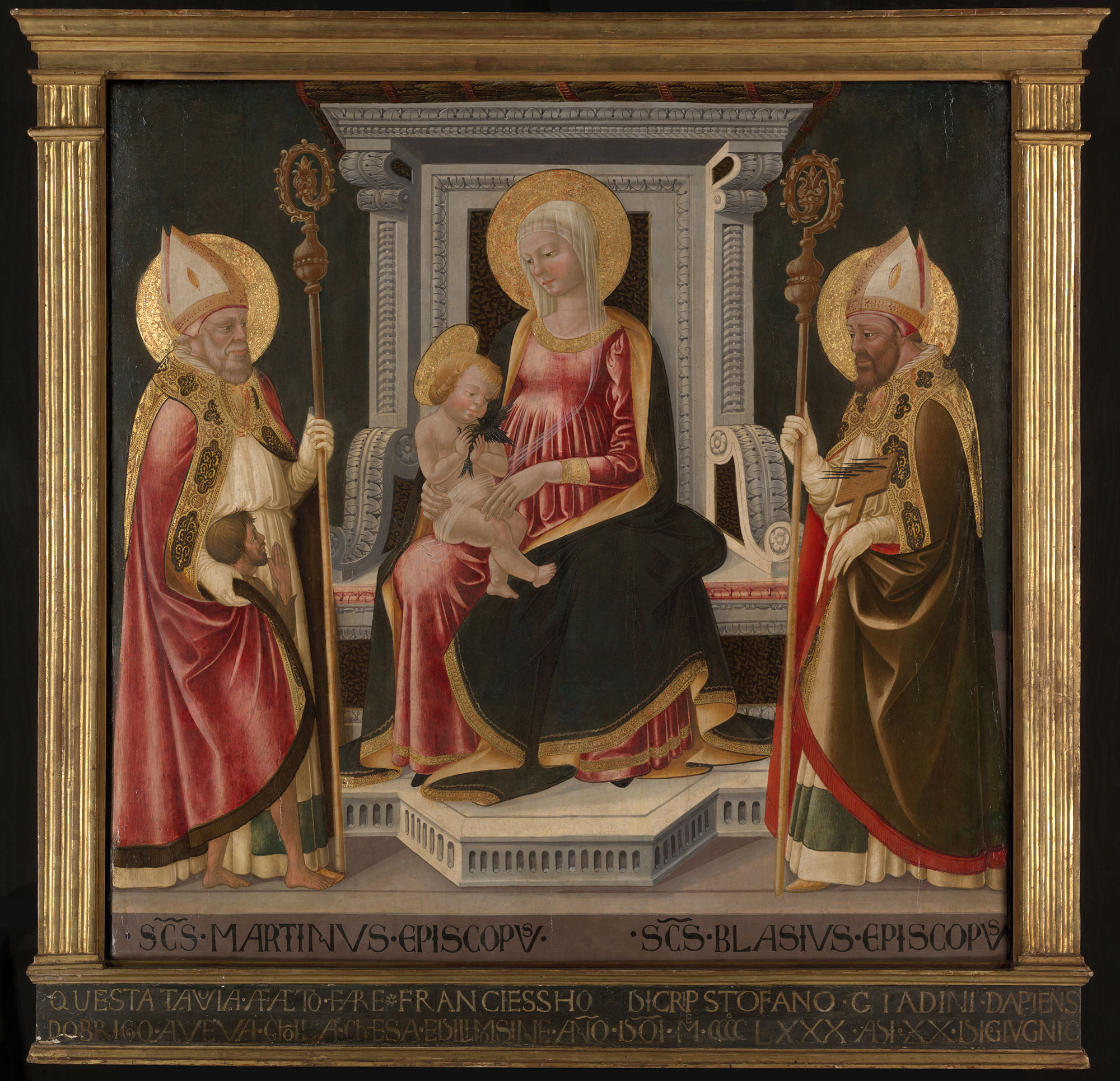
The Virgin, wearing a red dress and a dark blue cloak
edged in gold, is seated frontally in the center of the
composition on a large and elaborately carved marble
throne with serpentine or verde antico marble
inlays set atop a projecting angular dais. Above the
cornice of the throne, supported on two acanthus volutes,
is a canopy of laurel leaves bound into fasces by pink
ribbon. The background behind the throne is painted smalt
blue, now decayed to a flat olive-gray tone, and the
foreground below is a lilac-gray stone. The Christ Child,
seated naked on the Virgin’s right knee but wrapped
demurely in the trailing end of her long transparent veil,
plays with a goldfinch held between His two hands.
Standing on either side of the throne are two bishop
saints. To the Virgin’s right, at the left of the throne,
is Saint Martin of Tours sheltering a diminutive figure
within the folds of his cope, a reference to the story of
Martin, when a soldier of the Roman legion stationed at
Amiens, France, cutting his cloak in half to clothe a
beggar and later receiving a vision that the beggar was an
apparition of Christ. To the Virgin’s left, at the right
of the throne, is Saint Blaise, bishop of Sebaste in
Cappadocia (present-day Turkey), holding an iron curry
comb, symbol of his martyrdom. The saints’ names are
inscribed on the front face of the stone pavement on which
they stand: “SCS.•MARTINVS•EPISCOPVS” and “SCS•
The frame of the altarpiece (fig. 1) is a modern reconstruction but incorporates across the bottom a damaged and much restored fragment of the original predella containing an inscription memorializing its patron and date. The inscription has been restored to read: “QUESTA TAVOLA A FACTO FARE FRANCIESSHO DI CRIPSTOFANO GI[. . .]ADINI DA PIENS DOBRIGO AVEVA CHOLA CHIESA E DI LIMOSINE ANNO DOMINI MCCCCLXXX ADI XX DI GIVGNIO” (Francesco di Cristofano Gi[. . .]adini of Pienza[?] had this painting made for an obligation he had with the Church and for charity on the 20th day of June in the year of our Lord 1480). The surviving remnants of the original inscription, visible beneath this restoration in raking and infrared light, read: “QUESTA TAVOLA A FACTO FARE DONATO DI PAGOLO DI LORENZO DA S[CO] MARTINO AL[. . .] P[. . .] DOBRIGO AVEVA CHOLLA CHIESA E DILIMOSINE ANNO DOMINI MCCCCLXXVI A DI [. . .].” The patron is thus properly identified as a certain Donato di Paolo di Lorenzo from San Martino [alla Palma?], and the date of dedication corrected to 1476. The original day and month do not survive beneath the modern surface.
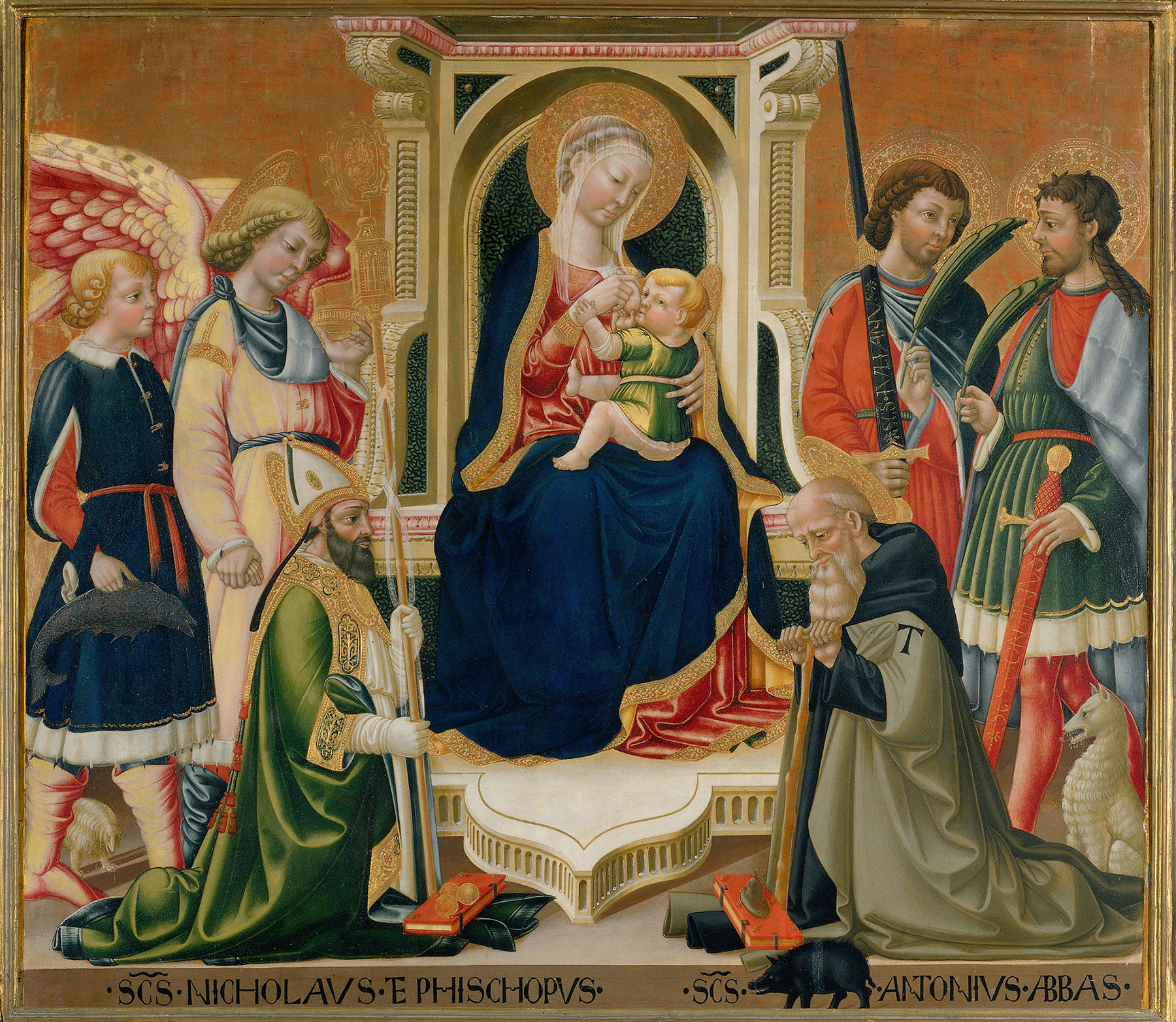
No record of the commission for this altarpiece is included in Neri di Bicci’s Ricordanze, the final entry in which is dated April 30, 1475, but in which marginal notes extend to July 6, 1476. The painting conforms perfectly in style and composition to works of approximately that date, however, specifically to three altarpieces: one in the Museo d’Arte Sacra at Tavarnelle in the Val di Pesa, which was delivered to its patron, Niccolò Sernigi, on April 15, 1473 (fig. 2); one of the Coronation of the Virgin in the cenacolo of Sant’Apollonia in Florence, delivered on July 17, 1473; and, above all, one painted for Radda in Chianti and delivered to its patron, Mariotto di Meo, on November 23, 1474. The last of these, which survives in precarious condition, provides a close parallel to the Yale altarpiece in its composition, substituting Saints Catherine of Alexandria and Cristina for Martin and Blaise, and for its use of a smalt blue background.1 The first—which represents the Virgin and Child Enthroned with the Archangel Raphael, Tobias, and Saints Nicholas, Anthony Abbot, Julian, and Donnino and is similar in format to the Yale panel but with a more crowded composition and a gilt background—uses many of the same architectural forms, including the same patterns for the acanthus supports of the cornice of the throne.2
Although a progressive development in Neri di Bicci’s style is apparent over the course of his long career, the great number of assistants and apprentices listed by name in the Ricordanze left a visible trace in a lack of uniformity to his output at any given moment. In the early 1470s, a striking dichotomy of handling suggests the dominating presence of one of these apprentices, Polito del Donzello, to whom large portions and even the design of several altarpieces may be attributed, including altarpieces of the Lamentation and Annunciation also in Tavarnelle, both of 1473, and a Virgin and Child with Four Saints of 1474 from Radda in Chianti.3 The 1474 Radda altarpiece was commissioned after Polito is presumed to have left Neri’s employ, so it is possible that the two artists may have continued a commercial relationship into the middle years of the decade.4 No evidence of Polito’s participation in the ideation or execution of the Yale altarpiece is anywhere apparent, however. With the possible exception of the figure of the Christ Child and the hands of the Virgin—where the drawing is relatively slack and modeling is less solid—the Yale panel appears to be an entirely autograph work and a useful benchmark for assessing Neri di Bicci’s production in the undocumented years following the terminal date of the Ricordanze. —LK
Published Reference
“Acquisitions 2002.” In “The Original Work of Art: What It Has to Teach.” Special issue, Yale University Art Gallery Bulletin (2003): 121–70., 134
Notes
-
Santi, Bruno. “Due dipinti recuperate di Neri di Bicci.” In Scritti di storia dell’arte in onore di Roberto Salvini, 329–34. Florence: Sansoni, 1984., 329–34, pl. 99. ↩︎
-
Another close point of comparison for the figure style of the Yale altarpiece is provided by two further panels painted by Neri di Bicci for Niccolò Sernigi, after April 1475, and now also exhibited at the Museo d’Arte Sacra at Tavarnelle (Val di Pesa). Thought to have been lateral panels flanking a marble tabernacle, these portray the Virgin and Saint John the Evangelist in adoration, accompanied by a martyr saint and Saint Roch. See Thomas, Anabel. “Neri di Bicci and the Franciscan Nuns of S. Maria a Monticelli: New Evidence of His Later Paintings.” Rivista d’arte 44 (1992): 317–30., 321–22, fig. 2. ↩︎
-
Santi, Bruno. “Due dipinti recuperate di Neri di Bicci.” In Scritti di storia dell’arte in onore di Roberto Salvini, 329–34. Florence: Sansoni, 1984., 329–34. ↩︎
-
For Polito del Donzello, see Sricchia Santoro, Fiorella. “Pittura a Napoli negli anni di Ferrante e di Alfonso duca di Calabria: Sulle trace di Costanzo de Moysis e di Polito del Donzello.” Prospettiva 159–60 (July–October 2015): 25–109., 25–109; Kanter, Laurence. “Pietro or Polito del Donzello?” In Regards sur les primitifs: Mélanges en l’honneur de Dominique Thiébaut, ed. Michel Laclotte and Dominique Thiébaut, 110–17. Paris: Hazan, 2018., 110–17; and Ugolini, Andrea. “Riepilogo su Pietro e Polito del Donzello.” Pictrix. Pt. 45, rel. 3.0 (progetto extra moenia 5). June 22, 2020, 1–70. https://www.academia.edu/41714523/PICTRIX_PARTE_45_Riepilogo_su_Pietro_e Polito_del_Donzello_Rel_3 0_Progetto_Extra_Moenia_5 ., 1–70. ↩︎