on the predella, AVE • MARIA • GRATIA • PLENA • DOMINIS • TECVM
Georges Chalandon, Parcieux, La Grange (Lyon), France; Wildenstein & Co., New York, ca. 1965
The frame is constructed around its painted tympanum, the support of which is a poplar panel of horizontal grain measuring approximately 27 by 54 centimeters and 4.5 centimeters thick. This is nailed to a 2-centimeter-thick backing board of a soft wood, possibly abete (fir or spruce), again of horizontal grain, the surviving fragment of which measures approximately 27 by 42 centimeters. The backing board was cut at the top of the sight edge of the frame when its original stucco relief was removed and the frame repurposed to house a painting, probably in the late nineteenth century. All the other members of the frame were assembled around these two structural members, the predella added last as a separate unit. All the raised moldings on the front of the frame have been repaired by releafing over original gold. The painted and gilded surfaces of the tympanum and sloping sight edges of the frame are beautifully—almost perfectly—preserved, as is the stenciled and sgraffito frieze ornament of a ribbon-and-stick (or wreath-and-vine) design that fills the sides and rounded top of the outer frame. The stenciled design of the bottom frieze is damaged and reconstructed at both corners and for a length of 15 centimeters on the right and 23 centimeters on the left. All the decoration and lettering of the predella is modern except for the final characters in the words “[DOMINI]S TECVM.”
This beautifully preserved tabernacle frame is one of many made for and painted by Neri di Bicci, according to his account books, the Ricordanze, to house polychromed stucco reliefs of the Virgin and Child, as can be deduced by the original backing board on which such reliefs were cast that is still attached to the reverse of the frame. Innumerable entries in the Ricordanze refer to the framing, painting, and gilding of tabernacles containing such reliefs, typically described as “una meza Nostra Donna di pocho rilievo che abraccia el Figliuolo” (a half-length Virgin embracing her Child, in low relief), “una 1/2 Nostra Donna di gesso di quelle che adorano” (a half-length Virgin of the adoring type, in gesso), or “Nostre Donne di gesso di pocho rilievo, le quali Nostre Donne sono meze e stanno cholle mani giunte” (Our Ladies in gesso in low relief, the said Our Ladies shown in half-length with their hands joined [in prayer]), without naming their author.1 As early as April 25, 1454, Neri accepted a commission from the goldsmith Piero di Ghuccio to paint and gild a terracotta relief of the Virgin, with its frame; five months later, on August 31, he supplied “una Nostra Donna di gesso grande chol Fanciullo in chollo” (a large gesso of Our Lady with the Child’s arms around her neck) to Tommaso Soderini; and on April 3, 1456, he delivered to the painter Piero del Masaio “1a Vergine Maria di rilievo grande di gesso, la quale gli ò cholorita e ornata, chol Bambino in chollo” (a large gesso relief of the Virgin Mary holding the Child which I had colored and decorated).2 Five more are recorded on March 20 and April 16, 1459, presumably the beginning of a regular business practice.3 On April 28, he painted three tabernacles with gesso reliefs for Andrea di Biagio, a Florentine merchant in Rome, and on May 15, he sold two tabernacles to Bartolomeo Tazi, with four more delivered to different clients in June and July.4 From that point, commissions for gesso reliefs of the Virgin and Child occur regularly—twenty-three in the year 1459 alone—and Neri is careful to distinguish when a tabernacle was meant to include a panel painting instead (“Vergine Maria dipinta di piano”).5
Although most of the scores of such reliefs noted in Neri’s Ricordanze are unidentified, it is assumed by modern scholarship that they were all designed by the artist’s younger contemporary Desiderio da Settignano (1429/30–1464). Neri first recorded collaborating with Desiderio on September 28, 1456, when he paid the sculptor 11 soldi for an enameled stucco relief (“ismalto di stucho”) to be used as an insert in the chest of a terracotta head that he was commissioned to paint for a Vallombrosan monk of San Pancrazio.6 On January 3, 1461, Neri delivered to the goldsmith Pietro Tazzi a tabernacle that he, Neri, had gilt and painted and that housed a marble relief of the Virgin and Child by Desiderio.7 Desiderio is mentioned twice again by name in Neri’s Ricordanze: on June 4, 1462, as the author of “una 1/2 Nostra Donna di gesso di pocho rilievo e Nostro Signore che abraccia la Nostra Donna ingnudo” (a half-length Virgin in gesso in low relief with Our Lord, naked, who embraces Our Lady), contained within a large tabernacle that Neri sold to his neighbor Alessandro di Luigi di ser Lanberto; and on February 19, 1465, when Neri delivered a similar large tabernacle to Ronbolo d’Andrea di Nofri, a battiloro (goldbeater), “drentovi 1a Nostra Donna di gesso di mano di Disidero cho Nostro Signiore in chollo ch’è mezzo faciato, el quale tabernacholo e Nostra Donna fu già altra volta dipinto e messo parte d’oro e parte biancho e d’altri cholori e di nuovo lo rasi e missi el tabernacholo d’oro fine a Nostra Donna e Nostro Signiore” (in which is a gesso of Our Lady by the hand of Desiderio with Our Lord half swathed in her arms, which tabernacle and Our Lady had already been painted with white and other colors and partly gilt and I cleaned it off and regilt with fine gold the tabernacle and Our Lady and Our Lord).8
On April 25, 1459, Neri first recorded ordering a frame for a tabernacle from the woodcarver Luca di Paolo Manucci.9 Manucci seems to have been the painter’s preferred collaborator for these domestic commodities, in the same way that Giuliano da Majano fulfilled most of his commissions for altarpiece frames. On February 19, 1460, Neri ordered twelve tabernacle frames of various sizes from him.10 In a remarkable transaction of June 30, 1468, he ordered twelve more tabernacle frames “al modo usato” (of the usual style) from Manucci, “acetto che gli à a fascire tuti dirieto d’asse d’abeto pialate e debe formare la Vergine Maria del gesso ed io gli debo dare el gesso” (except that he must make backing boards of planed abete [a soft wood] for each and must cast the Virgin Mary in gesso, and I will provide the gesso). In addition to these, he ordered twenty-four “quadretti al modo usato” (small panels of the usual style), again to be cast with gesso reliefs of the Virgin and Child.11 Presumably, the latter could be inserted into larger tabernacle frames if a client wished. The implication is that Neri not only worked on commission but also kept a ready stock of reliefs and frames prefabricated in his workshop, to be painted as customers required. Either he or Luca Manucci must have owned the molds—Desiderio had died four years earlier—and perfected a mass-production system of fabrication. Neri may also have worked with a network of dealers. The merchant Mariotto Mazi, for example, purchased a tabernacle with a gesso relief from Neri on January 5, 1460, two on September 6, 1461, three on December 16, 1461, one on August 30, 1463, one on September 15, 1464, and another on September 7, 1467.12
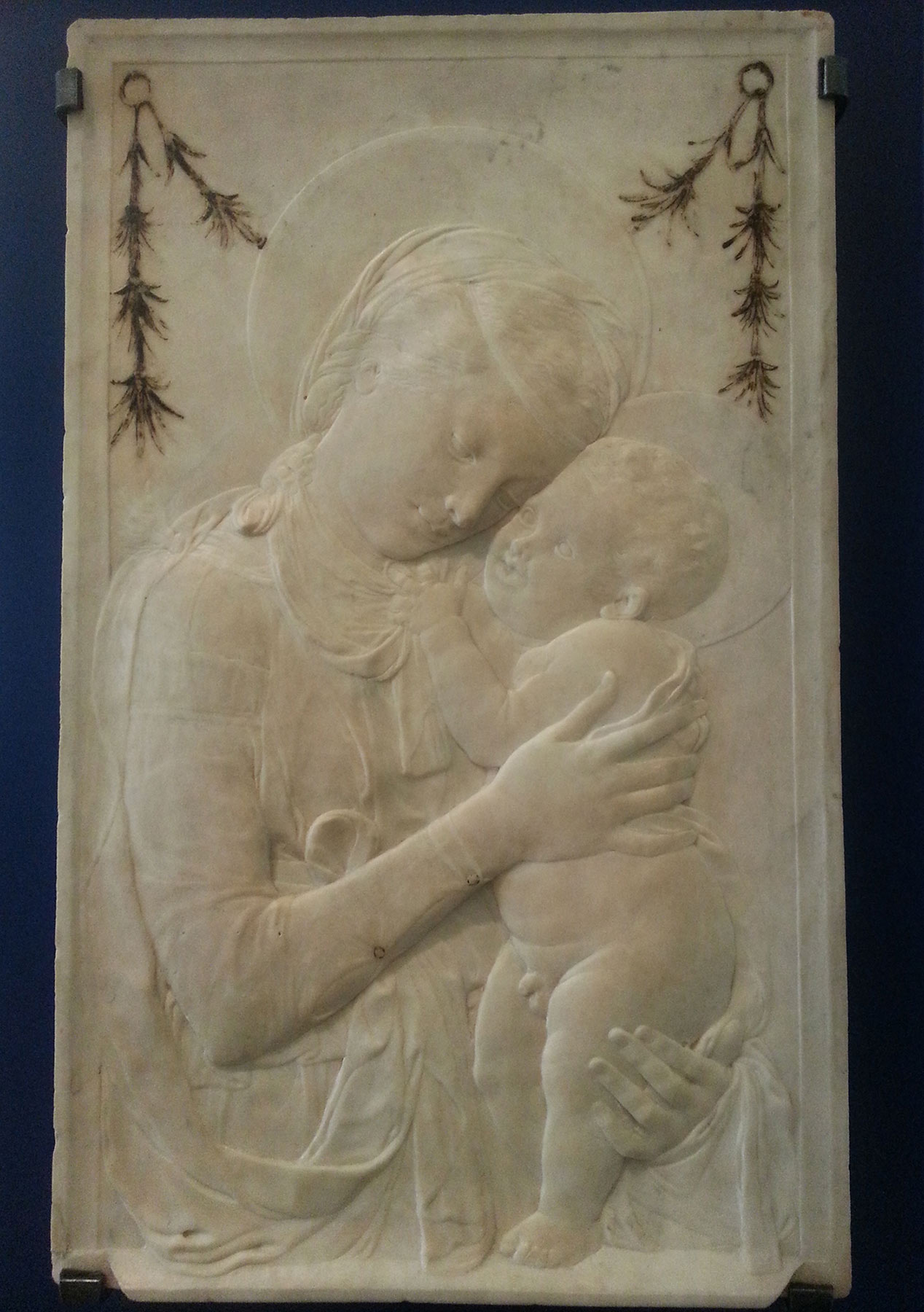
Of the four Virgin and Child compositions most often associated with Desiderio da Settignano, two are known through a large series of stucco replicas, undoubtedly corresponding to the vague descriptions of gesso reliefs included in the Ricordanze. These are commonly known as the Turin Madonna (fig. 1) and the Alberti Madonna (see Neri di Bicci, Virgin and Child, fig. 1), after their supposed marble prototypes.13 The Turin Madonna is considerably taller than it is wide, whereas the Alberti Madonna is more nearly square in format. The known casts of the latter, which can be divided into groups based on differences in their polychromy that can be attributed to at least three different artists’ workshops, are nearly all the same dimensions as the sight opening of the Yale frame. It is an inescapable conclusion that the frame was designed in the first instance to house a relief of this composition. Although the inventory of surviving examples of this relief cannot be considered complete, only eight of them can unequivocally be attributed to Neri di Bicci.14 Two of these versions—one in the Pinacoteca Civica F. Podesti e Galleria d’Arte Moderna, Ancona (see Neri di Bicci, Virgin and Child, fig. 2) and the other formerly in a private collection15—and possibly a third, also in a private collection,16 are preserved in their original frames, but it cannot be established with confidence whether any of the other five might have been the missing relief belonging to the Yale frame.
It is also difficult to establish with certainty whether the Yale frame is identical to any mentioned in the Ricordanze, as most of the notices included there are generic, not specifying the size or design of the frame. Several frames are described as “al’anticha, cholonne da lato, ghocciola di sotto, architrave di sopra, fregio e uno frontone” (in the antique style, columns at the side, antependium beneath, architrave above, frieze and a tympanum), although some specify “fregio e chornicione di sopra sanza punta” (frieze and cornice at the top without a point).17 In one case, the artist specified that the frame is to have “gli sghuanci d’atorno d’azuro chon istelle” (squinches [i.e., deep sloping sight edges] around it painted blue with stars), and in another he recorded that the frame was “fatta al modo usato salvo ch’era leghata in legniame de sopra tonda chon uno fiorettino di sopra e da llato 2 viticci” (made in the usual fashion except that the carpentry was round at the top with a small flower above and two palmettes at the sides),18 types well known among surviving quattrocento tabernacle frames (see Pseudo-Pier Francesco Fiorentino, Virgin and Child with Two Angels).
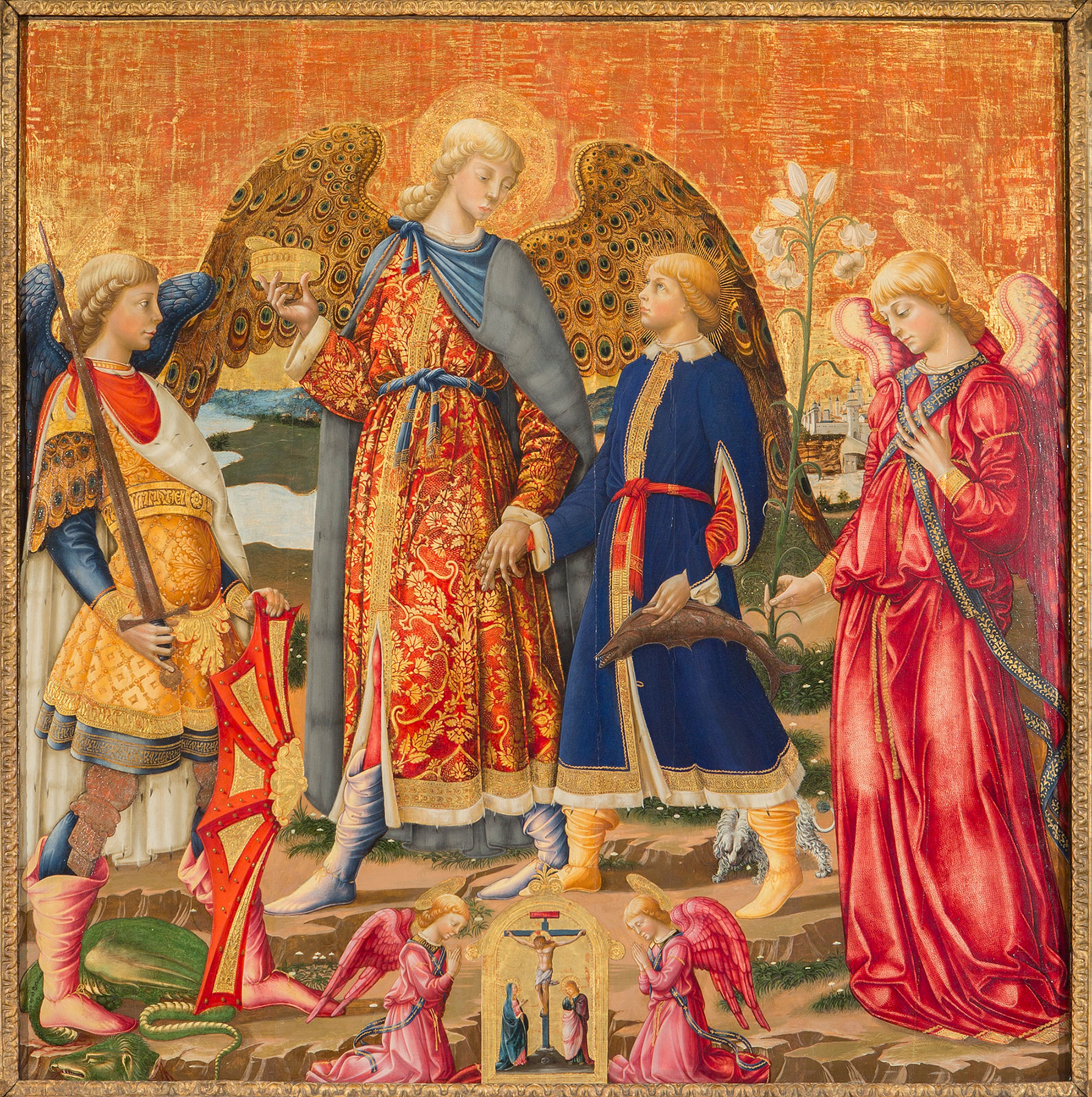
No entries in the Ricordanze include descriptions that follow the design or decoration of the Yale frame exactly, but the search for possible correspondences may be narrowed to the years between 1469 and 1472/73, the period during which Polito del Donzello, to whom the standing angels and several of the cherub heads in the sloping frieze may be attributed, is documented as a garzone in Neri’s shop.19 Born in 1458, Polito del Donzello was placed in Neri di Bicci’s studio on May 30, 1469, with a contract stipulating his residence there for two years, and his articles of indenture were renewed for two additional years on September 9, 1471.20 The exact date of Polito del Donzello’s departure from the studio is not recorded, except that it must have occurred after December 19, 1472, when he is last mentioned by Neri, and probably before July 30, 1473, when the articles of indenture were to expire.21 Five altarpieces commissioned from Neri di Bicci during the first two years of Polito’s apprenticeship are lost or unidentified, but beginning in May 1471 and continuing through April 1473, eight others can be identified today that can also be qualified as among the most unusual and accomplished of Neri’s otherwise uniformly competent but uninspired production. Two of the most singular of these, an altarpiece dedicated to Tobias and the three archangels now in the Detroit Institute of Arts (fig. 2) and an Annunciation altarpiece in the church of Santa Lucia a Borghetto in Tavarnelle in the Val di Pesa, were commissioned within one month of each other, in May and June 1471.22 The principal figures in these paintings, especially of the Virgin in the Annunciation altarpiece and of Tobias, Gabriel, and Raphael in the Detroit panel, are so unlike Neri di Bicci’s routine treatment of these stock types—slenderer, less rounded and caricatured, and better modeled—as to raise the question of another artist’s intervention in their conception as well as execution. Lighting (particularly cast shadows) and drapery forms and textures in these paintings are treated with much greater sophistication and subtlety than is typical in Neri di Bicci’s engaging but formulaic works. All these points of divergence from Neri’s usual practice recur in cognate form, although reduced in scale, in the Yale frame.
During the period of Polito del Donzello’s apprenticeship with Neri di Bicci, only three tabernacles including gesso reliefs of the Virgin and Child are mentioned in the Ricordanze, implying either a dramatically lessened demand for such objects or a more casual approach by Neri to keeping records of their sales. Two other tabernacles, sold on January 26, 1471, to Betto di Piero di Dino, and on March 10, 1473, to Bernabé da Cingholi, are described only as showing the Virgin and Child, without stipulating their size or whether they contained paintings or gesso reliefs.23 Of the three frames containing gesso reliefs, one, commissioned by Giuliano da Maiano and his brothers, measured 2 3/4 by 1 1/4 braccia (approximately 160 × 72 cm), too large and of the wrong proportions to be identified with the frame now at Yale.24 Another, sold on November 28, 1472, to Bino veturale, outside the Porta San Pietro Gattolino, measured 1 7/8 by 7/8 braccia (approximately 109 × 51 cm), too small and again of the wrong proportions to be identified with the Yale frame.25 The third, sold on October 31, 1472, to Francesco di Cristofano calzolaio, measured 1 3/4 by 1 1/8 braccia (approximately 102 × 65 cm), not quite the size but exactly the same proportions as the Yale frame.26 The entry for this transaction does not describe the shape of the frame nor mention the painted angels or God the Father. It is possible that the frame now at Yale is not to be identified with any of the entries in Neri di Bicci’s Ricordanze, but if it is, this transaction with Francesco di Cristofano Calzolaio is the premier candidate. —LK
Published References
Unpublished
Notes
-
Neri di Bicci. Le ricordanze (10 marzo 1453–24 aprile 1475). Ed. Bruno Santi. Pisa: Marlin, 1976., 186, 305, 109, respectively. ↩︎
-
Neri di Bicci. Le ricordanze (10 marzo 1453–24 aprile 1475). Ed. Bruno Santi. Pisa: Marlin, 1976., 14, 18, 53, respectively. ↩︎
-
Neri di Bicci. Le ricordanze (10 marzo 1453–24 aprile 1475). Ed. Bruno Santi. Pisa: Marlin, 1976., 109, 111–12. ↩︎
-
Neri di Bicci. Le ricordanze (10 marzo 1453–24 aprile 1475). Ed. Bruno Santi. Pisa: Marlin, 1976., 114–18. ↩︎
-
In Neri di Bicci. Le ricordanze (10 marzo 1453–24 aprile 1475). Ed. Bruno Santi. Pisa: Marlin, 1976., 132, for example, he notes that he sold two tabernacles to Gianozo de’ Mozi, one with a painting of the Virgin and the other with a gesso relief. ↩︎
-
Neri di Bicci. Le ricordanze (10 marzo 1453–24 aprile 1475). Ed. Bruno Santi. Pisa: Marlin, 1976., 59–60. ↩︎
-
Neri di Bicci. Le ricordanze (10 marzo 1453–24 aprile 1475). Ed. Bruno Santi. Pisa: Marlin, 1976., 156–57. ↩︎
-
Neri di Bicci. Le ricordanze (10 marzo 1453–24 aprile 1475). Ed. Bruno Santi. Pisa: Marlin, 1976., 239. Neri does not specify whether the previous painting and gilding of the second relief had been his work, just that he erased and replaced it. ↩︎
-
Neri di Bicci. Le ricordanze (10 marzo 1453–24 aprile 1475). Ed. Bruno Santi. Pisa: Marlin, 1976., 114. The frame ordered on April 25, 1459, was intended for the gesso relief commissioned nine days before (see note 3, above) by Tedaldo della Casa. A suggestion of standardized practice may be the note appended to the April 16 record of commission, wherein Neri stated that he loaned to his client, Tedaldo della Casa, a tabernacle belonging to mona Lionarda di Lionardo di Gualtieri for whatever length of time it would require to finish the new one. The relief delivered to Tommaso Soderini on August 31, 1454, had been commissioned two weeks previously, on August 19 (Neri di Bicci. Le ricordanze (10 marzo 1453–24 aprile 1475). Ed. Bruno Santi. Pisa: Marlin, 1976., 18), a possible indication of the average length of time such works required. ↩︎
-
Neri di Bicci. Le ricordanze (10 marzo 1453–24 aprile 1475). Ed. Bruno Santi. Pisa: Marlin, 1976., 137. ↩︎
-
Neri di Bicci. Le ricordanze (10 marzo 1453–24 aprile 1475). Ed. Bruno Santi. Pisa: Marlin, 1976., 313–14. ↩︎
-
Neri di Bicci. Le ricordanze (10 marzo 1453–24 aprile 1475). Ed. Bruno Santi. Pisa: Marlin, 1976., 132, 169, 174, 204–5, 305. ↩︎
-
For more information, see Neri di Bicci, Virgin and Child; and Pseudo-Pier Francesco Fiorentino and Desiderio da Settignano, Virgin and Child. ↩︎
-
For details on each object, see Neri di Bicci, Virgin and Child. ↩︎
-
Patrizia Zambrano, in Sabatelli, Franco, ed. La cornice italiana dal Rinascimento al Neoclassico. Milan: Electa, 1992., 30–32, fig. 30. ↩︎
-
Fototeca Zeri, Federico Zeri Foundation, Bologna, inv. no. 73238. ↩︎
-
Neri di Bicci. Le ricordanze (10 marzo 1453–24 aprile 1475). Ed. Bruno Santi. Pisa: Marlin, 1976., 115, 112, respectively. ↩︎
-
Neri di Bicci. Le ricordanze (10 marzo 1453–24 aprile 1475). Ed. Bruno Santi. Pisa: Marlin, 1976., 132, 305, respectively. ↩︎
-
For Polito del Donzello, see Kanter, Laurence. “Pietro or Polito del Donzello?” In Regards sur les primitifs: Mélanges en l’honneur de Dominique Thiébaut, ed. Michel Laclotte and Dominique Thiébaut, 110–17. Paris: Hazan, 2018., 110–17. For a contrary view of the artist, see Sricchia Santoro, Fiorella. “Pittura a Napoli negli anni di Ferrante e di Alfonso duca di Calabria: Sulle trace di Costanzo de Moysis e di Polito del Donzello.” Prospettiva 159–60 (July–October 2015): 25–109., 25–109; and Ugolini, Andrea. “Riepilogo su Pietro e Polito del Donzello.” Pictrix. Pt. 45, rel. 3.0 (progetto extra moenia 5). June 22, 2020, 1–70. https://www.academia.edu/41714523/PICTRIX_PARTE_45_Riepilogo_su_Pietro_e Polito_del_Donzello_Rel_3 0_Progetto_Extra_Moenia_5 .. ↩︎
-
Neri di Bicci. Le ricordanze (10 marzo 1453–24 aprile 1475). Ed. Bruno Santi. Pisa: Marlin, 1976., 329, 377. ↩︎
-
Neri di Bicci. Le ricordanze (10 marzo 1453–24 aprile 1475). Ed. Bruno Santi. Pisa: Marlin, 1976., 408. ↩︎
-
Neri di Bicci. Le ricordanze (10 marzo 1453–24 aprile 1475). Ed. Bruno Santi. Pisa: Marlin, 1976., 372, 374. ↩︎
-
Neri di Bicci. Le ricordanze (10 marzo 1453–24 aprile 1475). Ed. Bruno Santi. Pisa: Marlin, 1976., 364–65, 409–10. The transaction with Bernabé da Cingholi also included a large tabernacle containing a gesso relief of the Annunciation and payments on account for “più Vergine Marie da chamera” (several tabernacles of the Virgin Mary), apparently taken to be sold at a fair in Recanati (Marches) but again without specifying whether paintings or gesso reliefs. If they were reliefs, it is interesting to speculate whether one of them might have been the relief now displayed at the Pinacoteca Civica in Ancona (see Neri di Bicci, Virgin and Child, fig. 2), which may be dated on stylistic grounds not far from 1473. ↩︎
-
Neri di Bicci. Le ricordanze (10 marzo 1453–24 aprile 1475). Ed. Bruno Santi. Pisa: Marlin, 1976., 364. ↩︎
-
Neri di Bicci. Le ricordanze (10 marzo 1453–24 aprile 1475). Ed. Bruno Santi. Pisa: Marlin, 1976., 408. ↩︎
-
Neri di Bicci. Le ricordanze (10 marzo 1453–24 aprile 1475). Ed. Bruno Santi. Pisa: Marlin, 1976., 401–2. ↩︎