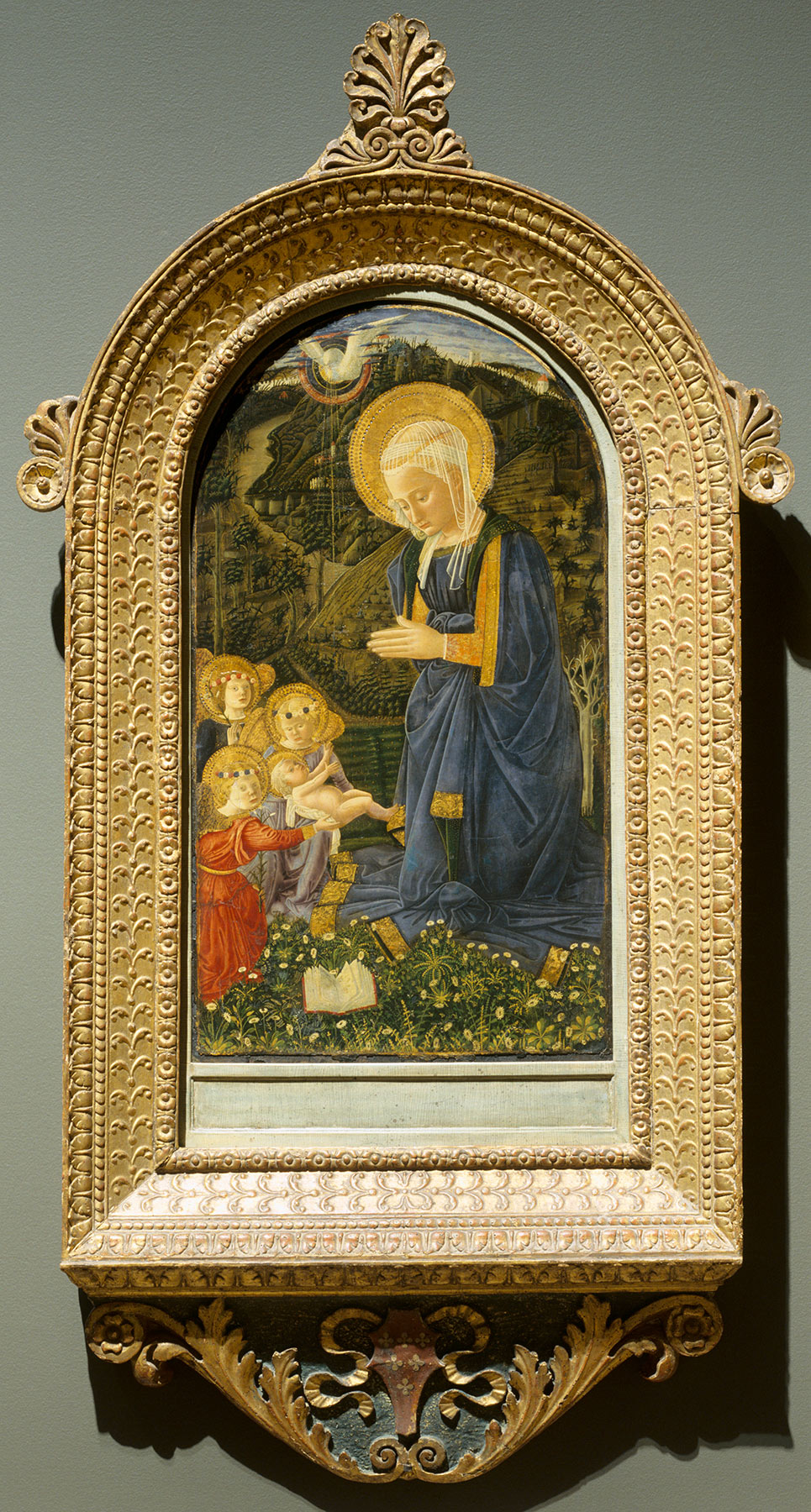
on frame, GLORIA IN EXCELSIS DEO ET IN TERRA PAX HOMINIBUS BONAE VOLUNTATIS
Edward Hutton (1875–1969), London; Maitland Fuller Griggs (1872–1943), New York, 1923
The panel support, of a vertical wood grain, is 2 centimeters thick, to which a cove molding, also 2 centimeters thick, and a capping strip, 1.2 centimeters thick, have been attached to form the frame. A base molding, also affixed to the backing board, measures 2 by 53 centimeters and is 5 centimeters deep. Beneath this, the antependium, measuring 11.6 by 50.4 centimeters, is fashioned from a separate piece of wood. A major split runs the full height of the backing board, 13 centimeters from the left edge, and is open on the front of the panel, though it has caused only minor flaking losses at the waist of the leftmost angel and in the blue background. The flesh tones throughout the painting are heavily abraded, while the gilding of the haloes is well preserved. A synthetic varnish applied during a cleaning of 1957–58 has left the surface with a dry, grayed appearance. The frame preserves its original surface, including the red-glaze reveal lettering in its cassetta, except that the top molding has been regilt to match the modern anthemion decorations applied to it.
In a letter dated April 27, 1923, Richard Offner recommended this painting to Maitland Griggs as a worthwhile acquisition on the order of the Virgin and Child Enthroned attributed at the time to the Master of the Castello Nativity that Griggs had recently purchased (see Zanobi di Migliore(?), Virgin and Child Enthroned with Two Angels). He referred to it—and again in a letter of May 31, 1923,1 acknowledging that Griggs had indeed bought the painting from its owner, Edward Hutton—as by the artist Bernard Berenson had identified as “Pier Francesco Fiorentino,” an identification that has not been questioned in any published sources since then, even though the names attached to Berenson’s group of works have varied.2 In keeping with the standard practice of this artist, now referred to either as the Pseudo-Pier Francesco Fiorentino or more inclusively as the Lippi-Pesellino Imitators, the composition is a cut-and-paste derivation of sources, in this case two works by Filippo Lippi. The Virgin is a replica, cropped to half-length and slightly reduced in scale, of the same figure in Lippi’s Adoration altarpiece painted for the private chapel in the Palazzo Medici in 1459 (now in Berlin),3 while the Christ Child and the three angels around Him are all copied from the center panel of the altarpiece Lippi painted for Alfonso of Aragon, king of Naples, in 1458. The original of that painting is lost. It was commissioned from Lippi by Giovanni de’ Medici as a gift for the king and is known to have been completed and delivered to Naples by May 1458. Its appearance is recorded in a sketch by Lippi included in a letter addressed to Giovanni de’ Medici in Florence in July 1457. The wings of the altarpiece, portraying Saints Michael and Anthony Abbot kneeling in landscapes, are preserved in the Cleveland Museum of Art, where a full-scale replica of the center panel by the Pseudo-Pier Francesco Fiorentino is also kept (fig. 1).4
At least seventeen versions of this composition by the Pseudo-Pier Francesco Fiorentino are known.5 In addition to the present panel, these include eight in public collections:
-
Harvard University Art Museums, Cambridge, Massachusetts;6
-
Museo Horne, Florence;7
-
Städel Museum, Frankfurt (fig. 2);
-
Musée des Beaux-Arts, Lille, France;8
-
Musée Grobet-Labadié, Marseille, France;9
-
Philadelphia Museum of Art, John G. Johnson Collection;10
-
Hermitage, Saint Petersburg;11
-
Kunsthaus, Zürich.12
Eight additional versions whose present whereabouts are unknown include paintings that appeared at auction at:
-
Semenzato, Florence, February 19, 2003, lot 208;13
-
Sotheby’s, London, March 28, 1979, lot 229;
-
Sotheby’s, Milan, November 20, 2007, lot 14;14
-
Christie’s, New York, June 4, 1986, lot 128;15
and paintings at one time in the Pacini collection in Florence; with Frascione in Florence; with Volterra in Florence; and with Ugo Jandolo in Rome.
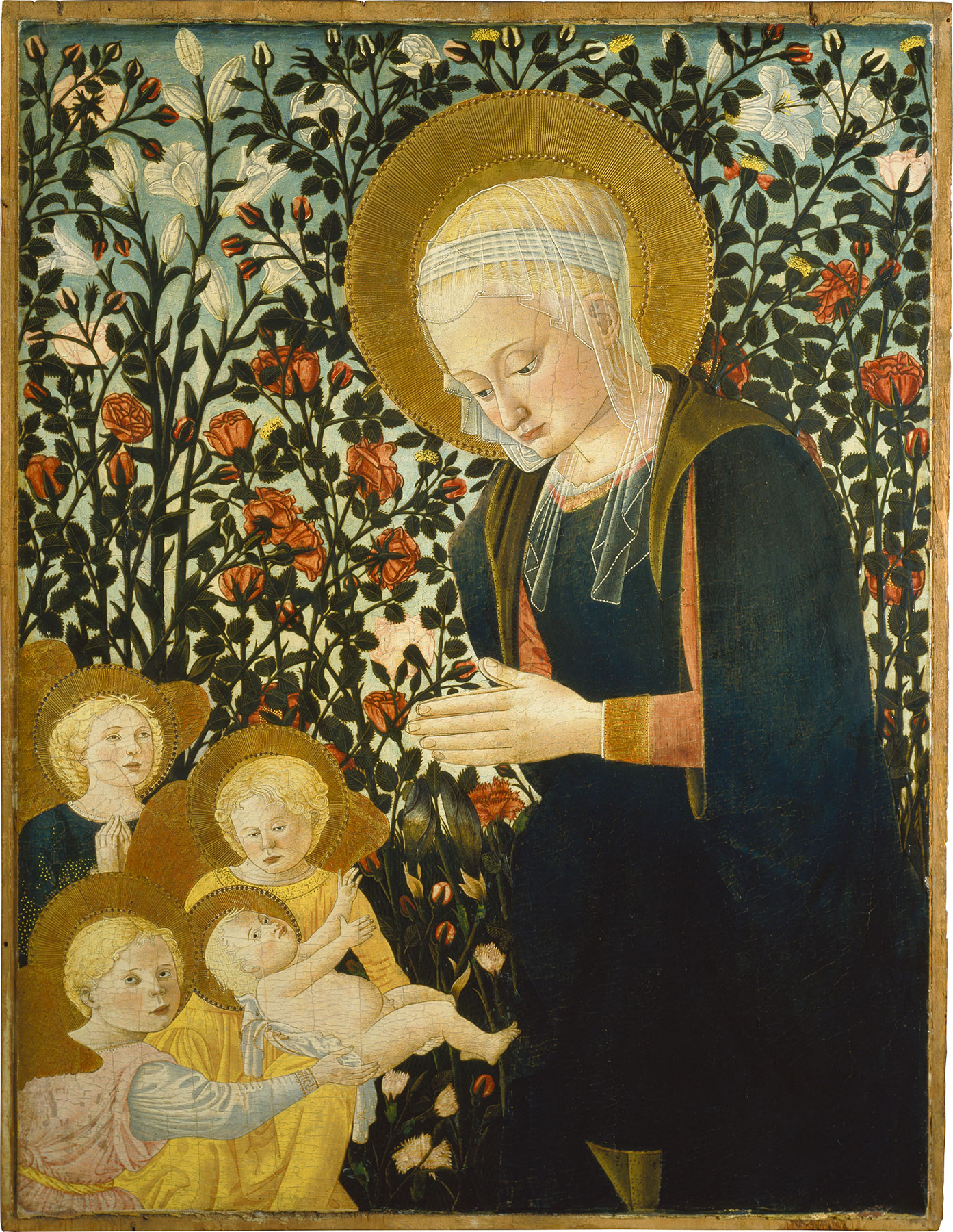
Most of these combine the Virgin from Lippi’s Medici/Berlin altarpiece with the Christ Child and angels from the lost Naples altarpiece, although some abbreviate the number of angels, and one, formerly with Ugo Jandolo in Rome, introduces an additional figure: the young Saint John the Baptist appearing in profile at the lower right of the scene. Most of these replicas are rectangular in format and of these, two (Museo Horne, Florence; and Städel Museum, Frankfurt) are more elaborate than the others in substituting a painted rose hedge for a solid blue or, in a few cases, gold background. Three—those appearing at Sotheby’s, London; Sotheby’s, Milan; and Christie’s, New York—follow the arched-top format of the Yale painting and, like it, include the Dove of the Holy Spirit within the arch. The second of these three, appearing at auction in Milan on November 20, 2007, is slightly smaller (80 × 49.5 cm overall) than the Yale version, suppressing the angel at the lower left, but includes the same inscription of the Gloria and Ave Maria in the lining frieze of its frame.
Like the other three paintings by the Pseudo-Pier Francesco Fiorentino at Yale (see Pseudo-Pier Francesco Fiorentino, Virgin and Child with Two Angels; Pseudo-Pier Francesco Fiorentino, Virgin and Child with Saint Catherine and Four Angels; and Pseudo-Pier Francesco Fiorentino, Virgin and Child with an Angel), the present work preserves its original frame. Unlike the others, it may be possible to identify the coat of arms painted in the antependium beneath it. Holmes suggested that the dexter side of the shield, showing a black eagle astride a green chalice on an argent ground, might be a reference to the Arte dei Vinattieri in Florence, the guild of wine merchants, at one time associated with the innkeepers’ guild and responsible for regulating gaming and drinking hours within the city. This is possible if the arms have been retouched or if some liberties were taken with the official arms of the guild, which are argent, a chalice gules, without an eagle. Similarly, the sinister side of the shield may indicate the Rati family of Florence if some liberties were permitted in rendering. The Rati arms are dexter, gules, three roses argent; and sinister, argent, three roses gules. These devices and colors appear at the right of the Yale shield but above and below each other rather than side by side. —LK
Published References
Exhibition of Italian Primitive Paintings, Selected from the Collection of Maitland F. Griggs. Exh. cat. New York: Century Association, 1930., no. 27; van Marle. Raimond. The Development of the Italian Schools of Painting. Vol. 13. The Hague: M. Nijhoff, 1931., 435; Berenson, Bernard. Italian Pictures of the Renaissance: A List of the Principal Artists and Their Works with an Index of Places. Oxford: Clarendon, 1932., 451; Berenson, Bernard. Italian Pictures of the Renaissance, A List of the Principal Artists and Their Works with an Index of Places: Florentine School. 2 vols. London: Phaidon, 1963., 1:173; Rossi, Filippo, ed. Il museo Horne a Firenze. Florence: Cassa di Risparmio, 1966., 141; Seymour, Charles, Jr. Early Italian Paintings in the Yale University Art Gallery. New Haven: Yale University Art Gallery, 1970., 168, 317, no. 121; Fredericksen, Burton B., and Federico Zeri. Census of Pre-Nineteenth-Century Italian Paintings in North American Public Collections. Cambridge, Mass.: Harvard University Press, 1972., 600; Laurence Kanter, in Kanter, Laurence, with Bruno Mottin and Rita Piccione Albertson. Leonardo: Discoveries from Verrocchio’s Studio, Early Paintings and New Attributions. Exh. cat. New Haven: Yale University Art Gallery, 2018.; von Gaertringen, Rudolf Hiller. Italienische Gemälde im Stadel, 1300–1550: Toskana und Umbrien. Mainz, Germany: Philipp von Zabern, 2004., 269; Holmes, Megan. “Copying Practices and Marketing Strategies in a Fifteenth-Century Florentine Painter’s Workshop.” In Artistic Exchange and Cultural Translation in the Italian Renaissance City, ed. Stephen Campbell and Stephen Milner, 38–74. Cambridge: Cambridge University Press, 2004. , 69n44, 70n54; Christopher Daly, in De Marchi, Andrea, and Davide Civettini, eds. Pseudo Pier Francesco Fiorentino: Cristo di dolori. Florence: Enrico Frascione antiquario, 2022. , 44
Notes
-
Both letters are in the curatorial files, Department of European Art, Yale University Art Gallery. ↩︎
-
For more on this artist, see Pseudo-Pier Francesco Fiorentino, Virgin and Child with Two Angels; and Pseudo-Pier Francesco Fiorentino, Virgin and Child with Saint Catherine and Four Angels. ↩︎
-
Gemäldegalerie, Staatliche Museen zu Berlin, inv. no. 69, https://id.smb.museum/object/864730/die-anbetung-im-walde. ↩︎
-
Inv. no. 1964.150, https://www.clevelandart.org/art/1964.150. For the historical details of the commission, see Ruda, Jeffrey. Fra Filippo Lippi: Life and Work with a Complete Catalogue. London: Phaidon, 1993., 194–99, 442–44. ↩︎
-
Megan Holmes cites ten versions known to her, but she does not list them; see Holmes, Megan. “Copying Practices and Marketing Strategies in a Fifteenth-Century Florentine Painter’s Workshop.” In Artistic Exchange and Cultural Translation in the Italian Renaissance City, ed. Stephen Campbell and Stephen Milner, 38–74. Cambridge: Cambridge University Press, 2004. , 40. ↩︎
-
Inv. no. 1943.109, https://hvrd.art/o/230290. ↩︎
-
Inv. no. 62. ↩︎
-
Inv. no. P797. ↩︎
-
Inv. no. 105. ↩︎
-
Inv. no. cat. 40, https://philamuseum.org/collection/object/102176. ↩︎
-
Inv. no. 4160, https://www.hermitagemuseum.org/digital-collection/29474. ↩︎
-
Inv. no. 1625. ↩︎
-
Previously Sotheby’s, New York, January 22, 1976, lot 113. ↩︎
-
Possibly identical with a painting formerly in the collection of Carl Hamilton, New York. ↩︎
-
Formerly collection of Raymond Hurd. ↩︎