Possibly Galerie Durand-Ruel, Paris; private collection, Russia, before 1931; Hannah D. and Louis M. Rabinowitz (1887–1957), Sands Point, Long Island, N.Y., by 1945
The panel comprises two separate fragments cut out of a larger composition, both of a horizontal wood grain and both thinned to a depth of 5 millimeters, inlaid into a larger walnut panel, and cradled. The upper fragment measures 33.8 by 24.5 centimeters, and the lower measures 2.6 by 34.0 centimeters. Although they have been abutted to each other in their present configuration, there is clearly some amount of pictorial material missing between them. The upper fragment exhibits three partial splits, 9.5, 23.5, and 32 centimeters from its top edge, that have provoked only small disturbances of the surface, except for losses below the hand at the right and below the arm at the left edge. A much larger split, approximately 29.5 centimeters from the top edge, has resulted in extensive paint loss along the full length of the panel. The skin tones have been heavily abraded, leaving little more than green underpaint and preparatory layers of brown shadow in evidence. Traces of the pattern of gold dots that once decorated the halo are clearly visible under ultraviolet light, as are some of the highlights on the crown of thorns, which is otherwise still largely intact.
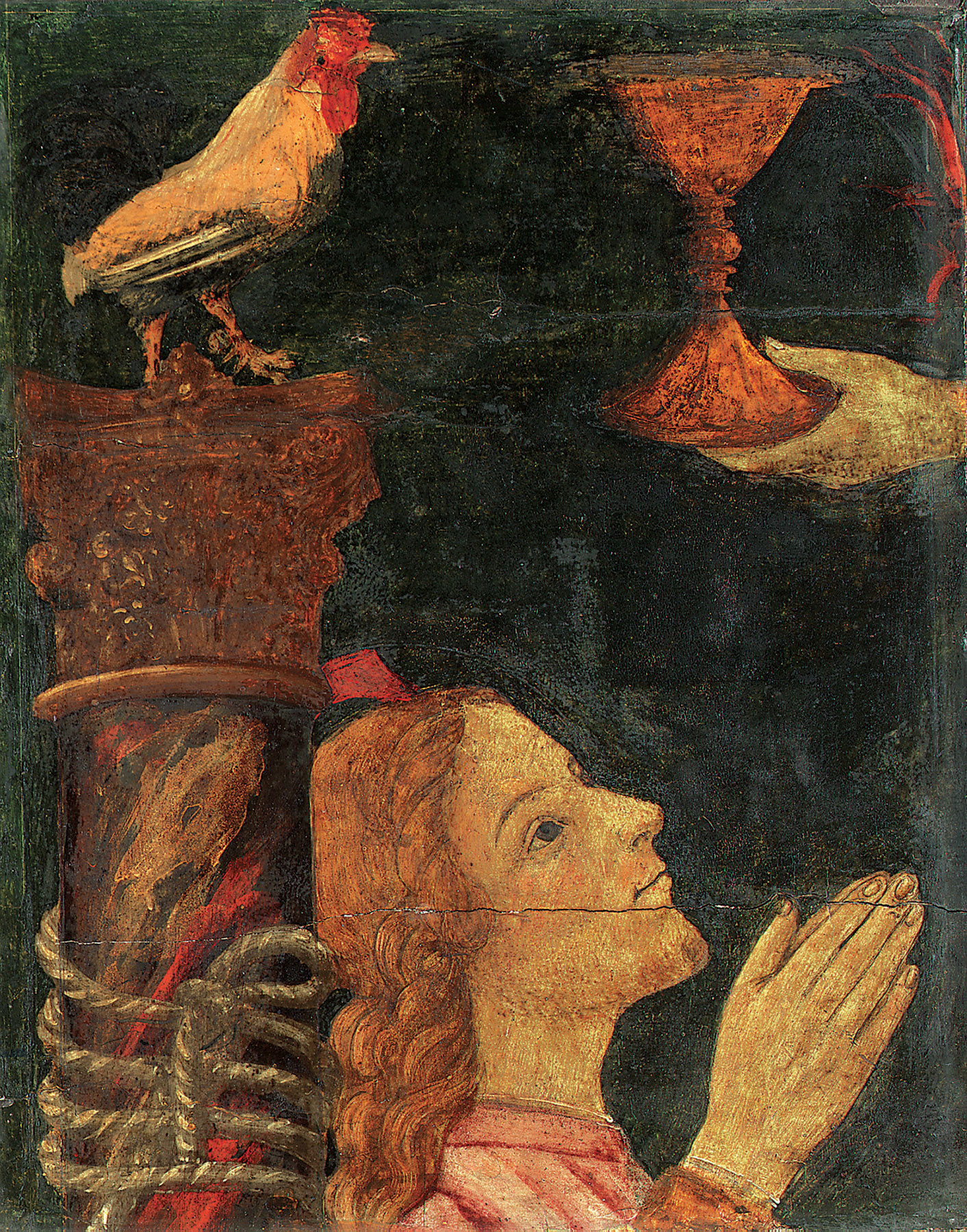
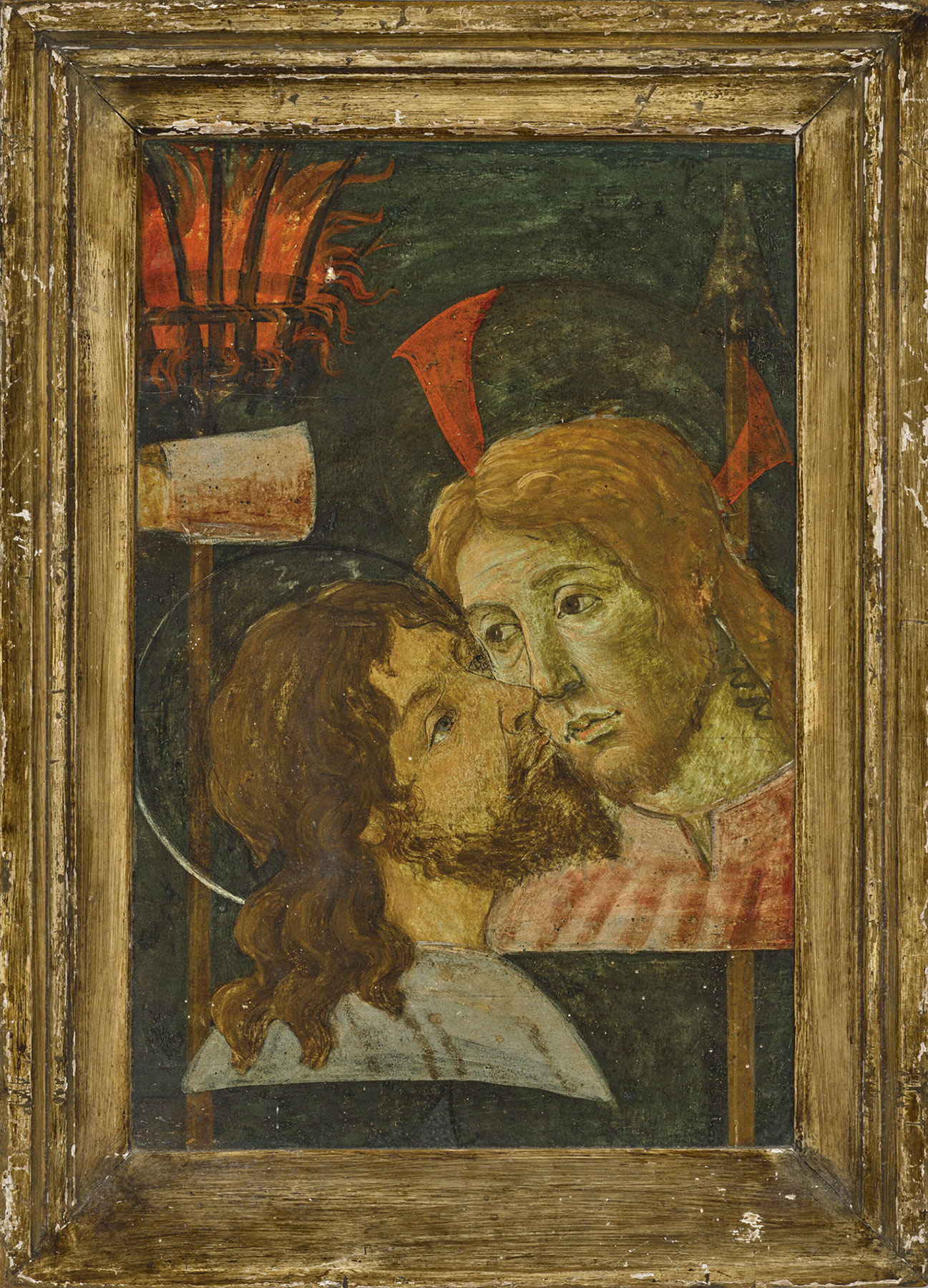
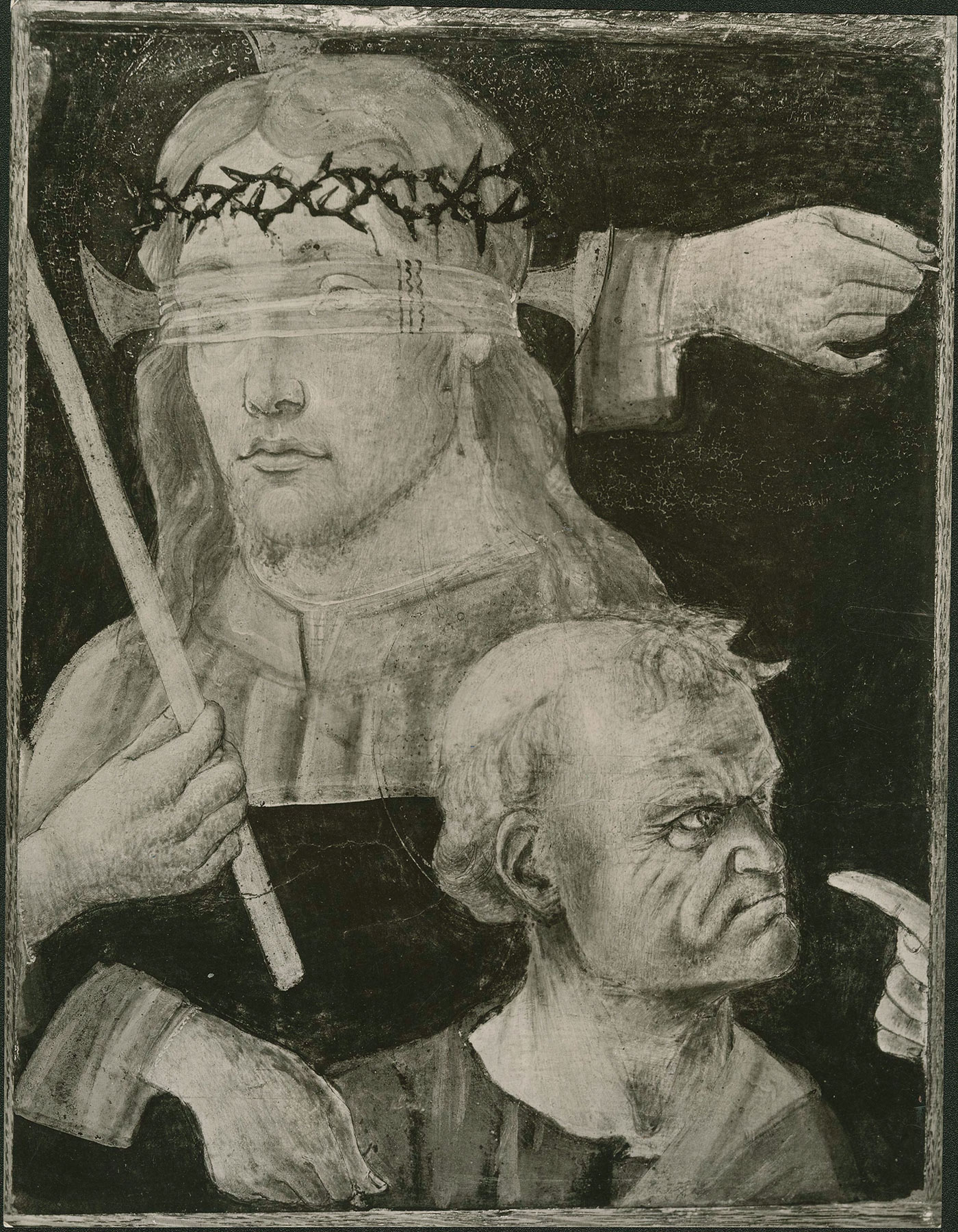
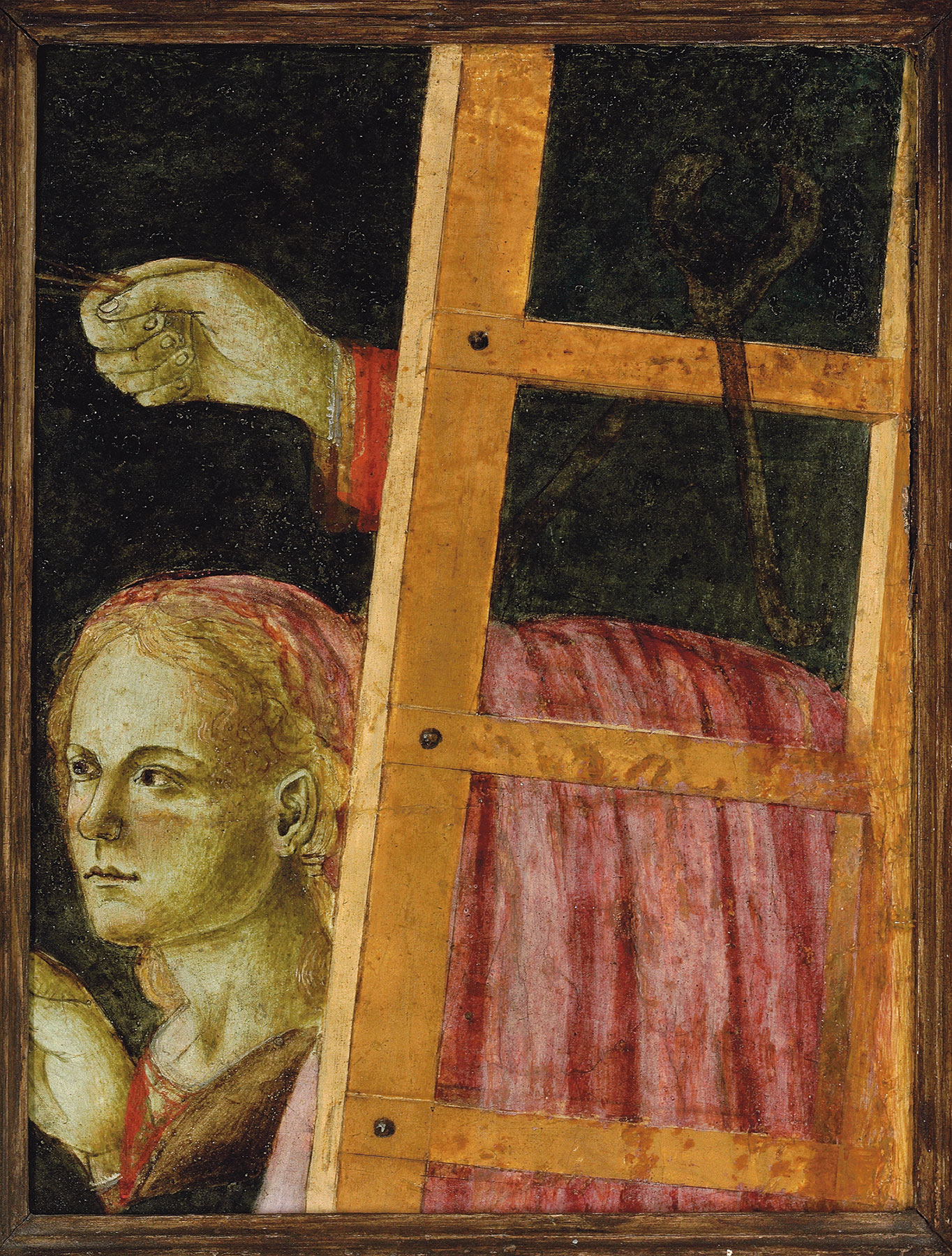
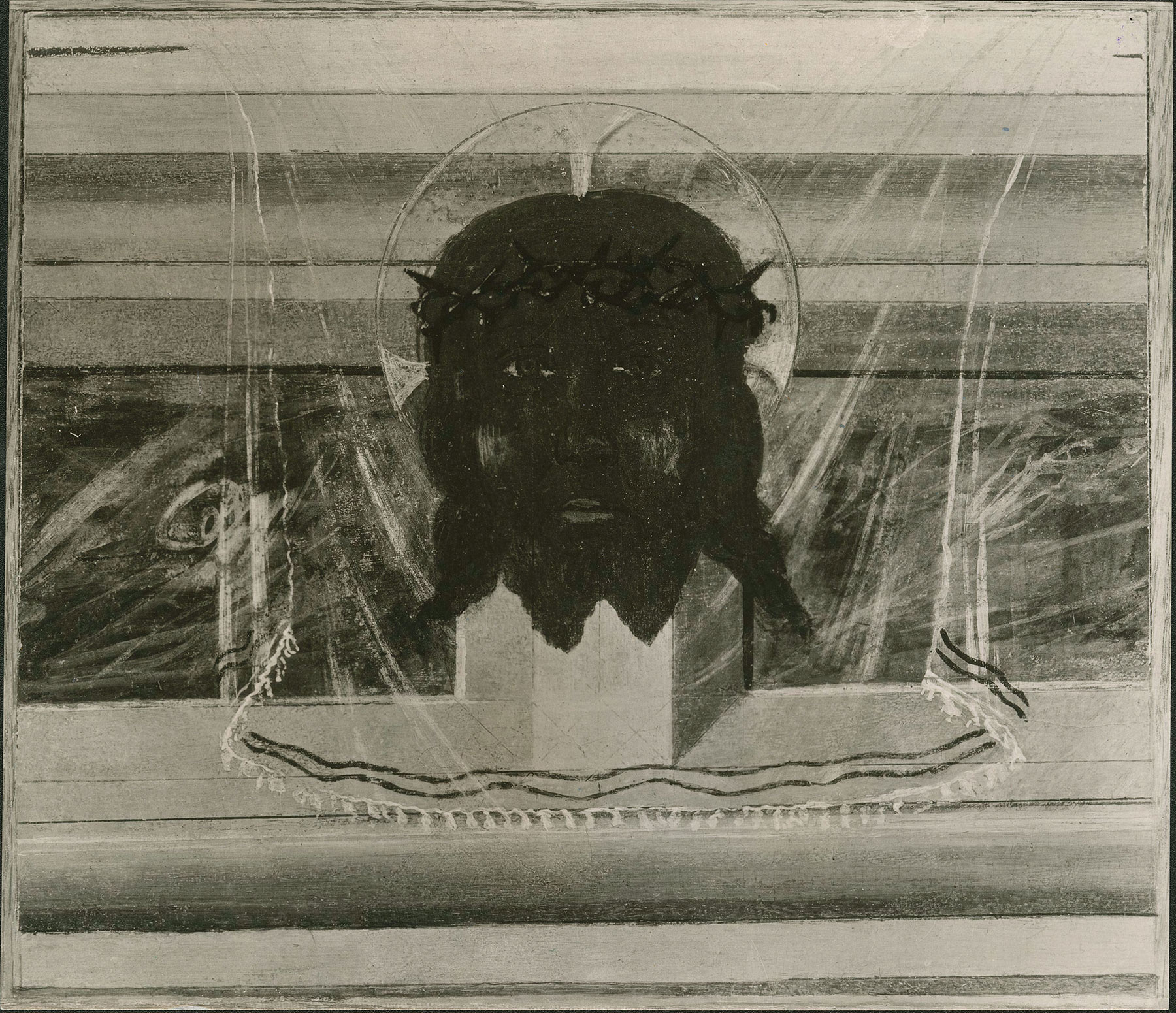
The painting is one of nine fragments of a large dossal showing the Man of Sorrows between the Virgin and Saint John the Evangelist with symbols of the Passion. The appearance of the original panel, measuring 111 by 139 centimeters, is recorded in an undated photograph gifted by Durand-Ruel Galleries, Paris and New York, to the Frick Collection, New York, in 1952 (fig. 1).1 The composition, descended from early fifteenth-century Florentine prototypes, conflates the traditional image of the imago pietatis with an elaborate rendering of the instruments of the Passion, the so-called arma Christi, to produce a complex aggregate of visual reminders of Christ’s sacrifice.2 The dead Christ is shown in a sitting position on the edge of His tomb, hands crossed over His lap and blood streaming from His wounds. Visible behind Him is the base of the Cross, stained with His blood. Seated on the ground in front of the sarcophagus are the Virgin and Saint John the Evangelist. The Virgin, enveloped in ample robes, rests her head on one knee, her eyes closed in an expression of grief, while the Evangelist addresses the viewer and, gesturing toward the Man of Sorrows, invites reflection on Christ’s suffering. Randomly scattered in the background and around the sarcophagus are the arma Christi, along with small vignettes referring to the different stages of the Passion. From left to right are the Column and Rope of the Flagellation; the rooster whose crowing marked the third denial of Saint Peter; Christ in the Garden of Gethsemene; the Kiss of Judas; the hand of Peter cutting off Malchius’s ear; the Mocking of Christ, who is shown blindfolded before the stick-wielding hands of His tormentors; the hands of the soldiers who drew straws for Christ’s clothes during the Crucifixion; Saint Peter Confronted by the Servant Girl of Caiaphas, who recognized him as Christ’s disciple (the first denial); the hands that paid Judas to betray Christ; Pilate Washing His Hands; and the ladder used at the Crucifixion with the mantle of Christ. In the foreground, resting on the ledge of the sarcophagus, are the Holy Nails with which Christ was crucified. Hanging off the front of the tomb is a transparent cloth with the imprint of Christ’s face, the so-called Veronica.
_2000.jpg)
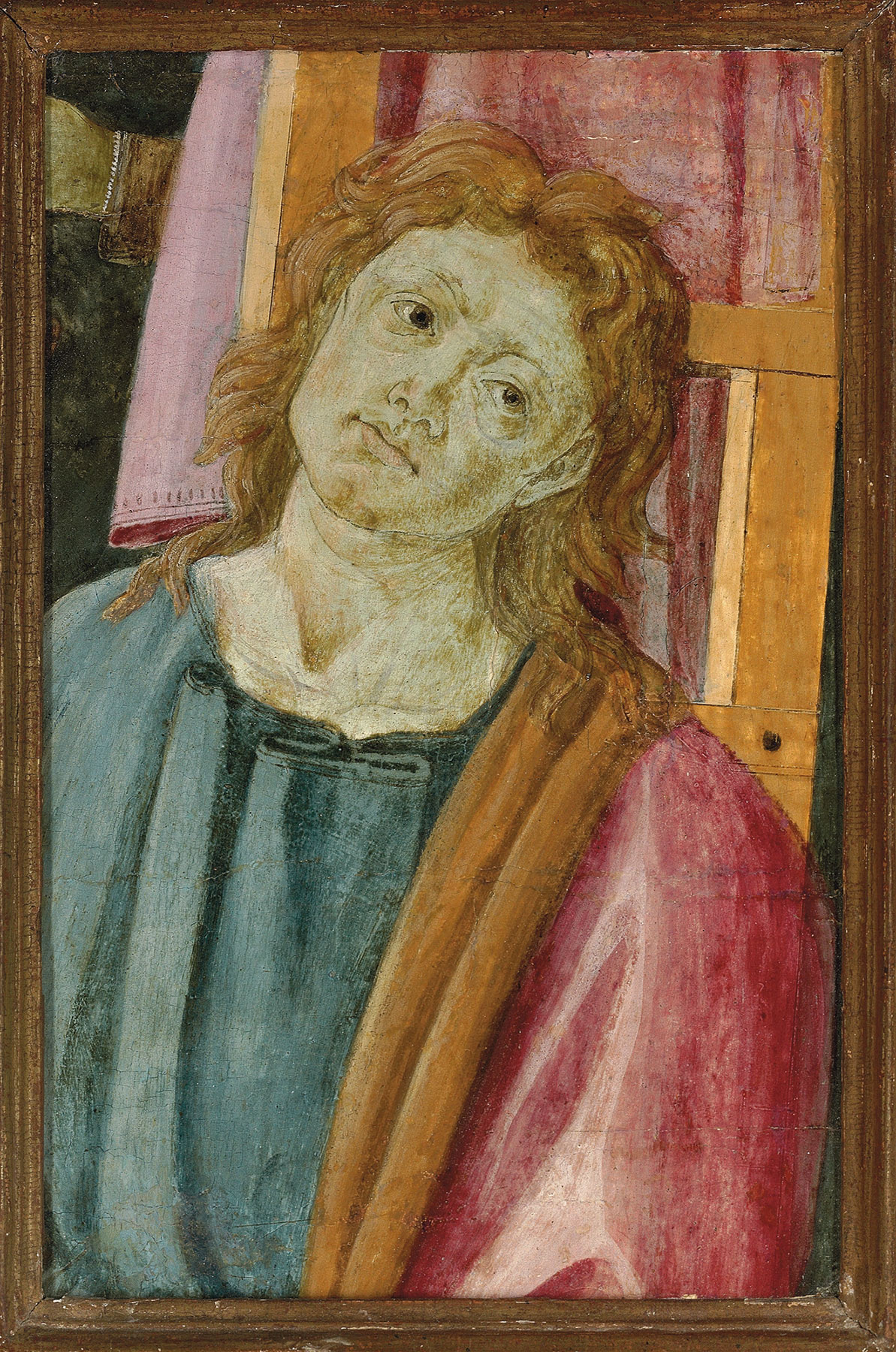
It is not clear if Galerie Durand-Ruel in Paris owned the dossal before it was dismembered. By the time the work first emerged on the art market, in the early 1930s, it had already been broken up into nine fragments, said to have been smuggled out of Russia in 1917. In 1931 Thomas Agnew and Sons, London, purchased five fragments from the English art critic and historian Paul George Konody (1872–1933): The Column of the Flagellation with Christ in the Garden of Gethsemane; The Kiss of Judas; The Mocking of Christ and Saint Peter; The Servant Girl of Caiaphas; and The Veronica (figs. 2–6). A sixth fragment with Saint John the Evangelist and the bottom half of the ladder (fig. 7) was consigned by Konody to Agnew’s in 1933.3 By 1944, when Lionello Venturi first published them, the six ex-Konody panels were divided between the Alphonse Kahn collection, Saint-Germain-en-Laye, France; the Baron Hatvany collection, Budapest; and Agnew’s.4 Venturi added to the group the Yale Man of Sorrows, then in New York, and an eighth fragment with the Mourning Virgin, in an unspecified location, and proposed a reconstruction of the original altarpiece that was embraced by all subsequent scholarship—apparently unaware of the existence of the Durand-Ruel connection and photograph of the original painting. Venturi’s rendering of the composition, however, misrepresented the pose of the Man of Sorrows by showing him emerging from the tomb with His arms displayed to reveal His wounds and omitted a ninth fragment showing the detail of Pilate Washing His Hands.5 Since the appearance of Venturi’s article, seven fragments have been variously recorded on the English art market and in private hands. The Veronica and Christ in the Garden of Gethsemene last appeared at Christie’s, London, in 1981 and 2000, respectively.6 Saint John the Evangelist, the Servant Girl of Caiaphas, and the Kiss of Judas, more recently on the art market,7 are currently divided among private collections in London. The Mourning Virgin and the Mocking of Christ and Saint Peter were reportedly in a London private collection in 1998,8 but their present location has not been confirmed.
Following the dismissal of Venturi’s overly ambitious attribution to Andrea del Castagno, modern assessments of the Yale Man of Sorrows and its related fragments have been marked by a large degree of uncertainty, reflected in the numerous changes of attribution. The Yale panel was initially categorized by Charles Seymour, Jr.,9 and Federico Zeri10 as a product of the Florentine school in the third to last quarter of the fifteenth century, although Zeri seems to have later revised his opinion in favor of “Manner of Francesco Botticini.”11 Listed under the Master of San Miniato by Bernard Berenson in 1963,12 the fragments were assigned to a follower of Jacopo del Sellaio in the 1980 London sale of the ex-Hatvany pieces.13 In 1988 Giggetta Dalli Regoli and Gemma Landolfi inserted the dismembered dossal in their reconstruction of the personality of the Master of the Johnson Nativity, suggesting a date in the last period of the artist’s activity, influenced by Domenico Ghirlandaio’s production in the late 1480s.14 The attribution was embraced by most authors, including Carl Strehlke who catalogued the Yale Man of Sorrows as a work of Domenico di Zanobi—based on Annamaria Bernacchioni’s identification of this painter with the Master of the Johnson Nativity.15 In 2003 Everett Fahy, who had initially concurred with the attribution to the Master of the Johnson Nativity, included the Yale fragment and its companions in his list of works by the Master of the Fiesole Epiphany.16 The panels were omitted from the Master’s corpus by Christopher Daly, however, in his recent revision to the outlines of the artist’s personality.17
None of the attributions proposed thus far account for the more nuanced technique of the dismembered dossal, discernible in fragments like the Yale Man of Sorrows and the Saint John the Evangelist, which depart from the more schematic rendering of the works usually cited for comparison. Equally unrelated to them is the interest in dramatic content reflected in the furrowed brow and painted tear falling down the left cheek of the anguished Virgin and in the fierce expression of Saint Peter, whose unusual characterization as a balding, beardless old man has elicited comparisons with the studies of Leonardo.18 These concerns reflect a vision far removed from the serial production of artists such as the Master of the Johnson Nativity or the Master of the Fiesole Epiphany.
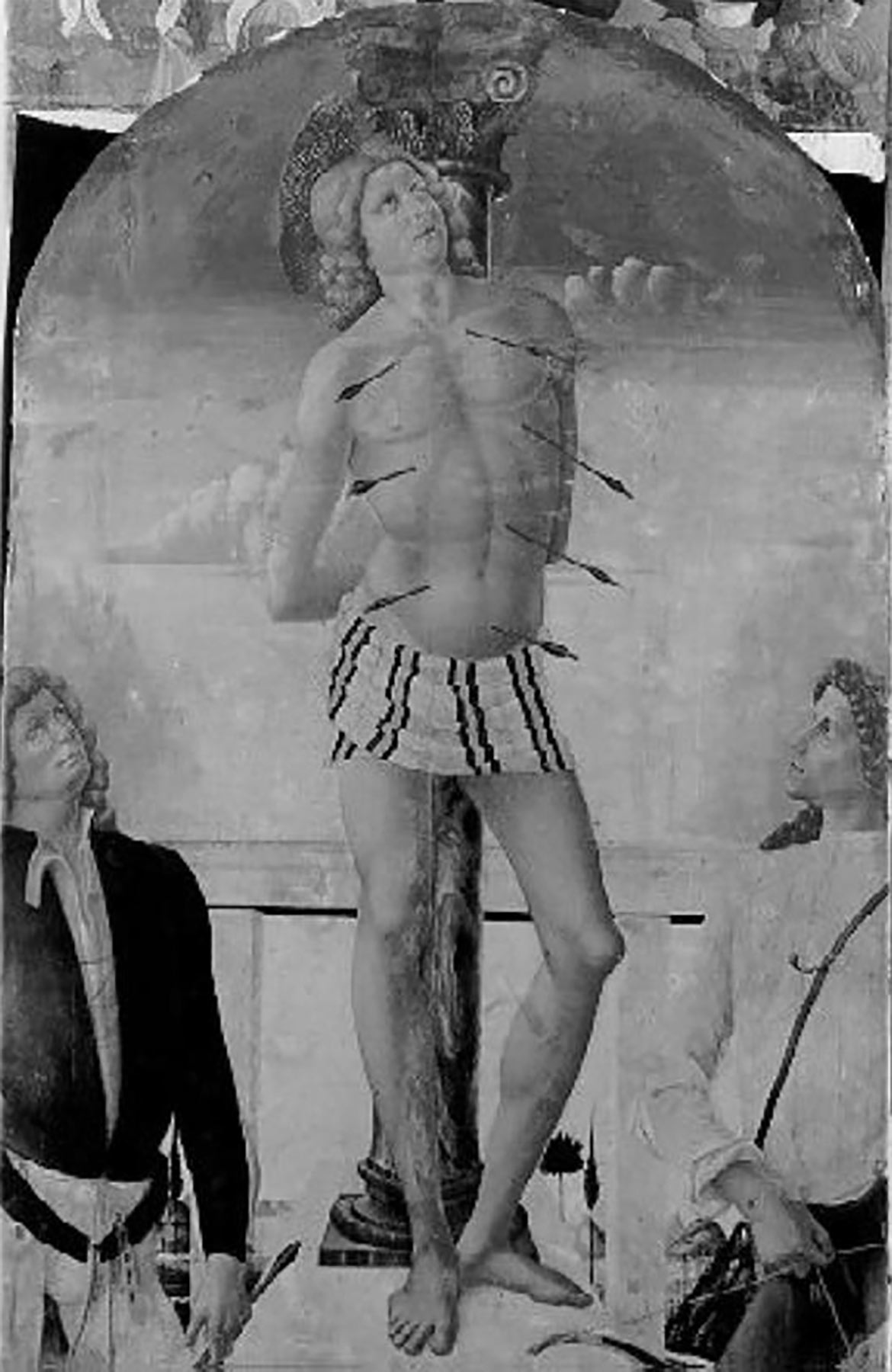
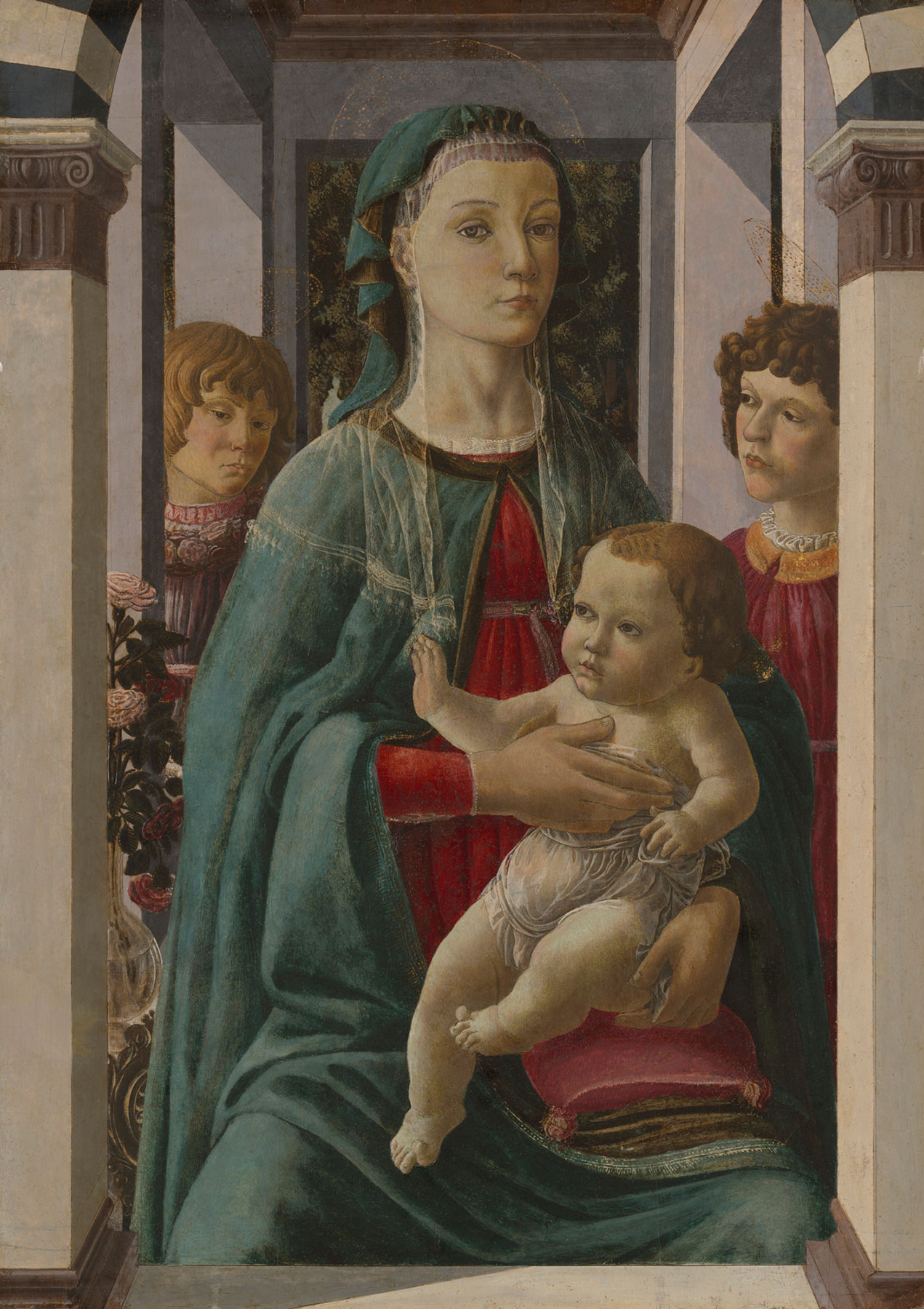
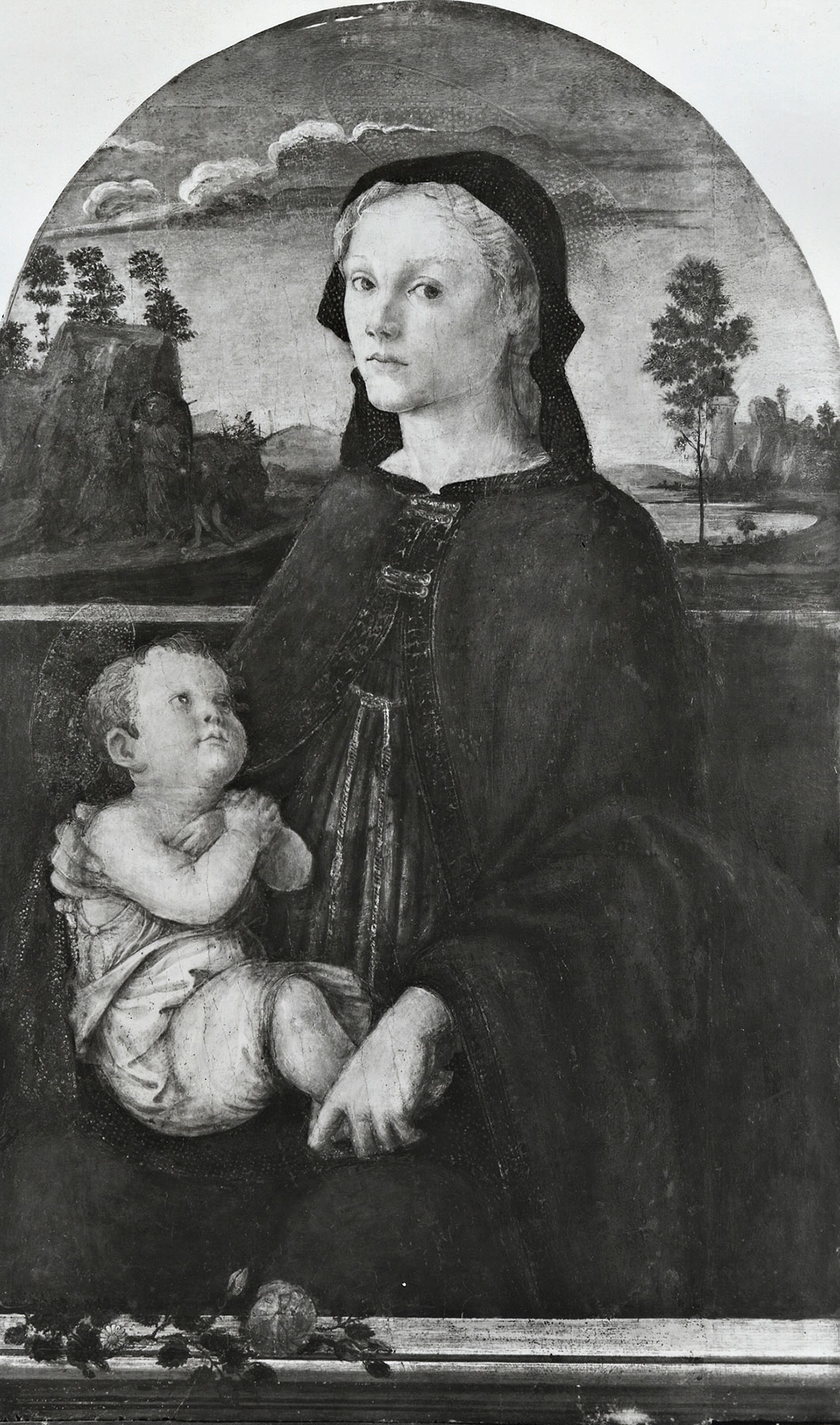
More compelling comparisons for the dossal fragments are to be found in a small nucleus of paintings characterized by a similar eccentric quality that were gathered by Zeri under the epithet “Painter of the Pisa Saint Sebastian,” after a Martyrdom of Saint Sebastian in the Museo Nazionale di San Matteo, Pisa (fig. 8).19 Included among these works are a Virgin and Child with Angels in the Art Institute of Chicago and a Virgin and Child formerly in Elwes collection, London (figs. 9–10). Identical to the fragments in style and technique, both images were clearly painted by the same hand responsible for the dismembered dossal, with which they share the same physiognomic types, defined by a caricatural handling of individual strands of hair and folds of skin and a pronounced chiaroscuro for the flesh tones. Allowing for the compromised state of the fragments, it is possible to draw a direct comparison between the young servant of Caiphas and the three-quarter profile of the ex-Elwes Virgin, and between the different busts of Christ in the dossal and those of the two Chicago angels. Like the dossal, the Chicago Virgin and Child combines a formulaic approach to the figures and architectural components with an emphasis on realistically conceived details, such as the shimmering, translucent cloth of the Virgin’s veil and the clear-glass flower vase half-filled with water. These elements find an echo in the similar handling of the veil in the Veronica fragment and in the vivid representation of the cascading water being poured from a metal pitcher and splashing into a gleaming metal plate in the Pilate Washing His Hands segment. While the artist’s formal vocabulary appears essentially rooted in the example of Botticelli, albeit interpreted in a more provincial vein, such details, along with the idiosyncratic portrayal of Saint Peter, leave room for speculation about possible derivations from Northern examples. The provenance of the artist’s name-piece, the Pisa Saint Sebastian, painted for the local monastery of San Domenico, may offer a clue to the painter’s identity. —PP
Published References
Venturi, Lionello. “Reconstruction of a Painting by Andrea del Castagno.” Art Quarterly 7 (Winter 1944): 23–33., 23; Venturi, Lionello. The Rabinowitz Collection. New York: Twin Editions, 1945., 21–25; Seymour, Charles, Jr. The Rabinowitz Collection of European Paintings. New Haven: Yale University Art Gallery, 1961., 54; Berenson, Bernard. Italian Pictures of the Renaissance, A List of the Principal Artists and Their Works with an Index of Places: Florentine School. 2 vols. London: Phaidon, 1963., 1:146; Seymour, Charles, Jr. Early Italian Paintings in the Yale University Art Gallery. New Haven: Yale University Art Gallery, 1970., 132, 314, no. 90; Fredericksen, Burton B., and Federico Zeri. Census of Pre-Nineteenth-Century Italian Paintings in North American Public Collections. Cambridge, Mass.: Harvard University Press, 1972., 601; Landolfi, Gemma. “Il Maestro della Natività Johnson.” In Il “Maestro di San Miniato”: Lo stato degli studi, i problemi, le risposte della filologia, ed. Federico Zeri and Gigetta Dalli Regoli, 242–327. Pisa: Giardini, 1988. , 303, 323–24, no. 33; Fahy, Everett. “The Este Predella Panels and Other Works by the Master of the Fiesole Epiphany.” Nuovi studi 6–7, no. 9 (2001–2): 17–29., 24
Notes
-
The panel’s dimensions are recorded on the back of the photograph. Frick Art Reference Library, New York, inv. no. 704G. ↩︎
-
For the evolution of this imagery in the fifteenth century, see the comprehensive study by Joachim Jacoby; Jacoby, Joachim. “The Image of Pity in the Later Middle Ages: Images, Prayers and Prayer Instructions.” Studi medievali, ser. 3a, 46, no. 2 (2005): 569–605., 569–605. For the concept of the Arma Christi (with a focus on manuscript illustrations and woodcuts), see also, most recently, Wagner, Daniela. “Aesthetics of Enumeration: The Arma Christi in Medieval Visual Art.” In Forms of List-Making: Epistemic, Literary, and Visual Enumeration, ed. Roman Alexander Barton, Julia Böckling, Sarah Link, and Anne Rüggemeier, 249–74. Cham, Switzerland: Springer International, 2022. https://doi.org/10.1007/978-3-030-76970-3., 249–74. ↩︎
-
Alexis Ashot, email to the author, April 6, 2026. ↩︎
-
Venturi, Lionello. “Reconstruction of a Painting by Andrea del Castagno.” Art Quarterly 7 (Winter 1944): 23–33., 23. ↩︎
-
According to Everett Fahy, this fragment was in the Kahn collection in 1941, along with the Kiss of Judas; Fahy, Everett. “The Este Predella Panels and Other Works by the Master of the Fiesole Epiphany.” Nuovi studi 6–7, no. 9 (2001–2): 17–29., 25. The panel is not mentioned in Agnew’s records, however, which report Kahn’s purchase of the Kiss of Judas on September 25, 1941, and the Mocking of Christ with the Head of Saint Peter on March 24, 1942. These sales records provided by Ashot, email to the author, April 6, 2026. ↩︎
-
Sale, Christie’s, London, July 17, 1981, lot 13c; and sale, Christie’s, London, July 7, 2000, lot 188. ↩︎
-
Sale, Christie’s, London, July 9, 2008, lot 251 (Saint John the Evangelist; The Servant Girl of Caiaphas); and sale, Christie’s, London, 9 July 2021, lot 177 (The Kiss of Judas). ↩︎
-
According to Fahy, Everett. “The Este Predella Panels and Other Works by the Master of the Fiesole Epiphany.” Nuovi studi 6–7, no. 9 (2001–2): 17–29., 23. ↩︎
-
Seymour, Charles, Jr. The Rabinowitz Collection of European Paintings. New Haven: Yale University Art Gallery, 1961., 54; and Seymour, Charles, Jr. Early Italian Paintings in the Yale University Art Gallery. New Haven: Yale University Art Gallery, 1970., 132, 314, no. 90. ↩︎
-
Fredericksen, Burton B., and Federico Zeri. Census of Pre-Nineteenth-Century Italian Paintings in North American Public Collections. Cambridge, Mass.: Harvard University Press, 1972., 601. ↩︎
-
Zeri Fototeca, Federico Zeri Foundation, Bologna, inv. nos. 104235–37. ↩︎
-
Berenson, Bernard. Italian Pictures of the Renaissance, A List of the Principal Artists and Their Works with an Index of Places: Florentine School. 2 vols. London: Phaidon, 1963., 1:146. ↩︎
-
Sale, Christie’s, London, July 11, 1980, lot 24. ↩︎
-
Landolfi, Gemma. “Il Maestro della Natività Johnson.” In Il “Maestro di San Miniato”: Lo stato degli studi, i problemi, le risposte della filologia, ed. Federico Zeri and Gigetta Dalli Regoli, 242–327. Pisa: Giardini, 1988. , 303, 324, citing the opinion of Giggetta Dalli Regoli. ↩︎
-
Strehlke, unpublished checklist of Italian paintings at Yale, 1998–2000, curatorial files, Department of European Art, Yale University Art Gallery; and Bernacchioni, Annamaria. “Committenti sanminiatesi nell’attività di Domenico di Michelino: I Borromei e i Chiellini.” Bollettino dell’Accademia degli Euteleti della città di San Miniato 57 (1990): 95–118., 109n43. ↩︎
-
Fahy, Everett. “The Este Predella Panels and Other Works by the Master of the Fiesole Epiphany.” Nuovi studi 6–7, no. 9 (2001–2): 17–29., 24. ↩︎
-
Daly, Christopher. “Thinking through a Tondo by the Master of the Fiesole Epiphany.” Journal of the Walters Art Museum 77 (2024), https://journal.thewalters.org/volume/77/essay/tondo.. See also Master of the Fiesole Ephiphany, The Penance of Saint Jerome with the Stigmatization of Saint Francis for a full discussion of the artist. ↩︎
-
Venturi, Lionello. “Reconstruction of a Painting by Andrea del Castagno.” Art Quarterly 7 (Winter 1944): 23–33., 24–25; and Venturi, Lionello. The Rabinowitz Collection. New York: Twin Editions, 1945., 22. ↩︎
-
Zeri Fototeca, Federico Zeri Foundation, Bologna. ↩︎