James Jackson Jarves (1818–1888), Florence, by 1859
The panel support, a single plank with a vertical grain, has been waxed and cradled. It has been trimmed on all four sides but apparently not thinned: its current depth of 2 centimeters seems to be original. Removal of an engaged frame has left a barb along all four edges of the picture field, with scattered remnants of red paint that must once have continued onto the missing moldings. The paint surface, though thinly applied, is overall in excellent condition, other than modest abrasion in the flesh tones. A partial split, approximately 15 centimeters from the right edge of the panel, extends from the top edge to a large inpainted loss in the sky above Saint Jerome’s right hand, possibly caused by a knot in the wood of the support. Smaller splits across the lower half of the composition and several long scratches have been lightly retouched. The painting was cleaned by Andrew Petryn in 1955–57 and restored by Patricia Garland in 1997.
Conceived as an object of private devotion, this image conforms to the traditional iconography of Saint Jerome in penitence that originated in Tuscany around 1400, coinciding with the spread of Hieronymite congregations.1 Focused on the eremitical, self-mortifying experience of the saint rather than on his role as Doctor of the Church, these paintings show the scantily dressed Saint Jerome alone in the wilderness, kneeling before a cave and beating his breast with a stone as he looks up in exaltation toward Heaven or the Crucified Christ. As in the present instance, he is often accompanied by his attributes of the lion and a red cardinal’s hat. In the Yale picture, a wiry, emaciated-looking Saint Jerome kneels before a crucifix, wearing only an ample white cloth draped in complicated folds over the lower half of his body. In his right hand is the stone used to self-inflict the bleeding wounds visible on his chest. On the ground next to the saint is his cardinal’s hat. A lion crouches behind him, in front of the cavernous entrance to his dwelling beneath a large rocky outcrop. Gradually receding into the distance is a mountainous landscape, with a river flanked by wooded banks running through green plains. A crystalline spring issues from a promontory on the left, feeding a small pool not far from the saint’s abode.
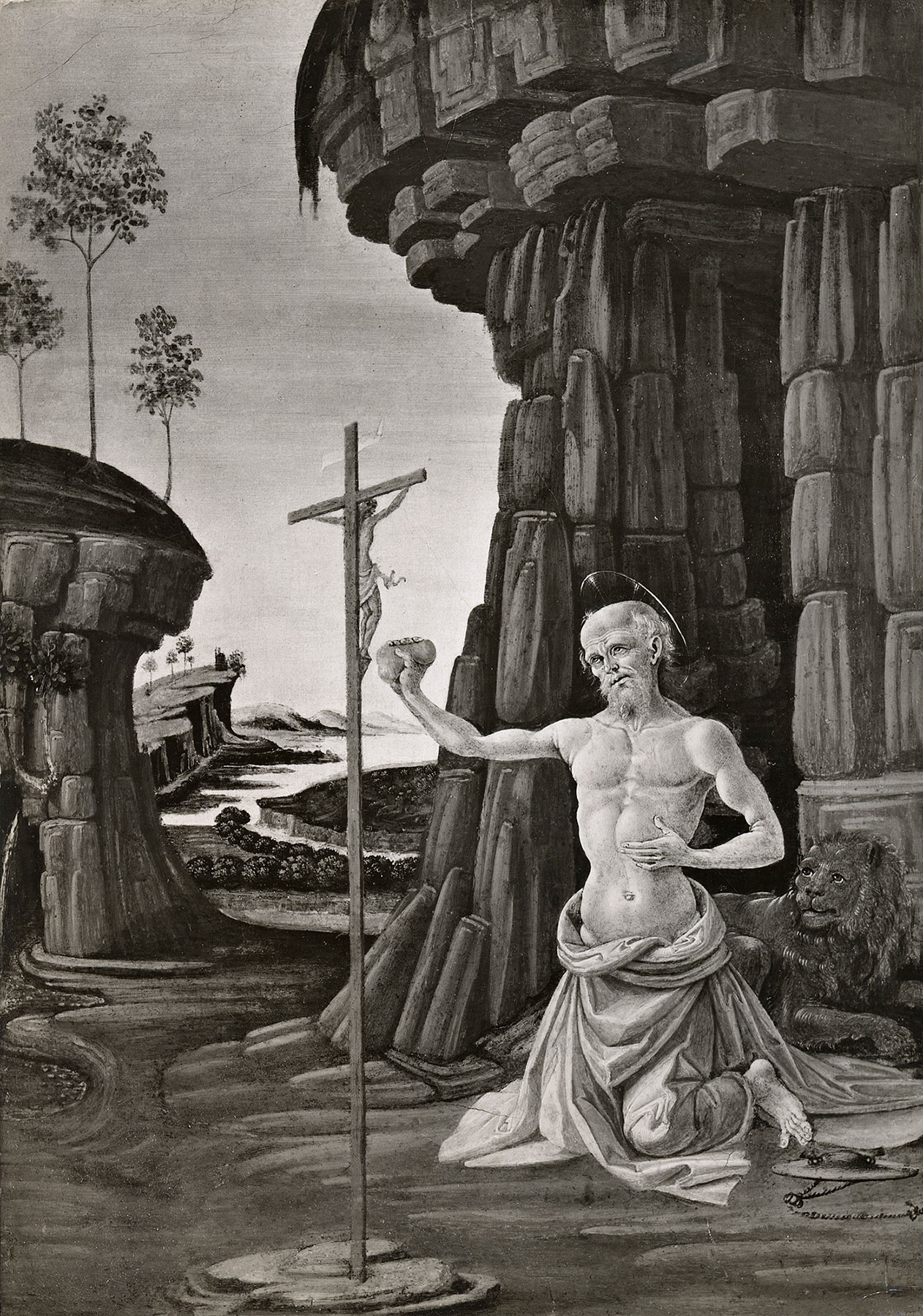
The Yale Penitent Saint Jerome is one of three nearly identical versions of this composition, clearly based on the same cartoon, that have been traditionally attributed to Perugino’s elder contemporary Fiorenzo di Lorenzo. A panel in the Accademia Carrara, Bergamo (fig. 1), already assigned to Fiorenzo in 1892, is slightly smaller than the Yale picture and has a different landscape background, but it conforms to it in every other aspect, including the identically painted folds of the saint’s draperies.2 Another reduced version, formerly in the collection of Sir Ronal Storrs, London, appeared on the art market in the 1950s, with Richard Offner’s attribution to Fiorenzo, and was subsequently listed as in a private collection in New York (fig. 2).3 This work is an almost exact replica of the Yale composition, the only distinction being minor variations in the details of the vegetation, like the smaller number of trees above the promontory on the left.
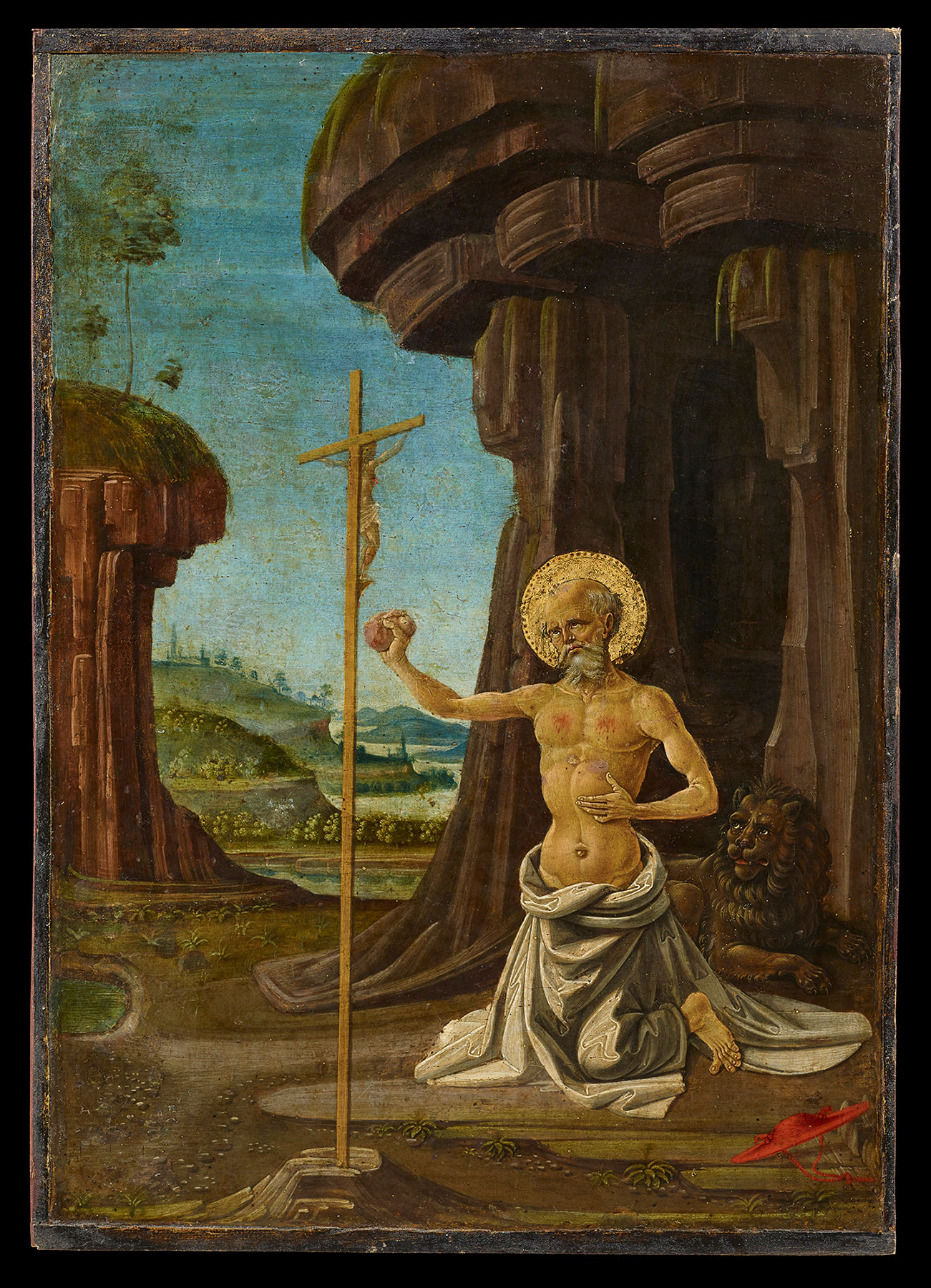
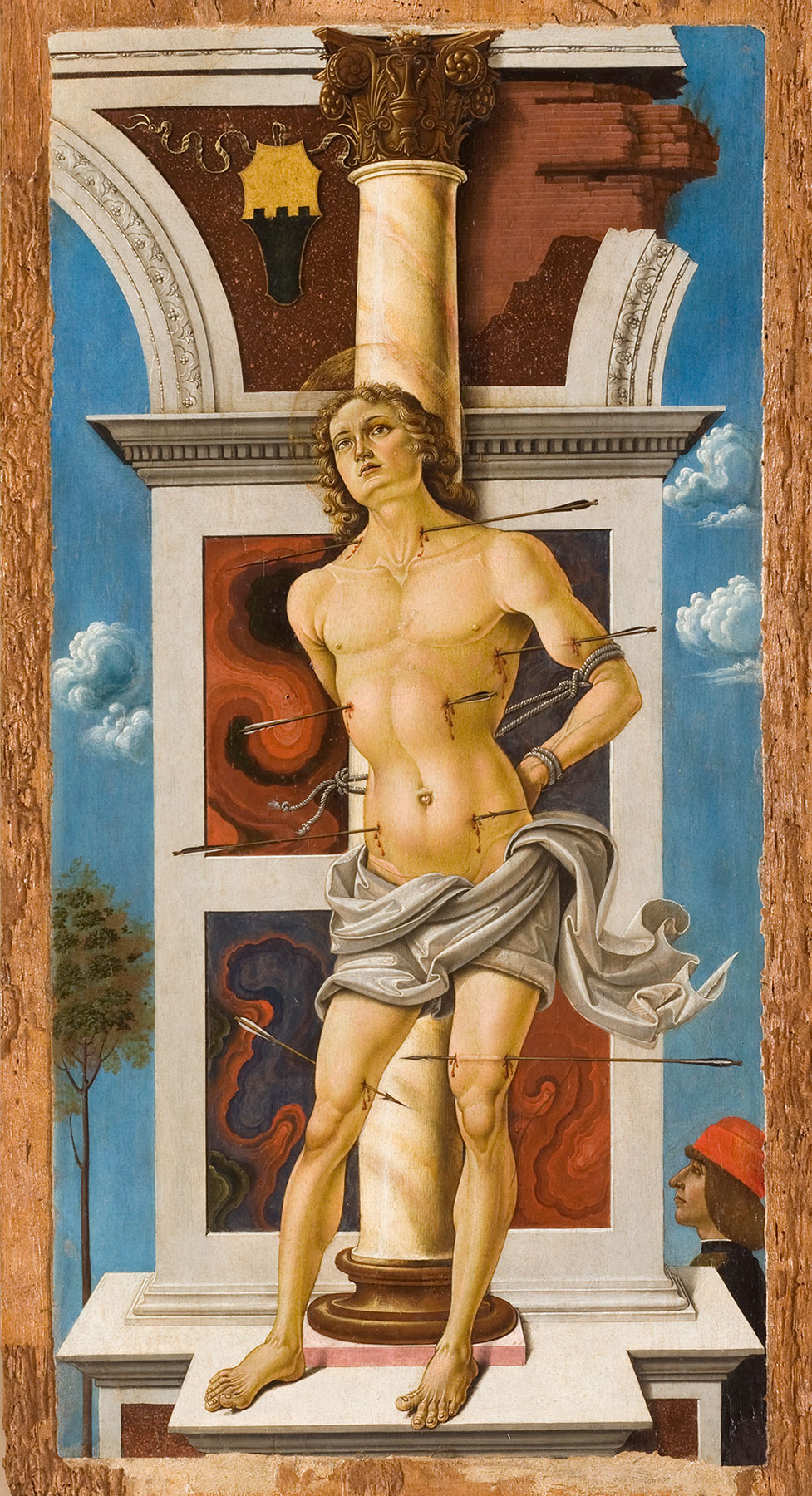
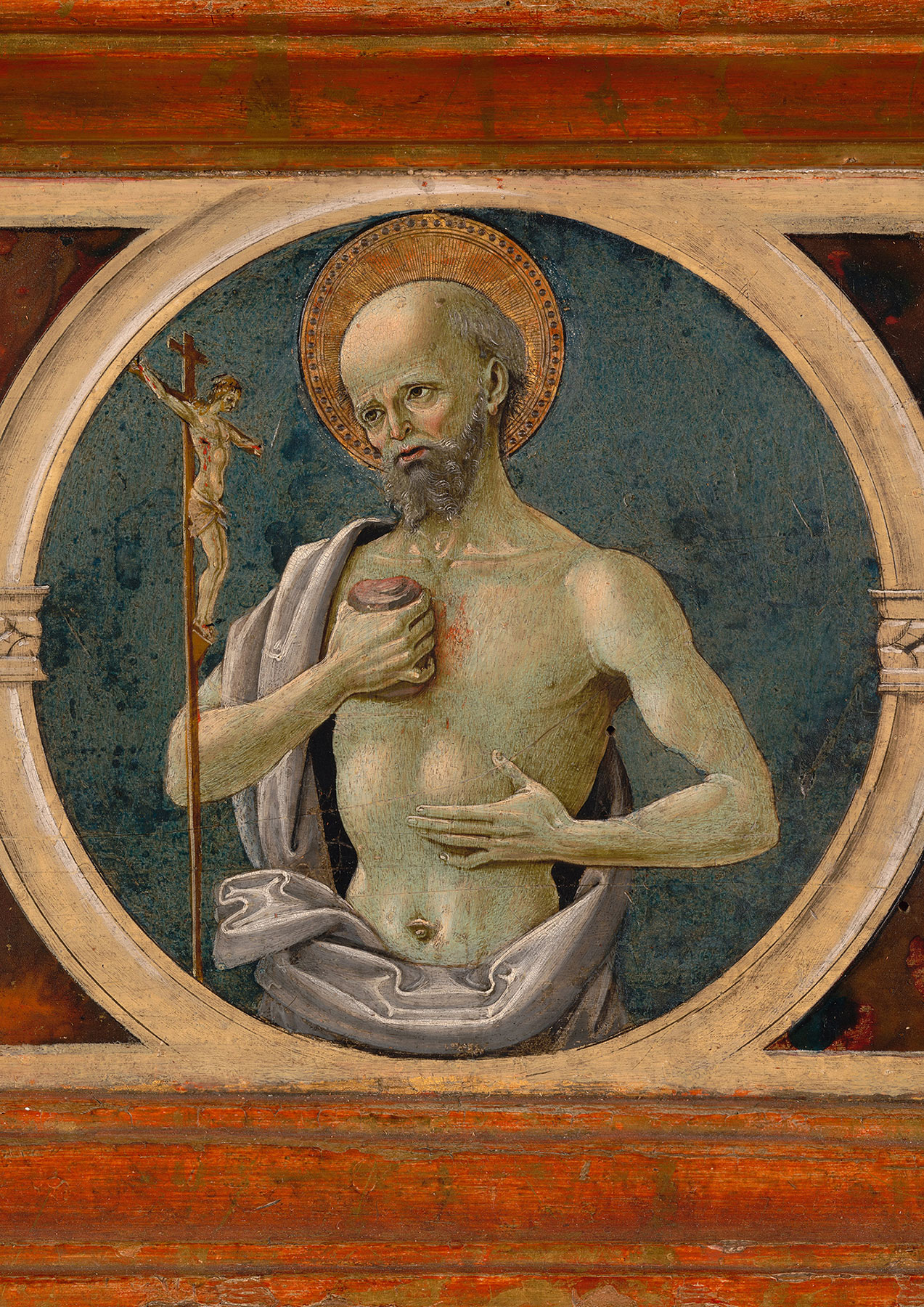
The Yale panel, catalogued by James Jackson Jarves as a work of Filippo Lippi,4 was first assigned to Fiorenzo di Lorenzo by William Rankin,5 who counted it among the artist’s best works and noted its exact correspondences in “norms” and technique with the Saint Sebastian by the artist in the Galleria Nazionale dell’Umbria, Perugia (fig. 3). The attribution was accepted by Jean Graham,6 who drew comparisons to the image of Saint Jerome in the predella of the Adoration of the Shepherds from the church of Santa Maria di Monteluce, Perugia, now also in the Galleria Nazionale dell’Umbria (fig. 4)—a work that, along with the so-called Trittico della Giustizia, again in the same museum,7 was then considered a touchstone for Fiorenzo’s early career. Osvald Sirén8 and Bernard Berenson9 also inserted the work in an early phase of the artist’s activity, whereas Adolfo Venturi10 placed it after the signed and dated 1487 altarpiece from the church of San Francesco al Prato (fig. 5).11 The Yale picture received scant attention in the subsequent literature, lost in the radical reappraisal of the artist’s personality following the archival discoveries of Michael Bury in 1990, which revealed that Bartolomeo Caporali and Sante di Apollonio del Celandro received payments for the execution of the Trittico della Giustizia in 1475 and 1476.12 Additional documentary evidence published by Pietro Scarpellini13 demonstrated that Caporali was also responsible for the Monteluce Adoration of the Shepherds, completed between 1478 and 1479, thus upending many of the assumptions made by nineteenth- and early twentieth-century scholarship. The result was a drastic reduction in the number of works that could confidently be ascribed to Fiorenzo on the basis of the few firm reference points for his activity: the signed and dated 1476 fresco of the Madonna of Mercy in the Galleria Nazionale dell’Umbria, whose precarious condition prevents proper evaluation;14 the signed and dated 1487 altarpiece from the church of San Francesco al Prato (see fig. 5); and the documented polyptych for the Silvestrines of Santa Maria Nuova, completed between 1487 and 1493.15
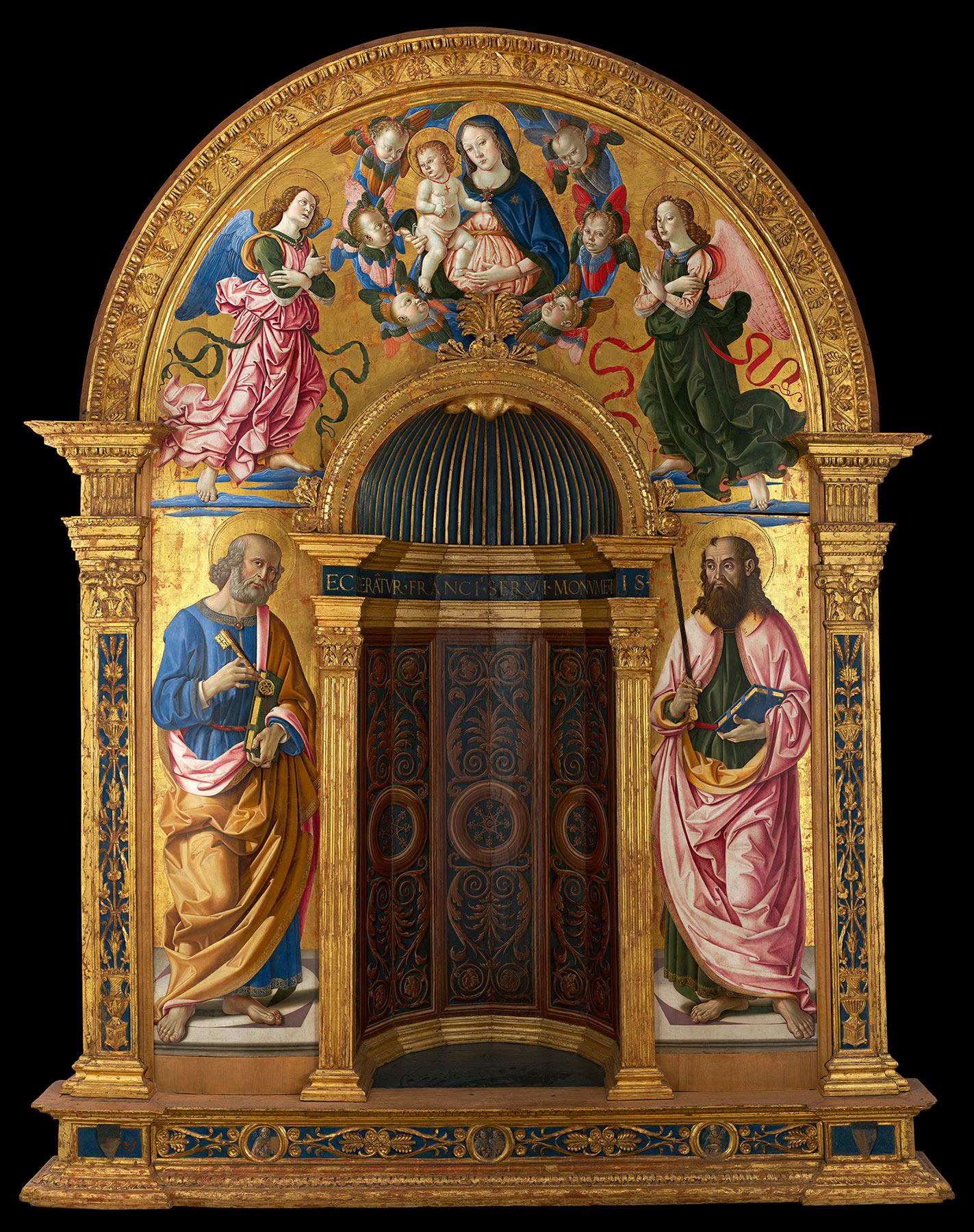
Notwithstanding the differences in scale, perhaps the closest formal analogies for the Yale Saint Jerome, as noted by Rankin, are found in the Perugia Saint Sebastian (see fig. 3), which shares the sinewy anatomy of the figure and certain Morellian details, like the identical rendering of the gnarled feet with knobby toes. The long-standing attribution of the Saint Sebastian to Fiorenzo was recently challenged by some authors in favor of Sante di Apollonio del Celandro, but the personality of that artist remains vague and the small group of works attributed to his hand not entirely homogeneous.16 When compared to the metallic, polished surfaces of the Saint Sebastian or to the crystalline quality of the 1487 San Francesco al Prato altarpiece, emblematic of Fiorenzo’s mature style, the Yale Saint Jerome stands out, however, for its softer atmosphere and more modulated approach to lighting effects, especially evident in the description of the saint’s careworn features and in the Peruginesque landscape disappearing into the distance. In this respect, the Yale picture approximates some of those images currently viewed by scholars among Fiorenzo’s less typical and more refined efforts, resulting from the influence of Pinturicchio and Perugino in the late 1470s. Among them is a Virgin and Child with Saint Jerome in the Museum of Fine Arts, Boston (fig. 6), sometimes attributed to Pinturicchio, which shares a similar backdrop and delicacy of execution.17 The debts to the young Pinturicchio are even more pronounced in the Yale panel, where the artist’s approach is recalled in the thin layer of paint warming the green base of the flesh tones and in the meticulous attention to the rendering of the tufts of grass.
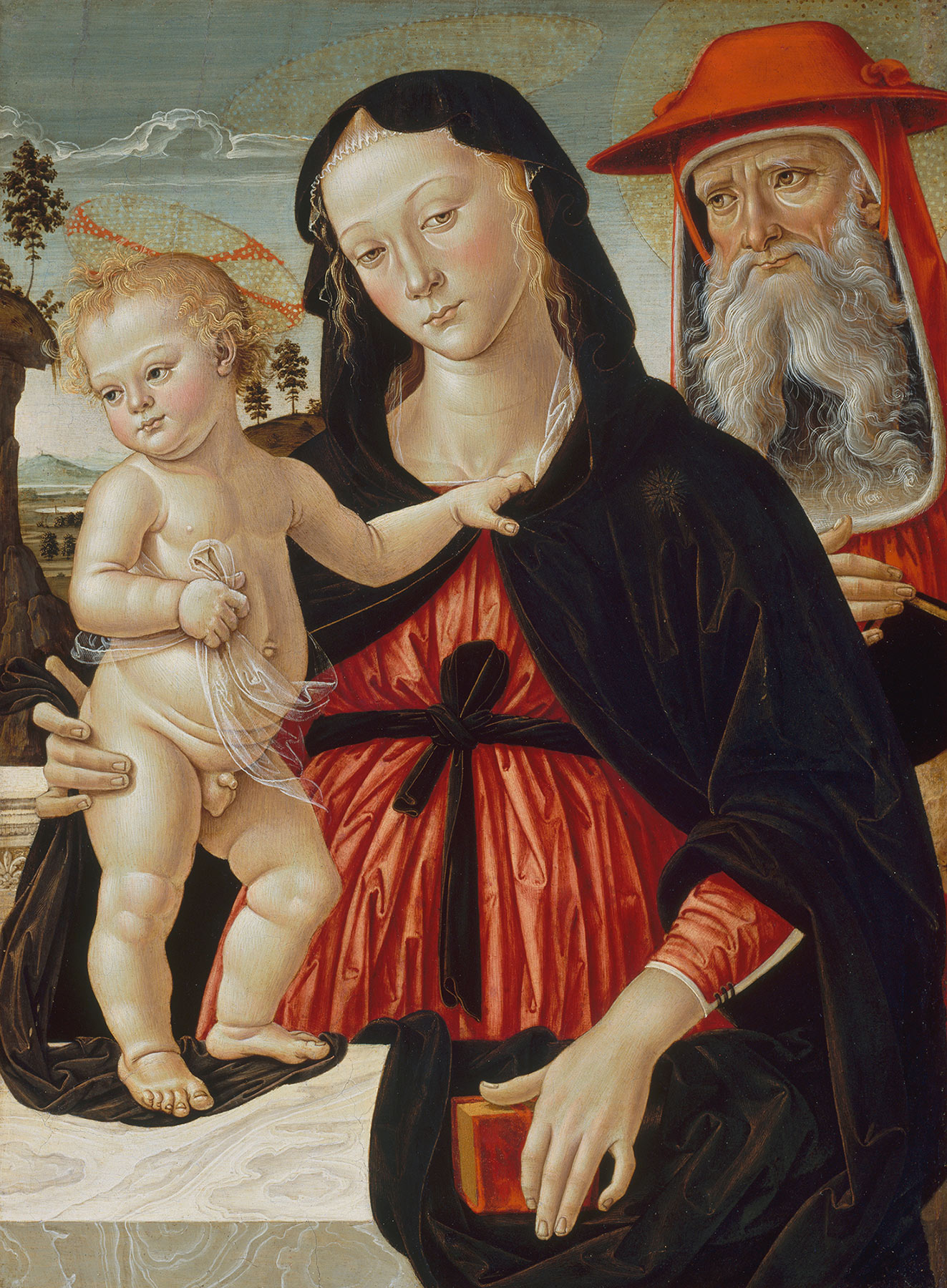
Following earlier scholarship, Irene Sbrilli, who assigned the Yale panel and the ex-Storrs (see fig. 2) and Bergamo (see fig. 1) versions to different but unspecified periods in Fiorenzo’s career, highlighted the derivation of these images from that of Saint Jerome in the predella of the Santa Maria di Monteluce Adoration (see fig. 4), which she tentatively ascribed to Pinturicchio during a presumed formation in Caporali’s workshop.18 Of the three versions, however, the Bergamo Saint Jerome has the strongest claim to being directly inspired by the Monteluce predella. Federico Zeri and Francesco Rossi, who regarded the Bergamo panel as the earliest of the three versions, rightly noted its more archaic quality, reflected in the execution of the figure and landscape backdrop and in the presence of a traditional gilt halo, replaced by a more modern, foreshortened translucent disk in the Yale and ex-Storrs panels.19 Although Zeri and Rossi dated the Bergamo panel around 1480–85, an earlier chronology in the 1470s is not out of the question. A date for the Yale Saint Jerome and the ex-Storrs copy around 1480 seems consistent with their more pronounced affinities with the work of Pinturicchio. —PP
Published References
Jarves, James Jackson. Descriptive Catalogue of “Old Masters” Collected by James J. Jarves to Illustrate the History of Painting from A.D. 1200 to the Best Periods of Italian Art. Cambridge, Mass.: H. O. Houghton, 1860., 51; Sturgis, Russell, Jr. Manual of the Jarves Collection of Early Italian Pictures. New Haven: Yale College, 1868., 59; W. F. Brown, Boston. Catalogue of the Jarves Collection of Early Italian Pictures. Sale cat. November 9, 1871., 20, no. 60; Rankin, William. “Some Early Italian Pictures in the Jarves Collection of the Yale School of Fine Arts at New Haven.” American Journal of Archaeology 10, no. 2 (April–June 1895): 137–51., 144–45, 150–51, pl. 10; Crowe, Joseph Archer, and Giovanni Battista Cavalcaselle. A History of Painting in Italy, Umbria, Florence, and Siena from the Second to the Sixteenth Century. Vols. 1–4, ed. Robert Langton Douglas. Vols. 5–6, ed. Tancred Borenius. London: J. Murray, 1903–14., 3:191n3, 5:270; Graham, Jean Carlyle. The Problem of Fiorenzo di Lorenzo of Perugia: A Critical and Historical Study. Perugia: Domenico Terese, 1903., 113, pl. 22; Weber, Siegfried. Fiorenzo di Lorenzo: Eine kunsthistorische Studie. Strasbourg, France: J. H. Ed. Heitz, 1904., 88n1; Rankin, William. Notes on the Collections of Old Masters at Yale University, the Boston Museum of Fine Arts, the Fogg Museum of Harvard University. Wellesley, Mass.: Department of Art, Wellesley College, 1905., 11, no. 60; Berenson, Bernard. The Central Italian Painters of the Renaissance. 2nd rev. ed. New York: G. P. Putnam’s Sons, 1909., 169; Jacobsen, Emil. “Fiorenzo di Lorenzo, 2.” Gazette des Beaux Arts, 4th ser., 11, no. 4 (1914): 309–26., 325; Sirén, Osvald. A Descriptive Catalogue of the Pictures in the Jarves Collection Belonging to Yale University. New Haven: Yale University Press, 1916., 175–76, no. 68; Gnoli, Umberto. Pittori e miniatori nell’ Umbria. Spoleto: C. Argentieri, 1923., 116; Comstock, Helen. “Umbrian Paintings in American Collections.” International Studio 86, no. 356 (January 1927): 21–30, 90., 30; Offner, Richard. Italian Primitives at Yale University: Comments and Revisions. New Haven: Yale University Press, 1927., 8; “Handbook: A Description of the Gallery of Fine Arts and the Collections.” Special issue, Bulletin of the Associates in Fine Arts at Yale University 5, nos. 1–3 (1931): 1–64., 29; Venturi, Lionello. Pitture italiane in America. 2 vols. Milan: Ulrico Hoepli, 1931., 1: pl. 147; Berenson, Bernard. Italian Pictures of the Renaissance: A List of the Principal Artists and Their Works with an Index of Places. Oxford: Clarendon, 1932., 193; van Marle, Raimond. The Development of the Italian Schools of Painting. Vol. 14. The Hague: M. Nijhoff, 1935., 182, 192n2; Venturi, Lionello. Italian Paintings in America. Trans. Countess Vanden Heuvel and Charles Marriott. 3 vols. New York: E. Weyhe, 1933., 2: pl. 325; Louchheim, Aline B. “Saint Jerome: Variations on a Theme.” Art News 44, no. 3 (March 15–31, 1945): 10–11, 31–32., 11; “Picture Book Number One: Italian Painting.” Special issue, Bulletin of the Associates in Fine Arts at Yale University 15, nos. 1–3 (October 1946): n.p., fig. 26; Ottino Della Chiesa, Angela. Accademia Carrara. Bergamo: Istituto Italiano d’arti grafiche, 1955. , 103; Berenson, Bernard. Italian Pictures of the Renaissance, A List of the Principal Artists and Their Works with an Index of Places: Central Italian and North Italian Schools. 3 vols. London: Phaidon, 1968., 1:134 ; Seymour, Charles, Jr. Early Italian Paintings in the Yale University Art Gallery. New Haven: Yale University Art Gallery, 1970., 228–30, no. 173; Fredericksen, Burton B., and Federico Zeri. Census of Pre-Nineteenth-Century Italian Paintings in North American Public Collections. Cambridge, Mass.: Harvard University Press, 1972., 600; Brown, David Alan. Berenson and the Connoisseurship of Italian Painting: A Handbook to the Exhibition. Exh. cat. Washington, D.C.: National Gallery of Art, 1979., 33, fig. 72; Zeri, Federico, and Francesco Rossi. La raccolta Morelli nell’Accademia Carrara. Cinisello Balsamo, Milan: Silvana, 1986., 83; Todini, Filippo. La pittura umbra: Dal duecento al primo cinquecento. 2 vols. Milan: Longanesi, 1989., 1:68; Sbrilli, Irene. “Sante d’Apollonio del Celandro e Pinturicchio nella bottega di Bartolomeo Caporali.” Prospettiva 159–60 (July–October 2015): 110–31., 131n73; Giovanni Valagussa, in Valagussa, Giovanni, ed. Accademia Carrara Bergamo: Dipinti italiani del trecento e del quattrocento; Catalogo completo. Milan: Officina libraria, 2018, 89
Notes
-
See Rice, Eugene F., Jr. Saint Jerome in the Renaissance. Baltimore: Johns Hopkins University Press, 1985., 75–83. ↩︎
-
The panel measures 39.7 by 28 centimeters and has virtually the same thickness (1.6 cm) as the Yale picture. ↩︎
-
Sale, Christie’s, London, May 12, 1950, lot 131. It was exhibited at Wildenstein & Co., London, in 1962, where it was listed as being in a private collection in New York; Wildenstein & Co., London. Religious Themes in Painting from the 14th Century Onwards. Sale cat. March 16–May 5, 1962., no. 16. The dimensions given in the catalogue are 15 3/4 by 11 inches. ↩︎
-
Jarves, James Jackson. Descriptive Catalogue of “Old Masters” Collected by James J. Jarves to Illustrate the History of Painting from A.D. 1200 to the Best Periods of Italian Art. Cambridge, Mass.: H. O. Houghton, 1860., 51, no. 65. ↩︎
-
Rankin, William. “Some Early Italian Pictures in the Jarves Collection of the Yale School of Fine Arts at New Haven.” American Journal of Archaeology 10, no. 2 (April–June 1895): 137–51., 144–45. ↩︎
-
Graham, Jean Carlyle. The Problem of Fiorenzo di Lorenzo of Perugia: A Critical and Historical Study. Perugia: Domenico Terese, 1903., 113. ↩︎
-
Inv. no. 230. ↩︎
-
Sirén, Osvald. A Descriptive Catalogue of the Pictures in the Jarves Collection Belonging to Yale University. New Haven: Yale University Press, 1916., 175–76, no. 68. ↩︎
-
Berenson, Bernard. Italian Pictures of the Renaissance: A List of the Principal Artists and Their Works with an Index of Places. Oxford: Clarendon, 1932., 193. ↩︎
-
Venturi, Lionello. Italian Paintings in America. Trans. Countess Vanden Heuvel and Charles Marriott. 3 vols. New York: E. Weyhe, 1933., 2: pl. 325. ↩︎
-
For this work, see Garibaldi, Vittoria. Galleria Nazionale dell’Umbria: Dipinti e sculture dal XII al XV secolo; Catalogo generale I. Perugia: Quattroemme, 2015., 485–88, no. 183. ↩︎
-
Bury, Michal. “Bartolomeo Caporali: A New Document and Its Implications.” Burlington Magazine 132, no. 1048 (July 1990): 469–75., 469–75. See also Costanza Neve, in Pierini, Marco, and Veruska Picchiarelli, eds. “Il meglio maestro d’Italia”: Perugino nel suo tempo. Exh. cat. Milan: Dario Cimorelli, 2023., 220–23, no. I.11 (with previous bibliography). ↩︎
-
Pietro Scarpellini, in Bon Valvassina, Caterina, and Vittoria Garibaldi, eds. Dipinti, sculture e ceramiche della Galleria Nazionale dell’Umbria: Studi e restauri. Florence: Arnaud, 1994., 235–38. ↩︎
-
Inv. no. 432; see Garibaldi, Vittoria. Galleria Nazionale dell’Umbria: Dipinti e sculture dal XII al XV secolo; Catalogo generale I. Perugia: Quattroemme, 2015., 483–85, no. 182. ↩︎
-
Galleria Nazionale dell’Umbria, Perugia, inv. nos. 219a–e, 208–18; see Garibaldi, Vittoria. Galleria Nazionale dell’Umbria: Dipinti e sculture dal XII al XV secolo; Catalogo generale I. Perugia: Quattroemme, 2015., 490–97, nos. 185a–p. ↩︎
-
See Garibaldi, Vittoria. Galleria Nazionale dell’Umbria: Dipinti e sculture dal XII al XV secolo; Catalogo generale I. Perugia: Quattroemme, 2015., 469–71, no. 173 (with previous bibliography). The image was first attributed to Sante di Apollonio by Laura Teza based on comparisons with the Trittico della Giustizia, but the division of hands in that work is all but clear; see Teza, Laura. Per Fiorenzo di Lorenzo pittore e scultore: Una proposta di ricomposizione della nicchia di San Francesco al Prato a Perugia e altre novità. Perugia: Quattroemme, 2003., 38n3. ↩︎
-
For the attributional history of this work, see, most recently, Emanuele Zappasodi, in Caglioti, Francesco, and Andrea De Marchi, eds. Verrocchio: Il maestro di Leonardo. Exh. cat. Florence: Marsilio, 2019., 182–83, no. 5.11 (with previous bibliography). ↩︎
-
Sbrilli, Irene. “Sante d’Apollonio del Celandro e Pinturicchio nella bottega di Bartolomeo Caporali.” Prospettiva 159–60 (July–October 2015): 110–31., 121. ↩︎
-
Zeri, Federico, and Francesco Rossi. La raccolta Morelli nell’Accademia Carrara. Cinisello Balsamo, Milan: Silvana, 1986., 83. More recently, Giovanni Valagussa proposed a much later chronology around 1495, but his comparisons with the predella of Pintoricchio’s Santa Maria dei Fossi altarpiece, datable around 1496–98, seem far-fetched; in Valagussa, Giovanni, ed. Accademia Carrara Bergamo: Dipinti italiani del trecento e del quattrocento; Catalogo completo. Milan: Officina libraria, 2018, 88–90. ↩︎