Lionel Hierschel de Minerbi(?);1 Dan Fellows Platt (1873–1937), Englewood, N.J., 1905; Robert Langton Douglas (1864–1951), London; Hannah D. and Louis M. Rabinowitz (1887–1957), Sands Point, Long Island, N.Y., by 1945
The panel support, of a vertical wood grain, has been cut to an irregular profile along all four sides and inlaid into a modern poplar surround measuring 39.2 by 31.5 centimeters. The maximum depth of the original panel is 1.2 centimeters. The paint surface has been violently abraded throughout. Only the deep reds of the Virgin’s dress and the lilac underlayer of the Child’s robe survive as continuous color fields. The Child’s hair is also preserved, as are some flesh tones in His head and neck. The Child’s arms and legs and the Virgin’s hands and face retain only traces of color. Islands of highlighting can be discerned in the Virgin’s blue robe along her right shoulder, breast, and cuff, and some blue remains in the sky. A fine brush drawing is evident on the exposed gesso, defining light and dark modeling in both figures.
The Virgin is enveloped in a mantle of deep sea-green, which shows between its folds at her breast and about her wrists touches of a carmine tunic, lightly embroidered with gold, and revealing at its turn, the edges of a white chemisette. The Christ child is clad in a short lavender-tinted shift, worn over a transparent muslin under-shirt. The sky, unlike the usual blue skies of Venetian painting, is of a limpid green, untroubled save by a few light diaphanous clouds in its upper reaches. Below, to the right, is the shape of a hillock of darker brownish green.2
With this evocative description of the painting, F. Mason Perkins left a valuable record of the Yale panel’s appearance in 1909, four years after it had been acquired in Venice by the American collector Dan Fellows Platt and before the disastrous interventions of 1962–63 reduced it to its present state. By the time Perkins was writing, however, the panel had already undergone a cleaning by the famous Italian restorer Luigi Cavenaghi (1844–1918). When Platt purchased it, Perkins noted, it was “so thickly bedaubed with varnish and coated with dirt as barely to permit a recognition of its subject; the Virgin’s head was reduced to a blackened silhouette, while that of the Christ Child was hardly distinguishable. It was only after undergoing a careful cleaning at the hands of Signor Cavenaghi that its real beauty was disclosed.”3 Notwithstanding Perkins’s praise of the work’s beauty and renewed brilliance, it is impossible to determine the extent to which the hand of Cavenaghi, who is known for his sophisticated but often invasive approach to conservation, influenced the evaluation of the image. The oldest surviving black-and-white photographs and the color reproduction in Lionello Venturi’s 1945 catalogue of the Rabinowitz collection (fig. 1) show those areas where the panel was built out and completely repainted by Cavenaghi to complete the figure of the Christ Child along the right edge, the head of the Virgin at the top, and her body along the left, while other areas were significantly reinforced.
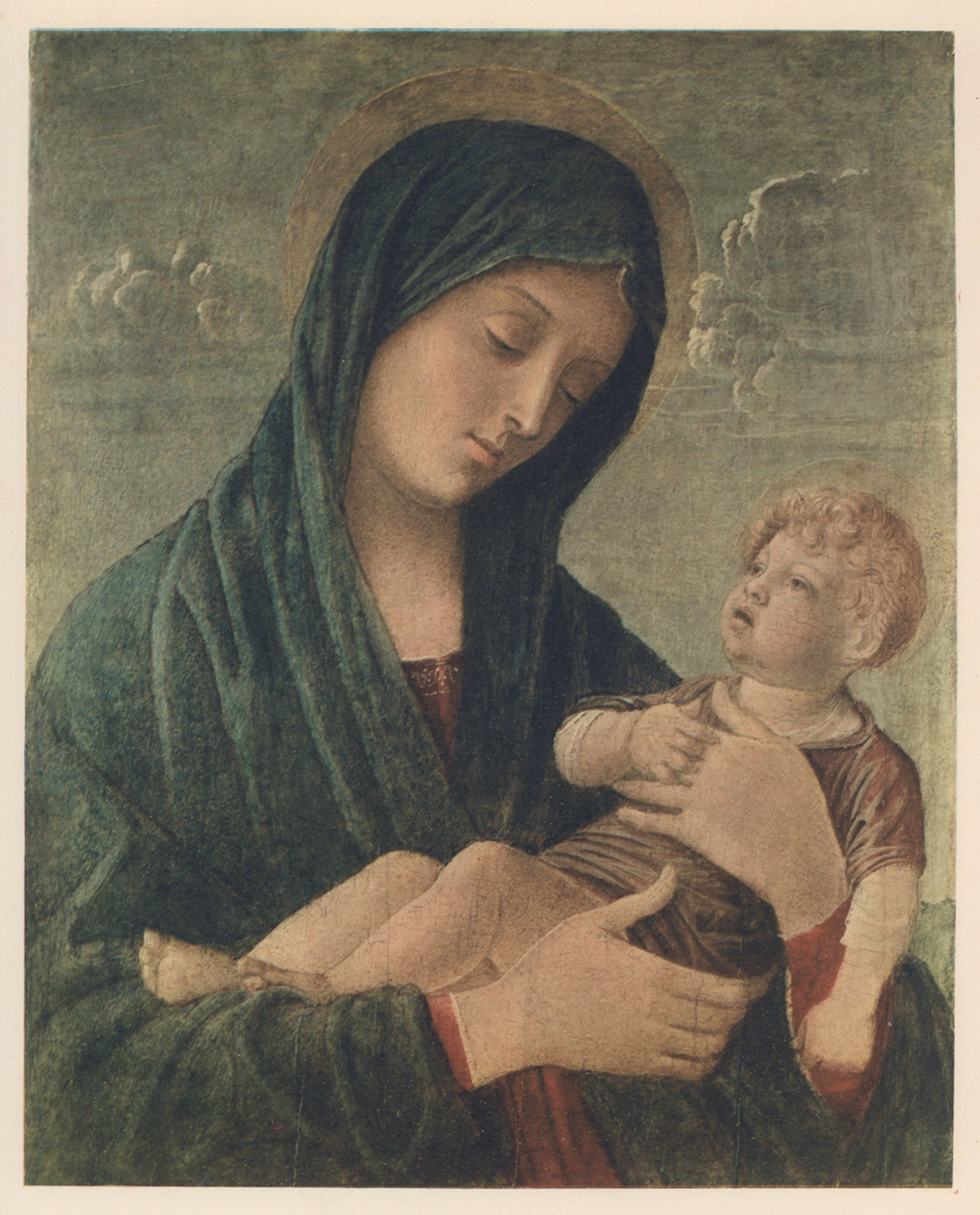
For Perkins, who attributed the work without hesitation to Giovanni Bellini, the Platt Madonna, as it came to be known, belonged to the “earlier part” of the artist’s career and was closely linked to the Virgin Adoring the Christ Child in the Museo di Castelvecchio, Verona, dated by modern scholars around 1475.4 Bernard Berenson5 also assigned the picture to Bellini’s “first manner” but invoked closer comparisons with the signed Coronation of the Virgin in the Museo Civico, Pesaro, plausibly dated between about 1472 and 1475,6 and he judged the image of the Virgin in the present work to be a later variant, based on the same cartoon, of the figure in the Pesaro altarpiece. The attribution to Bellini was unanimously accepted by scholars until the 1962–63 cleaning, which prompted Timothy Verdon and Humberto Rodriguez to state that, as a fragment, “the primary interest of this piece is historical and cultural.”7 Both authors followed Charles Seymour, Jr.,8 in denying the intervention of Bellini himself and instead assigning the painting to a follower, concluding that it was “probably shop work in the style of the master’s mid-1470’s production.”9 Aside from Everett Fahy, who assigned the Yale Virgin and Child to Bartolomeo Montagna,10 later scholarship has remained divided between those who have viewed the picture as a workshop product11 and others who have detected the hand of Bellini in the few areas left untouched by restorers and in the uniqueness of the composition.12
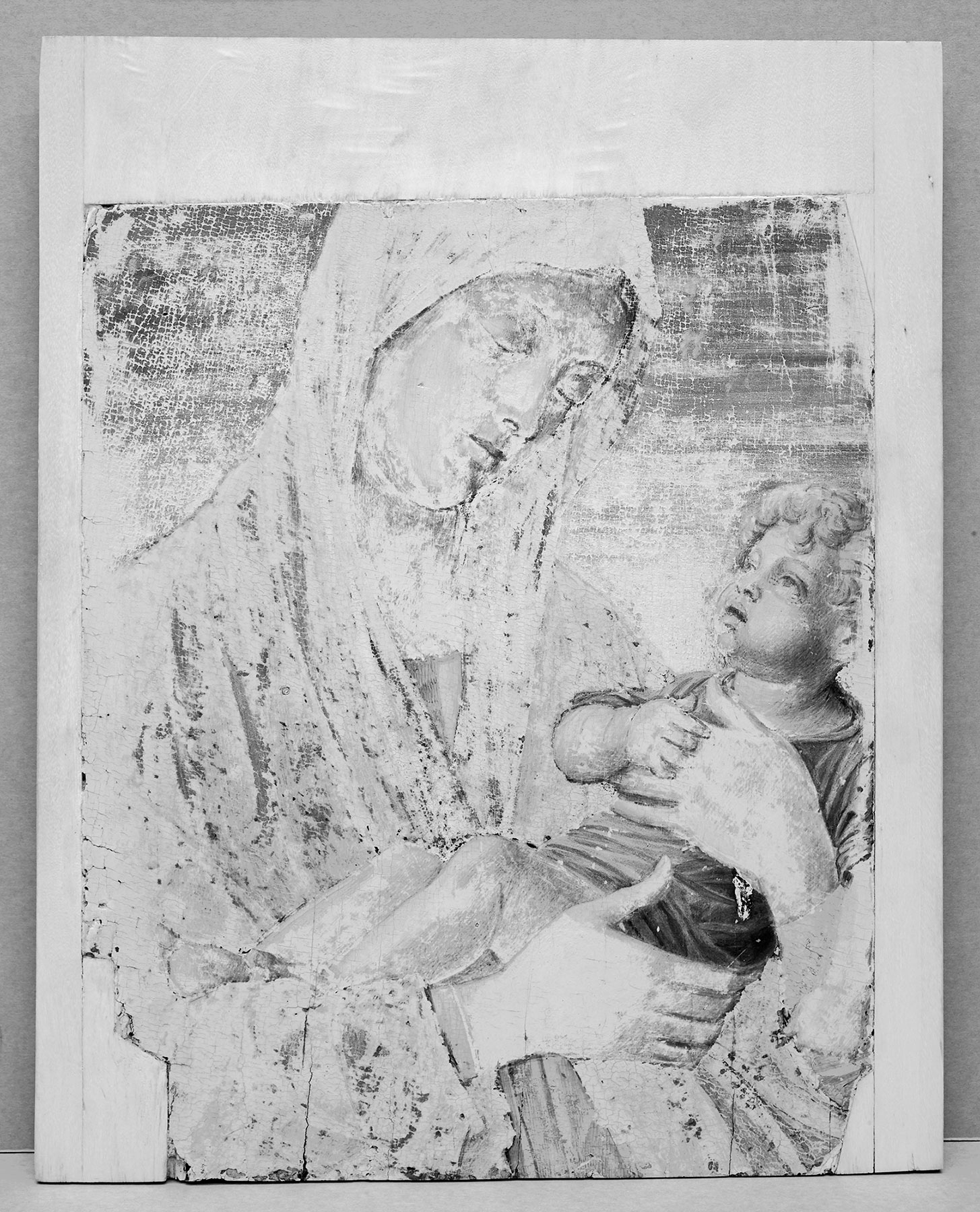
Recent infrared reflectography of the Yale Virgin and Child (fig. 2) has yielded valuable if not conclusive evidence for evaluating its relationship to Bellini’s production. The dense parallel hatchings carried out with a small brush and used to create shadow and define the volumes—still visible around the Child’s cheek but also discernible in the modeling of His legs and in the hands of the Virgin—are consistent with the technique employed by the artist from the mid- to late 1460s through the 1470s, as evidenced by comparison with the underdrawings of some of his paintings from this period. Especially relevant are the similarities to infrared photographs of works executed in the earlier part of this time frame, including the Pesaro Coronation of the Virgin.13 Berenson’s contention regarding the close relationship between the head of the Pesaro Virgin and the Yale panel is confirmed by infrared reflectography, although it remains difficult to ascertain whether the same cartoon was used in both instances. Such evidence does not necessarily imply the intervention of the master in the final product, although the sensitive treatment of the hands of the Virgin and right hand of the Christ Child, as well as the careful highlights used to articulate the underlying bone structure and movements of the fingers in the underdrawing, appear to distinguish the Yale work from the more serial nature of other compositions of the Virgin and Child produced in Bellini’s workshop. The heavily abraded condition and the loss of the top layers of paint, even in the better-preserved parts, like the head of the Child, prevent a more definitive judgment, however.
It is worth noting that in his monograph on Bellini, Fritz Heinemann recorded a copy of the Yale Virgin and Child that was purportedly once “in the collection of Prince Hohenzollern, Sigmaringen.”14 The collection of the Hohenzollern-Sigmaringen Castle in southern Germany did, in fact, include a Virgin and Child by Bellini that was described by Fritz Harck in 1893, in the following terms:
Since a few years back Sigmaringen has owned a small panel [un quadretto] by the master himself, by Giovanni Bellini, which is not very well preserved; but which gives absolutely the impression of being truly his, and which by virtue of the light palette belongs to the master’s first manner. It is the half-length figure of a Madonna with the Child on her knees, and it belongs, if I recall well, to the same period as the Madonna and Child owned by dott. Gustavo Frizzoni in Milan. Three years ago, I saw the painting on sale in Italy. It is not part of the Sigmaringen picture gallery but is located in the private rooms of the current prince, a lover of the fine arts, in his palace in the city.15
Modern scholars have unanimously identified the Sigmaringen panel with a Virgin and Child by Bellini in the Isabella Stewart Gardner Museum, Boston,16 but it is difficult to understand how Harck’s reference could apply to that picture, which is signed and which does not show the Child seated on the Virgin’s knees but lying asleep on a pillow on top of the parapet before her. On the other hand, Harck’s description, which also refers to the panel’s poor condition and early date, is not incompatible with the Yale picture. If the Sigmaringen “copy” alluded to by Heinemann is, in fact, the painting described by Harck, and as no other copies of the Yale Virgin and Child are known, it could be speculated, with due caution, that both notices actually refer to the present work. —PP
Published References
Venturi, Adolfo. Storia dell’arte italiana. 11 vols. Milan: Ulrico Hoepli, 1901–40., 7, pt. 4: 306, 308, fig. 179; Perkins, F. Mason. “An Unpublished Picture by Giovanni Bellini.” Burlington Magazine 15, no. 74 (May 1909): 126–31., 126–31, pl. 1; Perkins, F. Mason. “Dipinti italiani nella raccolta Platt, parte II.” Rassegna d’arte antica e moderna 11, no. 9 (September 1911): 145–49., 147; Berenson, Bernard. Venetian Paintings in America: The Fifteenth Century. New York: F. F. Sherman, 1916. , 74–78, fig. 33; Bernard Berenson, “Venetian Paintings in the United States: Part Five.” Art in America 4, no. 2 (February 1916): 61–84., 61–65, fig. 1; Reinach, Salomon. Répertoire de peintures du Moyen Âge et de la Renaissance (1280–1580). Vol. 5. Paris: Ernest Leroux, 1922., 285, fig. 1; Gronau, Georg. Giovanni Bellini: Des Meisters Gemälde. Stuttgart: Deutsche Verlags-Anstalt, 1930., 46; Venturi, Lionello. Pitture italiane in America. 2 vols. Milan: Ulrico Hoepli, 1931., pl. 389; Berenson, Bernard. Italian Pictures of the Renaissance: A List of the Principal Artists and Their Works with an Index of Places. Oxford: Clarendon, 1932., 70; Dussler, Luitpold. Giovanni Bellini. Frankfurt: Prestel, 1935., 146; van Marle, Raimond. The Development of the Italian Schools of Painting. Vol. 17. The Hague: M. Nijhoff, 1935., 249–50; Berenson, Bernard. Pitture italiane del Rinascimento: Catalogo dei principali artisti e delle loro opere. Trans. Emilio Cecchi. Milan: Ulrico Hoepli, 1936., 60; Gamba, Carlo. Giovanni Bellini. Milan: Ulrico Hoepli, 1937., 73, fig. 56; Venturi, Lionello. The Rabinowitz Collection. New York: Twin Editions, 1945., 33–34, pl. 14; Berenson, Bernard. Italian Pictures of the Renaissance, A List of the Principal Artists and Their Works with an Index of Places: Venetian School. 2 vols. London: Phaidon, 1957., 1:32; “Recent Gifts and Purchases: February 22–December 31, 1959.” Yale University Art Gallery Bulletin 26, no. 1 (December 1960): 52–58., 53; Seymour, Charles, Jr. The Rabinowitz Collection of European Paintings. New Haven: Yale University Art Gallery, 1961., 54; Heinemann, Fritz. Giovanni Bellini e i Belliniani. Vol. 1. Venice: Neri Pozza, 1962., 4, no. 16; Robertson, Giles. Giovanni Bellini. Oxford: Clarendon, 1968., 79; Pignatti, Terisio. L’opera completa di Giovanni Bellini. Milan: Rizzoli, 1969., 88–89, no. 33; Seymour, Charles, Jr. Early Italian Paintings in the Yale University Art Gallery. New Haven: Yale University Art Gallery, 1970., 236–37, 324, no. 178; Fredericksen, Burton B., and Federico Zeri. Census of Pre-Nineteenth-Century Italian Paintings in North American Public Collections. Cambridge, Mass.: Harvard University Press, 1972., 601; Charles Seymour, Jr., in Seymour, Charles, Jr., et al. Italian Primitives: The Case History of a Collection and Its Conservation. Exh. cat. New Haven: Yale University Art Gallery, 1972., 8, no. 178; Timothy Verdon and Humberto Rodriguez, in Seymour, Charles, Jr., et al. Italian Primitives: The Case History of a Collection and Its Conservation. Exh. cat. New Haven: Yale University Art Gallery, 1972., 53, no. 46, figs. 46a–b; Sutton, Denys. “Robert Langton Douglas: New York, part XX.” Apollo 110, no. 209 (July 1979): 35–41 [227–33]., 38 [230]; Heinemann, Fritz. Giovanni Bellini e i Belliniani. Vol. 3: Supplemento e ampliamenti. Hildesheim, Germany: Georg Olms, 1991., 2, no. 16, fig. 20; Tempestini, Anchise. Giovanni Bellini: Catalogo complete dei dipinti. Florence: Cantini, 1992., 72, 92; Longhi, Roberto. “Escursioni Belliniane, 1925–26.” In Roberto Longhi, Il palazzo non finito: Saggi inediti, 1910–1926, ed. Francesco Frangi and Cristina Montagnani, 361–433. Milan: Electa, 1995., 374–75; Tempestini, Anchise. Giovanni Bellini. Milan: Fabbri, 1997., 64; Hoeniger, Cathleen. “The Restoration of the Early Italian ‘Primitives’ during the 20th Century: Valuing Art and Its Consequences.” Journal of the American Institute of Conservation 38, no. 2 (Summer 1999): 144–61., 152, figs. 7–8; Tempestini, Anchise. Giovanni Bellini. Milan: Electa, 2000., 186, no. 14; Mauro Lucco, in Lucco, Mauro, Peter Humfrey, and Giovanni C. F. Villa. Giovanni Bellini: Catalogo ragionato. Ed. Mauro Lucco. Quinto di Treviso: ZeL, 2019., 354, 406, no. 63; Tempestini, Anchise. Giovanni Bellini e i pittori belliniani. Florence: Nicomp Laboratorio, 2021., 125, no. 133
Notes
-
According to Charles Seymour, Jr., the picture was “in the Minerbi Collection,” before being purchased by Dan Fellows Platt in Venice in 1905; Seymour, Charles, Jr., et al. Italian Primitives: The Case History of a Collection and Its Conservation. Exh. cat. New Haven: Yale University Art Gallery, 1972., 8, no. 178. It is not clear which is the Minerbi collection referred to. The Minerbi were a prominent Jewish family in Ferrara, granted a baronial title in 1877. In 1833 Clementina de Minerbi (1816–1905) married Leone Hierschel (1807–1881), from one of the great Jewish families of Viennese descent in Trieste, who were granted noble status by the Austrian emperor Franz Joseph in 1857. Under the impulse of Clementina, the Hierschel de Minerbi residence in Trieste became the fulcrum of artistic and intellectual activity in the city. The family produced writers, diplomats, and artists of varying talent. After Clementina’s death in 1905, the family estate in Precenicco, near Udine, passed to her grandson Count Lionel Hierschel de Minerbi (1873–1937), an eccentric figure and amateur art dealer, who in 1906 acquired the Ca’ Rezzonico in Venice. The Yale painting may have been owned by this branch of the Minerbi family. See Pozzetto, Edi. “La famiglia Hierschel de Minerbi.” In Precenicco: Una comunità nella storia, ed. Edi Pozzetto, 93–113. Udine: Forum, 2012., 93–113; and Minerbi, Sergio. I Minerbi: Una famiglia ebraica Ferrarese. Livorno: Belforte Salomone, 2015., 413–29. For a preliminary investigation into Count Lionel Hierschel de Minerbi’s activity as a marchand-amateur, see Paruzzo, Valeria. “Ca’ Rezzonico in the 19th Century: The Dispersal of Its Collections and the New Uses of the Palace.” Acta historiae artis slovenica 28, no. 2 (2023): 53–75., 69. ↩︎
-
Perkins, F. Mason. “An Unpublished Picture by Giovanni Bellini.” Burlington Magazine 15, no. 74 (May 1909): 126–31., 126. ↩︎
-
Perkins, F. Mason. “An Unpublished Picture by Giovanni Bellini.” Burlington Magazine 15, no. 74 (May 1909): 126–31., 131. ↩︎
-
Inv. no. 865-1B110; see Mauro Lucco, in Lucco, Mauro, Peter Humfrey, and Giovanni C. F. Villa. Giovanni Bellini: Catalogo ragionato. Ed. Mauro Lucco. Quinto di Treviso: ZeL, 2019., 402–4, no. 60 (with previous bibliography). ↩︎
-
Bernard Berenson, “Venetian Paintings in the United States: Part Five.” Art in America 4, no. 2 (February 1916): 61–84., 61–62. ↩︎
-
Inv. no. 3909; see Lucco, in Lucco, Mauro, Peter Humfrey, and Giovanni C. F. Villa. Giovanni Bellini: Catalogo ragionato. Ed. Mauro Lucco. Quinto di Treviso: ZeL, 2019., 392–96, no. 55 (with previous bibliography). ↩︎
-
Timothy Verdon and Humberto Rodriguez, in Seymour, Charles, Jr., et al. Italian Primitives: The Case History of a Collection and Its Conservation. Exh. cat. New Haven: Yale University Art Gallery, 1972., 53. ↩︎
-
Seymour, Charles, Jr. Early Italian Paintings in the Yale University Art Gallery. New Haven: Yale University Art Gallery, 1970., 236–37, no. 178. ↩︎
-
Verdon and Rodriguez, in Seymour, Charles, Jr., et al. Italian Primitives: The Case History of a Collection and Its Conservation. Exh. cat. New Haven: Yale University Art Gallery, 1972., 53. ↩︎
-
Everett Fahy, expert opinion, January 27, 1999, curatorial files, Department of European Art, Yale University Art Gallery. ↩︎
-
After a tentative attribution to Gentile Bellini, Anchise Tempestini opted, most recently, for “Workshop of Giovanni Bellini.” See Tempestini, Anchise. Giovanni Bellini. Milan: Electa, 2000., 186, no.14; and Tempestini, Anchise. Giovanni Bellini e i pittori belliniani. Florence: Nicomp Laboratorio, 2021., 125, no. 133. ↩︎
-
Heinemann, Fritz. Giovanni Bellini e i Belliniani. Vol. 3: Supplemento e ampliamenti. Hildesheim, Germany: Georg Olms, 1991., 2, no. 16; and Lucco, in Lucco, Mauro, Peter Humfrey, and Giovanni C. F. Villa. Giovanni Bellini: Catalogo ragionato. Ed. Mauro Lucco. Quinto di Treviso: ZeL, 2019., 406, no. 63. ↩︎
-
The number of technological investigations carried out on the paintings of Giovanni Bellini over the course of the last thirty years has produced a repertoire of infrared photographs without precedent for a single artist. See the analysis of the Dead Christ in the National Gallery, London (inv. no. NG3912, https://www.nationalgallery.org.uk/paintings/giovanni-bellini-the-dead-christ-supported-by-two-angels), painted about 1465–70, in Jill Dunkerton and Marika Spring, in Dunkerton, Jill, Marika Spring, Rachel Billinge, et al. “Giovanni Bellini’s Painting Technique.” Special issue, National Gallery Technical Bulletin 39 (2018)., 44–49; of the Pietà in the Pinacoteca di Brera, Milan (inv. no. 228, https://pinacotecabrera.org/collezioni/conservazione-e-restauro/pieta/), variously dated between the late 1460s and early 1470s, in the museum’s web entry; and of the Pesaro Coronation in the fundamental study by Giovanni Carlo Federico Villa, in Villa, Giovanni Carlo Federico. “Indagando Bellini: Quattro ancone in un itinerario.” In Indagando Bellini, ed. Gianluca Poldi and Giovanni Carlo Federico Villa, 13–127. Milan: Skira, 2009., 50–62. ↩︎
-
Heinemann, Fritz. Giovanni Bellini e i Belliniani. Vol. 1. Venice: Neri Pozza, 1962., 4, no. 16. ↩︎
-
Harck, Fritz von. “Quadri italiani nelle gallerie private di Germania.” Archivio storico dell’arte 6, no. 6 (1893): 385–90., 389. ↩︎
-
Inv. P16s2, https://www.gardnermuseum.org/experience/collection/11794; see Lucco, in Lucco, Mauro, Peter Humfrey, and Giovanni C. F. Villa. Giovanni Bellini: Catalogo ragionato. Ed. Mauro Lucco. Quinto di Treviso: ZeL, 2019., 354–55, no. 33 (with previous bibliography). ↩︎