James Jackson Jarves (1818–1888), Florence, by 1859
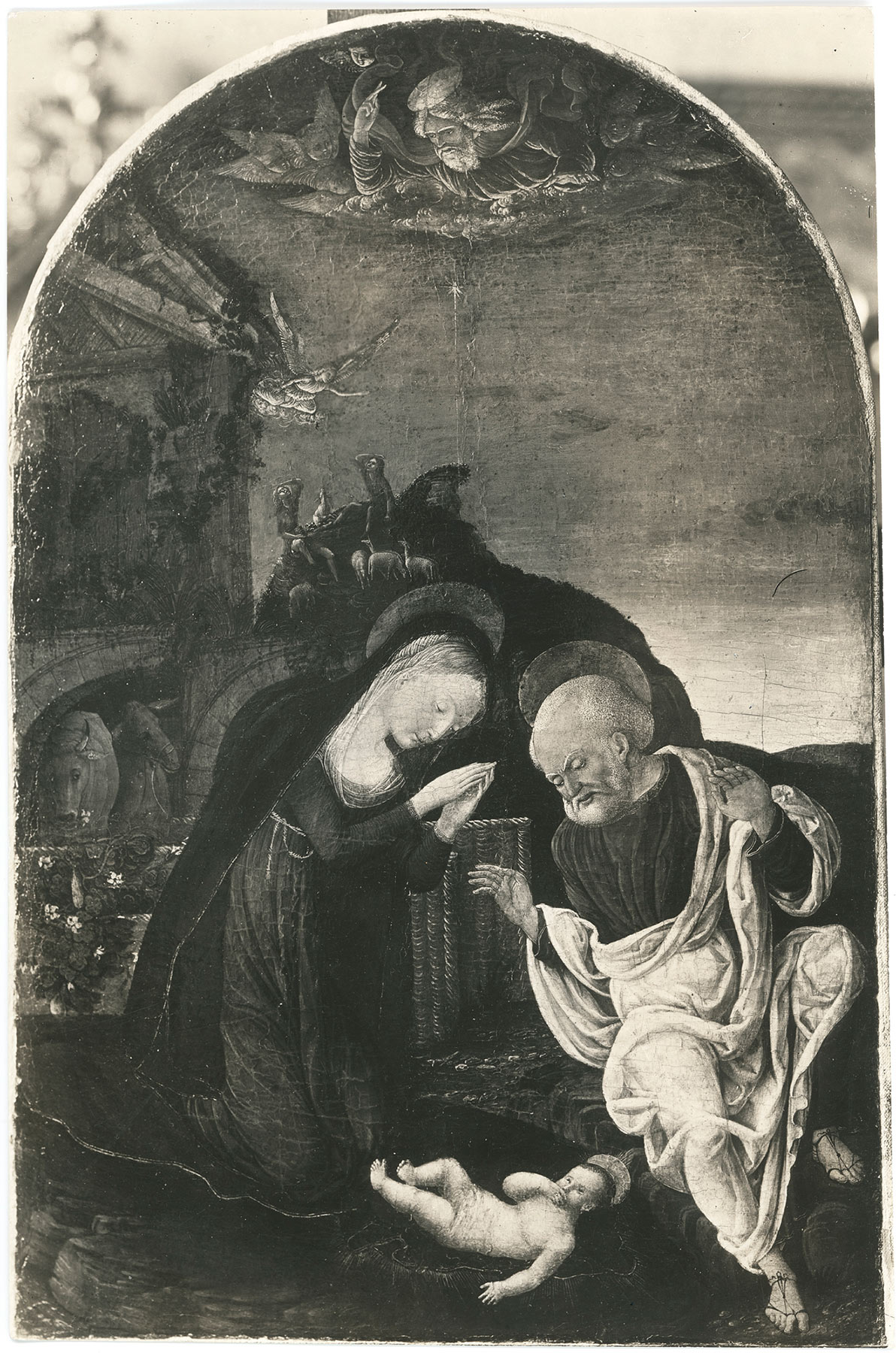
The painting was transferred from panel to canvas by J. Howorth in Boston in 1867 at the request of its previous owner, James Jackson Jarves. The heavy paste and lead white pigment used to adhere the transfer caused major deformations of the paint surface over time before hardening and becoming intractably rigid and brittle, leading to its being mounted onto a honeycombed aluminum auxiliary support during a cleaning in 1950. The surface now is extremely irregular, with horizontal undulations and distortions caused by the weight of the lining adhesives and a prominent horizontal crack—unrelated to the structural tensions of the original support—crossing from the left wrist and chin of Saint Joseph through the hands of the Virgin and ending in her shoulders. Yellowed retouching of losses from a vertical split or seam in the original panel support run the full height of the picture field, from the torso of the Christ Child to the head of God the Father, passing between the Virgin and Saint Joseph. Retouching of losses along minor splits in the sky at the upper right have similarly yellowed. The paint surface is extremely damaged throughout most of the left third of the composition: heavy abrasion and extensive flaking losses obscure most of the landscape and architecture in this area, as well as the Virgin’s blue robe, the vignette of the ox and ass in their manger, and the scene of the Annunciation to the Shepherds in the left middle ground. By contrast, Saint Joseph is well preserved, as is most of the figure of the Virgin, including her red dress. The feet and head of the Christ Child retain much of the original sharpness and refinement of detail in their rendering, whereas the Child’s legs and torso are heavily damaged and clumsily repainted. God the Father surrounded by cherubim and seraphim is relatively well preserved. The Christ Child’s halo is original; the haloes of the Virgin and Saint Joseph have been reconstructed.
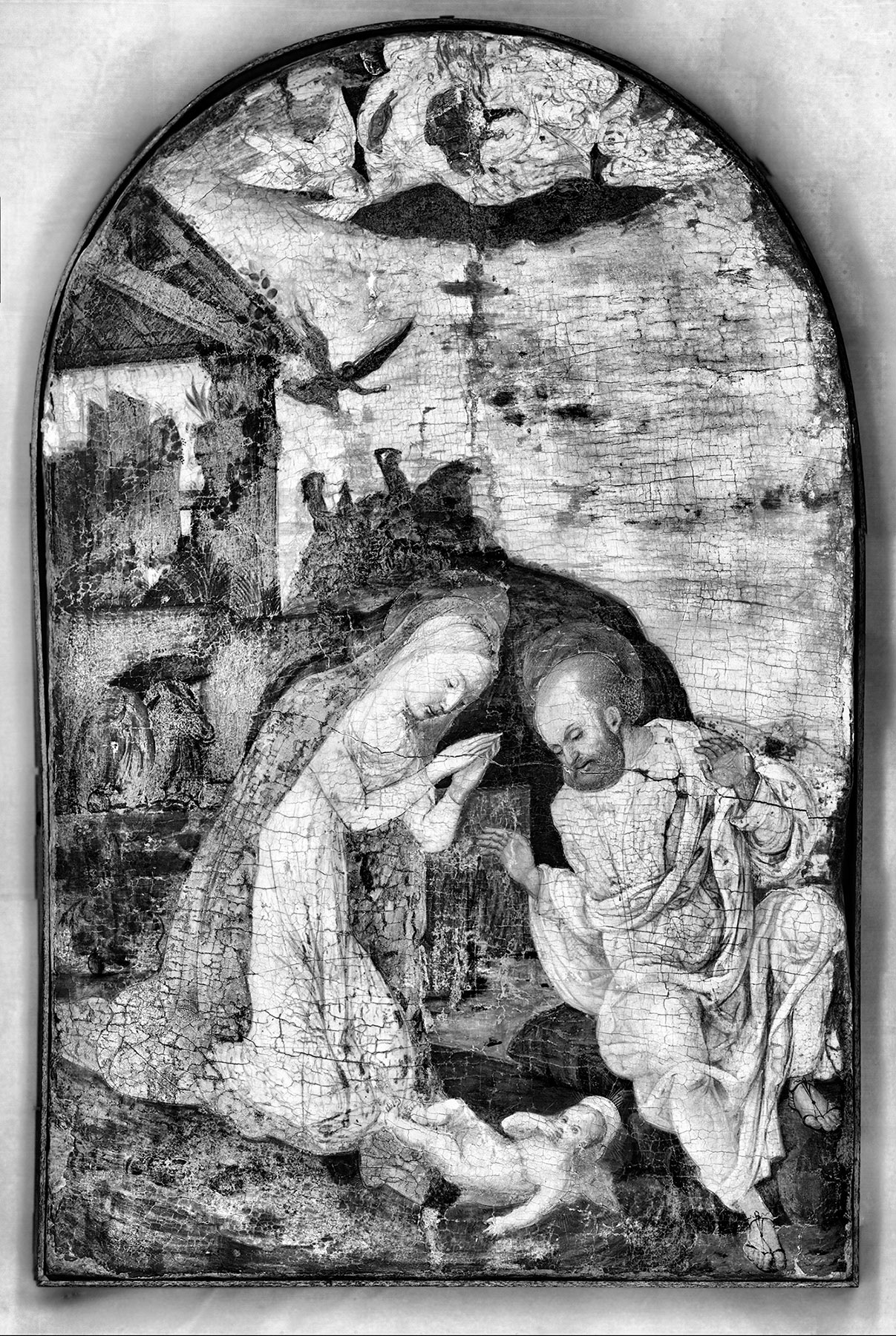
As in other instances in the Yale University Art Gallery’s collection, the original qualities of this panel, transferred to canvas in the nineteenth century and subsequently subjected to harsh cleaning, are best evaluated from old photographs (fig. 1). Although parts of the composition, such as the head of Joseph and the complex folds of his mantle, have suffered only minor losses, most of the background elements can no longer be discerned clearly or have been irreparably lost. In the foreground, on a rocky outcrop covered with grass, the Virgin kneels in adoration before the naked Christ Child, who is lying on the extended hem of her blue mantle, spread out before her as a blanket. The Virgin wears a carmine robe with gold trim, belted at the waist with a dainty gold rope. A diaphanous white veil covers her head. Joseph, perched above a stony ledge with his arms raised in wonder, is clad in a carmine tunic with gold trim, in harmony with the Virgin’s dress. A magnificent yellow cloak is draped dramatically over his arms and shoulder, covering most of his lower body and adhering to his limbs in complicated artificial folds. Rising up behind the Virgin is a wooden stable covered in vegetation and built over the ruins of a classical foundation. Nestled inside the remains of a Roman archway are an ox and an ass feeding from a wattle manger partially covered by a climbing gourd plant, identified by the white blooms and two hanging fruit. On a grassy promontory in the distance, two shepherds—now completely repainted—gaze up toward the winged figure of an annunciatory angel hovering above a bank of clouds and illuminated from below. Crowning the composition is the figure of God the Father emerging from another bank of clouds and surrounded by cherubim and seraphim, whose forms are more clearly recognizable in the underdrawing (fig. 2). Judging from the still-intact winged cherub along the top edge of the panel, they were possibly all painted black and mordant gilt. Framing the head of God is a billowing carmine cloak worn over a verdigris tunic. A small star, whose rays descended toward the figures below along the central axis of the panel, is no longer visible. Barely discernable at present are the evocative, naturalistic light effects that were remarked upon by Osvald Sirén, who noted that “the ruins and the small figures in the background are almost wrapped in darkness, but further back, at the horizon, an orange streak is breaking through, announcing the approaching day.”1
The Nativity entered Yale’s collection with James Jackson Jarves’s attribution to Squarcione, qualified by the collector’s note that “some critics ascribe this picture to Andrea Mantegna, when a pupil of Squarcione.”2 The Mantegnesque connotations were also noted by William Rankin, who first associated the Yale panel with the miniatures by Girolamo da Cremona, an illuminator strongly influenced by Mantegna, in a famous series of choir books in the Piccolomini Library in Siena Cathedral.3 Possibly the most important commissions in the history of Sienese manuscript illumination, the decoration of the new set of choir books for Siena Cathedral extended from 1467 to 1476, and it involved the participation of several Northern illuminators, chief among whom were Girolamo da Cremona and his younger contemporary Liberale da Verona.4 Rankin’s intuition provided the foundation for subsequent studies analyzing the Yale Nativity within the contexts of the Piccolomini Library miniatures, although the lack of a clear consensus over the division of hands between Girolamo and Liberale, who worked side by side on the same volumes between 1472 and 1474, resulted in radically divergent conclusions.
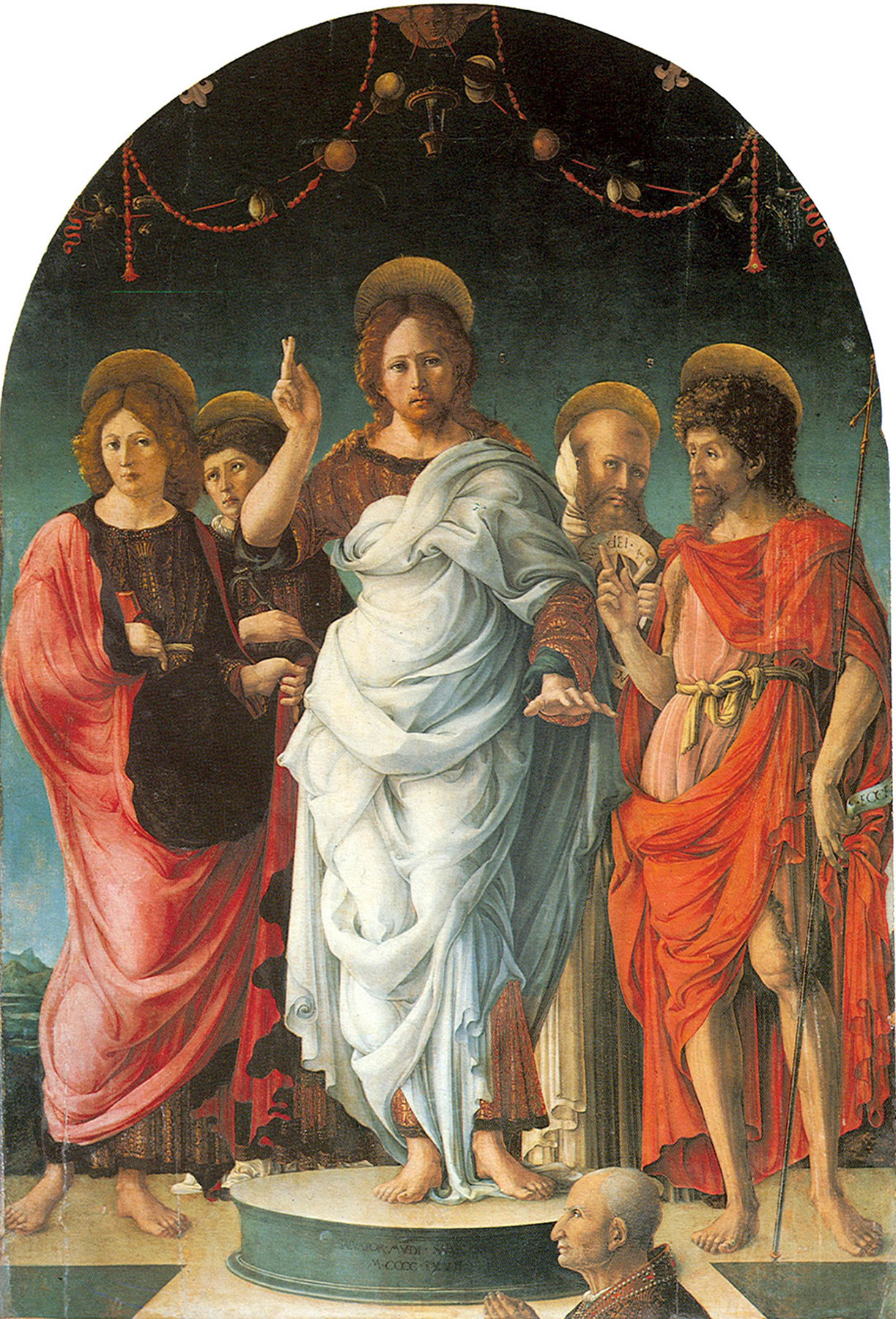
Rankin’s tentative proposal that the Nativity might be by Girolamo was fully embraced by Bernard Berenson, who devoted a 1902 article to Girolamo’s otherwise unknown activity as a panel painter and attributed to the same artist an altarpiece showing Christ as Salvator Mundi, dated 1472, in the cathedral of San Lorenzo, Viterbo (fig. 3)—an impressive image assigned by local scholars to Albrecht Dürer or Mantegna but given by Joseph Crowe and Giovanni Cavalcaselle to Liberale.5 Berenson’s study formed the basis for a growing body of works assigned to Girolamo over the course of the next four decades, beginning with another version of the Yale Nativity formerly in the Serristori collection, Florence,6 and including a large altarpiece in the church of Santa Francesca Romana in Rome.7
In 1955 the arguments in favor of Girolamo’s activity as a panel painter were completely upended by Roberto Longhi, who acknowledged the homogeneity of the paintings gathered by Berenson around Girolamo’s name but identified their author as Liberale, pointedly referring to the art-historical “imbroglio” that had resulted from the collaboration of the two artists in the Piccolomini Library choir books.8 Referring to Rankin’s attribution of the Yale Nativity to Girolamo in vivid metaphorical terms, as the “first spark” that ignited the error of Berenson’s conclusions, Longhi downplayed Girolamo’s role in the most inventive solutions of the Piccolomini Library miniatures, arguing that he had been made responsible for what were, in effect, the most accomplished efforts of Liberale’s career.9 Tracing Liberale’s evolution from the beginnings of his Sienese activity in the choir books for Monte Oliveto Maggiore, executed around 1466, to the Piccolomini Library miniatures, Longhi drew a distinction between the visionary, poetic imagination underlying Liberale’s approach, in both manuscripts and panel paintings, and the more prosaic, detail-oriented sensibility of Girolamo, active almost exclusively as an illuminator. Although rejected by Federico Zeri,10 Longhi’s revisions culminated in Carlo Del Bravo’s 1967 monograph on Liberale, where the Viterbo and the Santa Francesca Romana altarpieces were presented as masterpieces of the artist’s early career. Del Bravo qualified the attribution of the Yale Nativity, however, by suggesting that it might have been painted by Girolamo over a design by Liberale and dated the work around 1473.11
The identification of the Yale picture as a work by Liberale, with or without the assistance of Girolamo, did not meet with universal consensus in the subsequent literature. While Berenson and Zeri reiterated the attribution to Girolamo, Charles Seymour, Jr., catalogued the Nativity more cryptically as a work of “Girolamo da Cremona (most probably with Liberale da Verona).”12 A firm basis for Liberale’s authorship was finally established by Hans-Joachim Eberhardt, in a definitive study of the documentary evidence relating to the Piccolomini Library illuminations, published in 1983.13 Through a meticulous analysis of the payment records, Eberhardt was able to determine, in some cases with near-exact precision, the respective contributions of Liberale and Girolamo to the series and to confirm many of the observations already made by Longhi. Eberhardt, who dated the Yale Nativity around 1474, convincingly compared it to the large historiated initials in Gradual 22.7 in the Piccolomini Library, for which Liberale received payment between 1473 and 1474.14 Based on the consistencies in palette and execution between Liberale’s work in this gradual and his contributions to the later volumes in the series executed after Girolamo’s departure from Siena in 1474, Eberhardt dismissed the possibility of Girolamo’s intervention in the application of the final paint layer, albeit noting the latter’s influence on certain figure types.15 In addition to the Yale Nativity, Eberhardt associated with the same moment in the artist’s activity the Santa Francesca Romana altarpiece, placing its execution in the six-month interval between the final payments to Liberale for Gradual 22.7 in November 1474, after which the artist’s name disappears from the cathedral’s account books, and June 1475, when he was working next to Venturino Mercati da Milano on the remaining choir books in the series.16
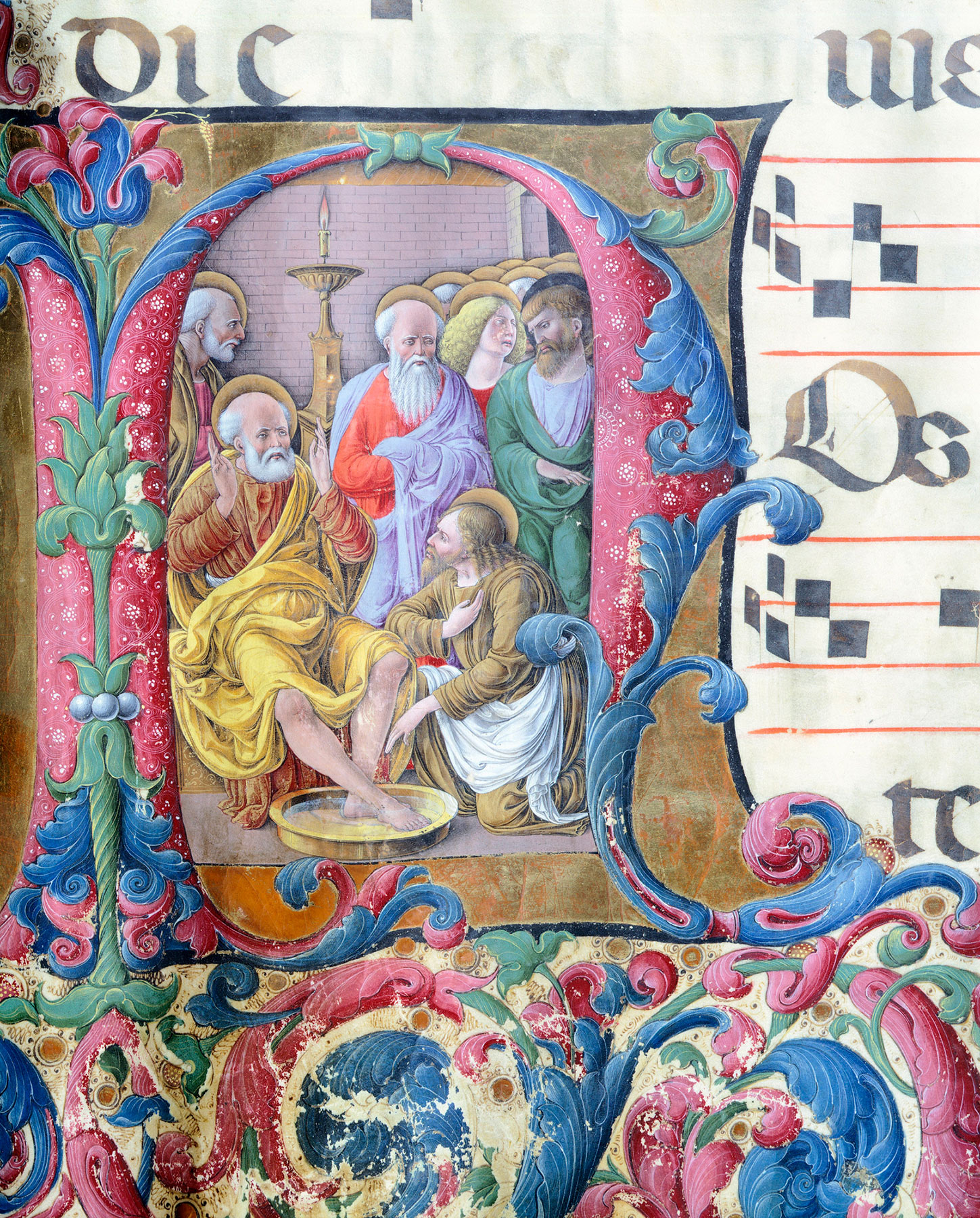
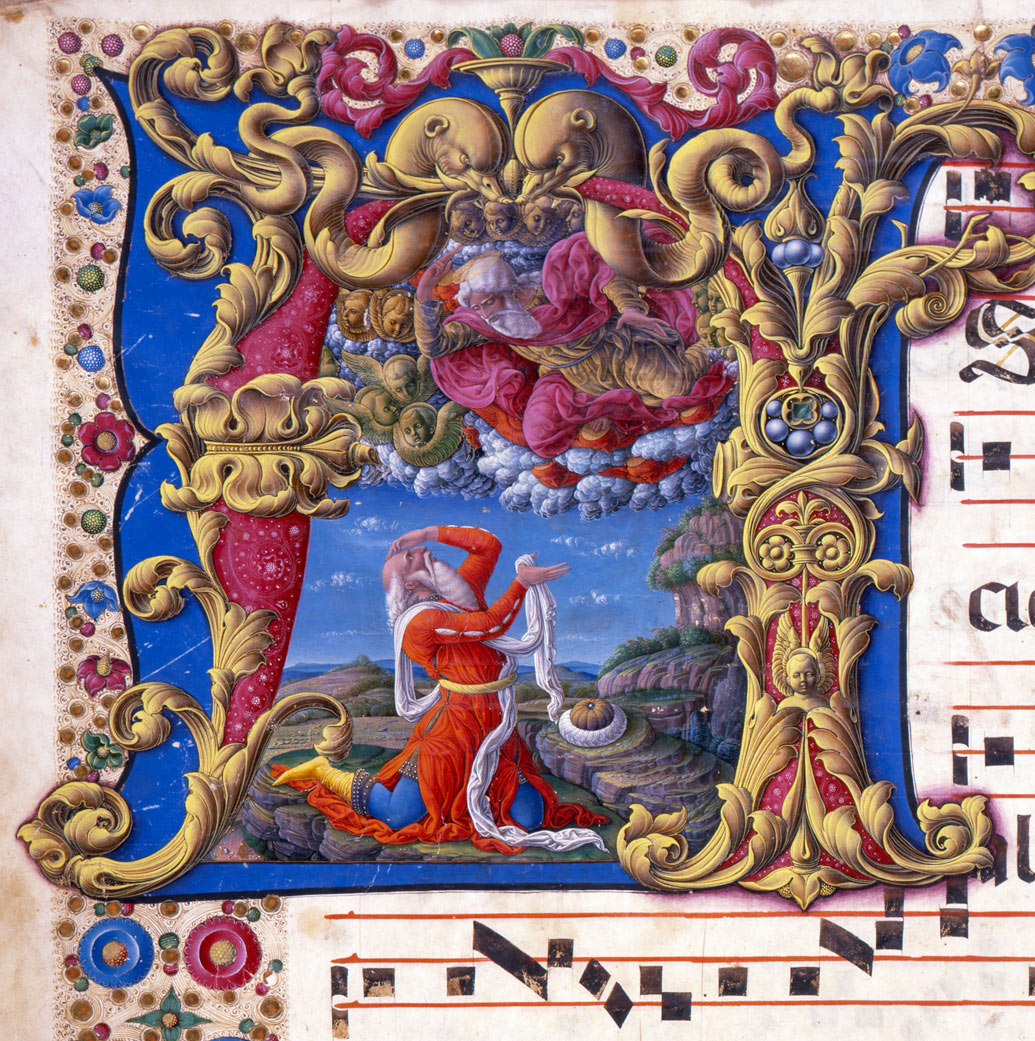
Eberhardt’s compelling arguments all but confirmed Liberale’s authorship of the Yale Nativity. His comparisons between the Yale picture and the large Christ Washing the Feet of the Apostles in an Initial H on folio 37v of Gradual 22.7 (fig. 4) leave little doubt as to the identity of hands. The facial morphology of the bearded Saint Peter finds an almost exact correspondence in the Yale Saint Joseph, as does the treatment of the apostle’s yellow mantle, swirling in comparable folds around the figure’s body. Other parallels for the panel may be found in analogies with the four historiated initials contributed by Liberale to Antiphonary 1.A in the same series, for which the artist received payment between September and November 1474. The God the Father Appearing to Isaiah in an Initial A on folio 4v of this codex (fig. 5) provides an obvious analogy for the same motif in the Yale picture, although in the present instance the artist seems to have returned to his earlier version of the subject—with a half-length figure of God the Father—in the 1466 choir books for Monte Oliveto Maggiore.17
Among the not-entirely-homogeneous body of paintings currently attributed to Liberale, the Santa Francesca Romana altarpiece bears close comparison to the Yale Nativity; the delicate proportions of the female figures and angels are closely related to the Yale Virgin, and both works share the same type of Christ Child with elongated torso and dainty features. Other comparisons for the Yale Nativity are to be found in the cassone panels executed by Liberale during his Sienese sojourn, where the impact of the sculptor and architect Francesco di Giorgio Martini on the younger painter are most pronounced. Chief among these is the Metropolitan Museum of Art/Villa I Tatti cassone, originally attributed to Francesco Giorgio by Berenson and later recognized by Zeri as a product of the same hand that executed the Santa Francesca Romana altarpiece.18 The elegant figures with identical morphological features, delicate limbs, and tapered hands that inhabit the chest are perhaps more intimately related to the Yale Virgin than those in the Santa Francesca Roman altarpiece; common to the present work and the cassone, moreover, is the incisive drawing technique combined with the use of white paint to highlight faces and hands—an approach that is still discernible in the Yale Virgin and in the nude body of the Christ Child.
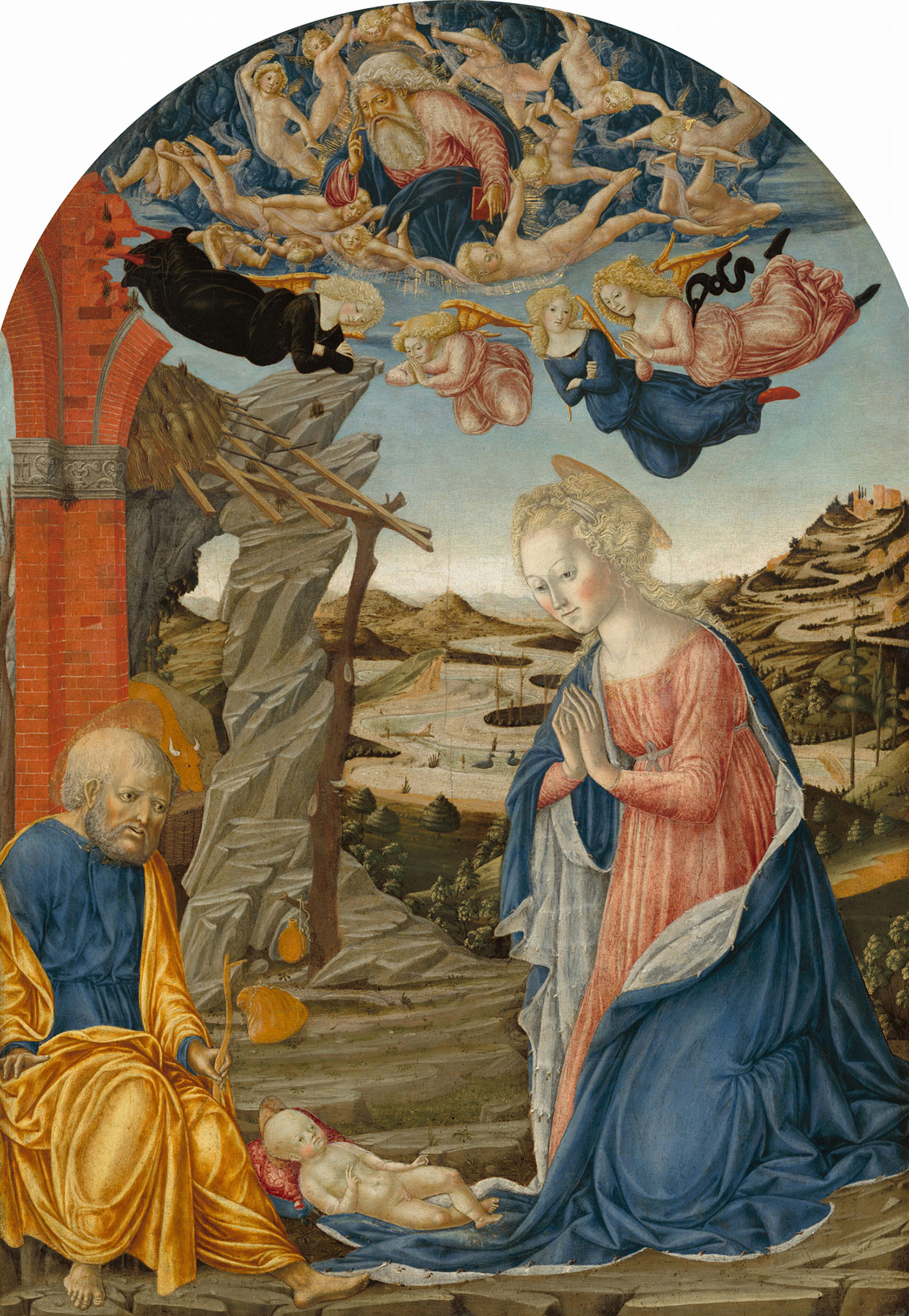
The Metropolitan Museum/I Tatti cassone, recognized as a work of Liberale by Del Bravo,19 was dated to 1473 by Eberhardt, contemporary to the artist’s documented illuminations in Gradual 18.3 of the Piccolomini Library series.20 The attribution and dating were recently reiterated by Keith Christiansen, who also underscored Liberale’s debt to the figural models of Francesco di Giorgio.21 Exchanges between the two artists are already evident in some of the devotional images inserted by past scholars among Liberale’s earliest efforts as a panel painter, predating the Yale Nativity. A painting of the Virgin and Child formerly in a private collection, Paris, first recognized as a work of Liberale by Zeri,22 who dated it no later than 1470, has traditionally been viewed as an example of the influence of Sano di Pietro on Liberale, but the analogies with Sano are confined primarily to the composition, which reflects the standardization of his models into the late fifteenth century. The slender proportions and oval heads with pointed features, as well as the hair styles, closely recall the types found in Francesco di Giorgio’s Madonnas.23 Possible evidence of direct contact between the two artists is Francesco’s borrowings of motifs developed by Liberale in two of his own versions of the Nativity. As was already pointed out by early scholars,24 Francesco’s fragmentary Nativity presently divided between the Metropolitan Museum and the National Gallery of Art, Washington, D.C. (fig. 6), owes a debt to Liberale in both the type of setting and the inclusion of the vision of God the Father encircled by a swirl of flying angels and cherubim; the detail of the two nude angels immediately below God the Father, ultimately derived from Donatello’s sculpture, closely adheres to Liberale’s rendering of the same motif in the Monte Oliveto Maggiore choir books.25 Another Nativity painted by Francesco in one of the later volumes for Monte Oliveto Maggiore, where the master was active between 1472 and 1474, appears equally inspired by the present composition.26 Although the exact nature of these artistic exchanges has been much debated, Christiansen’s suggestion that Liberale may have been engaged in “some sort of an informal association or compagnia” with Francesco di Giorgio during his Sienese sojourn seems highly plausible.27
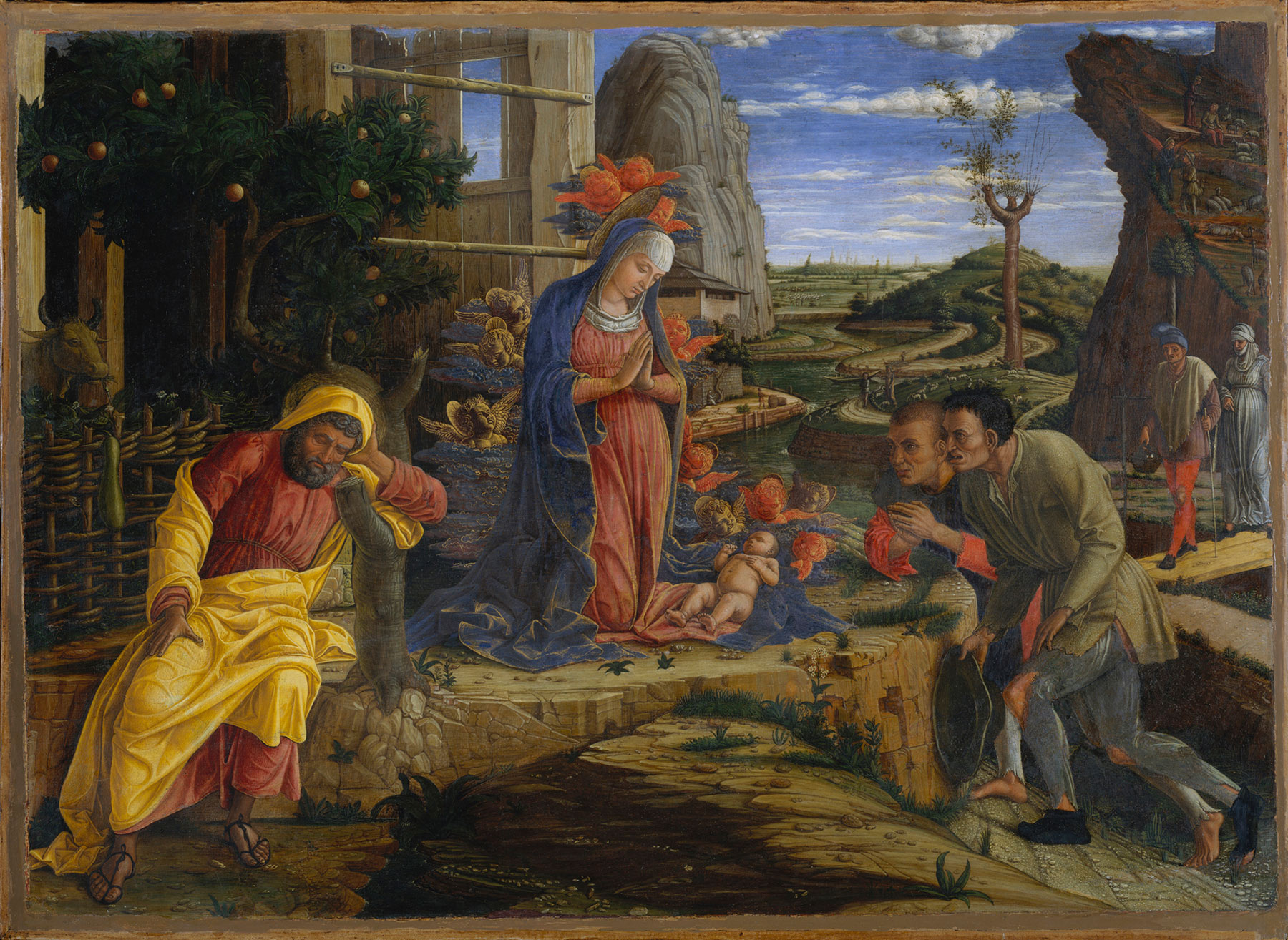
The roots of Liberale’s style remain the subject of speculation, given the absence of secure authenticated works from his first Veronese period. The first and only mentions of his name in Veronese documents before his appearance in Siena are in the Veronese census of 1455, where he is listed as the ten-year-old son of the baker Giacomo da Monza and as a witness in a legal act on behalf of the Olivetans of Santa Maria in Organo, in Verona, in 1465—a connection that most likely led to the commission for the choir books of Monte Oliveto Maggiore.28 Clear echoes of the Bible of Borso d’Este in an illuminated copy of Pliny the Elder’s Historia naturalis, commissioned by the Piccolomini immediately upon Liberale’s arrival in Siena and assigned to the artist by Eberhardt,29 appear to confirm the hypothesis of an early Ferrarese apprenticeship, possibly with Michele Pannonio, but the details remain vague.30 Not sufficiently emphasized by current scholarship is the impact on the young artist of Mantegna’s models, whose influence has been viewed more broadly through the mediation of Girolamo da Cremona. As noted in the earliest literature, however, Mantegna’s Adoration of the Shepherds in the Metropolitan Museum (fig. 7), executed around 1450–51 for Borso d’Este, duke of Ferrara, was undoubtedly a source for the Yale Nativity.31 Liberale’s direct knowledge of the Adoration, possibly acquired during Liberale’s Ferrarese stay, is suggested by one of the more unusual elements of the Yale image, the wattle manger with the flowering gourd plant and hanging fruit—a motif that was accorded special prominence by Mantegna as a possible allusion to Borso d’Este.32 The Metropolitan panel is also recalled in the palette of Joseph’s attire and in the figure’s precariously balanced pose above the rocks, which perhaps reflects Liberale’s effort to adapt Mantegna’s conceit to the exigencies of his own composition. —PP
Published References
Jarves, James Jackson. Descriptive Catalogue of “Old Masters” Collected by James J. Jarves to Illustrate the History of Painting from A.D. 1200 to the Best Periods of Italian Art. Cambridge, Mass.: H. O. Houghton, 1860., 52; Sturgis, Russell, Jr. Manual of the Jarves Collection of Early Italian Pictures. New Haven: Yale College, 1868., 55–56; W. F. Brown, Boston. Catalogue of the Jarves Collection of Early Italian Pictures. Sale cat. November 9, 1871., no. 55; Rankin, William. “Some Early Italian Pictures in the Jarves Collection of the Yale School of Fine Arts at New Haven.” American Journal of Archaeology 10, no. 2 (April–June 1895): 137–51., 149; Berenson, Bernard. “An Altar-piece by Girolamo da Cremona.” In The Study and Criticism of Italian Art, 97–110. London: George Bell and Sons, 1902., 102–3; Berenson, Bernard. North Italian Painters of the Renaissance. New York: G. P. Putnam’s Sons, 1907., 240; Berenson, Bernard. “Una nuova pittura di Gerolamo da Cremona.” Rassegna d’arte antica e moderna 7, no. 3 (March 1907): 33–35., 33; Cagnola, Guido “Un’altra Natività di Gerolamo da Cremona.” Rassegna d’arte antica e moderna 7, no. 5 (May 1907): 78., 78; Mather, Frank Jewett, Jr. “The Jarves Collection.” Yale Alumni Weekly 23, no. 36 (1914): 965–70., 967; Pacchioni, Guglielmo. “Belbello da Pavia e Gerolamo da Cremona, miniatori: Un prezioso messale gonzaghesco del secolo XV; II.” L’arte 18, no. 4 (1915): 343–72., 350; Sirén, Osvald. A Descriptive Catalogue of the Pictures in the Jarves Collection Belonging to Yale University. New Haven: Yale University Press, 1916., 181–82, no. 71; Berenson, Bernard. “A Cassone Front at Le Havre by Girolamo da Cremona.” Revue archéologique, 5th ser., 6 (July–December 1917): 369–73., 369, reprinted in Berenson, Bernard. “Guidoccio Cozzarelli and Matteo di Giovanni.” In Essays in the Study of Sienese Painting, 81–94. New York: F. F. Sherman, 1918., 52; Salmi, Mario. “Gerolamo da Cremona miniatore e pittore.” Bollettino d’arte, 2nd ser., 2, no. 2 (March 1923): 385–404, 461–77., 462; McComb, Arthur. “The Life and Works of Francesco di Giorgio.” Art Studies 2 (1924): 1–32., 15, 18; Offner, Richard. Italian Primitives at Yale University: Comments and Revisions. New Haven: Yale University Press, 1927., 41; Venturi, Lionello. Pitture italiane in America. 2 vols. Milan: Ulrico Hoepli, 1931., pl. 238; Berenson, Bernard. Italian Pictures of the Renaissance: A List of the Principal Artists and Their Works with an Index of Places. Oxford: Clarendon, 1932., 256; Weller, Allen Stuart. Francesco di Giorgio, 1939–1501. Chicago: University of Chicago Press, 1943., 63–64; “Picture Book Number One: Italian Painting.” Special issue, Bulletin of the Associates in Fine Arts at Yale University 15, nos. 1–3 (October 1946): n.p., fig. 28; Longhi, Roberto. “Un apice espressionistico di Liberale da Verona.” Paragone 6, no. 65 (May 1955): 3–7., reprinted in Longhi, Roberto. Ricerche sulla pittura veneta: 1946–1969. Edizione delle opere complete di Roberto Longhi 10. Florence: Sansoni, 1978., 137; Del Bravo, Carlo. “Liberale a Siena.” Paragone 11, no. 129 (September 1960): 16–38., 31; Zeri, Federico. “Un intervento su Francesco di Giorgio Martini.” Bollettino d’arte, 4th ser., 49, no. 1 (January–March 1964): 41–44., 43; Shapley, Fern Rusk. Paintings from the Samuel H. Kress Collection: Italian Schools, XIII–XV Century. London: Phaidon, 1966., 154; Del Bravo, Carlo. Liberale da Verona. Florence: Il Fiorino, 1967., 48, pl. 110–11; Berenson, Bernard. Italian Pictures of the Renaissance, A List of the Principal Artists and Their Works with an Index of Places: Central Italian and North Italian Schools. 3 vols. London: Phaidon, 1968., 1:190; D’Ancona, Mirella Levi. The Wildenstein Collection of Illuminations: The Lombard School. Florence: Leo S. Olschki, 1970., 70; Seymour, Charles, Jr. Early Italian Paintings in the Yale University Art Gallery. New Haven: Yale University Art Gallery, 1970., 214–15, 320, no. 160; Fredericksen, Burton B., and Federico Zeri. Census of Pre-Nineteenth-Century Italian Paintings in North American Public Collections. Cambridge, Mass.: Harvard University Press, 1972., 600; Eberhardt, Hans-Joachim. “Liberale da Verona.” In Maestri della pittura veronese, ed. Pierpaolo Brugnoli, 101–12. Verona: Banca Mutua Popolare, 1974., 110–11; Shapley, Fern Rusk. Catalogue of the Italian Paintings: National Gallery of Art. 2 vols. Washington, D.C.: National Gallery of Art, 1979., 190; Zeri, Federico, and Elizabeth E. Gardner. Italian Paintings: A Catalogue of the Collection of the Metropolitan Museum of Art. Vol. 3, Sienese and Central Italian Schools. New York: Metropolitan Museum of Art, 1980., 12; Cuppini, Maria Teresa. “L’arte a Verona tra XV e XVI secolo.” In Verona e il suo territorio, vol. 4, pt. 1, Verona nel quattrocento, 242–503. Verona: Istituto per Gli Studi Storici Veronesi, 1981., 362; Eberhardt, Hans-Joachim. Die miniaturen von Liberale da Verona: Girolamo da Cremona und Venturino da Milano in den Chorbüchern des Doms von Siena; Dokumentation—Attribution—Chronologie. Munich: Wasmuth, 1983., 219–20n253; Toledano, Ralph. Francesco di Giorgio Martini: Pittore e scultore. Milan: Electa, 1987., 15, 38, 49–50, 64, 85; Andrea G. De Marchi, in Zeri, Federico, ed. La pittura in Italia: Il quattrocento. 2 vols. Milan: Electa, 1987., 2:664; Laurence Kanter, in Christiansen, Keith, Laurence Kanter, and Carl Brandon Strehlke. Painting in Renaissance Siena, 1420–1500. Exh. cat. New York: Metropolitan Museum of Art, 1988., 324; De Marchi, Andrea. “I miniatori padani a Siena.” In Francesco di Giorgio e il Rinascimento a Siena, 1450–1500, ed. Luciano Bellosi, 228–61. Exh. cat. Milan: Electa, 1993., 236n28, 244; Tumidei, Stefano. “Liberale da Verona: Un’aggiunta per gli anni senesi.” Nuovi studi 1, no. 2 (1996): 5–9., 7; Tagliaferro, Giorgio. “Liberale di Iacopo da Verona.” In Dizionario biografico degli Italiani. Rome: Istituto della Enciclopedia Italiana, 2005. https://www.treccani.it/enciclopedia/liberale-di-iacopo-da-verona (Dizionario-Biografico)/.; Mattia Vinco, in Strehlke, Carl Brandon, and Machtelt Brüggen Israëls, eds. The Bernard and Mary Berenson Collection of European Paintings at I Tatti. Milan: Officina Libraria, 2015., 360
Notes
-
Sirén, Osvald. A Descriptive Catalogue of the Pictures in the Jarves Collection Belonging to Yale University. New Haven: Yale University Press, 1916., 182. ↩︎
-
Jarves, James Jackson. Descriptive Catalogue of “Old Masters” Collected by James J. Jarves to Illustrate the History of Painting from A.D. 1200 to the Best Periods of Italian Art. Cambridge, Mass.: H. O. Houghton, 1860., 52, no. 70. ↩︎
-
Rankin, William. “Some Early Italian Pictures in the Jarves Collection of the Yale School of Fine Arts at New Haven.” American Journal of Archaeology 10, no. 2 (April–June 1895): 137–51., 149. ↩︎
-
The fundamental study on the series remains that of Hans-Joachim Eberhardt; see Eberhardt, Hans-Joachim. Die miniaturen von Liberale da Verona: Girolamo da Cremona und Venturino da Milano in den Chorbüchern des Doms von Siena; Dokumentation—Attribution—Chronologie. Munich: Wasmuth, 1983.. ↩︎
-
Berenson, Bernard. “An Altar-piece by Girolamo da Cremona.” In The Study and Criticism of Italian Art, 97–110. London: George Bell and Sons, 1902., 97–110. Crowe and Cavalcaselle’s attribution, advanced in notes preserved in the Biblioteca Marciana, Venice, is cited by Eberhardt, in Marinelli, Sergio C., and Paola Marini, eds. Mantegna e le arti a Verona, 1450–1500. Exh. cat. Venice: Marsilio, 2006., 269, no. 45. ↩︎
-
Cagnola, Guido “Un’altra Natività di Gerolamo da Cremona.” Rassegna d’arte antica e moderna 7, no. 5 (May 1907): 78., 78. ↩︎
-
Zeri, Federico. “Una pala d’altare di Gerolamo da Cremona.” Bollettino d’arte, 4th ser., 35, no. 1 (January–March 1950): 35–42., 35–42. ↩︎
-
Longhi, Roberto. Ricerche sulla pittura veneta: 1946–1969. Edizione delle opere complete di Roberto Longhi 10. Florence: Sansoni, 1978., 135–39. ↩︎
-
Longhi, Roberto. Ricerche sulla pittura veneta: 1946–1969. Edizione delle opere complete di Roberto Longhi 10. Florence: Sansoni, 1978., 137. ↩︎
-
Zeri, Federico. “Appunti sul Lindenau-Museum di Altenburg.” Bollettino d’arte, 4th ser., 49, no. 1 (January–March 1964): 45–53., 47–48. ↩︎
-
Del Bravo, Carlo. Liberale da Verona. Florence: Il Fiorino, 1967., 48, pl. 110. ↩︎
-
Berenson, Bernard. Italian Pictures of the Renaissance, A List of the Principal Artists and Their Works with an Index of Places: Central Italian and North Italian Schools. 3 vols. London: Phaidon, 1968., 1:190; Fredericksen, Burton B., and Federico Zeri. Census of Pre-Nineteenth-Century Italian Paintings in North American Public Collections. Cambridge, Mass.: Harvard University Press, 1972., 600; Zeri, Federico, and Elizabeth E. Gardner. Italian Paintings: A Catalogue of the Collection of the Metropolitan Museum of Art. Vol. 3, Sienese and Central Italian Schools. New York: Metropolitan Museum of Art, 1980., 12; and Seymour, Charles, Jr. Early Italian Paintings in the Yale University Art Gallery. New Haven: Yale University Art Gallery, 1970., 214–15, no. 160. ↩︎
-
Eberhardt, Hans-Joachim. Die miniaturen von Liberale da Verona: Girolamo da Cremona und Venturino da Milano in den Chorbüchern des Doms von Siena; Dokumentation—Attribution—Chronologie. Munich: Wasmuth, 1983., 219–20n253. ↩︎
-
Eberhardt, Hans-Joachim. Die miniaturen von Liberale da Verona: Girolamo da Cremona und Venturino da Milano in den Chorbüchern des Doms von Siena; Dokumentation—Attribution—Chronologie. Munich: Wasmuth, 1983., 219–20n253. ↩︎
-
See also Eberhardt, Hans-Joachim. “Sull’attività senese di Liberale da Verona, Girolamo da Cremona, Venturino da Milano, Giovanni da Udine e prete Carlo da Venezia.” In La miniature italiana tra gotico e Rinascimento: Atti del II congresso di storia della miniatura italiana, Cortona, 24–26 settembre, 1982, ed. Emanuela Sesti, 1:415–34. Florence: Leo S. Olschki, 1985., 1:424–26; and Eberhardt, Hans-Joachim. “Il quattrocento maturo e la svolta del secolo.” In La parola illuminata: Per una storia della miniature a Verona e a Vicenza tra Medioevo e età romantica, ed. Gino Castiglioni, 175–95. Verona: Fondazione Cariverona, 2011., 182–83. ↩︎
-
Eberhardt, Hans-Joachim. “Liberale da Verona.” In Dizionario biografico dei miniatori italiani: Secoli IX–XVI, ed. Milvia Bollati, 378–87. Milan: Sylvestre Bonnard, 2004., 383; and Eberhardt, Hans-Joachim. “Il quattrocento maturo e la svolta del secolo.” In La parola illuminata: Per una storia della miniature a Verona e a Vicenza tra Medioevo e età romantica, ed. Gino Castiglioni, 175–95. Verona: Fondazione Cariverona, 2011., 183–84. ↩︎
-
See Museo della Cattedrale, Chiusi, Antiphonary A, fol. 4r; Mariani Canova, Giordana, and Mauro Tagliabue. “I corali miniati di Santa Maria di Monte Oliveto: Nuovi documenti e nuove considerazioni.” In Bernardo Tolomei e le origini di Monte Oliveto: Atti del convegno di studi per il VII centenario di fondazione dell’abbazia, Monte Oliveto Maggiore, 9–10 maggio 2019, ed. Giancarlo Andenna and Mauro Tagliabue, 323–96. Cesena: Badia di Santa Maria del Monte, 2020., 357, fig. 43. ↩︎
-
Metropolitan Museum of Art, New York, inv. nos. 43.98.8, https://www.metmuseum.org/art/collection/search/436885, and 1986.147, https://www.metmuseum.org/art/collection/search/436884; Villa I Tatti, Harvard University Center for Italian Renaissance Studies, Settignano, inv. no. P40. See Berenson, Bernard. Italian Pictures of the Renaissance: A List of the Principal Artists and Their Works with an Index of Places. Oxford: Clarendon, 1932., 202; and Zeri, Federico. “Una pala d’altare di Gerolamo da Cremona.” Bollettino d’arte, 4th ser., 35, no. 1 (January–March 1950): 35–42., 39 (as Girolamo da Cremona). ↩︎
-
Del Bravo, Carlo. Liberale da Verona. Florence: Il Fiorino, 1967., pls. 114–17. ↩︎
-
Eberhardt, Hans-Joachim. Die miniaturen von Liberale da Verona: Girolamo da Cremona und Venturino da Milano in den Chorbüchern des Doms von Siena; Dokumentation—Attribution—Chronologie. Munich: Wasmuth, 1983., 219n53. ↩︎
-
Keith Christiansen, in Strehlke, Carl Brandon, and Machtelt Brüggen Israëls, eds. The Bernard and Mary Berenson Collection of European Paintings at I Tatti. Milan: Officina Libraria, 2015., 361–65. See also Vinco, Mattia. Cassoni: Pittura profana del Rinascimento a Verona. Milan: Officina Libraria, 2018., 68–73, nos. 6–6.3. ↩︎
-
Zeri, Federico. “The Beginnings of Liberale da Verona.” Burlington Magazine 93, no. 577 (April 1951): 114–17., 114–17, fig. 10. ↩︎
-
The Paris panel seems to predate the Nativity in the Serristori collection, also dated by Zeri before 1470; see Zeri, Federico. “The Beginnings of Liberale da Verona.” Burlington Magazine 93, no. 577 (April 1951): 114–17., 117. Stefano Tumidei’s proposal (cited by De Marchi, Andrea. “I miniatori padani a Siena.” In Francesco di Giorgio e il Rinascimento a Siena, 1450–1500, ed. Luciano Bellosi, 228–61. Exh. cat. Milan: Electa, 1993., 236n28; and Tumidei, Stefano. “Liberale da Verona: Un’aggiunta per gli anni senesi.” Nuovi studi 1, no. 2 (1996): 5–9., 7) to relate a Virgin and Child formerly in the Lucas Gallery, Vienna, to the Yale panel is not persuasive and is based on misconceptions about the actual state of preservation of the present work. ↩︎
-
Weller, Allen Stuart. Francesco di Giorgio, 1939–1501. Chicago: University of Chicago Press, 1943., 64. ↩︎
-
Laurence Kanter, in Christiansen, Keith, Laurence Kanter, and Carl Brandon Strehlke. Painting in Renaissance Siena, 1420–1500. Exh. cat. New York: Metropolitan Museum of Art, 1988., 322. ↩︎
-
Kanter, in Christiansen, Keith, Laurence Kanter, and Carl Brandon Strehlke. Painting in Renaissance Siena, 1420–1500. Exh. cat. New York: Metropolitan Museum of Art, 1988., 324 (with previous bibliography). ↩︎
-
Christiansen, in Strehlke, Carl Brandon, and Machtelt Brüggen Israëls, eds. The Bernard and Mary Berenson Collection of European Paintings at I Tatti. Milan: Officina Libraria, 2015., 364. ↩︎
-
De Marchi, Andrea. “I miniatori padani a Siena.” In Francesco di Giorgio e il Rinascimento a Siena, 1450–1500, ed. Luciano Bellosi, 228–61. Exh. cat. Milan: Electa, 1993., 228; and, more recently, Mariani Canova, Giordana, and Mauro Tagliabue. “I corali miniati di Santa Maria di Monte Oliveto: Nuovi documenti e nuove considerazioni.” In Bernardo Tolomei e le origini di Monte Oliveto: Atti del convegno di studi per il VII centenario di fondazione dell’abbazia, Monte Oliveto Maggiore, 9–10 maggio 2019, ed. Giancarlo Andenna and Mauro Tagliabue, 323–96. Cesena: Badia di Santa Maria del Monte, 2020., 349–50. ↩︎
-
Eberhardt, Hans-Joachim. “Una primizia di Liberale a Siena.” In Il codice miniato in Europa: Libri per la chiesa, per la città, per la corte, ed. Giordana Mariani Canova and Alessandra Perriccioli Saggese, 525–33. Padua: Il Poligrafo, 2014., 525–33. ↩︎
-
Extending Longhi’s arguments (in Longhi, Roberto. “Un apice espressionistico di Liberale da Verona.” Paragone 6, no. 65 (May 1955): 3–7., 3–7), Carlo Volpe (in Volpe, Carlo. “L’apice espressionistico ferrarese di Liberale da Verona.” Arte antica e moderna 4, nos. 13–16 (1961): 154–57., 154–57) suggested a Ferrarese formation period between 1460 and 1465. Longhi and Volpe’s hypothesis, however, was largely based on the attribution to Liberale of works now assigned to Pannonio himself. The possibility that Liberale may have reached Ferrara at a very young age via the contacts between the monks of Santa Maria in Organo and the Olivetan monastery of San Giorgio in Ferrara was posited by De Marchi; see De Marchi, Andrea. “I miniatori padani a Siena.” In Francesco di Giorgio e il Rinascimento a Siena, 1450–1500, ed. Luciano Bellosi, 228–61. Exh. cat. Milan: Electa, 1993., 228, 234n8. More recently, Giordana Mariani Canova and Alessandra Tagliabue have preferred to emphasize the influence on the artist of Cosimo Tura, rather than Pannonio or Crivelli, but the comparisons are not persuasive; see Mariani Canova, Giordana, and Mauro Tagliabue. “I corali miniati di Santa Maria di Monte Oliveto: Nuovi documenti e nuove considerazioni.” In Bernardo Tolomei e le origini di Monte Oliveto: Atti del convegno di studi per il VII centenario di fondazione dell’abbazia, Monte Oliveto Maggiore, 9–10 maggio 2019, ed. Giancarlo Andenna and Mauro Tagliabue, 323–96. Cesena: Badia di Santa Maria del Monte, 2020., 351–52. ↩︎
-
For the dating and commission of Mantegna’s Adoration, see Keith Christiansen, in Martineau, Jane, ed. Andrea Mantegna. Exh. cat. London: Royal Academy of Arts, 1992., 126–28, no. 8. The relevance of this work for the Yale composition was already pointed out in Pacchioni, Guglielmo. “Belbello da Pavia e Gerolamo da Cremona, miniatori: Un prezioso messale gonzaghesco del secolo XV; II.” L’arte 18, no. 4 (1915): 343–72., 350. ↩︎
-
Christiansen (in Martineau, Jane, ed. Andrea Mantegna. Exh. cat. London: Royal Academy of Arts, 1992., 127) suggested that it could refer to Borso’s favored device, the paraduro (a wattle dike employed for water drainage). Mantegna’s Adoration, as noted by Christiansen, made an immediate impression on both painters and manuscript illuminators, and it was cited by Girolamo da Cremona in the missal he painted in 1461 for Barbara of Brandenburg, as well as in the Siena choir books. An early adaptation also appears in a book of hours illustrated between 1464 and 1465 by a Veronese illuminator from a slightly earlier generation than Liberale, known as Master of the Offices of Montecassino. See Castiglioni, Gino. “L’influsso di Andrea Mantegna sulla miniatura veronese del tardo quattrocento.” In Mantegna e le arti a Verona, 1450–1500, ed. Sergio C. Marinelli and Paola Marini, 123–32. Exh. cat. Venice: Marsilio, 2006., 123–32; and Gino Castiglioni, in Marinelli, Sergio C., and Paola Marini, eds. Mantegna e le arti a Verona, 1450–1500. Exh. cat. Venice: Marsilio, 2006., 293, no. 63. All of these versions, however, omit the detail of the wattle manger and gourds. ↩︎