San Domenico, Modena, until about 1708–10; James Jackson Jarves (1818–1888), Florence, by 1859
The panel support, of a vertical wood grain, has been thinned to 1 centimeter, cradled, and waxed. A split, 8 centimeters from the left edge, running the full height of the panel has resulted in major losses of paint along its length; another, 17 centimeters from the left edge, has scarcely interrupted the paint surface. Two smaller splits at the bottom edge, 12 and 19 centimeters from the left, seem to have been provoked by the cradle. Except for the total losses along the leftmost split, the paint surface is reasonably well preserved, with light abrasion largely confined to the face of the building in the center, the figure of Saint Thomas’s mother in the center foreground, and the attendants bathing Saint Thomas in the middle ground at right. A radical cleaning by Andrew Petryn in 1961 exposed these losses and excavated the ground and linen layers along the split. It also left irregular losses to the gesso borders exposed along both sides of the composition (fig. 1). These and the visible exit holes from worm damage were filled and repainted by Elizabeth Mention in 2000, who liberally reinforced the abraded passages as well, especially in the green dress of Saint Thomas’s mother.
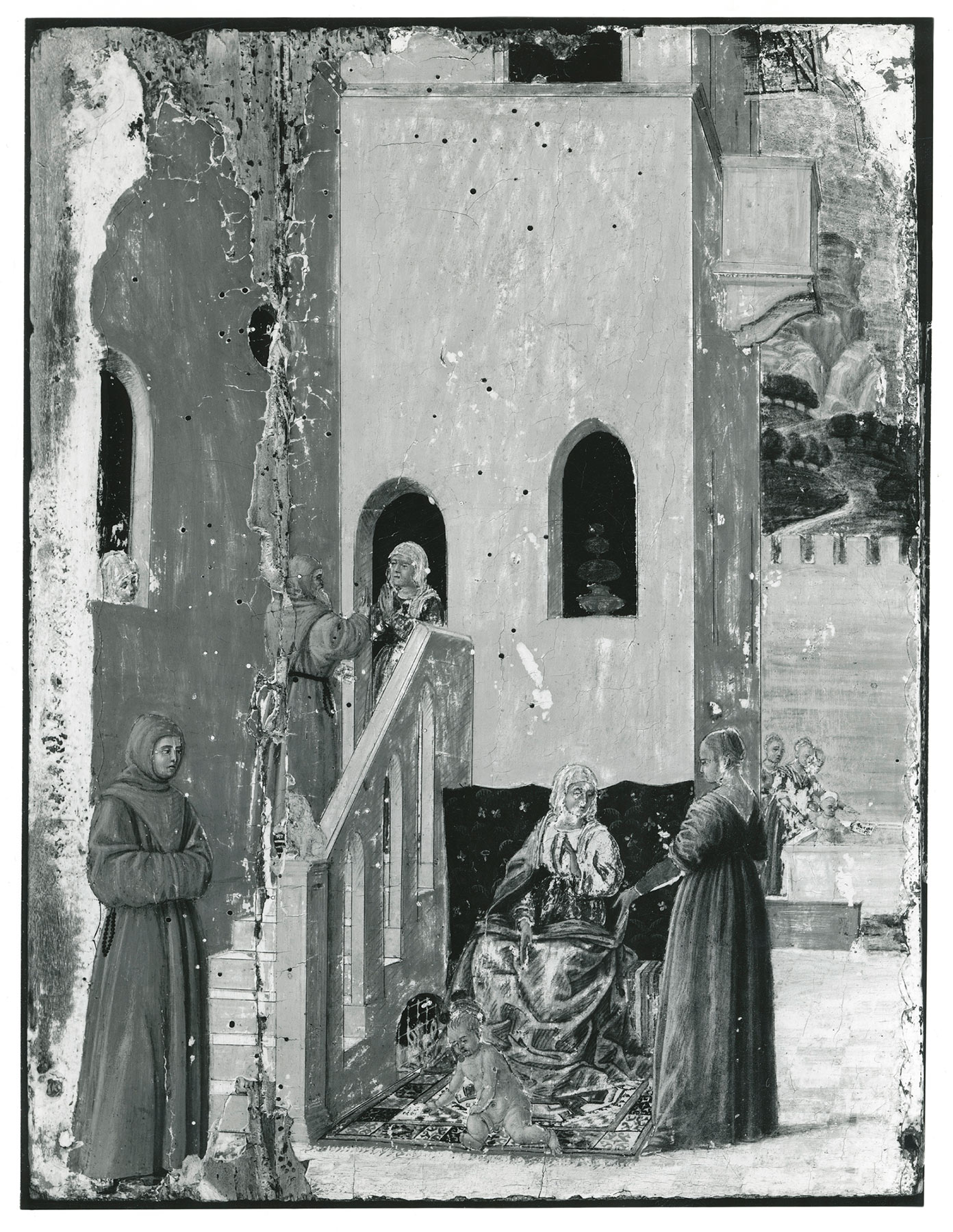
Originally thought to refer to the infancy of Saint John the Baptist,1 this unusual composition was recognized by Bernard Berenson as representing several episodes from the birth and childhood of the famous Dominican preacher and theologian Saint Thomas Aquinas (1225–1274).2 The narrative, unique in Italian painting, follows the first official biography of the saint, the Ystoria sancti Thomae de Aquino, compiled by the Dominican friar William of Tocco in 1318 to support the saint’s canonization, approved in 1323.3 Combining legend and hearsay with historical recollections, the Ystoria begins by narrating how Thomas’s birth was prophesized to his mother, Lady Theodora, at Roccasecca, the fortified stronghold of his family, the counts of Aquino, in the mountains of today’s Lazio region. According to the legend, an old hermit friar named Bono (or Good), renowned for his sanctity, appeared to Lady Theodora in a vision and told her she would bear a child named Thomas, who would be entrusted to the care of the nearby Benedictine abbey of Montecassino until God would direct him to join the Dominican order of preachers, becoming its most brilliant scholar and teacher. The castle of Roccasecca is alluded to in the Yale panel by the imposing, meticulously drawn architectural complex of pink stone, set against a mountainous landscape with a narrow road on the right winding its way up toward a rocky outcrop. On the left of the composition, a young anchorite monk in gray habit stands at the base of the stairs leading up to the castle’s entrance, where his older, bearded companion, Bono, delivers the message to Thomas’s mother, who has her hands joined in prayer.4 In the background below the crenellated walls is a reference to a subsequent episode described in the Ystoria, which recounts how one day Lady Theodora took her son, accompanied by his wet nurse and other women, to the public baths near Naples; placed on the ground before being bathed, the infant picked up a piece of parchment inscribed with the angelic salutation to the Virgin, Ave Maria, and refused to let go of it even while he was being washed. In the background of the painting, the baby Saint Thomas, depicted with a halo, is shown standing in a rectangular stone bath, attended by his wet nurse and two other women, who try to take from him a white note, once inscribed with the words “AVE MARIA GRATIAE”—now only partially legible. The foreground scene appears to illustrate the next passage in William of Tocco’s account, describing how the wet nurse brought the child home to his mother, who pried open his hand to discover the parchment. Lady Theodora is seated on a colorful bench against a flowered tapestry while her son frolics on an elegant Oriental rug at her feet, one hand reaching again for the inscribed note; his wet nurse is engaged in conversation with Theodora, possibly discussing the infant’s odd behavior. As William of Tocco relates, “From this time on it became the child’s extraordinary habit—one instilled by divine inspiration rather than acquired by repeated behavior—that whenever he began to cry for any reason, he would not be comforted by any of his nurse’s coddling until he could lay hold of a piece of parchment. Immediately after he received one, he would put it into his mouth. By this it seemed to be divinely foreshown that the boy’s discerning rumination upon the Scriptures would precede everything that he set out in writing.”5 The significance of the parchment as “the first stroke of our salvation,” in William’s terms, is reiterated in the Yale scene by the inclusion of two white rabbits in a hatch below the staircase—a symbol of rebirth and the Resurrection, according to Saint Ambrose. These allusions and the depiction of the infant Thomas as a Christ Child parallel William of Tocco’s efforts to articulate the events in the Ystoria in biblical terms, beginning with the announcement of Thomas’s birth, cast as another “salvific event” for the good of the Church.6
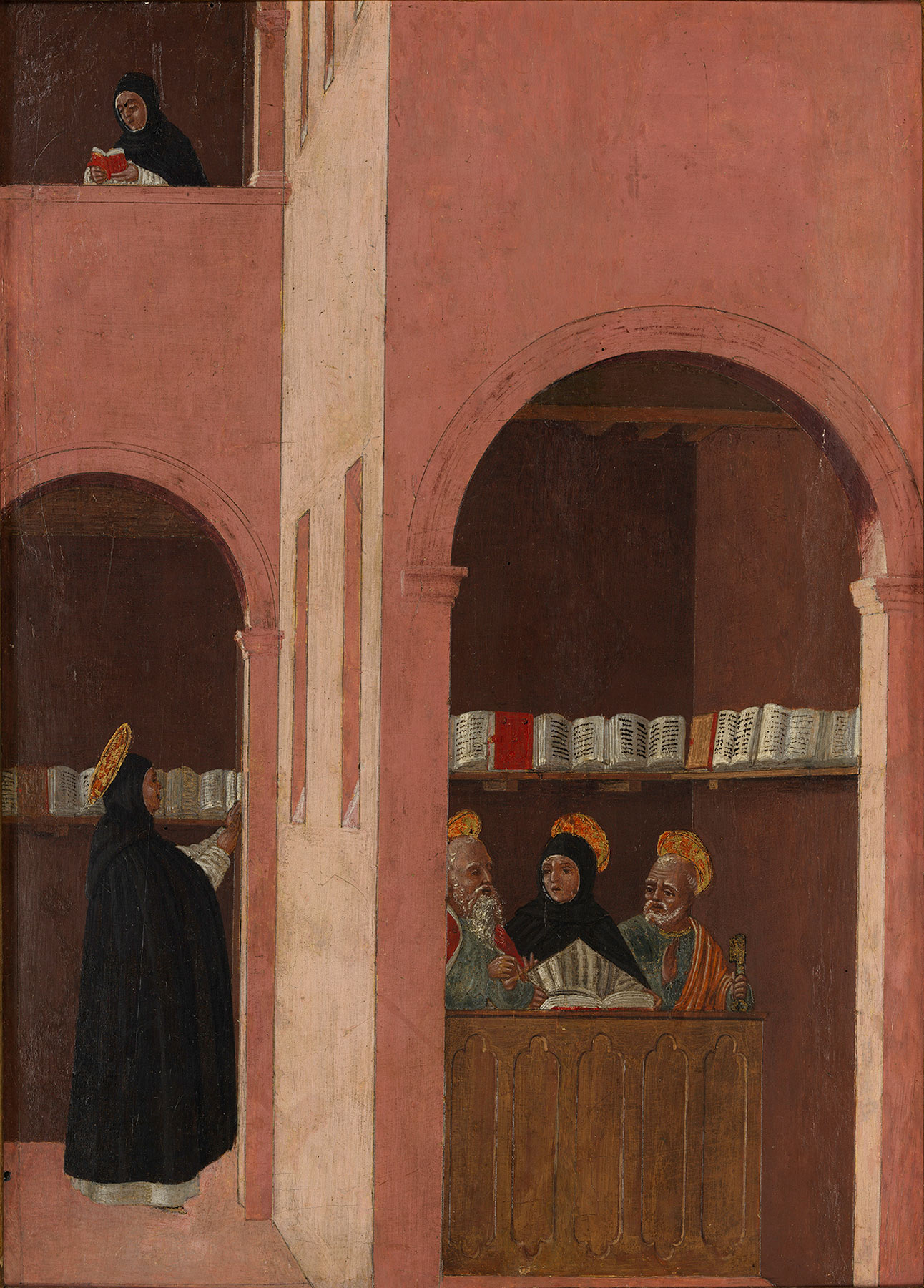
The Yale picture was acquired by James Jackson Jarves—who, at the time, already referred to its “injured” state—as a fragment of Masaccio’s famous altarpiece for the church of Santa Maria del Carmine in Pisa.7 The attribution to Masaccio persisted throughout the nineteenth century, until Osvald Sirén proposed the name of Alesso Baldovinetti, with a date around 1450.8 In 1923 Bryson Burroughs,9 who described the Yale picture as a “Scene from the Infancy of a Saint,” identified the same hand in a recently acquired panel in the Metropolitan Museum of Art, New York, showing Saint Thomas Aquinas aided in the interpretation of Scripture by Saints Peter and Paul (Ystoria, chapter 31) (fig. 2), and in two other scenes: The Miracle of Saint Dominic Resuscitating Napoleone Orsini, also in the Metropolitan Museum;10 and Saint Vincent Ferrer Preaching, in the Ashmolean Museum, University of Oxford.11 While leaving open the issue of attribution, Burroughs noted Berenson’s identification of the Metropolitan Miracle of Saint Dominic and the Oxford Saint Vincent Ferrer Preaching as works of Domenico Morone. The North Italian components of these images had already been recognized by Wilhelm Suida in 1909, when he noted that the Oxford picture was by the same hand as a series of twelve scenes from the life of Saint Vincent Ferrer in the Kunsthistorisches Museum, Vienna—which he erroneously thought to refer to the life of Saint Thomas Aquinas—and considered them products of an anonymous follower of Vincenzo Foppa.12 In a seminal 1925 study, Berenson attributed all of the above works to Domenico Morone, with a date between 1480 and 1490, but he separated the Yale Infancy of Saint Thomas Aquinas and the Metropolitan Museum Saint Thomas Aquinas Aided in the Interpretation of Scripture from the Vienna series as fragments of a different altarpiece by the same artist, dedicated to Saint Thomas Aquinas.13 In addition to the Yale and Metropolitan Museum panels, Berenson published four more scenes from the same structure, presently divided between a private collection (fig. 3), the Fine Arts Museums of San Francisco (figs. 4–5), and the National Gallery of Art, Washington, D.C. (fig. 6).14 Based on the vertical format of these works and the traces of Gothic framing elements on the Yale panel, Berenson posited that the dismembered complex had at its center an image of the standing saint framed by episodes from his life.
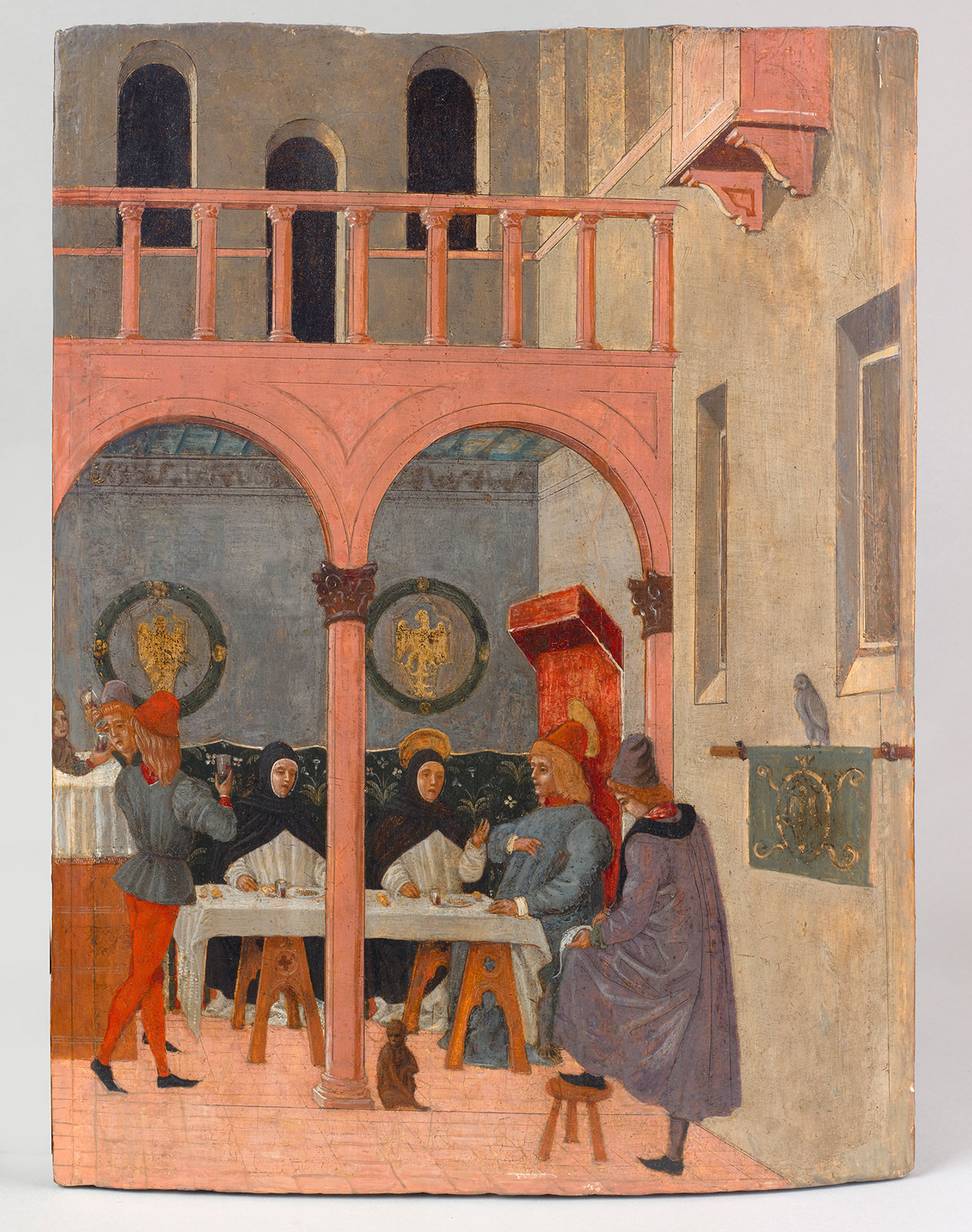
Like the Yale Infancy and Metropolitan Museum Saint Thomas Aquinas Aided in the Interpretation of Scripture, three of the paintings made known by Berenson are clearly derived from events described in William of Tocco’s biography. The first panel, on the art market in 2013 and formerly in the Paravicini collection, Savoy, France (see fig. 3),15 illustrates an event in chapter 43 of the Ystoria, recounting how Saint Thomas and his prior in Paris were invited to dine at the table of the canonized king Saint Louis of France, who was so impressed by Thomas’s ability to remove his mind from the frivolity of the banquet to contemplate theological questions that he ordered his secretary to write down the theologian’s thoughts for posterity. The painting shows Saint Louis seated at the head of a table placed in the open loggia of a palace. To the king’s right is Saint Thomas, flanked by his prior. Thomas is shown with raised hand, in the act of expostulating, as the king’s scribe, his back to the viewer and knee raised for support on a stool, takes notes on a piece of parchment. Against a wall in the background are two coats of arms, one of which, as noted by Berenson, is clearly recognizable as the Este eagle.
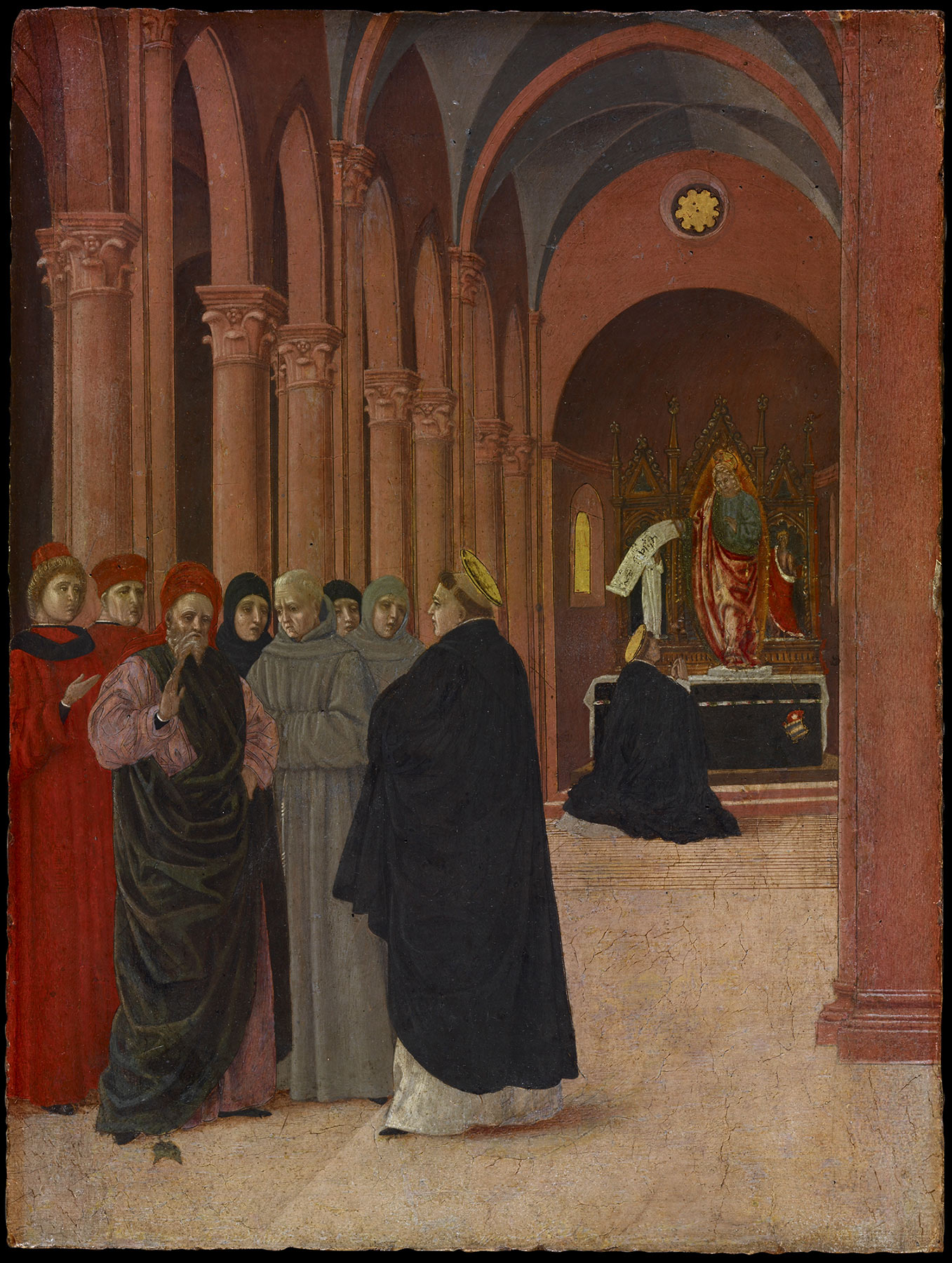
The second image, in the Fine Arts Museums of San Francisco (see fig. 4), has traditionally been thought to represent Thomas Discussing Theology in Naples or Thomas Debating with a Heretic, in the foreground; and Christ Approving Thomas’s Work, with the famous words Thoma bene scripsisti de me (You have written well of me, Thomas), in the background.16 The Miracle of Christ Speaking to Thomas, however, appears twice in the Ystoria. The episode most commonly referred to by scholars is that of the Crucified Christ addressing the saint while he is alone in prayer in the church of the Dominican convent in Naples, an event witnessed by Brother Dominic of Caserta (chapter 34). The San Francisco painting, however, follows closely William of Tocco’s later account of a similar vision (chapter 52), specifically related to Thomas’s writings on the Eucharist. In this chapter, William of Tocco explains how all the “masters of Paris,” who were in disagreement about the proper way to describe the mystery of transubstantiation, decided to go to Thomas to resolve the issue and asked him to provide them with a “magisterial definition” that would be accepted by them all as “true.” After being presented “with everything that each master had written about the question,” William of Tocco continues, Thomas wrote down his own arguments, but since
he did not presume to offer his solution to the school in the presence of the masters without first consulting Christ about the question, he went before the altar beseeching the Lord to instruct him, and there he placed the parchment on which he had written about this question as if before his Master. He then lifted his hands to the Crucifix and prayed. . . . While the doctor was thus engaged in prayer, Reginald and some other brothers were observing him, when suddenly they saw Christ standing before the friar above the parchment that he had written, and He said to Friar Thomas: “you have written well about the sacrament of My body, and you have made a true determination about the question that has been proposed to you.”
In a manner that closely adheres to the last passage, the San Francisco panel shows the full-length figure of Christ with his feet firmly planted on the volume placed by the saint on the altar table. In his right hand is a scroll inscribed “[BE]NE [SCRI]PSISTII.” In the foreground are the university masters who petitioned Thomas, as well as two Franciscan and two Dominican friars, as if to emphasize the consensus over his eucharistic philosophy.
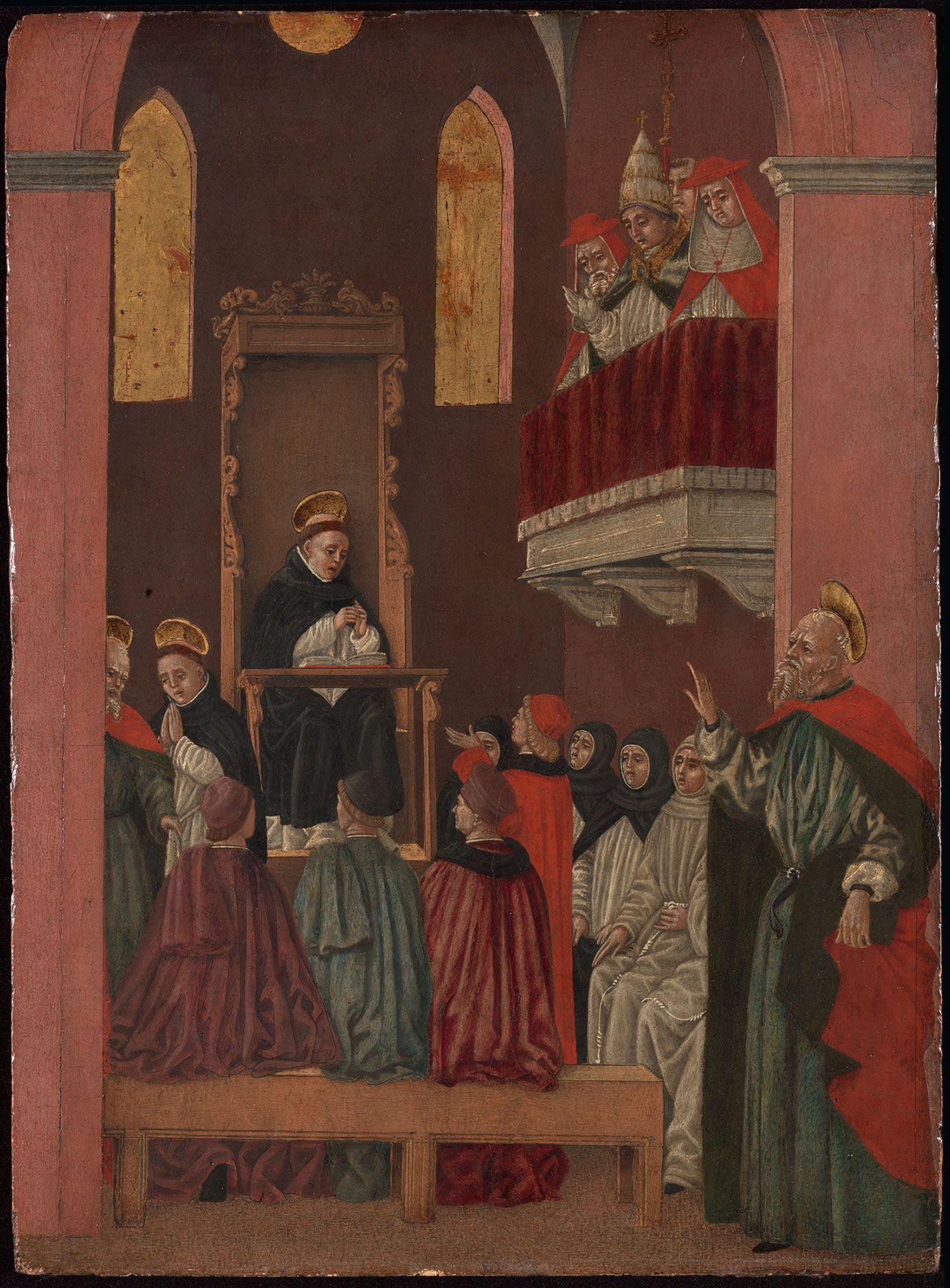
As recognized by Berenson, the third panel, also in San Francisco (see fig. 5), illustrates the vision of Fra Paolino of Aquila, who had a premonition of the saint’s death while Thomas was lying ill in the Cistercian abbey of Fossanova, where he had stopped to rest on his way to Rome. According to chapter 60 of the Ystoria, Brother Paolino had a vision in which he saw the saint lecturing before a multitude, when Saint Paul, to whom Thomas was especially devoted, entered the classroom. Upon giving his approval to Thomas’s lesson on Paul’s Epistles, the apostle asked that the theologian accompany him to a place where he would gain a clearer understanding of all things, seeming “to draw Thomas along by the cloak, leading him out of the lecture hall.” The vision made Brother Paolino cry out that Thomas was being taken away from them, and shortly thereafter they received news of Thomas’s death at Fossanova. Once more, the artist has closely followed William of Tocco’s text: Saint Thomas is seated at a lectern before a varied audience that includes lay scholars, Dominican and Franciscan friars, and a pope attended by his cardinals in a gallery above the lecture hall. Saint Paul is painted twice: on the right, giving his assent to Thomas’s exposition, and again on the left, pulling Thomas out of the room by grabbing his cloak.
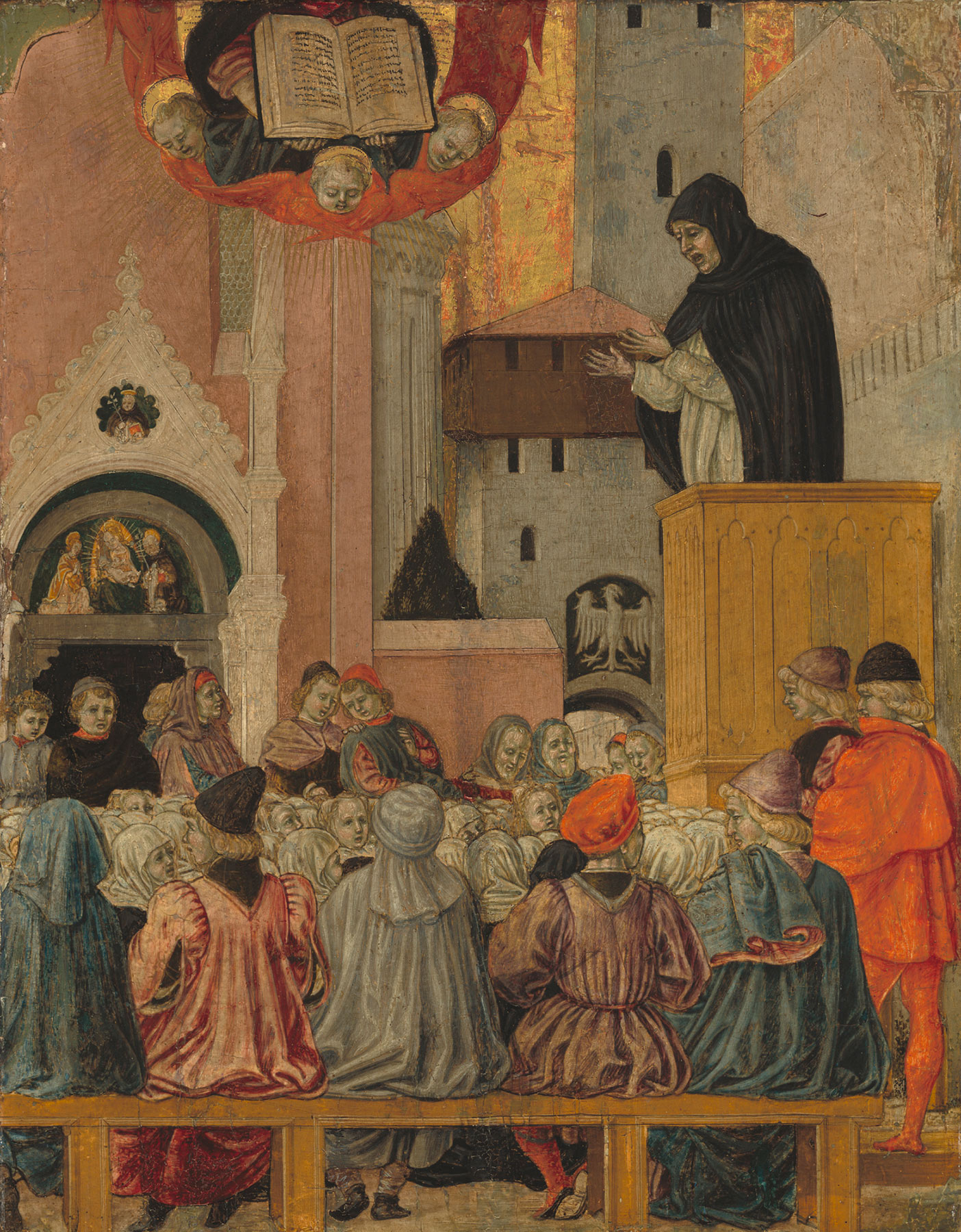
The fourth panel published by Berenson, in Washington (see fig. 6), was briefly described in a footnote by the author, who saw it when it was still in the Lazzaroni collection in Rome, as “Saint Thomas Preaching.”17 The subject of this image has been questioned by some critics, however, who have observed that the Dominican speaking before a crowd in front of a Dominican church—clearly identified by the presence of Saint Dominic in the sculptural group above the portal and again in the medallion above—does not have a halo, as in all the other episodes in the series, and is therefore probably not a saint.18 The panel, truncated at the top, originally showed the figure of God the Father surrounded by cherubim holding open a large volume. It has been suggested that the book could refer to the writings of Saint Thomas Aquinas, rather than a volume of Scripture, held up by God as a model for the aspiring preacher.19 Above an arched entrance to the palace on the right of the composition is the Este eagle, already seen in the ex-Paravicini panel (see fig. 3).
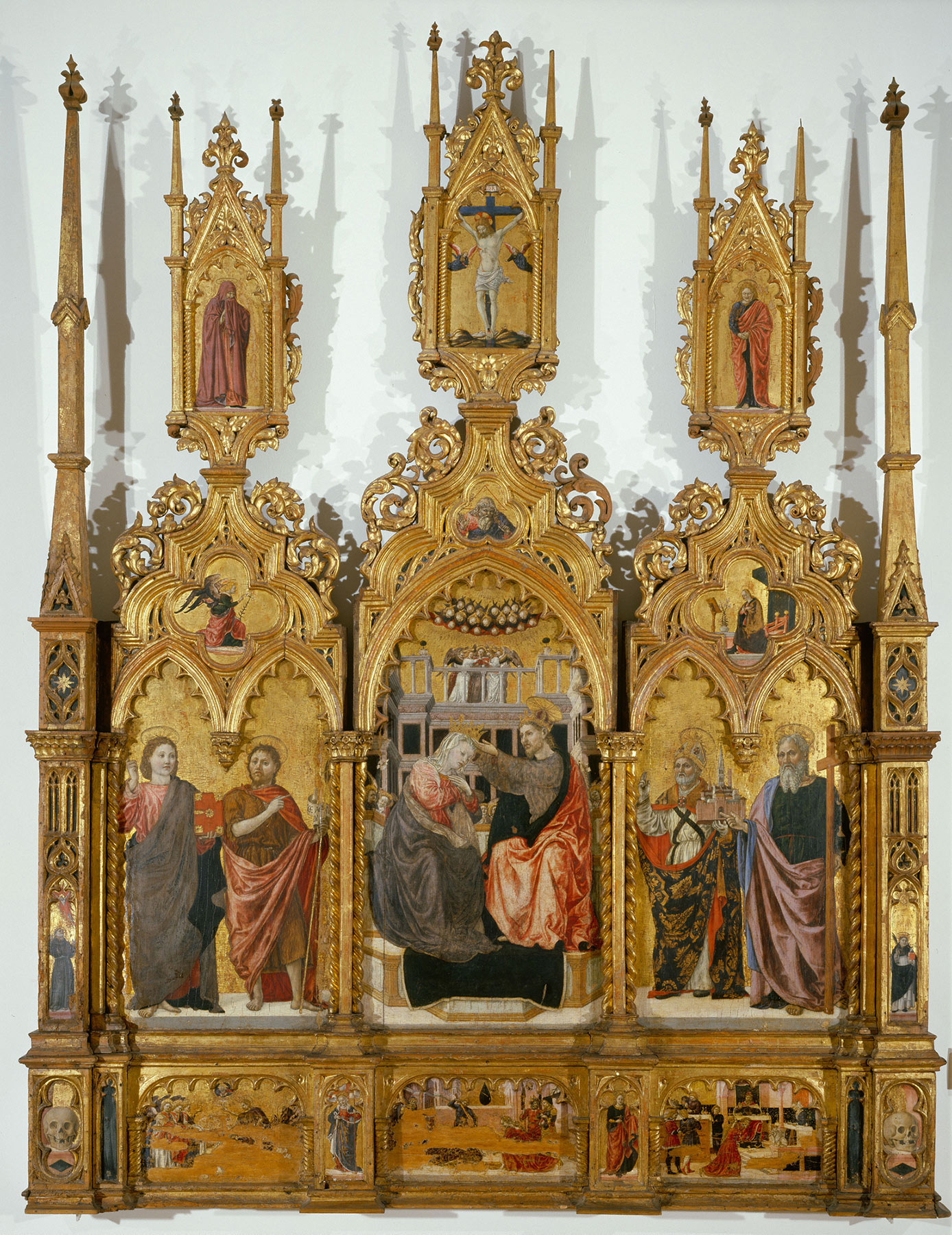
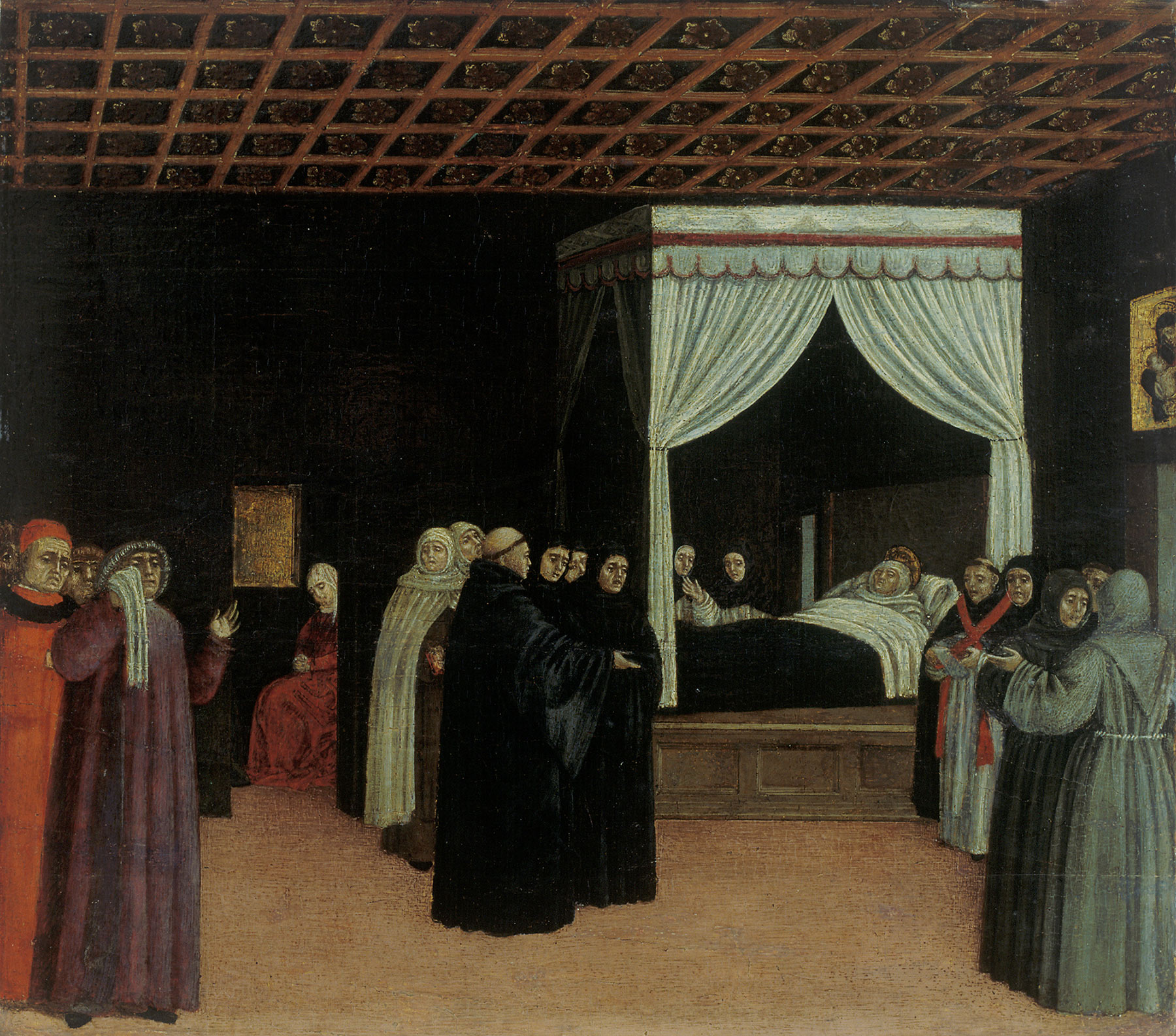
Contemporary to Berenson’s 1925 study, Adolfo Venturi, who was not aware of Berenson’s attributions to Morone, discussed the Saint Vincent Ferrer series in Vienna within the context of Modenese instead of Veronese quattrocento painting, linking the figure types to those in the Coronation of the Virgin with Saints painted by Agnolo and Bartolomeo degli Erri between 1462 and 1466 for the Confraternity of San Giovanni Battista della Buona Morte in Modena (fig. 7).20 Venturi, who drew a distinction between the hands of the two brothers, assigned all the panels in the Vienna series to Agnolo, tentatively identifying them with the “many small pictures seen in San Domenico in Modena, in the church next to the Este palace.”21 In 1929 Suida, followed shortly thereafter by Evelyn Sandberg-Vavalà, extended Venturi’s attribution to the Saint Thomas Aquinas series.22 Suida also added a seventh panel to the group, The Death of Saint Thomas Aquinas in the Moravská Galerie, Brno, Czech Republic (fig. 8), whose rectangular format suggests that it was located, like a predella, below the image of the standing saint. The composition appears to conflate the accounts of Thomas’s illness with those of his funeral as told in the Yistoria (chapter 62), where William of Tocco describes the number and variety of mourners who gathered to pay their last respects. The saint is shown laying on his deathbed in the abbey of Fossanova, as a Dominican brother administers the last rites. He is surrounded by Dominican friars as well as members of the Franciscan order: “A great many friars of Thomas’ Order,” his biographer relates, “were present at these burial rites, having gathered there from many priories to visit their dead brother. Present as well was Msg. Francis of the order of Friars Minor, bishop of Terracina, with many friars of his order.” The Brno painting shows a Franciscan brother with his back to the viewer engaged in conversation with a Dominican monk. In the center, behind another group of presumably Dominican monks, are two friars wearing a white cloak over a brown tunic, perhaps Carmelite brothers.23 Two of Thomas’s lay relatives, “noblemen from Campania,” appear on the left of the composition, one of them shown in the act of drying his tears. Seated in prayer in a separate room in the background is Thomas’s niece Lady Francesca, who tended to him when he first fell ill at her castle in Maenza, before he was transferred to the nearby abbey of Fossanova (chapter 56). She is the only woman named by William of Tocco as having been present at Thomas’s funeral; “not daring to enter the monastery,” she asked for his body to be brought to the abbey gate so that she and other women could lament over him.24
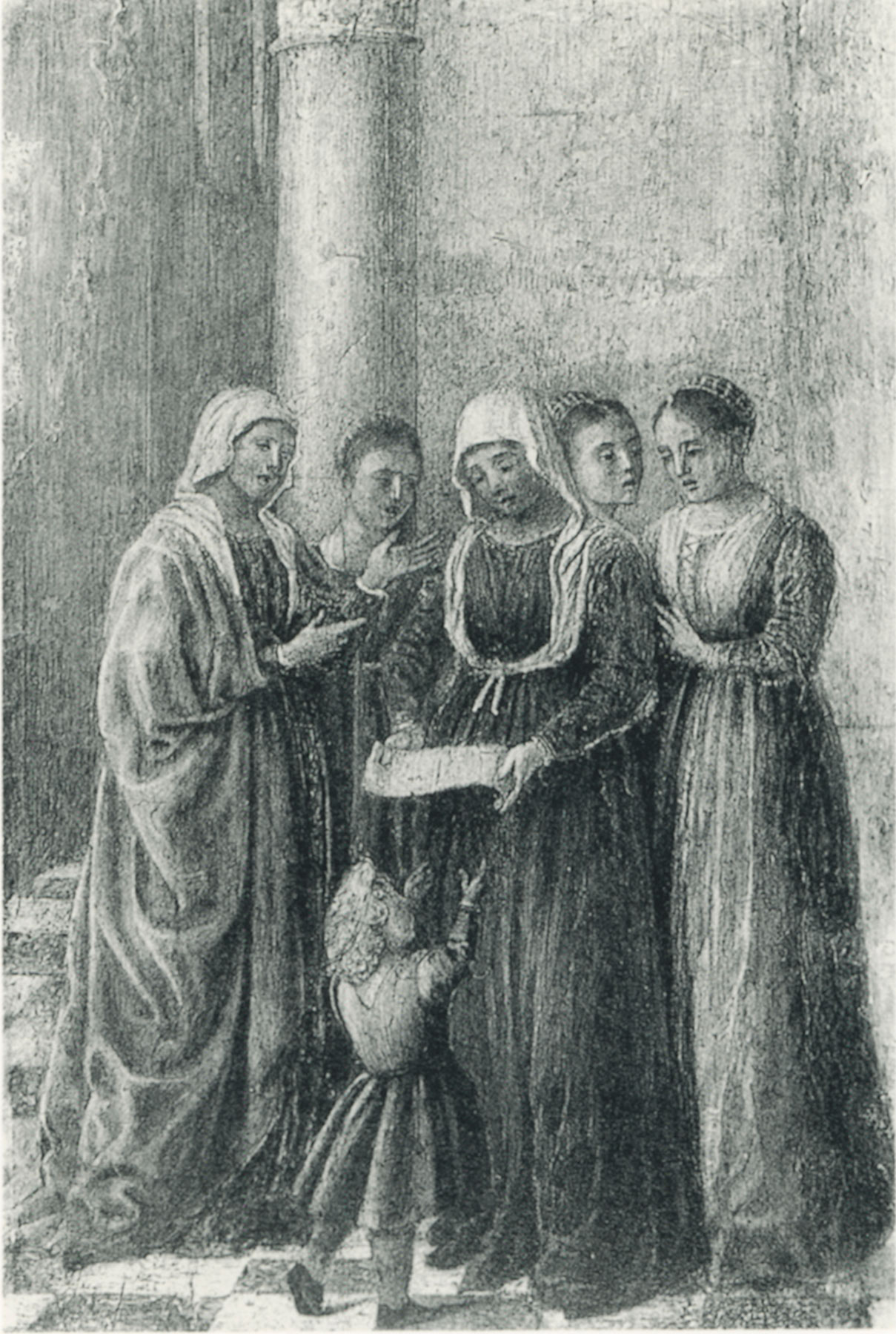
In 1939 Ludovico Ragghianti firmly established the Modenese context for the Vincent Ferrer and Thomas Aquinas series and suggested that they might both be associated with the altarpieces seen by Giorgio Vasari in the chapels of the rood screen of San Domenico in Modena.25 “Among the Modenese, also,” Vasari had written in the 1568 edition of his Lives, “there have been at all times craftsmen excellent in our arts, as has been said in other places, and as may be seen from four panel-pictures, of which no mention was made in the proper place because the master was not known; which pictures were executed in distemper a hundred years ago in that city, and, for those times, they are painted with diligence and very beautiful. The first is on the high altar of San Domenico and the others in the chapels that are in the tramezzo of that church.”26 The subject of the four altarpieces was clarified by the seventeenth-century local historian Lodovico Vedriani, who recorded that, by then, the high altarpiece had been transferred to the choir, while the other three—dedicated to Saints Thomas, Peter Martyr, and Vincent Ferrer, all “subdivided into events and miracles from the saint’s lives” (inquartate tutte delle attioni, e miracoli suoi)—were on the rood screen.27 By the time Ragghianti was writing, the altarpiece of Saint Peter Martyr had already been identified by eighteenth-century scholars with the virtually intact dossal of Saint Peter Martyr, showing the saint surrounded by nineteen scenes from his life, in the Pinacoteca Nazionale, Parma (fig. 9)—a work that Armando Quintavalle had attributed to a fictitious “Simone Lamberti,” based on his reading of a presumed signature and the date 1450 in one of the episodes.28 While accepting the attribution of the Parma dossal to “Lamberti,” Ragghianti assigned the Thomas Aquinas and Vincent Ferrer series to the Erri workshop—without distinguishing between the two brothers. Ragghianti placed the execution of all three altarpieces between around 1450 and 1480, specifying, however, that a date “closer to 1460 than ’80” was suggested by the proximity of the Yale Infancy, the Washington Dominican Preaching (see fig. 6), and the San Francisco Vision of Fra Paolino (see fig. 5) to the predella and pilaster saints of the Modena Coronation of the Virgin (see fig. 7).29 In the same study, Ragghianti published another panel possibly related to the Thomas Aquinas series, formerly in the Schweitzer collection, Berlin (fig. 10).30 The painting, which shows a young child with a halo offering a scroll to a noblewoman surrounded by her attendants, has been interpreted as a companion to the Yale Infancy, with Thomas as a toddler handing the same inscribed parchment to his mother.31 The badly damaged state of the panel does not allow for any firm conclusions, however, nor does the subject matter, which does not follow the thread of events described in the Ystoria.
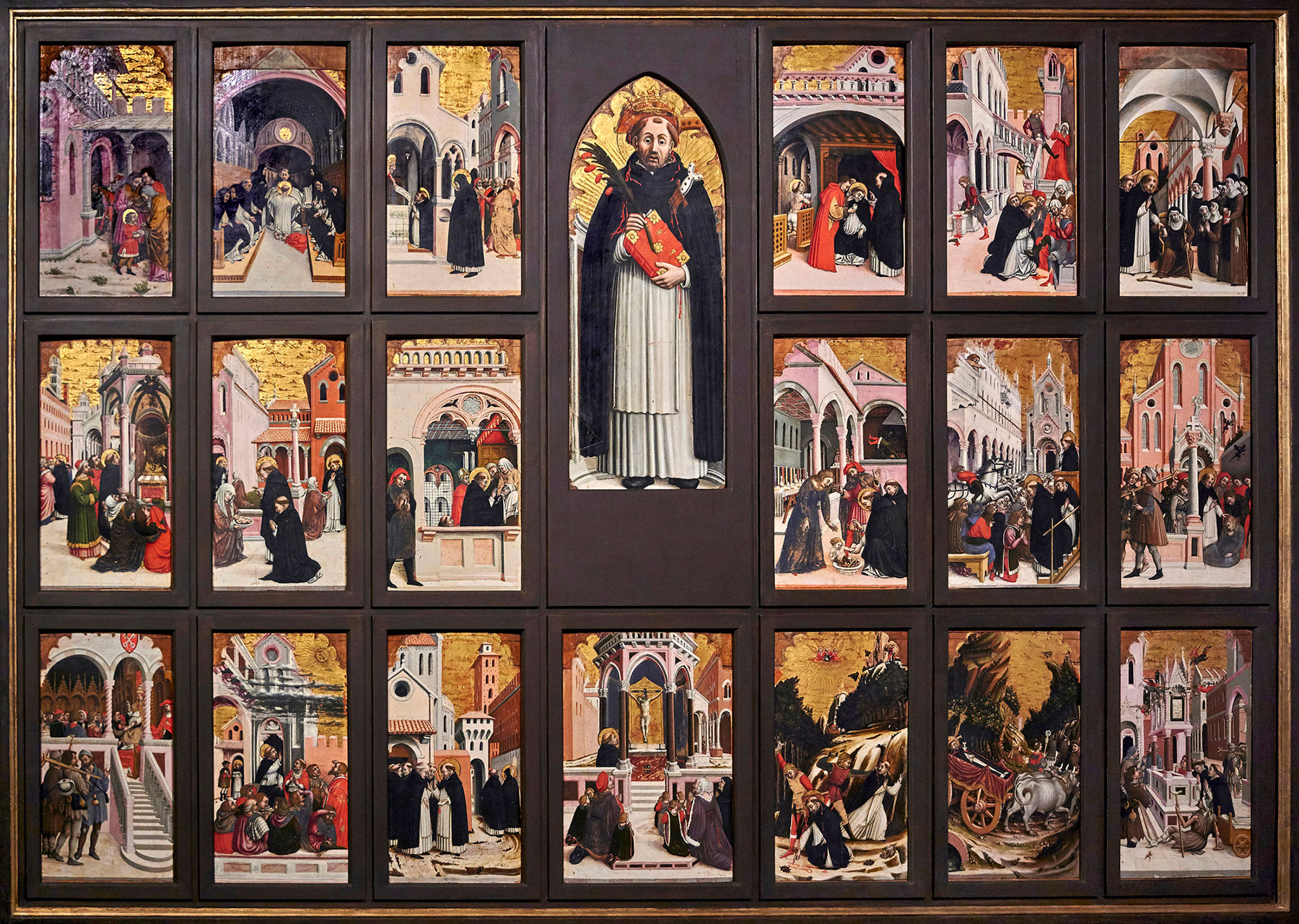
Ragghianti’s study, and the confirmation of the altarpieces’ provenance from San Domenico, set the stage for the ongoing debate over the division of hands in the Erri workshop. In the absence of signed works, the reconstruction of the two artists’ activity has always been based primarily on documentary evidence, which records the brothers’ partnership from at least 1460 until Bartolomeo’s death between 1479 and 1480. A division of hands was first attempted by Roberto Longhi,32 who identified the Saint Peter Martyr dossal (see fig. 9) as Agnolo’s earliest effort around 1450 and related to it, as a product of the same artist, the Modena Coronation (see fig. 7) and the Washington Dominican Preaching (see fig. 6); leaving the rest of the panels in the Thomas Aquinas series, and all the others from San Domenico, to Bartolomeo. Longhi’s argument was seemingly confirmed by the subsequent recovery of a 1467 document recording the commission for the high altarpiece of San Domenico to Bartolomeo—although the contract was signed by both artists.33 For Alberto Chiodi, the Metropolitan Miracle of Saint Dominic, identified as the only surviving fragment of the high altarpiece, was to be considered the cornerstone for the reconstruction of Bartolomeo’s activity.34 Emphasizing the central role played by Bartolomeo in the execution of that important commission, Chiodi followed Longhi in attributing the Thomas Aquinas and Vincent Ferrer series to his hand, limiting Agnolo’s intervention to the Washington panel. Chiodi’s discovery of a full-length image of Saint Vincent Ferrer in the Seminario Arcivescovile, Modena, allowed him to reconstruct that dossal, which he dated after the Thomas Aquinas altarpiece, as the last work executed by Bartolomeo before his death in 1479/80.
Longhi’s and Chiodi’s position was taken up by most later scholarship, including Charles Seymour, Jr., who catalogued the Yale Infancy of Saint Thomas Aquinas as a work of Bartolomeo, with a date around 1470.35 Burton Fredericksen and Federico Zeri, on the other hand, preferred to list the Metropolitan Miracle of Saint Dominic and all of the paintings in the Thomas Aquinas group, including the Washington panel (see fig. 6), under the names of both brothers.36 This opinion was revised in Federico Zeri and Elizabeth Gardner’s 1986 Metropolitan Museum catalogue, however, where the execution of all the Thomas Aquinas scenes, except for the Washington panel, were assigned to Bartolomeo.37 Following a 1980 verbal opinion of Keith Christiansen,38 Zeri and Gardner considered the Thomas Aquinas complex the earliest of the artist’s three altarpieces for San Domenico, with a date before 1467. Like Berenson and Suida before them, the same authors also highlighted the relevance of the Este eagle in the ex-Paravicini (see fig. 3) and Washington episodes and suggested that this work may have been commissioned by some member of the Este family.
In 1985 Massimo Ferretti proposed a radical revision of Longhi’s premise, and refuting the notion of a division of hands, he proposed that the brothers’ output should be evaluated in terms of the progressive evolution of a single workshop rather than an individual, over the course of three decades.39 Ferretti’s approach formed the basis for Daniele Benati’s 1988 monograph on Agnolo and Bartolomeo, appositely titled La bottega degli Erri (The Erri Workshop).40 In it the author accepted the attribution of the high altarpiece of San Domenico to Bartolomeo but labeled all the brothers’ remaining production as workshop. Benati prefaced his discussion of the Saint Thomas Aquinas altarpiece by emphasizing the difficulties inherent in comparing the various scenes, many of which, beginning with the irreparably damaged Yale Infancy, were altered by modern interventions. These qualifications aside, the author followed Ferretti in positing that any discrepancies between the panels were due primarily to chronological differences and a progressively more “experimental” approach in the Erri workshop. Underlying Benati’s arguments, however, was a conviction of the supremacy of Bartolomeo in the brothers’ joint enterprise and the assumption that he was, in fact, the main author of the Modena Coronation of the Virgin (see fig. 7).41 During the seventh and eight decade, Benati argued, the expressive concerns of the Coronation gradually gave way to an increased interest in perspectival effects and architectural solutions influenced by local developments in Modenese art and, above all, the illusionistic conceits of the intarsia masters Lorenzo and Cristoforo Lendinara.42 According to this chronological interpretation, the closer allegiance of the Washington scene (see fig. 6) to the Coronation could be explained as a function of its earlier execution in a commission that probably began soon after the completion of the Modena polyptych in 1466 and was protracted into the early 1470s. Benati’s dating was seemingly confirmed by his identification of the arms of the Rangoni, an illustrious Modenese family, on the shield held up by the miniature lion atop the staircase in the Yale Infancy of Saint Thomas and again on the face of the altar in the eucharistic episode in San Francisco (see fig. 4).43 The Rangoni, who had a palace in proximity to the church of San Domenico, were especially tied to the church, where several members of the family had their burial. In 1467 Gaspare Rangoni dictated in his will that he wished to be buried in San Domenico before the altar of the Virgin, asking that two headstones be placed there to remember him and his mother, whose remains were on the other side of the church. Benati concluded that work on the Thomas Aquinas altarpiece, commissioned by an unknown member of the Rangoni family—if not Gaspare Rangoni himself—was probably carried out in tandem with that on the high altarpiece of San Domenico, begun in 1467. Based on stylistic evidence, the author suggested that its completion significantly predated that of the high altarpiece, however, which was still unfinished in 1480.44
Benati’s thesis was embraced, for the most part, by Andrea De Marchi, who did not distinguish between the hand of the two brothers in the Thomas Aquinas dossal but maintained Longhi’s attribution of the Coronation of the Virgin to Agnolo.45 In the most recent examination of the Thomas Aquinas series, however, Joseph Manca reiterated Longhi’s division of hands and attributed the Washington Dominican Preaching to Agnolo, emphasizing the different approaches of the two brothers to both spatial and luministic effects.46 Manca concurred with a dating of the Saint Thomas Aquinas altarpiece around 1470.
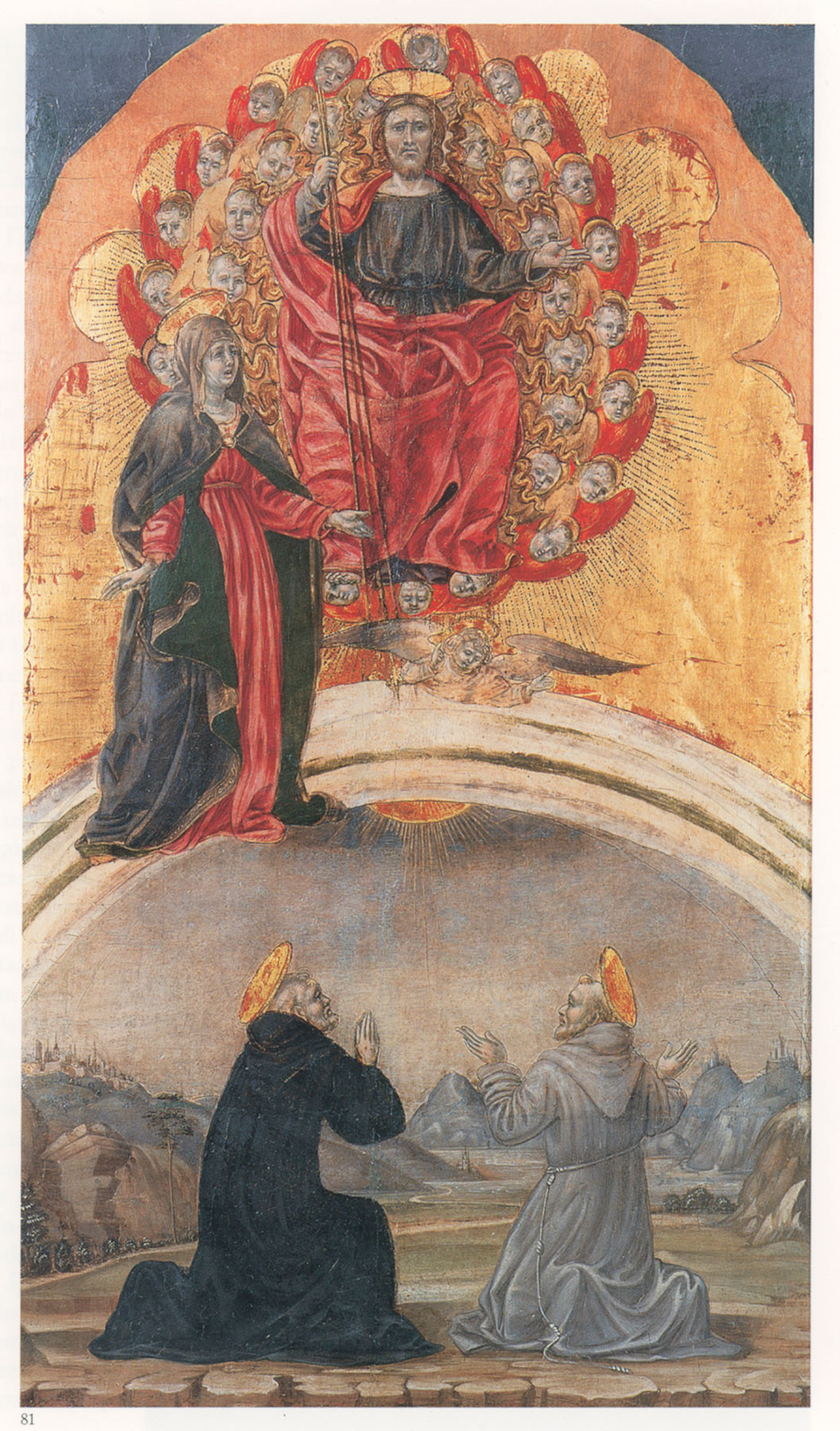
As highlighted by past opinion, the Modena Coronation of the Virgin (see fig. 7) has dictated much of the discourse surrounding the Saint Thomas Aquinas altarpiece and the nature of the Erri brothers’ collaboration. Although the first payments for this work, in 1462, are registered to Agnolo, it is Bartolomeo who receives the final adjustments in 1466. The differing interpretations of these documents, coupled with the undoubted homogeneity of this work, underlies the various opinions in favor of one or the other painter. Based on visual evidence alone, it seems all but certain that the Coronation was executed by a single personality, who was undoubtedly also responsible for the Washington Dominican Preaching (see fig. 6). Some of the figure types in the main panel of the polyptych, like that of Saint John the Evangelist, as well as those in the predella, are clearly recognizable among the frontally facing bystanders in the background of the Washington scene, defined by the same restless mood and agitated lines. As first suggested by Longhi,47 this hand is also recognizable in a panel formerly in the Gozzadini collection, now in a private collection in Bologna (fig. 11), which shares the vertical format of the Thomas Aquinas scenes and bears traces of identical Gothic framing elements. The fragment, which shows Saints Dominic and Francis kneeling in adoration below the Virgin interceding before Christ, illustrates a vision of Saint Dominic on the eve of his meeting with Saint Francis. Notwithstanding the doubts expressed by Benati,48 there is no reason to preclude the possibility that this work, which must be excluded from the Thomas Aquinas series on the basis of subject matter, could be the pinnacle of the San Domenico high altarpiece.49 The loose, undisciplined drawing technique of the Coronation and Washington scene has become an energetic frenzy in the ex-Gozzadini panel, possibly executed in the mid-1470s, when the workshop was receiving several payments for the high altarpiece.
The innately different approaches of the two brothers are highlighted by the comparisons between the Washington panel and the San Francisco Vision of Fra Paolino (see fig. 5), which repeats the motif of the seated listeners viewed from behind. Beyond the more elongated figural proportions and uniform expressions, the San Francisco panel is distinguished, above all, by a careful, meticulously controlled draftsmanship that cannot but be viewed as an indicator of an altogether different artistic sensibility—one more suited to the precise representation of architectural settings than the vivid expression of emotional content. The spatial clarity of the San Francisco fragment—and of all the other panels from the same altarpiece, including the Yale Infancy—moreover, is entirely at odds with the compressed setting of the Washington episode (see fig. 6). As pointed out by Christiansen, these works reveal a personality that is fully conversant with a new style of narrative painting, based on Albertian precepts, in which architecture is put in the service of storytelling to represent a given subject “in the clearest possible terms.”50 The preponderance of circumstantial evidence suggests, as it has to many other scholars, that this more rational approach, which reached its zenith in the elaborately conceived interiors of the Vincent Ferrer altarpiece, reflects the hand of Bartolomeo, presumed to be the younger and more modern of the two brothers, but the surviving documentary evidence does not allow for any certitude. As a result, the attribution to “Agnolo and Bartolomeo degli Erri” should be considered a label of convenience that, while reflecting the collaborative nature of the enterprise, simultaneously acknowledges the different levels of participation in the execution. The distinctions of hands, it must be noted, are not always confined to different scenes in the Thomas Aquinas series, and it is not inconceivable that some of them may have been painted by more than one artist. Issues of condition aside, while all the other compositions reflect an internal stylistic coherence, the Yale picture, like the ex-Schweitzer childhood scene (see fig. 10), appears to combine the spatial solutions of one artist with the fuller forms and looser handling—especially noticeable in the irregularity of the drapery folds—of the other.
A third personality, belonging in all probability to an older generation than Agnolo and Bartolomeo and christened the “Master of the Saint Peter Martyr Dossal” by Maria Cristina Chiusa,51 was responsible for the earliest of the altarpieces on the rood screen of San Domenico (see fig. 9). Newly discovered documentary evidence suggests a secure terminus post quem of 1449 for that commission, executed for the Modenese merchant and banker Antonio Colombi in fulfillment of his mother’s testamentary bequest.52 The brilliantly colored, engaging stories of Peter Martyr reflect an already fully developed idiom rather than the efforts of a developing artist. The elaborate Gothic structures, inconsistent proportions, and illogical spatial structure, along with the dark, caricatural modeling of the facial features, denote a provincial artist, possibly formed on the example of manuscript illuminators and strongly influenced by Paduan and Ferrarese models. Presumably executed in consultation with the Dominican monks, who most likely determined its subject matter, the Saint Peter Martyr dossal must have dictated the format of the later Saint Thomas Aquinas altarpiece, which shows evidence of similar Gothic framing elements. In the absence of comparable cycles dedicated to the life of Saint Thomas Aquinas, it is impossible to estimate the number of panels that completed the series. If the ex-Schweitzer fragment was indeed part of the same complex, bringing the total number of surviving narrative episodes to eight, it must be assumed that at least one other story is missing, since the original arrangement would have involved four scenes arranged vertically on each side of the saint, with the Death of Saint Thomas Aquinas (see fig. 8) in the predella. But it cannot be excluded that the dossal included as many episodes from the life of the saint as that of Saint Peter Martyr, with thirteen scenes, or that of Saint Vincent Ferrer, with nineteen.
Although Benati was able to associate the coats of arms in the Thomas Aquinas altarpiece with the Rangoni family, the presence of the Este eagle, which does not appear in either of the other two dossals, should also be considered in relation to the chapel’s patronage. The close political ties between the Rangoni and the Este dated back to the thirteenth century and were solidified by the marriage in 1289 between the daughter of Tobia Rangoni, Alda, and Aldobrandino II d’Este, son of Obizzo II d’Este, marquis of Ferrara—a union that had been arranged in exchange for the lordship (signoria) of Modena in 1288.53 It is likely that whoever commissioned the Saint Thomas Aquinas dossal was descended from this particular branch of the Rangoni family. —PP
Published References
Jarves, James Jackson. Descriptive Catalogue of “Old Masters” Collected by James J. Jarves to Illustrate the History of Painting from A.D. 1200 to the Best Periods of Italian Art. Cambridge, Mass.: H. O. Houghton, 1860., 51; Sturgis, Russell, Jr. Manual of the Jarves Collection of Early Italian Pictures. New Haven: Yale College, 1868., 49–50; W. F. Brown, Boston. Catalogue of the Jarves Collection of Early Italian Pictures. Sale cat. November 9, 1871., 18, no. 42; Rankin, William. “Some Early Italian Pictures in the Jarves Collection of the Yale School of Fine Arts at New Haven.” American Journal of Archaeology 10, no. 2 (April–June 1895): 137–51., 147; Breck, Joseph. “Noch ein Beispel für einen Drachen- und Phoenix-Teppich.” Der Cicerone 4, no. 4 (1912): 133–35., 133–35; Sirén, Osvald. “A Picture by Alesso Baldovinetti in the Jarves Collection in New Haven.” Art in America 2, no. 3 (1914): 235–40., 235–40; Sirén, Osvald. A Descriptive Catalogue of the Pictures in the Jarves Collection Belonging to Yale University. New Haven: Yale University Press, 1916., 107–10, no. 41, fig. 41; Burroughs, Bryson. “A Fifteenth-Century Italian Panel.” Metropolitan Museum of Art Bulletin 18, no. 11 (November 1923): 242–44., 243–44; Berenson, Bernard. “Nove pitture in cerca di un’attribuzione.” Dedalo 5, no. 10 (1925): 601–42; no. 11 (1925): 688–722; no. 12 (1925): 745–75., 601–42, 688–722, 745–75, fig. 1, reprinted in Berenson, Bernard. Three Essays in Method. Oxford: Clarendon, 1927., 1–71, fig. 1; Offner, Richard. Italian Primitives at Yale University: Comments and Revisions. New Haven: Yale University Press, 1927., 34; Erdmann, Kurt. “Orientalische Tierteppiche auf Bildern des XIV und XV Jahrhunderts: Eine Studie zu den Anfängen des orientalischen Knüpfteppichs.” Jahrbuch der preußischen Kunstsammlungen 50 (1929): 261–98., 284, 289–90, fig. 33; Suida, Wilhelm. “Einige italienische Gemälde in Landesmuseum zu Brünn.” Belvedere 8 (1929): 255–58., 256; Berenson, Bernard. Italian Pictures of the Renaissance: A List of the Principal Artists and Their Works with an Index of Places. Oxford: Clarendon, 1932., 376; Salmi, Mario. Masaccio. Rome: “Valori Plastici,” 1932., 106; Sandberg-Vavalà, Evelyn. “Francesco Benaglio.” Art in America 21, no. 2 (March 1933): 48–65., 61n12; Berenson, Bernard. Pitture italiane del Rinascimento: Catalogo dei principali artisti e delle loro opere. Trans. Emilio Cecchi. Milan: Ulrico Hoepli, 1936., 232; Ragghianti, Carlo L. “Sul problema Erri-D. Morone.” Critica d’arte 4, no. 1 (January–March 1939): 1–4., 4; Longhi, Roberto. “Ampliamenti nell’officina ferrarese.” Supplement, Critica d’arte 4 (1940)., reprinted in Longhi, Roberto. Officina ferrarese: 1934; Seguita dagli ampliamenti, 1940, e dai nuovi ampliamenti, 1940–55. Edizione delle opere complete di Roberto Longhi 5. Florence: Sansoni, 1956., 169–70n3; Preliminary Catalogue of Paintings and Sculpture: Descriptive List with Notes. Washington, D.C.: National Gallery of Art, 1941., 139; Chiodi, Alberto Mario. “Bartolomeo degli Erri e i polittici domenicani.” Commentari 2 (1951): 17–25., 18, 20; Suida, Wilhelm. The Samul H. Kress Collection. San Francisco: M. H. de Young Museum, 1955., 44, 46; Brenzoni, Raffaello. Domenico Morone, 1438/9 c.–1517 c.: Vita ed opere. Florence: Olschki, 1956., 42; Salmi, Mario. Pittura e miniature a Ferrara nel primo Rinascimento. Cinisello Balsamo, Milan: Silvana, 1961., 37; Berenson, Bernard. Italian Pictures of the Renaissance, A List of the Principal Artists and Their Works with an Index of Places: Central Italian and North Italian Schools. 3 vols. London: Phaidon, 1968., 1:280; Shapley, Fern Rusk. Paintings from the Samuel H. Kress Collection: Italian Schools, XV–XVI Century. London: Phaidon, 1968., 9; Seymour, Charles, Jr. Early Italian Paintings in the Yale University Art Gallery. New Haven: Yale University Art Gallery, 1970., 218–20, no. 164; Fredericksen, Burton B., and Federico Zeri. Census of Pre-Nineteenth-Century Italian Paintings in North American Public Collections. Cambridge, Mass.: Harvard University Press, 1972., 68; Lloyd, Christopher. A Catalogue of the Earlier Italian Paintings in the Ashmolean Museum. Oxford: Oxford University Press, 1977., 20; Kaftal, George. Saints in Italian Art. Vol. 1, Iconography of the Saints in the Painting of North East Italy. With the collaboration of Fasio Bisogni. Florence: Sansoni, 1978., col. 977, nos. 1–3, fig. 1259; Shapley, Fern Rusk. Catalogue of the Italian Paintings: National Gallery of Art. 2 vols. Washington, D.C.: National Gallery of Art, 1979., 1:174; Christiansen, Keith. “Early Renaissance Narrative Painting in Italy.” Metropolitan Museum of Art Bulletin 41, no. 2 (Autumn 1983): 1–48., 21; Zeri, Federico, with Elizabeth E. Gardner. Italian Paintings: A Catalogue of the Collection of the Metropolitan Museum of Art. Vol. 4, North Italian School. New York: Metropolitan Museum of Art, 1986., 15–16; Pujmanová, Olga. Italské gotické a renesanční obrazy v ceskoslovenských sbírkách. Prague: Národní Galerie, 1987., 41; Benati, Daniele. La bottega degli Erri e la pittura del Rinascimento a Modena. Modena: Artioli, 1988., 74, 93–108, 166–67, figs. 68, 75; Chiusa, Maria Cristina. “Sul dossale di San Pietro Martire: Un’ipotesi di lettura.” Bollettino d’arte, 6th ser., 56–57, no. 3 (July–October 1989): 109–34., 110–11, fig. 4; De Marchi, Andrea. “I miniatori padani a Siena.” In Francesco di Giorgio e il Rinascimento a Siena, 1450–1500, ed. Luciano Bellosi, 228–61. Exh. cat. Milan: Electa, 1993., 257; Joseph Manca, in Boskovits, Miklós, and David Alan Brown. Italian Paintings of the Fifteenth Century: The Collections of the National Gallery of Art, Systematic Catalogue. Washington, D.C.: National Gallery of Art, 2003., 257, 260n8, fig. 2; Cannon, Joanna. Religious Poverty, Visual Riches: Art in the Dominican Churches of Central Italy in the Thirteenth and Fourteenth Centuries. New Haven: Yale University Press, 2013., 40, 95; Roberto Cobianchi, in Kennedy, Trinita, ed. Sanctity Pictured: The Art of the Dominican and Franciscan Orders in Renaissance Italy. Exh. cat. New York: Tauris, 2014., 194, 196n7; Malagutti, Laura. “I polittici degli Erri per la chiesa di San Domenico a Modena: Contesto, forma, iconografia.” Ph.D. diss., Università degli studi di Udine, 2021. https://air.uniud.it/retrieve/e27ce0ca-0742-055e-e053-6605fe0a7873/Tesi_Malagutti.pdf., 89
Notes
-
Jarves, James Jackson. Descriptive Catalogue of “Old Masters” Collected by James J. Jarves to Illustrate the History of Painting from A.D. 1200 to the Best Periods of Italian Art. Cambridge, Mass.: H. O. Houghton, 1860., 51; Sturgis, Russell, Jr. Manual of the Jarves Collection of Early Italian Pictures. New Haven: Yale College, 1868., 49–50; W. F. Brown, Boston. Catalogue of the Jarves Collection of Early Italian Pictures. Sale cat. November 9, 1871., 18, no. 42; and Rankin, William. “Some Early Italian Pictures in the Jarves Collection of the Yale School of Fine Arts at New Haven.” American Journal of Archaeology 10, no. 2 (April–June 1895): 137–51., 147. ↩︎
-
Berenson, Bernard. Three Essays in Method. Oxford: Clarendon, 1927., 2–5. ↩︎
-
William of Tocco. Ystoria sancti Thome de Aquino de Guillaume de Tocco (1323). Ed. Claire le Brun-Gouanvic. Toronto: Pontifical Institute of Mediaeval Studies, 1996.. Recently translated into English by David Foley; see William of Tocco. The Life of Saint Thomas Aquinas. Translated by David M. Foley. Saint Marys, Kans., Angelus, 2023.. All quoted passages in this entry refer to this translation. In identifying the subject of the scene, Berenson (in Berenson, Bernard. “Nove pitture in cerca di un’attribuzione.” Dedalo 5, no. 10 (1925): 601–42; no. 11 (1925): 688–722; no. 12 (1925): 745–75.) relied on a seventeenth-century Spanish source for the lives of the saints, the Flos sanctorum of Pedro Ribadeneira (1527–1611), apparently unaware of William of Tocco’s text, on which both Ribadeneira and the later Acta sanctorum (Acta sanctorum: Martii. Vol. 1, pt. 7. Antwerp, Belgium: Société des Bollandistes, 1668., 657–86) relied. ↩︎
-
The episode of Bono may refer to the community of hermits on Monte Pescoloso that was affiliated with the abbey of Montecassino; see William of Tocco. Storia di San Tommaso d’Aquino. Ed. Davide Riserbato Milan: Jaca, 2015., 95n19. The gray habit worn by Bono and his companion recalls that of some of the hermit friars in Fra Angelico’s Thebaid, in the Gallerie degli Uffizi, Florence, inv. no. 1890 n. 447, https://catalogo.uffizi.it/it/29/ricerca/detailiccd/1185128. ↩︎
-
William of Tocco. The Life of Saint Thomas Aquinas. Translated by David M. Foley. Saint Marys, Kans., Angelus, 2023., chap. 4. ↩︎
-
As noted by Foley in his introduction to the English translation of William of Tocco’s text, “The Ystoria strongly impresses upon us the fact that William conceives of reality in biblical terms: episodes from the life of St. Thomas invariably recall scenes of the Old and New Testament to mind. . . . It is William’s sincere belief, and not a literary affectation, that Thomas’s life was a salvific event ordained by God for the good of His Church, standing in perfect continuity with the ages of salvation history presented by Sacred Scripture and the doctrinal labor of the Church Fathers”; William of Tocco. The Life of Saint Thomas Aquinas. Translated by David M. Foley. Saint Marys, Kans., Angelus, 2023., 28. ↩︎
-
Jarves, James Jackson. Descriptive Catalogue of “Old Masters” Collected by James J. Jarves to Illustrate the History of Painting from A.D. 1200 to the Best Periods of Italian Art. Cambridge, Mass.: H. O. Houghton, 1860., 51. ↩︎
-
Sirén, Osvald. “A Picture by Alesso Baldovinetti in the Jarves Collection in New Haven.” Art in America 2, no. 3 (1914): 235–40., 235–40; and Sirén, Osvald. A Descriptive Catalogue of the Pictures in the Jarves Collection Belonging to Yale University. New Haven: Yale University Press, 1916., 107–10, no. 41. ↩︎
-
Burroughs, Bryson. “A Fifteenth-Century Italian Panel.” Metropolitan Museum of Art Bulletin 18, no. 11 (November 1923): 242–44., 242–44. ↩︎
-
Inv. no. 22.60.59, https://www.metmuseum.org/art/collection/search/435616. ↩︎
-
Inv. no. WA1850.18, https://collections.ashmolean.org/object/372326. ↩︎
-
Inv. nos. GG 6691–702; Suida, Wilhelm. “Studien zur lombardischen Malerei del XV. Jahrhunderts.” Monatshefte für Kunstwissenschaft 2, no. 10 (1909): 470–95., 484–85. ↩︎
-
Berenson, Bernard. “Nove pitture in cerca di un’attribuzione.” Dedalo 5, no. 10 (1925): 601–42; no. 11 (1925): 688–722; no. 12 (1925): 745–75.; reprinted in Berenson, Bernard. Three Essays in Method. Oxford: Clarendon, 1927.. ↩︎
-
Berenson, Bernard. Three Essays in Method. Oxford: Clarendon, 1927., 2–8. ↩︎
-
Sale, Drouot-Richelieu and Audap & Mirabaud, Commissaires-priseurs, Paris, November 15, 2013, lot 22. ↩︎
-
Berenson, Bernard. Three Essays in Method. Oxford: Clarendon, 1927., 6; Suida, Wilhelm. The Samul H. Kress Collection. San Francisco: M. H. de Young Museum, 1955., 44; and Kaftal, George. Saints in Italian Art. Vol. 1, Iconography of the Saints in the Painting of North East Italy. With the collaboration of Fasio Bisogni. Florence: Sansoni, 1978., col. 980, nos. 11–12; followed by all subsequent scholars. ↩︎
-
Berenson, Bernard. Three Essays in Method. Oxford: Clarendon, 1927., 8n2. ↩︎
-
Preliminary Catalogue of Paintings and Sculpture: Descriptive List with Notes. Washington, D.C.: National Gallery of Art, 1941., 138–39, no. 547; and Joseph Manca, in Boskovits, Miklós, and David Alan Brown. Italian Paintings of the Fifteenth Century: The Collections of the National Gallery of Art, Systematic Catalogue. Washington, D.C.: National Gallery of Art, 2003., 255–60. ↩︎
-
Manca, in Boskovits, Miklós, and David Alan Brown. Italian Paintings of the Fifteenth Century: The Collections of the National Gallery of Art, Systematic Catalogue. Washington, D.C.: National Gallery of Art, 2003., 258. ↩︎
-
Venturi, Adolfo. Studi dal vero: Attraverso le raccolte artistiche d’Europa. Milan: Ulrico Hoepli, 1927., 137–54. ↩︎
-
Venturi, Adolfo. Studi dal vero: Attraverso le raccolte artistiche d’Europa. Milan: Ulrico Hoepli, 1927., 138. ↩︎
-
Suida, Wilhelm. “Einige italienische Gemälde in Landesmuseum zu Brünn.” Belvedere 8 (1929): 255–58., 256; and Sandberg-Vavalà, Evelyn. “Francesco Benaglio.” Art in America 21, no. 2 (March 1933): 48–65., 61n12. ↩︎
-
Daniele Benati (in Benati, Daniele. La bottega degli Erri e la pittura del Rinascimento a Modena. Modena: Artioli, 1988., 94) took the black-clad monks to be members of the Fossanova community, but one would expect them to be wearing the white habit of the Cistercian order. It could be that the artist, painting two hundred years after Thomas’s death, was indicating the members of the more famous Benedictine community of Montecassino, located in the territory of the Aquino, where the saint received his earliest education. It is more likely, however, that these are Dominican monks and that their white robes are simply hidden by their fastened black cloaks. More puzzling is the presence of Carmelite monks, if indeed it is they who are shown, unless their presence is intended to reflect the magnitude of the event, felt across different monastic communities. ↩︎
-
Although she was identified as Lady Francesca by Olga Pujmanová (in Pujmanová, Olga. Italské gotické a renesanční obrazy v ceskoslovenských sbírkách. Prague: Národní Galerie, 1987., 40), Benati (in Benati, Daniele. La bottega degli Erri e la pittura del Rinascimento a Modena. Modena: Artioli, 1988., 164) thought she was Thomas’s sister, Theodora. ↩︎
-
Ragghianti, Carlo L. “Sul problema Erri-D. Morone.” Critica d’arte 4, no. 1 (January–March 1939): 1–4., 1–7. For the evolution of rood-screen chapels, especially in a Dominican context, see Cannon, Joanna. Religious Poverty, Visual Riches: Art in the Dominican Churches of Central Italy in the Thirteenth and Fourteenth Centuries. New Haven: Yale University Press, 2013., 25–45; and, most recently, Malagutti, Laura. “I polittici degli Erri per la chiesa di San Domenico a Modena: Contesto, forma, iconografia.” Ph.D. diss., Università degli studi di Udine, 2021. https://air.uniud.it/retrieve/e27ce0ca-0742-055e-e053-6605fe0a7873/Tesi_Malagutti.pdf., 35–53 (with previous bibliography). ↩︎
-
Vasari, Giorgio. Le vite de’ più eccellenti pittori, scultori ed architettori. Ed. Gaetano Milanesi. 9 vols. Florence: G. C. Sansoni, 1906., 6:481; and Vasari, Giorgio. Lives of the Most Eminent Painters, Sculptors, and Architects by Giorgio Vasari. 10 vols. Trans. Gaston du C. De Vere. London: Macmillan, 1912–14., 8:37. ↩︎
-
Vedriani, Lodovico. Raccolta de’ pittori, scultori, et architetti modenesi piú celebri. Modena, 1662., 23–24; cited by Benati, Daniele. La bottega degli Erri e la pittura del Rinascimento a Modena. Modena: Artioli, 1988., 70. The old building of San Domenico was virtually destroyed between 1708 and 1710 to make room for the expansion of the ducal palace. The new church was dedicated in 1731. For a history of the first building, see Malagutti, Laura. “I polittici degli Erri per la chiesa di San Domenico a Modena: Contesto, forma, iconografia.” Ph.D. diss., Università degli studi di Udine, 2021. https://air.uniud.it/retrieve/e27ce0ca-0742-055e-e053-6605fe0a7873/Tesi_Malagutti.pdf., 61–81. ↩︎
-
Quintavalle, Armando Ottavio. “Precisazione e restauri nella riordinata Galleria di Parma.” Bollettino d’arte, 3rd ser., 31, no. 5 (November 1937): 210–34., 210–34. ↩︎
-
Ragghianti, Carlo L. “Sul problema Erri-D. Morone.” Critica d’arte 4, no. 1 (January–March 1939): 1–4., 4. ↩︎
-
Ragghianti, Carlo L. “Sul problema Erri-D. Morone.” Critica d’arte 4, no. 1 (January–March 1939): 1–4., 1n1. The panel had been attributed to the Ferrarese school, near Ercole de Roberti, by Georg Gronau, when it appeared in the 1918 Schweitzer sale; Paul Cassirer and Hugo Helbing, Berlin, June 6, 1918, lot 32. It was last on the art market in New York; sale, Christie’s, New York, January 11, 1979, lot 53. ↩︎
-
Benati, Daniele. La bottega degli Erri e la pittura del Rinascimento a Modena. Modena: Artioli, 1988., 168 (with previous bibliography). ↩︎
-
Longhi, Roberto. Officina ferrarese: 1934; Seguita dagli ampliamenti, 1940, e dai nuovi ampliamenti, 1940–55. Edizione delle opere complete di Roberto Longhi 5. Florence: Sansoni, 1956., 169–70n3. ↩︎
-
The document (first published by Venturi, Adolfo. “Nuovi documenti: I pittori degli Erri o del R.” Archivio storico dell’arte 7, no. 2 (1894): 132–43., 140–41) had been forgotten by scholars until it was discussed in relation to the Miracle of Saint Dominic, by Valeria Silvia Bariola, in an unpublished dissertation cited by Chiodi, Alberto Mario. “Bartolomeo degli Erri e i polittici domenicani.” Commentari 2 (1951): 17–25., 19n4. ↩︎
-
Chiodi, Alberto Mario. “Bartolomeo degli Erri e i polittici domenicani.” Commentari 2 (1951): 17–25., 19. For this work, see note 10, above. ↩︎
-
Seymour, Charles, Jr. Early Italian Paintings in the Yale University Art Gallery. New Haven: Yale University Art Gallery, 1970., 218–20, no. 164. ↩︎
-
Fredericksen, Burton B., and Federico Zeri. Census of Pre-Nineteenth-Century Italian Paintings in North American Public Collections. Cambridge, Mass.: Harvard University Press, 1972., 68. ↩︎
-
Zeri, Federico, with Elizabeth E. Gardner. Italian Paintings: A Catalogue of the Collection of the Metropolitan Museum of Art. Vol. 4, North Italian School. New York: Metropolitan Museum of Art, 1986., 15–17. ↩︎
-
Cited in Zeri, Federico, with Elizabeth E. Gardner. Italian Paintings: A Catalogue of the Collection of the Metropolitan Museum of Art. Vol. 4, North Italian School. New York: Metropolitan Museum of Art, 1986., 17; see also Christiansen, Keith. “Early Renaissance Narrative Painting in Italy.” Metropolitan Museum of Art Bulletin 41, no. 2 (Autumn 1983): 1–48., 21–22. ↩︎
-
Ferretti, Massimo. “Immagine del duomo e identità civica.” In Lanfranco e Wiligelmo: Il duomo di Modena, ed. Marina Armandi Barbolini, 577–92. Exh. cat. Modena: Panini, 1985., 582. ↩︎
-
Benati, Daniele. La bottega degli Erri e la pittura del Rinascimento a Modena. Modena: Artioli, 1988.. ↩︎
-
Benati, Daniele. La bottega degli Erri e la pittura del Rinascimento a Modena. Modena: Artioli, 1988., 197, commenting on the final payment of September 15, 1466. ↩︎
-
The impact of the Lendinara as the source for the architectural setting of these images had already been highlighted by Chiodi (in Chiodi, Alberto Mario. “Bartolomeo degli Erri e i polittici domenicani.” Commentari 2 (1951): 17–25., 22–23) and was the focus of Christiansen’s examination of the Metropolitan Museum Thomas Aquinas episode; see Christiansen, Keith. “Early Renaissance Narrative Painting in Italy.” Metropolitan Museum of Art Bulletin 41, no. 2 (Autumn 1983): 1–48., 21. ↩︎
-
Benati, Daniele. La bottega degli Erri e la pittura del Rinascimento a Modena. Modena: Artioli, 1988., 74, 102, 166, 173. ↩︎
-
On May 2, 1480, the friars invited Cristoforo Lendinara and Pietro Antonio Alberti to assess the ongoing work on the high altarpiece, in the presence of Agnolo degli Erri; Benati, Daniele. La bottega degli Erri e la pittura del Rinascimento a Modena. Modena: Artioli, 1988., 199–200. It can be assumed that Bartolomeo, who was not listed as present and had written his will in 1479, had died by this date. ↩︎
-
De Marchi, Andrea. “I miniatori padani a Siena.” In Francesco di Giorgio e il Rinascimento a Siena, 1450–1500, ed. Luciano Bellosi, 228–61. Exh. cat. Milan: Electa, 1993., 256–58. ↩︎
-
Joseph Manca, in Boskovits, Miklós, and David Alan Brown. Italian Paintings of the Fifteenth Century: The Collections of the National Gallery of Art, Systematic Catalogue. Washington, D.C.: National Gallery of Art, 2003., 255–60. ↩︎
-
Longhi, Roberto. Officina ferrarese: 1934; Seguita dagli ampliamenti, 1940, e dai nuovi ampliamenti, 1940–55. Edizione delle opere complete di Roberto Longhi 5. Florence: Sansoni, 1956., 170n3. The panel was first associated with the San Domenico altarpieces by Ragghianti, Carlo L. “Sul problema Erri-D. Morone.” Critica d’arte 4, no. 1 (January–March 1939): 1–4., 5. ↩︎
-
Benati, Daniele. La bottega degli Erri e la pittura del Rinascimento a Modena. Modena: Artioli, 1988., 98,132–33, 164. ↩︎
-
Too little evidence survives to bolster Benati’s assumption (in Benati, Daniele. La bottega degli Erri e la pittura del Rinascimento a Modena. Modena: Artioli, 1988., 132–33) that the high altarpiece had a modern Renaissance format that would have precluded the inclusion of the ex-Gozzadini panel. The available documents only suggest a traditional altarpiece design rather than a historiated dossal. The condition of the Metropolitan Museum Miracle of Saint Dominic—the only other element that can be associated with a measure of certainty with the same complex—is such as to preclude any conclusions about its original framing elements, since it has been transferred to canvas and extended on all sides. Benati embraced Christiansen’s hypothesis (verbal opinion, 1980; cited in Zeri, Federico, with Elizabeth E. Gardner. Italian Paintings: A Catalogue of the Collection of the Metropolitan Museum of Art. Vol. 4, North Italian School. New York: Metropolitan Museum of Art, 1986., 15) that a Virgin and Child in the Musée des Beaux-Arts, Strasbourg, France (inv. no. 441), might be the central compartment of the San Domenico high altar, but the connection between this work and the Metropolitan predella or the ex-Gozzadini panel is not self-evident. ↩︎
-
Christiansen, Keith. “Early Renaissance Narrative Painting in Italy.” Metropolitan Museum of Art Bulletin 41, no. 2 (Autumn 1983): 1–48., 24. ↩︎
-
Maria Cristina Chiusa, in Benati, Daniele. La bottega degli Erri e la pittura del Rinascimento a Modena. Modena: Artioli, 1988., 169–72; and Chiusa, Maria Cristina. “Sul dossale di San Pietro Martire: Un’ipotesi di lettura.” Bollettino d’arte, 6th ser., 56–57, no. 3 (July–October 1989): 109–34., 109–34. ↩︎
-
Confirmation of the commission comes from the recently recovered will of Giovanna Ghislieri, mother of Antonio Colombi—whose monogram, “A.C.,” and coat of arms appears in the altarpiece. The will, dated August 30, 1443, records her bequest for the decoration of an altar in San Domenico, the location of which was to be determined by her universal heir and executor, Antonio Colombi. Giovanna Ghisleri’s death must be placed after 1449, the date of a second will drawn up in Bologna. See Malagutti, Laura. “I polittici degli Erri per la chiesa di San Domenico a Modena: Contesto, forma, iconografia.” Ph.D. diss., Università degli studi di Udine, 2021. https://air.uniud.it/retrieve/e27ce0ca-0742-055e-e053-6605fe0a7873/Tesi_Malagutti.pdf., 83, 86, 167–68. ↩︎
-
Alda (died 1325) and Aldobrandino (died 1326) had three sons: Rinaldo II d’Este, Niccolò I d’Este, and Obizzo III d’Este. See the Chronicon Estense, in Muratori, Lodovico Antonius. Rereum italicorum scriptores. Vol. 15. Milan: Societatis palatinae, 1729., 340; and Dean, Trevor. “Este, Obizzo d’.” In Dizionario biografico degli italiani. Rome: Istituto della Enciclopedia italiana, 1993. https://www.treccani.it/enciclopedia/obizzo-d-este_res-c2de9201-87ec-11dc-8e9d-0016357eee51_(Dizionario-Biografico)/.. ↩︎