inside Christ’s halo, IHESUS CRISUS [sic] NAZARE[N]US RECX [sic]; along the border of Christ’s tunic, EGO SUN [sic] LUX MUNDI
Art market, London, 1950;1 private collection, Germany(?), by 1952;2 sale, Christie’s, London, July 7, 2004, lot 14; Margaret K. Koerner (born 1965) and Joseph Koerner (born 1958), 2004
The central panel, of a vertical wood grain, is approximately 1.6 centimeters thick with engaged moldings, which are also 1.6 centimeters thick, applied to its full perimeter. It is contained within a box frame 6.5 centimeters deep, the side moldings of which are 2.5 centimeters thick. The back of the box is composed of two planks, 2.5 centimeters thick and 12 centimeters wide (left) and 35.5 centimeters wide (right, as viewed from the back). The original wire loop hinges affixing the wings to the box prevent removal of the central panel, but the latter is otherwise attached to the box only by modern screws. The wings vary slightly in thickness, from 1.4 to 1.7 centimeters. Pierced in the top edge of the box are two holes for a rope hanging device. The front edges of the box and the margins of the wings are polished gesso, as are the two haloes depicted in the wings. The paint surfaces of the wings have been moderately abraded but have suffered no significant losses, other than over the hinge scars and the nails attaching the latch mechanism on their reverse. Mordant gilding originally outlining the crown of thorns and highlighting the cruciform haloes is largely missing. The gilding and paint surfaces of the central panel are extremely well preserved, with minor retouches strengthening the forms in Christ’s moustache and reinforcing the red fields of the cruciform halo. Mordant gilding in Christ’s collar is better preserved than it is in the wings. Two candle burns scar the bottom edge of the engaged frame of the central panel and of the box. Another burn mark cuts across the left arm of Christ in the right wing. The backs of the lateral panels bear evidence of four red wax seals that secured the wings in a closed position. A large label, the imprint of which is still visible, was also applied over the closed wings (fig. 1). Fragments of the label’s text, written in ink in what appears to be a nineteenth-century hand, bled through the paper onto the panel, but the words are not legible. On the back of the box are traces of two more red wax seals.
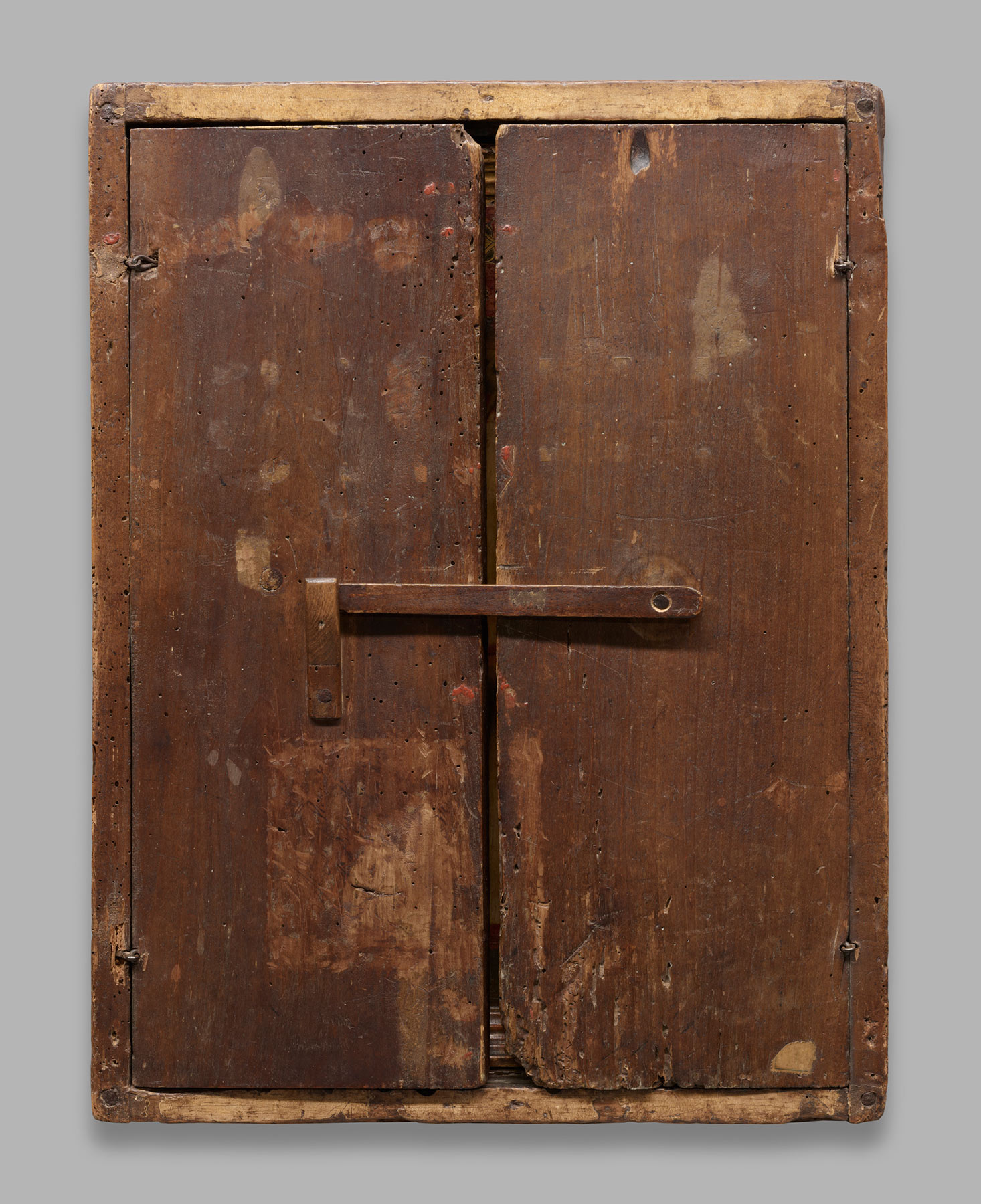
This unusual work is one the few surviving examples of a type of portable altarpiece whose format was conceived specifically for travel. The central element of the composite structure consists of a recessed box housing an image of Christ Crowned with Thorns. Attached to the box is a set of doors that closes over the image for protection, secured by a wooden latch (see fig. 1). The inside faces of the doors are painted with Christ Carrying the Cross on the left and the Crucifixion on the right, so that, when opened, the box functioned as a traditional triptych.3 Evidence of this use are the burn marks, presumably from altar candles, across the left arm of Christ in the Crucifixion and the wax drips at the bottom of the central panel and box.
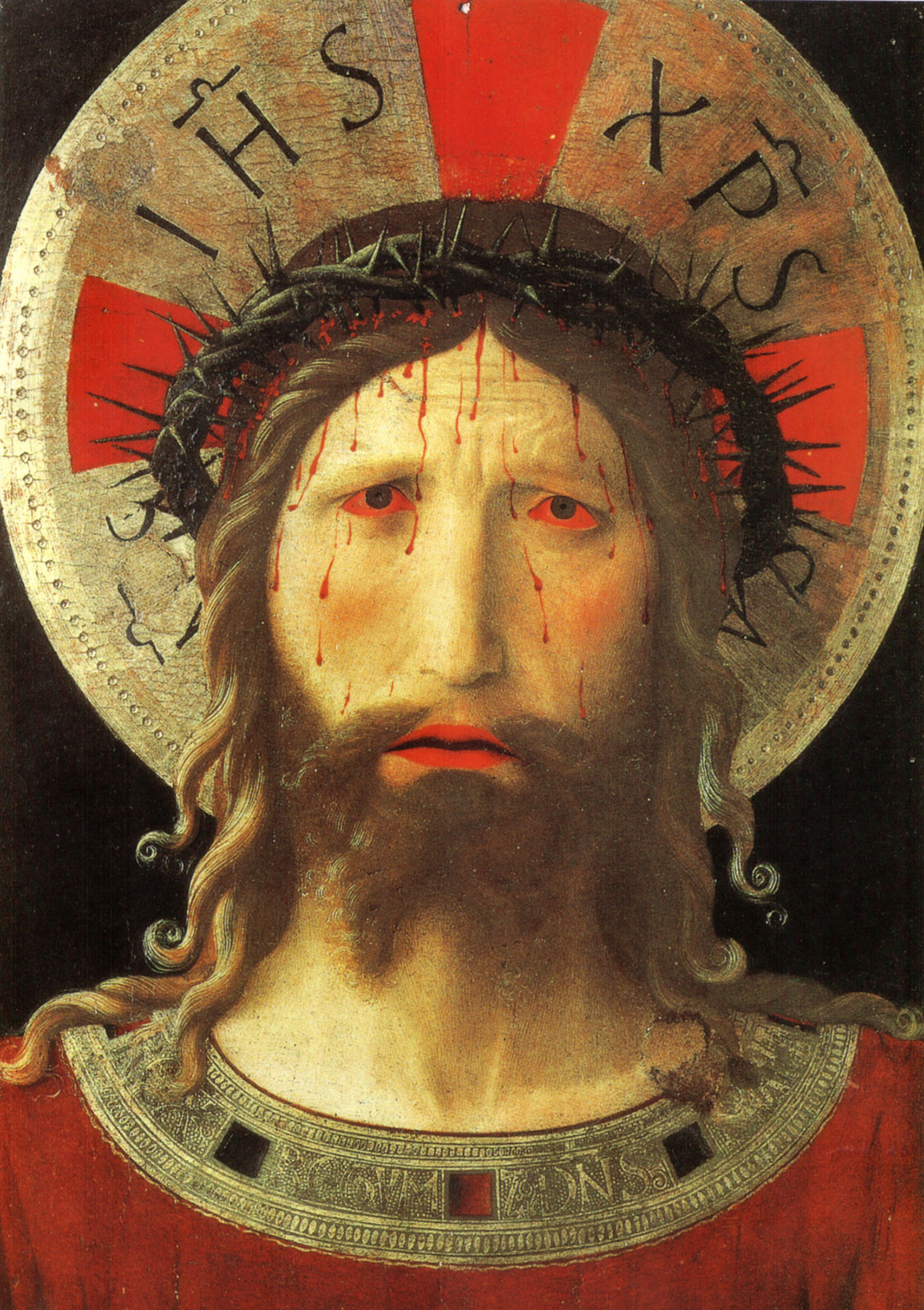
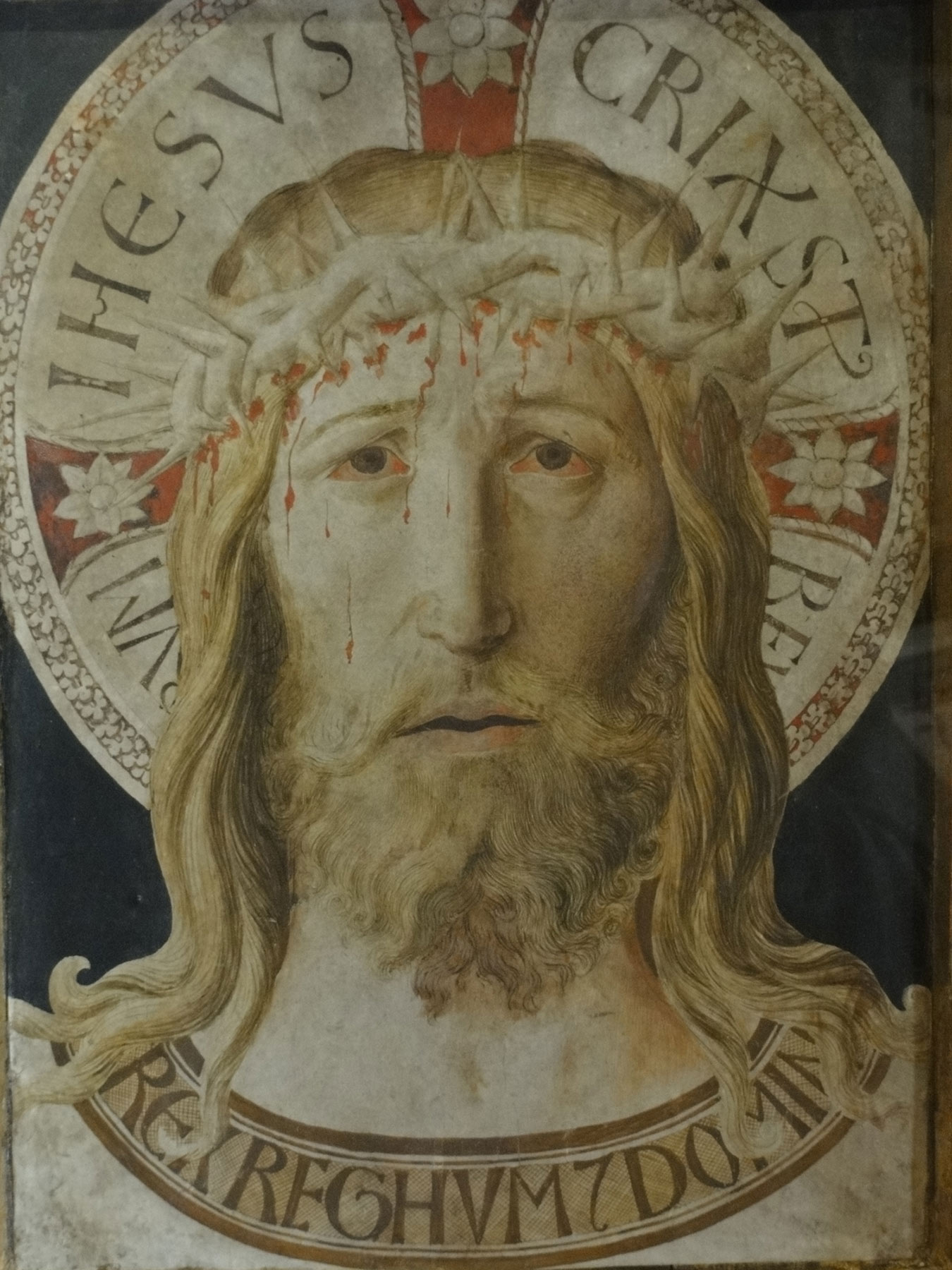
Technical evidence suggests that the Yale box was specially built to house the Christ Crowned with Thorns, which could not be removed once the doors were attached to the unit. Inspired by Netherlandish models, portraitlike images of the suffering Christ became increasingly sought-after objects of private devotion in Tuscany and Umbria around the middle of the fifteenth century. The earliest and most famous example is Fra Angelico’s intensely naturalistic representation in Livorno Cathedral (fig. 2), which has been viewed in the context of the vividly realistic depiction of Christ as Rex Regum (King of Kings) formulated by Jan van Eyck.4 Known only through copies, the earliest of which is dated 1438 (fig. 3), van Eyck’s prototype transformed the iconic, two-dimensional type of Holy Face paintings that had been widely circulating in Europe, especially in the Northern countries, since the early fourteenth century into a “volumetric portrait of a living being,” situated behind a trompe-l’oeil frame that further heightened the illusionistic quality.5 Wearing a regal red robe inscribed with the words “REX REGUM” (King of Kings), his face uniformly bathed in light, van Eyck’s Christ became the most immediate “true likeness” of the Redeemer in all His triumphant glory. While comparable in its naturalistic approach and sharing iconographic details, like the inscribed red tunic, Fra Angelico’s version departed from the Eyckian model in its emotive content and gruesome depiction of Christ’s wounds. Angelico’s new conception of Christ as Rex Regum represented, in effect, an entirely original fusion between the Eyckian Christ Triumphant, regal and distant, and the more affective, pathos-laden Veronica type of images, showing the head of Christ bleeding and crowned with thorns against a white sudarium.6 The source for the unique detail of Christ’s blood-filled eyes, absent from Veronica images, was traced by Pietro Scarpellini7 to the Revelations of Saint Bridget of Sweden (ca. 1302–1373), who recounted how the Virgin, detailing the various torments suffered by her Son on the Cross, had said that the crown of thorns “pricked so hard that both my son’s eyes were filled with the blood that flowed down, and the ears were stopped up, and his beard was thick with blood.”8 One of the most popular texts of the Middle Ages, the Revelations may, in turn, have inspired the writings of Saint Antoninus (1389–1459), the Dominican archbishop of Florence and friend of Angelico, whose Opera a ben vivere was cited by Miklós Boskovits in relation to Angelico’s painting.9 In this guide on how to lead a Christian life, written around 1454 for two Florentine laywomen, Antoninus advised:
You should meditate a little every day on the passion of our Lord Jesus Christ . . . kneel before a crucifix and with the eyes of the mind, more than with those of the body, consider his face. First, [consider] the crown of thorns, dug into his head, up to his brain; next the eyes, full of tears and blood and sweat; next the nose, full of mucus, tears and blood; the mouth, full of bile and slobber and blood; the beard, similarly full of slobber and blood and bile. . . . And in reverence of all these things direct an Our Father with a Hail Mary.10
__Holy_Face__1438__Berlin_2000.jpg)
The Livorno Christ (see fig. 2), sometimes dated to the last phase of Angelico’s activity but more likely executed between the late 1430s and early 1440s,11 is generally recognized as the model for three other versions of the subject made in Umbrian territory, including the Yale example. The closest image, in terms of naturalistic handling, is a painting on parchment in the Museo del Tesoro della Basilica di San Francesco in Assisi (fig. 4), the attribution of which has shifted between Benozzo Gozzoli and Angelico.12 This image, the dating of which has ranged from the mid- to late 1440s to the early 1460s, depending on its attribution, seems to conflate elements derived from the Livorno panel with the minor adaptations seen in the Yale picture, such as the crown placed lower on the forehead and the thorns piercing Christ’s brow. A third version, intimately related to the Yale Christ, is in the Galleria Nazionale dell’Umbria, Perugia (fig. 5). Virtually identical in dimensions, the Perugia panel is almost an exact replica of the Yale image, from its stylized approach to the rendering of individual details, like the crown of thorns; the rivulets of blood, falling in the same pattern around the eyes and on the cheeks; and the use of the same distinctive punch marks in the halo. The only difference lies in the words along the border of Christ’s red tunic. Whereas the Yale painting, in a departure from the Livorno (see fig. 2) and Assisi (see fig. 4) images, replaces the “REX REGUM” with the biblical verse “EGO SUN [sic] LUX MUNDI” (I am the light of the world; John 8:12), the Perugia inscription, in the vernacular, reads, “I[O] SONO PRINCIPIO” (I am the beginning [and the end]; Rev. 22:13).
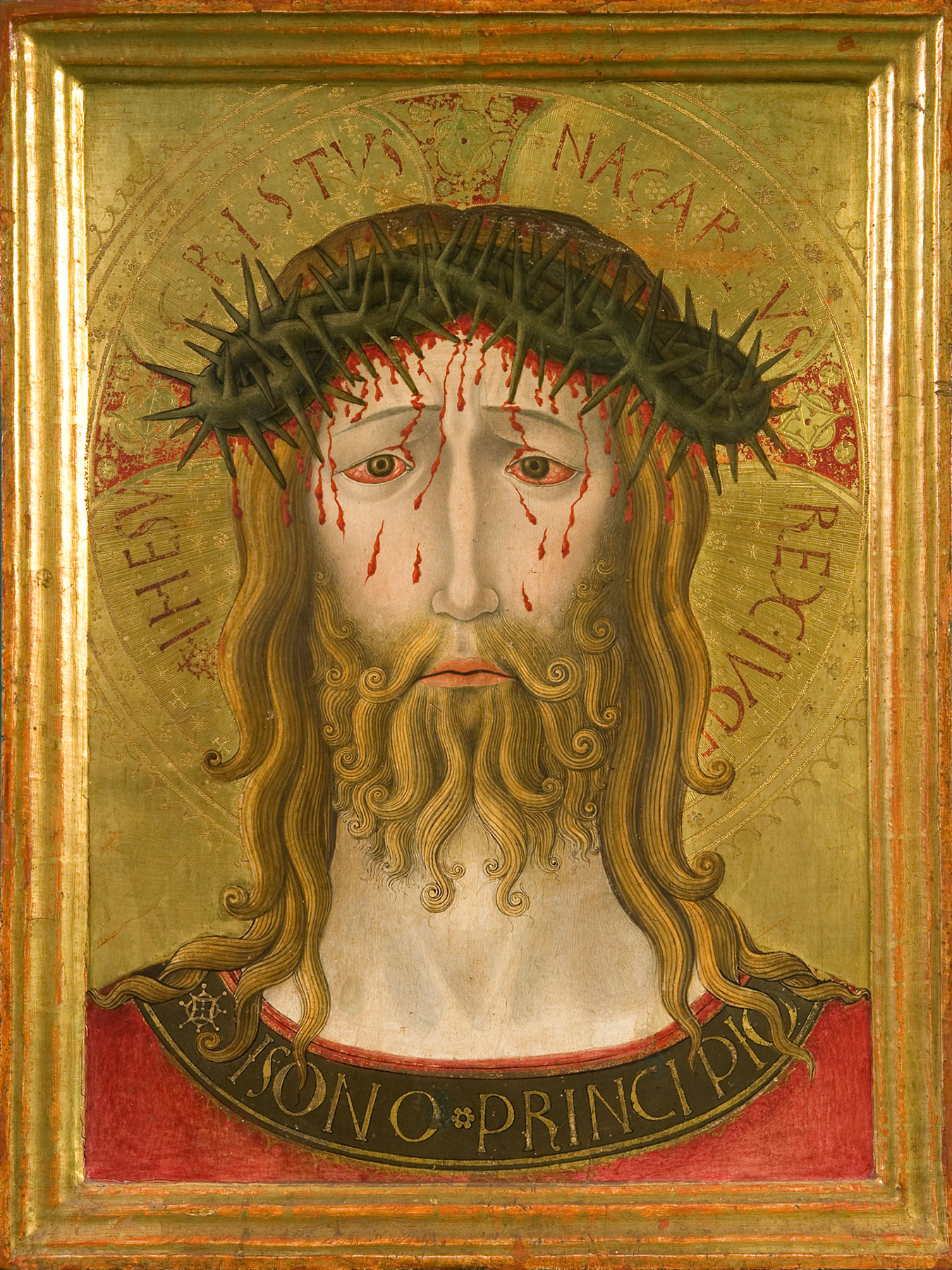
The Perugia Christ Crowned with Thorns (see fig. 5), first listed as a work of Benedetto Bonfigli in Bernard Berenson’s 1897 lists,13 has since been viewed as a product of the artist’s workshop or as the effort of a close follower.14 The Yale altarpiece, which reportedly first appeared on the art market in London in the early 1950s before reappearing in the 2004 Christie’s sale—where it was purchased by Joseph Koerner—went largely unnoticed by scholars until it was published by Filippo Todini in his seminal 1989 study of Umbrian painting.15 Todini listed both the Perugia panel and the Yale Christ among a small group of paintings that he assigned to a so-called Master of the Pietà of San Costanzo, purportedly an anonymous follower of Benedetto Bonfigli, named after a panel dated 1469 formerly in the church of San Costanzo in Perugia.16 Todini’s attribution and outline of the master’s personality were embraced by Federico Mancini—who did not mention the Yale image, however—and Vittoria Garibaldi, who also focused on the Perugia version.17 The identity of the Master of the Pietà of San Costanzo was questioned by Laurence Kanter, who reiterated Benedetto Bonfigli’s authorship of the Yale Christ, with a date between 1455 and 1460.18 In a departure from previous scholarship, Kanter drew a distinction between the central compartment and the wings of the Yale complex, advancing the suggestion that the latter were possibly painted at a later moment by Bartolomeo Caporali, who is known to have collaborated with Bonfigli on an altarpiece executed between 1467 and 1468 for the chapel of San Vincenzo in San Domenico, Perugia. The division of hands was also acknowledged by Maria Falcone, albeit with different conclusions. Falcone cited Kanter’s attribution of the Yale Christ to Bonfigli, but she posited the intervention of the Master of the Pietà of San Costanzo in the wings. The same author, who assigned the Perugia Christ Crowned with Thorns to a generic “Follower of Benedetto Bonfigli,” also highlighted the more accomplished quality of the Yale image and suggested that, rather than one artist copying the other, both images might be based on a single cartoon employed by different painters.19 Writing around the same time, Matteo Mazzalupi, on the other hand, expressed a radically divergent opinion, identifying both the Perugia Christ and the Yale triptych as Florentine works and advancing the name of the Master of Pratovecchio for the Yale wings.20
Notwithstanding efforts to place the Yale panels in a Florentine context, the comparisons with the Master of Pratovecchio, an altogether more expressive and nuanced personality, are unpersuasive. The quintessentially Umbrian elements of the Yale complex, especially as related to the work of both Bonfigli and Caporali, were emphasized by Jane McCree and Shelly Sims in an exhaustive but unpublished 2006 technical report, following their examination of the work at the Courtauld Institute of Art, London.21 While leaving open the issue of a specific attribution, their study concluded that “the material and techniques of all the pieces of this construction” were consistent with the school of Bonfigli. The confidently drawn lines and lack of alterations in the underdrawing of the central panel, visible in infrared reflectography, led the same examiners to postulate that the head of Christ was “likely made from a tracing,” a finding that confirms Falcone’s hypothesis that both the Yale and Perugia panel were based on the same cartoon.22
That the Yale Christ Crowned with Thorns fits comfortably within Bonfigli’s autograph production, rather than that of a follower, is confirmed by the analogies between this image and some of the artist’s most canonical works. Despite the derivative, almost iconic nature of the representation, the luminous quality of the painted surface and the subtle highlights marking the transitions between the facial features recall, above all, the artist’s approach in the remarkable series of angels that once surrounded a tabernacle niche in San Francesco al Prato, Perugia, executed in 1464 (fig. 6).23 These panels, which employ the same delicate “wheat and honey” tonalities cited by Falcone in her description of the Yale painting, also provide the closest equivalent for the preciously stylized locks of hair and curls of Christ’s beard, whose rendering departs from the naturalistic treatment of Angelico’s prototype (see fig. 2). Compared to the Yale image, the Perugia copy (see fig. 5) is harsher—more metallic in its coloring and hard edged in its contours—pointing to a less nuanced sensibility, as noted by Falcone. The use of the same cartoon and the identical design and punch patterns in the haloes suggest a different hand in the same workshop, however, instead of a follower of Bonfigli.
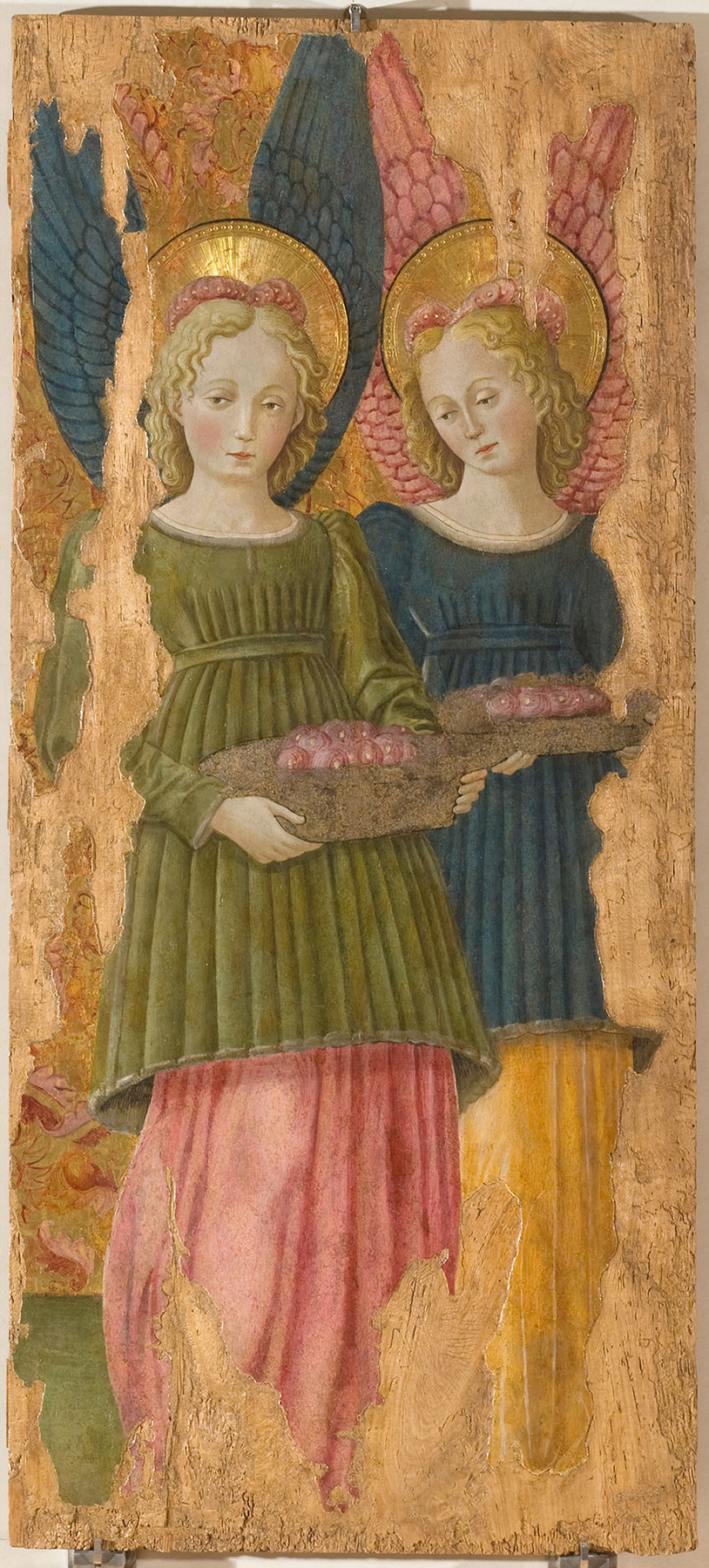
The fluid draftsmanship and looser, more cursory approach in the wings of the Yale box presents a marked contrast to the polished elegance of the Christ Crowned with Thorns, but it is difficult to ascertain the extent to which these differences might be the result of the more spontaneous quality of the representation rather than the intervention of a distinct personality.24 Falcone’s attribution to the Master of the Pietà di San Costanzo, whose eponymous work seems to reflect a drier, more incisive technique, is not convincing, but it does highlight the intimate relationship of the Yale laterals to both Bonfigli and Caporali, who were, in the past, thought responsible for the nucleus of works currently assigned to the Master of the Pietà di San Costanzo.25 Perhaps the most accurate comparison for the broader handling of the Yale wings, as well as for some of their coarser features, is found in two predella panels with miracles of Saint Vincent Ferrer, formerly on the art market and generally identified as fragments of the altarpiece painted by Bonfigli and Caporali in 1467–68 for the chapel of Saint Vincent in San Domenico.26 While Todini27 published these scenes as collaborative efforts between the two artists, subsequent authors have concurred in the attribution to Bonfigli28 or to his workshop.29 The possibility that the discrepancies between the central image of the Yale box and its wings might be explained in terms of workshop participation seems consistent with the nature of this category of object, in which the various elements, though separate, were conceived as a single unit, in much the same way as a traditional triptych. A date for the portable altarpiece around the middle of the 1460s is suggested by both the comparisons to the Perugia Angels (see fig. 6) and the links to the Saint Vincent predella fragments. —PP
Published References
Todini, Filippo. La pittura umbra: Dal duecento al primo cinquecento. 2 vols. Milan: Longanesi, 1989., 1:165, 2: figs. 838, 840; Padoa Rizzo, Anna. Benozzo Gozzoli in Umbria. Florence: Octavo, 1997., 17; Pia Palladino, in Kanter, Laurence, and Pia Palladino, eds. Fra Angelico. Exh. cat. New York: Metropolitan Museum of Art, 2005., 175; Garibaldi, Vittoria. Galleria Nazionale dell’Umbria: Dipinti e sculture dal XII al XV secolo; Catalogo generale I. Perugia: Quattroemme, 2015., 467; Maria Falcone, in Pierini, Marco, and Marzia Sagini, eds. L’altra galleria: Studi nella Galleria Nazionale dell’Umbria. Perugia: Aguaplano, 2022., 251–52, 254, 255n15–16, figs. 6, 8–9, 11; Matteo Mazzalupi, in Pierini, Marco, and Marzia Sagini, eds. L’altra galleria: Studi nella Galleria Nazionale dell’Umbria. Perugia: Aguaplano, 2022., 262n16; Machtelt Brüggen Israëls, in Strehlke, Carl Brandon, with Stefano Casciu and Angelo Tartuferi, eds. Beato Angelico. Exh. cat. Florence: Marsilio Arte, 2025., 245, 270
Notes
-
According to Todini, Filippo. La pittura umbra: Dal duecento al primo cinquecento. 2 vols. Milan: Longanesi, 1989., 165. ↩︎
-
A note on the back of a photograph of the triptych in the Berenson Library, Villa I Tatti, Harvard University Center for Italian Renaissance Studies, Settignano, records that it was “sent by Christian Salm, summer 1952.” The German art historian Christian Altgraf von Salm (1906–1973) was related on his mother’s side to the princes of Fürstenberg. During the early 1950s, after completing his dissertation on the Master of Messkirch at the University of Freiburg, Salm was responsible for the management of the princely collections at the Fürstenberg palace in Donaueschingen, Germany. See Martin, Kurt. “Christian Altgraf zu Salm.” Kunstchronik 26, no. 12 (1973): 409–10., 409–10. It is perhaps worth speculating whether Salm could have purchased the picture as an agent for the Fürstenberg family. ↩︎
-
Among the few comparable box structures is the portable altarpiece in the Museo di Palazzo Davanzati, Florence, inv. no. 432, https://catalogo.beniculturali.it/detail/HistoricOrArtisticProperty/0900281133-0. This work differs from the Yale box, however, in that it has a lunette over the main compartment and a base, thus approaching the more traditional altarpiece form. Another example is in the Museo Valtellinese di Storia e arte, Sondrio, inv. no. 1984 n. 50468, https://www.lombardiabeniculturali.it/opere-arte/schede/40010-00159/, where the original central image has been substituted with a later painting. ↩︎
-
See Palladino, Pia. “Pilgrims and Desert Fathers: Dominican Spirituality and the Holy Land.” In Fra Angelico, ed. Laurence Kanter and Pia Palladino, 27–39. Exh. cat. New York: Metropolitan Museum of Art, 2005., 172–75, no. 33 (with previous bibliography); and de Simone, Gerardo. Il Beato Angelico a Roma, 1445–1455: Rinascita delle arti e Umanesimo cristiano nell’Urbe di Niccolò V e Leon Battista Alberti. Florence: Leo S. Olschki, 2017., 65–66n97. ↩︎
-
Ainsworth, Maryan W. Petrus Christus: Renaissance Master of Bruges. Exh. cat. New York: Metropolitan Museum of Art, 1994., 86. See also the most recent discussion of this work in Cornini, Guido. “From Rome to Florence and Bruges, and Back Again: Van Eyck’s Sancta Facies, between Transcendence and Naturalism.” In Van Eyck: An Optical Revolution, ed. Maximiliaan Martens, Till-Holger Borchert, Jan Dumolyn, Johan De Smet, and Frederica Van Dam, 284–95. Exh. cat. London: Thames & Hudson, 2020., 285–95. ↩︎
-
Pia Palladino, in Kanter, Laurence, and Pia Palladino, eds. Fra Angelico. Exh. cat. New York: Metropolitan Museum of Art, 2005., 172. Paula Nuttall postulated that Angelico must have known a version of the Eyckian painting, “which was perhaps conflated with a more emotive type,” integrating the details of blood and thorns. Among the possible sources, according to Nuttall, may have been one of the paintings by van Eyck reputedly owned by Pope Eugenius IV or, more specifically, the Netherlandish Head of Christ listed in the Medici inventory of 1492. See Nuttall, Paula. From Flanders to Florence: The Impact of Netherlandish Painting, 1400–1500. New Haven: Yale University Press, 2004., 32, 235. Since none of these works survives or has been identified, Nuttall’s suggestion remains speculative. ↩︎
-
Scarpellini, Pietro. “Le pitture.” In Il tesoro della Basilica di San Francesco ad Assisi, ed. Maria Grazia Ciardi Dupré Dal Poggetto, 25–60. Assisi: Francescana, 1980., 56. ↩︎
-
Saint Bridget of Sweden, Revelations, Book 7, as cited in Butkovich, Anthony. Iconography: St. Bridgitta of Sweden. Los Angeles: Ecumenical Foundation of America, 1969., 62; and Palladino, in Kanter, Laurence, and Pia Palladino, eds. Fra Angelico. Exh. cat. New York: Metropolitan Museum of Art, 2005., 174. ↩︎
-
Boskovits, Miklós. Immagini da meditare: Ricerche su dipinti di tema religioso nei secoli XII–XV. Milan: Vita e pensiero, 1994., 386; and Palladino, in Kanter, Laurence, and Pia Palladino, eds. Fra Angelico. Exh. cat. New York: Metropolitan Museum of Art, 2005., 174. ↩︎
-
Antoninus Pierozzi. Opera a ben vivere. Ed. Francesco Palermo. Florence: Cellini, 1858., pt. 3, chap. 11, 169, as translated in Flanigan, Theresa. “Art, Memory, and the Cultivation of Virtue: The Ethical Function of Images in Antoninus’s Opera a ben vivere.” Gesta 53, no. 2 (September 2014): 175–95., 179, 194. Theresa Flanigan’s translation includes minor variations from the translation by the present author (in Kanter, Laurence, and Pia Palladino, eds. Fra Angelico. Exh. cat. New York: Metropolitan Museum of Art, 2005., 174), which relied on the text as cited by Boskovits, Miklós. Immagini da meditare: Ricerche su dipinti di tema religioso nei secoli XII–XV. Milan: Vita e pensiero, 1994., 386. ↩︎
-
See Palladino, in Kanter, Laurence, and Pia Palladino, eds. Fra Angelico. Exh. cat. New York: Metropolitan Museum of Art, 2005., 172–75, no. 33. More recently, Gerardo de Simone and Machtelt Brüggen Israëls suggested a date between 1445 and 1450, whereas Guido Cornini opted for a broader time frame, between 1440 and 1450; see de Simone, Gerardo. Il Beato Angelico a Roma, 1445–1455: Rinascita delle arti e Umanesimo cristiano nell’Urbe di Niccolò V e Leon Battista Alberti. Florence: Leo S. Olschki, 2017., 65; Machtelt Brüggen Israëls, in Strehlke, Carl Brandon, with Stefano Casciu and Angelo Tartuferi, eds. Beato Angelico. Exh. cat. Florence: Marsilio Arte, 2025., 264, no. 6.8; and Cornini, Guido. “From Rome to Florence and Bruges, and Back Again: Van Eyck’s Sancta Facies, between Transcendence and Naturalism.” In Van Eyck: An Optical Revolution, ed. Maximiliaan Martens, Till-Holger Borchert, Jan Dumolyn, Johan De Smet, and Frederica Van Dam, 284–95. Exh. cat. London: Thames & Hudson, 2020., 290. The original location of Angelico’s painting is not known. Following upon a hypothesis first put forth by Giulia Brunetti (in Brunetti, Giulia. “Una vacchetta segnata A.” In Scritti di storia dell’arte in onore di Ugo Procacci, ed. Maria Grazia Ciardi Duprè Dal Poggetto and Paolo Dal Poggetto, 1:228–35. Milan: Electa, 1977., 228–35), the present author tentatively proposed that it might be identified with the “volto sancto”(Holy Face) listed in an inventory of the furnishings of the altar of the Annunziata in the Servite church of Santissima Annunziata in Florence, compiled between 1439 and 1441; Palladino, in Kanter, Laurence, and Pia Palladino, eds. Fra Angelico. Exh. cat. New York: Metropolitan Museum of Art, 2005., 174–75. Sonia Chiodo, on the other hand, associated the “volto sancto” of the fifteenth-century inventory with an unidentified painting of a “Sacro Sudario” (Holy Cloth) against a gold background listed in the nineteenth-century inventory of the collection of the Servite master general Francesco Adami (1711–1792), housed in the library of Santissima Annunziata; Chiodo, Sonia. “Francesco Adami.” In La fortuna dei primitivi: Tesori d’arte delle collezioni italiane fra sette e ottocento, ed. Angelo Tartuferi and Gianluca Tormen, 230–31. Exh. cat. Florence: Giunti, 2014., 230–31. ↩︎
-
The attribution to Gozzoli is maintained, albeit with a question mark, by Laurence Kanter and the present author, in Kanter, Laurence, and Giovanni Morello, eds. The Treasury of Saint Francis of Assisi. Exh. cat. Milan: Electa, 1999., 110–11 (with previous bibliography). Elvio Lunghi subsequently assigned the Assisi painting to the workshop of Angelico; Toscano, Bruno, and Giovanna Capitelli, eds. Benozzo Gozzoli: Allievo a Roma, maestro in Umbria. Cinisello Balsamo, Milan: Silvana, 2002., 200–202, no. 19. De Simone observed that the high quality of the Assisi parchment, conceived as a sort of “pauper” version (copia pauperistica) of the Livorno panel, warranted an attribution to Angelico himself, with the assistance of a collaborator; de Simone, Gerardo. Il Beato Angelico a Roma, 1445–1455: Rinascita delle arti e Umanesimo cristiano nell’Urbe di Niccolò V e Leon Battista Alberti. Florence: Leo S. Olschki, 2017., 65n97. A tentative attribution to Gozzoli is maintained by Israëls, in Strehlke, Carl Brandon, with Stefano Casciu and Angelo Tartuferi, eds. Beato Angelico. Exh. cat. Florence: Marsilio Arte, 2025., 268–69, no. 6.10. It is generally assumed that the Assisi copy, which is first recorded in an inventory of relics in the sacristy of the Lower Church of San Francesco in June 1600, was originally intended as a gift to the basilica. ↩︎
-
Berenson, Bernard. The Central Italian Painters of the Renaissance. New York: G. P. Putnam’s Sons, 1897., 137. ↩︎
-
See Maria Falcone, in Pierini, Marco, and Marzia Sagini, eds. L’altra galleria: Studi nella Galleria Nazionale dell’Umbria. Perugia: Aguaplano, 2022., 244–55, no. 24 (with previous bibliography). ↩︎
-
Todini, Filippo. La pittura umbra: Dal duecento al primo cinquecento. 2 vols. Milan: Longanesi, 1989., 1:165, 2: figs. 838, 840. Berenson, who was sent photographs of the whole triptych and of the wings in 1952 (see note 2, above), did not include the work in any of his lists. The handwritten notations on the verso of the photographs, which are not in Berenson’s hand, state that they were filed with Bartolomeo Caporali. ↩︎
-
This work is now in the Basilica di San Pietro, Perugia; see Todini, Filippo. La pittura umbra: Dal duecento al primo cinquecento. 2 vols. Milan: Longanesi, 1989., 2:369, fig. 843. ↩︎
-
Mancini, Francesco Federico. Benedetto Bonfigli. Perugia: Electa, 1992., 145; and Garibaldi, Vittoria. Galleria Nazionale dell’Umbria: Dipinti e sculture dal XII al XV secolo; Catalogo generale I. Perugia: Quattroemme, 2015., 466–67, no. 171. ↩︎
-
Laurence Kanter, cited in Falcone, in Pierini, Marco, and Marzia Sagini, eds. L’altra galleria: Studi nella Galleria Nazionale dell’Umbria. Perugia: Aguaplano, 2022., 255n17. ↩︎
-
Falcone, in Pierini, Marco, and Marzia Sagini, eds. L’altra galleria: Studi nella Galleria Nazionale dell’Umbria. Perugia: Aguaplano, 2022., 253. ↩︎
-
Matteo Mazzalupi, in Pierini, Marco, and Marzia Sagini, eds. L’altra galleria: Studi nella Galleria Nazionale dell’Umbria. Perugia: Aguaplano, 2022., 262n16. ↩︎
-
Jane McCree and Shelley Sims, “Courtauld Institute, Technical Report, Volto Santo Boxed Triptych,” March 2006, curatorial files, Department of European Art, Yale University Art Gallery. ↩︎
-
According to the report, the underdrawing was made with charcoal applied with a thin dry point, as opposed to a brush. ↩︎
-
For these works, see Garibaldi, Vittoria. Galleria Nazionale dell’Umbria: Dipinti e sculture dal XII al XV secolo; Catalogo generale I. Perugia: Quattroemme, 2015., 426–30, no. 157 (with previous bibliography). ↩︎
-
The Courtauld technical report noted that infrared reflectography of the side panels confirms the absence of any underdrawing. ↩︎
-
For the most recent examination of the Master’s profile, see Mazzalupi, in Pierini, Marco, and Marzia Sagini, eds. L’altra galleria: Studi nella Galleria Nazionale dell’Umbria. Perugia: Aguaplano, 2022., 256–60, no. 25. ↩︎
-
The scenes previously identified as miracles of Saints Peter and Paul were recognized as episodes of the life of Saint Vincent Ferrer by Elvio Lunghi, in Garibaldi, Vittoria, ed. Un pittore e la sua città: Benedetto Bonfigli e Perugia. Exh. cat. Milan: Electa, 1996., 130–32, no. 14. The Miracle of Saint Vincent Ferrer Resuscitating a Child at the Altar was last recorded in the Sacerdoti collection, Milan, in 1976 and again in 1995; see Fototeca Zeri, Federico Zeri Foundation, Bologna, inv. no. 17967, https://catalogo.fondazionezeri.unibo.it/entry/work/19795/ (under Bartolomeo Caporali). The Miracle of Saint Vincent Ferrer Resuscitating a Drowned Child, sold at Sotheby’s, London, January 26–27, 2006, lot 170, with an attribution to Bonfigli, was last recorded in the Alana Collection, Newark, Del. For the much-debated reconstruction of the polyptych for the chapel of Saint Vincent, see Garibaldi, Vittoria. Galleria Nazionale dell’Umbria: Dipinti e sculture dal XII al XV secolo; Catalogo generale I. Perugia: Quattroemme, 2015., 411–15, no. 152 (with previous bibliography). ↩︎
-
Todini, Filippo. La pittura umbra: Dal duecento al primo cinquecento. 2 vols. Milan: Longanesi, 1989., 1:42, 50. ↩︎
-
Mancini, Francesco Federico. Benedetto Bonfigli. Perugia: Electa, 1992., 75, 126; and, most recently, Zappasodi, Emanuele. “L’autunno del medioevo a Perugia: La pittura da Gentile da Fabriano a Benedetto Bonfigli.” In L’autunno del medioevo in Umbria: Cofani nuziali in gesso dorato e una bottega perugina dimenticata, ed. Andrea De Marchi and Matteo Mazzalupi, 15–55. Exh. cat. Cinisello Balsamo, Milan: Silvana, 2019., 55n97. ↩︎
-
Lunghi, in Garibaldi, Vittoria, ed. Un pittore e la sua città: Benedetto Bonfigli e Perugia. Exh. cat. Milan: Electa, 1996., 132. ↩︎