James Jackson Jarves (1818–1888), Florence, by 1859
The panel support, of a horizontal wood grain, retains its original thickness of 2.5 centimeters and is not cradled. It has been much weakened by woodworm damage, resulting in several long splits along the right edge, at 4, 9, and 13 centimeters from the top. A 4-centimeter-wide vertical batten was glued to the reverse on center, but no nails securing it in place are in evidence. The paint surface has been very lightly abraded and losses, chiefly along the splits, retouched with visible inpainting. Heavier abrasions occur in Christ’s blue robe and are scattered throughout the thinly painted background architecture.
Beginning in the fourth century A.D. or earlier, the absence of biblical references to the later life of the Virgin gave rise to a corpus of apocryphal writings focused on the events leading up to her death, assumption, and coronation. According to the oldest versions of the legend, in fulfillment of a promise made to her by Christ, the Virgin was accompanied on her deathbed by her Son, who took personal charge of her soul, and by the twelve apostles, both dead and alive, who were made to appear miraculously at her home to guard her and to comfort her in her final hours and later to bear her to her tomb.1 The iconography developed by Byzantine artists focused on the central moment of the Virgin’s death, or koimesis (literally “the sleep of death”), and the transfer of her soul into heaven: The Virgin is shown lying horizontally on a luxurious bed, attended by the apostles and Christ, who lifts up her soul, wrapped in “radiant veils,” to a pair of receiving angels above.2 The Yale panel omits the angels but otherwise adheres more closely to the Byzantine koimesis than do other depictions of the theme in fifteenth-century Italy, which usually place the event in a landscape setting—conflating the episodes of the Virgin’s death with that of her funeral or entombment—or in an undefined space below the Assumption.3 In the present instance, the scene is articulated within a colonnaded Renaissance courtyard of pink and gray stone meant to evoke the residence of the Virgin. The Virgin’s body, clothed in white and ready for burial, lies on a bier covered with striped fabric, her head supported by two elegant pillows. Gathered around the bier are Christ, carrying the Virgin’s soul (animula), depicted as a small effigy, and the twelve apostles, who were instructed to recite the psalmody after her death.4
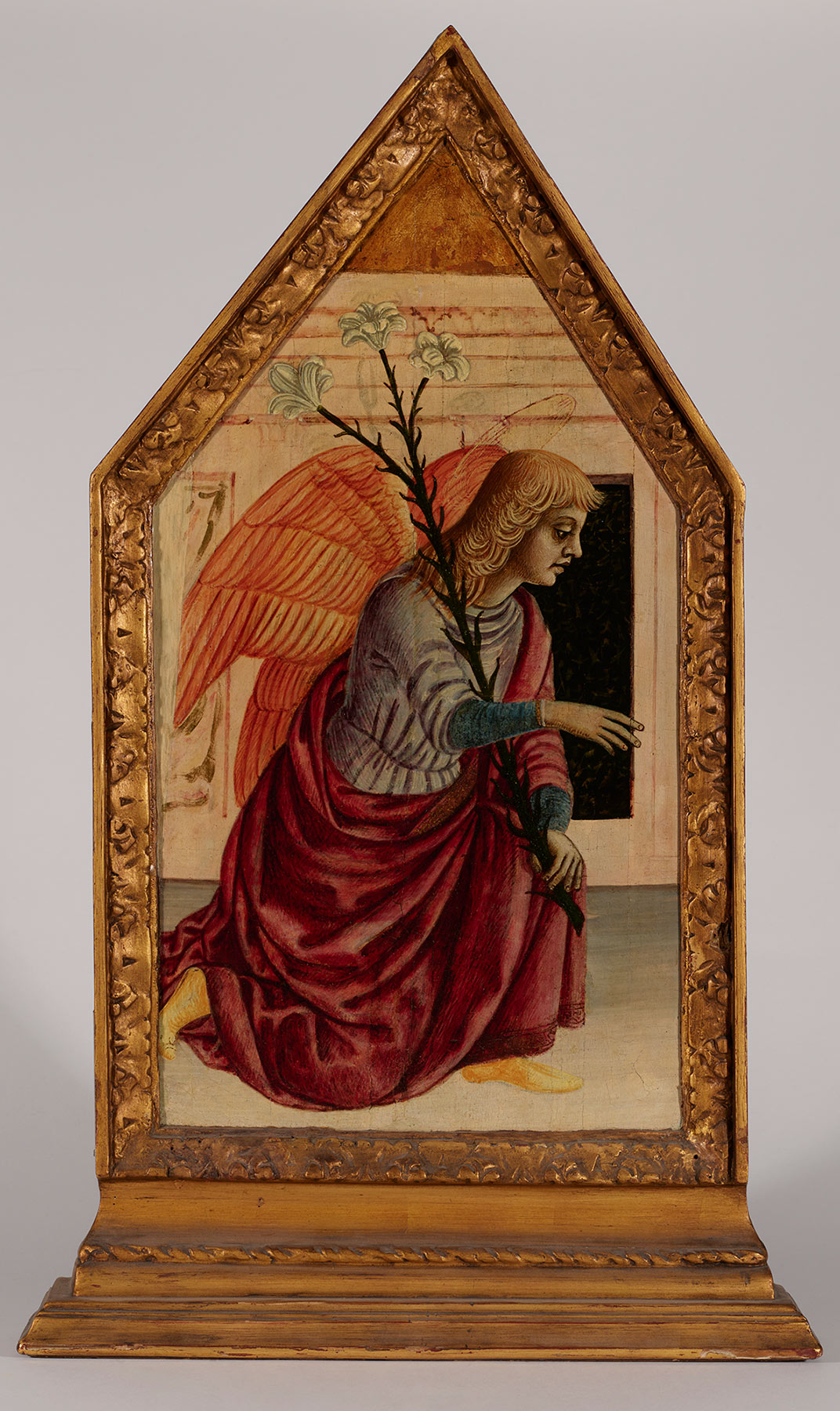
The Yale Death of the Virgin, identified by James Jackson Jarves as a product of an Umbrian painter5 and by subsequent scholars as the work of a “follower”6 or “crude imitator”7 of Andrea del Castagno, was first recognized by Mauro Natale8 as a fragment of the missing predella of a triptych with the Virgin and Child between Saints Peter and Paul and Saints Nicholas of Bari and John the Baptist, from the church of San Pietro in Bagnara, in Massa (fig. 1)—a small city along the Tyrrhenian coast north of Lucca, in the border region between Tuscany and Liguria. Prior to Natale’s study, the Bagnara altarpiece, presently missing its side pilasters and pinnacles as well as its predella, had been inserted by Massimo Ferretti9 among a small body of works by the so-called Master of Sant’Anastasio, a retardataire and eccentric painter named after an elaborate and still intact triptych in the parish church of Sant’Anastasio, a village in the municipality of Piazza al Serchio, Lucca (fig. 2). An Annunciatory Angel in the Walters Art Museum, Baltimore (fig. 3), previously attributed by Federico Zeri10 to the Master of Sant’Anastasio, was convincingly identified by Ferretti as one of the pinnacles of the Bagnara altarpiece. More recently, Severina Russo11 added to the reconstruction another predella panel with episodes from the lives of Saints Nicholas of Bari and John the Baptist in the Muzeul Național de Artă al Românie, Bucharest, Romania—a work already related to the Yale fragment by Roberto Longhi.12
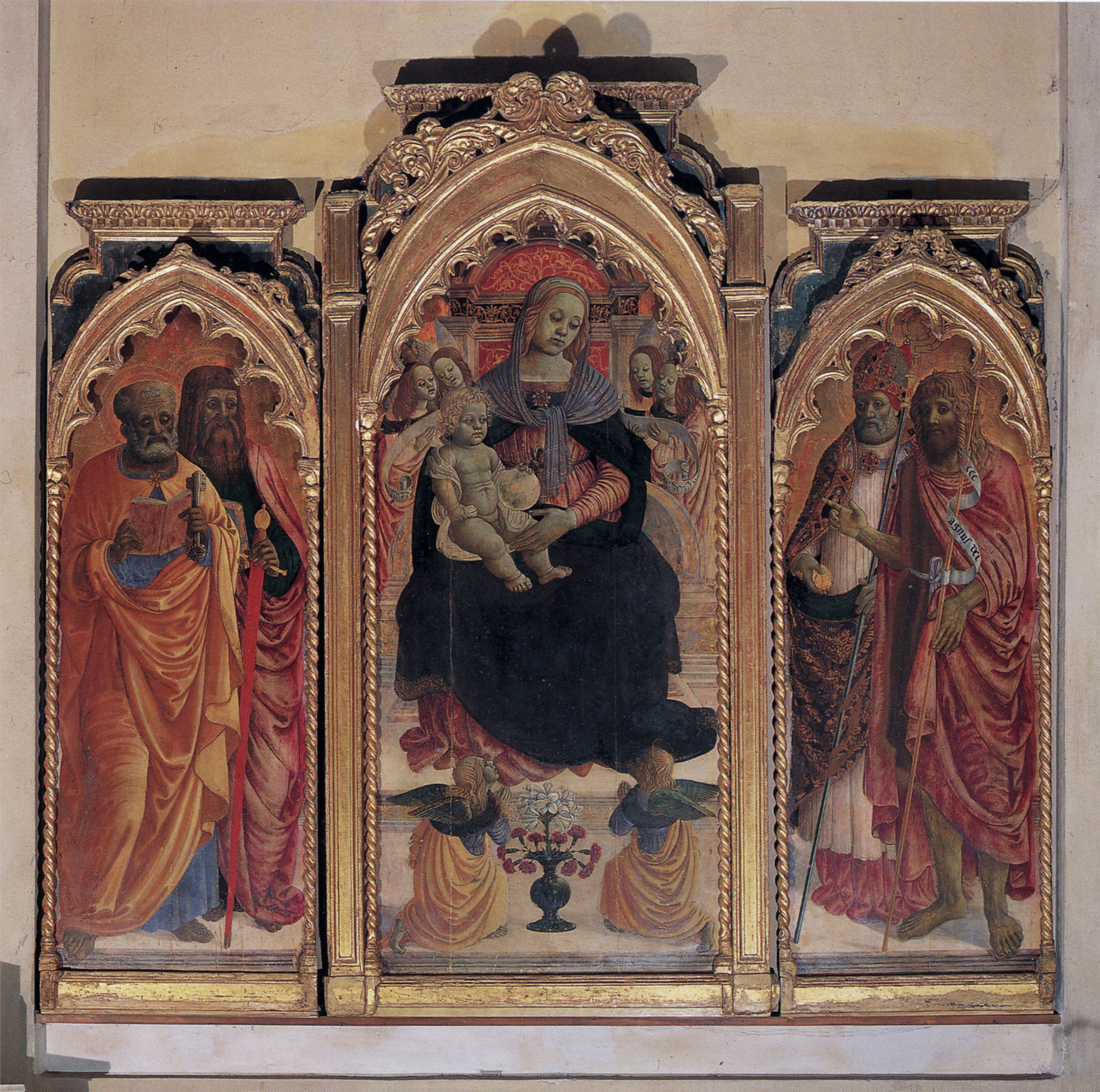
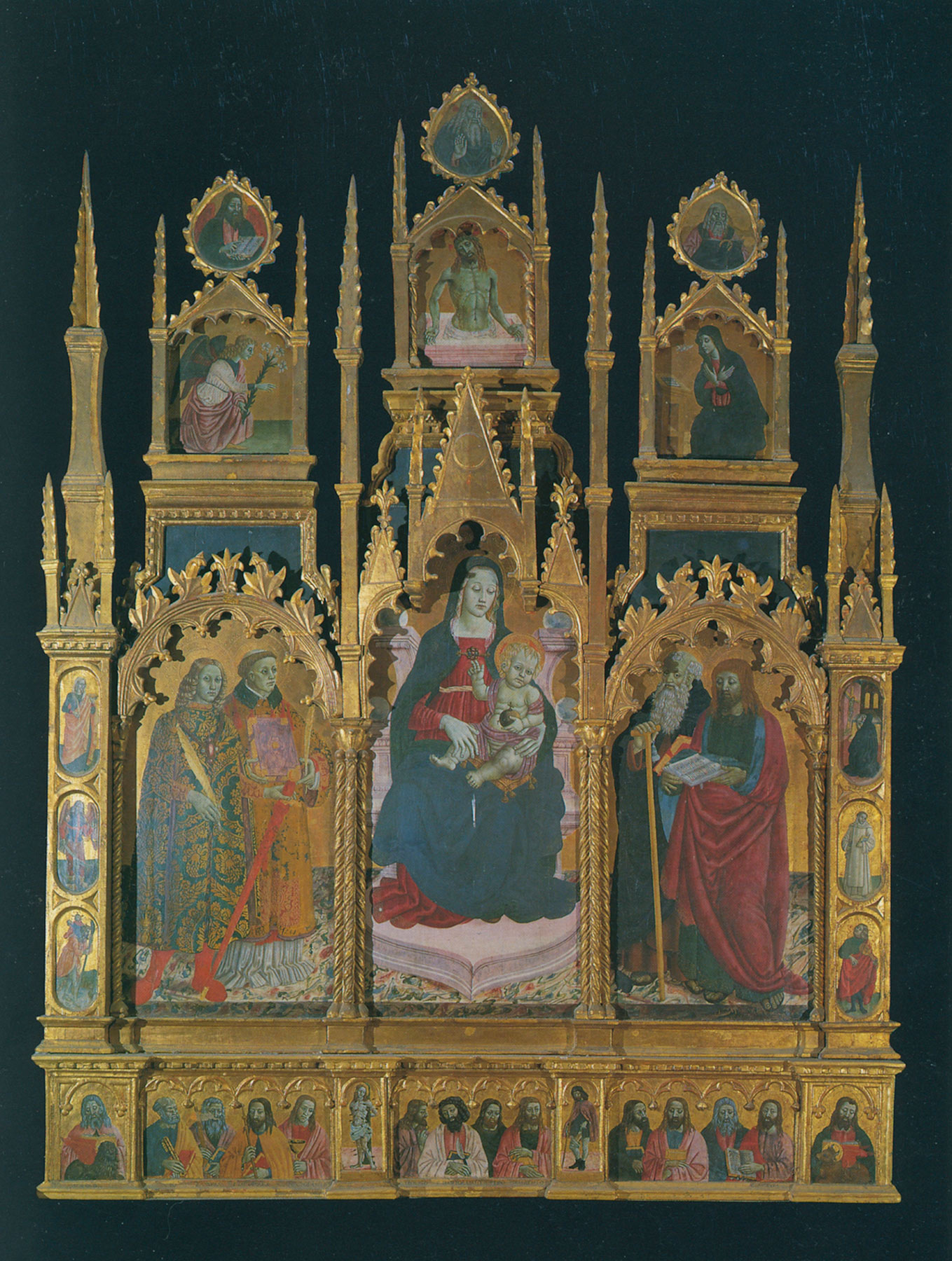
Ferretti, who highlighted first the Emilian and then the Ligurian and Foppesque components of the Master of Sant’Anastasio’s style, advanced the possibility that this artist might be identified with Bernardino del Castelletto di Massa,13 a painter of purportedly Milanese origin who is recorded in Massa from 1481 until his death after 1500, and whose only signed work is an altarpiece with the Virgin and Child between Saints Sixtus and Peter, painted in 1490 for the church of San Sisto in Pomezzana, in the hills southeast of Massa (fig. 4). Ferretti’s suggestion, reiterated without reservations by Natale,14 was embraced by other authors, culminating in Silvano Soldano’s 1994 monograph on Bernardino,15 which gathered under the artist’s name the following works in addition to the Pomezzana altarpiece: a triptych dated 1471 from the parish church of San Giacomo Maggiore in Vallico di Sotto, not far from Pomezzana, presumed to be the artist’s earliest effort;16 a single panel (tavola quadrata) with the Virgin and Child between Saints Francis, Louis of Toulouse, Jerome, and Elizabeth, executed for the altar of the Franciscan tertiaries in the church of San Francesco, in Massa (now Museo Diocesano di Massa);17 the San Pietro in Bagnara triptych (see fig. 1); the Sant’Anastasio triptych (see fig. 2); and a tavola quadrata with the Virgin and Child between Four Saints for the Pieve of San Pietro a Vico, outside Lucca.18 With the exception of the San Pietro a Vico altarpiece, later expunged from the artist’s oeuvre by Riccardo Massagli,19 the remaining five altarpieces are, at present, unanimously attributed to Bernardino del Castelletto. The acknowledged qualitative and stylistic discrepancies between some of these works, which have resulted in the perception of disparate points of reference—from Fillipo Lippi to Foppa, and from Castagno to Squarcione—have been explained in terms of the eclectic, cross-cultural artistic environment in which the artist operated.
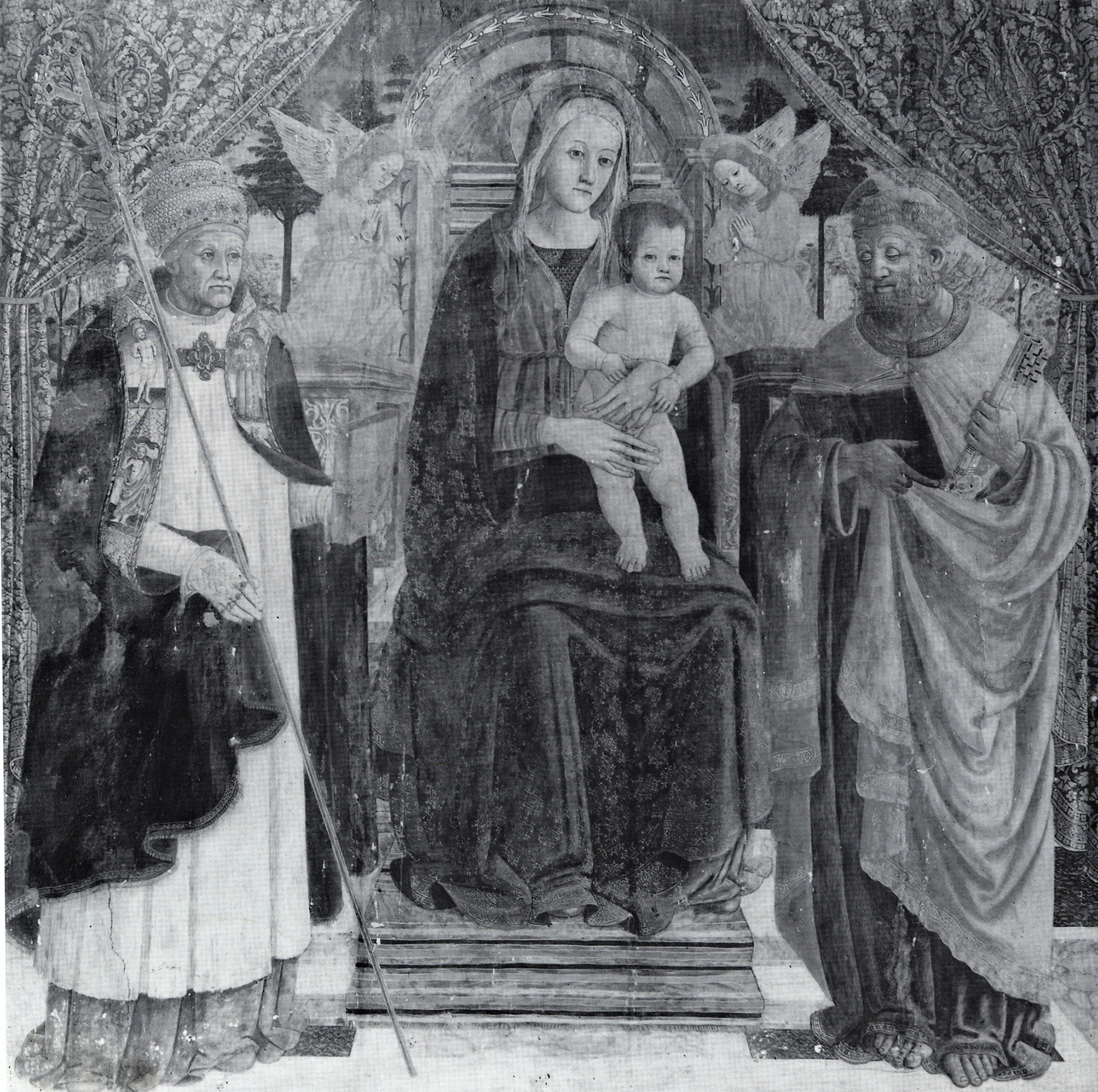
While there is little doubt that the author of the Sant’Anastasio triptych was also responsible for the execution of the San Pietro in Bagnara triptych, as well as the Massa tavola quadrata, the relationship of these works to the Pomezzana picture (see fig. 4) is less evident. Common to the first three altarpieces are identical, solidly built physiognomic types with pronounced features, a coarse handling of individual details, and heightened chiaroscuro effects that lend a stony hardness to the composition. These idiosyncratic qualities are not conspicuous in the Pomezzana panel, however, which is distinguished by the slender proportions of the Virgin and Christ Child and a more nuanced approach. Whether such distinctions are indicative of a different personality rather than the result of an evolution in the artist’s vision remains open to question.
Most recent authors concur that the San Pietro in Bagnara and the Sant’Anastasio triptychs (see figs. 1–2), which display similar carpentry—closer to Ligurian than to Lucchese models20—were executed around the same period and that the Bagnara commission shortly predates that for the church of Sant’Anastasio. Both works are generally placed sometime in the ninth decade, although a date after 1490 was recently suggested by Stefano Martinelli.21 A later time frame for the Sant’Anastasio altarpiece vis-à-vis the Bagnara triptych seems warranted by the more rational spatial solutions adopted by the artist in that work, where the lateral figures are given ample breathing room on the uninterrupted marbleized floor stretching across the compartments. In the Bagnara triptych, the lateral saints are squeezed into compressed, narrower spaces, and the angels are crowded around the Virgin’s throne, harking back to more traditional models. A date for the Bagnara triptych in the 1480s is also suggested by the detail of the figure of Salome in the Bucharest predella, whose intricate hairstyle and loose locks bring to mind the female heads of Verrocchio and Leonardo.
Notwithstanding early efforts to relate the San Pietro in Bagnara Virgin and Child to the work of Filippo Lippi, the artist’s approach is not inconsistent with the robust vocabulary of Lucchese personalities such as Baldassare di Biagio, formerly known as the Master of Benabbio, and Matteo Civitali, especially as reflected by their joint effort in the 1469 altarpiece for the church San Michele in Antraccoli, outside Lucca.22 The painter’s vernacular adaptation of multiple points of reference also seems to parallel the sculptural experiments of the so-called coastal school of carving in northern Tuscany, borne of the gathering, around the marble quarries of Carrara, of artists from different figurative traditions —Florentine, Lucchese, Liguro-Lombard, and Emilian.23 —PP
Published References
Jarves, James Jackson. Descriptive Catalogue of “Old Masters” Collected by James J. Jarves to Illustrate the History of Painting from A.D. 1200 to the Best Periods of Italian Art. Cambridge, Mass.: H. O. Houghton, 1860., 48, no. 51; Sturgis, Russell, Jr. Manual of the Jarves Collection of Early Italian Pictures. New Haven: Yale College, 1868., 58, no. 58; W. F. Brown, Boston. Catalogue of the Jarves Collection of Early Italian Pictures. Sale cat. November 9, 1871., 20, no. 58; Sirén, Osvald. A Descriptive Catalogue of the Pictures in the Jarves Collection Belonging to Yale University. New Haven: Yale University Press, 1916., 97–98, no. 38; van Marle, Raimond. The Development of the Italian Schools of Painting. Vol. 10. The Hague: M. Nijhoff, 1928., 378; Berenson, Bernard. Italian Pictures of the Renaissance: A List of the Principal Artists and Their Works with an Index of Places. Oxford: Clarendon, 1932., 195; Salmi, Mario. Paolo Uccello, Andrea del Castagno, Domenico Veneziano. Milan: Ulrico Hoepli, 1938., 73, 167, 176, fig. 176a; Seymour, Charles, Jr. Early Italian Paintings in the Yale University Art Gallery. New Haven: Yale University Art Gallery, 1970., 135–36 , no. 92; Fredericksen, Burton B., and Federico Zeri. Census of Pre-Nineteenth-Century Italian Paintings in North American Public Collections. Cambridge, Mass.: Harvard University Press, 1972., 599; Teodosiu, Anatolie. The Art Museum of the Socialist Republic of Romania: Catalogue of the Universal Art Gallery. Vol. 1, Italian Painting. Bucharest, Romania: Arta Grafica, 1974., 54; Natale, Mauro. “Note sulla pittura lucchese alla fine del quattrocento.” J. Paul Getty Museum Journal 8 (1980): 35–62., 39, 43n34, fig. 5; Soldano, Silvano. Bernardino del Castelletto: Pittore a Massa. Cinisello Balsamo, Milan: Silvana, 1994., 79–83; Russo, Severina. “Il trittico di Bernardino del Castelletto a Massa.” In Colloqui davanti alla Madre: Immagini mariane in Toscana tra arte, storia e devozione, ed. Antonio Paolucci, 137–43. Florence: Mandragora, 2004., 141
Notes
-
“Among the many things that the mother inquired of her son during the time that preceded the Passion of the Lord are those concerning her death, about which she began to ask him in these terms: ‘O most dear son, I pray to your Holiness that, when it is time for my soul to leave the body, let me known it three days in advance: and then you, dear Son, take charge of her in the company of your angels’”; Pseudo-Joseph of Arimathea, De transitu Beatae Mariae Virginis, Book 1, as cited by Salvador González, José María. “Iconography of the Dormition of the Virgin in the 10th to 12th Centuries: An Analysis from Its Legendary Sources.” Eikón/Imago 6(1), no. 11 (2017): 185–230., 216n150. ↩︎
-
“The Lord stood by her and went on to say: ‘Behold, from this moment your body will be transferred to paradise, while your holy soul will be in Heaven, among the treasures of my Father’”; Pseudo-John the Theologian, Book 34, as cited by Salvador González, José María. “Iconography of the Dormition of the Virgin in the 10th to 12th Centuries: An Analysis from Its Legendary Sources.” Eikón/Imago 6(1), no. 11 (2017): 185–230., 225n185. “He took her soul and put it in the hands of Michael, not without having first wrapped it in some like veils, whose radiance is impossible to describe”; John of Thessaloniki, Book 12, as cited by Salvador González, José María. “Iconography of the Dormition of the Virgin in the 10th to 12th Centuries: An Analysis from Its Legendary Sources.” Eikón/Imago 6(1), no. 11 (2017): 185–230., 225n187. ↩︎
-
Following medieval Latin authors, who sometimes translated the term koimesis as dormitio, or “sleep,” the subject is usually referred to as the Dormition of the Virgin. Technically, this term only applies to those images in which the Virgin is shown lying asleep and holding censers in her hand, in reference to the three days she lay waiting for the arrival of her Son, attended by the apostles in prayer. The term transitus, or “Transit of the Virgin” (into eternal life), which was actually preferred by Latin sources, would be more accurate for those works that adhere closely to the Byzantine prototype. See Bellocchi, Luca. “L’evoluzione del tema iconografico della Dormitio Virginis in ambito italiano.” Annales: Series historia et sociologia 22, no. 1 (2012): 65–76., 66. ↩︎
-
“Then the Lord turned and said to Peter: ‘The time has come to start the psalmody’;” Pseudo-John the Theologian, Book 44, as cited by Salvador González, José María. “Iconography of the Dormition of the Virgin in the 10th to 12th Centuries: An Analysis from Its Legendary Sources.” Eikón/Imago 6(1), no. 11 (2017): 185–230., 219–20. ↩︎
-
Jarves, James Jackson. Descriptive Catalogue of “Old Masters” Collected by James J. Jarves to Illustrate the History of Painting from A.D. 1200 to the Best Periods of Italian Art. Cambridge, Mass.: H. O. Houghton, 1860., 58, no. 58 ↩︎
-
Sirén, Osvald. A Descriptive Catalogue of the Pictures in the Jarves Collection Belonging to Yale University. New Haven: Yale University Press, 1916., 97–98, no. 38; van Marle, Raimond. The Development of the Italian Schools of Painting. Vol. 10. The Hague: M. Nijhoff, 1928., 378; Salmi, Mario. Paolo Uccello, Andrea del Castagno, Domenico Veneziano. Milan: Ulrico Hoepli, 1938., 73, 167, 176, fig. 176a; Seymour, Charles, Jr. Early Italian Paintings in the Yale University Art Gallery. New Haven: Yale University Art Gallery, 1970., 135–36, no. 92; and Fredericksen, Burton B., and Federico Zeri. Census of Pre-Nineteenth-Century Italian Paintings in North American Public Collections. Cambridge, Mass.: Harvard University Press, 1972., 599. ↩︎
-
Berenson, Bernard. Italian Pictures of the Renaissance: A List of the Principal Artists and Their Works with an Index of Places. Oxford: Clarendon, 1932., 195. ↩︎
-
Natale, Mauro. “Note sulla pittura lucchese alla fine del quattrocento.” J. Paul Getty Museum Journal 8 (1980): 35–62., 43n. ↩︎
-
Ferretti, Massimo. “Di nuovo sul percorso lucchese.” Annali della Scuola Normale Superiore di Pisa, Classe di lettere e filosofia, 3rd ser., 8, no. 3 (1978): 1237–51., 1242. ↩︎
-
Zeri, Federico. Italian Paintings in the Walters Art Gallery. 2 vols. Baltimore: Walters Art Gallery, 1976., 1:141, no. 94. ↩︎
-
Russo, Severina. “Il trittico di Bernardino del Castelletto a Massa.” In Colloqui davanti alla Madre: Immagini mariane in Toscana tra arte, storia e devozione, ed. Antonio Paolucci, 137–43. Florence: Mandragora, 2004., 141–42. ↩︎
-
Inv. no. 7974/8. Unpublished expert opinion in correspondence in 1959, between Longhi and the Bucharest museum, as recorded by Antolie Teodosiu; see Teodosiu, Anatolie. The Art Museum of the Socialist Republic of Romania: Catalogue of the Universal Art Gallery. Vol. 1, Italian Painting. Bucharest, Romania: Arta Grafica, 1974., 54, no. 109 (with previous bibliography). The Bucharest panel was catalogued by Teodosiu as “Tuscan School, second half of the XV-th century.” ↩︎
-
Ferretti, Massimo. “Di nuovo sul percorso lucchese.” Annali della Scuola Normale Superiore di Pisa, Classe di lettere e filosofia, 3rd ser., 8, no. 3 (1978): 1237–51., 1242. ↩︎
-
Natale, Mauro. “Note sulla pittura lucchese alla fine del quattrocento.” J. Paul Getty Museum Journal 8 (1980): 35–62., 42n34. ↩︎
-
Soldano, Silvano. Bernardino del Castelletto: Pittore a Massa. Cinisello Balsamo, Milan: Silvana, 1994.. ↩︎
-
Soldano, Silvano. Bernardino del Castelletto: Pittore a Massa. Cinisello Balsamo, Milan: Silvana, 1994., 51–64. ↩︎
-
Soldano, Silvano. Bernardino del Castelletto: Pittore a Massa. Cinisello Balsamo, Milan: Silvana, 1994., 23–28. For the original location of this work, see “20. Bernardino del Castelletto, Madonna col Bambino in trono e I Santi Ludovico di Turingia, Francesco, Girolamo e Elisabetta d’Ungheria,” Beni Ecclesiastici in WEB, https://beweb.chiesacattolica.it/percorsitematici/sulle-tracce-del-rinascimento-pale-daltare-nella-diocesi-di-massa-carrara-pontremoli/1-itinerario-generale-dai-monti-al-mare-pale-daltare-in-una-terra-di-confine/20-bernardino-del-castelletto-madonna-col-bambino-in-trono-e-i-santi-ludovico-di-turingia-francesco-girolamo-e-elisabetta-dungheria/ . ↩︎
-
Soldano, Silvano. Bernardino del Castelletto: Pittore a Massa. Cinisello Balsamo, Milan: Silvana, 1994., 41–49. ↩︎
-
Massagli, Riccardo. “Fra opere e documenti: Alcuni aspetti della cultura artistica lucchese dal 1440 al 1480.” In Lucca città d’arte e i suoi archivi: Opere d’arte e testimonianze documentarie dal Medieoevo al Novecento, ed. Max Seidel and Romano Silva, 173–210. Venice: Marsilio, 2001., 205n24. ↩︎
-
Massagli, Riccardo. “Fra opere e documenti: Alcuni aspetti della cultura artistica lucchese dal 1440 al 1480.” In Lucca città d’arte e i suoi archivi: Opere d’arte e testimonianze documentarie dal Medieoevo al Novecento, ed. Max Seidel and Romano Silva, 173–210. Venice: Marsilio, 2001., 206n57; and Russo, Severina. “Il trittico di Bernardino del Castelletto a Massa.” In Colloqui davanti alla Madre: Immagini mariane in Toscana tra arte, storia e devozione, ed. Antonio Paolucci, 137–43. Florence: Mandragora, 2004., 143. ↩︎
-
Martinelli, Stefano. “La pittura dal duecento al quattrocento.” In Arte nell Valle del Serchio: Tesori in Garfagnana e Mediavalle dall’alto Medioevo al Novecento, ed. Annamaria Ducci and Sefano Martinelli, 137–60. Lucca: PubliEd, 2018., 154. ↩︎
-
Now in the Bob Jones University Museum and Gallery, Greenville, South Carolina, inv. no. P.61.272. For this work, see Everett Fahy, in Filieri, Maria Teresa, ed. Matteo Civitali e il suo tempo: Pittori, scultori e orafi a Lucca nel tardo quattrocento. Exh. cat. Cinisello Balsamo, Milan: Silvana, 2004., 317–19, no. 2.13. Massagli (in Massagli, Riccardo. “Fra opere e documenti: Alcuni aspetti della cultura artistica lucchese dal 1440 al 1480.” In Lucca città d’arte e i suoi archivi: Opere d’arte e testimonianze documentarie dal Medieoevo al Novecento, ed. Max Seidel and Romano Silva, 173–210. Venice: Marsilio, 2001., 185) posited that the carpentry of this altarpiece issued from the same workshop as the 1471 Vallico di Sotto altarpiece attributed to Bernardino del Castelletto—a painting that had been previously catalogued by Fahy (expert opinion, August 29, 1972, Fototeca Zeri, Federico Zeri Foundation, Bologna, inv. no. F763) as “Master of Benabbio,” alias Baldassare di Biagio, reflecting the overlap between these personalities. ↩︎
-
See Donati, Gabriele. Andrea Guardi: Uno scultore di costa nell’Italia del quattrocento. Pisa: Pisa University Press, 2015., 71. ↩︎