John Annan Bryce (1841–1923), London, by 1912; William Harrison Woodward (1855–1941), London, 1923;1 M. Knoedler and Co., New York; Hannah D. and Louis M. Rabinowitz (1887–1957), Sands Point, Long Island, N.Y., by 1946
This panel and the related Flight of the Soldiers before Saint Mamas and the Wild Beasts, both of a vertical wood grain, have been thinned to a depth of 4 millimeters, mounted on auxiliary, horizontally grained wooden supports, and cradled. Both have been cut on all four sides; the Aurelian (or Alexander?) and the Priest of Serapis panel has been cut further into the picture field along the left margin than has the panel depicting the Flight of the Soldiers. Evidence of continuous, minor diagonal splits following the wood grain at the bottom edge of the Flight of the Soldiers panel and top edge of the Aurelian panel suggests that the Flight may have stood directly above Aurelian (or Alexander?) and the Priest of Serapis in their original configuration. Larger vertical splits in both panels appear chiefly to have been caused by flattening and cradling. The paint and gilded surfaces of both scenes are in excellent condition, having suffered primarily from flaking losses rather than abrasion. The Flight of the Soldiers was cleaned by Andrew Petryn between 1970 and 1972, exposing its polished gesso spandrels; minor losses in the gilding near the top, in the paint surface across the bottom, and at the level of the missing frame capitals supporting the spring of the arch; and extensive loss of the tin leaf defining the armor of the fleeing soldiers at the center (fig. 1). Except for the missing armor, these were corrected by Patricia Garland in a treatment of 2000–2001, using a tratteggio inpainting technique. The Aurelian panel has not been cleaned. Its spandrels are overpainted black, and it retains old repaints along a vertical split, 21 centimeters from the left edge—following the corner of the building in which the protagonists sit—and at the level of the missing capital at the right edge. Saint Mamas’s halo in this panel is regilt and overpainted, and the small area of gilding visible beneath an arch at the lower right is also modern.
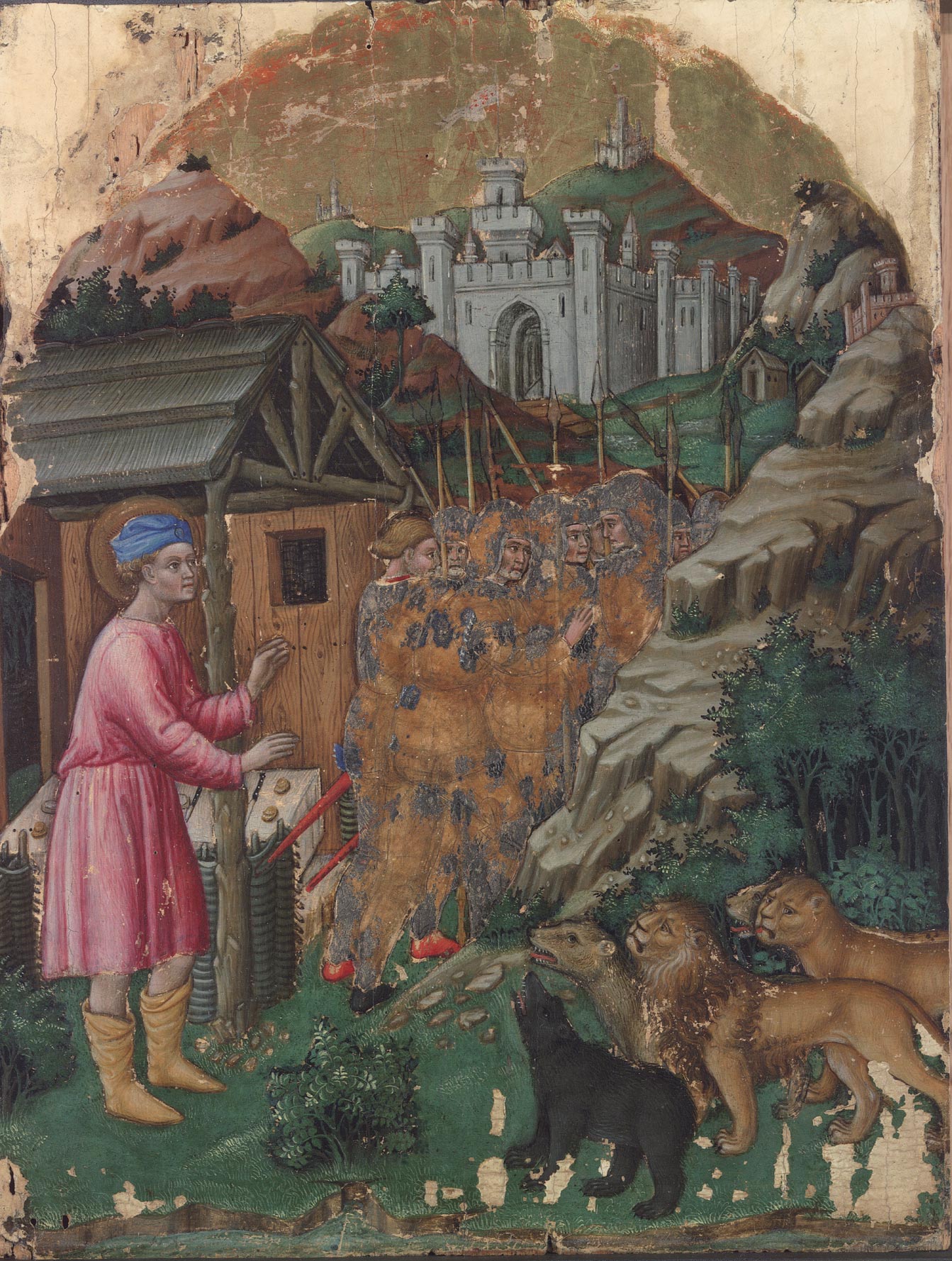
The earliest record of this picture and the related Flight of the Soldiers before Saint Mamas and the Wild Beasts is in the 1912 exhibition of Venetian painting organized by the Burlington Fine Arts Club in London, when they were listed as the property of the Irish Member of Parliament John Annan Bryce and attributed to Jacopo Bellini or his school. In a seminal article published the same year, Roger Fry recognized that the two panels were fragments of a larger complex that included two more episodes from the life of Saint Mamas in the Museo Correr, Venice (figs. 2–3), and a representation of the enthroned saint in the Museo di Castelvecchio, Verona (fig. 4).2 Fry’s detailed examination of the work’s narrative structure and its iconography, which has no known precedent in Western art, provided the starting point for all subsequent studies of these images.
Though relatively obscure to modern audiences, Saint Mamas (also known as Mama or Mammas), a young shepherd martyred in Caesarea during the reign of Emperor Aurelian (A.D. 270–75), was one of the most venerated figures in Asia Minor and the Byzantine Empire, where he was referred to as “the great martyr.”3 His cult soon spread to the West and, in particular, to France—after some of his most important relics were brought to the city of Langres—and to northern Italy. But while single images of the saint proliferated in the West, narrative cycles devoted to his life remained rare. The most comprehensive series consists of eighteen roundels illustrating single episodes from the saint’s legend in a thirteenth-century stained-glass window in the cathedral of Saint-Étienne in Auxerre, France.4 Aside from this work, the only other example is the set of eight tapestry panels designed by Jean Cousin the Elder in 1543 for Langres Cathedral.5 While sharing individual motifs with the Yale and Correr panels (see figs. 2–3), however, neither the Auxerre roundels nor the Langres tapestry bear a compositional relationship to the present cycle, reflecting the absence of a standardized narrative for the life of the saint.6 Fry noted that the events illustrated by the Yale and Correr fragments seemed “to accord the best” with the Life of Saint Mamas by the tenth-century Byzantine hagiographer Simeon Metaphrastes,7 although some of the episodes, as recently highlighted by Giada Petrillo,8 suggest a conflation of the Metaphratic account with other, more ancient texts. According to Metaphrastes, Mamas was the son of patrician parents devoted to Christianity, who were denounced for their faith. After his mother died while giving birth to him in prison, Mamas was adopted by a wealthy Christian widow who passed away by the time he was fifteen, leaving him her fortune. At this time, Mamas, who had already become known for his preaching and power of conversion, was summoned before the provincial governor (praeses) of Caesarea, Democritus, who, having tried without success to convince him to worship at the altar of Serapis, reported him to Emperor Aurelian. The emperor tried to entice Mamas to renounce his faith with the promise of a place at his court, but when the youth turned down his entreaties, Aurelian had him tortured. From this point, the Metaphrastic Life describes Mamas’s escape to the mountains, where he received a staff from Heaven and a Gospel book from the bowels of the earth, built a hut, preached to the wild beasts, and made cheese to distribute to the poor from the milk of the animals. Accused of magic by the new governor, Alexander, who sent soldiers to capture him, Mamas was imprisoned and finally killed with a trident after enduring numerous torments.
The Yale and Correr fragments (see figs. 2–3) illustrate the later events in Saint Mamas’s life, concluding with his death and calling to Heaven. It is generally assumed that the first panel in the sequence is the Flight of the Soldiers before Saint Mamas and the Wild Beasts, which shows Saint Mamas dressed as a shepherd, standing before the hut where he has welcomed with bread and cheese the soldiers sent by Governor Alexander to arrest him. In the Metaphrastic account, at the sight of the female wild animals who arrived, as usual, to be milked by the saint, the soldiers, not having realized who their host was, were seized by wonder and fear. To reassure them, Mamas revealed his true identity and then sent the soldiers away with the promise that he would soon present himself to the governor and surrender of his own free will. The Yale scene, however, seems less dependent on the Metaphrastic text than on the earliest Passio dedicated to the saint, composed in the fourth century,9 which relates how Mamas stopped the soldiers from fleeing by explaining to them how God’s words had the power to tame the wild beasts who gathered around to hear him preach.10 Consonant with the Passio is the detail of the bear, lions, and other wild animals assembled before Mamas, who is intent on reassuring the soldiers as they are about to turn back in fright toward the city behind them. The episode takes place in a wooded, rocky landscape meant to evoke the wilderness of the saint’s surroundings. A table set with knives and pieces of bread or cheese is arranged in the open shed behind Mamas, who is dressed in a pink tunic and blue cape with ochre-colored boots. The modern “cleaning” of the panel has left only traces of the tin leaf used to depict the brilliant armor of the soldiers and the tips of their lances. One of the soldiers in the foreground, without a helmet, wears bright red shoes and a red vest below his armor. The ends of two swords in red scabbards emerge from the group.
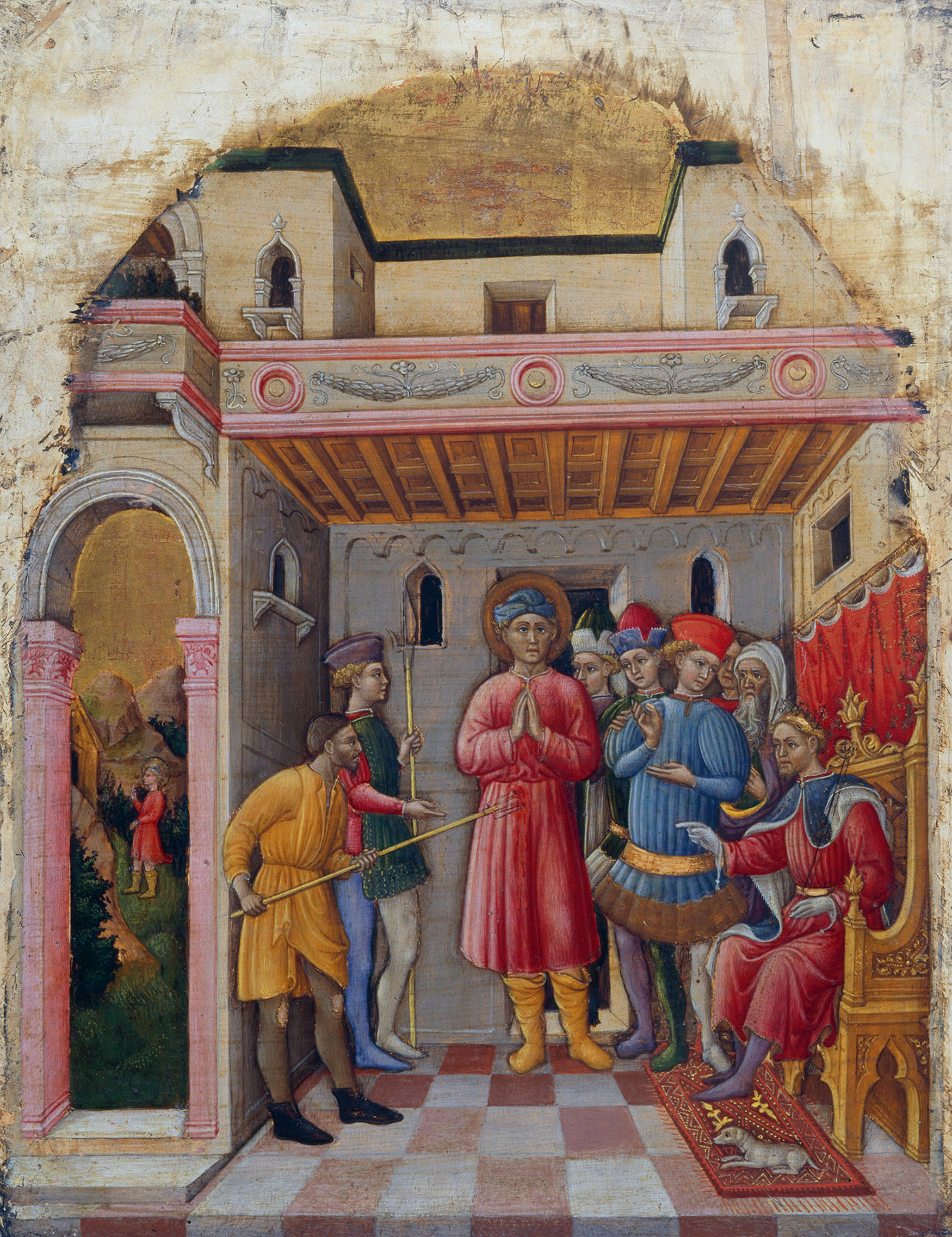
The subject of the second panel at Yale, described in the past as “Saint Mamas before Aurelian,” “The Trial of Saint Mamas,” or “Saint Mamas Thrown (or Fed) to the Beasts,” is more difficult to interpret. The composition is articulated around an elegant palace whose architecture recalls Late Gothic models in Venice and the Veneto. On the left, in the interior of an audience room with a coffered ceiling and tiled floor, two figures seated on an elaborately carved bench and a young man standing before them are engaged in lively interaction. A small page in the left corner is in attendance. The seated figure on the left, who seems to be addressing the standing youth, is identified as a royal personage by his crown and scepter, as well as his attire; he wears a pale blue, ermine-lined brocaded cloak with gold trim over a red-lake tunic, and white gloves with hanging tassels. Next to him is an older gray-bearded man dressed in priestly robes; his head is covered by a white shawl edged in gold, and he wears a lavender cloak with vermilion lining over a green tunic, both of which are also bordered in gold. The finely dressed youth, in contemporary fifteenth-century attire, wears a red-lake giornea, the typical outer garment trimmed with fur, over a pale blue shirt and green stockings decorated with gold dots. On the right side of the composition, standing in an open courtyard before the closed palace doors and painted larger than the figures in the left scene, is Saint Mamas looking up in prayer toward a half-length image of God the Father. Crouched at Mamas’s feet, in the act of licking his boots, are a leopard, a black bear, and a lion.
Fry, who observed that the Yale composition seemed to combine “two or three similar incidents” separated in the Metaphrastic account “by months or years,” thought that the interior scene, which is not accounted for by any of the Lives, might show the emperor Aurelian with the priest of Serapis, at whose altar the saint refused to worship.11 On the right, Fry supposed, was the saint after having delivered his reproof to the judges, while the figure of God the Father in the sky symbolized “the tenor of the Saint’s confession,” and the beasts stood for the “heads of the Saint’s cattle awaiting him.”12 Petrillo, on the other hand, proposed that the narrative was centered around the final torments suffered by the saint at the hands of the new provincial governor, Alexander, as described in the Metaphrastic Life. According to Petrillo, the bearded figure seated next to Aurelian is not a priest, but Alexander, and the two youths in contemporary costume simply pages in attendance. The imagery on the right side of the panel would therefore refer to the miraculous taming of the three wild beasts—a bear, a leopard, and a lion—who were sent by Alexander to devour the saint but instead knelt at Mamas’s feet to comfort him, “licking the sweat from his brow.”13
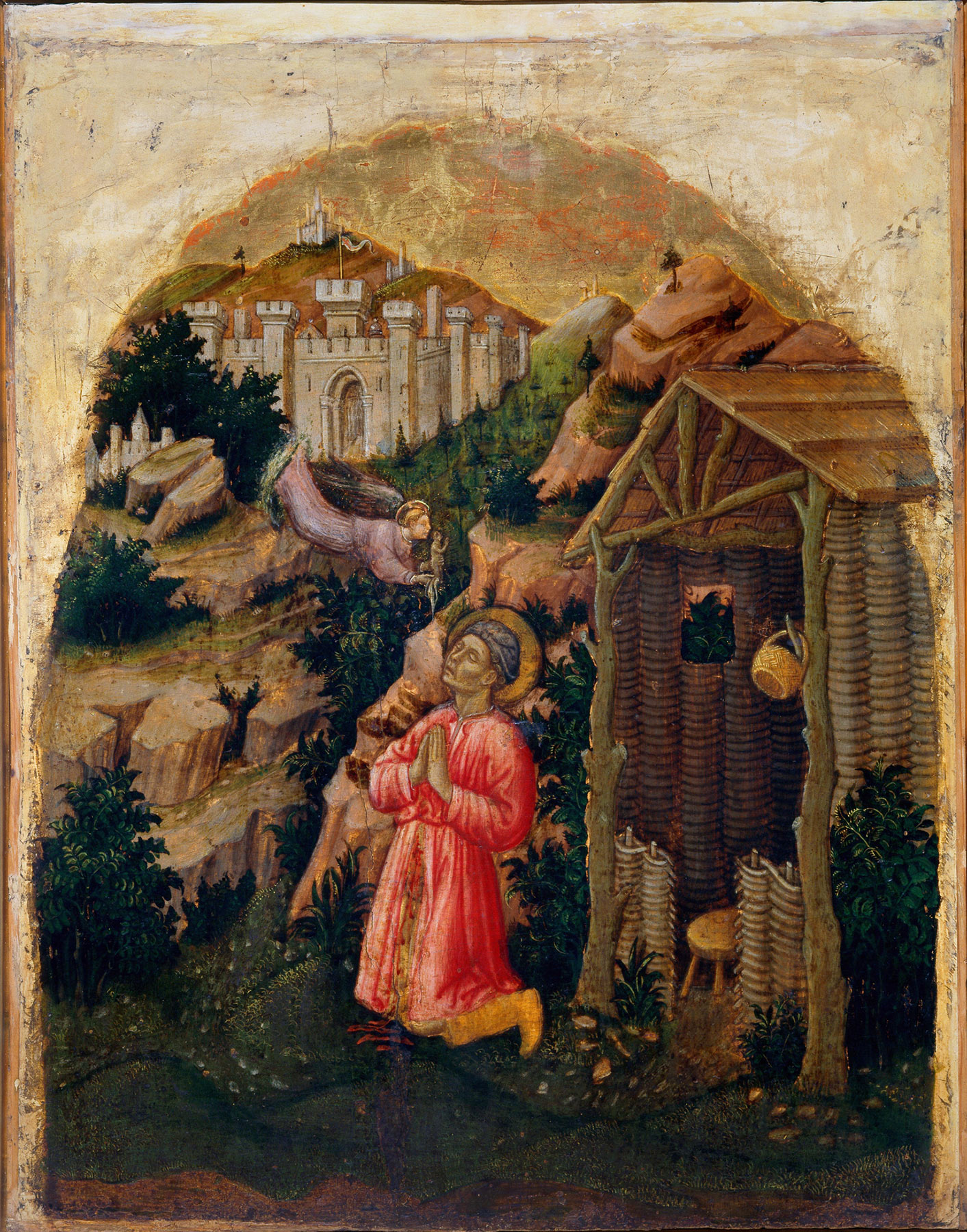
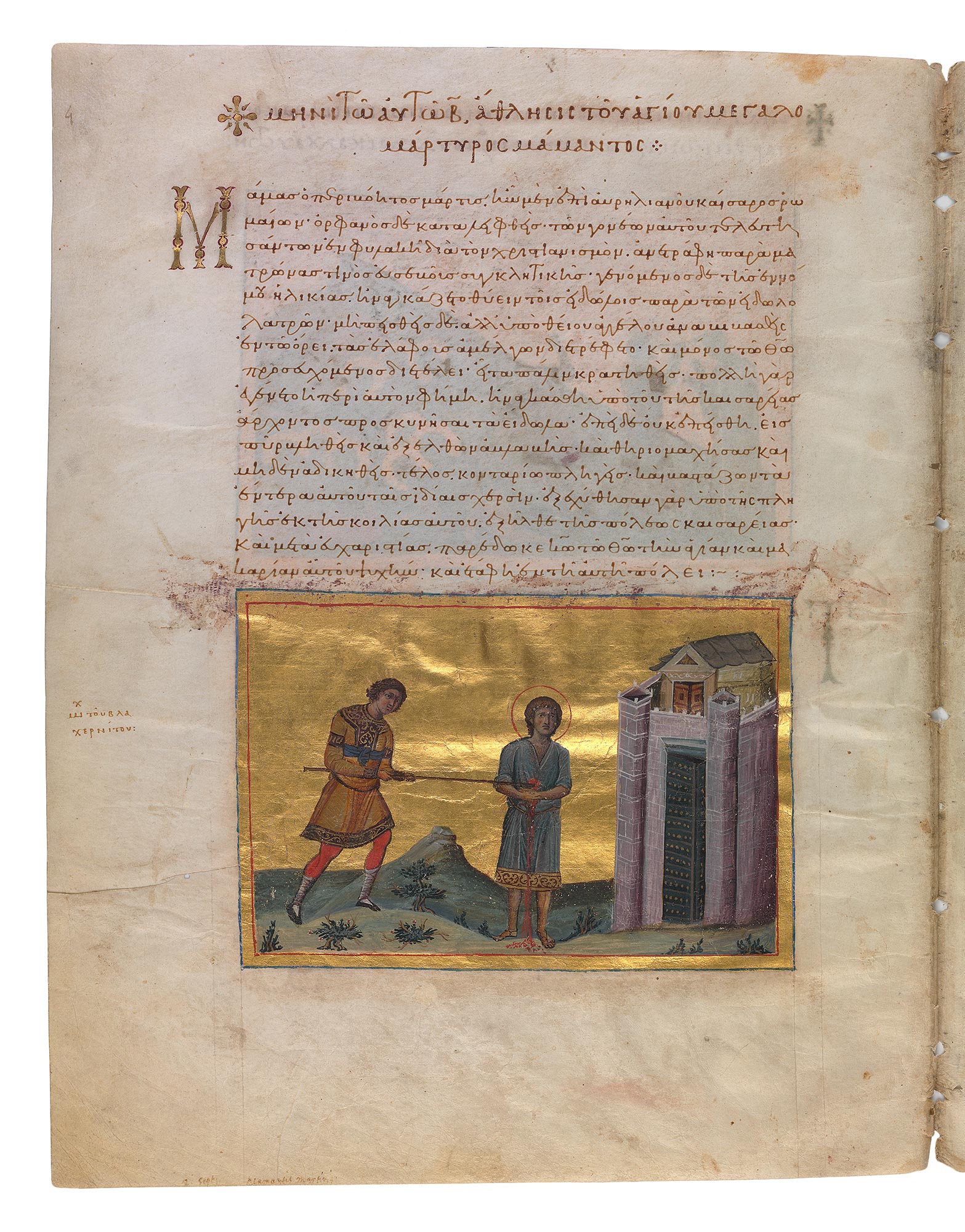
While the representation of Saint Mamas clearly relates to the events described in the Life, the identity of the figures in the Yale interior scene is ambiguous. Petrillo’s identification of the bearded elder as Alexander is inconsistent with his priestly robes and with the same character’s reappearance in the Correr Martyrdom of Saint Mamas (see fig. 2), where he is recognizable among the crowd of courtiers witnessing the spectacle. Fry’s suggestion that he might be a priest of Serapis seems more plausible, although other details still remain opaque. Since it was Governor Alexander who ordered the attack of the animals seen crouched at Mamas’s feet, narrative continuity would seem to dictate that the royally attired personage is not Aurelian but Alexander. That the Yale image might reflect a conflation between the figures of emperor and governor is suggested by other comparisons with the Correr Martyrdom, presumed to be the next episode in the sequence. In this instance, the setting has been transposed from the amphitheater described by Metaphrastes to a crowded throne room of a palace, similar in many architectural details to the audience hall in the Yale panel. The action unfolds according to the Metaphrastic legend, which relates how Alexander, in a fit of fury at Saint Mamas—who had survived unscathed the torments alluded to in the Yale picture—suddenly instructed an armed attendant to thrust his trident into the saint’s body. The crowned despot seated on his throne, holding a scepter and wearing a light blue mantle over a red tunic and white gloves, is the same imperial type who appears in the Yale panel, providing a clear visual link between the two scenes. Perhaps not coincidentally, a precedent for this conflation of characters is found in the thirteenth-century window of Auxerre Cathedral, in which the same episodes are presided over by identical figures with crown and scepter—most likely indicating a shared iconographic model.14 In the Correr Martyrdom, Mamas is shown calmly awaiting his fate, hands joined in prayer, as the long trident, wielded by a simply dressed guard, pierces his stomach. The rendering of this particular motif, absent from the Auxerre window, closely adheres to Byzantine sources, as represented by a miniature of the saint’s martyrdom in the so-called Menologion of Basil II (976–1025), a lavishly illuminated Greek manuscript in the Vatican Library (fig. 5).15 Metaphrastes’s account goes on to describe how the mortally struck Mamas managed to walk some distance away from the city before dying and rendering his soul to God. On the left of the Correr Martyrdom, viewed through a narrow archway, is the small shape of the wounded saint, headed toward his abode in the wilderness. The last panel in the sequence, also in the Correr Museum (see fig. 3), depicts Saint Mamas in his final hours, kneeling in prayer before his wattle hut, as an angel descends from the sky to collect his soul.
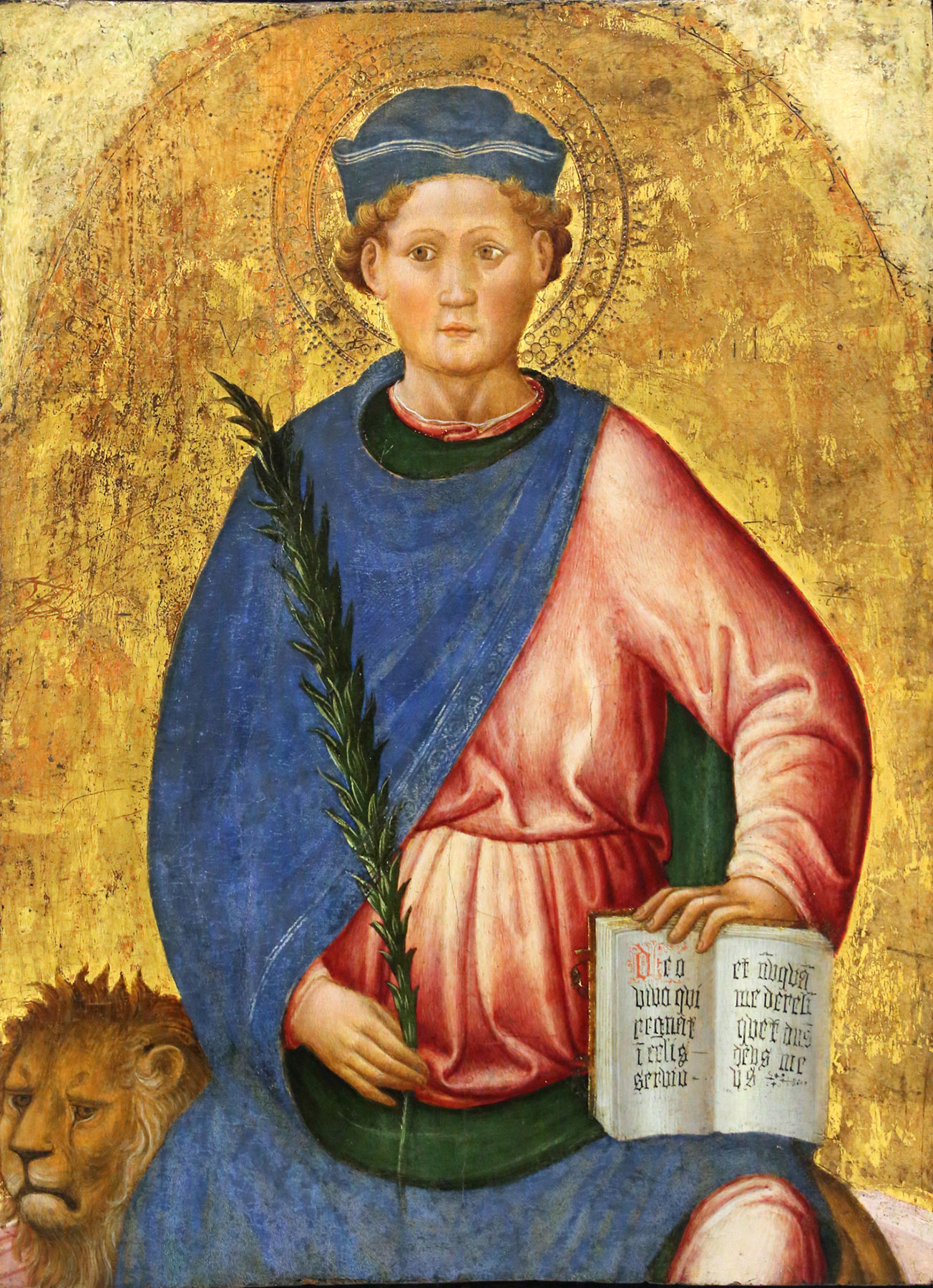
In his reconstruction of the original complex, Fry posited that the scenes from the life of the saint were arranged horizontally, two on each side of the Verona Saint Mamas (see fig. 4), which shows the young martyr accompanied by a lion, a common attribute in Byzantine representations. The saint displays an open volume, inscribed with a version of the confession of faith he made before his torturer Alexander: “DEO / VIVO QUI / REGNAT / I[N] CELIS / SERVIO / ET NU[N]QU[AM] / ME DERELI[N] / QUET D[OMIN] US / DEUS ME / US” (I serve the living God who resides in the Heavens, and my God will never abandon me). While leaving open the possibility that the panels might have formed a predella, Fry envisioned a structure in the nature of a reredos placed over an altar dedicated to the saint.16 Noting the essentially Venetian, Late Gothic elements of the artist’s approach, combined with an awareness of the more advanced architectural vocabulary of Jacopo Bellini, Fry assigned the altarpiece to Jacopo’s slightly older contemporary, Michele Giambono.
In 1924 Fry’s attribution was revised by Giuseppe Fiocco, who recognized the tight correspondences between the Saint Mamas panels and the signed and dated 1447 polyptych by Giambono’s lesser-known follower Francesco dei Franceschi in the Musei Civici, Padua, which displays virtually identical figure types and decorative elements.17 Since then, Francesco’s authorship of the series has never been questioned by scholars, who have generally dated the Saint Mamas panels around the middle of the fifteenth century, in close proximity to the Padua polyptych. Considerably less certainty, on the other hand, has characterized discussions of the appearance of the original complex. Fiocco accepted Fry’s arrangement and referred to the fragments as a “fronte di cassa,”18 presumably referring to the painted front of a reliquary box that also served as a dossal or antependium—a typology that had a long tradition in Venice and its outposts along the Adriatic coast, going back to the workshop of Paolo Veneziano.19 In 1927 Evelyn Sandberg-Vavalà associated an Angel of the Annunciation and Virgin Annunciate, also in the Museo di Castelvecchio, Verona,20 with the Saint Mamas and accompanying narrative scenes, and she proposed that they were fragments of an unidentified polyptych dedicated to the saint.21 The classification of the Yale and Correr panels as elements of a large predella was embraced by subsequent authors,22 who integrated other panels by Francesco, dispersed among various collections, in the same altarpiece, eventually arriving at the solution proposed by Andrea De Marchi in the most recent catalogue of the Museo di Castelvecchio.23 In De Marchi’s reconstruction, the Verona Saint Mamas (see fig. 4), which is considerably reduced from its original dimensions, was the central compartment of a monumental pentaptych that included pairs of standing saints and other half-length figures, with the Yale and Correr scenes (see figs. 2–3) below them. Doubts about the integration of all these fragments into the same structure were raised by Walter Angelelli,24 however, and were confirmed by Petrillo, who convincingly argued, based on both technical and stylistic evidence, that they were parts of two separate and independent works.25
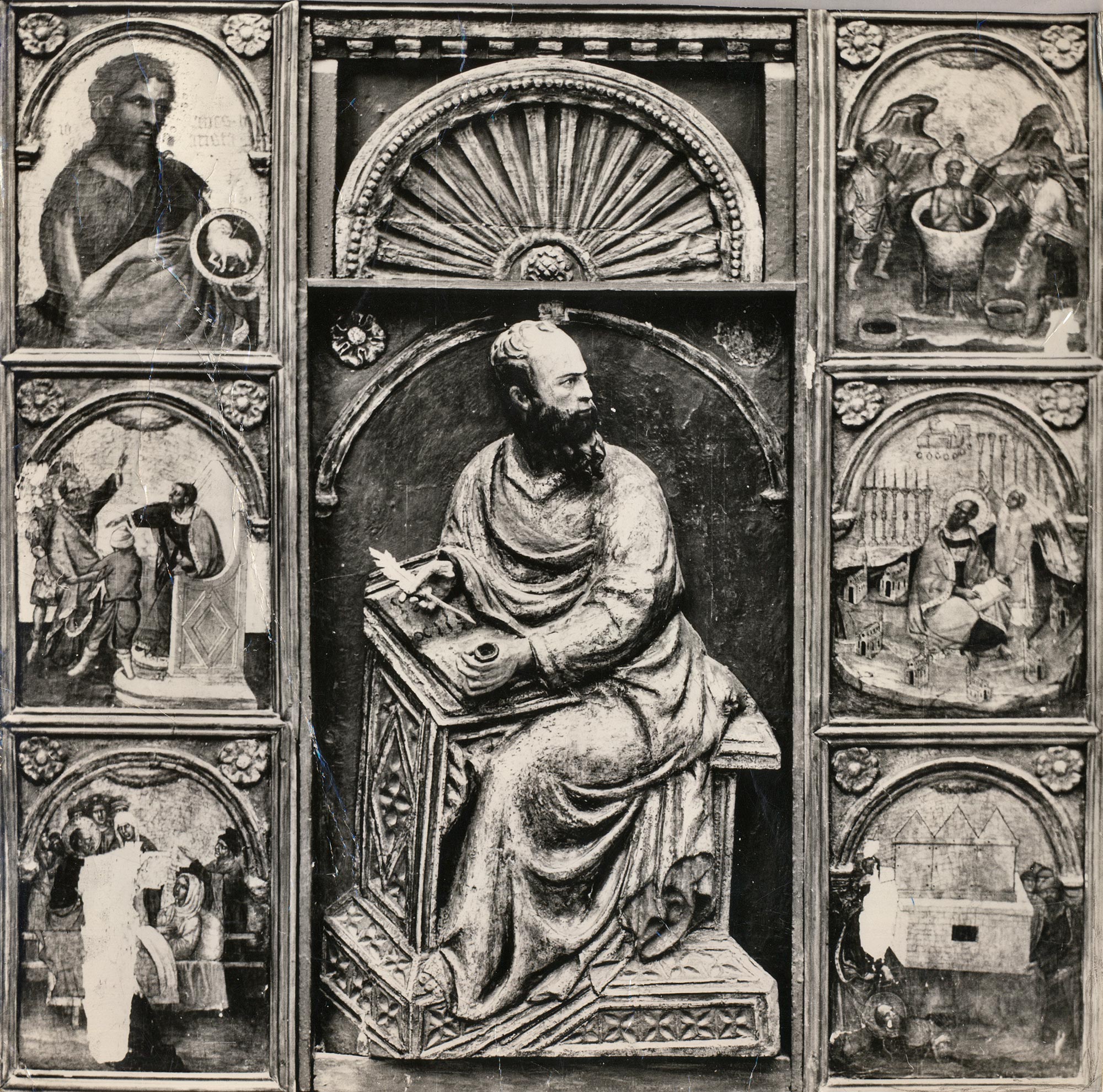
As noted by Petrillo, the large size of the Yale and Correr panels suggest a format not unlike the narrative dossal envisioned by Fiocco, with the episodes from the life of Saint Mamas arranged vertically alongside the Verona panel. Fragments of pink stone or marble visible behind Saint Mamas would appear to indicate that the saint was seated on a throne with the lion as an attribute behind him, instead of riding the animal as in Byzantine iconography. Given the current height of the Verona panel, 61.8 centimeters, it is possible to calculate that, if the figure was complete, at least 30 centimeters are now missing from the lower half, excluding elements of the throne’s platform or base. The original dimensions of the Saint Mamas would therefore accord with the combined height—at least 105 centimeters—of two narrative episodes placed one above the other, next to him. Referring to Jacobello del Fiore’s cycle of eight scenes from the life of Saint Lucy in the Pinacoteca Comunale, Fermo, Petrillo hypothesized that Francesco’s work may have included an additional four episodes, now lost, illustrating the earlier parts of the saint’s legend, resulting in a larger complex with four panels arranged in two tiers on each side of Saint Mamas.26 The vertical wood grain of the narrative fragments, however, could also argue for a more modest traditional typology, on the example of Jacobello del Fiore’s altarpiece for the church of Saint John the Evangelist in Omišalj, Krk, Croatia, which has a carved central element flanked by a single column of three painted panels on each side (fig. 6).
The circumstances surrounding the commission of this unique work remain unknown. A Veronese context was emphasized by De Marchi,27 who argued that the cult of Saint Mamas was especially strong in Verona, where there was an oratory dedicated to the saint and an altarpiece painted by Giovanni Badile for the church of Sant’Anastasia showing the young saint Mamas with the attribute of a lion at his feet.28 Based on the dating of the Verona Saint Mamas not long after Francesco’s 1447 polyptych, De Marchi tentatively proposed that the dismembered complex might have been executed for an altar dedicated to Saint Mamas in the church of San Tommaso Apostolo in Verona. That altar appears to have been erected in 1443–44 by the cheesemakers’ guild, whose members had a particular devotion to Mamas, on account of his work as a shepherd, milking the wild animals to make cheese for the poor. Other authors, however, have referred to the Saint Mamas altarpiece’s possible provenance from Venice, pointing out that the church of Santa Maria della Fava possessed a relic of the saint.29 Whoever the patron was, the derivations from iconic representations of Saint Mamas and the mingling of textual references in the altarpiece’s iconographic program clearly signal an intimate familiarity with the saint and his legend, acquired either from firsthand experience in Byzantine centers or through access to illuminated Greek and/or French manuscript sources.30 —PP
Published References
Burlington Fine Arts Club. Catalogue of a Collection of Pictures of the Early Venetian School and Other Works of Art. London, 1912., 11–12, 14, nos. 1, 5; Fry, Roger. “Exhibition of Pictures of the Early Venetian School at the Burlington Fine Arts Club—I.” Burlington Magazine 20, no. 108 (March 1912): 346, 350–54, 356–57, 359., 346, 350–52, pls. 1–2, figs. b–c; Fiocco, Giuseppe. “Due Madonne di Michele Giambono.” Dedalo 5 (1924): 443–55., 451–52; van Marle, Raimond. The Development of the Italian Schools of Painting. Vol. 7. The Hague: M. Nijhoff, 1926., 390; Sandberg-Vavala, Evelyn. “Michele Giambono and Francesco dei Franceschi.” Burlington Magazine 51, no. 296 (November 1927): 214–17, 221., 215; Constable, W. G. Paintings by Italian Masters in the Possession of William Harrison Woodward: A Catalogue. Oxford: Oxford University Press, 1928., 17–19, pl. 19; Berenson, Bernard. Italian Pictures of the Renaissance: A List of the Principal Artists and Their Works with an Index of Places. Oxford: Clarendon, 1932., 200; Sandberg-Vavala, Evelyn. “Additions to Francesco de’ Franceschi.” Burlington Magazine 76, no. 446 (May 1940): 154–57., 156n9; Pallucchini, Rodolfo, ed. I capolavori dei musei veneti. Venice: Arte Veneta, 1946., 46; “Picture Book Number One: Italian Painting.” Special issue, Bulletin of the Associates in Fine Arts at Yale University 15, nos. 1–3 (October 1946): n.p., fig. 29; Arslan, Edoardo. “Intorno a Giambono e a Francesco dei Franceschi.” Emporium 108, no. 648 (1948): 285–89., 287; Muraro, Michelangelo. La quadreria Correr. Venice: Ferdinando Ongania, 1948., 5; Lorenzetti, Giulio, Giovanni Mariacher, and Terisio Pignatti, eds. Civico museo Correr: Catalogo della quadreria. Venice: C. Ferrari, 1949., 22; Coletti, Luigi. Pittura veneta del quattrocento. Novara: De Agostini, 1953. , 15, 129; Berenson, Bernard. Italian Pictures of the Renaissance, A List of the Principal Artists and Their Works with an Index of Places: Venetian School. 2 vols. London: Phaidon, 1957., 1:79, pls. 53–54; Mariacher Giovanni. Il Museo Correr di Venezia: Dipinti dal XIV al XVI secolo. Venice: N. Pozza, 1957., 80–81; Seymour, Charles, Jr. “Louis Mayer Rabinowitz.” Bulletin of the Associates in Fine Arts at Yale University 23, no. 3 (September 1957), 10–14., 13; Seymour, Charles, Jr. The Rabinowitz Collection of European Paintings. New Haven: Yale University Art Gallery, 1961., 54–55; Cignitti, Benedetto. “Mama.” In Bibliotheca Sanctorum (Rome: Instituto Giovanni XXIII nella Pontificia Università Lateranense, 1967), 8: cols. 592–611., 611; Seymour, Charles, Jr. Early Italian Paintings in the Yale University Art Gallery. New Haven: Yale University Art Gallery, 1970., 241–43, nos. 182–83; Padovani, Serena. “Un contributo alla cultura Padovana del primo Rinascimento: Giovan Francesco da Rimini.” Paragone 22, no. 259 (September 1971): 3–31., 9, 26n33; Fredericksen, Burton B., and Federico Zeri. Census of Pre-Nineteenth-Century Italian Paintings in North American Public Collections. Cambridge, Mass.: Harvard University Press, 1972., 601; David Arnheim, in Seymour, Charles, Jr., et al. Italian Primitives: The Case History of a Collection and Its Conservation. Exh. cat. New Haven: Yale University Art Gallery, 1972., 43, nos. 35a–b; Kaftal, George. Saints in Italian Art. Vol. 1, Iconography of the Saints in the Painting of North East Italy. With the collaboration of Fasio Bisogni. Florence: Sansoni, 1978., cols. 647, 649–50, figs. 808–9; Ross, J. Beaudoin. “Jean Cousin the Elder and the Creation of the Tapestries of Saint Mamas.” Art Bulletin 60, no. 1 (March 1978): 28–34., 31; Merkel, Ettore. “Venezia, 1430–1450.” In La pittura nel Veneto: Il quattrocento, ed. Mauro Lucco, 1:49–79. Milan: Electa, 1989., 1:59; Angelelli, Walter, and Andrea G. De Marchi. Pittura dal duecento al primo cinquecento nelle fotografie di Girolamo Bombelli. Milan: Electa, 1991., 135; Kenney, Elise K., ed. Handbook of the Collections: Yale University Art Gallery. New Haven: Yale University Art Gallery, 1992., 136; Pesaro, Cristina. “Michele Giambono.” Saggi e memorie di storia dell’arte 18 (1992): 13–69, 153–81., 51–52, 57; Vauthier, Émile. Saint Mammès: Patron de la cathèdrale et du diocèse de Langres; Histoire, culte, légende, iconographie. Langres, France: D. Guéniot, 1994., 52; Angelelli, Walter. “Franceschi, Francesco dei.” In Dizionario biografico degli Italiani. Rome: Istituto della Enciclopedia Italiana, 1997. https://www.treccani.it/enciclopedia/francesco-dei-franceschi_(Dizionario-Biografico)/., 615; Campbell, Thomas P. Tapestry in the Renaissance: Art and Magnificence. Exh. cat. New York: Metropolitan Museum of Art, 2002., 478; Groppetti, Claudio, and Émile Vauthier. San Mamante, il grande martire: Da Cesarea di Cappadocia a Langres e a Cavaglio d’Agogna. Novara: Interlinea, 2005., 53; Petrillo, Giada. “Francesco de’ Franceschi.” Ph.D. diss., Università degli Studi di Trento, 2008–9., 26, 40–43, 85–88, 91–101, figs. 49, 72–73; Andrea De Marchi, in Marini, Paola, Gianni Peretti, and Francesca Rossi, ed. Museo di Castelvecchio: Catalogo generale dei dipinti e delle miniature delle collezioni civiche veronesi. Vol. 1, Dalla fine del X all’inizio del XVI secolo. Cinisello Balsano, Milan: Silvana, 2010., 165–67; Tsilipakou, Agathoniki D. “The Veneration of Saint Mamas in the Mediterranean: A Traveller and Border-defender Saint; The Case of Naxos in the Cyclades.” In Naxos and the Byzantine Aegean: Insular Responses to Regional Change, ed. James Crow and David Hill, 299–307. Athens: Norwegian Institute at Athens, 2018., 301
Notes
-
According to Constable, W. G. Paintings by Italian Masters in the Possession of William Harrison Woodward: A Catalogue. Oxford: Oxford University Press, 1928., 19. ↩︎
-
Fry, Roger. “Exhibition of Pictures of the Early Venetian School at the Burlington Fine Arts Club—I.” Burlington Magazine 20, no. 108 (March 1912): 346, 350–54, 356–57, 359., 346, 350–52. ↩︎
-
For the saint and his cult, see Vauthier, Émile. Saint Mammès: Patron de la cathèdrale et du diocèse de Langres; Histoire, culte, légende, iconographie. Langres, France: D. Guéniot, 1994.; and Groppetti, Claudio, and Émile Vauthier. San Mamante, il grande martire: Da Cesarea di Cappadocia a Langres e a Cavaglio d’Agogna. Novara: Interlinea, 2005.. ↩︎
-
See Vauthier, Émile. Saint Mammès: Patron de la cathèdrale et du diocèse de Langres; Histoire, culte, légende, iconographie. Langres, France: D. Guéniot, 1994., 121–23, for a detailed description of the individual roundels. ↩︎
-
For this commission, see Ross, J. Beaudoin. “Jean Cousin the Elder and the Creation of the Tapestries of Saint Mamas.” Art Bulletin 60, no. 1 (March 1978): 28–34., 28–34; and Pascal-François Bertrand and Thomas Campbell, in Campbell, Thomas P. Tapestry in the Renaissance: Art and Magnificence. Exh. cat. New York: Metropolitan Museum of Art, 2002., 477–80, no. 56. ↩︎
-
For an overview of the ancient sources and the genesis of the saint’s legend, see Cignitti, Benedetto. “Mama.” In Bibliotheca Sanctorum (Rome: Instituto Giovanni XXIII nella Pontificia Università Lateranense, 1967), 8: cols. 592–611., 592–611. ↩︎
-
Fry, Roger. “Exhibition of Pictures of the Early Venetian School at the Burlington Fine Arts Club—I.” Burlington Magazine 20, no. 108 (March 1912): 346, 350–54, 356–57, 359., 351. For Metaphrastes’s text, see Symeon Metaphrastes. “Martyrium S. Martyris Mamamntis.” In Patrologiae Cursus Completus, Series Greca. ed. Jacques-Paul Migne, 115: cols. 565–74. Paris: J.-P. Migne, 1864., cols. 565–74. ↩︎
-
Petrillo, Giada. “Francesco de’ Franceschi.” Ph.D. diss., Università degli Studi di Trento, 2008–9., 92. ↩︎
-
See Delehaye, Hippolytus, ed. “Passio sancti Mammetis.” Analecta Bollandiana 58 (1940): 126–41., 126–41. ↩︎
-
In the Passio, the soldiers prostrate themselves at Mamas’s feet and convert to Christianity. In this version of the legend, Mamas dies peacefully after surviving numerous tortures, not as a result of the wounds inflicted upon him. The text also omits the earlier events in the saint’s biography. ↩︎
-
Fry, Roger. “Exhibition of Pictures of the Early Venetian School at the Burlington Fine Arts Club—I.” Burlington Magazine 20, no. 108 (March 1912): 346, 350–54, 356–57, 359., 351. ↩︎
-
Fry, Roger. “Exhibition of Pictures of the Early Venetian School at the Burlington Fine Arts Club—I.” Burlington Magazine 20, no. 108 (March 1912): 346, 350–54, 356–57, 359., 351. ↩︎
-
Symeon Metaphrastes. “Martyrium S. Martyris Mamamntis.” In Patrologiae Cursus Completus, Series Greca. ed. Jacques-Paul Migne, 115: cols. 565–74. Paris: J.-P. Migne, 1864., 573–74. The image, summarizing one of the salient events in the saint’s life and his profession of faith, is iconographically related to the miniature of Saint Mamas addressing the bust-length image of God the Father while a doe and two stags graze at his feet, in a twelfth-century Greek manuscript of the Homilies of Gregory of Nazianzus in the Bibliothèque Nationale de France, Paris (MS Grec 550, fol. 30r, https://gallica.bnf.fr/ark:/12148/btv1b10721518f/f40.item). ↩︎
-
In the stained-glass cycle, it should be noted, the presiding figure appears as a king only in the roundels illustrating the later events, concerning Alexander. In the early episode of the meeting of Mamas and Democritus, the provincial governor is identified by a simple skullcap. ↩︎
-
See https://digi.vatlib.it/view/MSS_Vat.gr.1613 (with accompanying bibliography). The manuscript, containing remembrances to be read on the saints’ feast days, was brought from Constantinople in the fifteenth century as a gift to Ludovico Sforza, duke of Milan. Based on an erased notation, it is thought that it previously belonged to a Genovese notary active in Constantinople. ↩︎
-
Fry, Roger. “Exhibition of Pictures of the Early Venetian School at the Burlington Fine Arts Club—I.” Burlington Magazine 20, no. 108 (March 1912): 346, 350–54, 356–57, 359., 346. ↩︎
-
Inv. nos. 386–97. See Fiocco, Giuseppe. “Due Madonne di Michele Giambono.” Dedalo 5 (1924): 443–55., 451–52. Executed for the high altar of the church of San Pietro Apostolo in Padua, the altarpiece was disassembled in the nineteenth century and its original frame, bearing the date and the names of the painter and carver, Francesco Storibono, lost; see Petrillo, Giada. “Francesco de’ Franceschi.” Ph.D. diss., Università degli Studi di Trento, 2008–9., 49–56 (with previous bibliography). ↩︎
-
Fiocco, Giuseppe. “Due Madonne di Michele Giambono.” Dedalo 5 (1924): 443–55., 451. ↩︎
-
See Cozzi, Enrica. “Paolo Veneziano e bottega: Il politico di Santa Lucia e gli antependia per l’isola di Veglia.” Arte in Friuli, arte a Trieste 35 (2017): 235–93., 235–93; and Guarnieri, Cristina. “The Stories of St. Lucy by Jacobello del Fiore, and Venetian Folding Reliquary Altarpieces.” Musica e figura 5 (2018): 41–56., 41–56 (with previous bibliography). ↩︎
-
Inv. no. 62-1B2129. ↩︎
-
Sandberg-Vavala, Evelyn. “Michele Giambono and Francesco dei Franceschi.” Burlington Magazine 51, no. 296 (November 1927): 214–17, 221., 215–16. ↩︎
-
See Arslan, Edoardo. “Intorno a Giambono e a Francesco dei Franceschi.” Emporium 108, no. 648 (1948): 285–89., 287–88; and Walter Angelelli, in Angelelli, Walter, and Andrea G. De Marchi. Pittura dal duecento al primo cinquecento nelle fotografie di Girolamo Bombelli. Milan: Electa, 1991., 135. ↩︎
-
Andrea De Marchi, in Marini, Paola, Gianni Peretti, and Francesca Rossi, ed. Museo di Castelvecchio: Catalogo generale dei dipinti e delle miniature delle collezioni civiche veronesi. Vol. 1, Dalla fine del X all’inizio del XVI secolo. Cinisello Balsano, Milan: Silvana, 2010., 165–67. ↩︎
-
Angelelli, Walter. “Franceschi, Francesco dei.” In Dizionario biografico degli Italiani. Rome: Istituto della Enciclopedia Italiana, 1997. https://www.treccani.it/enciclopedia/francesco-dei-franceschi_(Dizionario-Biografico)/., who revised his initial opinion published in Angelelli, Walter, and Andrea G. De Marchi. Pittura dal duecento al primo cinquecento nelle fotografie di Girolamo Bombelli. Milan: Electa, 1991., 135. ↩︎
-
Petrillo, Giada. “Francesco de’ Franceschi.” Ph.D. diss., Università degli Studi di Trento, 2008–9., 40–47, 86–87. Petrillo inserted the panels previously gathered around the Verona Saint Mamas into a multitiered polyptych with six standing saints flanking an unidentified central compartment and dated this work a decade earlier than the Verona Saint Mamas. ↩︎
-
Petrillo’s reconstruction was based on the assumption, then held by most authors, that the eight scenes from the life of Saint Lucy in Fermo were placed on both sides of a central image, now lost. However, Cristina Guarnieri (in Guarnieri, Cristina. “The Stories of St. Lucy by Jacobello del Fiore, and Venetian Folding Reliquary Altarpieces.” Musica e figura 5 (2018): 41–56., 47) subsequently demonstrated that the Fermo panels, two of which contain upside-down images of Saints Lucy and Anthony Abbot on the reverse, were conceived as shutters of a folding reliquary altarpiece, consisting of two superimposed layers. A mechanical device allowed for the movement of one shutter over the other, revealing the reverse of the panel and exposing the caskets where the relics were stored. The most famous prototype for this type of altarpiece is Paolo Veneziano’s Pala d’oro in San Marco, Venice. For more information, see Paolo Veneziano and Workshop, Saint John the Baptist, note 25. ↩︎
-
De Marchi, in Marini, Paola, Gianni Peretti, and Francesca Rossi, ed. Museo di Castelvecchio: Catalogo generale dei dipinti e delle miniature delle collezioni civiche veronesi. Vol. 1, Dalla fine del X all’inizio del XVI secolo. Cinisello Balsano, Milan: Silvana, 2010., 166. ↩︎
-
Giovanni Badile, Polittico dell’Aquila, Museo di Castelvecchio, Verona, inv. no. 152-1B373. Saint Mamas appears among the standing saints flanking the Virgin and Child. ↩︎
-
Merkel, Ettore. “Venezia, 1430–1450.” In La pittura nel Veneto: Il quattrocento, ed. Mauro Lucco, 1:49–79. Milan: Electa, 1989., 59. ↩︎
-
According to documentary evidence, the scenes of Saint Mamas in the sixteenth-century Langres tapestry series were to follow “the story and description of the said Saint Mamas which had been presented to him [Cousin the Elder]” by his patron, Claude de Longwy, cardinal of Givry. It has been suggested that the program provided to Cousin most likely “melded local and historical texts, perhaps interpreted specifically for the tapestries”; Pascal-François Bertrand and Thomas P. Campbell, in Campbell, Thomas P. Tapestry in the Renaissance: Art and Magnificence. Exh. cat. New York: Metropolitan Museum of Art, 2002., 478. A similar set of circumstances could apply to Francesco’s commission. ↩︎