Paul Bottenwieser (1892–1942), Berlin; sale, Park-Bernet Galleries, New York, May 25, 1944, lot 80; Seligmann, Rey & Co., New York; Dr. Lillian Malcove (1902–1981), New York, 1950
The main panel support is 2.2 centimeters thick and of a vertical wood grain. Additional moldings, 1.5 centimeters thick, have been added to define the architectural structure of the frame, while ornamentation filling the tympanum—including the painted roundel—has been carved into the surface. The areas of Flamboyant tracery have also been carved behind to create a gap between the frame and any subjacent support surfaces, increasing the play of light and cast shadow across the intricate decorative detail. The moldings are broken at the lower right and top center but are otherwise very well preserved. The raised edges of the moldings are more worn and reveal more exposed bolus than the recessed carved areas, but the gilding overall is in good condition. The paint surface in the roundel is abraded and is interrupted by two large losses, following partial splits in the panel.
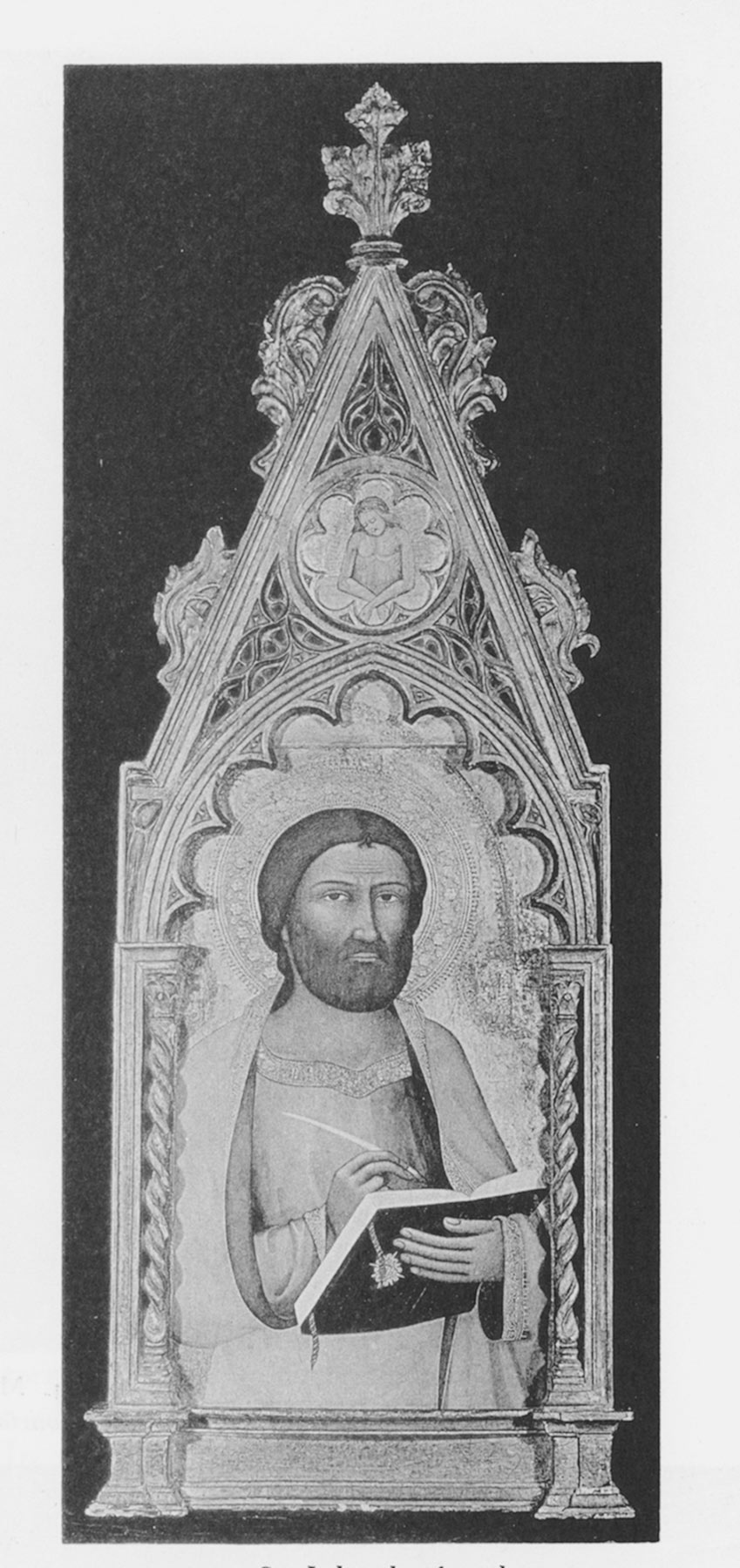
This remarkably intact pinnacle fragment, excised from an unidentified complex, first appeared on the art market in 1944, when it was arbitrarily placed above an unrelated image of Saint Mark by Andrea Vanni, presently in the Harvard Art Museums, Cambridge, Massachusetts (fig. 1).1 The reconstructed complex was acquired in 1950 by Dr. Lillian Malcove, a Canadian-born psychoanalyst and art collector, who donated the Cambridge panel to the Fogg Art Museum in 1956 and the pinnacle, by then recognized as an independent element, to the Yale University Art Gallery. In 1970 Charles Seymour, Jr., catalogued the Man of Sorrows as Sienese School, around 1400, although noting that it was possibly painted during the early years of the fifteenth century.2 In 1972 the same author puzzlingly referred to the pinnacle as “an unusually well-preserved fragment of an original mid-15th century gilt framing element” but advanced a date of around 1390–1400.3 The only other scholar to consider the work was Carl Strehlke, who suggested an attribution to the Marchigian School, around 1420.4
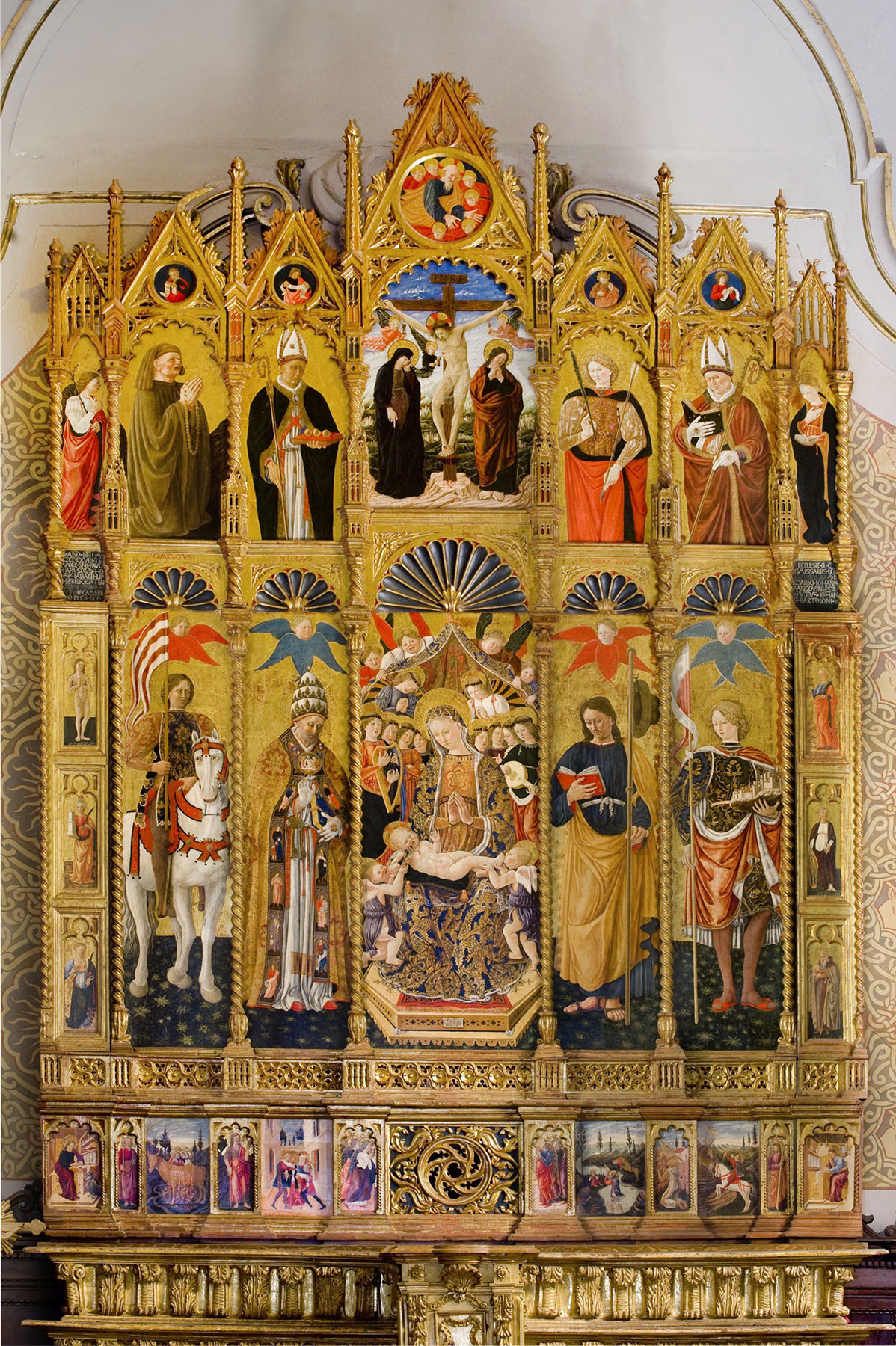
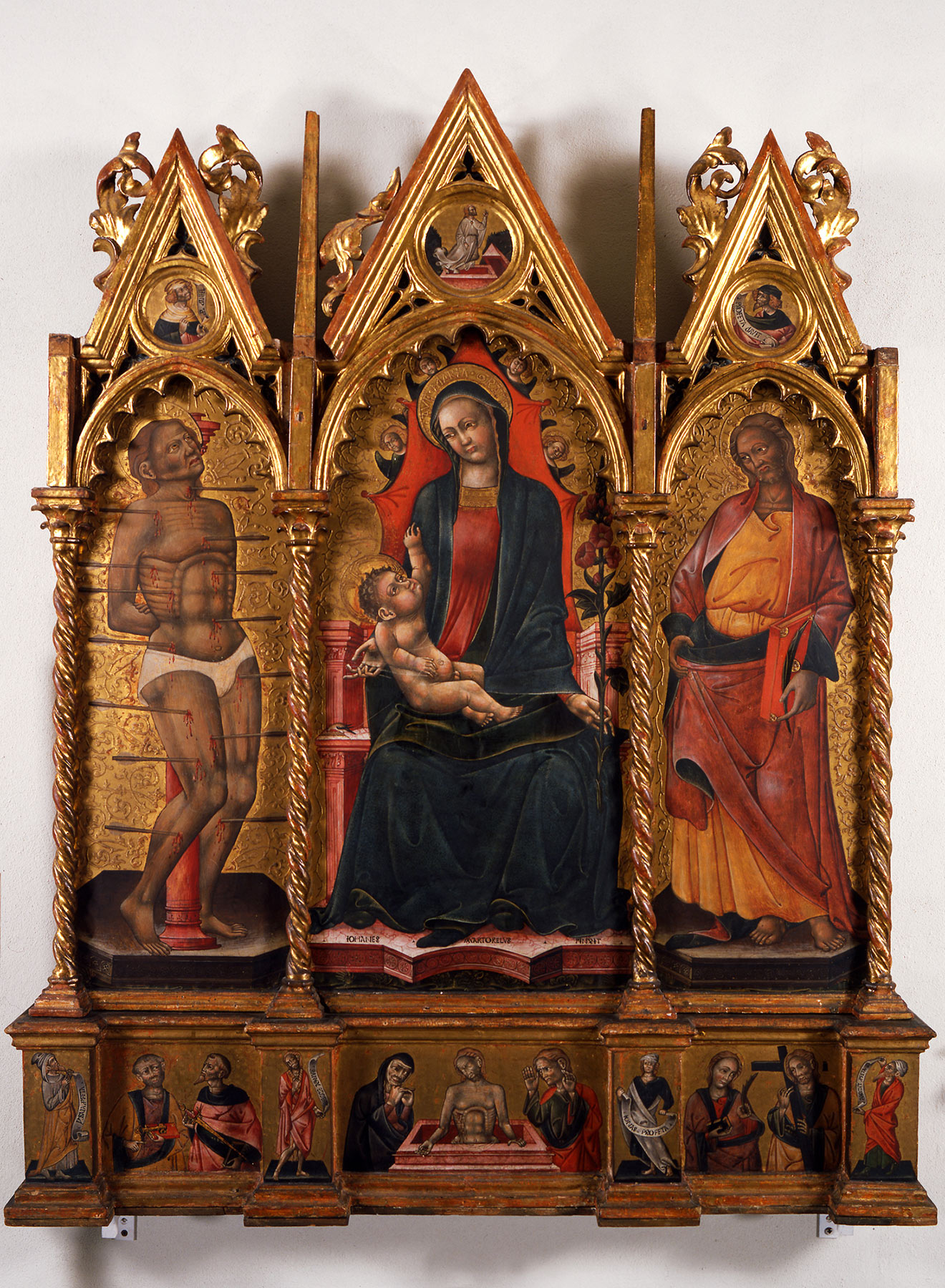
There is no doubt that the Man of Sorrows in the roundel set in the tympanum is an integral part of the pinnacle structure. The Flamboyant Gothic tracery around the image, derived from Northern models, precludes the possibility of a Tuscan origin. The combination of a triangular tympanum with tracery and this type of acanthus ornament closely parallels the so-called Adriatic framing elements of the monumental polyptych by Giovanni Boccati in Belforte del Chienti (fig. 2), signed and dated 1468;5 but it is also reminiscent of an altarpiece signed by the Lombard, possibly Brescian painter Giovanni Martorelli in the Pinacoteca Nazionale, Bologna (fig. 3). The latter has been dated around 1460,6 suggesting, perhaps, a later chronology for the Yale fragment than has hitherto been supposed. Although the size of the Yale Man of Sorrows and its present abraded condition make an evaluation of its stylistic components tentative at best, the expressive concerns still visible in the corrugated brow of the figure and the detailed handling of the facial features and underlying bone structure seem to support a dating around 1450 or later. The unusual dotted rays punched into the gold background and in Christ’s halo, recalling a technique particularly favored by followers of Gentile da Fabriano, such as Zanino di Pietro, may point to the generation of Late Gothic painters active in the Marche in the third quarter of the fifteenth century. —PP
Published References
Official Art Exhibition of the California Pacific International Exposition. Exh. cat. San Diego: Palace of Fine Arts, 1936., no. 451; Ziff, Jerrold. “The Reconstruction of an Altarpiece by Andrea Vanni.” Art Bulletin 39, no. 2 (June 1957): 138–42., 138, fig. 2; Seymour, Charles, Jr. Early Italian Paintings in the Yale University Art Gallery. New Haven: Yale University Art Gallery, 1970., 93–94, 312, no. 65; Charles Seymour, Jr., in Seymour, Charles, Jr., et al. Italian Primitives: The Case History of a Collection and Its Conservation. Exh. cat. New Haven: Yale University Art Gallery, 1972., 50–51, no. 44, fig. 44
Notes
-
Sale, Parke-Bernet Galleries, New York, 1944, lot 80. According to the sale catalogue, this was the same work that appeared in the 1936 California Pacific International Art Exhibition in San Diego, where it was attributed to Lippo Vanni; see Official Art Exhibition of the California Pacific International Exposition. Exh. cat. San Diego: Palace of Fine Arts, 1936., no. 451. The absence of an illustration in the San Diego catalogue, however, and the fact that the work is simply described there as “Portrait of a Saint” make it difficult to determine whether the Yale pinnacle was already included in the same framing structure. ↩︎
-
Seymour, Charles, Jr. Early Italian Paintings in the Yale University Art Gallery. New Haven: Yale University Art Gallery, 1970., 93–94, no. 65. ↩︎
-
Charles Seymour, Jr., in Seymour, Charles, Jr., et al. Italian Primitives: The Case History of a Collection and Its Conservation. Exh. cat. New Haven: Yale University Art Gallery, 1972., 50. ↩︎
-
Carl Strehlke, unpublished checklist of Italian paintings at Yale, 1998–2000, curatorial files, Department of European Art, Yale University Art Gallery. ↩︎
-
For this work, executed for the parish church of Sant’Eustachio in Belforte del Chienti and still in situ, see Mauro Minardi, in De Marchi, Andrea, ed. Pittori a camerino nel quattrocento. Milan: Federico Motta, 2002., 267–78, no. 19 (with previous bibliography). ↩︎
-
Daniele Benati, in Bentini, Jadranka, Gian Piero Cammarota, and Daniela Scaglietti Kelescian, eds. Pinacoteca Nazionale di Bologna: Catalogo generale. Vol. 1, Dal duecento a Francesco Francia. Venice: Marsilio, 2004., 200–202, nos. 73a–b (with previous bibliography). ↩︎