Walter Schnackenberg Gallery, Munich, by 1921; Julius Böhler, Munich, 1921; August Liebmann Meyer (1885–1944), Munich, 1923; Julius Böhler, Munich, 1926; Maitland Fuller Griggs (1872–1944), New York, 19291
The panel support, of a vertical wood grain, had been irregularly thinned to a depth ranging between 3 and 7 millimeters and cradled, presumably before its acquisition by Maitland Griggs in 1929. The cradle was removed around 1999. No auxiliary bracing structure was introduced at that time, notwithstanding the open seam dividing the two planks of the original support, with the result that the panel now survives as two separate and extremely fragile fragments, one (on the left) measuring 120.5 by 29.2 centimeters, the other (on the right) measuring 120.5 by 40.5 centimeters. Losses along all the edges of both fragments, and along numerous minor splits rising from the bottom or descending from the top of each, were left unretouched, as was a circular loss in the Virgin’s throat, probably caused by a missing plug repairing a knot in the wood. There is a faint indication of a barb along the bottom edge of the paint surface; the top of the round arch has been truncated, and both lateral edges have been shaved to a modest bevel. Surviving remnants of the gold ground in the left fragment are all modern leaf. Gilding at the upper right of the right fragment is original; the gold at the center of that fragment has been reduced to bolus, and gilding formerly at the lower right is now just polished gesso. Decorative gilding along the hems of garments, in the haloes, and on the vases lined up across the foreground is relatively well preserved. Large passages of silver leaf survive only as tarnished bolus, with metal leaf remaining within the engraved hatching that enlivened those areas. Mordant gilt decoration of the dais of the throne is comparatively well preserved. The paint surface throughout is severely abraded, especially in the flesh tones and across the colored marble pavement of the foreground. The forms of the Christ Child are nearly obliterated. The Virgin’s blue robe is less badly damaged than might be expected.
The painting, now reduced to a shadow of its former qualities, first appeared on the art market in Munich in 1921. Photographs taken at the time already show the longitudinal crack in the panel and extensive retouches resulting from previous restorations (fig. 1). Completely repainted at the time were the heads of the Christ Child and of the two angels in profile in the foreground, as well as the face of the angel playing a portative organ on the right. The head of the Virgin appears less heavily altered in the photographs, except where the vertical crack runs through the side of her face. It is difficult to see the extent to which the draperies of the figures and red wings of the angels were also repainted: judging from the flat surface of the Child’s gown, it may be presumed that losses in the original glazes extended to other areas. Still discernible at present is the imposing, solidly constructed marble throne with a raised dais embellished with a geometric gold pattern. Lined up along a red-and-green marbleized platform are three tall gilt vases, the one in the center containing the single stem of a white lily. The exquisite rendering of the elegantly shaped vessels, in which the appearance of three-dimensionality is achieved through the subtle application of glazes over a granulated gold surface, is an indicator of the technical sophistication that most likely once characterized the entire picture. The strongest evidence of the dazzling quality of the original image, however, lies in the technique employed by the artist in the figures’ draperies, where the color was applied over a layer of silver leaf incised with small parallel strokes following the direction of the folds. The silver would have lent a cool luminosity to the blue pigment of the Virgin’s mantle, comparable to that of enamel, while the incisions were intended to convey special textural and illusionistic effects.2 Complementing these elements would have been the warm brilliance of the gold stippling and sgraffito decorations that are still discernible in the green lining of the Virgin’s cloak and in the delicately etched gold-leaf band along the hem, inscribed with pseudo-Kufic letters. This painstaking decorative approach, unusual in Florentine workshops but consistent with the elaborate methods developed by Gentile da Fabriano, all but confirms the painting’s long-standing attribution to one of the latter’s most intimate Marchigian followers and imitators, Arcangelo di Cola da Camerino.
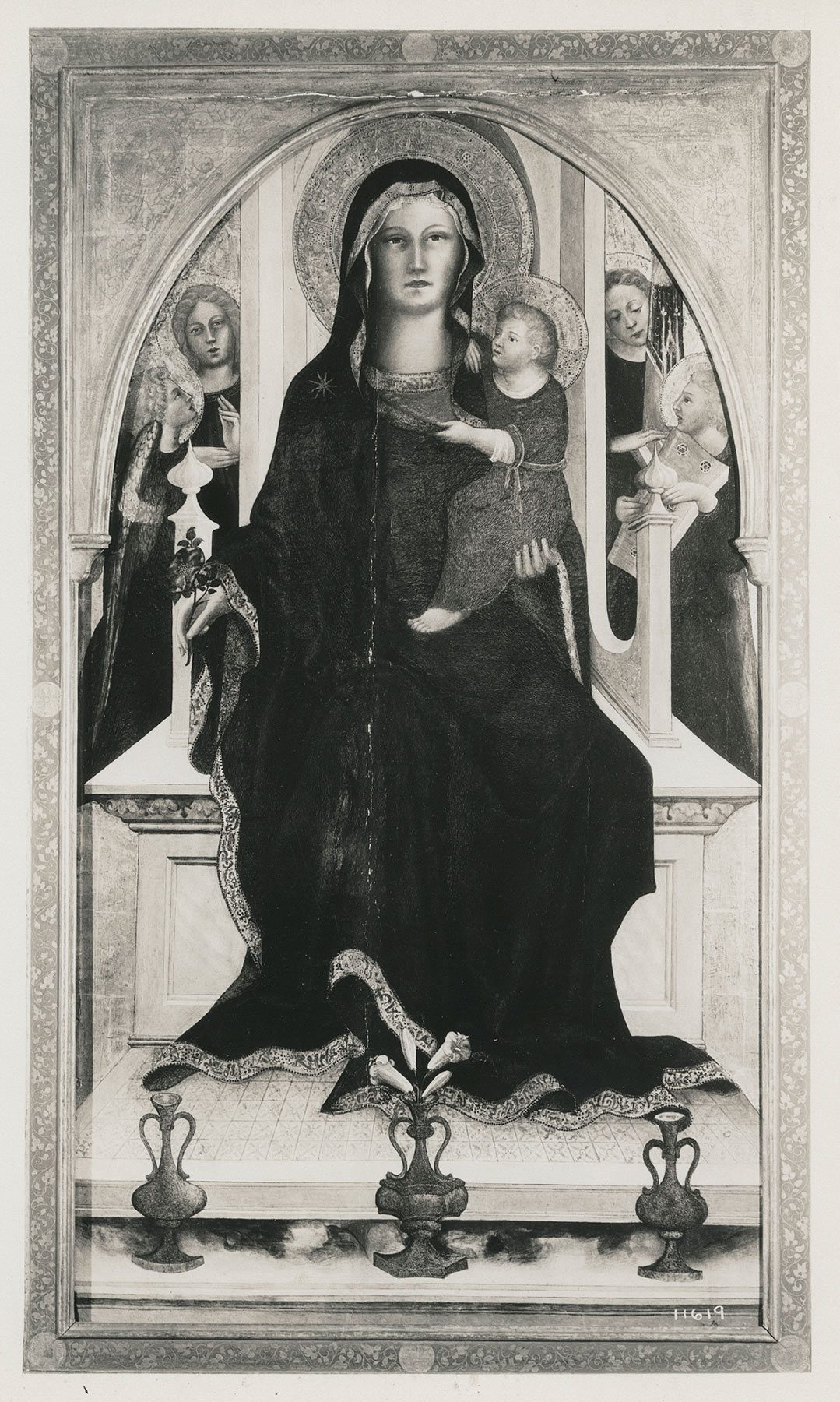
Following an early attribution to Taddeo di Bartolo, suggested by August Meyer, the Yale Virgin and Child was first recognized as a work of Arcangelo by Bernard Berenson and Hans Gronau, and this identification has been unanimously embraced by modern scholarship.3 The work’s current condition, however, has interfered with the proper evaluation of its place within the very limited scope of Arcangelo’s known activity. An accurate assessment of the artist’s full range and personality has been hampered by the paucity of surviving documentary evidence and a corpus of no more than a dozen paintings. Although Arcangelo’s name is first mentioned among the beneficiaries in his father’s will in 1406, the records of his activity are confined to a tightly circumscribed period between 1416 and 1425, when he received commissions in Città di Castello (1416), Florence (1420–24), and Rome (1422), as well as in the Marches (1425).4 The frescoes painted in 1416 in the main Council Hall of the Palazzo Pubblico of Città di Castello, however, are lost, and the last known commission, a large altarpiece signed and dated 1425 in Cessapalombo, near Camerino, was destroyed in a fire in 1889 and is known only through a very poor photograph.5 The absence of these terminal points of reference has made it difficult to chart the evolution of the artist’s style. Arcangelo’s only signed work, a diptych with the Virgin and Child and the Crucifixion in the Frick Pittsburgh (fig. 2), which forms the basis for his identification, already reveals a fully formed personality. Clearly related to this diptych is a small but relatively homogeneous group of images that make up the core of the painter’s unanimously accepted production: the Virgin and Child Enthroned in the Galleria Nazionale delle Marche, Urbino (fig. 3); the present panel at Yale; the Virgin and Child Enthroned with Six Angels in the Propositura of Bibbiena (Arezzo) (fig. 4); and the Virgin and Child with Two Angels in the Pinacoteca e Museo Civici, Camerino. Most modern scholarship has circumscribed the execution of these works, with the exception of the Camerino Virgin, to the artist’s Florentine period or shortly after, scaling their execution between around 1420 and 1425.6 During these years, Andrea De Marchi observed, the painter became a “shadow of Gentile,” sharing in the latter’s success and receiving commissions from some of the most important Florentine banking families, such as the Bardi and Martellini.7 The existence of a “very tight relationship” between the two artists, De Marchi pointed out, is attested to by Arcangelo’s “voracious assimilation of exquisitely Gentilesque decorative techniques,”8 such as those visible in the Yale panel and in all the works gathered around the Frick diptych.
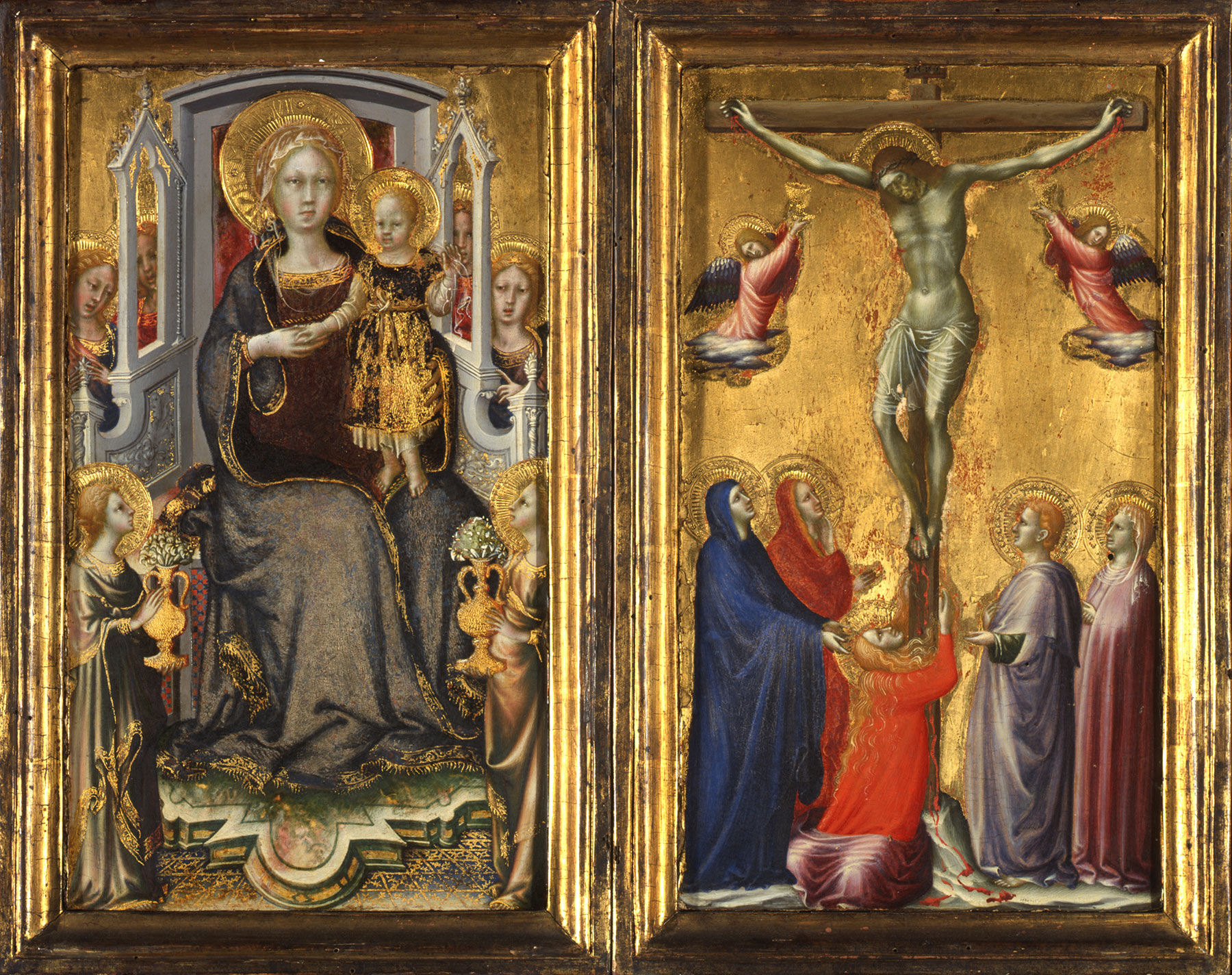
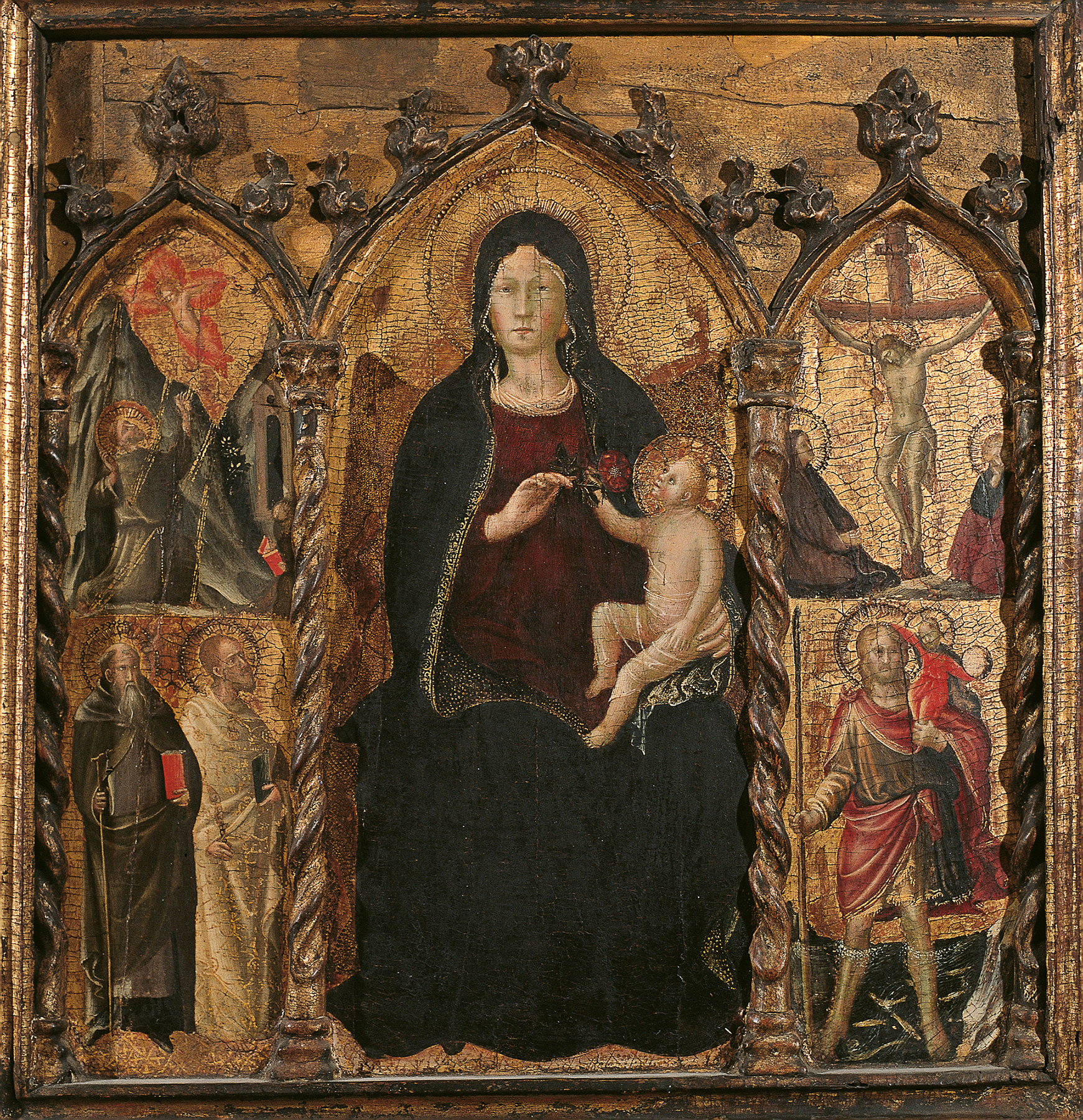
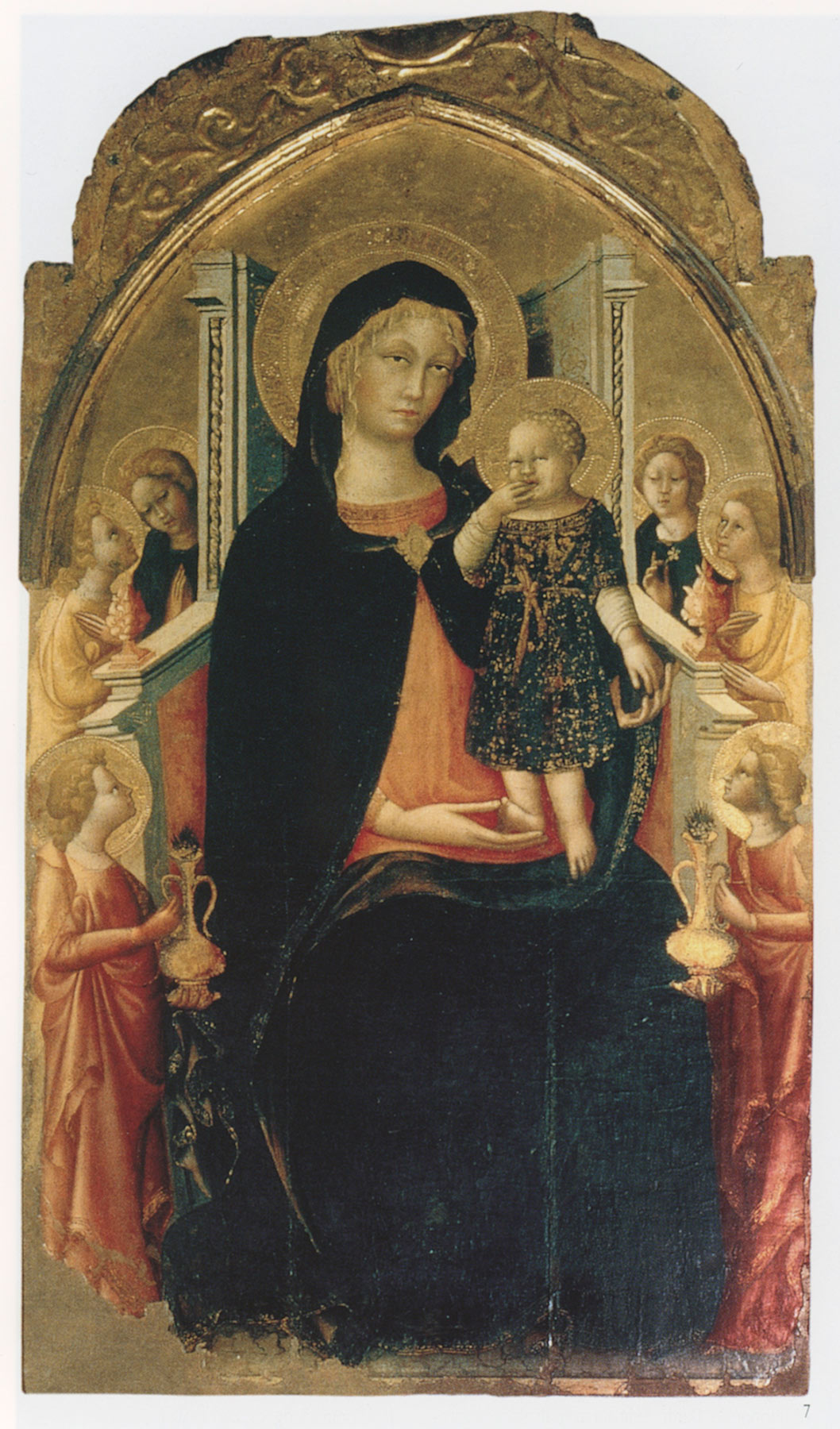
De Marchi, who refers to Arcangelo as a “fiancheggiatore,” or admirer, of Gentile, stops short of implying a direct contact between the two artists, although he notes that their appearance in Florence around the same time, between 1419 and 1420, could not have been coincidental.9 Arcangelo’s use of decorative techniques otherwise found only in paintings by Gentile, however, implies that the two artists must have shared a workshop at some point in their respective carers.10 That Arcangelo was exposed to Gentile’s production much earlier than hitherto supposed is suggested by the Urbino Virgin and Child (see fig. 3), traditionally placed at the head of his Florentine production, around 1420, but more likely executed in the previous decade. The often-noted “Adriatic” components of the framing elements and the internal division of the composition clearly situate the execution of this work outside Florence, in the Marche or the Veneto. The slender proportions of the Virgin and dainty Christ Child present a marked contrast to the robust, rounder bodies in the Yale and Bibbiena panels as well as in the Frick diptych (see fig. 2 and fig. 4); the granulated cloth of honor covering the entire throne—a unicum in Arcangelo’s production—is also inconsistent with the spatial concerns of those paintings. These elements appear more consonant with Gentile’s earliest efforts, strongly influenced by Venetian models, than with Gentile’s Florentine altarpieces.11 Arcangelo’s possible formation in the orbit of Gentile as early as the first decade of the fifteenth century is not out of the question, given that he was most likely already a well-established personality by the time he was entrusted with the prestigious 1416 commission for Città di Castello. Like Gentile, the artist may have had an itinerant career along the Adriatic coast, as well as in Umbria, well before his arrival in Florence.12 Aside from Gentile, the other main influence on Arcangelo’s style seems to be that of the fourteenth-century Riminese school of painting, discernible in both the palette and figure types in the lateral scenes of the Urbino panel—which have little to do with Florentine models—and, even more so, in the Frick Crucifixion, with its distant echoes of the Master of Verucchio.13
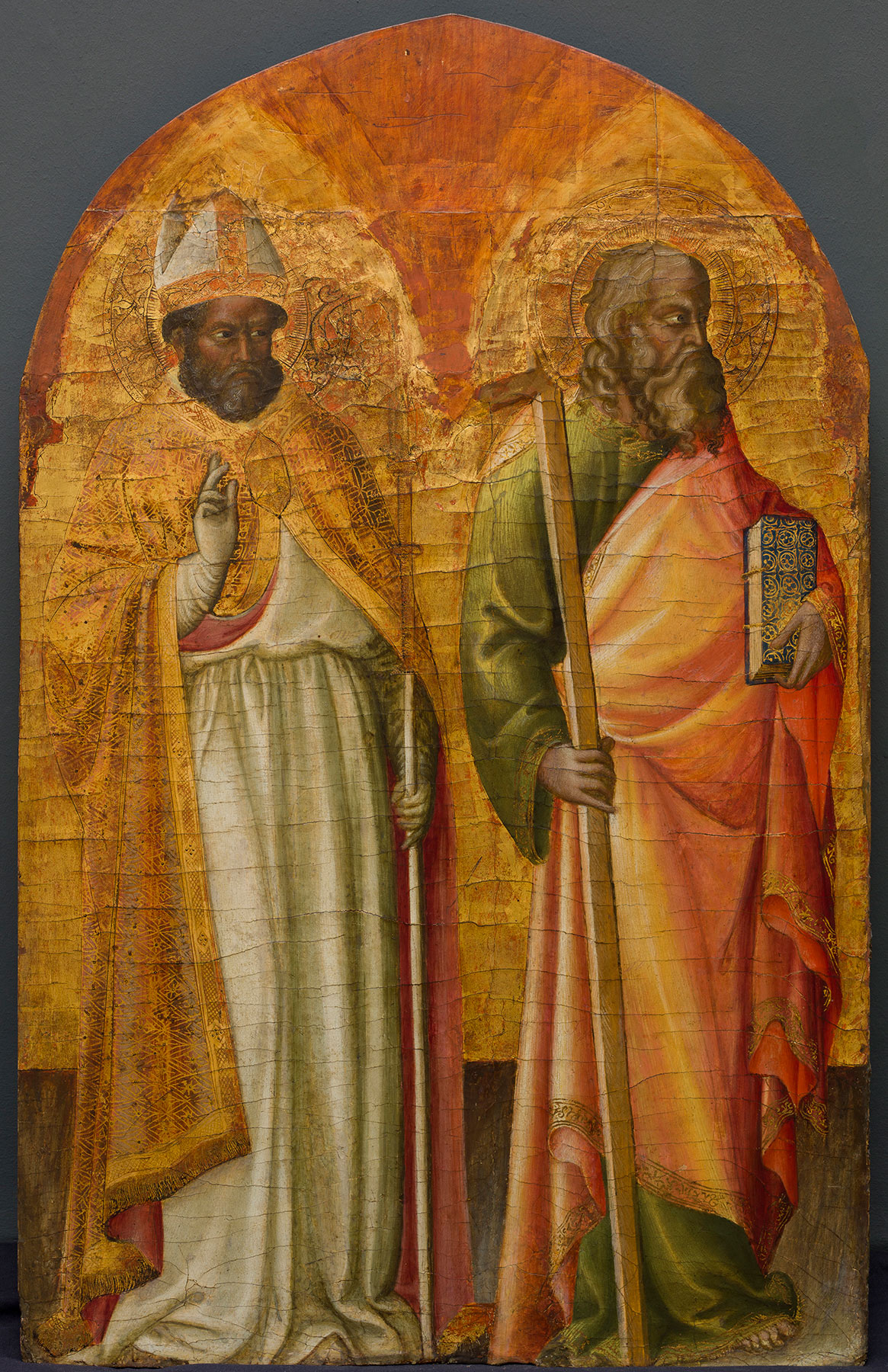
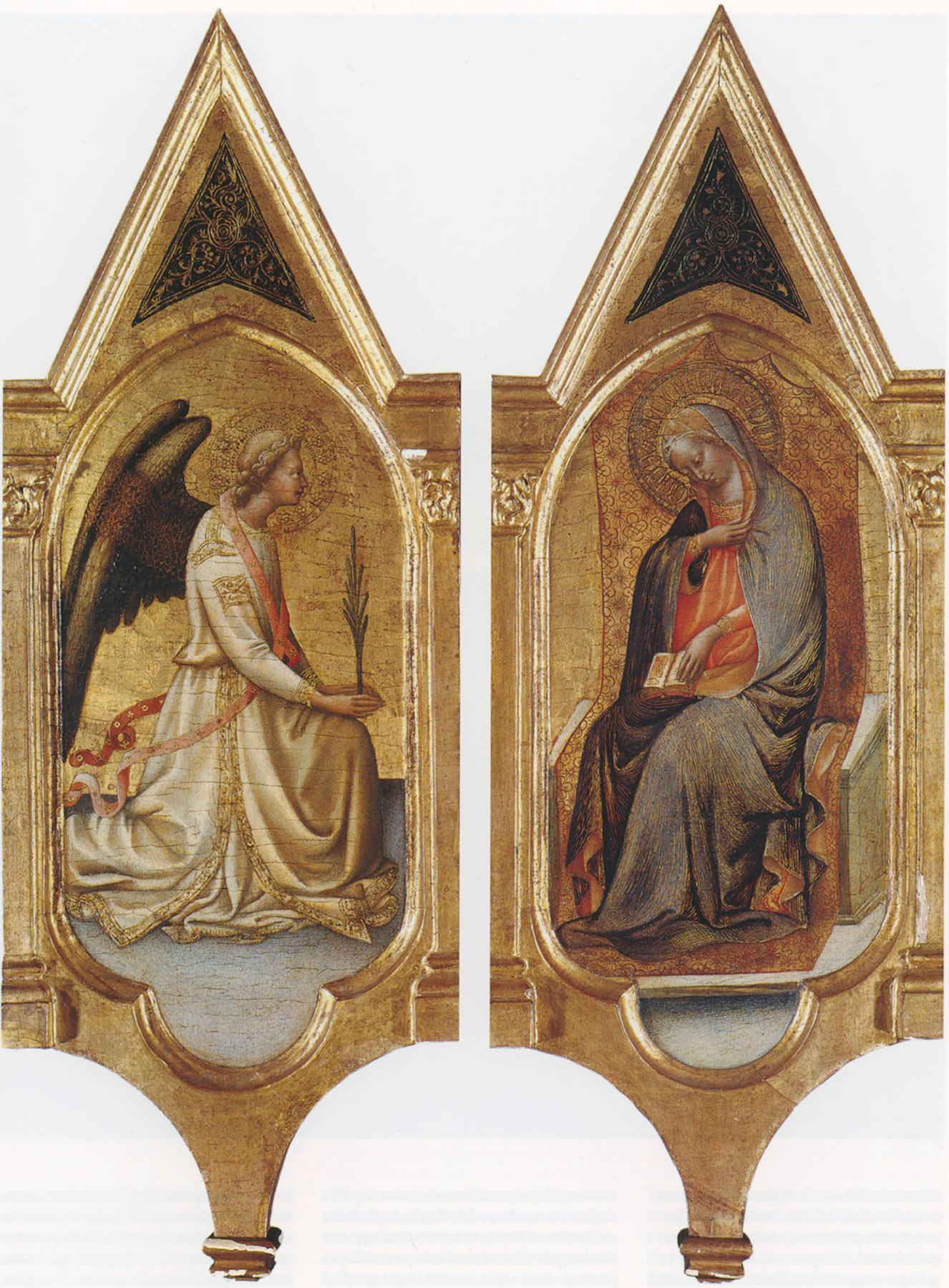
In the most extensive discussion of the Yale panel to date, Alessandro Marchi proposed that it might be the center of a large, undocumented polyptych executed by the artist in Florence between 1423 and 1424, immediately following the execution of the Frick diptych, which he dated around 1420–22.14 Included in the same structure, according to Marchi, would have been a series of panels otherwise assigned to different moments in the artist’s career by previous authors: two pairs of standing saints in the Národní Galerie, Prague (fig. 5),15 first attributed to Arcangelo by Federico Zeri, who associated them with four predella scenes in the Galleria Estense, Modena;16 and two pinnacles with the Annunciation in a private collection in Dallas (fig. 6), also published as works of Arcangelo by Zeri but with an earlier chronology than the Prague/Modena panels.17 Marchi’s reconstruction was not questioned by Andrea De Marchi and Claudia Caldari,18 whereas Olga Pujmanová accepted the relationship of the Prague Saints to the Modena predella but thought that the inclusion of the Yale Virgin and Child in the same complex did not “seem probable.”19 The possibility of a common provenance had already been dismissed by Zeri, who pointedly observed that the Prague and Modena panels had “little or nothing” in common with those works that could certainly be inserted in Arcangelo’s Florentine period—including the Yale picture—and belonged instead to a later phase following the artist’s return to the Marches.20 The stern expressions and powerfully built figures of the Prague Saints Zenobius and Andrew (see fig. 5), who bear no relationship to Gentile’s art, are, in fact, incompatible with the dreamy atmosphere and delicate handling of the Yale Virgin. Also unlike the Yale Virgin is the unusual and rather coarse freehand tooling in the saints’ haloes, not traceable in any other known work by the artist. Finally, the incised line and remains of the original paint on the bottom right of the Yale panel appear to indicate that the multicolored surface continued across into the laterals of the original polyptych; unless the gray floor on which the Prague saints are presently standing is the result of later repaints, such a discrepancy reinforces the stylistic argument against their inclusion in the same structure.
Although the Yale panel is generally dated in close proximity to the Frick diptych (see fig. 2), it reflects an entirely different orientation in Arcangelo’s approach. Miklós Boskovits, who dated the diptych around 1420 and suggested that it preceded the painter’s “Florentine moment,” correctly pointed out that it still lacked the “monumental air” (respiro monumentale) of those works securely executed in Florence, such as the Yale picture and the Bibbiena Virgin and Child (see fig. 4).21 Arcangelo’s embrace of a more monumental vision, in direct response to his new artistic environment, is first apparent in the Yale Virgin and Child, where the quintessentially Late Gothic throne of the Frick diptych has been replaced by a massive Renaissance structure with classically inspired architectural elements that dominates the composition and articulate it in depth. At the same time, still discernible in the Yale picture are some of the exquisite details that characterized the Frick Virgin and Child, like the multicolored marble surfaces and the geometric gilt pattern in the dais, along with the carefully gilt vases. These decorative concerns are less evident in the slightly later Bibbiena panel, with its pronouncedly Masaccesque Christ Child and simpler design. The latter was convincingly associated by Annamaria Bernacchioni with the altarpiece commissioned by the Florentine banker Esaù Martellini for his family church in Bibbiena and is generally dated toward the end of Arcangelo’s Florentine activity, between 1423 and 1424/25.22
The earlier chronology of the Yale panel suggests that it could be a fragment of Arcangelo’s first major Florentine commission—the altarpiece painted between 1421 and 1422 for Ilarione de’ Bardi’s newly built chapel in Santa Lucia de’ Magnoli. The chapel, dedicated to Saints Hilarion and Lawrence was destroyed, but detailed records of the prestigious project are preserved in the account books of Ilarione de’ Bardi in the Archivio di Stato, Florence, first published by Ugo Procacci.23 The documents provide an idea of the elaborate and expensive nature of the chapel’s decoration, which also involved a series of frescoes by Bicci di Lorenzo. The altarpiece, which included a predella, was begun by Arcangelo no later than September 1421 and completed by June of the following year. The impressive payment of 80 florins suggests a large complex, presumably a polyptych with lateral compartments containing images of Saints Hilarion and Lawrence, and perhaps also Saint Lucy in honor of the church’s dedication, along with stories from the saints’ lives in the predella. Although he did not associate them directly with the Yale Virgin, Zeri’s hypothesis that the two panels with the Annunciation in a Dallas private collection (see fig. 6) might be the pinnacles of the Santa Lucia de’ Magnoli altarpiece merits consideration.24 —PP
Published References
Berenson, Bernard. “Missing Pictures by Arcangelo di Cola.” International Studio 93 (July 1929): 21–25., 22–23, fig. 4; Berenson, Bernard. “Quadri senza casa.” Dedalo 10, no. 3 (1929): 133–42., 137, 140; “Notes of the Month.” International Studio 94, no. 390 (November 1929): 60–66., 60, 61; Berenson, Bernard. Italian Pictures of the Renaissance: A List of the Principal Artists and Their Works with an Index of Places. Oxford: Clarendon, 1932., 33; Zeri, Federico. “Arcangelo di Cola da Camerino: Due tempere.” Paragone 1, no. 7 (June 1950): 33–38., 35, 36; Chiarini, Marco. “Arcangelo di Cola da Camerino.” In Dizionario biografico degli italiani. Rome: Istituto della Enciclopedia Italiana, 1961. https://www.treccani.it/enciclopedia/arcangelo-di-cola-da-camerino (Dizionario-Biografico)/.; Berenson, Bernard. Italian Pictures of the Renaissance, A List of the Principal Artists and Their Works with an Index of Places: Central Italian and North Italian Schools. 3 vols. London: Phaidon, 1968., 1:20; Zeri, Federico. “Opere maggiori di Arcangelo di Cola.” Antichità viva 8, no. 6 (November–December 1969): 5–15., 8; Seymour, Charles, Jr. Early Italian Paintings in the Yale University Art Gallery. New Haven: Yale University Art Gallery, 1970., 126, 312, no. 84; Fredericksen, Burton B., and Federico Zeri. Census of Pre-Nineteenth-Century Italian Paintings in North American Public Collections. Cambridge, Mass.: Harvard University Press, 1972., 12, 600; De Marchi, Andrea. “Arcangelo di Cola a Firenze.” In “Scritti in ricordo di Giovanni Previtali, pt. I.” Special issue, Propettiva 53–56 (April 1988–January 1989): 190–99., Zampetti, Pietro. Pittura nelle Marche. Vol. 1, Dalle origini al primo Rinascimento. Florence: Nardini, 1988., 226; 195; Magnolia Scudieri, in Berti, Luciano, and Antonio Paolucci, eds. L’età di Masaccio: Il primo quattrocento a Firenze. Exh. cat. Milan: Electa, 1990., 116; Boskovits, Miklós. Immagini da meditare: Ricerche su dipinti di tema religioso nei secoli XII–XV. Milan: Vita e pensiero, 1994., 303n62; Claudia Caldari, in Dal Poggetto, Paolo, ed. Fioritura tardogotica nelle Marche. Exh. cat. Milan: Electa, 1998., 24; Andrea De Marchi, in De Marchi, Andrea, ed. Pittori a camerino nel quattrocento. Milan: Federico Motta, 2002., 179; Marchi, Alessandro. “Arcangelo di Cola.” In Pittori a camerino nel quattrocento, ed. Andrea De Marchi, 160–86. Milan: Federico Motta, 2002., 161, 166, 173–74, 176, no. 3, figs. 2–3, 3a; Claudia Caldari, in Laura Laureati and Lorenza Mochi Onori, eds. Gentile da Fabriano and the Other Renaissance. Exh. cat. Milan: Electa, 2006., 284–85; Andrea De Marchi, in Laura Laureati and Lorenza Mochi Onori, eds. Gentile da Fabriano and the Other Renaissance. Exh. cat. Milan: Electa, 2006., 247; Olga Pujmanová, in Pujmanová, Olga, and Petr Pribyl. Italian Painting, c. 1330–1550: I. National Gallery in Prague; II. Collections in the Czech Republic; Illustrated Summary Catalogue. Prague: Národní Galerie, 2008., 51
Notes
-
The full provenance history is recorded in the Böhler firm archives retained by the Zentralinstitut für Kunstgeschichte, Munich; see http://boehler.zikg.eu/wisski/navigate/93144/view. ↩︎
-
The author is grateful to Irma Passeri for sharing her knowledge of the various techniques employed in the panel. ↩︎
-
The suggestion by August Meyer and the expert opinion of Hans Gronau, along with that of Bernard Berenson, are cited in the Böhler firm archives; see note 1, above. The attribution was first published in Berenson, Bernard. “Missing Pictures by Arcangelo di Cola.” International Studio 93 (July 1929): 21–25., 22–23. ↩︎
-
The 1406 document was discovered in relatively recent times by Matteo Mazzalupi; Mazzalupi, Matteo. “Tra pittura e scultura: Ricerche nell’Archivio notarile di Camerino.” In Storie da un archivio: Frequentazioni, vicende e ricerche negli archivi camerinesi; Atti della conferenza di Camerino (8 aprile 2006), ed. Pierluigi Moriconi, 1–32. Camerino: La nuova stampa, 2006., 1–5. The documents pertaining to the artist’s residence in Florence—interrupted by a trip to Rome at the behest of Pope Martin V in 1422—were first published by Ugo Procacci; Procacci, Ugo. “Il soggiorno fiorentino di Arcangiolo di Cola.” Rivista d’arte 11 (1929): 119–27., 119–27. For a compilation of all the documentary evidence on the artist, except for the 1406 document, see di Stefano, Emanuela, and Rossano Cicconi. “Regesto dei pittori a Camerino nel Quattrocento.” In Pittori a camerino nel quattrocento, ed. Andrea De Marchi, 448–66. Milan: Federico Motta, 2002., 449–50. The last notice of the painter is in July 1429, when he is mentioned as one of the experts called in to appraise the wooden choir executed by Gaspare da Foligno in San Domenico in Camerino. ↩︎
-
On the Cessapalombo altarpiece, photographed and described when it was in the Benedictine abbey of Monastero dell’Isola (Cessapalombo) but possibly executed for a church in Camerino, see, most recently, Mazzalupi, Matteo. “Opere di pittura e scultura.” In Gioielli dei Sibillini: Cessapalombo, Montalto, Col di Pietra, Monastero tra storia e arte, ed. Rossano Cicconi and Matteo Mazzalupi, 195–253. Fontenoce: Recanati, 2021., 215–17 (with previous bibliography). ↩︎
-
Marchi, Alessandro. “Arcangelo di Cola.” In Pittori a camerino nel quattrocento, ed. Andrea De Marchi, 160–86. Milan: Federico Motta, 2002., 170–74, nos. 1–3; and Andrea De Marchi, in De Marchi, Andrea, ed. Pittori a camerino nel quattrocento. Milan: Federico Motta, 2002., 178–79, 182–85, nos. 7, 12. ↩︎
-
De Marchi, Andrea. “Gentile e la sua bottega.” In Gentile da Fabriano: Studi e ricerche, ed. Andrea De Marchi, Laura Laureati, and Lorenza Mochi Onori, 9–54. Milan: Electa, 2006., 17. ↩︎
-
De Marchi, Andrea. “Gentile e la sua bottega.” In Gentile da Fabriano: Studi e ricerche, ed. Andrea De Marchi, Laura Laureati, and Lorenza Mochi Onori, 9–54. Milan: Electa, 2006., 17. ↩︎
-
De Marchi, Andrea. “Gentile e la sua bottega.” In Gentile da Fabriano: Studi e ricerche, ed. Andrea De Marchi, Laura Laureati, and Lorenza Mochi Onori, 9–54. Milan: Electa, 2006., 17. See also De Marchi, Andrea. “Arcangelo di Cola a Firenze.” In “Scritti in ricordo di Giovanni Previtali, pt. I.” Special issue, Propettiva 53–56 (April 1988–January 1989): 190–99., 193, where the author states that Arcangelo’s privileged position in Florence was probably determined by his relationship to Gentile: “Il fatto, probabilmente, è che il pittore di Camerino doveva essersi stabilito in Firenze con una posizione tutta particolare, garantita all’ombra di Gentile da Fabriano” (The fact is, probably, that the painter from Camerino must have arrived in Florence with a special status in the shadow of Gentile). Annamaria Bernacchioni (in Bernacchioni, Annamaria. “Arcangelo di Cola per i banchieri Esaù Martellini e Ilarione de’ Bardi.” In I da Varano e le arti: Atti del Convegno internazionale Camerino, Palazzo Ducale 4–6 ottobre 2001, ed. Andrea De Marchi and Pier Luigi Falaschi, 1:233–44. Aquaviva Picena: Maroni, 2003., 1:233–44) has otherwise posited that Arcangelo’s arrival in Florence was a result of his ties to the Varano, lords of Camerino, and their political and economic contacts with the Florentine establishment. ↩︎
-
Similar techniques are later encountered in the paintings by Masolino and Sassetta, presumably following exposure to Gentile’s example. On Masolino’s probable contact with Gentile, see Bellucci, Roberto, and Cecilia Frosinini. “Working Together: Technique and Innovation in Masolino’s and Masaccio’s Panel Paintings.” In The Panel Paintings of Masolino and Masaccio: The Role of Technique, ed. Carl Brandon Strehlke and Cecilia Frosinini, 29–68. Milan: 5 Continents, 2002., 39–40. ↩︎
-
Although some modern authors have persisted in seeing the influence of Masaccio in the Urbino Virgin and Child (see Claudia Caldari, in Dal Poggetto, Paolo, ed. Fioritura tardogotica nelle Marche. Exh. cat. Milan: Electa, 1998., 24; and Claudia Caldari, in Laura Laureati and Lorenza Mochi Onori, eds. Gentile da Fabriano and the Other Renaissance. Exh. cat. Milan: Electa, 2006., 284–85), the “fairy tale” of Arcangelo as early imitator of Masaccio was categorically rejected by Miklós Boskovits (in Boskovits, Miklós. Immagini da meditare: Ricerche su dipinti di tema religioso nei secoli XII–XV. Milan: Vita e pensiero, 1994., 295), who highlighted the influence of Gentile and Venetian art on his early formation. ↩︎
-
Boskovits suggested that Arcangelo may have traveled as far as Venice; Boskovits, Miklós. Immagini da meditare: Ricerche su dipinti di tema religioso nei secoli XII–XV. Milan: Vita e pensiero, 1994., 303. ↩︎
-
De Marchi (in De Marchi, Andrea. “Per un riesame della pittura tardogotica a Venezia: Niccolò di Pietro e il suo contesto Adriatico.” Bollettino d’arte, 6th ser., 72, nos. 44–45 (July–October 1987): 25–66., 55), who highlighted the influence of Venetian and Riminese models in the Marche, pointedly characterized Arcangelo as a “neo-Riminese” painter. While noted in passing by other scholars, the Riminese components of Arcangelo’s style have never been adequately explored. Despite modern efforts to discern Arcangelo’s debt to Olivuccio di Ciccarello (documented 1390–1439) (see Marchi, Alessandro. “Arcangelo di Cola.” In Pittori a camerino nel quattrocento, ed. Andrea De Marchi, 160–86. Milan: Federico Motta, 2002., 160–69), the latter’s work is rooted in a more rigid, archaic trecento vocabulary that bears but a superficial resemblance to Arcangelo and reflects none of his subtleties of modeling. ↩︎
-
Marchi, Alessandro. “Arcangelo di Cola.” In Pittori a camerino nel quattrocento, ed. Andrea De Marchi, 160–86. Milan: Federico Motta, 2002., 173–74, no. 3. ↩︎
-
Inv. nos. O 11890–91. ↩︎
-
Inv. no. R.C.G.E. 4183. ↩︎
-
Zeri, Federico. “Opere maggiori di Arcangelo di Cola.” Antichità viva 8, no. 6 (November–December 1969): 5–15., 5–15. ↩︎
-
De Marchi, in Laura Laureati and Lorenza Mochi Onori, eds. Gentile da Fabriano and the Other Renaissance. Exh. cat. Milan: Electa, 2006., 247; and Caldari, in Laura Laureati and Lorenza Mochi Onori, eds. Gentile da Fabriano and the Other Renaissance. Exh. cat. Milan: Electa, 2006.. ↩︎
-
Olga Pujmanová, in Pujmanová, Olga, and Petr Pribyl. Italian Painting, c. 1330–1550: I. National Gallery in Prague; II. Collections in the Czech Republic; Illustrated Summary Catalogue. Prague: Národní Galerie, 2008.. The same conclusion was recently reached by Mauro Minardi in his entry for the forthcoming online catalogue of paintings in the Galleria Estense, Modena. Minardi associated the Prague/Modena/Dallas panels with a different altarpiece painted by Arcangelo between 1421–25. The present author is grateful to Minardi for sharing a typescript of his work. ↩︎
-
“Quale sia la realtà, è ovvio che nel trittico qui illustrato poco o nulla va d’accordo, sotto il profile cronologico, con le opera da riferire con certezza al tempo Fiorentino” (Whatever [the explanation] might be, it is obvious that in the triptych reproduced here there is little or nothing that agrees chronologically with those works that can be securely assigned to the Florentine period); Zeri, Federico. “Opere maggiori di Arcangelo di Cola.” Antichità viva 8, no. 6 (November–December 1969): 5–15., 9. ↩︎
-
Boskovits, Miklós. Immagini da meditare: Ricerche su dipinti di tema religioso nei secoli XII–XV. Milan: Vita e pensiero, 1994., 303n62. ↩︎
-
Bernacchioni, Annamaria. “Arcangelo di Cola per i banchieri Esaù Martellini e Ilarione de’ Bardi.” In I da Varano e le arti: Atti del Convegno internazionale Camerino, Palazzo Ducale 4–6 ottobre 2001, ed. Andrea De Marchi and Pier Luigi Falaschi, 1:233–44. Aquaviva Picena: Maroni, 2003., 238. The exact date of the commission is not known. A terminus ante quem of 1427 can be established from the fact that, in that year’s tax declaration, Esaù Martellini reported the costs for having the altarpiece transported from Florence to the recently renovated family church of San Lorenzo in Bibbiena. Bernacchioni surmised that the painting was executed following Arcangelo’s return from Rome to Florence, around 1423. De Marchi (in De Marchi, Andrea, ed. Pittori a camerino nel quattrocento. Milan: Federico Motta, 2002., 178–79, no. 7) dated the work slightly later, around 1424–25—that is, immediately preceding the Cessapalombo altarpiece. ↩︎
-
Procacci, Ugo. “Il soggiorno fiorentino di Arcangiolo di Cola.” Rivista d’arte 11 (1929): 119–27., 124. ↩︎
-
Zeri, Federico. “Opere maggiori di Arcangelo di Cola.” Antichità viva 8, no. 6 (November–December 1969): 5–15., 10. ↩︎