on the window casement, lower left, GENT[ILIS DE] FABRIANO
James Jackson Jarves (1818–1888), Florence, by 1859
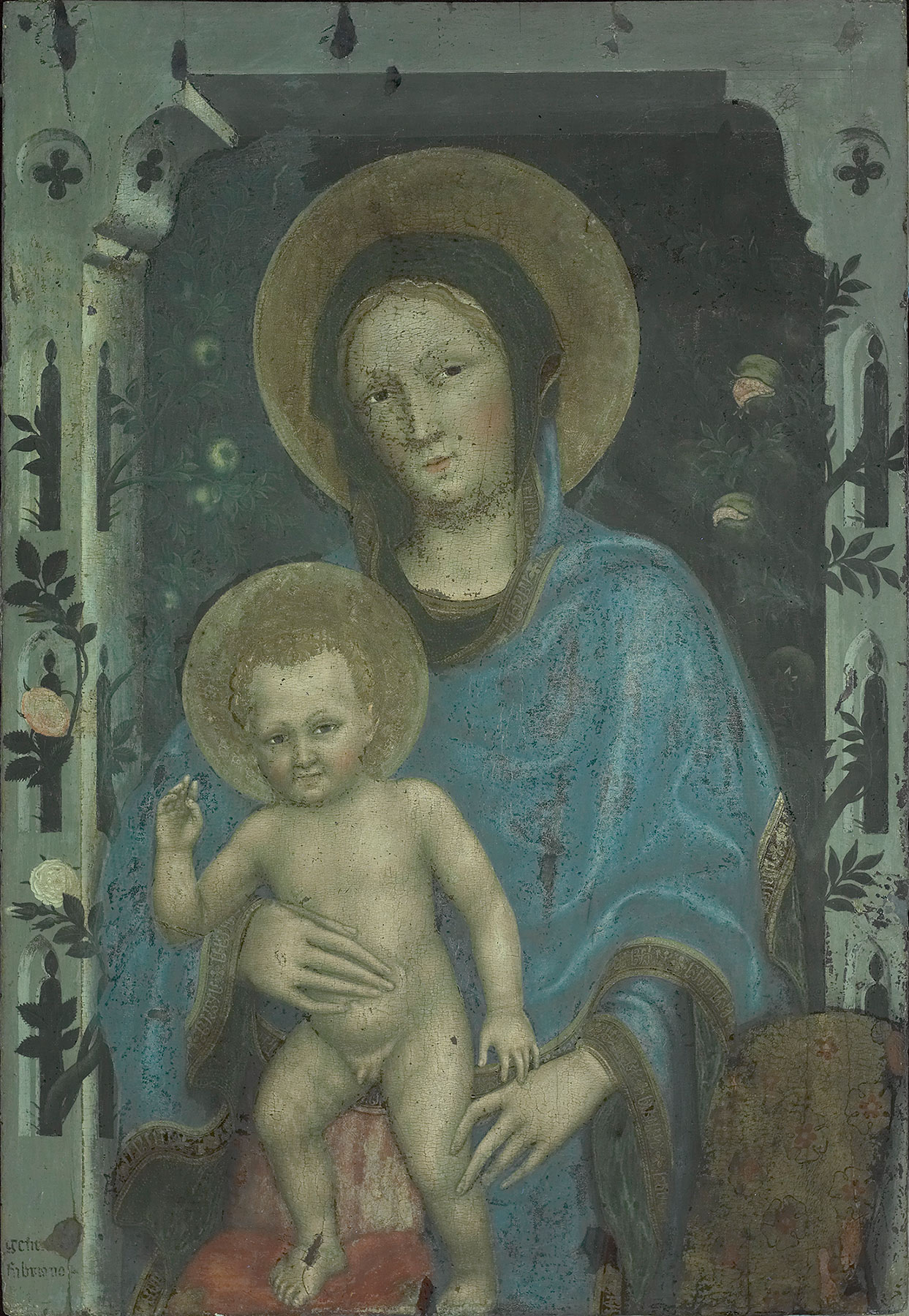
The panel support, of a vertical wood grain, has been thinned to a depth of 1.3 centimeters and cradled but has not been cut on any side. The panel shows no evidence of the means by which it was secured in its original frame, but four nail holes aligned 3 centimeters below the top edge and four others aligned 5.5 centimeters above the bottom edge indicate the placement of battens that might once have served this function. A number of partial splits radiate up or down from these nail holes. The gilding of haloes and hems is relatively well preserved, as is the painted background of roses and the painted architecture on the right and at the top. The architecture at the left is abraded, as are the flesh tones, especially in areas of shadow. The Virgin’s face is considerably more worn than is the Christ Child’s. The draperies—above all the red lake of the Virgin’s dress but also the blue of her robe and green of its lining—are severely abraded. The red cushion on which the Christ Child stands has lost its modeling glazes but is otherwise largely intact. Mordant gilding is well preserved in some areas and is missing entirely in others. Larger local losses occur in the bottom-right corner of the composition; at the Virgin’s left breast, along her right sleeve, and beneath her nose; in the architrave above her halo; and at the right edge of the panel above the lowest painted lancet in the pilaster of the window casement.
The painting, signed by Gentile da Fabriano, is among the most important works in Yale’s collection and one of the artist’s most inventive compositions on a smaller scale. Its unique qualities have sometimes been overlooked in modern discussions, however, due to past restorations and misconceptions about its present condition. Joseph Crowe and Giovanni Cavalcaselle, who first saw the picture in the James Jackson Jarves residence in Florence, described it in their 1866 volume as “injured by restoring.”1 The purportedly disfiguring repaints were removed sometime before the 1871 auction of the Jarves collection, when it was noted that “by great care and unusual good fortune this was done without appreciable injury to the picture, which is thus left in excellent preservation. The recovery of so admirable and characteristic a picture as this from the bad state it was in, is one of the triumphs of picture-collecting.”2 The results of this intervention are presumably documented by a photograph of the panel taken ca. 1900 (fig. 1), which betrays the noticeably modern reconstruction of the head of the Virgin and the reinforcements in the body of the Christ Child. In 1915, a year before Osvald Sirén’s catalogue of the collection, Gentile’s Virgin and Child was among the works treated at Yale by Hammond Smith, who noted that the picture had been “much repainted” in oil colors and pointedly observed that, on cleaning, the Child’s body and head and the Virgin’s hands appeared “in quite good condition,” although the Virgin’s face was more injured.3 Notwithstanding Smith’s own interpretation of the losses, Sirén was enthusiastic enough to write that the image stood out with “renewed beauty and character,” extolling its design and “lyrical” execution.4 Later scholarship was less forgiving. An abrasive cleaning in 1950–52, which removed some of the old restorations but also the original surface glazes, led Keith Christiansen, in his groundbreaking monograph on Gentile, to refer to the work’s “ruinous” condition.5 Such an assessment, which has endured in the literature, was overly harsh and failed to acknowledge those large parts of the picture that still visibly illustrate the nuanced approach and exquisite technique typical of the artist.
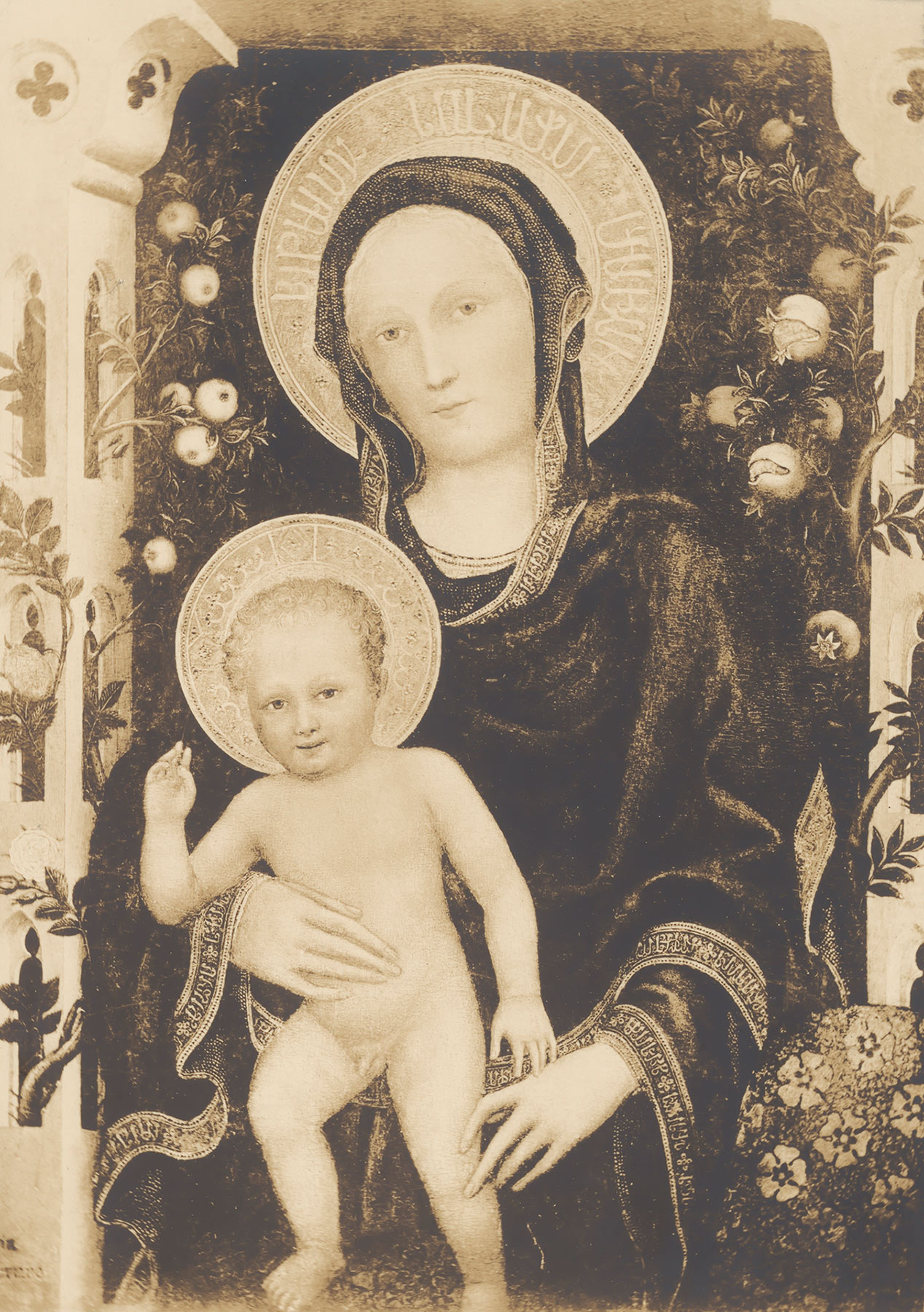
The composition, without precedent in Italian painting at this date, is organized inside a window opening or loggia of gray stone, through which the Virgin and Child look out on the viewer. In a departure from earlier devotional images, the traditional gold ground has been replaced by a bower of apple and pomegranate trees, whose branches are trellised into the openwork of the stone casement along with white and red roses (now faded to pink). The setting has been interpreted by scholars as an allusion to the hortus conclusus (enclosed garden) of the Old Testament Song of Songs, understood by Christian mystics and theologians as a reference to Mary’s virginity: “A garden enclosed is my sister, my spouse; a spring shut up, a fountain sealed. Thy plants are an orchard of pomegranates, with pleasant fruits” (Song of Songs 4:12–13).6 The garden eventually became associated with the mystery of the Incarnation, with Mary herself described as the virginal garden in which the rose—Christ—was planted.7 Roses took on a multiplicity of meanings, however, becoming attributes of both Christ and the Virgin. For Saint Bernard of Clairvaux (1090/91–1153), the Virgin herself was like a white-and-red rose: “white for her virginity, red for her charity; white in her body, red in her soul; white for her virtue, red for trampling on vice.”8 Included conspicuously to the right of the Virgin are large pomegranate fruits, two of which have split open to reveal the seeds inside them. Though often depicted in the hands of the Christ Child as a reference to the Passion and Resurrection, the pomegranate also had Marian associations and, as a symbol of harmony, was sometimes interpreted as an allegory of unity within the Church.9 The luminous glow and almost tactile quality of the round fruits result from the artist’s use of an oil medium alongside the tempera, a technique that was introduced by Gentile in Florence.10 Used in the dark background as well, it lends a rich depth to the composition.
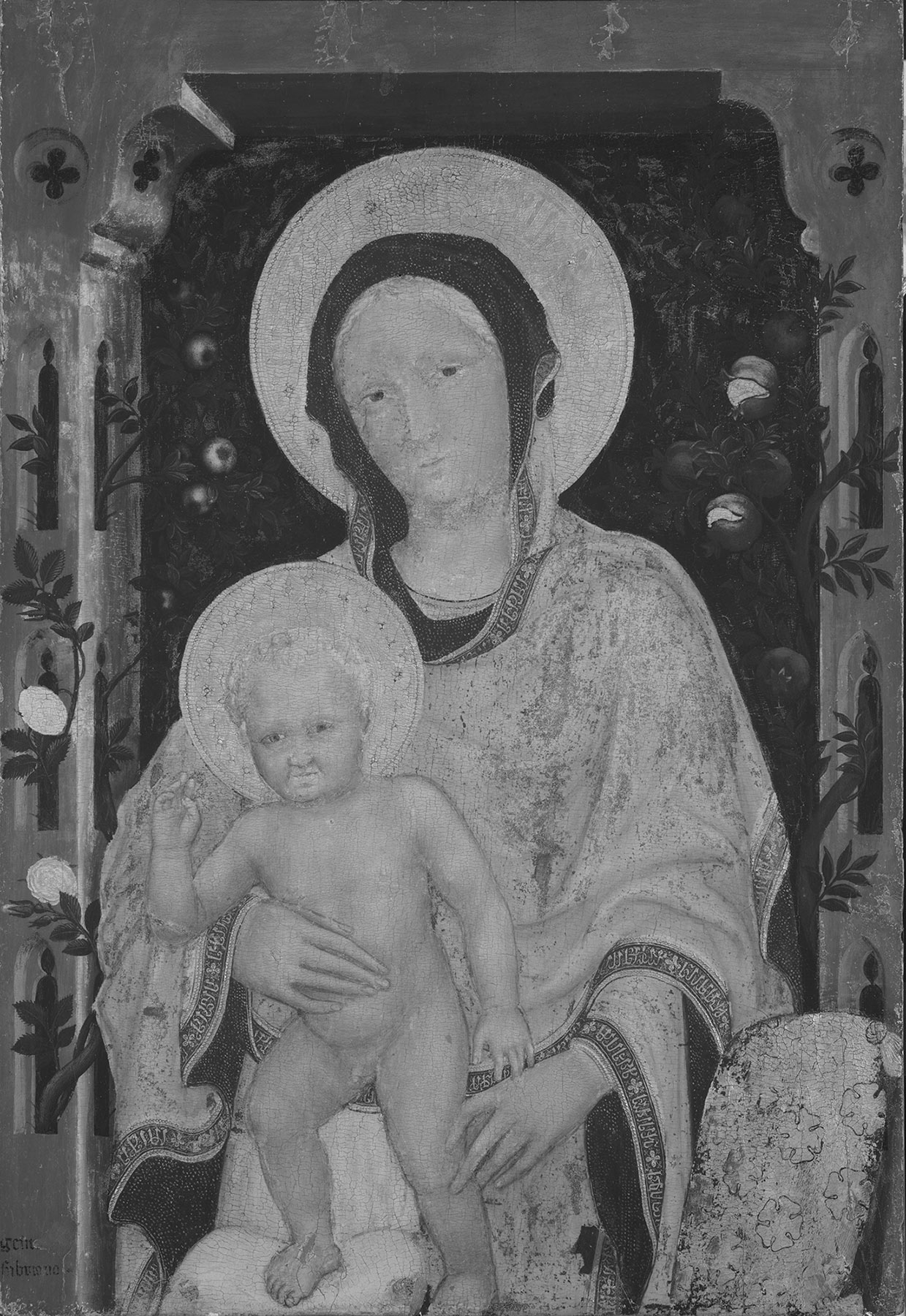
Among the most well-preserved features of the Yale picture is the sensitively handled, lively figure of the nude Christ Child, where Gentile’s particular skill in the “rich modelling of flesh with a subtle use of highlights,” as noted by Carl Strehlke, “is still very much evident.”11 Recalling the dynamically posed putti of antiquity or the spiritelli of Donatello, the restless Infant is being gently restrained by the Virgin as He pushes forward with His right foot firmly planted on the vermilion-colored pillow, His other foot resting on a ledge (now cropped), and His right hand raised in blessing. Clearly discernible in ultraviolet imaging (fig. 2) are the chiaroscuro gradations that thoughtfully articulate every part of the Child’s anatomy, defining the underlying bone structure of the head and musculature of the body, the folds of fat in the chubby legs, and the flexing of the limbs. Equally evident are otherwise imperceptible naturalistic details that contribute to the verisimilitude of the image, such as the light pressure exerted by the Virgin’s fingers over her Son’s belly and left leg, as she seeks to curtail His movements. Infrared reflectography highlights the artist’s confident drawing technique, especially evident in the firm contours and carefully observed gestures of the Child, the detailed articulation of the fingers and nails, and the precisely marked creases in the skin (fig. 3).
With the exception of Andrea De Marchi, who dated the Yale Virgin and Child to Gentile’s Brescian period (1414–19),12 scholars have generally inserted the panel among those works produced during the artist’s Florentine sojourn, between around 1420 and 1425. In the first effort to present a corpus of Gentile’s work, Adolfo Venturi identified the Yale panel as the central compartment of the dismembered signed and dated 1425 Quaratesi altarpiece, the artist’s last certain Florentine commission.13 Herbert Horne later corrected the “error” by recognizing that the Virgin and Child at Hampton Court, London, instead, formed part of the famous altarpiece admired by Giorgio Vasari,14 but the affinities between the Quaratesi panels and the Yale picture continued to be emphasized by subsequent scholars. Beginning with Sirén, most authors placed the execution of the Yale panel between the 1423 Adoration of the Magi in the Gallerie degli Uffizi, Florence (fig. 4), painted for the Florentine merchant Palla Strozzi, and the Quaratesi altarpiece. Charles Seymour, Jr., dated the painting about 1424–25, while Christiansen suggested a date around 1424.15 An earlier chronology was recently advanced by Strehlke, however, who proposed that the painting was commissioned to the artist sometime between 1420 and 1423.16 This time frame corresponds more or less with the execution of the Uffizi Adoration, dated May 1423 but possibly begun as early as 1420, when Gentile was already renting a house from the Strozzi family.17 Highlighting the inclusion of the pomegranate in other images of this period, Strehlke hypothesized that the fruit as a symbol of Church unity might have had a topical significance, related to Pope Martin V’s efforts between 1417 and 1423–24 to unify the Church after the Great Schism.
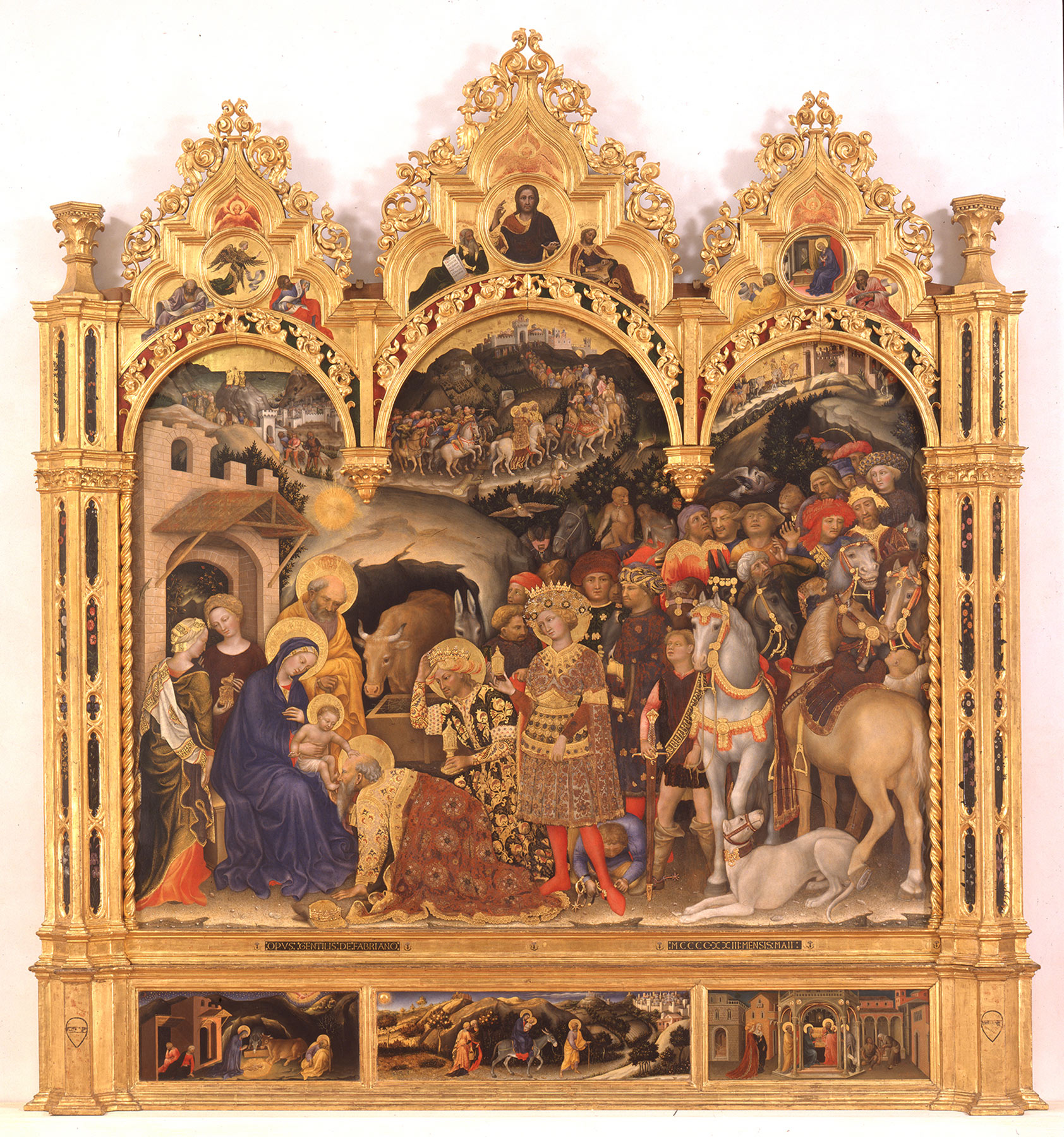
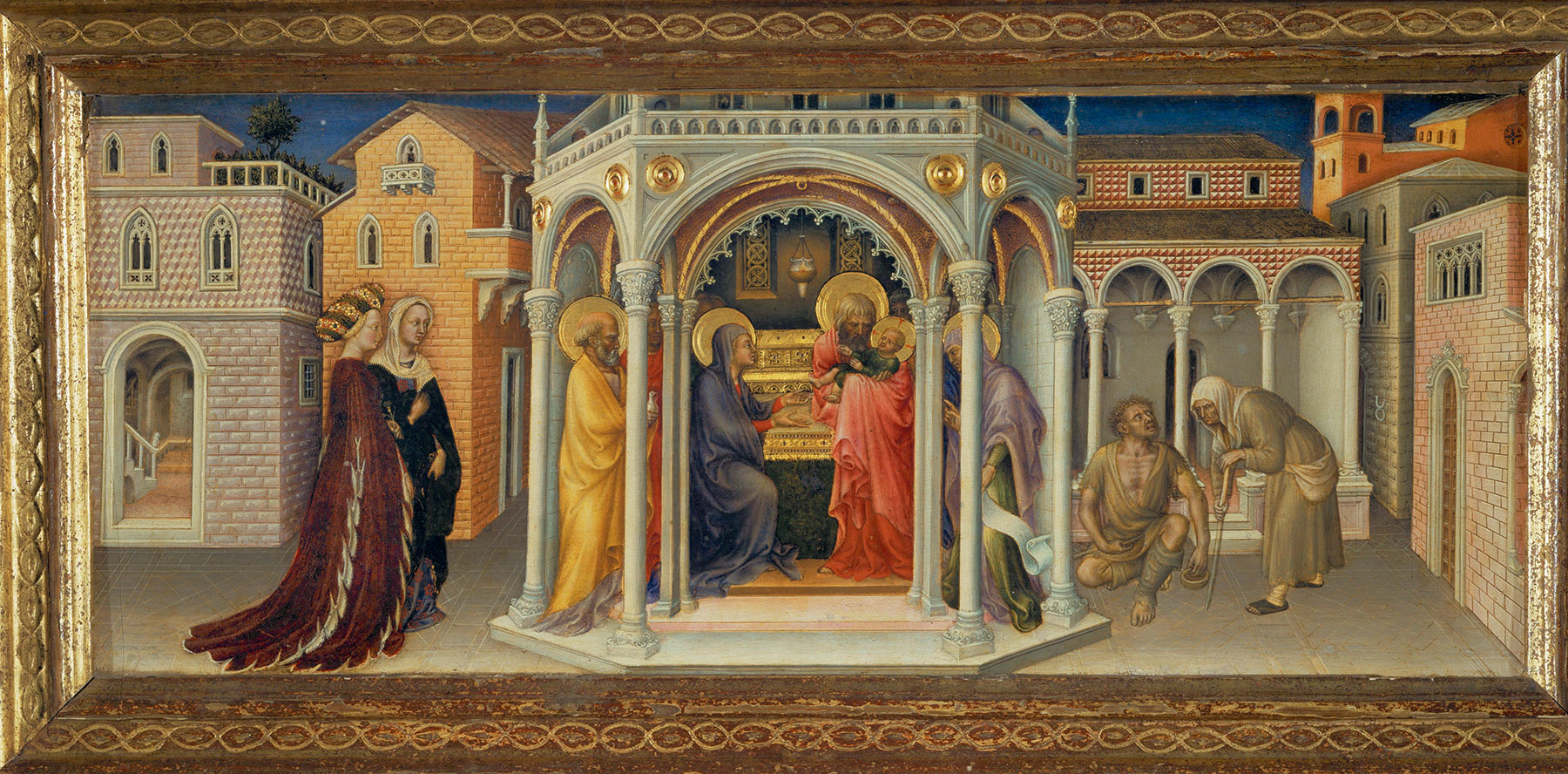
A date for the Yale picture in proximity to the Uffizi Adoration is supported by stylistic observations and the close correspondences in figure types and decorative motifs. The tight relationship between the two works is evident in the resemblance of the Yale Christ Child to His counterpart in the Adoration, who shares the same features and modeling of the anatomy. The slenderer proportions and reserved smile of these infants separate them from the ebullient, laughing Child of the Quaratesi altarpiece. Likewise, notwithstanding its present condition, the face of the Virgin may be convincingly compared to the heads of the Virgin and other figures in three-quarter profile in the Adoration. A similar approach also distinguishes the painting of botanical details in the two works, such as the virtually identical thicket of pomegranate trees and their open fruits. The relationship to the Adoration was not dismissed by Christiansen, who observed that the most innovative feature of the Yale composition, the conceit of the feigned window, “grows naturally out of Gentile’s exploitation of the frame” in that altarpiece (fig. 5).18 Notwithstanding the obvious correspondences, however, the architectural elements in the two works present some crucial distinctions. The Uffizi frame, sometimes thought to have been designed by Lorenzo Ghiberti in collaboration with Gentile, has been characterized as a unique amalgam of Florentine and Venetian elements—a combination that is also reflected in the painted architecture of the Presentation in the Temple predella scene from the same altarpiece, now in the Musée du Louvre, Paris (fig. 6).19 The painted frame of the Yale Virgin and Child, with its lancet windows and quatrefoil openings, is instead entirely rooted in Venetian models. While there is no exact parallel among existing Venetian buildings, a comparable conceit may have been visible to the artist on the illusionistically painted facades of Venice and the mainland; the remains of decoration in a fourteenth-century palace in Asolo, in the province of Treviso (Veneto), for example, shows a fictive architectural window frame with perforated pillars that are structurally very similar to those in the Yale composition.20 The idea of interweaving vegetation in the architecture, moreover, is already present in embryonic form, as pointed out by De Marchi, in the elaborately carved Gothic throne of Gentile’s early Virgin and Child in Perugia, confidently datable to his Venetian period.21
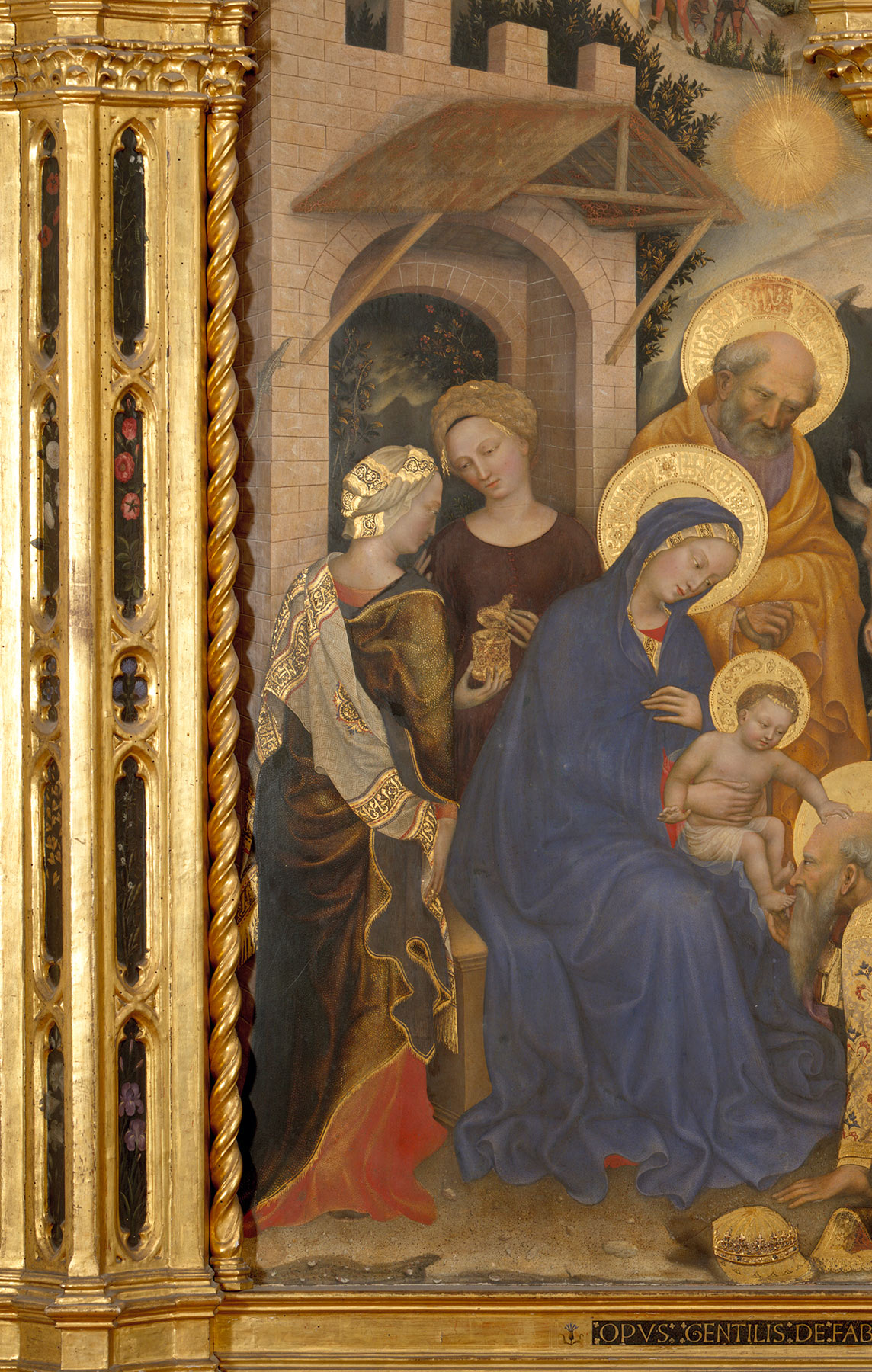
The strong Venetian components of the Yale Virgin and Child point to a moment of execution just before the Uffizi Adoration. De Marchi tentatively suggested that the Yale panel might be identified with a painting commissioned to the artist toward the end of his stay in Brescia, while he was still engaged in the decoration of the chapel of San Giorgio al Broletto for Pandolfo Maltesta III, completed in September 1419.22 The work is recorded in a document dated December 20, 1417, which notes a reimbursement of 9 lire and 8 soldi to Gentile for a small panel to make a painting (“una tavoletta da fare una anchona”) for Carlo Malatesta, lord of Rimini and brother of Pandolfo.23 The same picture is mentioned in a second payment dated January 31, 1418, when the artist received 3 lire and 12 soldi for the frame and other carvings (“per cornixe e altri lavori d’intalio”) of the panel (“tavola”) of Lord Carlo, for other work in turned wood (“lavori torniti”) in the chapel, and for the purchase of a cartload of firewood.24 But the small sums involved in the payments, especially for the carved elements of the frame, and the reference to a “tavoletta” in the first instance make it unlikely that Carlo Malatesta’s painting was other than a small image for private devotion, rather than an ambitious altarpiece, as suggested by the size and structure of the Yale Virgin and Child.25
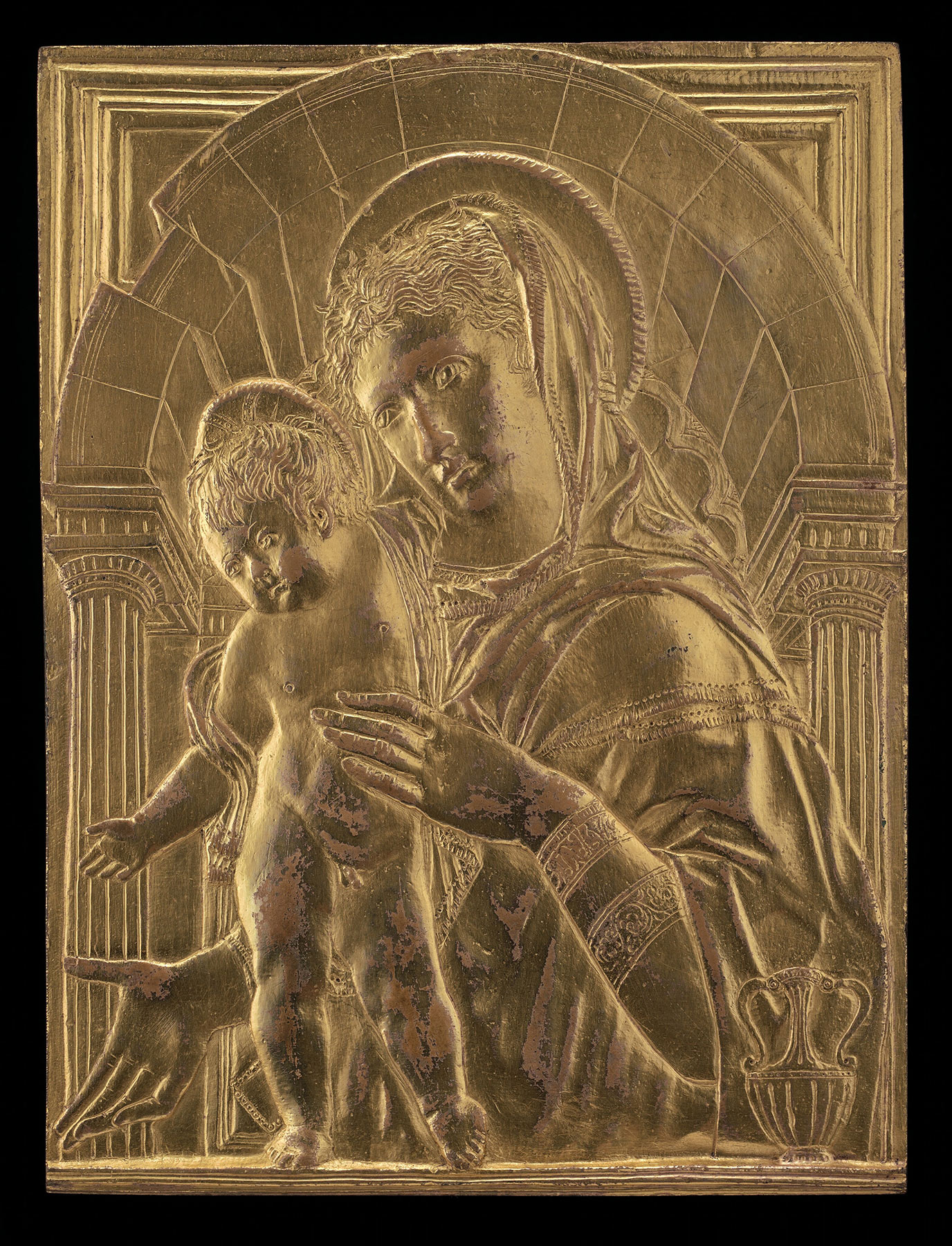
Overlooked by all past scholarship is the fact that the Yale panel preserves its original edges and gesso preparation along both sides, a significant clue that indicates it did not have an engaged frame. The evidence of nail heads securing battens just below the top and just above the bottom edges, moreover, suggest that it was attached to another component of a larger structure or that it was inserted into a fixed framework, like a stone or marble tabernacle. This last possibility seems the more plausible in light of the illusionistic elements of the composition, which would have been heightened by the architecture of the tabernacle. Although a North Italian provenance cannot be ruled out, a Florentine context is perhaps suggested by the extraordinary motif of the feigned view through a window, which Christiansen traced to the influence on Gentile of Donatello’s stiacciato reliefs.26 Christiansen’s assertion that a work such as Donatello’s Pazzi Madonna27 constitutes “the closest parallel” for Gentile’s painting is perhaps an overstatement, since the two works reflect radically different approaches to the same illusionistic concept.28 More germane to the Yale Virgin and Child is the design of a plaquette in the National Gallery of Art, Washington, D.C. (fig. 7), which is based on an unidentified prototype by Donatello known through a number of copies in different media. Recent scholarship has dated Donatello’s invention around 1426–30, too late, therefore, to be considered the inspiration for Gentile’s painting.29 While it is not out of the question that Donatello may have conceived an unknown earlier variant of the composition, it is worth speculating on the role that Gentile himself could have played in the development of the motif when he burst onto the Florentine artistic scene in 1419/20. —PP
Published References
Jarves, James Jackson. Descriptive Catalogue of “Old Masters” Collected by James J. Jarves to Illustrate the History of Painting from A.D. 1200 to the Best Periods of Italian Art. Cambridge, Mass.: H. O. Houghton, 1860., 51, no. 60; Crowe, Joseph Archer, and Giovanni Battista Cavalcaselle. A New History of Painting in Italy: From the Second to the Sixteenth Century; Drawn Up from Fresh Material and Recent Researches in the Archives of Italy, as Well as from Personal Inspection of the Works of Art Scattered throughout Europe. 3 vols. London: J. Murray, 1864., 3:103; Sturgis, Russell, Jr. Manual of the Jarves Collection of Early Italian Pictures. New Haven: Yale College, 1868., 45, no. 39; W. F. Brown, Boston. Catalogue of the Jarves Collection of Early Italian Pictures. Sale cat. November 9, 1871., 17–18, no. 39; Rankin, William. “Some Early Italian Pictures in the Jarves Collection of the Yale School of Fine Arts at New Haven.” American Journal of Archaeology 10, no. 2 (April–June 1895): 137–51., 144, pl. 9; Vasari, Giorgio. Le vite de’ più eccellenti pittori, scultori e architettori. Vol. 1, Gentile da Fabriano e il Pisanello. Ed. Adolfo Venturi. Florence: Sansoni, 1896., 23–24, no. 11; Herbert P. Horne, in Cust, Lionel, and Herbert P. Horne. “Notes on Pictures in the Royal Collection: Article VII—The Quaratesi Altarpiece by Gentile da Fabriano.” Burlington Magazine 6, no. 24 (March 1905): 470–71, 473–75., 470; Rankin, William. Notes on the Collections of Old Masters at Yale University, the Boston Museum of Fine Arts, the Fogg Museum of Harvard University. Wellesley, Mass.: Department of Art, Wellesley College, 1905., 9, 18, no. 39; Colasanti, Arduino. Gentile da Fabriano. Bergamo: Instituto Italiano d’Arti Grafiche, 1909., 58–59; Mather, Frank Jewett, Jr. “The Jarves Collection.” Yale Alumni Weekly 23, no. 36 (1914): 965–70., 967; Sirén, Osvald. A Descriptive Catalogue of the Pictures in the Jarves Collection Belonging to Yale University. New Haven: Yale University Press, 1916., 167–70, no. 66; van Marle, Raimond. The Development of the Italian Schools of Painting. Vol. 8. The Hague: M. Nijhoff, 1927., 26, fig. 19; Molajoli, Bruno. Gentile da Fabriano. Fabriano: “Gentile,” 1927., 76–78, pl. 16; Offner, Richard. Italian Primitives at Yale University: Comments and Revisions. New Haven: Yale University Press, 1927., 7, 43, fig. 36; Berenson, Bernard. Italian Pictures of the Renaissance: A List of the Principal Artists and Their Works with an Index of Places. Oxford: Clarendon, 1932., 16; Rediscovered Italian Paintings. Exh. cat. New Haven: Yale University Art Gallery, 1952., 8, 23; Grassi, Luigi, ed. Tutta la pittura di Gentile da Fabriano. Milan: Rizzoli, 1953., 42, 64, 71; Krautheimer, Richard, and Trude Krautheimer-Hess. Lorenzo Ghiberti. 2 vols. Princeton, N.J.: Princeton University Press, 1956., 1:146; Bellosi, Luciano. Gentile da Fabriano. Milan: Fratelli Fabbri, 1966., 4; Berenson, Bernard. Italian Pictures of the Renaissance, A List of the Principal Artists and Their Works with an Index of Places: Central Italian and North Italian Schools. 3 vols. London: Phaidon, 1968., 1:164; Seymour, Charles, Jr. Early Italian Paintings in the Yale University Art Gallery. New Haven: Yale University Art Gallery, 1970., 226–28, no. 172; Fredericksen, Burton B., and Federico Zeri. Census of Pre-Nineteenth-Century Italian Paintings in North American Public Collections. Cambridge, Mass.: Harvard University Press, 1972., 600; Ellen Frank, in Seymour, Charles, Jr., et al. Italian Primitives: The Case History of a Collection and Its Conservation. Exh. cat. New Haven: Yale University Art Gallery, 1972., 20–21, no. 11, figs. 11a–e; Micheletti, Emma. L’opera completa di Gentile da Fabriano. Milan: Rizzoli, 1976., 9–10, 92, no. 46, pl. 62; Christiansen, Keith. Gentile da Fabriano. Ithaca, N.Y.: Cornell University Press, 1982., 42–43, 45, 53, 101–2, no. 8, pl. 45; Zampetti, Pietro. Pittura nelle Marche. Vol. 1, Dalle origini al primo Rinascimento. Florence: Nardini, 1988., 1:281; De Marchi, Andrea. Gentile da Fabriano: Un viaggio nella pittura italiana all fine del gotico. Milan: Federico Motta, 1992., 101, 105, 109n44, 153, 187, 191, pl. 29; Dean, Clay. A Selection of Early Italian Paintings from the Yale University Art Gallery. New Haven: Yale University Art Gallery, 2001., 28–29, no. 7; Christiansen, Keith. “L’Adorazione dei Magi di Gentile da Fabriano.” In Gentile da Fabriano agli Uffizi, ed. Alessandro Cecchi, 11–40. Exh. cat. Cinisello Balsamo, Milan: Silvana, 2005., 18; Keith Christiansen, in Christiansen, Keith, Emanuela Daffra, Andrea De Marchi, et al. From Filippo Lippi to Piero della Francesca: Fra Carnevale and the Making of a Renaissance Master. Exh. cat. New York: Metropolitan Museum of Art, 2005., 166; Bollati, Milvia, ed. “Catalogo completo delle opera autografe di Gentile da Fabriano.” In Gentile da Fabriano: Studi e ricerche, ed. Andrea De Marchi, Laura Laureati, and Lorenza Mochi Onori, 156–67. Milan: Electa, 2006., 162; Falcioni, Anna. “Brescia.” In Gentile da Fabriano: Studi e ricerche, ed. Andrea De Marchi, Laura Laureati, and Lorenza Mochi Onori, 116–20. Milan: Electa, 2006., 119; Laureati, Laura. “Gentile Disappears from Fabriano, But Returns Some Centuries Later: A Short History of the Nineteenth-Century Dispersal of Certain Works by Gentile and Their Partial Reunification for This Exhibition.” In Gentile da Fabriano and the Other Renaissance, ed. Laura Lureati and Lorenza Mochi Onori, 53–59. Exh. cat. Milan: Electa, 2006., 55; Grassi, Vincenza. “Le iscrizioni arabo-islamiche nell’opera di Gentile da Fabriano.” In Nuovi studi sulla pittura tardogotica: Intorno a Gentile da Fabriano, ed. Andrea De Marchi, 33–44. Exh. cat. Livorno: Sillabe, 2007., 39; Marciari, John. Italian, Spanish, and French Paintings before 1850 in the San Diego Museum of Art. San Diego: San Diego Museum of Art, 2015., 79, fig. 11.2; Machtelt Brüggen Israëls, in Strehlke, Carl Brandon, and Machtelt Brüggen Israëls, eds. The Bernard and Mary Berenson Collection of European Paintings at I Tatti. Milan: Officina Libraria, 2015., 292; Strehlke, Carl Brandon. Fra Angelico and the Rise of the Florentine Renaissance. Exh. cat. Madrid: Museo Nacional del Prado, 2019., 114–15, no. 16
Notes
-
Crowe, Joseph Archer, and Giovanni Battista Cavalcaselle. A New History of Painting in Italy: From the Second to the Sixteenth Century; Drawn Up from Fresh Material and Recent Researches in the Archives of Italy, as Well as from Personal Inspection of the Works of Art Scattered throughout Europe. 3 vols. London: J. Murray, 1864., 3:103. ↩︎
-
W. F. Brown, Boston. Catalogue of the Jarves Collection of Early Italian Pictures. Sale cat. November 9, 1871., 17–18. ↩︎
-
Hammond Smith, curatorial files, Department of European Art, Yale University Art Gallery. ↩︎
-
Sirén, Osvald. A Descriptive Catalogue of the Pictures in the Jarves Collection Belonging to Yale University. New Haven: Yale University Press, 1916., 167–70. ↩︎
-
Christiansen, Keith. Gentile da Fabriano. Ithaca, N.Y.: Cornell University Press, 1982., 42, 101. ↩︎
-
See Strehlke, Carl Brandon. Fra Angelico and the Rise of the Florentine Renaissance. Exh. cat. Madrid: Museo Nacional del Prado, 2019., 114. For a more complete treatment of the theme in European medieval literature and poetry, see Winston-Allen, Anne. “Gardens of Heavenly and Earthly Delight: Medieval Gardens of the Imagination.” Neuphilologische Mitteilungen 99, no. 1 (1998): 83–92., 83–92. By extension, the biblical hortus conclusus also came to symbolize the medieval monastic cloister. See, most recently, Salvestrini, Francesco. “Il giardino monastico.” In “Prati, verzieri e pomieri”: Il giardino medievale; Culture, ideali, società, ed. Ptrizia Caraffi and Paolo Pirillo, 99–117. Florence: Edifir, 2017., 99–117. ↩︎
-
Winston-Allen, Anne. “Gardens of Heavenly and Earthly Delight: Medieval Gardens of the Imagination.” Neuphilologische Mitteilungen 99, no. 1 (1998): 83–92., 84. ↩︎
-
Bernard of Clairvaux, Sermo de beata Maria; quoted in Joret, Charles. La rose dans l’antiquité et au Moyen Âge: Histoire, légendes et symbolisme. Paris: Émile Bouillon, 1892., 247. See also Touw, Mia. “Roses in the Middle Ages.” Economic Botany 36, no. 1 (January–March 1982): 71–83., 75–77. ↩︎
-
See Strehlke, Carl Brandon. Fra Angelico and the Rise of the Florentine Renaissance. Exh. cat. Madrid: Museo Nacional del Prado, 2019., 114, 140–42, where the author elaborates on the theme in his discussion of Fra Angelico’s Virgin of the Pomegranate in the Museo Nacional del Prado, Madrid, inv. no. P008233, https://www.museodelprado.es/en/the-collection/art-work/the-virgin-with-the-pomegranate/61b654df-1de2-483f-88bb-404f37747d4a. The fruit as an allegory of Church unity, as observed by Strehlke, was expounded upon by Saint Jerome. ↩︎
-
Gentile and Masolino have been credited with being among the first painters to work in an oil-based medium and to have introduced it to Florence in the 1420s. Although Masolino may have learned the technique from Gentile in Florence, it is also possible that both artists, who worked extensively outside the city, learned it elsewhere, independently of each other. See Bellucci, Roberto, and Cecilia Frosinini. “Working Together: Technique and Innovation in Masolino’s and Masaccio’s Panel Paintings.” In The Panel Paintings of Masolino and Masaccio: The Role of Technique, ed. Carl Brandon Strehlke and Cecilia Frosinini, 29–68. Milan: 5 Continents, 2002., 35 (with previous bibliography). ↩︎
-
Strehlke, Carl Brandon. Fra Angelico and the Rise of the Florentine Renaissance. Exh. cat. Madrid: Museo Nacional del Prado, 2019., 114. ↩︎
-
De Marchi, Andrea. Gentile da Fabriano: Un viaggio nella pittura italiana all fine del gotico. Milan: Federico Motta, 1992., 101. ↩︎
-
Adolfo Venturi, in Vasari, Giorgio. Le vite de’ più eccellenti pittori, scultori e architettori. Vol. 1, Gentile da Fabriano e il Pisanello. Ed. Adolfo Venturi. Florence: Sansoni, 1896., 23. ↩︎
-
This panel is on loan to the National Gallery, London, inv. no. L37, https://www.nationalgallery.org.uk/paintings/gentile-da-fabriano-the-quaratesi-madonna; Herbert P. Horne, in Cust, Lionel, and Herbert P. Horne. “Notes on Pictures in the Royal Collection: Article VII—The Quaratesi Altarpiece by Gentile da Fabriano.” Burlington Magazine 6, no. 24 (March 1905): 470–71, 473–75., 470–75. ↩︎
-
Seymour, Charles, Jr. Early Italian Paintings in the Yale University Art Gallery. New Haven: Yale University Art Gallery, 1970., 226–28, no. 172; and Christiansen, Keith. Gentile da Fabriano. Ithaca, N.Y.: Cornell University Press, 1982., 102. ↩︎
-
Strehlke, Carl Brandon. Fra Angelico and the Rise of the Florentine Renaissance. Exh. cat. Madrid: Museo Nacional del Prado, 2019., 114–15, no. 16. ↩︎
-
Christiansen, Keith. Gentile da Fabriano. Ithaca, N.Y.: Cornell University Press, 1982., 97; Christiansen, Keith. “L’Adorazione dei Magi di Gentile da Fabriano.” In Gentile da Fabriano agli Uffizi, ed. Alessandro Cecchi, 11–40. Exh. cat. Cinisello Balsamo, Milan: Silvana, 2005., 13; and Mauro Minardi, in Laura Laureati and Lorenza Mochi Onori, eds. Gentile da Fabriano and the Other Renaissance. Exh. cat. Milan: Electa, 2006., 252–53, no. 6.2. ↩︎
-
Christiansen, Keith. Gentile da Fabriano. Ithaca, N.Y.: Cornell University Press, 1982., 42. ↩︎
-
Christiansen, Keith. “L’Adorazione dei Magi di Gentile da Fabriano.” In Gentile da Fabriano agli Uffizi, ed. Alessandro Cecchi, 11–40. Exh. cat. Cinisello Balsamo, Milan: Silvana, 2005., 18–19; and Minardi, in Laura Laureati and Lorenza Mochi Onori, eds. Gentile da Fabriano and the Other Renaissance. Exh. cat. Milan: Electa, 2006., 252–53. ↩︎
-
See Arslan, Wart [Edoardo]. “Il gotico civile veneziano in terraferma.” Rivista dell’Istituto Nazionale d’Archeologia e Storia dell’Arte, n.s., 23–24 (1976–77): 257–304., 293, 301, 303n9, fig. 49; and Arslan, Edoardo [Wart]. Venezia gotica: L’architettura civile. Milan: Electa, 1986., 262. As noted by Wart Arslan, traces of these painted facade elements are now confined mostly to the mainland, in places such as Treviso, Asolo, and Padua, among others, but the practice must have been common in Venice as well. ↩︎
-
Galleria Nazionale dell’Umbria, Perugia, inv. no. 129. De Marchi, Andrea. Gentile da Fabriano: Un viaggio nella pittura italiana all fine del gotico. Milan: Federico Motta, 1992., 153. For the Perugia panel, see, most recently, Garibaldi, Vittoria. Galleria Nazionale dell’Umbria: Dipinti e sculture dal XII al XV secolo; Catalogo generale I. Perugia: Quattroemme, 2015., 303–9, no. 106 (with previous bibliography). ↩︎
-
De Marchi, Andrea. Gentile da Fabriano: Un viaggio nella pittura italiana all fine del gotico. Milan: Federico Motta, 1992., 109n44. ↩︎
-
“E dì XX del deto [December 1417] versati a maestro Gientile per II centenara d’oro e stagnuolo per la capela et per una tavoletta da fare una anchona per lo signore Carlo”; Mazzalupi, Matteo. “Regesto.” In Gentile da Fabriano: Studi e ricerche, ed. Andrea De Marchi, Laura Laureati, and Lorenza Mochi Onori, 68–84. Milan: Electra, 2006., 74, doc. 47 (transcribed by Anna Falcioni). ↩︎
-
“E dì ultimo de gienaro [1418] versati a maestro Gientile per cornixe e altri lavori d’intalio per la tavola del signore Carlo e altri lavori torniti per la capela e uno caro de legne per ardere per la capela”; Mazzalupi, Matteo. “Regesto.” In Gentile da Fabriano: Studi e ricerche, ed. Andrea De Marchi, Laura Laureati, and Lorenza Mochi Onori, 68–84. Milan: Electra, 2006., 75, doc. 50 (transcribed by Falcioni). ↩︎
-
The same may be said for a second painting by Gentile, commissioned as a gift from Pandolfo to Pope Martin V, who had passed through Brescia in October 1418. The only reference to the work is a payment of November 8, 1418, of 1 lira and 8 soldi to the carpenter Giovanni da Prata for a panel—“ancona”—painted by Gentile “to be gifted to the Pope”; see Mazzalupi, Matteo. “Regesto.” In Gentile da Fabriano: Studi e ricerche, ed. Andrea De Marchi, Laura Laureati, and Lorenza Mochi Onori, 68–84. Milan: Electra, 2006., 76, doc. 58 (transcribed by Falcioni). Recent efforts to associate this work with the large fragment of a Virgin and Child in the Berenson Collection at Villa I Tatti, Harvard University Center for Italian Renaissance Studies, Settignano (inv. no. BB P44), are not entirely persuasive. See Machtelt Brüggen Israëls, in Strehlke, Carl Brandon, and Machtelt Brüggen Israëls, eds. The Bernard and Mary Berenson Collection of European Paintings at I Tatti. Milan: Officina Libraria, 2015., 289–92, no. 39. ↩︎
-
Christiansen, Keith. Gentile da Fabriano. Ithaca, N.Y.: Cornell University Press, 1982., 42–43. ↩︎
-
Bode Museum, Staatliche Museen zu Berlin, inv. no. 51, https://id.smb.museum/object/871363/madonna-und-kind-die-pazzi-madonna. ↩︎
-
Christiansen, Keith. Gentile da Fabriano. Ithaca, N.Y.: Cornell University Press, 1982., 42. De Marchi (in De Marchi, Andrea. Gentile da Fabriano: Un viaggio nella pittura italiana all fine del gotico. Milan: Federico Motta, 1992., 109n44) observed that the illusionistic conceits of the two images could not be more “antithetical” to each other. ↩︎
-
Aldo Galli, in Caglioti, Francesco, ed. Donatello: Il Rinascimento. Exh. cat. Venice: Marsilio Arte, 2022., 268–69, no. 8.13. ↩︎