Maitland Fuller Griggs (1872–1943), New York, by 1927
The panel support, 5 centimeters thick, comprises three separate planks of vertically grained wood, approximately 25, 43, and 25 centimeters wide, from left to right. These are joined together with dowels and secured by the insertion on the back of modern walnut butterflies. The gaps between the panels are masked on the front by applied pastiglia colonettes. The frame moldings, which are all original, are built around the three planks and nailed to them with extremely heavy, hand-forged nails. The upper and lower moldings are 6.5 centimeters deep and are joined to the lateral moldings, which are 5 centimeters deep (i.e., flush with the panel surface), with miter joins at the corners. The lateral moldings are capped with 1.5-centimeter-deep top moldings that cover and strengthen the mitered corners. Two hanging holes are drilled into the top edge of the frame, 62 centimeters apart.
Major splits have opened in the panel support through the face of the Virgin in the center plank and the left shoulder of Saint Paul in the right plank. Large losses in the robes of Saints Peter and Paul were caused by knots in the wood of the panel support, and a large loss of wood above the head of Saint Peter in the left plank was caused by one of the nails securing the frame driven in too close to the surface. The paint surface and gold ground throughout have been severely compromised by old caustic soda damage exacerbated by a harsh cleaning of 1958. The pastiglia decoration of the spandrels is abraded but relatively free of caustic soda damage.
The triptych, which retains its original structure and format, is built of three vertical panels enclosed in a simple rectangular engaged frame. Spiral colonnettes and arches in raised pastiglia articulate the division between the compartments. Modern restorations and abrasions to the painted surface have greatly compromised the legibility of the figures, which were still intact, although possibly altered by modern retouches when the picture first entered Yale’s collection (fig. 1). In the center is the Virgin seated on a simple marble throne, with the blessing, naked Christ Child standing on her lap. She wears a blue robe lined with green over what appears to have been a pink dress. The standing saints on either side of the Virgin are reduced to no more than a shadow of the original. Saint Peter, in the position of honor on the Virgin’s right, is enveloped in what looks like a yellow-and-green cloak; Saint Paul, on her left, seems to be wearing a cloak lined in green over a scarlet tunic. Elaborate pastiglia decoration fills the spaces between the arches enclosing the figures. On the reverse is evidence of a rope hanger, suggesting that the picture was originally suspended against a wall or other structure—such as a rood screen or church pier—rather than placed on an altar.
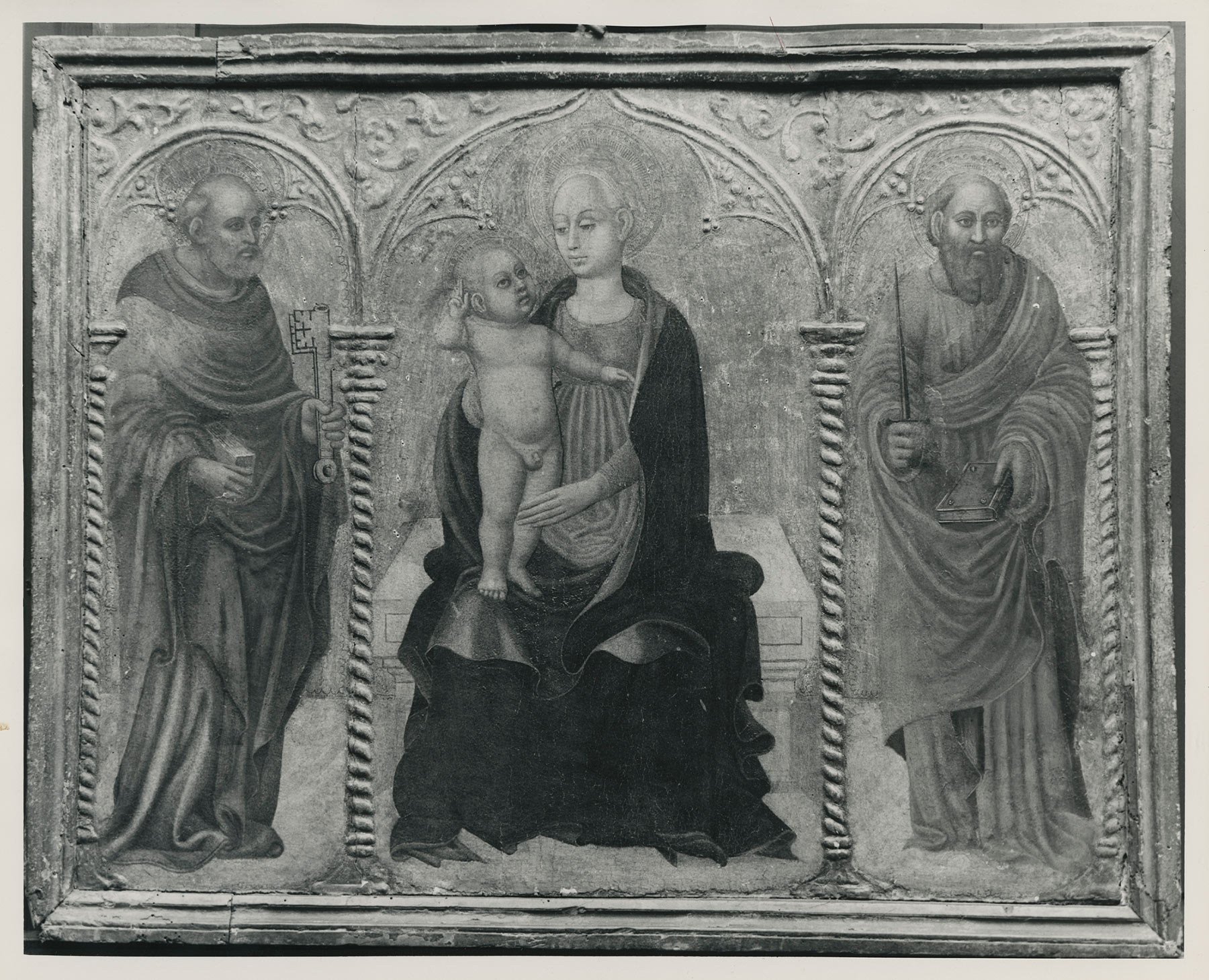
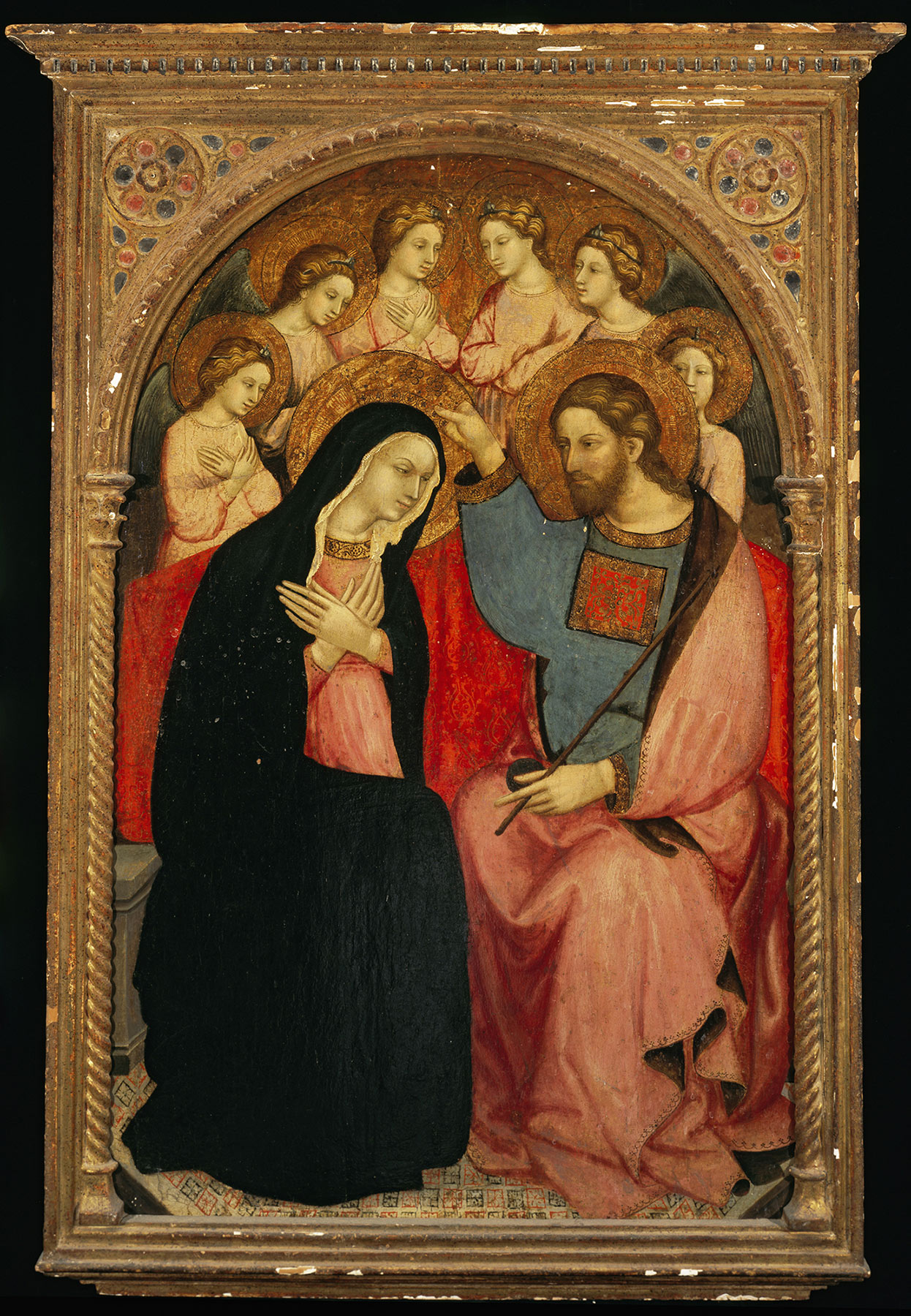
The triptych, which has received scant scholarly attention, was first published by Charles Seymour, Jr., who recorded Richard Offner’s verbal opinion that it was a product of the fifteenth-century Marchigian school and proposed a date around 1450.1 The attribution was accepted by Burton Fredericksen and Federico Zeri and cautiously acknowledged by Luisa Vertova.2 Mojmír Frinta,3 who labeled the work as “Marches or Abruzzo,” subsequently listed it alongside two other altarpieces with the same punched decoration by the Marchigian painter Pietro di Domenico da Montepulciano: the Recanati Polyptych,4 signed and dated 1422; and the Coronation of the Virgin in the Howard University Gallery of Art, Washington, D.C. (fig. 2). The picture’s relationship to Marchigian painting was reiterated by Carl Strehlke, who proposed an attribution to the brothers Lorenzo and Jacopo Salimbeni, with a date around 1420.5
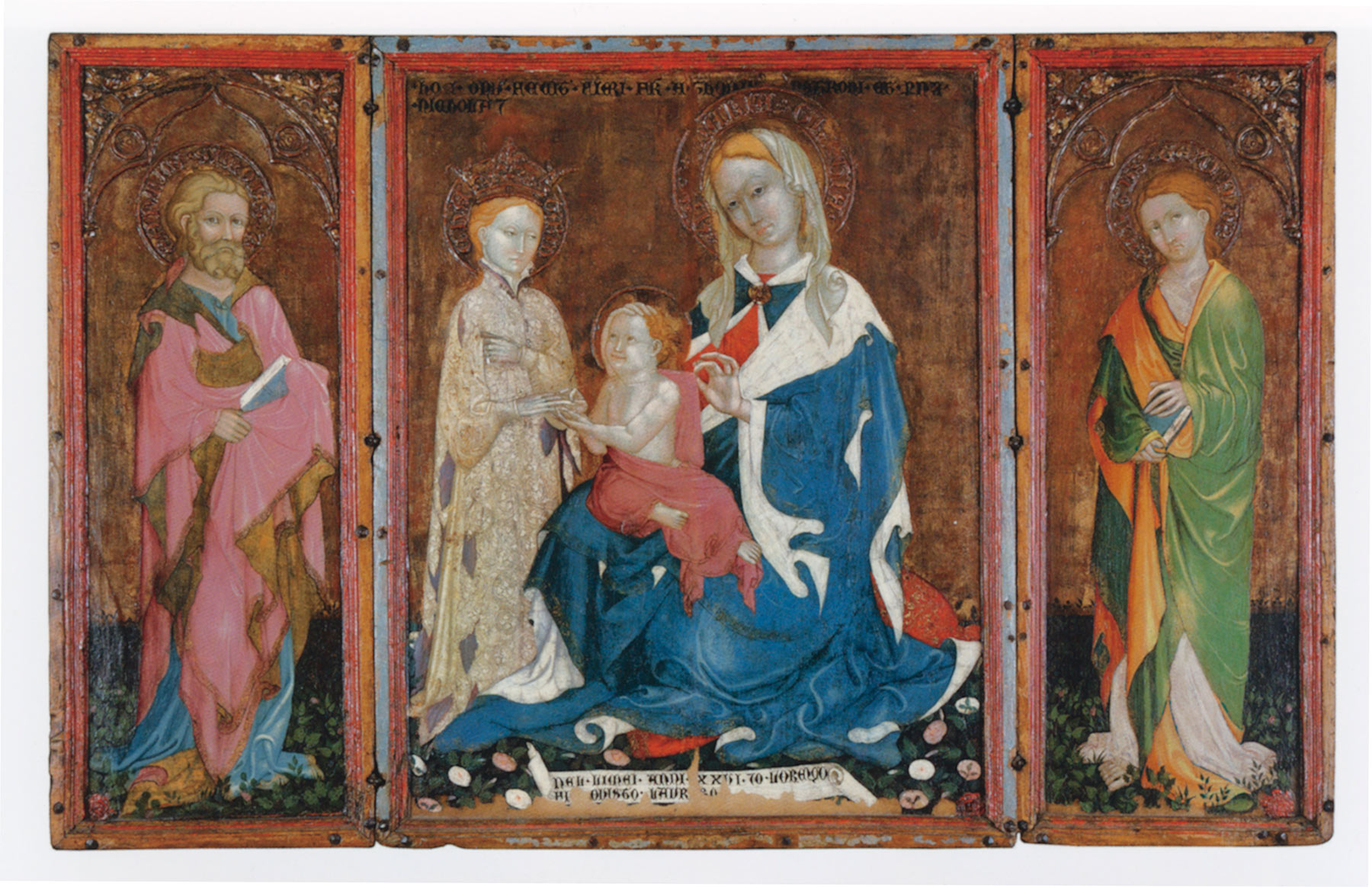
Given the present impoverished condition of the painted surface, the unusual format and construction of the Yale triptych offer perhaps the most important clues to its geographic and cultural orientation. The rectangular layout and exclusive use of pastiglia elements to articulate the composition are most closely related to prototypes developed in the Veneto, as represented in particular by the example of the so-called Master of Roncaiette, whose altarpiece formerly in the D’Atri collection, Paris, recently dated around 1410, is especially relevant for comparison.6 A similar structure also defines Lorenzo Salimbeni’s triptych in San Severino (fig. 3), dated 1400, which is conceived as a folding altarpiece with wings but shares the same rectangular format and includes pastiglia architectural details consonant with the Yale picture, such as the pointed trilobe arch of Venetian derivation. The analogies with the Sanseverino triptych, however, do not extend beyond these observations. Notwithstanding efforts to associate the Yale image with the Salimbeni workshop, the quietly restrained mood and stillness of the figures provide a marked contrast to the agitated expressivity that informs the Sanseverino altarpiece and all of the subsequent oeuvre of the two brothers.7
Stylistically, the closest analogies for the Yale triptych are to be found in the production of early fifteenth-century Marchigian painters active along the Adriatic coast in and around Ancona, where personalities such as Olivuccio di Ciccarello—who appears to have specialized in the technique of pastiglia work—developed an eclectic style with Bolognese derivations that has sometimes been considered in opposition to the florid, courtly tendencies of the Salimbeni brothers.8 Olivuccio’s activity coincided with that of his perhaps slightly older contemporary Pietro di Domenico da Montepulciano, an enigmatic personality with possible ties to Venice, who is documented as residing in Ancona in 1421 and who operated primarily between Ancona and Fermo in the 1410s and 1420s.9 It is tempting to view Frinta’s identification of Pietro di Domenico’s punch tool in the Yale painting as evidence of a workshop relationship. Several aspects of the present composition invite comparison with those pictures generally associated with Pietro’s activity before 1420, beginning with the small Virgin and Child in the Landesmuseum, Hannover, Germany,10 which shares the unusual shape of the pastiglia arch enclosing the figures and is usually dated between around 1415 and 1418. Further analogies can be drawn between the Virgin in the Yale panel and the Virgin and attendant angels in the slightly later Washington Coronation (see fig. 2), which present almost identical morphological traits and include the same punching and tooling in the haloes.11 Other features of the Yale painting, however, remain problematic. Above all, it is difficult to judge the extent to which the modern repaints visible in old photography might or might not reflect the original appearance of the two lateral saints, who seem at odds with Pietro’s approach. These elements, along with the hybrid nature of Marchigian painting in general, limit the extent to which one can draw definitive conclusions about the work’s authorship. —PP
Published References
Seymour, Charles, Jr. Early Italian Paintings in the Yale University Art Gallery. New Haven: Yale University Art Gallery, 1970., 218, 320, no. 163; Fredericksen, Burton B., and Federico Zeri. Census of Pre-Nineteenth-Century Italian Paintings in North American Public Collections. Cambridge, Mass.: Harvard University Press, 1972., 601; Vertova, Luisa. “The New Yale Catalogue.” Burlington Magazine 115 (March 1973): 159–61, 163., 160; Frinta, Mojmír S. Punched Decoration on Late Medieval Panel and Miniature Painting. Vol. 1, Catalogue Raisonné of All Punch Shapes. Prague: Maxdorf, 1998., 164
Notes
-
Seymour, Charles, Jr. Early Italian Paintings in the Yale University Art Gallery. New Haven: Yale University Art Gallery, 1970., 218, no. 163; and Richard Offner, verbal opinion, 1927, recorded in the Frick Art Reference Library, New York. ↩︎
-
Fredericksen, Burton B., and Federico Zeri. Census of Pre-Nineteenth-Century Italian Paintings in North American Public Collections. Cambridge, Mass.: Harvard University Press, 1972., 601; and Vertova, Luisa. “The New Yale Catalogue.” Burlington Magazine 115 (March 1973): 159–61, 163., 160. ↩︎
-
Frinta, Mojmír S. Punched Decoration on Late Medieval Panel and Miniature Painting. Vol. 1, Catalogue Raisonné of All Punch Shapes. Prague: Maxdorf, 1998., 164. ↩︎
-
Museo Civico Villa Colloredo Mels, Recanati, inv. no. F3146 ↩︎
-
Carl Strehlke, unpublished checklist of Italian paintings at Yale, 1998–2000, curatorial files, Department of European Art, Yale University Art Gallery. ↩︎
-
For this work, only recently reemerged on the art market—albeit in a fragmentary state—see Baradel, Valentina. “Riemerge un importante fondo oro di un pittore da rivalutare, il Maestro di Roncajette.” About Art Online. January 24, 2021. https://www.aboutartonline.com/riemerge-un-importante-fondo-oro-di-un-artista-da-rivalutare-il-maestro-di-roncajette/.. The altarpiece is now in a private collection in Milan. ↩︎
-
As noted by Mauro Minardi (in Minardi, Mauro. Lorenzo e Jacopo Salimbeni: Vicende e protagonist della pittura tardogotica nelle marche e in Umbria. Florence: Leo S. Olschki, 2008., 9), the choice of pastiglia elements in the Sanseverino altarpiece constitutes an exception to Lorenzo’s usual approach; it is the only instance in which the artist employed the technique more typical of workshops along the Adriatic coast. ↩︎
-
For a reconstruction of the personality of Olivuccio di Ciccarello (ex–Carlo da Camerino), see Mazzalupi, Matteo. “Carlo da Cemerino, il pittore insistente.” L’appenino camerte, May 18, 2002, 5., 5; and Marchi, Alessandro. “Olivuccio di Ciccarello.” In Pittori a camerino nel quattrocento, ed. Andrea De Marchi, 102–57. Milan: Federico Motta, 2002., 102–57. ↩︎
-
For this artist, see De Marchi, Andrea. “Pietro di Domenico da Montepulciano.” In La pittura in Italia: Il quattrocento, ed. Federico Zeri, 2:738–39. Milan: Electa, 1987., 2:738–39 (with previous bibliography); and, more recently, Mazzalupi, Matteo. “Pietro di Domenico da Montepulciano.” In Pittori ad Ancona nel quattrocento, ed. Andrea De Marchi, Matteo Mazzalupi, and Alessandro Delpriori, 114–43. Milan: Federico Motta, 2008., 114–43. ↩︎
-
Inv. no. KM300. ↩︎
-
Although the Coronation has sometimes been dated around 1420 or later (De Marchi, Andrea. “Pietro di Domenico da Montepulciano.” In La pittura in Italia: Il quattrocento, ed. Federico Zeri, 2:738–39. Milan: Electa, 1987., 739; and Mazzalupi, Matteo. “Pietro di Domenico da Montepulciano.” In Pittori ad Ancona nel quattrocento, ed. Andrea De Marchi, Matteo Mazzalupi, and Alessandro Delpriori, 114–43. Milan: Federico Motta, 2008., 131), it is difficult to reconcile that work with the eccentric qualities of Pietro’s signed and dated 1420 Madonna of Humility in the Metropolitan Museum of Art, New York, inv. no. 07.201, https://www.metmuseum.org/art/collection/search/437290. A chronology for the Washington Coronation before 1420 was recently proposed by Mauro Minardi, in Chiodo, Sonia, and Serena Padovani, eds. Italian Paintings from the 14th to 16th Century. The Alana Collection 3. Florence: Mandragora, 2014., 239. ↩︎